



CEFTRIAXONA 2 g Powder for Solution for Infusion

Prescription review online
A doctor will review your case and decide whether a prescription is medically appropriate.

Talk to a doctor about this medicine
Discuss your symptoms and possible next steps in a quick online consultation.



How to use CEFTRIAXONE LDP TORLAN 2 g POWDER FOR SOLUTION FOR INFUSION
Contents of the leaflet
- Introduction
- What Ceftriaxone LDP Torlan 2 g powder for solution for infusion EFG is and what it is used for
- What you need to know before you use Ceftriaxone LDP Torlan 2 g powder for solution for infusion EFG
- How to use Ceftriaxone LDP Torlan 2 g powder for solution for infusion EFG
- Possible side effects
- Storage of Ceftriaxone LDP Torlan 2 g powder for solution for infusion EFG
- Contents of the pack and further information
- Date of the last revision of this prospectus: May 2024
Introduction
Package Leaflet: Information for the User
Ceftriaxone LDP Torlan 2 g powder for solution for infusion EFG
ceftriaxone (as ceftriaxone sodium)
Read all of this leaflet carefully before you start using this medicine.
- Keep this leaflet, you may need to read it again.
- If you have any further questions, ask your doctor or pharmacist.
- This medicine has been prescribed for you, do not pass it on to others, it may harm them, even if their symptoms are the same as yours.
- If you experience any side effects, talk to your doctor or pharmacist. This includes any possible side effects not listed in this leaflet.
Contents of the pack:
- What Ceftriaxone LDP Torlan 2 g powder for solution for infusion EFG is and what it is used for.
- What you need to know before you use Ceftriaxone LDP Torlan 2 g powder for solution for infusion EFG.
- How to use Ceftriaxone LDP Torlan 2 g powder for solution for infusion EFG.
- Possible side effects.
- Storage of Ceftriaxone LDP Torlan 2 g powder for solution for infusion EFG.
- Contents of the pack and further information.
1. What Ceftriaxone LDP Torlan 2 g powder for solution for infusion EFG is and what it is used for
This medicine is an antibiotic belonging to the group called cephalosporins.

Antibiotics are used to treat bacterial infections and are not effective against viral infections such as flu or common cold.
It is essential to follow the instructions regarding dosage, administration interval, and treatment duration as indicated by your doctor.
Do not store or reuse this medicine. If you have any leftover antibiotic after finishing the treatment, return it to the pharmacy for proper disposal. Do not throw away medicines via wastewater or household waste.
Ceftriaxone LDP Torlan is indicated for the treatment of severe infections caused by microorganisms sensitive to ceftriaxone, such as: septicemia (infection caused by the passage of pathogenic bacteria into the blood), bacterial meningitis, abdominal infections (such as peritonitis and infections of the biliary tract), bone and joint infections, complicated skin and soft tissue infections, complicated urinary tract infections including pyelonephritis (kidney infection), respiratory tract infections, genital infections (including gonococcal disease) and stages II and III of Lyme disease (infection caused by a tick bite).
Ceftriaxone LDP Torlan is also indicated for the prevention of infections before or after a surgical operation.

Not sure if this medicine is right for you?
Discuss your symptoms and treatment with a doctor online.
2. What you need to know before you use Ceftriaxone LDP Torlan 2 g powder for solution for infusion EFG
Do not use Ceftriaxone LDP Torlan 2 g:
- if you are allergic (hypersensitive) to the active substance or to cephalosporins, penicillins or any other antibiotic of the so-called β-lactamics or to any of the other components of Ceftriaxone LDP Torlan. If you have had a sudden or severe allergic reaction to penicillin or other similar antibiotics (such as cephalosporins, carbapenems or monobactams); signs of such a reaction are sudden swelling of the throat or face that makes breathing or swallowing difficult, sudden swelling of hands, feet, and ankles, chest pain or a severe and rapid skin rash.
- in newborns with jaundice (yellow skin color due to excess bilirubin) or hypoalbuminemia (deficit of a blood protein called albumin), nor in premature babies due to the risk of developing hyperbilirubinemic encephalopathy (a disease that can cause brain damage due to bilirubin accumulation and be fatal).
- ceftriaxone must not be mixed or administered simultaneously with solutions or products containing calcium, even if different infusion routes are used, as precipitates may form.
Warnings and precautions
- If you have had any allergic reaction to ceftriaxone or any penicillin or have suffered from severe allergies or asthma, as ceftriaxone may cause allergic reactions that can sometimes be fatal (anaphylaxis). If this happens, contact a doctor immediately or go to the nearest hospital.
- If you experience severe and prolonged diarrhea during or after using this medicine, it may be due to a type of colitis (pseudomembranous colitis) that can be severe. In this case, your doctor will stop the administration of ceftriaxone and initiate appropriate treatment. Inform your doctor if you have had gastrointestinal diseases, particularly colitis.
- If you follow prolonged treatment with ceftriaxone, other infections (superinfections) may appear due to an overgrowth of some organisms such as enterococci or candida.
- When following prolonged treatments, your doctor should perform periodic blood tests.
- If, due to the sedimentation of ceftriaxone calcium, signs and symptoms of gallbladder disease appear, accompanied by alterations in gallbladder ultrasound. The risk of these alterations may increase in treatments of more than 14 days, in patients with renal failure, dehydration, or total parenteral nutrition, as well as in very small children. If this occurs, the medication with ceftriaxone should be suspended.
- Before starting treatment with Ceftriaxone LDP Torlan, if you have severe liver or kidney disease, as you may need a dose adjustment or if you are at risk of developing pancreatitis (inflammation of the pancreas).
- If you are going to undergo any diagnostic test (including blood tests, urine tests, skin tests that use allergens, etc.), inform your doctor that you are using this medicine, as it may alter the results.
- If you have liver or kidney problems (see section 4).
Other medicines and Ceftriaxone LDP Torlan
Tell your doctor or pharmacist if you are using or have recently used any other medicines, including those obtained without a prescription.
Your doctor will be particularly careful during the simultaneous use of ceftriaxone with:
- Probenecid (a medicine used to treat gout)
- Other antibiotics (medicines used for infections)
- Hormonal contraceptives. It is recommended to take additional measures during the treatment period and in the following month.
Pregnancy and breastfeeding
Consult your doctor or pharmacist before using any medicine.
If you are pregnant or think you may be pregnant, inform your doctor before using this medicine, and he will decide whether to use it. The consumption of medicines during pregnancy can be dangerous for the embryo or fetus and must be monitored by your doctor.
Driving and using machines
It has not been shown that the use of Ceftriaxone LDP Torlan can affect your ability to drive vehicles or operate tools or machines, but you should take into account that Ceftriaxone LDP Torlan can occasionally cause dizziness.
Important information about some of the components of Ceftriaxone LDP Torlan 2 g
This medicine contains 165.6 mg (7.2 mmoles) of sodium (main component of table salt/cooking salt) per dose unit. This is equivalent to 8.28% of the maximum recommended daily sodium intake for an adult.
3. How to use Ceftriaxone LDP Torlan 2 g powder for solution for infusion EFG
Ceftriaxone is administered intravenously. Consult your doctor or pharmacist if you have any doubts.
Depending on your disease, age, weight, and response to treatment with Ceftriaxone LDP Torlan, your doctor will prescribe the most suitable dose and treatment duration.
Never modify the dose on your own. If you think the effect of Ceftriaxone LDP Torlan is too strong or too weak, tell your doctor or pharmacist. Ceftriaxone LDP Torlan is administered through intravenous infusion.
You will continue to receive this medicine for at least 2 to 3 days after you have recovered from your illness or to prevent infections for a few days after your surgical operation.
Your doctor will indicate when you should stop the treatment. Do not prolong it on your own.
Adults and children over 12 years:1 to 2 g of ceftriaxone every 24 hours, which means 1-2 g/day; in severe cases, the dose may be increased to 4 g/day.
Newborns, infants, and children under 12 years:The following doses are recommended, once a day: in newborns (up to 14 days), 20 to 50 mg/kg of body weight; do not exceed this dose.
In infants and children (from 15 days to 12 years), a daily dose of 20-80 mg/kg of body weight. For children weighing 50 kg or more, it should be administered by infusion for at least 30 minutes. The duration of therapy varies with the course of the disease. As with antibiotic therapy in general, the administration of ceftriaxone will continue for a minimum of 48 to 72 hours after the disappearance of fever or after obtaining evidence of the eradication of bacteria.
Elderly patients:In the case of elderly patients, it is not necessary to modify the recommended doses for adults.
Treatment of bacterial meningitis (infants and children):It starts with a dose of 100 mg/kg (not exceeding 4 g) once a day. As soon as the causal microorganism is identified and its sensitivity is determined, the dose can be reduced.
Gonococcal disease:For the treatment of gonorrhea, a single intramuscular dose of 250 mg is recommended.
Perioperative prophylaxis:1 to 2 vials (1 to 2 g of ceftriaxone) administered 30-90 minutes before the intervention.
Patients with renal or hepatic impairment:In case of patients with altered renal function, it is not necessary to reduce the dose of Ceftriaxone LDP Torlan, as long as liver function remains normal. Only in cases of pre-terminal renal failure (creatinine clearance less than 10 ml/min) the dose should not exceed 2 g daily.
Treatment of patients on dialysis:no additional supplementary dose is necessary after dialysis, however, serum concentrations will be monitored to determine if dose adjustments are necessary, as the elimination rate in these patients may be reduced.
If you use more Ceftriaxone LDP Torlan 2 g than you should
In case of overdose or accidental ingestion, consult your doctor or pharmacist immediately or call the Toxicology Information Service, phone 91 562 04 20, indicating the medicine and the amount used.
If you forget to use Ceftriaxone LDP Torlan 2 g
Do not use a double dose to make up for forgotten doses.
If you stop using Ceftriaxone LDP Torlan 2 g
Do not stop the treatment before finishing it, as the desired effect will not be achieved. It is very important to treat infections for the recommended time; otherwise, it may worsen.
If you have any other questions about the use of this product, ask your doctor or pharmacist.

Started taking the medicine and have questions?
Discuss your symptoms and treatment with a doctor online.
4. Possible side effects
Ceftriaxone must not be mixed or administered simultaneously with solutions or products containing calcium, even if different infusion routes are used.
Cases of reactions that have caused the death of newborns and premature babies due to the formation of precipitates of ceftriaxone calcium in the lungs and kidneys of these patients have been described. In some cases, the infusion routes and administration times of ceftriaxone and calcium-containing solutions were different.
Like all medicines, Ceftriaxone LDP Torlan can have side effects, although not everyone gets them.
If you think any of the side effects you are suffering from is serious or if you notice any side effect not mentioned in this leaflet, tell your doctor or pharmacist.
Infections and infestations
- Rare (between 1 and 10 per 10,000 patients): vulvovaginitis (infections of the female genital tract caused by bacteria).
Blood and lymphatic system disorders
- Rare (between 1 and 10 per 10,000 patients): anemia (decrease in hemoglobin concentration in blood), leukopenia (decrease in the number of white blood cells in blood), granulocytopenia (decrease in the number of granulocytes in blood), thrombocytopenia (decrease in the number of platelets in blood), and eosinophilia (increase in a certain group of white blood cells).
- Very rare (in less than 1 per 10,000 patients): coagulation disorders, agranulocytosis (decrease or absence of white blood cells in blood), especially after 10 days of treatment or after high doses.
Immune system disorders
- Rare (between 1 and 10 per 10,000 patients): anaphylactic (allergic) or anaphylactoid reactions and urticaria (generalized itching of the skin).
- Frequency not known: Chest pain in the context of allergic reactions, which can be a symptom of myocardial infarction triggered by the allergy (Kounis syndrome).
Nervous system disorders
- Rare (between 1 and 10 per 10,000 patients): headache and dizziness.
Gastrointestinal disorders
- Frequent (between 1 and 10 per 100 patients): diarrhea, nausea, stomatitis (inflammation of the mouth mucosa), and glossitis (inflammation of the tongue).
- Very rare (in less than 1 per 10,000 patients): pseudomembranous colitis (severe diarrhea caused by a superinfection by a bacterium), pancreatitis, gastrointestinal bleeding.
Hepatobiliary disorders
- Rare (between 1 and 10 per 10,000 patients): symptomatic precipitation of ceftriaxone calcium in the gallbladder and increased liver enzymes (parameters detected in blood tests).
- Frequency not known: Problems with the gallbladder or liver, which can cause pain, nausea, vomiting, yellowing of the skin, itching, abnormal urine, and clay-colored stools.
Skin and subcutaneous tissue disorders
- Uncommon (between 1 and 10 per 1,000 patients): exanthema (skin rash), allergic dermatitis (skin inflammation), rash (exanthema), edema (fluid accumulation in tissues), and erythema multiforme.
- Very rare (in less than 1 per 10,000 patients): Stevens-Johnson syndrome, toxic epidermal necrolysis, or Lyell syndrome (destruction of the skin with epidermal detachment that starts with the formation of blisters but without inflammation).
Renal and urinary disorders
- Rare (between 1 and 10 per 10,000 patients): oliguria (decreased urine production), increased serum creatinine (parameter detected in blood tests).
- Very rare (in less than 1 per 10,000 patients): renal precipitation of ceftriaxone sodium in pediatric patients, hematuria (blood in urine).
General disorders and administration site conditions
- Rare (between 1 and 10 per 10,000 patients): fever and chills, phlebitis (inflammation of the veins) that can be even less frequent if administered by slow injection over a period of 2-4 minutes).
Treatment with ceftriaxone, particularly in elderly patients with severe kidney problems or nervous system problems, can rarely cause decreased consciousness, abnormal movements, agitation, and convulsions.
Reporting of side effects:
If you experience any type of side effect, consult your doctor, pharmacist, or nurse, even if it is a possible side effect not listed in this leaflet. You can also report them directly through the Spanish Pharmacovigilance System for Human Use Medicines (Website: www.notificaRAM.es). By reporting side effects, you can contribute to providing more information on the safety of this medicine.
5. Storage of Ceftriaxone LDP Torlan 2 g powder for solution for infusion EFG
Keep out of the reach and sight of children.
This medicine does not require special temperature storage conditions.
Keep the vial in the outer packaging to protect it from light.
Once reconstituted, the solution is stable for 3 hours at 25°C and for 24 hours in the refrigerator (2-8°C).
Do not use Ceftriaxone LDP Torlan after the expiration date shown on the packaging after "CAD". The expiration date is the last day of the month indicated.
Do not use Ceftriaxone LDP Torlan if you observe particles or turbidity.
Medicines should not be disposed of through wastewater or household waste. Ask your pharmacist how to dispose of the packaging and medicines you no longer need. This will help protect the environment.
6. Contents of the pack and further information
Composition of Ceftriaxone LDP Torlan 2 g powder for solution for infusion EFG
The active ingredient is ceftriaxone (as ceftriaxone sodium).
Each vial contains 2 g of ceftriaxone (as ceftriaxone sodium).
Appearance of the product and package contents
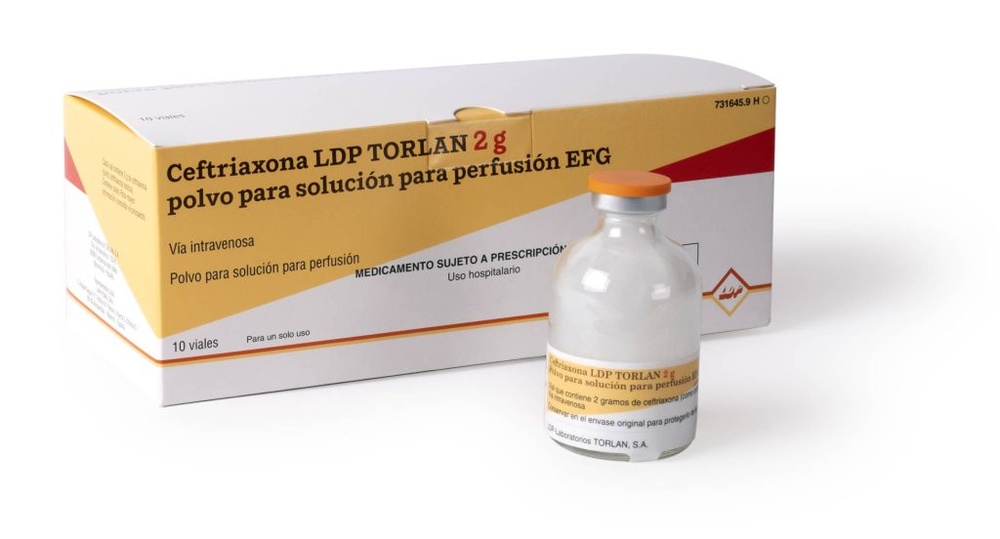
Ceftriaxone LDP Torlan is presented in a glass vial, closed with a rubber stopper and sealed with a flip-off cap, and in packaging of 1 vial, 10 vials, and 50 vials.
Other presentations
Ceftriaxone LDP Torlan 500 mg powder and solvent for solution for intravenous injection EFG: Box with 1 vial + 1 ampoule of 5 ml of water for injectable preparations. Packaging of 100 vials + 100 ampoules.
Ceftriaxone LDP Torlan 500 mg powder and solution for solution for intramuscular injection EFG: Box with 1 vial + 1 ampoule of 2 ml of lidocaine hydrochloride solution (20mg/2ml). Packaging of 100 vials + 100 ampoules.
Ceftriaxone LDP Torlan 1 g powder and solvent for solution for intravenous injection EFG: Box with 1 vial + 1 ampoule of 10 ml of water for injectable preparations. Packaging of 100 vials + 100 ampoules.
Ceftriaxone LDP Torlan 250 mg powder and solvent for solution for intravenous injection EFG: Box with 1 vial + 1 ampoule of 5 ml of water for injectable preparations. Packaging of 100 vials + 100 ampoules.
Ceftriaxone LDP Torlan 1 g powder and solution for solution for intramuscular injection EFG: Box with 1 vial + 1 ampoule of 3.5 ml of lidocaine hydrochloride solution (35mg/3.5ml). Packaging of 100 vials + 100 ampoules.
Only some package sizes may be marketed
HOLDER OF THE MARKETING AUTHORIZATION AND MANUFACTURER
LDP-Laboratorios TORLAN S.A
Ctra de Barcelona, 135 B
08290 Cerdanyola del Vallès, Barcelona
Spain
Local Representative
LAPHYSAN, SAU
C/ Anabel Segura nº11. Edificio A. Planta 4. Puerta D
28108 Alcobendas, Madrid
Spain
Date of the last revision of this prospectus: May 2024
Detailed and updated information on this medication is available on the website of the Spanish Agency for Medicines and Health Products (AEMPS) http://www.aemps.gob.es/
----------------------------------------------------------------------------------------------------------------
Warning: Use exclusively by a healthcare professional
This information is intended only for doctors or healthcare professionals:
Solutions containing ceftriaxone should not be mixed or added with other agents.
In particular, diluents containing calcium (e.g., Ringer's solution, Hartmann's solution)
should not be used to reconstitute ceftriaxone vials or to dilute reconstituted vials
when administered intravenously, as it may form precipitates.
Ceftriaxone should not be mixed or administered simultaneously with solutions containing
calcium (see sections 4.2, 4.3, 4.4, and 4.8 of the technical sheet and section 6 of the prospectus).
CEFTRIAXONA LDP TORLAN 2g must be reconstituted before use. The reconstituted solution
is for single use. Discard excess solution.
The reconstituted solution is clear and yellow or slightly yellowish. During the storage of prepared solutions, an increase in the intensity of the color may occur without affecting the potency of the drug.
How to prepare this medication
For administration by intravenous infusion, the CEFTRIAXONA LDP TORLAN 2g powder for solution for infusion EFG vial is dissolved in 40 ml of one of the following calcium-free infusion solutions: 0.9% sodium chloride, 0.45% sodium chloride + 2.5% glucose, 5% glucose, 10% glucose, 6% hydroxyethyl starch in 5% glucose, or sterile water for injectable preparations. The intravenous infusion should be administered over 30 minutes.
Once reconstituted with 40 ml of solvent, the concentration of the solution is 50 mg of ceftriaxone (as ceftriaxone sodium) per ml.
The solution should be examined before administration by intravenous infusion for particles or turbidity. If foreign particles are observed, the solution should be discarded.
The dose and administration schedule used is based on the patient's age and weight, as well as the severity of the infection.
The solution should not be mixed with solutions containing other antibiotics or in other solutions different from those mentioned above.
- Country of registration
- Dosage formINJECTABLE PERFUSION, 2 g/vial of powder
- ATC codeJ01DD04
- Active substance
- Prescription requiredYes
- Manufacturer
- This information is for reference only and does not constitute medical advice. Always consult a doctor before taking any medication. Oladoctor is not responsible for medical decisions based on this content.
- Alternatives to CEFTRIAXONE LDP TORLAN 2 g POWDER FOR SOLUTION FOR INFUSIONDosage form: INJECTABLE, 1 g ceftriaxone disodiumActive substance: ceftriaxoneManufacturer: Fresenius Kabi España, S.A.U.Prescription requiredDosage form: INJECTABLE, 1 g ceftriaxone disodiumActive substance: ceftriaxoneManufacturer: Fresenius Kabi España, S.A.U.Prescription requiredDosage form: INJECTABLE PERFUSION, 2 g ceftriaxone disodiumActive substance: ceftriaxoneManufacturer: Fresenius Kabi España, S.A.U.Prescription required
Online doctors for CEFTRIAXONE LDP TORLAN 2 g POWDER FOR SOLUTION FOR INFUSION
Discuss questions about CEFTRIAXONE LDP TORLAN 2 g POWDER FOR SOLUTION FOR INFUSION, including use, safety considerations and prescription review, subject to medical assessment and local regulations.









Get CEFTRIAXONE LDP TORLAN 2 g POWDER FOR SOLUTION FOR INFUSION Prescription Online
Fill in a 2-min form
Tell us your symptoms, history, and what medicine you're requesting.
Pick a doctor or let us assign
Choose a specialist or we'll match you with the next available doctor.
Doctor reviews your case
Usually within 30 minutes. They may ask follow-up questions via chat.
Collect from any pharmacy
Electronic prescription sent to your email — valid across Spain.
Frequently Asked Questions
CEFTRIAXONE LDP TORLAN 2 g POWDER FOR SOLUTION FOR INFUSION requires a prescription in Spain. You can check with a doctor online whether this medicine may be appropriate for your situation.
The active ingredient in CEFTRIAXONE LDP TORLAN 2 g POWDER FOR SOLUTION FOR INFUSION is ceftriaxone. This information helps identify medicines with the same composition but different brand names.
CEFTRIAXONE LDP TORLAN 2 g POWDER FOR SOLUTION FOR INFUSION is manufactured by Ldp Laboratorios Torlan S.A.. Pharmacy brands and packaging may differ depending on the distributor.
Doctors such as Family doctors, Psychiatrists, Dermatologists, Cardiologists, Endocrinologists, Gastroenterologists, Pulmonologists, Nephrologists, Rheumatologists, Hematologists, Infectious disease physicians, Allergists, Geriatricians, Paediatricians, Oncologists may assess whether CEFTRIAXONE LDP TORLAN 2 g POWDER FOR SOLUTION FOR INFUSION is appropriate, depending on your situation and local regulations. You can book an online consultation to discuss your symptoms and possible next steps.
Spain has a well-developed healthcare infrastructure across major cities such as Madrid, Barcelona, Valencia, and Seville. Pharmacies are widely available and operate under strict regulations, ensuring access to prescribed medications.
You can buy CEFTRIAXONE LDP TORLAN 2 g POWDER FOR SOLUTION FOR INFUSION in Madrid, Barcelona, Seville, or Valencia at any local pharmacy with a valid prescription.
To obtain a prescription, you can use Oladoctor:
Other medicines with the same active substance (ceftriaxone) include CEFTRIAXONE Fresenius Kabi 1 g POWDER AND SOLVENT FOR INTRAMUSCULAR INJECTION SOLUTION, CEFTRIAXONE Fresenius Kabi 1 g POWDER FOR INTRAVENOUS INJECTION SOLUTION, CEFTRIAXONE Fresenius Kabi 2 g POWDER FOR SOLUTION FOR INFUSION. These may have different brand names or formulations but contain the same therapeutic ingredient. Always consult a doctor before switching or starting a new medicine.
