



CARDIOXANE 500 mg Powder For Solution For Infusion

Prescription review online
A doctor will review your case and decide whether a prescription is medically appropriate.

Talk to a doctor about this medicine
Discuss your symptoms and possible next steps in a quick online consultation.



How to use CARDIOXANE 500 mg POWDER FOR SOLUTION FOR INFUSION
Contents of the leaflet
- Introduction
- Dexrazoxane
- What is Cardioxane and what is it used for
- What you need to know before you start using Cardioxane
- How Cardioxane is administered
- Possible side effects
- Storage of Cardioxane
- Container Contents and Additional Information
Introduction
Package Leaflet: Information for the Patient
Cardioxane500 mg powder for solution for infusion
Dexrazoxane
Read all of this leaflet carefully before you start taking this medicine because it contains important information for you.
- Keep this leaflet, you may need to read it again.
- If you have any further questions, ask your doctor, pharmacist, or nurse.
- If you experience any side effects, talk to your doctor, pharmacist, or nurse, even if they are not listed in this leaflet. See section 4.
Contents of the package leaflet:
- What is Cardioxane and what is it used for
- What you need to know before you start using Cardioxane
- How Cardioxane is administered
- Possible side effects
- Storage of Cardioxane
- Contents of the pack and further information.

Not sure if this medicine is right for you?
Discuss your symptoms and treatment with a doctor online.
1. What is Cardioxane and what is it used for
Cardioxane contains the active substance called dexrazoxane, which belongs to a group of medicines that protect the heart (cardioprotective medicines).
This medicine is used to prevent heart damage when using medicines called anthracyclines (such as doxorubicin or epirubicin) during the treatment of breast cancer in adults.
2. What you need to know before you start using Cardioxane
You should not be givenCardioxane
- if you are under 18 years old and the planned dose of anthracycline for you is considered low. Consult your doctor about this.
- if you are allergic (hypersensitive) to dexrazoxane
- if you are breast-feeding (see also “Pregnancy and breast-feeding”)
- if you are being given the yellow fever vaccine
Warnings and precautions
Talk to your doctor, pharmacist, or nurse before receiving Cardioxane
You should also know that:
- Your doctor may perform tests before and during treatment with this medicine to check how you respond to treatment and monitor the function of some organs, such as the heart, kidneys, or liver.
- Your doctor may perform blood tests during treatment with Cardioxane to monitor the function of your bone marrow. If you are receiving high-dose cancer treatment (e.g., chemotherapy or radiation) and are also being treated with high-dose Cardioxane, your bone marrow function may decrease. This can affect the production of red blood cells, white blood cells, and platelets.
- Cardioxane may increase the risk of developing leukemia (blood cancer).
- During treatment with Cardioxane, women who can become pregnant and men must use effective contraceptive methods. Women and men should continue to use them for at least six months after finishing treatment with Cardioxane (see also “Pregnancy and breast-feeding”).
- The combination of Cardioxane with the cancer treatment you are receiving may increase the risk of blood clots.
- IfCardioxanepowder or solution comes into contact with the skin,inform your doctor immediately. You or your doctor should wash the affected area immediately with plenty of water.
Children and adolescents
The long-term benefit/risk relationship of the medicine in children and adolescents is not yet clear. Your doctor will inform you of the benefit/risk relationship of this medicine.
Elderly patients (over 65 years old)
Your doctor may adjust your treatment with this medicine according to your state of health (in case of heart, liver, or kidney problems).
Other medicines and Cardioxane
Tell your doctor or pharmacist if you are taking, have recently taken, or might take any other medicines.
Do not take other medicines without informing your doctor, as there may be interactions between Cardioxane and other medicines:
- Vaccines: you should not use this medicine if you are going to be given the yellow fever vaccine, and it is not recommended to use Cardioxane if you are going to be given a vaccine that contains live virus particles.
- Phenytoin, a treatment for seizures.
- Cyclosporin or tacrolimus (both treatments reduce the body's immune system and are used to prevent organ rejection after an organ transplant).
- Myelosuppressive medicines (reduce the production of red blood cells, white blood cells, or platelets).
Pregnancy and breast-feeding
- You should not be given Cardioxane if you are pregnant or planning to become pregnant, unless your doctor considers it necessary.
- Women who can become pregnant and men must use effective contraceptive methods during treatment with Cardioxane and for at least six months after finishing treatment with Cardioxane.
- Stop breast-feeding while being treated with this medicine.
If you are pregnant or breast-feeding, think you may be pregnant, or are planning to have a baby, ask your doctor or pharmacist for advice before taking this medicine.
Driving and using machines
Fatigue has been reported with Cardioxane treatment. Therefore, if you feel drowsy, do not drive or use machinery.

Started taking the medicine and have questions?
Discuss your symptoms and treatment with a doctor online.
3. How Cardioxane is administered
How you will be givenCardioxane
This medicine is prepared and administered by a doctor or other healthcare professional. Your doctor will decide what dose you should be given.
- Cardioxane is administered as a drip (infusion) into a vein over approximately 15 minutes.
- Administration will start about 30 minutes before the administration of your cancer treatment (doxorubicin and/or epirubicin).
If you think you have been given too muchCardioxane
If you are given too much Cardioxane, inform your doctor or nurse immediately. You may experience some of the side effects listed in section 4, “Possible side effects”.
4. Possible side effects
Like all medicines, this medicine can cause side effects, although not everybody gets them.
Some side effects can be serious and need immediate medical attention:
Very common(may affect more than 1 in 10 patients):
- Common infections, fever, sore throat, bruising, and unexpected bleeding (signs of blood disorders such as low red blood cell count, low white blood cell count, low platelet count, and low granulocyte count. However, blood cell counts may return to normal after each treatment cycle)
Common(may affect up to 1 in 10 patients):
- Swelling and redness in a vein
Uncommon(may affect up to 1 in 100 patients):
- Leukemia (blood cancer)
- Sudden loss of consciousness
- Swelling and pain in a part of the body that may be caused by blood clots in the vein
- Swelling of the tissue in the legs
The following adverse reactions have been reported in a few patients during treatment with Cardioxane:
- Allergic reactions including itching, rash, swelling of the face/throat, wheezing, difficulty breathing, changes in consciousness, low blood pressure
- Sudden difficulty breathing, coughing up blood, and chest pain (signs of blood clots in the lungs)
If you experience any of the above side effects, informyour doctor or go to the nearest emergency department immediately.
Other side effects include:
Very common(may affect more than 1 in 10 patients):
- Hair loss
- Vomiting, mouth sores, nausea
- Weakness
Common(may affect up to 1 in 10 patients):
− | Diarrhea, stomach pain, constipation, feeling of fullness in the stomach, and loss of appetite |
− | Decreased heart muscle function, rapid heartbeat |
− | Pain, redness, and swelling of the mucous membranes of internal ducts such as respiratory or digestive tracts |
− | Changes in nail color such as blackening |
− | Skin reactions such as swelling, redness, pain, burning sensation, itching at the injection site |
− | Numbness or tingling of hands or feet, dizziness, headache |
− | Fatigue, general feeling of being unwell |
− | Mild fever, chest pain, increased heart rate, shortness of breath or rapid breathing |
Uncommon(may affect up to 1 in 100 patients)
− | Increased blood cell count |
− | Dizziness, ear infection |
− | Bleeding, sensitive or inflamed gums, oral thrush |
− | Thirst |
− | Redness, heat, and pain caused by inflammation under the skin |
Reporting of side effects
If you experience any side effects, talk to your doctor, pharmacist, or nurse, even if they are not listed in this leaflet.
You can also report side effects directly through the Spanish Medicines Agency's online platform: https://www.notificaram.es. By reporting side effects, you can help provide more information on the safety of this medicine.
5. Storage of Cardioxane
Keep this medicine out of the sight and reach of children.
- Do not store above 25°C. Store in the original packaging to protect from light.
- Do not use this medicine after the expiry date stated on the packaging after EXP.
Medicines should not be disposed of via wastewater or household waste. Ask your pharmacist how to dispose of medicines no longer required. This will help protect the environment.
6. Container Contents and Additional Information
Composition ofCardioxane
- The active ingredient is dexrazoxane (as dexrazoxane hydrochloride).
- Each vial contains 500 mg of dexrazoxane. Cardioxane does not contain any other components.
Appearance ofCardioxaneand Container Contents
Cardioxane is a white to off-white powder for solution for infusion, available in packs of one vial and packs of four vials. Only certain pack sizes may be marketed.
Marketing Authorization Holder
CNX Therapeutics Ireland Limited
5th Floor Rear
Connaught House
1 Burlington Road
Dublin 4
Dublin, Ireland
Manufacturer
Cenexi Laboratoires Thissen S.A.
Rue de la Papyrée 2-4-6
1420 Braine-l’Alleud
Belgium
Date of Last Revision of this Leaflet:22/08/2017.
Detailed and up-to-date information on this medicinal product is available on the website of the Spanish Agency for Medicines and Health Products (AEMPS) http://www.aemps.gob.es
____________________________________________________________________________
THIS INFORMATIONIS INTENDED ONLY FORHEALTHCARE PROFESSIONALS
Cardioxane500mg powder for solution for infusion
Dexrazoxane
DOSAGE AND ADMINISTRATION
Cardioxane is administered by short intravenous infusion (15 minutes), approximately 30 minutes before the administration of the anthracycline, with a dose equal to 10 times the doxorubicin equivalent and 10 times the epirubicin equivalent dose.
Therefore, it is recommended to administer Cardioxane at a dose of 500 mg/m2 when using the usual doxorubicin dosing regimen of 50 mg/m2, or at a dose of 600 mg/m2 when using the usual epirubicin dosing regimen of 60 mg/m2.
Pediatric Population
The safety and efficacy of this medicinal product in children from 0 to 18 years have not been established.
Cardioxane is contraindicated in children from 0 to 18 years who are scheduled to receive a cumulative dose less than 300 mg/m2 of doxorubicin or the cumulative equivalent dose of another anthracycline.
Renal Impairment
In patients with moderate to severe renal impairment (creatinine clearance <40ml>
Hepatic Impairment
The dose ratio should be maintained; i.e., if the dose of anthracycline is reduced, the dose of dexrazoxane should be reduced accordingly.
Elderly Patients (over 65 years)
The dose may be adjusted during treatment with Cardioxane according to the patient's health status (in case of heart, liver, or kidney problems).
In case of overdose, symptomatic treatment should be applied.
INSTRUCTIONS FOR USE
Recommendations for Safe Handling
Prescribers should consult national or recognized guidelines on the handling of cytotoxic agents when using Cardioxane. Reconstitution should only be carried out by trained personnel in a designated area for cytotoxics. Pregnant women should not handle the preparation.
It is recommended to use gloves and other protective clothing to avoid skin contact. Skin reactions have been described after contact with Cardioxane. In case Cardioxane comes into direct contact with the skin or mucous membranes, the affected area should be washed immediately with plenty of water.
Preparation for Intravenous Administration
Reconstitution of Cardioxane
For reconstitution, the contents of each vial should be dissolved in 25 ml of water for injectable preparations. The vial contents dissolve in a few minutes with gentle agitation. The resulting solution has a pH of approximately 1.6. This solution should be further diluted before administration to the patient.
Dilution of Cardioxane
To avoid the risk of thrombophlebitis at the injection site, Cardioxane should be diluted before infusion with one of the solutions mentioned in Table 1. The final volume should be proportional to the number of Cardioxane vials used and the amount of infusion solution for dilution, which can range from 25 ml to 100 ml per vial.
The following table (Table 1) summarizes the final volume and approximate pH of the reconstituted and diluted product from one vial and four vials of Cardioxane. The minimum and maximum volumes of infusion solution to be used per vial are indicated in Table 1.
Table 1. Reconstitution and Dilution of Cardioxane Vials
Infusion Solution Used for Dilution | Volume of Liquid Used to Dilute 1 Reconstituted Vial of Cardioxane | Final Volume from One Vial | Final Volume from Four Vials | pH (Approximate) |
Ringer lactate | 25 ml 100 ml | 50 ml 125 ml | 200 ml 500 ml | 2.2 3.3 |
Sodium lactate 0.16M* | 25 ml 100 ml | 50 ml 125 ml | 200 ml 500 ml | 2.9 4.2 |
- The sodium lactate 11.2% should be diluted with a factor of 6 to achieve a concentration of 0.16M.
It is normally recommended, to increase the pH of the solution, to use larger dilution volumes (with a maximum of 100 ml of additional infusion liquid per 25 ml of reconstituted Cardioxane). Smaller volumes (with a minimum of 25 ml of additional infusion liquid per 25 ml of reconstituted Cardioxane) may be used if necessary, depending on the patient's hemodynamic status.
The reconstituted and diluted Cardioxane solution is for single use. Once the product has been diluted, it should be used immediately or within the next four hours, provided it is stored at a temperature between 2°C and 8°C and protected from light.
In cases where the solution and its container allow, parenteral drugs should be inspected visually for particulate matter or precipitate. Cardioxane usually appears as a colorless to yellow solution immediately after reconstitution, although some color variability may be observed over time, which does not indicate loss of activity as long as the product has been stored according to the recommendations. However, it is recommended to discard the product if it is not colorless or yellow immediately after reconstitution.
Incompatibilities
Cardioxane should not be mixed with other products except for the dilution solutions mentioned above.
Storage
Do not use Cardioxane after the expiry date stated on the container.
Before Opening
Do not store above 25°C. Store in the original packaging to protect from light.
After Reconstitution and Dilution
The diluted Cardioxane solution is physically and chemically stable for 4 hours at 25°C.
From a microbiological point of view, the freshly prepared infusion solution should be used immediately. Otherwise, the responsibility for the storage time and conditions of the product before administration lies with the user and, in any case, should not exceed 4 hours at a temperature between 2°C and 8°C (in the refrigerator), with protection from light.
Disposal
Disposal of the used medicinal product and materials that have come into contact with it should be carried out in accordance with local regulations. Care and caution should be taken when disposing of items used to reconstitute and dilute Cardioxane.
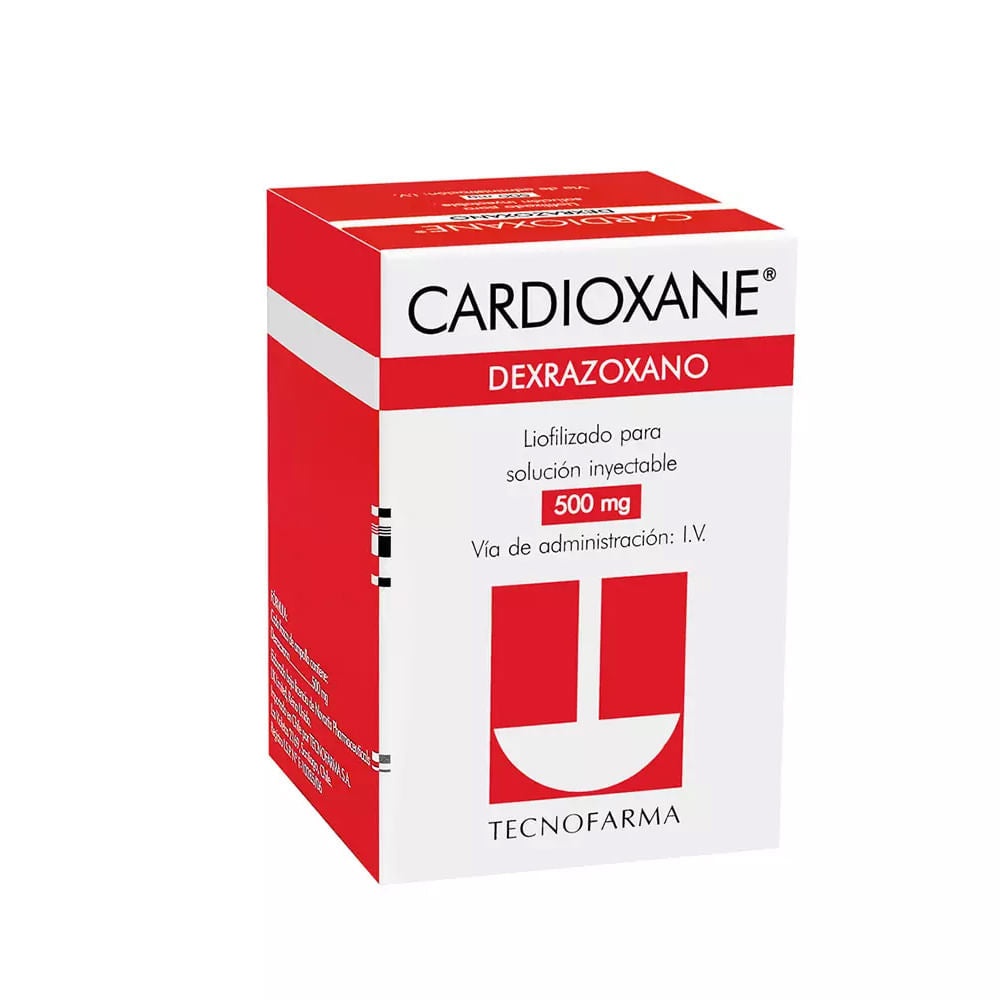
- Country of registration
- Dosage formINJECTABLE PERFUSION, DEXRAZOXANE (D.O.E) 500 MG
- ATC codeV03AF02
- Availability in pharmaciesSupply issue reported
- Active substance
- Prescription requiredYes
- Manufacturer
- This information is for reference only and does not constitute medical advice. Always consult a doctor before taking any medication. Oladoctor is not responsible for medical decisions based on this content.
- Alternatives to CARDIOXANE 500 mg POWDER FOR SOLUTION FOR INFUSIONDosage form: INJECTABLE INFUSION, 20 mgActive substance: dexrazoxaneManufacturer: Cnx Therapeutics Ireland LimitedPrescription requiredDosage form: INJECTABLE INFUSION, UnknownActive substance: rasburicaseManufacturer: Sanofi Winthrop IndustriePrescription requiredDosage form: INJECTABLE PERFUSION, UnknownActive substance: rasburicaseManufacturer: Sanofi Winthrop IndustriePrescription required
Online doctors for CARDIOXANE 500 mg POWDER FOR SOLUTION FOR INFUSION
Discuss questions about CARDIOXANE 500 mg POWDER FOR SOLUTION FOR INFUSION, including use, safety considerations and prescription review, subject to medical assessment and local regulations.









Get CARDIOXANE 500 mg POWDER FOR SOLUTION FOR INFUSION Prescription Online
Fill in a 2-min form
Tell us your symptoms, history, and what medicine you're requesting.
Pick a doctor or let us assign
Choose a specialist or we'll match you with the next available doctor.
Doctor reviews your case
Usually within 30 minutes. They may ask follow-up questions via chat.
Collect from any pharmacy
Electronic prescription sent to your email — valid across Spain.
Frequently Asked Questions
CARDIOXANE 500 mg POWDER FOR SOLUTION FOR INFUSION requires a prescription in Spain. You can check with a doctor online whether this medicine may be appropriate for your situation.
The active ingredient in CARDIOXANE 500 mg POWDER FOR SOLUTION FOR INFUSION is dexrazoxane. This information helps identify medicines with the same composition but different brand names.
CARDIOXANE 500 mg POWDER FOR SOLUTION FOR INFUSION is manufactured by Cnx Therapeutics Ireland Limited. Pharmacy brands and packaging may differ depending on the distributor.
Doctors such as Family doctors, Psychiatrists, Dermatologists, Cardiologists, Endocrinologists, Gastroenterologists, Pulmonologists, Nephrologists, Rheumatologists, Hematologists, Infectious disease physicians, Allergists, Geriatricians, Paediatricians, Oncologists may assess whether CARDIOXANE 500 mg POWDER FOR SOLUTION FOR INFUSION is appropriate, depending on your situation and local regulations. You can book an online consultation to discuss your symptoms and possible next steps.
Spain has a well-developed healthcare infrastructure across major cities such as Madrid, Barcelona, Valencia, and Seville. Pharmacies are widely available and operate under strict regulations, ensuring access to prescribed medications.
You can buy CARDIOXANE 500 mg POWDER FOR SOLUTION FOR INFUSION in Madrid, Barcelona, Seville, or Valencia at any local pharmacy with a valid prescription.
To obtain a prescription, you can use Oladoctor:
Other medicines with the same active substance (dexrazoxane) include SAVENE 20 mg/ml POWDER FOR CONCENTRATE AND SOLVENT FOR PERFUSION SOLUTION, FASTURTEC 1.5 mg/ml POWDER AND SOLVENT FOR CONCENTRATE FOR INFUSION SOLUTION, FASTURTEC 1.5 mg/ml POWDER AND SOLVENT FOR CONCENTRATE FOR PERFUSION SOLUTION. These may have different brand names or formulations but contain the same therapeutic ingredient. Always consult a doctor before switching or starting a new medicine.
