


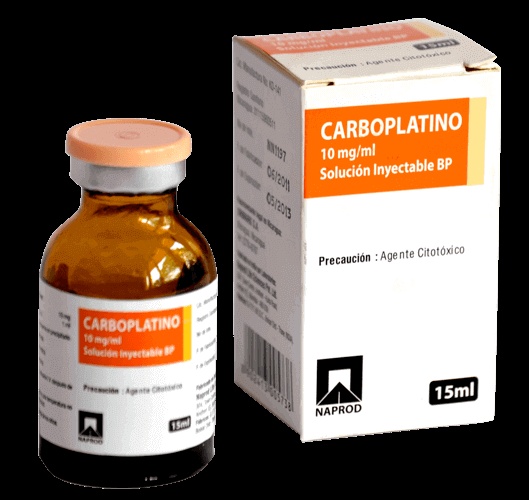
Carboplatino 10 mg/ml injectable perfusión

Prescription review online
A doctor will review your case and decide whether a prescription is medically appropriate.

Talk to a doctor about this medicine
Discuss your symptoms and possible next steps in a quick online consultation.



How to use CARBOPLATIN ACCORD 10 mg/ml CONCENTRATE FOR INFUSION SOLUTION
Contents of the leaflet
- Introduction
- What is Carboplatino Accord and what is it used for
- What you need to know before you use Carboplatino Accord
- How to use Carboplatino Accord
- Possible side effects
- Storage of Carboplatino Accord
- Additional Information
Introduction
Package Leaflet: Information for the User
Carboplatino Accord 10 mg/ml Concentrate for Solution for Infusion EFG
Read all of this leaflet carefully before you start using this medicine because it contains important information for you.
- Keep this leaflet, you may need to read it again.
- If you have any further questions, ask your doctor, pharmacist, or nurse.
- If you get any side effects, talk to your doctor or nurse. This includes any possible side effects not listed in this leaflet. See section 4.
Contents of the pack
- What is Carboplatino Accord and what is it used for
- What you need to know before you use Carboplatino Accord
- How to use Carboplatino Accord
- Possible side effects
- Storage of Carboplatino Accord
- Contents of the pack and other information
1. What is Carboplatino Accord and what is it used for
Carboplatino Accord is a cancer medicine. Treatment with a cancer medicine is sometimes called cancer chemotherapy.
Carboplatino Accord is used in adults to treat certain types of lung cancer and ovarian cancer.

Not sure if this medicine is right for you?
Discuss your symptoms and treatment with a doctor online.
2. What you need to know before you use Carboplatino Accord
Do not use Carboplatino Accord
- If you are allergic to Carboplatino or any of the other ingredients of this medicine (listed in section 6).
- If you have had a severe hypersensitivity reaction to platinum-containing medicines in the past.
- If you have severe kidney problems.
- If you have fewer blood cells than normal (your doctor will check this with a blood test).
- If you have bleeding tumors.
- If you are going to receive or have recently received a yellow fever vaccine.
Talk to your doctor before using this medicine if any of the above applies to you.
Warnings and precautions
Talk to your doctor, pharmacist, or nurse before receiving the infusion of Carboplatino Accord:
- If you are pregnant or think you might be pregnant.
- If you are breast-feeding.
- If you have mild kidney disease. Your doctor will monitor you more regularly.
- If you are elderly (over 65 years of age).
- If you have any hearing problems.
- If you have been treated with cisplatin or similar cancer medicines in the past, carboplatin may cause abnormalities in your nervous system, such as tingling or hearing and vision problems. Your doctor will advise you regularly.
- If you have a headache, altered mental function, seizures, and abnormal vision, from blurred vision to loss of vision.
- If you experience extreme fatigue and difficulty breathing, with a decrease in the number of red blood cells (hemolytic anemia), alone or in combination with a low platelet count, abnormal bruising (thrombocytopenia), and kidney disease if you urinate little or not at all (symptoms of hemolytic-uremic syndrome).
- If you have a fever (temperature of 38°C or higher) or chills, which could be signs of infection. You may be at risk of contracting a blood infection.
During treatment with carboplatin, you will be given medicines to help reduce a potentially life-threatening complication known as tumor lysis syndrome, caused by chemical changes in the blood due to the breakdown of dying cancer cells releasing their contents into the bloodstream.
Children and adolescents
The safety and efficacy of carboplatin in children and adolescents have not been established yet.
Other medicines and Carboplatino Accord
Tell your doctor, pharmacist, or nurse if you are taking, have recently taken, or might take any other medicines, for example:
- Medicines that may reduce the number of blood cells, at the same time as carboplatin, may require changes in the dose and frequency of treatment with carboplatin.
- Certain antibiotics called aminoglycosides, vancomycin, or capreomycin, at the same time as carboplatin, may increase the risk of kidney or hearing problems.
- Certain water pills (diuretics), at the same time as carboplatin, may increase the risk of kidney or hearing problems.
Live or live-attenuated vaccines (for yellow fever vaccine, see section 2 "Do not use Carboplatino Accord")
- Anticoagulants such as warfarin, at the same time as carboplatin, may require an increase in the frequency of blood coagulation monitoring.
- Phenytoin and fosphenytoin (used to treat various types of seizures and attacks) at the same time as carboplatin may increase the risk of seizures.
- Other medicines that decrease the activity of the immune system (e.g., cyclosporine, tacrolimus, or sirolimus).
Tell your doctor if you are using, have recently used, or might use other medicines, including those obtained without a prescription.
Using Carboplatino Accord with alcohol
No interaction is known between carboplatin and alcohol. However, you should discuss this with your doctor, as carboplatin may affect the liver's ability to process alcohol.
Pregnancy, breast-feeding, and fertility
If you are pregnant or breast-feeding, think you may be pregnant, or are planning to have a baby, ask your doctor for advice before receiving this medicine.
Contraception in men and women
Women of childbearing age should avoid becoming pregnant and use effective contraceptive methods during treatment and for at least 6 months after the last dose. Inform your doctor immediately if you become pregnant during this period.
Men should use effective contraceptive methods and not father a child during treatment and for up to 3 months after the last dose.
Pregnancy
This medicine should not be used during pregnancy unless your doctor considers it necessary. This medicine may cause serious birth defects.
Breast-feeding
Do not breast-feed during treatment and for at least one month after the last dose.
Fertility in men and women
Treatment with this medicine may temporarily or permanently reduce fertility in men and women. Talk to your doctor about fertility preservation before starting treatment.
Driving and using machines
Do not drive or use machines if you experience any side effects that may reduce your ability to do so, such as nausea, vomiting, worsening of vision, or changes in hearing and vision.
3. How to use Carboplatino Accord
This medicine will be given to you by intravenous infusion (drip) over 15 to 60 minutes.
Dose
Your doctor will calculate the correct dose of carboplatin for you and how often it will be given.
The dose will depend on your physical condition, weight, and kidney function. Your doctor will check your kidney function with blood and urine tests. You will have blood tests after your dose of carboplatin. You will also have checks for nerve damage and hearing loss.
There will probably be about 4 weeks between each dose of carboplatin.
If you use more Carboplatino Accord than you should
This medicine will be given to you in a hospital under the supervision of a doctor. It is unlikely that you will be given too much or too little, but talk to your doctor or nurse if you have any concerns.
If you interrupt treatment with Carboplatino Accord
If you have any further questions on the use of this product, ask your doctor, pharmacist, or nurse.

Started taking the medicine and have questions?
Discuss your symptoms and treatment with a doctor online.
4. Possible side effects
Like all medicines, this medicine can cause side effects, although not everybody gets them.
Tell your doctor immediatelyif you notice any of the following symptoms:
- Unusual bruising, bleeding, or signs of infection such as sore throat and fever (very common, may affect more than 1 in 10 people).
- Severe allergic reactions (anaphylaxis/anaphylactoid reactions) - you may experience a sudden rash with itching (urticaria), swelling of the hands, feet, ankles, face, lips, or throat (which may cause difficulty swallowing or breathing), and you may feel like you are going to faint (common, may affect up to 1 in 10 people).
- Hemolytic-uremic syndrome (a disease characterized by acute kidney failure), decreased urination, or blood in the urine (not known, frequency cannot be estimated from the available data).
- Muscle cramps, muscle weakness, confusion, altered or lost vision, irregular heartbeats, kidney failure, or abnormal blood test results (symptoms of tumor lysis syndrome that may be caused by the rapid breakdown of tumor cells) (see section 2) (not known, frequency cannot be estimated from the available data).
- Stroke (sudden numbness or weakness in the face, arm, or leg, especially on one side of the body) (not known, frequency cannot be estimated from the available data).
- Blockage of a blood vessel (embolism and veno-occlusive disease), swelling, or sensitivity in the leg or arm (not known, frequency cannot be estimated from the available data).
- Chest pain that may be a sign of a potentially serious allergic reaction called Kounis syndrome (not known, frequency cannot be estimated from the available data).
- Swelling of the skin, often of the face and lips (angioedema) (rare, may affect up to 1 in 1,000 people).
These are serious side effects. You may need urgent medical attention.
Other side effects that may occur:
Very common (may affect more than 1 in 10 patients):
- Fatigue, difficulty breathing, and paleness caused by anemia (a condition in which the number of red blood cells decreases).
- Feeling sick (nausea) or being sick (vomiting).
- Stomach pain and cramps.
Tests may also show:
- Changes in red blood cells, white blood cells, and platelets (myelosuppression).
- Increased urea level in the blood.
- Decreased levels of sodium, potassium, calcium, and magnesium in the blood.
- Decreased renal creatinine clearance.
- Altered liver enzyme levels.
Common (may affect up to 1 in 10 patients):
- Diarrhea or constipation.
- Rash and/or itching of the skin.
- Ringing in the ears or changes in hearing.
- Hair loss.
- Flu-like symptoms.
- Infections.
- Numbness and/or tingling in the hands, feet, arms, or legs.
- Burning sensation or pinching.
- Decreased tendon reflexes.
- Altered or lost sense of taste.
- Temporary visual disturbances or changes in vision.
- Heart disorders.
- Chest pressure or wheezing.
- Interstitial lung disease (a group of lung disorders in which the deep lung tissue becomes inflamed).
- Pain or ulcers in the mouth (mucosal disorder).
- Pain or discomfort in the bones, joints, muscles, or surrounding structures (musculoskeletal disorders).
- Kidney or urine problems.
- Extreme fatigue/weakness (asthenia).
Tests may also show:
- Increased bilirubin and creatinine levels in the blood.
- Increased uric acid level in the blood, which may cause gout.
Rare (may affect up to 1 in 1,000 patients):
- Temporary loss of vision.
- Exfoliative skin condition (exfoliative dermatitis).
Very rare (may affect up to 1 in 10,000 patients):
- Lung scarring that causes breathing difficulties and/or cough (pulmonary fibrosis).
Not known (frequency cannot be estimated from the available data)
- Cancer caused by treatment with carboplatin (secondary neoplasms).
- Feeling unwell with fever due to low white blood cell count in the blood (febrile neutropenia).
- Bone marrow failure (the bone marrow does not produce enough blood cells).
- Dry mouth, fatigue, and headache due to excessive loss of body water (dehydration).
- Lack of appetite, anorexia.
- Severe liver function impairment, damage, or death of liver cells.
- Heart failure.
- Changes in blood pressure (hypertension or hypotension).
- Skin disorders such as urticaria, rash, redness of the skin (erythema), and itching.
- Swelling or pain at the injection site.
- A set of symptoms such as headache, altered mental function, seizures, and abnormal vision (from blurred vision to loss of vision). These are symptoms of a rare neurological disorder called posterior reversible leukoencephalopathy syndrome.
- Pancreatitis.
- Pain or inflammation inside the mouth (stomatitis).
- Lung infection.
- Brain disorders (encephalopathy).
- Anemia due to abnormal breakdown of red blood cells (hemolytic anemia).
Carboplatin may cause blood, liver, and kidney problems. Your doctor will perform blood tests to check for these problems.
Reporting of side effects:
If you experience any side effects, talk to your doctor or pharmacist, even if they are not listed in this leaflet. You can also report side effects directly through the Spanish Pharmacovigilance System for Human Use Medicines: https://www.notificaRAM.es. By reporting side effects, you can help provide more information on the safety of this medicine.
5. Storage of Carboplatino Accord
Keep this medicine out of the sight and reach of children.
Do not use Carboplatino Accord after the expiry date which is stated on the carton after CAD or EXP. The expiry date is the last day of the month stated.
Store below 25°C. Do not refrigerate or freeze. Keep the vial in the outer packaging to protect it from light.
In use: the physical and chemical stability in use has been demonstrated for 24 hours at room temperature and for 30 hours at 2-8°C.
From a microbiological point of view, the product should be used immediately. If not used immediately, the in-use storage times and conditions are the responsibility of the user and would normally not be longer than 24 hours at 2-8°C, unless the dilution has taken place in controlled and validated aseptic conditions.
Medicines should not be disposed of via wastewater or household waste. Ask your pharmacist how to dispose of medicines no longer required. This will help protect the environment.
6. Additional Information
Composition of Carboplatino Accord
The active ingredient of Carboplatino Accord is carboplatin.
Each ml of concentrate for solution for infusion contains 10 mg of carboplatin.
Each 5 ml vial contains 50 mg of carboplatin.
Each 15 ml vial contains 150 mg of carboplatin.
Each 45 ml vial contains 450 mg of carboplatin.
Each 60 ml vial contains 600 mg of carboplatin.
The other component is water for injectable preparations.
Appearance of the Product and Packaging Contents
Concentrate for solution for infusion
Carboplatino Accord is a clear, colorless to pale yellow solution, free of particles.
It is supplied in a type I amber glass vial of 5 ml, 15 ml, 50 ml or 100 ml, containing 5 ml, 15 ml, 45 ml or 60 ml of concentrate for solution, respectively. The vials are closed with a gray butyl rubber stopper or a gray siliconized butyl rubber stopper with a removable aluminum seal.
Only some pack sizes may be marketed.
Marketing Authorization Holder
Accord Healthcare, S.L.U.
World Trade Center
Moll de Barcelona, s/n
Edifici Est, 6ª planta
08039 Barcelona
Manufacturer
Accord Healthcare Polska Sp.z o.o.,
ul. Lutomierska
50,95-200 Pabianice
Poland
or
Accord Healthcare Single Member S.A.
64th Km National Road Athens, Lamia, 32009,
Greece
This Medicinal Product is Authorized in the Member States of the European Economic Area Under the Following Names
Member State Name | Medicinal Product Name |
Austria | Carboplatin Accord 10 mg/ml Konzentrat zur Herstellung einer Infusionslösung |
Belgium | Carboplatin Accord Healthcare 10mg/ml concentré pour solution de perfusion/ concentraat voor oplossing voor infusie/ Konzentrat zur Herstellung einer Infusionslösung |
Czech Republic | Carboplatin Accord 10 mg/ml koncentrát pro prípravu infuzního roztoku |
Germany | Carboplatin Accord 10 mg/ml Konzentrat zur Herstellung einer Infusionslösung |
Denmark | Carboplatin Accord 10mg/ml koncentrat til infusionsvæske, opløsning |
Estonia | Carboplatin Accord 10 mg/ml infusioonilahuse kontsentraat |
Spain | Carboplatino Accord 10 mg/ml concentrado para solución para perfusión EFG |
Finland | Carboplatin Accord 10 mg/ml infuusiokonsentraatti, liuosta varten/ koncentrat till infusionsvätska, lösning |
Hungary | Carboplatin Accord 10 mg/ml koncentrátum oldatos infúzióhoz |
Ireland | Carboplatin 10 mg/ml Concentrate for Solution for Infusion |
Italy | Carboplatino AHCL 10 mg/ml Concentrato per soluzione per infusione |
Lithuania | Carboplatin Accord 10mg/ml koncentratas infuziniam tirpalui |
Latvia | Carboplatin Accord 10 mg/ml koncentrats infuziju šķiduma pagatavošanai |
Netherlands | Carboplatin Accord 10 mg/ml concentraat voor oplossing voor infusie |
Norway | Carboplatin Accord 10 mg/ml konsentrat til infusjonsvæske |
Poland | Carboplatin Accord |
Portugal | Carboplatina Accord 10 mg/ml concentrado para solução para perfusão |
Sweden | Carboplatin Accord 10 mg/ml koncentrat till infusionsvätska, lösning |
Slovakia | Carboplatin Accord 10 mg/ml infúzny koncentrát |
United Kingdom (NI) | Carboplatin 10 mg/ml concentrate for solution for infusion |
Cyprus | Carboplatin Accord 10 mg / ml concentrate for solution for infusion |
Croatia | Karboplatin Accord 10 mg / ml koncentrat za otopinu za infuziju |
Romania | Carboplatina Accord 10 mg / ml concentrat pentru soluție perfuzabilă |
Slovenia | Karboplatin Accord 10 mg/ml koncentrat za raztopino za infundiranje |
This Leaflet was Approved in June 2024
Detailed and updated information on this medicinal product is available on the website of the Spanish Agency for Medicines and Health Products (AEMPS) http://www.aemps.gob.es
----------------------------------------------------------------------------------------------------------------
This Information is Intended for Healthcare Professionals Only:
Instructions for Use –Cytotoxic
The recommended dose of carboplatin in adult patients who have not been previously treated and have normal renal function, i.e., creatinine clearance > 60 ml/min, is 400 mg/m² as a single short-term intravenous dose administered over 15-60 minutes.
Alternatively, the Calvert formula indicated below can be used to determine the dose:
Dose (mg) = target AUC (mg/ml x min) x [GFR ml/min + 25]
Dose (mg) = target AUC (mg/ml x min) x [GFR ml/min + 25] | ||
Target AUC | Scheduled Chemotherapy | Patient Treatment Status |
5-7 mg/ml·min | Carboplatin as a single agent | Previously untreated |
4-6 mg/ml·min | Carboplatin as a single agent | Previously untreated |
4-6 mg/ml·min | Carboplatin plus cyclophosphamide | Previously untreated |
Note:With the Calvert formula, the total dose of carboplatin is calculated in mg, not in mg/m². The Calvert formula should not be used in patients who have received prior intensive treatment**
**Patients will be considered to have received prior intensive treatment if they have been treated with any of the following regimens:
- Mitomycin C
- Nitrosourea
- Combination treatment with doxorubicin/cyclophosphamide/cisplatin,
- Combination treatment with 5 or more agents,
- Radiation therapy ³ 4,500 rad, focused on a 20 x 20 cm field or in more than one treatment field.
Treatment with carboplatin will be discontinued in the event of a resistant tumor, progressive disease, and/or the appearance of intolerable adverse effects.
Treatment should not be repeated until 4 weeks have elapsed since the last administration of carboplatin and/or until the neutrophil count is at least 2,000 cells/mm³ and the platelet count is at least 100,000 cells/mm³.
A reduction in the initial dose by 20-25% is recommended in patients with risk factors such as prior myelosuppressive treatment and low functional status (ECOG/Zubrod 2-4 or Karnofsky <80).
It is recommended to determine the minimum hematological level by means of weekly hemograms during the initial treatment sessions with carboplatin for future dose adjustment.
Renal Impairment:
Patients with creatinine clearance values below 60 ml/min have a higher risk of developing myelosuppression.
The optimal use of carboplatin in patients with renal impairment requires adequate dose adjustments and frequent monitoring of minimum hematological levels and renal function.
In the event of a glomerular filtration rate <20 ml min, carboplatin should not be administered under any circumstances.< p>
Combination Treatment:
The optimal use of carboplatin in combination with other myelosuppressive agents requires dose adjustments according to the regimen and treatment schedule adopted.
Pediatric Population:
The safety and efficacy of carboplatin have not been established in children and adolescents. No data are available. Since there is insufficient experience with carboplatin in children and adolescents, no specific dosage recommendations can be given.
Elderly Patients:
Dose adjustment may be necessary, either at the start or subsequently, depending on the patient's physical condition.
Dilution and Reconstitution:
The product must be diluted before starting the infusion, with 5% dextrose solution (50 mg/ml) or 0.9% sodium chloride solution (9 mg/ml), to achieve concentrations as low as 0.5 mg/ml.
Method of Administration
Carboplatin should only be used by the intravenous route.
Incompatibilities
Needles or intravenous equipment containing aluminum parts that may come into contact with Carboplatino Accord should not be used in the preparation or administration of Carboplatino Accord.
This medicinal product should not be mixed with any other medicinal product, except with 5% dextrose solution or 0.9% sodium chloride solution.
Carboplatin may react with aluminum to form a black precipitate. In the preparation or administration of carboplatin, needles, syringes, catheters, or intravenous equipment containing aluminum parts that may come into contact with carboplatin should not be used.
Shelf Life and Storage
Carboplatino Accord is for single use.
Before Opening
Store below 25°C. Do not refrigerate or freeze. Keep the vial in the outer packaging to protect it from light.
After Dilution
In use: the physicochemical stability in use has been demonstrated for 24 hours at room temperature and for 30 hours at 2-8°C.
From a microbiological point of view, the product should be used immediately. If not used immediately, the storage times in use and the conditions prior to use will be the responsibility of the user and will generally not exceed 24 hours at 2-8°C, unless the dilution has taken place in controlled and validated aseptic conditions.
INSTRUCTIONS FOR USE/MANIPULATION, PREPARATION GUIDE AND ELIMINATION FOR THE USE OF CARBOPLATIN
Handling of Carboplatin
As with other antineoplastic agents, carboplatin should be prepared and handled with caution.
The following protective measures will be taken when handling carboplatin.
Personnel should receive training on the proper techniques for reconstitution and handling.
- Carboplatin should only be prepared for administration by professionals who have been trained in the safe use of chemotherapeutic agents. Personnel handling Carboplatino Accord should wear protective clothing: glasses, gown, gloves, and disposable masks.
- A designated area should be defined for the preparation of syringes (preferably under a laminar flow system), and the work surface should be protected with absorbent paper with a disposable plastic lining.
- All materials used for reconstitution, administration, or cleaning (including gloves) should be placed in high-risk waste bags for high-temperature incineration.
- Spills or leaks should be treated with diluted sodium hypochlorite solution (1% available chlorine), preferably by soaking, and then with water. All contaminated materials and cleaning materials should be placed in high-risk waste bags for high-temperature incineration. Accidental contact with skin or eyes should be treated immediately with abundant water washing, or with water and soap, or sodium bicarbonate solution. However, avoid scrubbing the skin using a brush. Medical attention should be sought. Always wash hands after removing gloves.
Preparation of the Infusion Solution
The product must be diluted before use. It can be diluted with dextrose or sodium chloride, to concentrations as low as 0.5 mg/ml (500 micrograms/ml).
Elimination
Medicines should not be disposed of via wastewater or household waste. All materials used for preparation, administration, or that otherwise come into contact with carboplatin should be disposed of in accordance with local regulations for the handling of cytotoxic compounds.
- Country of registration
- Dosage formINJECTABLE PERFUSION, 10 mg/mL
- ATC codeL01XA02
- Availability in pharmaciesSupply issue reported
- Active substance
- Prescription requiredYes
- Manufacturer
- This information is for reference only and does not constitute medical advice. Always consult a doctor before taking any medication. Oladoctor is not responsible for medical decisions based on this content.
- Alternatives to CARBOPLATIN ACCORD 10 mg/ml CONCENTRATE FOR INFUSION SOLUTIONDosage form: INJECTABLE PERFUSION, 10 mg/mlActive substance: carboplatinManufacturer: Eugia Pharma (Malta) LimitedPrescription requiredDosage form: INJECTABLE PERFUSION, 10 mg/mlActive substance: carboplatinManufacturer: Hikma Farmaceutica (Portugal) S.A.Prescription requiredDosage form: INJECTABLE PERFUSION, 10 mg carboplatin/mlActive substance: carboplatinManufacturer: Pharmacia Nostrum S.A.Prescription required
Online doctors for CARBOPLATIN ACCORD 10 mg/ml CONCENTRATE FOR INFUSION SOLUTION
Discuss questions about CARBOPLATIN ACCORD 10 mg/ml CONCENTRATE FOR INFUSION SOLUTION, including use, safety considerations and prescription review, subject to medical assessment and local regulations.
Frequently Asked Questions
CARBOPLATIN ACCORD 10 mg/ml CONCENTRATE FOR INFUSION SOLUTION requires a prescription in Spain. You can check with a doctor online whether this medicine may be appropriate for your situation.
The active ingredient in CARBOPLATIN ACCORD 10 mg/ml CONCENTRATE FOR INFUSION SOLUTION is carboplatin. This information helps identify medicines with the same composition but different brand names.
CARBOPLATIN ACCORD 10 mg/ml CONCENTRATE FOR INFUSION SOLUTION is manufactured by Accord Healthcare S.L.U.. Pharmacy brands and packaging may differ depending on the distributor.
Doctors such as Family doctors, Psychiatrists, Dermatologists, Cardiologists, Endocrinologists, Gastroenterologists, Pulmonologists, Nephrologists, Rheumatologists, Hematologists, Infectious disease physicians, Allergists, Geriatricians, Paediatricians, Oncologists may assess whether CARBOPLATIN ACCORD 10 mg/ml CONCENTRATE FOR INFUSION SOLUTION is appropriate, depending on your situation and local regulations. You can book an online consultation to discuss your symptoms and possible next steps.
The prescription is issued by a doctor after assessing your health. In Spain, CARBOPLATIN ACCORD 10 mg/ml CONCENTRATE FOR INFUSION SOLUTION is then dispensed in pharmacies with that prescription. An online consultation does not guarantee that a prescription will be issued: the decision always rests with the doctor.
To request a review, you can use Oladoctor:
Other medicines with the same active substance (carboplatin) include CARBOPLATIN AUROVITAS 10 mg/mL concentrate for solution for infusion, CARBOPLATIN HIKMA 10 mg/mL SOLUTION FOR INFUSION, CARBOPLATIN Pharmacia 10 mg/ml Concentrate for Infusion Solution. These may have different brand names or formulations but contain the same therapeutic ingredient. Always consult a doctor before switching or starting a new medicine.
