


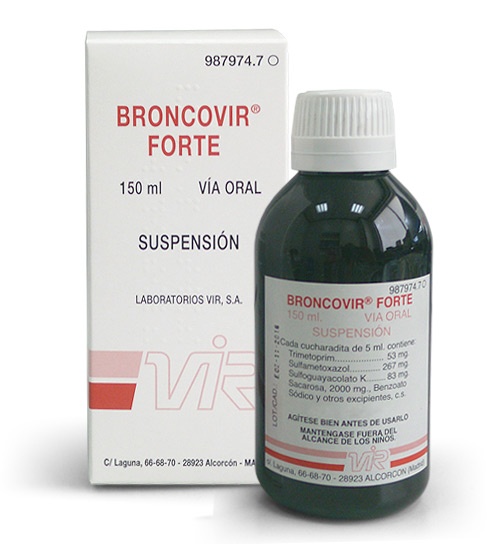
Broncovir Oral suspensión

Prescription review online
A doctor will review your case and decide whether a prescription is medically appropriate.

Talk to a doctor about this medicine
Discuss your symptoms and possible next steps in a quick online consultation.



How to use BRONCOVIR ORAL SUSPENSION
Contents of the leaflet
- Introduction
- What is Broncovir and what is it used for
- What you need to know before you take Broncovir suspension
- How to take Broncovir
- Possible side effects
- Storage of Broncovir
- Package Contents and Additional Information
Introduction
Package Leaflet: Information for the User
Broncovir Oral Suspension
Trimethoprim, Sulfamethoxazole, Potassium Sulfoguaiacolate
Read all of this leaflet carefully before you start taking this medicine because it contains important information for you.
- Keep this leaflet, you may need to read it again.
- If you have any further questions, ask your doctor or pharmacist.
- This medicine has been prescribed for you only. Do not pass it on to others. It may harm them, even if their signs of illness are the same as yours.
- If you get any side effects, talk to your doctor or pharmacist. This includes any possible side effects not listed in this leaflet. See section 4.
Contents of the Package Leaflet
- What is Broncovir and what is it used for
- What you need to know before you take Broncovir
- How to take Broncovir
- Possible side effects
- Storage of Broncovir
- Contents of the pack and other information
1. What is Broncovir and what is it used for
Broncovir belongs to a group of medicines called antibiotics that eliminate the bacteria that cause infections, associated with a medicine called mucolytics that act by decreasing the viscosity of mucous secretions, making them more fluid and facilitating their elimination. It contains three different active substances called trimethoprim, sulfamethoxazole (antibiotics), and potassium sulfoguaiacolate (mucolytic).
Antibiotics are used to treat bacterial infections and are not effective against viral infections such as the flu or the common cold. It is essential that you follow the instructions regarding dosage, administration interval, and treatment duration indicated by your doctor. Do not store or reuse this medicine. If you have any leftover antibiotic after completing treatment, return it to the pharmacy for proper disposal. Do not throw medicines down the drain or in the trash. |
Broncovir is indicated in adults, adolescents, and children (2-11 years) for the treatment of the following infections:
- Exacerbation of pulmonary infections in patients with chronic bronchitis
- Treatment of pneumonia caused by Pneumocystis jiroveci (P. carinii)
Broncovir may also be useful for other infections: middle ear infections and acute bacterial sinusitis.

Not sure if this medicine is right for you?
Discuss your symptoms and treatment with a doctor online.
2. What you need to know before you take Broncovir suspension
Do not take Broncovir:
- If you are allergic to sulfonamides, trimethoprim, cotrimoxazole, or any of the other components of this medicine (listed in section 6).
- If you have or think you have acute porphyria (a blood disease in which hemoglobin is not produced properly).
- Do not administer to children under 2 years of age.
- If you are pregnant.
Warnings and precautions
Consult your doctor or pharmacist before starting to take Broncovir oral suspension.
- In elderly patients, as they may be more likely to experience severe effects.
- If you have kidney problems (known renal insufficiency). Your doctor should take special measures. To ensure adequate renal elimination, the patient should receive adequate fluid intake and the urinary pH should be maintained within normal limits, avoiding acidification of the urine.
- If you have liver problems.
- If you have severe blood disorders, except in cases where there is close medical supervision.
- If you have a deficiency of an enzyme called glucose-6-phosphate dehydrogenase (G-6-PD).
- If you take Broncovir for a long time or if you have a folate deficiency or are an elderly patient, your doctor may request that you have blood tests to perform blood counts.
- If you are at risk of hyperkalemia (high potassium levels) or hyponatremia (low sodium levels), your doctor will consider the need for potassium and sodium control in the blood.
- If you have phenylketonuria (a metabolic disease that affects the enzyme phenylalanine), as the administration of trimethoprim alters phenylalanine metabolism. This is not a problem in patients with an adequate restrictive diet.
- Broncovir may interfere with the results of some analytical tests.
- If you experience an unexpected worsening of cough and shortness of breath, inform your doctor immediately.
There have been rare cases of death due to severe reactions, including fulminant hepatic necrosis (severe liver damage), agranulocytosis (decrease in the number of a certain type of white blood cell), aplastic anemia (insufficiency of the bone marrow to produce different types of cells), and other blood disorders, as well as respiratory hypersensitivity.
There have been reports of skin eruptions that can be life-threatening (Stevens-Johnson syndrome and toxic epidermal necrolysis) with the use of Broncovir, initially appearing as red spots or patches, often with a central blister.
Other additional signs that may appear are sores in the mouth, throat, nose, genitals, and conjunctivitis (swollen and red eyes).
These life-threatening skin eruptions are often accompanied by flu-like symptoms. The rash can progress to generalized blistering or peeling of the skin.
The period of highest risk of severe skin reactions is during the first weeks of treatment.
If you have developed Stevens-Johnson syndrome or toxic epidermal necrolysis with the use of Broncovir, you should not use Broncovir again at any time.
If you develop a rash or these skin symptoms, stop taking Broncovir, go to a doctor immediately, and inform them that you are taking this medicine.
Hemophagocytic lymphohistiocytosis
Very rare cases of excessive immune reactions have been reported due to unregulated activation of white blood cells, causing inflammation (hemophagocytic lymphohistiocytosis), which can be potentially fatal if not diagnosed and treated early. If you experience multiple symptoms such as fever, swelling of the lymph nodes, feeling of weakness, dizziness, shortness of breath, bruising, or skin rash, either simultaneously or with a slight delay, contact your doctor immediately.
Taking Broncovir oral suspension with food and drinks:
Broncovir can be taken with or without food.
To ensure adequate renal elimination, the patient should receive adequate fluid intake and the urinary pH should be maintained within normal limits, avoiding acidification of the urine.
Pregnancy, breastfeeding, and fertility
If you are pregnant or breastfeeding, think you may be pregnant, or plan to become pregnant, consult your doctor or pharmacist before using this medicine.
Trimethoprim and sulfamethoxazole cross the placenta, and their safety in pregnant women has not been established. Trimethoprim/sulfamethoxazole should be avoided in pregnancy, unless the potential benefit to the mother outweighs the potential risk to the fetus, and a folate supplement may be considered if trimethoprim/sulfamethoxazole is used during pregnancy.
When Broncovir is administered to the mother before birth, there may be a theoretical risk of kernicterus (severe neurological complication due to increased bilirubin in the blood) in the newborn. This theoretical risk is particularly important in children with a higher risk of hyperbilirubinemia, such as premature infants or those with glucose-6-phosphate dehydrogenase deficiency.
The administration of trimethoprim/sulfamethoxazole should be avoided in the final stage of pregnancy and in breastfeeding mothers, when the mothers or children have or are at particular risk of developing hyperbilirubinemia, are premature, or have glucose-6-phosphate dehydrogenase deficiency (G-6-PD).
The medicine is excreted in breast milk.
Driving and using machines:
The influence of Broncovir on the ability to drive and use machines is negligible or insignificant.
However, if you notice any symptoms, do not drive or use machines until you know how you tolerate the medicine.
Broncovir oral suspension contains sucrose
This medicine contains 3g of sucrose per 7.5ml, which should be taken into account in patients with hereditary fructose intolerance, glucose/galactose malabsorption, sucrose-isomaltase deficiency, and diabetic patients.
This medicine may cause severe allergic reactions and bronchospasm (sudden feeling of suffocation) because it contains ammonium sulfate.
Use of other medicines:
Tell your doctor or pharmacist if you are taking, have recently taken, or might take any other medicines.
Broncovir may enhance the effect and/or toxicity of some medicines. It is essential that you inform your doctor if you are taking or have recently taken any of the following medicines:
- Medicines used to increase urine elimination: diuretics (especially thiazides). The concomitant administration of diuretics with trimethoprim/sulfamethoxazole in elderly patients may have a higher risk of thrombocytopenia (decrease in platelet count) and hyponatremia (low sodium levels).
- Medicines that are antagonists of folic acid, such as phenytoin (used to treat epilepsy) and methotrexate (used to treat various types of cancer and also to treat rheumatoid arthritis). If trimethoprim/sulfamethoxazole and phenytoin are administered, the excessive effect of phenytoin should be taken into account. If Broncovir is administered with methotrexate, the administration of a folate supplement should be considered.
- Medicines for treating diabetes or for making blood more fluid (anticoagulants). If a variation in response to usual doses of anticoagulant or antidiabetic is observed, the doctor will adjust the dose during the period of concomitant administration with Broncovir.
3. How to take Broncovir
Follow the instructions for administration of this medicine exactly as indicated by your doctor or pharmacist. In case of doubt, consult your doctor or pharmacist again.
Remember to take your medicine.
Your doctor will indicate the duration of your treatment with Broncovir. Do not stop treatment before.
Pneumocystis jiroveci (P. carinii) pneumonia
Adults, adolescents, and children:
20mg of trimethoprim and 100mg of sulfamethoxazole/kg/day in two or more doses for two weeks.
The daily dose administered in one day of treatment is approximately 150mg of trimethoprim/day and 750mg of sulfamethoxazole/day. The total daily dose should not exceed 320mg of trimethoprim and 1600mg of sulfamethoxazole (30ml).
Acute exacerbations of chronic bronchitis in patients without risk factors, acute otitis media, and acute bacterial sinusitis:
- Adults and adolescents (12 to 18 years):
15ml of Broncovir oral suspension every 12 hours (160mg of trimethoprim/800mg of sulfamethoxazole/12 hours)
- Children (2-11 years):
3.75ml of Broncovir oral suspension every 12 hours (40mg of trimethoprim/200mg of sulfamethoxazole/12 hours)
Special populations
Elderly patients:
Available data do not indicate that the dose should be adjusted in this population; therefore, the standard dose will be used.
Patients with renal insufficiency:
Adults and adolescents (12 to 18 years)
Creatinine clearance (ml/min) | Recommended dose |
> 30 | Standard dose |
15-30 | Half of the standard dose |
<15 | Not recommended |
It is recommended to measure the plasma concentration of sulfamethoxazole at intervals of 2-3 days in samples obtained 12 hours after the administration of Broncovir. If the total sulfamethoxazole concentration exceeds 150 micrograms/ml, treatment should be interrupted until the value is below 120 micrograms/ml.
No information is available for children under 12 years of age.
If you take more Broncovir than you should:
Symptoms of overdose include vomiting, visual and mental disturbances, yellowing of the skin (jaundice), skin lesions (purpura and petechiae).
In acute overdose with trimethoprim, bone marrow depression has been observed.
If vomiting does not occur, it should be induced. Gastric lavage should be performed. Depending on the state of renal function, administration of fluids is recommended if urinary elimination is low.
In case of overdose or accidental ingestion, consult the Toxicology Information Service. Phone: 91 562 04 20, indicating the medicine and the amount taken.
If you forget to take Broncovir:
Do not take a double dose to make up for forgotten doses, wait for the next dose and continue taking Broncovir as usual.

Started taking the medicine and have questions?
Discuss your symptoms and treatment with a doctor online.
4. Possible side effects
Like all medicines, Broncovir can cause side effects, although not everybody gets them.
The side effects described for Broncovir oral suspension are classified by frequency and include:
- Much frequent (may affect more than 1 in 10 people): hyperkalemia (elevated potassium levels).
- Frequent (may affect up to 1 in 10 people): candidiasis (overgrowth of a fungus called Candida), headache, nausea, diarrhea, and skin rashes.
- Uncommon (may affect up to 1 in 100 people): vomiting.
- Very rare (may affect up to 1 in 10,000 people): leukopenia (decrease in white blood cell count), neutropenia (decrease in a certain type of white blood cell), thrombocytopenia (decrease in platelet count), agranulocytosis (decrease in a certain type of white blood cell), megaloblastic anemia (decrease in red blood cell count and increase in size), aplastic anemia (insufficiency of the bone marrow to produce different types of cells), hemolytic anemia (characterized by an insufficient number of red blood cells), methemoglobinemia (inability of hemoglobin to transport oxygen), eosinophilia (abnormally high amount of a certain type of white blood cell), purpura (red spots on the skin), hemolysis (breakdown of red blood cells) in certain susceptible patients deficient in G-6-PD.
Serum sickness (hypersensitivity reaction similar to an allergy), anaphylaxis (severe allergic reaction), allergic myocarditis (allergic reaction affecting the heart), angioedema (fluid retention in the skin and mucous membranes), fever, allergic vasculitis (inflammation affecting small veins), periarteritis nodosa (inflammation of blood vessels), systemic lupus erythematosus (immune system disease).
Hypoglycemia (low blood sugar), hyponatremia (low sodium levels), anorexia (loss of appetite). Depression, hallucinations, aseptic meningitis, convulsions, peripheral neuritis (nerve damage and deterioration), ataxia (loss of coordination), vertigo, tinnitus (ringing in the ears), dizziness, inflammation of a part of the eye (uveitis), cough, difficulty breathing, pulmonary infiltrates, glossitis (inflammation of the tongue), stomatitis (lesions in the mouth), pseudomembranous colitis (inflammation of the colon), pancreatitis (inflammation of the pancreas), hepatobiliary disorders (alteration of liver function), photosensitivity (skin reaction caused by interaction with light), exfoliative dermatitis (severe inflammation of the entire skin surface), fixed drug eruption (allergic reaction), erythema multiforme (allergic reaction affecting the skin), arthralgia (joint pain), myalgia (muscle pain), alteration of renal function, uveitis (inflammation of the eye). Life-threatening skin eruptions may occur (Stevens-Johnson syndrome, toxic epidermal necrolysis) (see section 2).
- Very rare side effects (may affect up to 1 in 10,000 people) related to the treatment of Pneumocystis jiroveci(P. carinii) pneumonia: severe hypersensitivity reactions, rashes, fever, neutropenia (decrease in a certain type of white blood cell), thrombocytopenia (decrease in platelet count), increased liver enzymes, hyperkalemia (elevated potassium levels), hyponatremia (low sodium levels), and rhabdomyolysis (muscle destruction or inflammation with severe muscle pain and weakness).
- Frequency not known: purple, elevated, and painful sores on the extremities and sometimes on the face and neck, with fever (Sweet's syndrome)
Severe side effects
Call emergency services immediately if you experience multiple symptoms such as fever, very low blood pressure, or increased heart rate after taking this medicine, as it may be a symptom of shock.
Reporting of side effects
If you experience any side effects, talk to your doctor or pharmacist, even if it is possible side effects not listed in this leaflet. You can also report them directly through the Spanish Pharmacovigilance System for Human Use Medicines: www.notificaram.es. By reporting side effects, you can help provide more information on the safety of this medicine.
5. Storage of Broncovir
Keep this medication out of sight and reach of children.
Do not use this medication after the expiration date that appears on the box, after CAD. The expiration date is the last day of the month indicated.
Medicines should not be disposed of via wastewater or household waste. Deposit the packaging and medications you no longer need at the SIGRE Point of your usual pharmacy. Ask your pharmacist how to dispose of the packaging and medications you no longer need. This way, you will help protect the environment.
6. Package Contents and Additional Information
Composition of Broncovir
The active ingredients are sulfamethoxazole, trimethoprim, and potassium sulfoguaiacolate. Each spoonful contains 5 ml of the mixture.
Each 5 ml contains:
Trimethoprim, 53.2 mg; sulfamethoxazole, 266.6 mg; and potassium sulfoguaiacolate, 83.4 mg.
The other components (excipients) are: Sodium saccharin, sucrose, microcrystalline cellulose, raspberry flavor (contains ammonium sulfite), sodium benzoate, water.
Appearance of the Product and Package Contents:
Broncovir is presented as a white-yellowish oral suspension, with a raspberry odor and flavor.
Each package contains 150ml.
Marketing Authorization Holder and Manufacturer:
INDUSTRIA QUÍMICA Y FARMACÉUTICA VIR, S.A.
C/ Laguna 66-70, Polígono Industrial Urtinsa II - 28923 ALCORCÓN (Madrid)
Date of the Last Revision of this Prospectus:August 2025
Detailed and updated information on this medication is available on the website of the Spanish Agency for Medicines and Health Products (AEMPS) http://www.aemps.es
- Country of registration
- Dosage formORAL SOLUTION/SUSPENSION, -
- ATC codeR05CZ95
- Active substance
- Prescription requiredYes
- Manufacturer
- CompositionSACARINA SODICA (0,06 g mg), SACAROSA (60 g mg), BENZOATO DE SODIO (E 211) (0,30 g mg)
- This information is for reference only and does not constitute medical advice. Always consult a doctor before taking any medication. Oladoctor is not responsible for medical decisions based on this content.
- Alternatives to BRONCOVIR ORAL SUSPENSIONDosage form: ORAL SOLUTION/SUSPENSION, 2.66 g; 0.05 g; 0.54 g/mlActive substance: Expectorants, excl. combinations with cough suppressantsManufacturer: Desma Laboratorio Farmaceutico S.L.Prescription requiredActive substance: Expectorants, excl. combinations with cough suppressantsManufacturer: Faes Farma S.A.Prescription requiredDosage form: ORAL SOLUTION/SUSPENSION, 7 mg/mlActive substance: Hederae helicis foliumManufacturer: Engelhard Arzneimittel Gmbh & Co. KgPrescription not required
Online doctors for BRONCOVIR ORAL SUSPENSION
Discuss questions about BRONCOVIR ORAL SUSPENSION, including use, safety considerations and prescription review, subject to medical assessment and local regulations.









Frequently Asked Questions
BRONCOVIR ORAL SUSPENSION requires a prescription in Spain. You can check with a doctor online whether this medicine may be appropriate for your situation.
The active ingredient in BRONCOVIR ORAL SUSPENSION is Expectorants, excl. combinations with cough suppressants. This information helps identify medicines with the same composition but different brand names.
BRONCOVIR ORAL SUSPENSION is manufactured by Industria Quimica Y Farmaceutica Vir S.A.. Pharmacy brands and packaging may differ depending on the distributor.
Doctors such as Family doctors, Psychiatrists, Dermatologists, Cardiologists, Endocrinologists, Gastroenterologists, Pulmonologists, Nephrologists, Rheumatologists, Hematologists, Infectious disease physicians, Allergists, Geriatricians, Paediatricians, Oncologists may assess whether BRONCOVIR ORAL SUSPENSION is appropriate, depending on your situation and local regulations. You can book an online consultation to discuss your symptoms and possible next steps.
The prescription is issued by a doctor after assessing your health. In Spain, BRONCOVIR ORAL SUSPENSION is then dispensed in pharmacies with that prescription. An online consultation does not guarantee that a prescription will be issued: the decision always rests with the doctor.
To request a review, you can use Oladoctor:
Other medicines with the same active substance (Expectorants, excl. combinations with cough suppressants) include BALSOPRIM 26.6mg/mL + 5.4mg/mL + 0.5mg/mL ORAL SUSPENSION, BRONQUIDIAZINA CR SUSTAINED-RELEASE ORAL SUSPENSION, ABRILAR SYRUP. These may have different brand names or formulations but contain the same therapeutic ingredient. Always consult a doctor before switching or starting a new medicine.
