



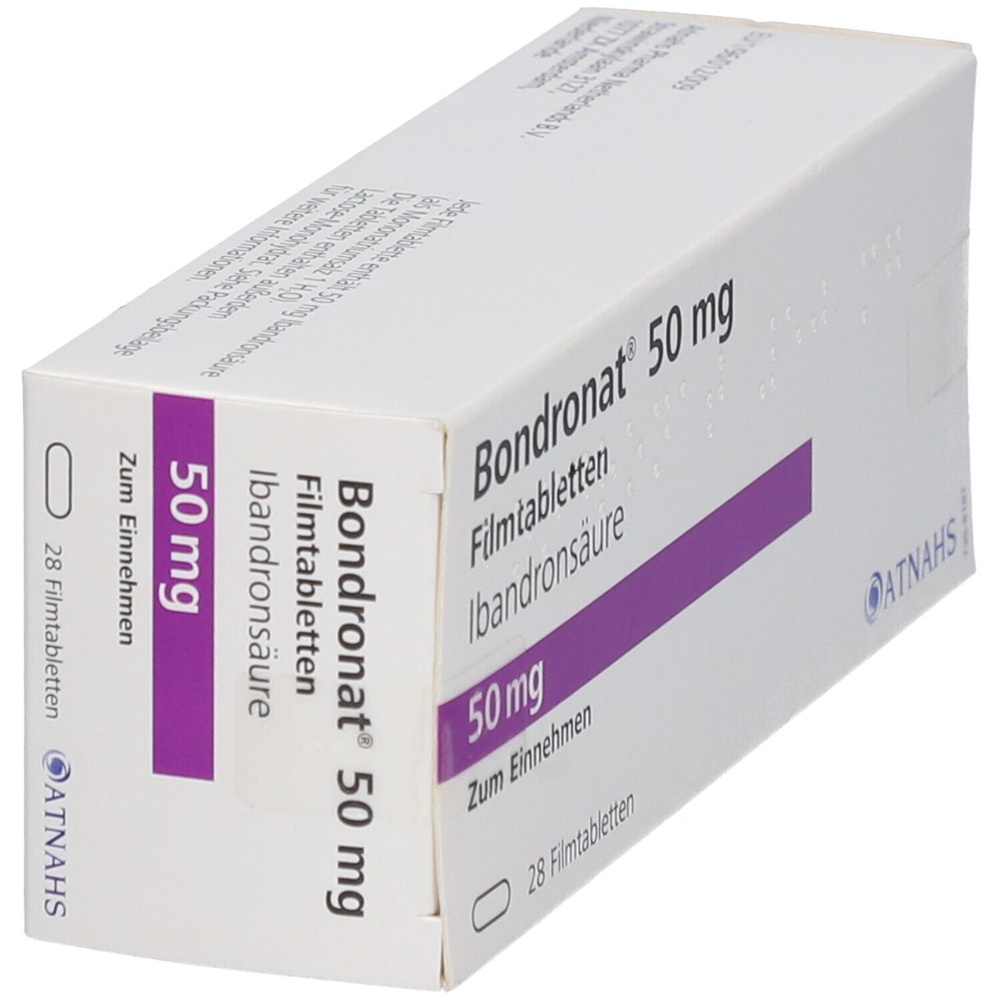
BONDRONAT 50 mg Film-Coated Tablets

Prescription review online
A doctor will review your case and decide whether a prescription is medically appropriate.

Talk to a doctor about this medicine
Discuss your symptoms and possible next steps in a quick online consultation.



How to use BONDRONAT 50 mg FILM-COATED TABLETS
Contents of the leaflet
- Introduction
- Read all of this leaflet carefully before you start taking this medicine because it contains important information for you.
- Contents of the pack:
- What is Bondronat and what is it used for
- What you need to know before you take Bondronat
- Bondronat with food and drink
- How to take Bondronat
- If you forget to take Bondronat:
- Possible side effects
- Reporting of side effects
- Storage of Bondronat
- Contents of the pack and other information
- Marketing authorisation holder and manufacturer
- Marketing authorisation holder
Introduction
Package Leaflet: Information for the Patient
Bondronat 50 mg Film-Coated Tablets
ibandronic acid
Read all of this leaflet carefully before you start taking this medicine because it contains important information for you.
- Keep this leaflet, you may need to read it again
- If you have any further questions, ask your doctor or pharmacist
- This medicine has been prescribed for you only. Do not pass it on to others. It may harm them, even if their signs of illness are the same as yours
- If you get any side effects, talk to your doctor or pharmacist. This includes any possible side effects not listed in this leaflet. See section 4.

Not sure if this medicine is right for you?
Discuss your symptoms and treatment with a doctor online.
Contents of the pack:
- What is Bondronat and what is it used for
- What you need to know before you take Bondronat
- How to take Bondronat
- Possible side effects
- Storage of Bondronat
- Contents of the pack and other information
1. What is Bondronat and what is it used for
Bondronat contains the active substance ibandronic acid. This belongs to a group of medicines called bisphosphonates.
Bondronat is used in adults and has been prescribed to you if you have breast cancer that has spread to the bone (called bone metastases).
- It helps to prevent your bones from breaking (fractures)
- It helps to prevent other bone problems that may need surgery or radiotherapy.
Bondronat works by reducing the amount of calcium that is lost from your bones. This helps to slow down the rate at which your bones become weaker.

Started taking the medicine and have questions?
Discuss your symptoms and treatment with a doctor online.
2. What you need to know before you take Bondronat
Do not take Bondronat
- if you are allergic to ibandronic acid or any of the other ingredients of this medicine (listed in section 6)
- if you have problems with the tube that carries food from the mouth to the stomach (the esophagus), such as narrowing or difficulty swallowing
- if you cannot stand or sit up for at least an hour (60 minutes)
- if you have or have had low levels of calcium in the blood.
Do not take this medicine if any of the above applies to you. If you are not sure, consult your doctor or pharmacist before taking Bondronat.
Warnings and precautions
A very rare side effect called osteonecrosis of the jaw (ONJ) (bone damage in the jaw) has been reported in patients treated with Bondronat for cancer-related conditions. ONJ can also occur after stopping treatment.
It is important to try to prevent ONJ from developing as it can be a painful condition that can be difficult to treat. To reduce the risk of developing osteonecrosis of the jaw, certain precautions need to be taken.
Before receiving treatment, tell your doctor/nurse (healthcare professional) if:
- You have problems with your mouth or teeth, such as poor dental health, gum disease, or a planned tooth extraction
- You do not receive regular dental check-ups or have not had a dental check-up for a long time
- You are a smoker (as this can increase the risk of dental problems)
- You have been previously treated with a bisphosphonate (used to treat or prevent bone disorders)
- You are taking medicines called corticosteroids (such as prednisolone or dexamethasone)
- You have cancer
Your doctor may ask you to have a dental check-up before starting treatment with Bondronat.
While you are being treated, you should maintain good oral hygiene (including regular tooth brushing) and have regular dental check-ups. If you wear dentures, you should make sure they fit properly. If you are having dental treatment or are going to have a dental operation (e.g. tooth extraction), tell your doctor about your dental treatment and tell your dentist that you are being treated with Bondronat.
Contact your doctor and dentist immediately if you experience any problems with your mouth or teeth, such as tooth loss, pain, or swelling, or difficulty healing of ulcers or discharge, as these could be signs of osteonecrosis of the jaw.
Atypical fractures of long bones, such as the forearm (cubitus) and shinbone (tibia), have also been reported in patients receiving long-term treatment with ibandronate. These fractures occur after minimal or no trauma and some patients experience pain in the area of the fracture before a complete fracture occurs.
Talk to your doctor or pharmacist before taking Bondronat:
- If you are allergic to any other bisphosphonate
- If you have any problems swallowing or digestive problems
- If you have high or low levels of vitamin D or any other mineral
- If you have kidney problems
Irritation, inflammation, or ulceration of the esophagus can occur, often with symptoms of severe chest pain, severe pain after swallowing food and/or drink, severe nausea, or vomiting, especially if you do not drink a full glass of water and/or if you lie down less than 1 hour after taking Bondronat. If you develop these symptoms, stop taking Bondronat and tell your doctor immediately (see sections 3 and 4).
Children and adolescents
Bondronat should not be used in children and adolescents under 18 years.
Using Bondronat with other medicines
Tell your doctor or pharmacist if you are taking or have recently taken or might take any other medicines. This is because Bondronat may affect the way other medicines work. Other medicines may also affect the way Bondronat works.
In particular, tell your doctor or pharmacistif you are taking any of the following medicines:
- supplements containing calcium, magnesium, iron, or aluminum
- acetylsalicylic acid and non-steroidal anti-inflammatory drugs (NSAIDs) such as ibuprofen or naproxen. This is because both NSAIDs and Bondronat can irritate the stomach and intestines
- a type of injected antibiotic called an aminoglycoside, such as gentamicin. This is because both aminoglycosides and Bondronat can lower the level of calcium in the blood.
Taking medicines that reduce stomach acid, such as cimetidine and ranitidine, may slightly increase the effects of Bondronat.
Bondronat with food and drink
Do not take Bondronat with food or other drinks except water, as Bondronat loses its effect if taken with food or drinks (see section 3).
Take Bondronat at least 6 hours after the last meal, drink, or any other medicine or supplement (e.g. products containing calcium (milk), aluminum, iron, and magnesium) except water. And after taking the tablet, wait at least 30 minutes before taking your first food and drink and taking any other medicine or supplement (see section 3).
Pregnancy and breastfeeding
Do not take Bondronat if you are pregnant, planning to become pregnant, or breastfeeding.
Talk to your doctor or pharmacist before taking this medicine.
Driving and using machines
You can drive and use machines as Bondronat is not expected to affect your ability to drive or use machines. However, talk to your doctor first if you want to drive, use machines, or tools.
Bondronat contains lactose.
If your doctor has told you that you have an intolerance to some sugars, consult your doctor before taking this medicine.
3. How to take Bondronat
Follow the instructions for administration of this medicine exactly as told by your doctor. If you are unsure, consult your doctor or pharmacist again. Take the tablet after a minimum of 6 hours after the last meal, drink, or any other medicine or supplement except water. Do not take with water with a high concentration of calcium. If you are unsure about the levels of calcium in your tap water (hard water), it is recommended to use bottled water with a low mineral content.
Your doctor may perform regular blood tests while you are taking Bondronat. This is to check that you are receiving the correct amount of this medicine.
Taking this medicine
It is important to take Bondronat at the right time and in the right way. This is because it can cause irritation, inflammation, or ulcers in the esophagus.
You can help reduce this by doing the following:
- Take your tablet as soon as you get up that day and before you have your first food, drink, or take any other medicine or supplement
- Take the tablet with a full glass of water (approximately 200 ml). Do not take the tablet with any drink other than water
- Swallow the tablet whole. Do not chew, suck, or crush the tablet. Do not let the tablet dissolve in your mouth
- After taking the tablet, wait at least 30 minutes. After that, you can have your first food and drink and take any other medicine or supplement
- Stay upright (standing or sitting) when taking the tablet and for the next hour (60 minutes). If you do not, some of the medicine may come back up into the esophagus.
How much to take
The usual dose of Bondronat is one tablet per day. If you have moderate kidney problems, your doctor should reduce your dose to one tablet every other day. If you have severe kidney problems, your doctor should reduce your dose to one tablet per week.
If you take more Bondronat than you should
If you take too many tablets, talk to your doctor or go to the hospital immediately. Drink a full glass of milk before you go. Do not induce vomiting and do not lie down.
If you forget to take Bondronat:
Do not take a double dose to make up for a forgotten dose. If you are taking one tablet per day, skip that dose. Then continue with your normal daily dose the next day. If you are taking one tablet every other day or once a week, talk to your doctor or pharmacist.
If you stop taking Bondronat
Keep taking Bondronat until your doctor tells you to stop. The medicine will only work if you take it for the whole time.
If you have any other questions about the use of this medicine, ask your doctor or pharmacist.
4. Possible side effects
Like all medicines, this medicine can cause side effects, although not everybody gets them.
Tell your doctor or nurse immediately if you notice any of the following serious side effects, as you may need urgent medical treatment:
Common(may affect up to 1 in 10 people):
- Feeling dizzy, heartburn, and difficulty swallowing (inflammation of the esophagus)
Uncommon(may affect up to 1 in 100 people)
- Severe stomach pain. This could be a sign of an ulcer in the first part of the intestine (duodenum) that is bleeding, or inflammation of the stomach (gastritis).
Rare(may affect up to 1 in 1,000 people)
- Persistent eye pain and inflammation
- New pain, weakness, or discomfort in the thigh, hip, or groin. These can be early symptoms of a possible unusual fracture of the thigh bone.
Very rare(may affect up to 1 in 10,000 people)
- Pain or sensation of pain in the mouth or jaw. These can be early symptoms of serious jaw problems [necrosis (death of bone tissue) of the jawbone]
- Talk to your doctor if you have ear pain, discharge from the ear, or an ear infection. These could be symptoms of damage to the bones of the ear
- Itching, swelling of the face, lips, tongue, and throat, with difficulty breathing. You may be having a serious allergic reaction that can be life-threatening
- Severe skin reactions
Frequency not known(cannot be estimated from the available data)
- Asthma attack
Other possible side effects
Common(may affect up to 1 in 10 people)
- Stomach pain, indigestion
- Decreased levels of calcium in the blood
- Weakness
Uncommon(may affect up to 1 in 100 people)
- Chest pain
- Itching or tingling sensation on the skin (paresthesia)
- Flu-like symptoms, usually with general feeling of being unwell or pain
- Dry mouth, unpleasant taste, or difficulty swallowing
- Anemia (reduced blood count)
- High levels of urea or parathyroid hormone in the blood
Reporting of side effects
If you experience any side effects, talk to your doctor or pharmacist, even if they are not listed in this leaflet. You can also report side effects directly via the national reporting system listed in Appendix V. By reporting side effects, you can help provide more information on the safety of this medicine.
5. Storage of Bondronat
- Keep this medicine out of the sight and reach of children
- Do not use this medicine after the expiry date which is stated on the blister and carton after EXP. The expiry date is the last day of the month shown
- Store in the original package to protect from moisture
- Medicines should not be disposed of via wastewater or household waste. Ask your pharmacist how to dispose of medicines no longer required. This will help protect the environment.
6. Contents of the pack and other information
Composition of Bondronat
- The active substance is ibandronic acid. Each film-coated tablet contains 50 mg of ibandronic acid (as sodium monohydrate).
The other ingredients are:
- tablet core: lactose monohydrate, povidone, microcrystalline cellulose, crospovidone, purified stearic acid, anhydrous colloidal silica
- tablet coating: hypromellose, titanium dioxide (E 171), talc, macrogol 6000
Appearance and packaging
The film-coated tablets are oblong, white to off-white, and engraved with L2/IT. They are available in packs of 28 and 84 tablets. Not all pack sizes may be marketed.
Marketing authorisation holder and manufacturer
Marketing authorisation holder
Atnahs Pharma Netherlands B.V.
Copenhagen Towers,
Ørestads Boulevard 108, 5.tv
DK-2300 København S
Denmark
Manufacturer
IL CSM Clinical Supplies Management GmbH
Marie-Curie-Strasse 8
Lörrach
Baden-Württemberg
79539, Germany
Atnahs Pharma Denmark ApS
Copenhagen Towers,
Ørestads Boulevard 108, 5.tv
DK-2300 København S
Denmark
Date of last revision of this leaflet: MM/AAAA
Detailed information on this medicine is available on the European Medicines Agency web site http://www.ema.europa.eu.
- Country of registration
- Dosage formTABLET, 50 mg
- ATC codeM05BA06
- Active substance
- Prescription requiredYes
- Manufacturer
- CompositionLACTOSA HIDRATADA (0 - mg)
- This information is for reference only and does not constitute medical advice. Always consult a doctor before taking any medication. Oladoctor is not responsible for medical decisions based on this content.
- Alternatives to BONDRONAT 50 mg FILM-COATED TABLETSDosage form: TABLET, 150 mgActive substance: ibandronic acidManufacturer: Especialidades Farmaceuticas Centrum S.A.Prescription requiredDosage form: INJECTABLE PERFUSION, 2 mgActive substance: ibandronic acidManufacturer: Accord Healthcare S.L.U.Prescription requiredDosage form: INJECTABLE PERFUSION, 6 mgActive substance: ibandronic acidManufacturer: Accord Healthcare S.L.U.Prescription required
Online doctors for BONDRONAT 50 mg FILM-COATED TABLETS
Discuss questions about BONDRONAT 50 mg FILM-COATED TABLETS, including use, safety considerations and prescription review, subject to medical assessment and local regulations.


Get BONDRONAT 50 mg FILM-COATED TABLETS Prescription Online
Fill in a 2-min form
Tell us your symptoms, history, and what medicine you're requesting.
Pick a doctor or let us assign
Choose a specialist or we'll match you with the next available doctor.
Doctor reviews your case
Usually within 30 minutes. They may ask follow-up questions via chat.
Collect from any pharmacy
Electronic prescription sent to your email — valid across Spain.
Frequently Asked Questions
BONDRONAT 50 mg FILM-COATED TABLETS requires a prescription in Spain. You can check with a doctor online whether this medicine may be appropriate for your situation.
The active ingredient in BONDRONAT 50 mg FILM-COATED TABLETS is ibandronic acid. This information helps identify medicines with the same composition but different brand names.
BONDRONAT 50 mg FILM-COATED TABLETS is manufactured by Atnahs Pharma Netherlands Bv.. Pharmacy brands and packaging may differ depending on the distributor.
Doctors such as Family doctors, Psychiatrists, Dermatologists, Cardiologists, Endocrinologists, Gastroenterologists, Pulmonologists, Nephrologists, Rheumatologists, Hematologists, Infectious disease physicians, Allergists, Geriatricians, Paediatricians, Oncologists may assess whether BONDRONAT 50 mg FILM-COATED TABLETS is appropriate, depending on your situation and local regulations. You can book an online consultation to discuss your symptoms and possible next steps.
Spain has a well-developed healthcare infrastructure across major cities such as Madrid, Barcelona, Valencia, and Seville. Pharmacies are widely available and operate under strict regulations, ensuring access to prescribed medications.
You can buy BONDRONAT 50 mg FILM-COATED TABLETS in Madrid, Barcelona, Seville, or Valencia at any local pharmacy with a valid prescription.
To obtain a prescription, you can use Oladoctor:
Other medicines with the same active substance (ibandronic acid) include ABRION 150 mg FILM-COATED TABLETS, Ibandronic Acid Accord 2 mg concentrate for infusion solution, Ibandronic Acid Accord 6 mg concentrate for infusion solution. These may have different brand names or formulations but contain the same therapeutic ingredient. Always consult a doctor before switching or starting a new medicine.
