


Bisolvon 10 mg/5 ml solución oral

Prescription review online
A doctor will review your case and decide whether a prescription is medically appropriate.

Talk to a doctor about this medicine
Discuss your symptoms and possible next steps in a quick online consultation.



How to use BISOLVON ANTITUSSIVE 2 mg/ml SYRUP
Contents of the leaflet
- Introduction
- Package Leaflet: Information for the User
- Bisolvon Antitussive 2 mg/ml Syrup
- What is Bisolvon Antitussive and what is it used for
- What you need to know before taking Bisolvon Antitussive
- How to take Bisolvon Antitussive
- Possible side effects
- Storage of Bisolvon Antitussive
- Contents of the pack and further information
Introduction
Package Leaflet: Information for the User

Not sure if this medicine is right for you?
Discuss your symptoms and treatment with a doctor online.
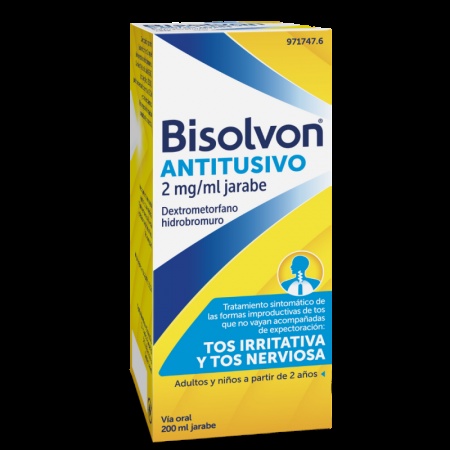
Bisolvon Antitussive 2 mg/ml Syrup
Dextromethorphan hydrobromide
Read all of this leaflet carefully before you start taking this medicine because it contains important information for you.
Follow the instructions for administration of the medicine contained in this leaflet or as indicated by your doctor or pharmacist.
- Keep this leaflet, you may need to read it again.
- If you need advice or more information, consult your pharmacist.
- If you experience side effects, consult your doctor or pharmacist, even if they are not listed in this leaflet. See section 4.
- You should consult a doctor if it worsens or does not improve after 5 days of treatment.
Contents of the Package Leaflet:
- What is Bisolvon Antitussive and what is it used for
- What you need to know before taking Bisolvon Antitussive
- How to take Bisolvon Antitussive
- Possible side effects
- Storage of Bisolvon Antitussive
- Contents of the pack and further information
1. What is Bisolvon Antitussive and what is it used for
Dextromethorphan, the active substance of this medicine, is a cough suppressant that inhibits the cough reflex.
It is indicated for the symptomatic treatment of forms of cough that are not accompanied by expectoration (irritative cough, nervous cough) in adults and children from 2 years of age.
You should consult a doctor if it worsens or does not improve after 5 days of treatment.

Started taking the medicine and have questions?
Discuss your symptoms and treatment with a doctor online.
2. What you need to know before taking Bisolvon Antitussive
This medicine can cause dependence. Therefore, treatment should be of short duration.
Do not take Bisolvon Antitussive:
- If you are allergic to dextromethorphan or any of the other components of this medicine (listed in section 6).
- Children under 2 years of age must not take this medicine.
- If you have bronchial asthma.
- If you have chronic obstructive pulmonary disease (COPD).
- If you have pneumonia.
- If you have respiratory failure.
- If you have respiratory depression.
- If you are breastfeeding.
- If you have a cough accompanied by abundant secretions (e.g., in patients with diseases such as bronchiectasis (lung disease where the bronchi are dilated and filled with pus) or cystic fibrosis).
- If you are being treated or have been treated in the last 2 weeks with any monoamine oxidase inhibitor (MAOI) medication used to treat depression, Parkinson's disease, or other diseases, as well as other serotonin reuptake inhibitor medications used to treat depression, such as fluoxetine and paroxetine; or also with bupropion, which is a medication used to quit smoking, or with linezolid, which is an antibacterial medication. (See section "Other medications and Bisolvon Antitussive").
Warnings and precautions
Consult your doctor before starting to take Bisolvon Antitussive.
- If you have persistent or chronic cough.
- If you are taking serotonergic medications (different from MAOIs) such as serotonin reuptake inhibitors or tricyclic antidepressants (see section "Other medications and Bisolvon Antitussive").
- In patients with neurological diseases associated with a significantly reduced cough reflex (such as stroke, Parkinson's disease, and dementia), treatment with Bisolvon Antitussive should be administered with special caution and only after carefully evaluating the benefit-risk ratio (see section "Other medications and Bisolvon Antitussive").
- If you have liver or kidney disease.
- If you have atopic dermatitis (inflammatory skin disease characterized by erythema, itching, exudation, crusts, and scaling, which begins in childhood in individuals with a hereditary allergic predisposition) and/or mastocytosis (increase in mast cells in the blood).
- If you are sedated, debilitated, or bedridden.
- Dextromethorphan has a mild potential for addiction. Its prolonged use (e.g., if the recommended time period is exceeded) may produce tolerance or mental and physical dependence. People with a tendency to abuse or dependence should only take it under strict medical control and for short periods of time. Patients should not exceed the recommended dose or duration of treatment.
- There have been cases of abuse with medications containing dextromethorphan, especially in adolescents and young adults, as well as in patients with a history of drug or psychoactive substance abuse. Therefore, this possibility should be taken into account, as serious side effects can occur (see section "If you take more Bisolvon Antitussive than you should").
- Medical supervision is recommended for the treatment of children between 2 and 12 years of age.
- If you are taking other medications such as antidepressants or antipsychotics, Bisolvon Antitussive may interact with these medications, and you may experience changes in your mental state (e.g., agitation, hallucinations, coma) and other effects such as body temperature above 38°C, increased heart rate, high blood pressure, and exaggerated reflexes, muscle stiffness, lack of coordination, and/or gastrointestinal symptoms (e.g., nausea, vomiting, and diarrhea).
Other medications and Bisolvon Antitussive
Tell your doctor or pharmacist if you are using, have recently used, or might use any other medication.
Do not take this medicine during treatment or in the 2 weeks following treatment with the following medications, as excitement, high blood pressure, and fever above 40°C (hyperpyrexia) may occur:
- Monoamine oxidase inhibitor (MAOI) antidepressants (moclobemide, tranilcipromine)
- Serotonin reuptake inhibitor (SSRI) antidepressants (paroxetine, fluoxetine)
- Bupropion (used to quit smoking)
- Linezolid (used as an antibacterial)
- Procarbazine (used to treat cancer)
- Selegiline (used to treat Parkinson's disease)
- Terbinafine (used as an antifungal)
Before taking this medicine, you should consult your doctor if you are using any of the following medications, as it may be necessary to modify the dose of one of them or interrupt treatment:
- Medications to treat heart arrhythmias such as amiodarone, quinidine, flecainide, and propafenone.
- Anti-inflammatory medications such as celecoxib, parecoxib, or valdecoxib.
- CNS depressant medications used to treat mental illnesses, allergies, or Parkinson's disease.
- Medications used to eliminate phlegm and mucus, such as expectorants and mucolytics, especially if you have a chest disease such as bronchiectasis (lung disease where the bronchi are dilated and filled with pus) or cystic fibrosis.
- Medications for the treatment of psychosis (mental states in which there is a loss of contact with reality) such as haloperidol and thioridazine.
- Medications for the treatment of HIV such as ritonavir.
- Plant-based medications such as berberine.
- Medications for the treatment of hyperparathyroidism such as cinacalcet.
- Antifungal medications such as terbinafine.
- Medications for the treatment of stomach acidity such as cimetidine.
Taking Bisolvon Antitussive with food, drinks, and alcohol
Alcoholic beverages should not be consumed during treatment, as they may increase the occurrence of side effects.
Do not take with grapefruit or bitter orange juice, as they may increase the side effects of this medicine.
Pregnancy, breastfeeding, and fertility
If you are pregnant or breastfeeding, think you may be pregnant, or plan to become pregnant, consult your doctor or pharmacist before using this medicine.
Bisolvon Antitussive contains propylene glycol. If you are pregnant or breastfeeding, do not take this medicine unless it is recommended by your doctor, as it may cause a slow and shallow breathing effect (respiratory depressant) in infants.
Your doctor may perform additional checks while you are taking this medicine.
Driving and using machines
During treatment, a decrease in reaction capacity or drowsiness and mild dizziness may occur, even when taken at the recommended doses. If you notice these symptoms, you should not drive vehicles or operate machinery.
Bisolvon Antitussive contains maltitol, propylene glycol, methyl parahydroxybenzoate, and sodium
This medicine contains liquid maltitol. If your doctor has told you that you have an intolerance to certain sugars, consult with them before taking this medicine.
This medicine contains 66.08 mg of propylene glycol per ml. If you are pregnant or breastfeeding, do not take this medicine unless it is recommended by your doctor. Your doctor may perform additional checks while you are taking this medicine. If you have liver or kidney failure, do not take this medicine unless it is recommended by your doctor. Your doctor may perform additional checks while you are taking this medicine. If the child is under 5 years of age, consult your doctor or pharmacist, especially if they have been given other medications that contain propylene glycol or alcohol.
It may cause allergic reactions (possibly delayed) because it contains methyl parahydroxybenzoate (E-218).
This medicine contains less than 23 mg of sodium (1 mmol) per ml; i.e., it is essentially "sodium-free".
3. How to take Bisolvon Antitussive
Follow the instructions for administration of the medicine contained in this leaflet or as indicated by your doctor or pharmacist. In case of doubt, ask your doctor or pharmacist. Do not exceed the recommended dose or duration of treatment. Cases of dextromethorphan abuse have been reported, even in children and adolescents.
The recommended dose is:
Adults and adolescents from 12 years of age :take 5 to 10 ml, depending on the intensity of the cough, every 4 hours if necessary. Do not exceed 6 doses in 24 hours.
It can also be taken 15 ml every 6 or 8 hours if necessary.
- The maximum amount that can be taken in 24 hours is 60 ml, divided into several doses.
Use in children
Severe side effects can occur in children in case of overdose, including neurological disorders. Caregivers should not exceed the recommended dose.
Children from 6 to 11 years of age: take 2.5 to 5 ml, depending on the intensity of the cough, every 4 hours if necessary. Do not exceed 6 doses in 24 hours.
It can also be taken 7.5 ml every 6 or 8 hours if necessary.
- The maximum amount that can be taken in 24 hours is 30 ml, divided into several doses.
Children from 2 to 5 years of age :take 1.25 to 2.5 ml, depending on the intensity of the cough, every 4 hours if necessary. Do not exceed 6 doses in 24 hours.
It can also be taken 3.75 ml (one 2.5 ml measure + one 1.25 ml measure) every 6 or 8 hours if necessary. The maximum amount that can be taken in 24 hours is 15 ml, divided into several doses.
Children under 2 years of age:
This medicine is contraindicated in children under 2 years of age.
How to take:
This medicine is taken orally.
A measuring cup is included in the box to measure the amount of medicine to be taken.
Drink the medicine directly from the measuring cup and wash it after each use.
It can be taken with or without food.
Do not take with grapefruit or bitter orange juice or with alcoholic beverages (see section "Taking Bisolvon Antitussive with food, drinks, and alcohol").
If it worsens or if the cough persists for more than 5 days of treatment, or if it is accompanied by high fever, skin rash, or persistent headache, consult your doctor.
If you take more Bisolvon Antitussive than you should
If you think you have taken too much Bisolvon Antitussive, seek medical help immediately.
If you take more Bisolvon Antitussive than recommended, you may notice, especially in children and adolescents or in case of abuse: nausea, vomiting, gastrointestinal discomfort, dizziness, fatigue, drowsiness, and hallucinations. Additionally, restlessness and excitement can turn into agitation with increased overdose. Also, symptoms such as decreased concentration and consciousness up to coma as a symptom of severe poisoning, changes in mood such as dysphoria and euphoria, confused speech, loss of balance, psychotic disorders such as disorientation and delirium up to confused or paranoid states, increased muscle tone, ataxia (uncoordinated movements), dysarthria, nystagmus (uncontrolled and involuntary eye movements), and visual disturbances, as well as respiratory depression, changes in blood pressure (high or low blood pressure), and tachycardia (accelerated heart rate) can occur.
Dextromethorphan may increase the risk of serotonin syndrome, and this risk is increased in cases of overdose, especially if taken with other serotonergic agents.
There have been reports of death from overdose when taking dextromethorphan with other drugs (combined poisoning).
If you take more Bisolvon Antitussive than indicated, you may experience the following symptoms: nausea and vomiting, involuntary muscle contractions, agitation, confusion, drowsiness, disorders of consciousness, involuntary and rapid eye movements, cardiac disorders (accelerated heart rate), coordination disorders, psychosis with visual hallucinations, and hyperexcitability.
Other symptoms in case of massive overdose may be: coma, severe respiratory problems, and convulsions.
Contact your doctor or hospital immediately if you experience any of the mentioned symptoms.
In case of overdose or accidental ingestion, consult your doctor or call the Toxicological Information Service (telephone 91.5620420), indicating the medication and the amount ingested. Naloxone can be used as an antidote.
If you forget to take Bisolvon Antitussive
If you forget to take Bisolvon Antitussive and the symptoms continue, do not take a double dose to make up for the forgotten dose. If necessary, resume the medication in the same way as indicated in the section "How to take Bisolvon Antitussive".
4. Possible side effects
Like all medicines, this medicine can cause side effects, although not everybody gets them.
Very common side effects: may affect more than 1 in 10 patients
- dizziness
Rare side effects: may affect up to 1 in 1,000 patients
- excitement
- decreased appetite
Side effects with unknown frequency (cannot be estimated from the available data)
- itching (urticaria)
- skin rash (erythema, rash, fixed drug eruption)
- addiction to medications
- breathing difficulties (bronchospasm)
- hallucinations
- confusion
- drowsiness
- allergic reactions (hypersensitivity, including anaphylactic reaction)
- swelling of the face and lips (angioedema)
- difficulty speaking and eye spasms (nystagmus)
- muscle tension disorder (dystonia), especially in children
- feeling of spinning (vertigo)
- stupor
- vomiting
- constipation
- fatigue
- dilated pupils (mydriasis)
Reporting of side effects
If you experience any side effects, consult your doctor or pharmacist, even if they are not listed in this leaflet. You can also report them directly through the Spanish Medicines and Healthcare Products Agency (AEMPS) website: www.notificaRAM.es. By reporting side effects, you can help provide more information on the safety of this medicine.
5. Storage of Bisolvon Antitussive
Keep this medicine out of the sight and reach of children.
No special storage conditions are required.
Do not freeze.
Do not use this medicine after the expiry date stated on the packaging after "EXP". The expiry date is the last day of the month indicated.
Medicines should not be disposed of via wastewater or household waste. Return the packaging and any unused medicine to a pharmacy. If you are unsure, consult your pharmacist on how to dispose of the packaging and any unused medicine. This will help protect the environment.
6. Contents of the pack and further information
Composition of Bisolvon Antitussive
- The active substance is dextromethorphan hydrobromide. Each ml of syrup contains
2 mg of dextromethorphan hydrobromide.
The other ingredients (excipients) are: sodium saccharin, liquid maltitol (E965), propylene glycol (E1520), vanilla flavor, apricot flavor, methyl parahydroxybenzoate (E218), and purified water.
Appearance of the product and contents of the pack
Bisolvon Antitussive is a syrup with an apricot and vanilla flavor.
It is presented in a 200 ml package with a measuring cup.
Marketing authorization holder
Opella Healthcare Spain, S.L.
C/ Rosselló i Porcel, 21
08016 – Barcelona
Spain
Sanofi Group
Manufacturer
DELPHARM REIMS, S.A.S.
10, Rue Colonel Charbonneaux
51100 Reims
France
Date of the last revision of this leaflet: March 2024
Detailed information about this medicine is available on the website of the Spanish Agency for Medicines and Healthcare Products (AEMPS) http://www.aemps.gob.es/
- Country of registration
- Dosage formORAL SOLUTION/SUSPENSION, 10 mg dextromethorphan hydrobromide/5 ml
- ATC codeR05DA09
- Active substance
- Prescription requiredNo
- Manufacturer
- CompositionSACARINA SODICA (15 mg mg), PROPILENGLICOL (310 mg mg), PARAHIDROXIBENZOATO DE METILO (E-218) (7,5 mg mg), MALTITOL (E965) (4340 mg mg)
- This information is for reference only and does not constitute medical advice. Always consult a doctor before taking any medication. Oladoctor is not responsible for medical decisions based on this content.
- Alternatives to BISOLVON ANTITUSSIVE 2 mg/ml SYRUPDosage form: ORAL SOLUTION/SUSPENSION, 500 mg dextromethorphan hydrobromideActive substance: dextromethorphanManufacturer: Pharminicio S.L.Prescription not requiredDosage form: BUCCAL/SUCKING TABLET, 10 mgActive substance: dextromethorphanManufacturer: Laboratorios Cinfa S.A.Prescription not requiredDosage form: ORALLY DISINTEGRATING TABLET/LIOTAB, 15 mgActive substance: dextromethorphanManufacturer: Laboratorios Cinfa S.A.Prescription not required
Online doctors for BISOLVON ANTITUSSIVE 2 mg/ml SYRUP
Discuss questions about BISOLVON ANTITUSSIVE 2 mg/ml SYRUP, including use, safety considerations and prescription review, subject to medical assessment and local regulations.









Frequently Asked Questions
BISOLVON ANTITUSSIVE 2 mg/ml SYRUP does not require a prescription in Spain. You can check with a doctor online whether this medicine may be appropriate for your situation.
The active ingredient in BISOLVON ANTITUSSIVE 2 mg/ml SYRUP is dextromethorphan. This information helps identify medicines with the same composition but different brand names.
BISOLVON ANTITUSSIVE 2 mg/ml SYRUP is manufactured by Opella Healthcare Spain S.L.. Pharmacy brands and packaging may differ depending on the distributor.
Doctors such as Family doctors, Psychiatrists, Dermatologists, Cardiologists, Endocrinologists, Gastroenterologists, Pulmonologists, Nephrologists, Rheumatologists, Hematologists, Infectious disease physicians, Allergists, Geriatricians, Paediatricians, Oncologists may assess whether BISOLVON ANTITUSSIVE 2 mg/ml SYRUP is appropriate, depending on your situation and local regulations. You can book an online consultation to discuss your symptoms and possible next steps.
The prescription is issued by a doctor after assessing your health. In Spain, BISOLVON ANTITUSSIVE 2 mg/ml SYRUP is then dispensed in pharmacies with that prescription. An online consultation does not guarantee that a prescription will be issued: the decision always rests with the doctor.
To request a review, you can use Oladoctor:
Other medicines with the same active substance (dextromethorphan) include BICASAN 2 mg/ml SYRUP, CINFATOS 10 mg LOZENGES, CINFATOS 15 mg ORALLY DISPERSIBLE TABLETS. These may have different brand names or formulations but contain the same therapeutic ingredient. Always consult a doctor before switching or starting a new medicine.
