


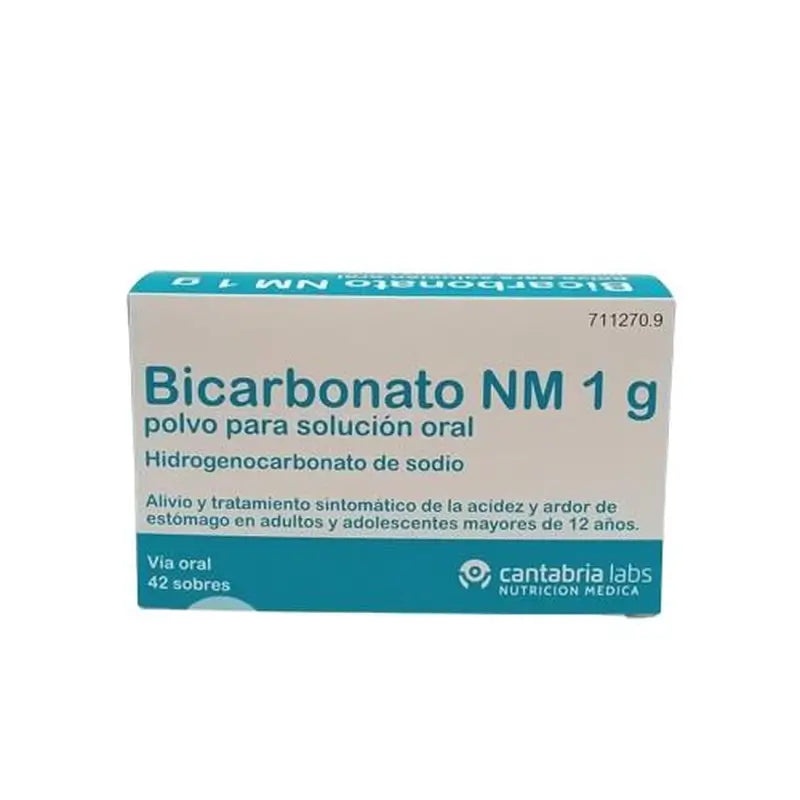
Bicarbonato Nutricion Medica 1 g polvo for solución oral

Prescription request online
A doctor will review your case and decide whether a prescription is medically appropriate.

Talk to a doctor about this medicine
Discuss your symptoms and possible next steps in a quick online consultation.



How to use BICARBONATE 1 g POWDER FOR ORAL SOLUTION
Contents of the leaflet
- Introduction
- What is Sodium Bicarbonate NM and what is it used for
- What you need to know before taking Sodium Bicarbonate NM
- How to Take Sodium Bicarbonate NM
- Possible Side Effects
- Storage of Sodium Bicarbonate NM
- Package Contents and Additional Information
Introduction
Package Leaflet: Information for the Patient
Sodium Bicarbonate NM 1 g Powder for Oral Solution
Sodium Hydrogencarbonate
Read the entire package leaflet carefully before starting to take this medication, as it contains important information for you.
Follow the administration instructions for the medication contained in this package leaflet or as indicated by your doctor or pharmacist.
- Keep this package leaflet, as you may need to read it again.
- If you need advice or more information, consult your pharmacist.
- If you experience side effects, consult your doctor or pharmacist, even if they are side effects not listed in this package leaflet. See section 4.
- You should consult a doctor if your symptoms worsen or do not improve after 7 days.
Contents of the Package Leaflet
- What is Sodium Bicarbonate NM and what is it used for
- What you need to know before taking Sodium Bicarbonate NM
- How to take Sodium Bicarbonate NM
- Possible side effects
- Storage of Sodium Bicarbonate NM
- Package Contents and Additional Information
1. What is Sodium Bicarbonate NM and what is it used for
Sodium Bicarbonate NM belongs to the group of medications called antacids that work by reducing excess stomach acidity.
It is indicated for the relief and symptomatic treatment of heartburn and stomach acid in adults and adolescents over 12 years of age.
You should consult a doctor if your symptoms worsen or do not improve after 7 days.

Not sure if this medicine is right for you?
Discuss your symptoms and treatment with a doctor online.
2. What you need to know before taking Sodium Bicarbonate NM
Do not takeSodium Bicarbonate NM
- If you are allergic to sodium hydrogencarbonate.
- If you have metabolic or respiratory alkalosis (alteration of blood pH).
- If you have hypocalcemia (decreased calcium in the blood).
- If you have hypochlorhydria (decreased normal acidity of gastric juice).
- If you have a tendency to form edema (fluid retention).
- If you have appendicitis or its symptoms (nausea, vomiting, cramps, abdominal pain).
- If you have intestinal obstruction (partial or total blockage of the intestine that produces an interruption of the passage of intestinal contents).
- If you are on a low-sodium diet (if you have high blood pressure or heart or kidney problems)
- If you have kidney or liver disease
Warnings and Precautions
Consult your doctor or pharmacist before taking Sodium Bicarbonate NM.
As with other antacids, this medication may mask the symptoms of a more serious stomach disease, so if symptoms persist or worsen after 7 days of treatment, you should consult your doctor.
This medication should not be used in patients with hypertension (high blood pressure), in patients with liver, kidney, or heart problems, or in patients taking diuretics (medications used to treat hypertension) or on low-sodium diets.
Children and Adolescents
Do not administer to children under 12 years of age.
Taking Sodium Bicarbonate NM with Other Medications
Inform your doctor or pharmacist if you are taking, have recently taken, or may need to take any other medication:
In general, the intake of any antacid should be done at least 2 hours before or after the administration of another medication.
Antacids can modify the action of other medications such as:
- Iron salts (medications used to prevent or treat anemia)
- Quinolones, tetracyclines, sulfonamides, erythromycin, methenamine, rifampicin, isoniazid, ethambutol (antibiotics)
- Theophylline (used to treat asthma)
- Ulipristal (emergency contraceptive)
- Erlotinib (medication for cancer treatment). It is recommended to administer sodium hydrogencarbonate at least 4 hours before or 2 hours after Erlotinib
- Propranolol, atenolol (medications for high blood pressure treatment)
- Benzodiazepines (medications for insomnia and anxiety treatment) Digoxin, digitoxin (medications for heart rhythm disorders treatment)
- Phenothiazines (medications for psychiatric disorders treatment)
- Naproxen, salicylates, flufenamic acid or mefenamic acid, indomethacin (used to treat pain and fever)
- Valproic acid, gabapentin (used to treat epilepsy)
- Levodopa (used to treat Parkinson's disease)
- Amphetamine, dextroamphetamine, ephedrine (central nervous system stimulants)
- Flecainide, quinidine (medications for heart rhythm disorders treatment)
- Methadone (used to relieve intense pain)
- Mecamylamine (medication for hypertension)
- Lithium salts (used in certain psychiatric diseases)
- Methotrexate (used for cancer and rheumatoid arthritis treatment)
- Preparations containing calcium, as it can develop the "milk and alkali" syndrome, whose symptoms are: excess calcium in the blood, kidney problems, heart problems, metabolic alkalosis, dizziness, vomiting, muscle cramps, apathy, headache, confusion, and anorexia.
As with other antacids, this medication administered with enteric-coated medications may cause the coating to dissolve too quickly, which can produce gastric or duodenal irritation.
In general, the intake of this medication should be done at least 2 hours before or 2 hours after the administration of any other medication.
Interference with Analytical Tests
If you are going to have any diagnostic tests (including blood tests, urine tests, detection of gastric acid secretion, etc.), inform your doctor that you are taking this medication, as it may alter the results of these tests.
Taking Sodium Bicarbonate NM with Food and Drinks
Do not take this medication with milk or dairy products.
Do not use this medication after excessive food or drink, as it may rarely cause stomach wall perforation.
Pregnancy, Breastfeeding, and Fertility
If you are pregnant or breastfeeding, think you may be pregnant, or plan to become pregnant, consult your doctor or pharmacist before using this medication.
Taking medications during pregnancy can be hazardous to the embryo or fetus and should be monitored by your doctor.
Driving and Using Machines
No effects on driving or using machines have been described.
This Medication Contains Sodium
Patients on low-sodium diets should note that this medication contains 273.9 mg (11.9 mmol) of sodium per dose.
3. How to Take Sodium Bicarbonate NM
Follow the administration instructions for the medication contained in this package leaflet or as indicated by your doctor or pharmacist. In case of doubt, ask your doctor or pharmacist.
Adults and Adolescents over 12 years:The recommended dose is 1 to 2 sachets (1 to 2 g of sodium hydrogencarbonate) per day. If necessary, the dose can be repeated, increasing to 2 to 4 sachets (2 to 4 g of sodium hydrogencarbonate), after meals or when experiencing gastric discomfort. Do not exceed the maximum dose of 6 sachets per day.
This medication should be taken 20 minutes to 1 hour after meals.
Always use the lowest effective dose.
As symptoms disappear, the medication should be discontinued.
This medication is taken orally. Dissolve the contents of the sachet in a glass of water and stir until completely dissolved.
Before taking the medication, always wait until the contents of the sachet are completely dissolved and the bubbles disappear.
If symptoms do not improve within 7 days, treatment should be discontinued and a doctor consulted.
Use in Children and Adolescents
Do not administer to children under 12 years of age.
If You Take More Sodium Bicarbonate NM Than You Should
If you take more Sodium Bicarbonate NM than recommended, you may experience headache, dizziness, tinnitus, blurred vision, drowsiness, sweating, nausea, vomiting, occasional diarrhea, hyperirritability, muscle weakness, and fluid retention.
In case of overdose or accidental ingestion, consult your doctor or pharmacist immediately, or go to a medical center or call the Toxicology Information Service, phone: 91 562 04 20, indicating the medication and the amount ingested.
If You Forget to Take Sodium Bicarbonate NM
Do not take a double dose to make up for forgotten doses.
If you have any other questions about the use of this medication, ask your doctor or pharmacist.

Started taking the medicine and have questions?
Discuss your symptoms and treatment with a doctor online.
4. Possible Side Effects
Like all medications, Sodium Bicarbonate NM can cause side effects, although not everyone may experience them.
- Adverse reactions observed with the use of sodium hydrogencarbonate are presented with an unknown frequency (cannot be estimated from available data). Flatulence (gas in the stomach or intestine), belching, vomiting, cramps, stomach bloating, and rebound effect (increased acidity produced by the medication itself).
- Hypokalemia (decreased potassium levels in the blood) and hypernatremia (increased sodium levels in the blood).
- If used continuously or at high doses, it can produce systemic alkalosis (difficulty breathing, muscle weakness, increased muscle tone, anxiety, and other effects on the central nervous system), hypertension (high blood pressure), and edema (fluid retention).
When ingesting large amounts of milk, it can produce a syndrome known as "milk and alkali," resulting in hypercalcemia (anorexia, vomiting, nausea, apathy, muscle cramps).
Reporting Side Effects
If you experience any type of side effect, consult your doctor or pharmacist, even if it is a possible side effect not listed in this package leaflet. You can also report them directly through the Spanish Medication Surveillance System for Human Use: www.notificaRAM.es
By reporting side effects, you can contribute to providing more information on the safety of this medication.
5. Storage of Sodium Bicarbonate NM
Keep this medication out of the sight and reach of children.
Do not use this medication after the expiration date shown on the sachet, after CAD. The expiration date is the last day of the month indicated.
Medications should not be disposed of through wastewater or household waste. Deposit the packaging and medications you no longer need at the pharmacy's SIGRE Point. Ask your pharmacist how to dispose of the packaging and medications you no longer need. This will help protect the environment.
6. Package Contents and Additional Information
Composition of Sodium Bicarbonate NM
- The active ingredient is sodium hydrogencarbonate. Each sachet contains 1 g of sodium hydrogencarbonate.
This medication does not contain excipients.
Appearance of the Product and Package Contents
White or almost white powder.
Box containing 42 sachets of 1 g of sodium hydrogencarbonate.
Marketing Authorization Holder
Nutrición Médica, S.L.
C/ Arequipa, 1
28043 - Madrid, Spain.
Manufacturer
Industrial Farmacéutica Cantabria, S.A.
C/ Pirita, 9.
28850 Torrejón de Ardoz (Madrid), Spain.
This Package Leaflet was Approved in: June2016
Detailed information about this medication is available on the website of the Spanish Agency for Medicines and Health Products (AEMPS), http://www.aemps.gob.es/
- Country of registration
- Dosage formORAL SOLUTION/SUSPENSION, 1 gram per sachet
- ATC codeA02AH91
- Active substance
- Prescription requiredNo
- Manufacturer
- This information is for reference only and does not constitute medical advice. Always consult a doctor before taking any medication. Oladoctor is not responsible for medical decisions based on this content.
- Alternatives to BICARBONATE 1 g POWDER FOR ORAL SOLUTIONDosage form: ORAL SOLUTION/SUSPENSION, 310 mg; 190 mg; 315 mg/5 mlActive substance: ordinary salt combinationsManufacturer: Arafarma Group S.A.Prescription not requiredDosage form: ORAL SOLUTION/SUSPENSION, 1.5 gActive substance: almagateManufacturer: Laboratorio Stada S.L.Prescription not requiredDosage form: CHEWABLE TABLET, 500 mgActive substance: almagateManufacturer: Laboratorio Stada S.L.Prescription not required
Online doctors for BICARBONATE 1 g POWDER FOR ORAL SOLUTION
Discuss questions about BICARBONATE 1 g POWDER FOR ORAL SOLUTION, including use, safety considerations and whether a prescription is appropriate, subject to medical assessment and local regulations.









Frequently Asked Questions
BICARBONATE 1 g POWDER FOR ORAL SOLUTION does not require a prescription in Spain. You can check with a doctor online whether this medicine may be appropriate for your situation.
The active ingredient in BICARBONATE 1 g POWDER FOR ORAL SOLUTION is Antacids with sodium bicarbonate. This information helps identify medicines with the same composition but different brand names.
BICARBONATE 1 g POWDER FOR ORAL SOLUTION is manufactured by Nutricion Medica S.L.. Pharmacy brands and packaging may differ depending on the distributor.
Doctors such as Family doctors, Psychiatrists, Dermatologists, Cardiologists, Endocrinologists, Gastroenterologists, Pulmonologists, Nephrologists, Rheumatologists, Hematologists, Infectious disease physicians, Allergists, Geriatricians, Paediatricians, Oncologists may assess whether BICARBONATE 1 g POWDER FOR ORAL SOLUTION is appropriate, depending on your situation and local regulations. You can book an online consultation to discuss your symptoms and possible next steps.
The prescription is issued by a doctor after assessing your health. In Spain, BICARBONATE 1 g POWDER FOR ORAL SOLUTION is then dispensed in pharmacies with that prescription. An online consultation does not guarantee that a prescription will be issued: the decision always rests with the doctor.
To request an assessment, you can use Oladoctor:
Other medicines with the same active substance (Antacids with sodium bicarbonate) include ACYLINE 620 mg/380 mg/630 mg ORAL SUSPENSION, ALMAGATO STADAPHARM 1.5 G ORAL SUSPENSION, ALMAGATO STADAPHARM 500 MG CHEWABLE TABLETS. These may have different brand names or formulations but contain the same therapeutic ingredient. Always consult a doctor before switching or starting a new medicine.
