






How to use BARILUX 50 mg/ml ORAL AND RECTAL SUSPENSION CONCENTRATE
Translated with AI
This page provides general information and does not replace a doctor’s consultation. Always consult a doctor before taking any medication. Seek urgent medical care if symptoms are severe.
Show originalContents of the leaflet
Introduction
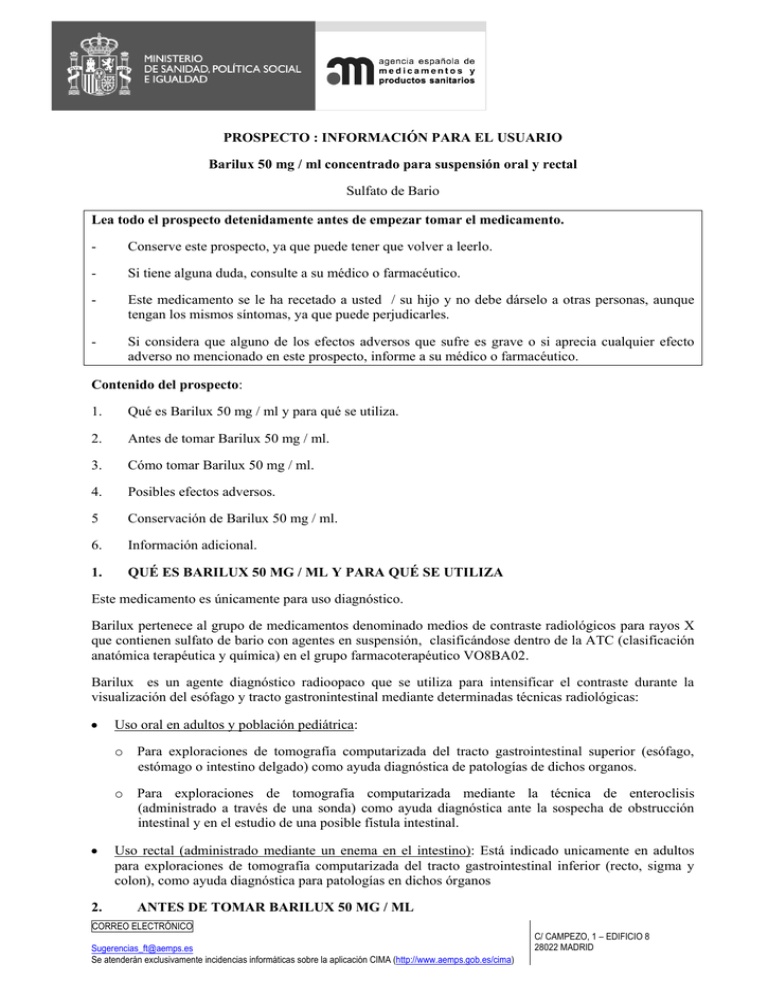
PACKAGE LEAFLET: INFORMATION FOR THE USER
Barilux 50 mg / ml concentrate for oral and rectal suspension
Barium sulfate
Read all of this leaflet carefully before you start taking this medicine.
|
Contents of the package leaflet:
- What Barilux 50 mg / ml is and what it is used for.
- Before taking Barilux 50 mg / ml.
- How to take Barilux 50 mg / ml.
- Possible side effects.
- Storage of Barilux 50 mg / ml.
- Further information.
1. What Barilux 50 mg/ml is and what it is used for
This medicinal product is for diagnostic use only.
Barilux belongs to a group of medicinal products called radiological contrast media for X-rays that contain barium sulfate with suspension agents, classified within the ATC (anatomical, therapeutic, and chemical) classification in the pharmacotherapeutic group VO8BA02.
Barilux is a radiopaque diagnostic agent used to enhance contrast during visualization of the esophagus and gastrointestinal tract using certain radiological techniques:
- Oral use in adults and pediatric population:
- For computed tomography scans of the upper gastrointestinal tract (esophagus, stomach, or small intestine) as a diagnostic aid for pathologies of these organs.
- For computed tomography scans using the enteroclysis technique (administered through a tube) as a diagnostic aid in cases of suspected intestinal obstruction and in the study of a possible intestinal fistula.
- Rectal use (administered through an enema): It is indicated only in adults for computed tomography scans of the lower gastrointestinal tract (rectum, sigma, and colon), as a diagnostic aid for pathologies in these organs.

2. Before taking Barilux 50 mg/ml
Do not take Barilux:
- if you are allergic (hypersensitive) to the active substance or to any of the other components of Barilux (by oral and rectal route).
- if you have inflammation of the abdominal cavity walls (irritated peritoneum) (by oral and rectal route).
- if you have or suspect you have a complete obstruction of the gastrointestinal tract (only for oral use).
- if you have pyloric stenosis (only for oral use).
- if you have or suspect you have a perforation of the gastrointestinal tract (by oral and rectal route).
- if you have postoperative gastrointestinal suture dehiscence (opening of the suture) (only for oral use).
- if you have a history of or suspect intestinal perforation (only for oral use).
- if you have intestinal fistulas (by oral and rectal route).
- if you have tracheoesophageal or bronchoesophageal fistulas (only for oral use).
- if you have recently suffered injuries or chemical burns in the gastrointestinal tract (by oral and rectal route).
- if you have insufficient blood supply (ischemia) to the intestinal wall (by oral and rectal route).
- if you have an inflammatory disease of the intestine called "necrotizing enterocolitis" (by oral and rectal route).
- if you are about to undergo gastrointestinal surgery (oral and rectal route).
- during the 7 days following an endoscopic resection (by oral and rectal route).
- during 4 weeks after concurrent radiotherapy (by oral and rectal route).
Special warnings and precautions for use
Special attention should be paid when administering Barilux:
- If you are an elderly person with diseases, mainly cardiovascular, as the examination can be stressful for you.
- If you have high-grade stenosis, especially the most distant (distal) from the stomach, or conditions and diseases with a high risk of perforation, such as fistulas and known gastrointestinal carcinomas, inflammatory bowel disease, diverticulitis (inflammation of a diverticulum), diverticulosis, and amoebiasis (infection caused by amoebas), as in these cases, a meticulous assessment of the benefit/risk is necessary.
During the radiological examination, the penetration of barium sulfate into parental areas such as tissues, vascular space, and body cavities or into the respiratory tract should be prevented to avoid potentially serious adverse reactions.
You should also ensure adequate hydration after the procedure to avoid severe constipation.
To avoid potentially serious adverse reactions, during the diagnostic process, the penetration of barium sulfate into areas outside the gastrointestinal tract (parenteral) such as tissues, vascular space, and body cavities or into the respiratory tract should be prevented.
In case of massive aspiration of the product, intravasation (penetration into blood vessels), or perforation, immediate specialized medical intervention, intensive care, or even surgery may be necessary.
During the radiological examination, barium sulfate may accumulate in colon diverticula, which may favor and/or aggravate infectious processes at this location.
In case barium sulfate coprolites (barioliths) form due to thickening of the barium sulfate, in this case, it is recommended to administer laxatives and/or saline purgatives (with salts or minerals).
Using other medicines
Tell your doctor or pharmacist if you are using or have recently used any other medicines, including those obtained without a prescription.
Certain medicines may interact with Barilux, in these cases, it may be necessary to change the dose or interrupt treatment with one of the medicines. It is especially important that you inform your doctor if you are using any of the following medicines:
- Medicines that reduce intestinal peristalsis (contractions in the form of a wave along the intestine): Taking these medicines may cause thickening of the barium sulfate suspension and increase the risk of constipation.
Pregnancy and breastfeeding
Consult your doctor or pharmacist before using any medicine.
It has not been sufficiently demonstrated that the use of barium contrast media in pregnant patients is safe. Radiological examinations should not be performed in pregnant women unless it is strictly necessary or when the benefit to the mother outweighs the risk to the fetus. In any case, given the teratogenic effects of radiation exposure during pregnancy, regardless of the use or not of a contrast agent, the benefit of the radiological examination should be carefully assessed.
The safety of Barilux in breastfeeding women has not been investigated. Contrast media are eliminated in breast milk in minimal amounts. No harm to the infant is expected, and your doctor will assess the benefit/risk before performing the examination.
The use of Barilux is not contraindicated during breastfeeding.
Driving and using machines
Barilux does not affect driving or the use of tools or machines.
Important information about some of the ingredients of Barilux
Barilux contains maltitol as an excipient. If your doctor has told you that you have an intolerance to certain sugars, consult with them before taking this medicine.
Patients on low-sodium diets should note that this medicine contains 1.89-2.00 mg of sodium (0.082-0.087 mmol) per 1 ml of concentrate for suspension.
Patients with renal insufficiency or on low-potassium diets should note that this medicine contains 0.89 mg (0.176 mmol) of potassium per 1 ml of concentrate for suspension.
3. How to take Barilux 50 mg/ml
Follow the administration instructions of Barilux indicated by your doctor. Consult your doctor or pharmacist if you have doubts.
The medical staff will administer Barilux orally or rectally (through an enema).
The doctor will determine the correct amount and administration schedule of the product required for your radiographic examination, depending on your age, weight, and the technique to be used.
In infants and children, the dose will be adjusted accordingly by the doctor based on the child's age, body weight, and the specific requirements of pediatric radiodiagnosis.
Consult your doctor if you wish to clarify the procedure for the examination. It is essential to follow your doctor's instructions once the examination is completed.
Preparation of the patient
You should drink plenty of water after the examination to reduce the risk of constipation.
Preparation of the patient for stomach examination:
If abundant acid secretion (acid stomach) is observed on an empty stomach, it is recommended, as far as possible, to aspirate the gastric secretion or perform the examination on another day (in the morning, as early as possible).
Some professionals use acid secretion inhibitors (which reduce the amount of acid produced in the stomach) before performing the computed tomography scan, with the aim of increasing the adherence of the contrast medium to the stomach walls. The administration of an additional antispasmodic (a medication intended to combat spasms, cramps, and convulsions) by intravenous or intramuscular route leads to a marked hypotonia (decrease in muscle tone) of the entire stomach, which significantly improves the result of the test and the patient's acceptance.
Preparation of the patient for examination using the enteroclysis technique:
The doctor may administer an additional antispasmodic by intravenous or intramuscular route, which decreases the tone of the intestine, reduces peristalsis (wave-like movement of the intestinal muscles), and delays the evacuation of the contrast, with the aim of improving the result of the test.
Preparation of the patient for pediatric use:
Newborns do not need to be fasting. Children from 1-24 months should be fasting from 4 hours before the test, 6 hours before for children from 2-4 years, and 8 hours before for children from 4-14 years, although in the latter case, they may drink a little water up to 3 hours before the study.
In small children, it is recommended not to provide the last meal to facilitate the ingestion of the contrast.
Preparation of the patient for rectal use of barium contrast:
To obtain a computed tomography scan of the large intestine, it is essential to perform a complete cleaning of the colon and eliminate mucus. In this case, it is recommended to administer laxatives of habitual use indicated especially for radiological preparation on the day before the test. From this moment on, the patient should take abundant liquid (approximately 2-3 liters), but only in the form of tea, water, vegetable soup, fruit juice, etc. Milk and alcohol should be avoided.
If necessary, a cleansing enema may be administered on the day of the radiological test to achieve a deep cleaning of the large intestine. At the time of the examination, the large intestine should be free of residues that affect the development of the radiological examination.
It is possible to administer acid secretion inhibitors before the test to increase the adherence of the contrast medium to the walls. The additional administration of an antispasmodic by intravenous or intramuscular route leads to a marked hypotonia of the entire colon, which significantly improves the result of the test and the patient's acceptance.
Patient with hepatic insufficiency:
No dose adjustment is necessary (see section 2: Special warnings and precautions for use).
Patient with renal insufficiency:
No dose adjustment is necessary (see section 2: Special warnings and precautions for use).
If you use more Barilux than you should
Rarely, repeated administration of barium sulfate suspensions may cause stomach spasms and diarrhea. These reactions are transient and are not considered serious.
In examinations where high doses of barium enema are administered, an alteration of the electrolyte balance in the blood serum may occur due to the large amount of water retained by the contrast. In these cases, the risk can be reduced by adding sodium chloride to the enema liquid. The electrolyte balance in the serum is restored through adequate infusion therapy.
In case of overdose or accidental ingestion, consult the Toxicology Information Service. Telephone 91.562.04.20.
If you forget to take Barilux
Do not take a double dose to make up for forgotten doses.
If you stop taking Barilux
If you have any further questions on the use of this product, ask your doctor or pharmacist.

4. Possible side effects
Like all medicines, Barilux can cause side effects, although not everybody gets them.
Serious adverse reactions, reported with the administration of barium sulfate formulations, are generally associated with a defective administration technique or pre-existing pathological conditions.
If you experience any of the side effects, or if you notice any side effects not mentioned in this leaflet, please tell your doctor or pharmacist.
Rare side effects(it is likely that they will affect between 1 and 10 in every 10,000 people)
- allergic reactions (urticaria, anaphylactic shock, skin rashes) (by oral and rectal route).
Very rare side effects(it is likely that they will affect less than 1 in every 10,000 people)
- intestinal perforation, which may be followed by peritonitis and granulomatosis (by rectal route).
- intravasation and embolization of barium (by oral and rectal route).
- bacteremia (by rectal route).
- formation of barium stones that can cause blockage of the large intestine (by oral and rectal route).
Side effects of unknown frequency
- Aspiration pneumonitis (oral route).
- Increased or intensified intestinal obstruction (oral and rectal route).
5. Storage of Barilux 50 mg/ml
Do not store above 25°C.
Keep out of the reach and sight of children.
Do not use Barilux after the expiry date stated on the packaging. The expiry date is the last day of the month indicated.
Medicines should not be disposed of via wastewater or household waste. Ask your pharmacist how to dispose of medicines no longer required. This will help protect the environment.
6. Further information
Composition of Barilux
- The active substance is barium sulfate. 1 ml of concentrate for suspension contains 50 mg of barium sulfate.
1 single-dose vial of 750 ml containing 150 ml of concentrate for suspension contains 7.5 g of barium sulfate.
1 multidose vial of 2000 ml with 2000 ml of concentrate for suspension contains 100 g of barium sulfate.
- The other ingredients are: xanthan gum, microcrystalline cellulose-carmellose sodium (85:15), maltitol, sodium citrate dihydrate, anhydrous citric acid, sodium saccharin, potassium sorbate, sodium benzoate, strawberry flavor, liquid, purified water.
Appearance and packaging of the product
Barilux is available in clinical packaging containing:
- 20 single-dose vials of 750 ml with 150 ml of concentrate for suspension each.
- 4 multidose vials of 2000 ml with 2000 ml of concentrate for suspension each.
Marketing authorization holder and manufacturer
Marketing authorization holder:
Iberoinvesa Pharma S.L. Calle Zurbarán 18, 6º. 28010. Madrid. Spain.
Manufacturer:
Lichtenheldt GmbH Industriestrasse 7-9 Justus-Liebig-Weg 1 D-23812 Wahlstedt. Germany.
For any information about this medicine, please contact the Marketing Authorization Holder:
This leaflet was approved in January 2011.
This information is intended only for healthcare professionals:
The complete technical data sheet of Barilux 50 mg / ml concentrate for oral and rectal suspensionis included as a detachable section at the end of this leaflet, in order to provide healthcare professionals with scientific and practical information on the administration and use of this medicine.
-

- Country of registration
- Dosage formORAL/RECTAL SOLUTION/SUSPENSION, 5 g barium sulfate per 100 ml of suspension
- ATC codeV08BA01
- Active substance
- Prescription requiredYes
- Manufacturer
- This information is for reference only and does not constitute medical advice. Always consult a doctor before taking any medication. Oladoctor is not responsible for medical decisions based on this content.
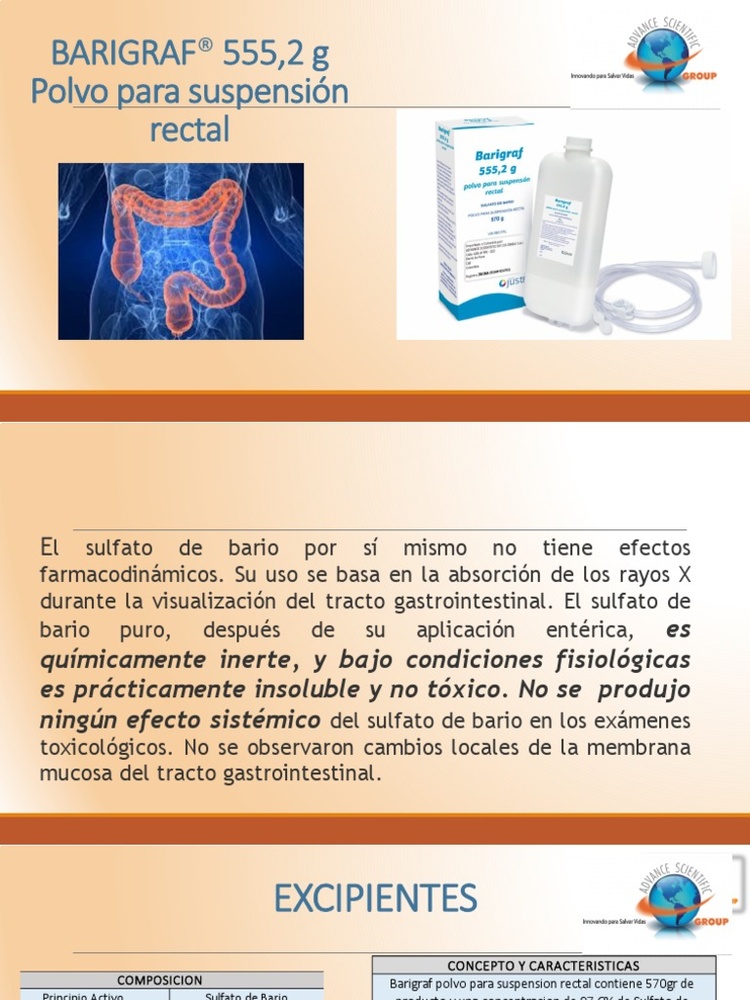
- Alternatives to BARILUX 50 mg/ml ORAL AND RECTAL SUSPENSION CONCENTRATEDosage form: RECTAL LIQUID, 97.4 gActive substance: barium sulfate with suspending agentsManufacturer: Laboratorios Ern S.A.Prescription requiredDosage form: ORAL SOLUTION/SUSPENSION, 98 gActive substance: barium sulfate with suspending agentsManufacturer: Laboratorios Ern S.A.Prescription requiredDosage form: ORAL SOLUTION/SUSPENSION, 10 g of barium sulfate per sachetActive substance: barium sulfate with suspending agentsManufacturer: Laboratorios Ern S.A.Prescription required

Online doctors for BARILUX 50 mg/ml ORAL AND RECTAL SUSPENSION CONCENTRATE
Discuss questions about BARILUX 50 mg/ml ORAL AND RECTAL SUSPENSION CONCENTRATE, including use, safety considerations and prescription review, subject to medical assessment and local regulations.









Get BARILUX 50 mg/ml ORAL AND RECTAL SUSPENSION CONCENTRATE Prescription Online
Fill in a 2-min form
Tell us your symptoms, history, and what medicine you're requesting.
Pick a doctor or let us assign
Choose a specialist or we'll match you with the next available doctor.
Doctor reviews your case
Usually within 30 minutes. They may ask follow-up questions via chat.
Collect from any pharmacy
Electronic prescription sent to your email — valid across Spain.
Frequently Asked Questions
BARILUX 50 mg/ml ORAL AND RECTAL SUSPENSION CONCENTRATE requires a prescription in Spain. You can check with a doctor online whether this medicine may be appropriate for your situation.
The active ingredient in BARILUX 50 mg/ml ORAL AND RECTAL SUSPENSION CONCENTRATE is barium sulfate with suspending agents. This information helps identify medicines with the same composition but different brand names.
BARILUX 50 mg/ml ORAL AND RECTAL SUSPENSION CONCENTRATE is manufactured by Iberoinvesa Pharma S.L.. Pharmacy brands and packaging may differ depending on the distributor.
Doctors such as Family doctors, Psychiatrists, Dermatologists, Cardiologists, Endocrinologists, Gastroenterologists, Pulmonologists, Nephrologists, Rheumatologists, Hematologists, Infectious disease physicians, Allergists, Geriatricians, Paediatricians, Oncologists may assess whether BARILUX 50 mg/ml ORAL AND RECTAL SUSPENSION CONCENTRATE is appropriate, depending on your situation and local regulations. You can book an online consultation to discuss your symptoms and possible next steps.
Spain has a well-developed healthcare infrastructure across major cities such as Madrid, Barcelona, Valencia, and Seville. Pharmacies are widely available and operate under strict regulations, ensuring access to prescribed medications.
You can buy BARILUX 50 mg/ml ORAL AND RECTAL SUSPENSION CONCENTRATE in Madrid, Barcelona, Seville, or Valencia at any local pharmacy with a valid prescription.
To obtain a prescription, you can use Oladoctor:
Other medicines with the same active substance (barium sulfate with suspending agents) include BARIGRAF 555.2 g POWDER FOR RECTAL SUSPENSION, BARIGRAF AD 333.2 g ORAL SUSPENSION POWDER, BARIGRAF TAC POWDER FOR ORAL SUSPENSION. These may have different brand names or formulations but contain the same therapeutic ingredient. Always consult a doctor before switching or starting a new medicine.
