



ATAMAX 18 mg Hard Capsules

Prescription review online
A doctor will review your case and decide whether a prescription is medically appropriate.

Talk to a doctor about this medicine
Discuss your symptoms and possible next steps in a quick online consultation.



How to use ATAMAX 18 mg HARD CAPSULES
Contents of the leaflet
- Introduction
- What is Atamax and what is it used for
- What you need to know before you take Atamax
- How to take Atamax
- Possible Adverse Effects
- Storage of Atamax
- Package Contents and Additional Information
Introduction
Package Leaflet:information for the user
Atamax 18 mg hard capsules EFG
atomoxetine
Read all of this leaflet carefully before you start taking this medicine because it contains important information for you..
- Keep this leaflet, you may need to read it again.
- If you have any further questions, ask your doctor or pharmacist.
- This medicine has been prescribed for you only. Do not pass it on to others. It may harm them, even if their signs of illness are the same as yours.
- If you get any side effects, talk to your doctor or pharmacist. This includes any possible side effects not listed in this leaflet. See section 4.
Contents of the pack
- What is Atamax and what is it used for
- What you need to know before you take Atamax
- How to take Atamax
- Possible side effects
- Storing Atamax
- Contents of the pack and other information
1. What is Atamax and what is it used for
What is it used for
Atamax contains atomoxetine and is used to treat Attention Deficit Hyperactivity Disorder (ADHD). It is used:
- in children from 6 years old
- in adolescents
- in adults
It is used only as part of a complete treatment program for ADHD which includes other non-medicine treatments, such as counseling or behavioral therapy.
It is not used to treat ADHD in children under 6 years old because the safety and efficacy in this age group have not been established.
In adults, this medicine is used to treat ADHD when the symptoms are very troublesome and affect work or social life and when symptoms of the disorder have been present since childhood.
How it works
This medicine increases the amount of noradrenaline in the brain. This is a naturally occurring chemical that increases attention and decreases impulsiveness and hyperactivity in patients with ADHD. This medicine has been prescribed to help control the symptoms of ADHD. This medicine is not a stimulant and therefore does not have the risk of dependence.
It may take a few weeks from the start of treatment for the medicine to start working.
About ADHD
Children and adolescents with ADHD find:
- it difficult to sit still
- it difficult to concentrate
This is not because they are not trying. Many children and adolescents without ADHD may have similar problems, but in ADHD these problems are much worse, and happen more often, making it difficult to manage daily life. Children and adolescents with ADHD may have difficulty learning and doing homework. They may have difficulty behaving well at home, in school or in other places. ADHD does not affect intelligence.
Adults with ADHD find it difficult to do all the things that children with ADHD find difficult, but for adults this may mean:
- problems at work
- problems with relationships
- low self-esteem
- problems with education

Not sure if this medicine is right for you?
Discuss your symptoms and treatment with a doctor online.
2. What you need to know before you take Atamax
Do not takeAtamax:
- if you are allergic to atomoxetine or any of the other ingredients of this medicine (listed in section 6).
- if you have taken a medicine called a monoamine oxidase inhibitor (MAOI), such as phenelzine, within the last two weeks. MAOIs are sometimes used for depression and other mental health conditions; taking Atamax with an MAOI could cause a serious reaction. You should also wait at least 14 days after you stop taking this medicine before taking an MAOI.
- if you have an eye problem called narrow-angle glaucoma (increased pressure in the eye).
- if you have serious heart problems that may get worse with an increase in heart rate and/or blood pressure, as this may be a side effect of Atamax.
- if you have serious blood vessel problems in the brain, such as a stroke, inflammation and weakening of the blood vessel wall (aneurysm) or narrowing or blockage of blood vessels.
- if you have a tumor of the adrenal gland (pheochromocytoma).
Do not take Atamax if any of the above applies to you. If you are not sure, consult your doctor or pharmacist before taking this medicine. The reason is that this medicine may make these problems worse.
Warnings and precautions
Both adults and children should be aware of the following warnings and precautions. Consult your doctor or pharmacist before starting treatment with Atamax if you:
- have serotonin syndrome
Serotonin syndrome is a potentially life-threatening condition that can occur when taking Atamax with other medicines (see section 2 "Other medicines and Atamax"). The signs and symptoms of serotonin syndrome can include a combination of the following: confusion, restlessness, lack of coordination, and rigidity, hallucinations, coma, rapid heartbeat, increased body temperature, rapid changes in blood pressure, sweating, flushing, tremors, hyperactive reflexes, nausea, vomiting, and diarrhea. Contact a doctor or go to the emergency department of the nearest hospital immediately if you think you are experiencing serotonin syndrome.
- the treatment with Atamax may make you feel aggressive, hostile or violent; or worsen these symptoms if they were present before treatment. It may also cause unusual changes in your behavior or mood (including physical aggression, threatening behavior, and thoughts of harming others). If you or your family and/or friends notice any of these reactions, talk to your doctor or pharmacist immediately.
- have suicidal thoughts or attempted suicide.
- have heart problems (including heart defects) or an increased heart rate. Atamax may increase your heart rate (pulse). There have been reports of sudden death in patients with heart defects.
- have high blood pressure. Atamax may increase your blood pressure.
- have low blood pressure. Atamax may cause dizziness or fainting in people with low blood pressure.
- have problems with sudden changes in your blood pressure or heart rate.
- have cardiovascular disease or a history of stroke.
- have liver problems. You may need a lower dose.
- have psychotic symptoms, including hallucinations (hearing voices or seeing things that are not real), believing things that are not true, or being suspicious.
- have mania (feeling elated or overexcited, leading to unusual behavior) and agitation.
- have aggression.
- have feelings of hostility and anger.
- have a history of epilepsy or have had seizures for any other reason. Atamax may increase the frequency of seizures.
- have mood swings or feelings of unhappiness.
- have repeated spasms that are difficult to control or repetition of sounds and words.
Talk to your doctor or pharmacist if you have any of the symptoms mentioned above before starting treatment. The reason is that Atamax may make these problems worse. Your doctor will want to monitor how the medicine affects you.
Tests your doctor will do before you start taking Atamax
These tests are to decide if Atamax is the right medicine for you.
Your doctor will measure your:
- blood pressure and heart rate (pulse) before and while you are taking Atamax
- weight and height if you are a child or adolescent while you are taking Atamax
Your doctor will ask you about:
- other medicines you are taking
- if you have a family history of sudden death
- any other medical problems (such as heart problems) that you or your family may have
It is important that you provide all the information you can. This will help your doctor decide if Atamax is the right medicine for you. Your doctor may decide that other medical tests are needed before starting treatment with this medicine.
Important information about the contents of the capsules
Do not open Atamax capsules because the contents of the capsule can irritate the eye. If the contents of the capsules come into contact with the eye, you should immediately wash the affected eye with water and consult a doctor. The hands and any other part of the body that may have come into contact with the contents of the capsule should also be washed as soon as possible.
Other medicines andAtamax
Tell your doctor or pharmacist if you are taking, have recently taken or might take any other medicines. This includes medicines that you buy without a prescription. Your doctor will decide if you can take Atamax with your other medicines and in some cases, your doctor may need to adjust your dose or increase your dose more slowly.
Do not take Atamax with medicines called MAOIs (monoamine oxidase inhibitors) used for depression. See section 2 "Do not take Atamax".
If you are taking other medicines, Atamax may affect how they work or cause side effects. If you are taking any of the following medicines, check with your doctor or pharmacist before taking Atamax.
Atamax may be affected by or affect other medicines. These include:
- certain antidepressants, opioids such as tramadol, and migraine medicines called triptans. These medicines can interact with Atamax and cause serotonin syndrome, a potentially life-threatening condition. (See section 2, Warnings and precautions, Serotonin syndrome).
- medicines that increase blood pressure or are used to control blood pressure
- medicines such as antidepressants, for example imipramine, venlafaxine, mirtazapine, fluoxetine, and paroxetine
- certain cough and cold remedies that contain medicines that can affect blood pressure. It is important that you check with your pharmacist when you buy these products.
- certain medicines used to treat mental health conditions
- medicines known to increase the risk of seizures
- certain medicines that make Atamax stay in the body longer than usual
(such as quinidine and terbinafine)
- salbutamol (a medicine for asthma) when taken by mouth or injected may cause a feeling that your heart is racing, but this will not make your asthma worse.
The medicines described below may increase the risk of an abnormal heart rhythm when taken with Atamax:
- medicines used to control heart rhythm
- medicines that alter the salt content of the blood
- medicines for the prevention and treatment of malaria
- certain antibiotics (such as erythromycin and moxifloxacin).
If you are not sure if the medicines you are taking are included in the list above, talk to your doctor or pharmacist before taking Atamax.
Pregnancy and breastfeeding
There is no information on whether this medicine can affect the unborn child or pass into breast milk.
- This medicine should not be taken during pregnancy unless your doctor recommends it.
- You should avoid taking this medicine if you are breastfeeding or stop breastfeeding.
If you are pregnant or breastfeeding, think you may be pregnant or are planning to have a baby, ask your doctor or pharmacist for advice before taking this medicine.
Driving and using machines
Atamax may cause you to feel tired, sleepy, or dizzy. Be careful while driving or using machines until you know how Atamax affects you. If you feel tired, sleepy, or dizzy, do not drive or use machines.
Atamax contains sodium
This medicine contains less than 23 mg of sodium (1 mmol) per capsule; this is essentially "sodium-free".
3. How to take Atamax
- Always take this medicine exactly as your doctor or pharmacist has told you. If you are not sure, check with your doctor or pharmacist. The recommended dose is once or twice daily (morning and late afternoon or early evening).
- Children should not take this medicine without the help of an adult.
- If you are taking Atamax once daily and feel sleepy or feel sick, your doctor may change your treatment schedule to twice daily.
- Take by mouth.
- The capsules should be swallowed whole, with or without food.
- The capsules should not be opened and the contents of the capsules should not be removed or taken in any other way.
- Taking the medicine at the same time each day can help you remember to take it.
How much to take
If you are a child (from 6 years old) or an adolescent:
Your doctor will tell you how much Atamax to take and will calculate it according to your weight. Normally, your doctor will start you on a lower dose and then increase the amount of Atamax according to your weight.
- Body weight up to 70 kg: starting with a total daily dose of 0.5 mg per kg of body weight for a minimum of 7 days. Your doctor will then decide if the dose should be increased to the usual maintenance dose of 1.2 mg per kg of body weight per day.
- Body weight over 70 kg: starting with a total daily dose of 40 mg for a minimum of 7 days. Your doctor will then decide if the dose should be increased to the usual maintenance dose of 80 mg per day. The maximum daily dose that your doctor will prescribe is 100 mg.
Adults
- Treatment with Atamax should be started with a total daily dose of 40 mg for a minimum of 7 days. Your doctor will then decide if the dose should be increased to the usual maintenance dose of 80-100 mg per day. The maximum daily dose that your doctor will prescribe is 100 mg.
If you have liver problems, your doctor may prescribe a lower dose.
What your doctor will do while you are taking Atamax
Your doctor will do some tests
- before you start - to make sure that Atamax is safe and will be of benefit to you.
- after you have started - the tests will be done at least every 6 months, although they may be more frequent.
The tests will also be done when the dose is changed. These tests will include:
- measuring height and weight in children and adolescents.
- measuring blood pressure and heart rate.
- checking if you have any problems or if side effects have worsened while taking Atamax.
Long-term treatment
Atamax does not need to be taken indefinitely. If you take Atamax for more than a year, your doctor should review your treatment to see if the medicine is still needed.
If you take moreAtamaxthan you shouldcontact your doctor or the emergency department of the nearest hospital immediately and tell them how many capsules you have taken. The most commonly reported symptoms after an overdose are gastrointestinal symptoms, sleepiness, dizziness, tremors, and abnormal behavior. Very rarely, serotonin syndrome, a potentially life-threatening condition, has also been reported. (See section 2, Warnings and precautions, Serotonin syndrome).
In case of overdose or accidental ingestion, consult your doctor or pharmacist immediately or call the Toxicology Information Service, telephone 91 562 04 20, indicating the medicine and the amount taken.
If you forget to take Atamax
If you miss a dose, take another as soon as you remember, but do not take more than the total daily dose in a 24-hour period. Do not take a double dose to make up for missed doses.
If you stop taking Atamax
If you stop taking Atamax, you will not normally get any side effects, but the symptoms of ADHD may return. You should talk to your doctor before stopping treatment.
If you have any questions about the use of this medicine, ask your doctor or pharmacist.

Started taking the medicine and have questions?
Discuss your symptoms and treatment with a doctor online.
4. Possible Adverse Effects
Like all medicines, this medicine can cause adverse effects, although not all people suffer from them. Although some people suffer from adverse effects, most people consider that Atamax helps them. Your doctor will talk to you about these adverse effects.
Some adverse effects could be serious. If you experience any of the following effects, contact your doctor immediately.
Uncommon(may affect up to 1 in 100 people)
- feeling or having a very fast heart rate, abnormal heart rhythm
- suicidal thoughts or feelings
- feeling aggressive
- feeling of hostility or anger
- mood swings or changes in mood
- severe allergic reaction with symptoms of:
- swelling of the face and throat
- difficulty breathing
- hives (itchy, raised, red patches)
- seizures
- psychotic symptoms including hallucinations (hearing voices or seeing things that do not exist), believing things that are not true, or being suspicious.
Children and adolescents under 18 years of age are at higher risk of suffering from adverse effects such as:
- suicidal thoughts or feelings (may affect up to 1 in 100 people)
- mood swings or changes in mood (may affect up to 1 in 10 people)
Adults have a lower risk(may affect up to 1 in 1,000 people) of suffering from adverse effects such as:
- seizures
- psychotic symptoms including hallucinations (such as hearing voices or seeing things that do not exist), believing things that are not true, or being suspicious
Rare(may affect up to 1 in 1,000 people)
- liver problems
Stop treatment with Atamax and contact your doctor immediately if you experience any of the following adverse effects:
- dark urine
- yellowing of the skin and eyes
- abdominal pain when pressed (tenderness) in the upper right part of the abdomen, just below the ribs
- unexplained nausea
- fatigue
- itching
- feeling of having a cold
Other reported adverse effects are as follows. If any of them worsen, consult your doctor or pharmacist.
Adverse effects very common(may affect more than 1 in 10 people) | |
CHILDREN over 6 years and ADOLESCENTS | ADULTS |
These effects may disappear over time in most patients. |
|
Adverse effects common(may affect up to 1 in 10 people) | |
CHILDREN over 6 years and ADOLESCENTS | ADULTS |
|
|
Adverse effects uncommon(may affect up to 1 in 100 people) | |
CHILDREN over 6 years and ADOLESCENTS | ADULTS |
(prolongation of the QT interval)
|
|
Adverse effects rare(may affect up to 1 in 1,000 people) | |
CHILDREN over 6 years and ADOLESCENTS | ADULTS |
|
|
Adverse effects of unknown frequency |
CHILDREN over 6 years and ADOLESCENTS |
|
Effects on Growth
Some children experience decreased growth (weight and height) when they start taking Atamax. However, with long-term treatment, children recover the expected weight and height for their age group. Your doctor will monitor your child's height and weight over time. If your child is not growing or gaining weight as expected, your doctor may change the dose of Atamax or decide to temporarily suspend treatment with Atamax.
Reporting Adverse Effects
If you experience any type of adverse effect, consult your doctor or pharmacist, even if it is a possible adverse effect that is not listed in this prospectus. You can also report them directly through the Spanish Pharmacovigilance System for Human Use Medicines: https://www.notificaram.es. By reporting adverse effects, you can contribute to providing more information on the safety of this medicine.
5. Storage of Atamax
Keep this medicine out of the sight and reach of children.
Do not use this medicine after the expiration date stated on the packaging and on the blister pack after the abbreviation "CAD". The expiration date is the last day of the month indicated.
This medicine does not require special storage conditions.
Medicines should not be disposed of via wastewater or household waste. Deposit the packaging and medicines you no longer need at the SIGRE collection point in your pharmacy. If in doubt, ask your pharmacist how to dispose of the packaging and medicines you no longer need. This will help protect the environment.
6. Package Contents and Additional Information
Composition of Atamax
- The active ingredient is atomoxetine.
Each hard capsule contains 18 mg of atomoxetine, equivalent to 20.57 mg of atomoxetine hydrochloride.
- The other ingredients are
Capsule content:pregelatinized corn starch, anhydrous colloidal silica, and dimethicone.
Capsule shell:gelatin, sodium lauryl sulfate (E487), titanium dioxide (E171), yellow iron oxide (E-172), and purified water.
- Printing ink (black) composed of: Shellac Glaze-45% (20% esterified) in ethanol, black iron oxide (E172), and propylene glycol.
Appearance of the Product and Package Contents
Hard gelatin capsule containing white powder, size 3 (length of 15.7±0.4 mm), with a white opaque cap with '18' printed in black ink and a white opaque body with 'mg' printed in black ink.
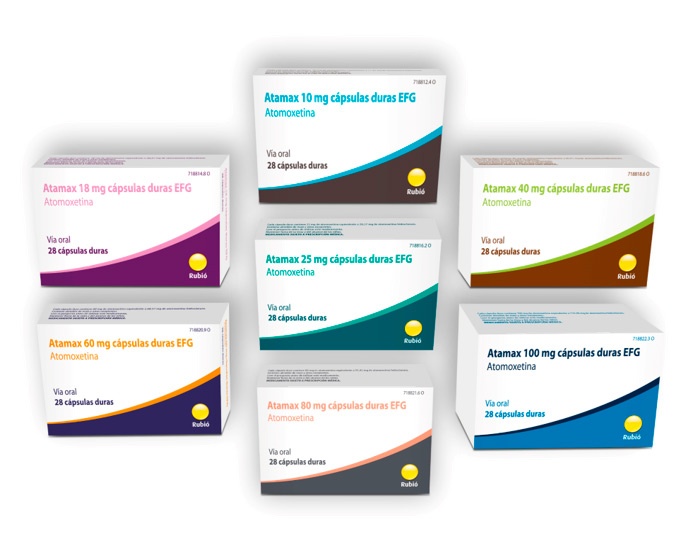
Atamax is presented in blister packs in a cardboard box.
Available in packs of 7, 14, 28, and 56 hard capsules.
Not all pack sizes may be marketed.
Marketing Authorization Holder and Manufacturer
Marketing Authorization Holder:
LABORATORIOS RUBIÓ, S.A.
Industria, 29
Pol. Ind. Comte de Sert
08755 Castellbisbal
Barcelona – Spain
Manufacturer:
Pharmathen International S.A.
Industrial Park Sapes, Rodopi Prefecture, Block No.5
69300 Rodopi
Greece
or
Pharmathen S.A.
6, Dervenakion Str
15351 Pallini Attikis
Greece
This medicine is authorized in the Member States of the European Economic Area with the following names:
Austria Atomoxetin Pharmathen 18 mg hard capsules
Greece ATAMA καψ?κιο σκληρ? 18 mg
Germany ATAMA 18 mg hard capsules
Spain Atamax 18 mg hard capsules EFG
Date of the Last Revision of thisProspectus:November 2024
Detailed information about this medicine is available on the website of the Spanish Agency for Medicines and Health Products (AEMPS) (http://www.aemps.gob.es/)
- Country of registration
- Dosage formCAPSULE, 18 mg
- ATC codeN06BA09
- Average pharmacy price44.58 EUR
- Availability in pharmaciesSupply issue reported
- Active substance
- Prescription requiredYes
- Manufacturer
- This information is for reference only and does not constitute medical advice. Always consult a doctor before taking any medication. Oladoctor is not responsible for medical decisions based on this content.
- Alternatives to ATAMAX 18 mg HARD CAPSULESDosage form: CAPSULE, 10 mgActive substance: atomoxetineManufacturer: Laboratorios Rubio S.A.Prescription requiredDosage form: CAPSULE, 100 mgActive substance: atomoxetineManufacturer: Laboratorios Rubio S.A.Prescription requiredDosage form: CAPSULE, 25 mgActive substance: atomoxetineManufacturer: Laboratorios Rubio S.A.Prescription required
Online doctors for ATAMAX 18 mg HARD CAPSULES
Discuss questions about ATAMAX 18 mg HARD CAPSULES, including use, safety considerations and prescription review, subject to medical assessment and local regulations.









Get ATAMAX 18 mg HARD CAPSULES Prescription Online
Fill in a 2-min form
Tell us your symptoms, history, and what medicine you're requesting.
Pick a doctor or let us assign
Choose a specialist or we'll match you with the next available doctor.
Doctor reviews your case
Usually within 30 minutes. They may ask follow-up questions via chat.
Collect from any pharmacy
Electronic prescription sent to your email — valid across Spain.
Frequently Asked Questions
ATAMAX 18 mg HARD CAPSULES requires a prescription in Spain. You can check with a doctor online whether this medicine may be appropriate for your situation.
The active ingredient in ATAMAX 18 mg HARD CAPSULES is atomoxetine. This information helps identify medicines with the same composition but different brand names.
The average pharmacy price for ATAMAX 18 mg HARD CAPSULES is around 44.58 EUR. Prices may vary depending on the manufacturer and dosage form.
ATAMAX 18 mg HARD CAPSULES is manufactured by Laboratorios Rubio S.A.. Pharmacy brands and packaging may differ depending on the distributor.
Doctors such as Family doctors, Psychiatrists, Dermatologists, Cardiologists, Endocrinologists, Gastroenterologists, Pulmonologists, Nephrologists, Rheumatologists, Hematologists, Infectious disease physicians, Allergists, Geriatricians, Paediatricians, Oncologists may assess whether ATAMAX 18 mg HARD CAPSULES is appropriate, depending on your situation and local regulations. You can book an online consultation to discuss your symptoms and possible next steps.
Spain has a well-developed healthcare infrastructure across major cities such as Madrid, Barcelona, Valencia, and Seville. Pharmacies are widely available and operate under strict regulations, ensuring access to prescribed medications.
You can buy ATAMAX 18 mg HARD CAPSULES in Madrid, Barcelona, Seville, or Valencia at any local pharmacy with a valid prescription.
To obtain a prescription, you can use Oladoctor:
Other medicines with the same active substance (atomoxetine) include ATAMAX 10 mg HARD CAPSULES, ATAMAX 100 mg HARD CAPSULES, ATAMAX 25 mg HARD CAPSULES. These may have different brand names or formulations but contain the same therapeutic ingredient. Always consult a doctor before switching or starting a new medicine.
