


Articaina Normon 40 mg/ml + 10 micrograms/ml injectable solution

Prescription request online
A doctor will review your case and decide whether a prescription is medically appropriate.

Talk to a doctor about this medicine
Discuss your symptoms and possible next steps in a quick online consultation.



How to use ARTICAINE/EPINEPHRINE NORMON 40 mg/mL + 10 micrograms/mL Injectable Solution
Contents of the leaflet
- Introduction
- What Articaine/Epinephrine Normon is and what it is used for
- What you need to know before starting to use Articaine/Epinephrine Normon
- How to use Articaine/Epinefrina Normon
- Possible side effects
- Storage of Articaine/Epinefrina Normon
- Package contents and additional information
Introduction
Leaflet: Information for the Patient
Articaine/Epinephrine Normon40mg/ml + 10micrograms/mlinjectable solution EFG
articaine hydrochloride/epinephrine (adrenaline)
Read the entire leaflet carefully before starting to use this medication, as it contains important information for you.
- Keep this leaflet, as you may need to read it again.
- If you have any doubts, consult your dentist, doctor, or pharmacist.
- If you experience side effects, consult your dentist, doctor, or pharmacist, even if they are side effects not listed in this leaflet. See section 4.
Contents of the Leaflet
- What Articaine/Epinephrine Normon is and what it is used for
- What you need to know before starting to use Articaine/Epinephrine Normon
- How to use Articaine/Epinefrine Normon
- Possible side effects
- Storage of Articaine/Epinephrine Normon
- Package contents and additional information
1. What Articaine/Epinephrine Normon is and what it is used for
Articaine/Epinephrine Normon is a local anesthetic (a medication used to numb a specific area) for use in dentistry. It contains the local anesthetic articaine, as well as epinephrine (adrenaline). Epinephrine constricts the blood vessels at the injection site, leading to local ischemia in the area, as well as prolonging the effect of the local anesthetic.
Articaine/Epinephrine Normon is used for infiltration anesthesia and nerve block anesthesia before dental treatments. This includes:
- Surgical interventions in the mucous membrane and bone tissue that require stronger ischemia.
- Surgical interventions in the pulp (amputation and extraction).
- Extraction of impacted or fractured teeth (osteotomy).
- Longer surgical procedures.
- Percutaneous osteosynthesis.
- Cystectomy.
- Mucogingival procedures.
- Root apex resection.

Not sure if this medicine is right for you?
Discuss your symptoms and treatment with a doctor online.
2. What you need to know before starting to use Articaine/Epinephrine Normon
Do not use Articaine/Epinephrine Normon
- If you are allergic to articaine or other local anesthetics of the amide type.
- If you are allergic to epinephrine or any of the other components of this medication (listed in section 6).
- If you have severe cardiac arrhythmias (e.g., second- and third-degree AV block).
- If you have a very low pulse.
- If you have congestive heart failure (acute cardiac weakness, e.g., unexpected chest pain at rest or after a myocardial injury [e.g., heart attack]).
- If you have very low blood pressure.
- If you have bronchial asthma and are sensitive to sulfite (sulfite-induced asthma attacks).
- If you have uncontrolled epilepsy.
Due to the effects of the active ingredient epinephrine, articaine/epinephrine should not be used:
- If you have elevated intraocular pressure (glaucoma).
- If you have hyperthyroidism.
- If you have paroxysmal tachycardia (episodes of rapid heart rate).
- If you have a specific type of cardiac arrhythmia (absolute arrhythmia with rapid and irregular heartbeat).
- If you have had a heart attack in the last 3 or 6 months.
- If you have had a coronary bypass in the last 3 months.
- If you are taking certain beta-blockers (e.g., propranolol), there is a risk of developing a crisis of high blood pressure or severe bradycardia.
- If you have pheochromocytoma (a tumor that produces adrenaline, usually found in the adrenal medulla).
- If you have very high blood pressure.
- If you are being treated simultaneously with certain antidepressants and antiparkinsonian medications (tricyclic antidepressants or MAO inhibitors), as these active ingredients can increase the cardiovascular effects of epinephrine; this may apply up to 14 days after finishing treatment with MAO inhibitors.
Articaine/epinephrine cannot be administered intravenously (into a vein).
Due to the epinephrine content, Articaine/Epinephrine Normon is not indicated for anesthesia of the distal phalanx of the limbs (e.g., fingers and toes) because there is a risk of blocking local blood flow.
Warnings and Precautions
Consult your dentist or pharmacist before starting to use Articaine/Epinephrine Normon:
- If you have a deficiency of a specific enzyme (cholinesterase deficiency), as a prolonged and sometimes increased effect of articaine/epinephrine can be expected.
- If you have inflammation or infection of the injection site. In this case, an increased absorption of articaine/epinephrine can be anticipated, which reduces efficacy.
- If you are over 70 years old.
- If you have reduced oxygen levels in the body tissue (hypoxia), elevated potassium levels in the blood (hyperkalemia), and metabolic disorders due to excess acid in the blood (metabolic acidosis).
Articaine/Epinephrine Normon should only be used after a thorough medical examination:
- If you have coagulation disorders.
- If you have kidney function disorders (e.g., nephritis).
- If you have liver function disorders (e.g., liver cirrhosis).
- If you are receiving other local anesthetics simultaneously, i.e., medications that cause reversible loss of sensitivity, including inhalation anesthetics such as halothane (see "Other medications and Articaine/Epinephrine Normon").
- If you have epilepsy (see section 4).
- If you are taking medications called platelet aggregation inhibitors or coagulation inhibitors to prevent constriction and/or hardening of blood vessels in the arms and legs.
- If you have low blood pressure.
- If you have a disease called myasthenia gravis that causes muscle weakness.
- If you have a disease called porphyria that causes neurological complications or skin problems.
- In case of reduced oxygen levels in the body tissue (hypoxia), elevated potassium levels in the blood (hyperkalemia), and metabolic disorders due to excess acid in the blood (metabolic acidosis).
If you have the following diseases, then Articaine/Epinephrine Normon 40 mg/ml + 10 micrograms/ml should only be used after a thorough examination by a doctor, and your dentist should consider the option of administering Articaine/Epinephrine Normon 40 mg/ml + 5 micrograms/ml instead of Articaine/Epinephrine Normon 40 mg/ml + 10 micrograms/ml due to the lower epinephrine content:
- Cardiovascular disorders, such as:
- Heart failure (cardiac weakness).
- Coronary artery disease (constriction of the coronary arteries).
- Angina pectoris (disruption of blood flow to the heart with chest pain and pressure).
- After a heart attack.
- Cardiac arrhythmias (irregular heart rate).
- High blood pressure.
- Arteriosclerosis (narrowing of the arteries due to deposits, e.g., of blood lipids).
- Disruption of blood flow to the brain.
- After a stroke.
- Chronic bronchitis, emphysema (abnormal dilation of the lungs).
- Diabetes mellitus.
- Severe anxiety disorder.
Your dentist will review your medical history:
- And the medication you are taking simultaneously to prevent side effects.
- Will perform a test injection in case of a risk of allergy to the medication.
- Will select the minimum possible dose.
- And will carefully check before the injection that no blood vessel has been hit.
The use of this medication can lead to prolonged numbness of the mouth area after dental treatment. In small children, caution should be exercised to prevent them from biting themselves, as this can lead to soft tissue injuries.
After using articaine/epinephrine, do not eat until the local anesthesia has worn off.
Other medications and Articaine/Epinephrine Normon
Tell your dentist or pharmacist if you are taking/using, have recently taken/used, or might take/use any other medication.
It is especially important to inform your dentist if you are taking/using any of the following medications:
- Sedatives (with a central sedative effect, e.g., benzodiazepines, opioids), for example, to reduce anxiety due to the dental appointment.
- Tricyclic antidepressants for treating depression (such as amitriptyline, desipramine, imipramine, nortriptyline, maprotiline, and protriptiline), COMT inhibitors for treating Parkinson's disease (such as entacapone or tolcapone).
- MAO inhibitors for treating depressive or anxiety disorders (e.g., moclobemide, phenelzine, tranylcypromine, linezolid).
- Medications for treating cardiac arrhythmias (e.g., digitalis, quinidine).
- Medications for migraine attacks (such as methysergide or ergotamine).
- Medications for the heart and blood pressure (such as guanadrel, guanethidine, propranolol, nadolol).
- Vasoconstrictors (such as cocaine, amphetamines, phenylephrine, pseudoephedrine, oxymetazoline) to increase blood pressure: If they have been used in the last 24 hours, then the scheduled dental treatment should be postponed.
- Neuroleptics (e.g., phenothiazine).
If you are receiving other local anesthetics simultaneously, their effects on the cardiovascular and nervous systems may increase.
Articaine/Epinephrine Normon contains the active ingredient epinephrine. This active substance constricts blood vessels and increases blood pressure. The hypertensive effect of epinephrine can be intensified by other medications for treating depression and Parkinson's disease. Tricyclic antidepressants and MAO inhibitors should not be taken at the same time (please see section 2 "What you need to know before starting to use Articaine/Epinephrine Normon").
If you are taking certain beta-blockers (e.g., propranolol), then articaine/epinephrine should not be administered (see section "Do not use Articaine/Epinephrine Normon").
Epinephrine can inhibit the release of insulin from the pancreas, reducing the efficacy of oral antidiabetic medications.
If articaine/epinephrine is used simultaneously with certain inhalation anesthetics (e.g., halothane), this can trigger cardiac arrhythmias.
Please note: In patients treated with coagulation inhibitors ("anticoagulants" such as heparin or acetylsalicylic acid), an accidental puncture of a blood vessel when administering local anesthetics can cause severe bleeding; furthermore, these patients have a high tendency to bleed in general.
Using Articaine/Epinephrine Normon with food
After the intervention, avoid eating and chewing gum until you have regained normal sensitivity; otherwise, there is a risk of biting your lips, cheeks, or tongue. This applies especially to children.
Pregnancy and breastfeeding
If you are pregnant or breastfeeding, think you may be pregnant, or plan to become pregnant, consult your dentist or doctor before using this medication.
If you are pregnant, your dentist should use articaine/epinephrine only after a thorough assessment of the risks and benefits.
As for the use of articaine, there is no documented experience during pregnancy, except at the time of birth. Experimental studies in animals have shown that epinephrine at doses higher than those used in dental anesthesia has had adverse effects on the creatures. After accidental injection of articaine/epinephrine into a mother's blood vessel, epinephrine can lead to reduced blood flow to the uterus.
If you are pregnant, then Articaine/Epinephrine Normon 40 mg/ml + 5 micrograms/ml should be preferred over Articaine/Epinephrine Normon 40 mg/ml + 10 micrograms/ml, as the former contains less epinephrine.
The active substances of Articaine/Epinephrine Normon are rapidly broken down in the body. Consequently, no harmful amounts of the active substances are transferred to the baby through breast milk. Therefore, during short-term use of articaine/epinephrine, it is not necessary to interrupt breastfeeding. Breastfeeding can be resumed 5 hours after anesthesia.
In the doses used for dental treatment, no negative effects on reproductive capacity are expected.
Driving and using machines
After the intervention, your dentist will decide when you are allowed to actively participate in road travel or operate machines. In the relevant studies, local anesthesia with articaine did not cause any detectable impairment of normal driving ability.
If you experience side effects such as dizziness, vision problems, or fatigue, then you should not drive vehicles or operate machines until you feel better again (usually within 30 minutes after dental treatment).
Use in athletes
This medication contains epinephrine, which can produce a positive result in doping tests.
Articaine/Epinephrine Normon contains sodium
This medication contains less than 1 mmol of sodium (23 mg) per cartridge; i.e., it is essentially "sodium-free".
Articaine/Epinephrine Normon contains metabisulfite sodium (E233)
Rarely, it can cause severe hypersensitivity reactions and bronchospasm.
If there is a risk of an allergic reaction, your dentist will choose another anesthetic.
3. How to use Articaine/Epinefrina Normon
Only doctors and dentists are trained to use Articaine/Epinefrina Normon.
Your dentist will choose between Articaine/Epinefrina Normon 40 mg/ml + 5 micrograms/ml and Articaine/Epinefrina Normon 40 mg/ml + 10 micrograms/ml, and determine the appropriate dose considering your age, weight, general health, and dental procedure.
The lowest dose that is sufficient for effective anesthesia (numbness) should be used.
This medication is administered by slow injection into the oral cavity.
Your dentist decides the dosage and method of application of Articaine/Epinefrina Normon. They will generally follow these recommendations:
Dose
For the extraction of uncomplicated upper teeth in a non-inflamed stage, an injection of 1.7 ml per tooth is usually sufficient. In some cases, a subsequent injection of 1 to 1.7 ml may be necessary to achieve complete local numbness. In most cases, a painful injection into the gums is not required.
If a cut or stitch in the gum is necessary, an injection of approximately 0.1 ml per puncture is sufficient.
For the extraction of a row of adjacent teeth, the full dose of articaine/epinefrina is usually not necessary. The number of injections can usually be reduced.
For extractions with a straight forceps of lower premolars in a non-inflamed stage, as a rule, an injection of 1.7 ml per tooth is sufficient. If complete effectiveness is still not achieved after this, your dentist may perform a subsequent injection of 1 to 1.7 ml. Only if complete anesthesia is still not achieved, your dentist may perform a mandibular nerve block (mandibular anesthesia), which is common in these cases.
For oral surgery, your dentist will individually adjust the dose of articaine/epinefrina according to the severity and duration of the intervention.
During treatment, adults may be administered up to 7 mg of articaine per kilogram of body weight. Amounts up to 500 mg (corresponding to 12.5 ml of injectable solution) are usually well tolerated.
Older adults and patients with severe hepatic and renal impairment
In older adults and patients with severe hepatic and renal impairment (e.g., nephritis or liver cirrhosis), high levels of articaine may occur in the plasma. If you are among these patients, your dentist should take special care to use the smallest amount of anesthesia sufficient.
Use in children and adolescents
If Articaine/Epinefrina Normon is used in children, the minimum volume necessary for sufficient anesthesia should be used. The injection dose should be determined individually, considering the child's age and weight. The maximum dose should not exceed 7 mg of articaine per kilogram of body weight (0.175 ml/kg).
This medication has not been studied in children under 1 year of age.
Method of use
Articaine/Epinefrina Normon is intended for use in the oral cavity.
To prevent infections (e.g., transmission of hepatitis), new and sterile syringes and needles should always be used for each injection.
To avoid intravascular injection, a two-level aspiration test should generally be performed before injection, i.e., by rotating the needle 90° or even better 180°. When using cylindrical ampoules, Uniject® K or Uniject® K vario are especially suitable for this purpose. The injection pressure should be adjusted to the sensitivity of the tissue.
Warnings
Adequate functioning and optimal protection against glass breakage are ensured by using suitable injection supports (infiltration anesthesia: Uniject® K or Uniject® K vario; intraligamentary anesthesia: Ultraject®). Damaged cylindrical ampoules cannot be used for injection.
For single use. Unused solution should be discarded.
The solution should be transparent and colorless. If it is discolored or turbid, the medication should not be used.
If you use more Articaine/Epinefrina Normon than you should
It is unlikely that you will be administered too much of this injection, but if you start to feel unwell, inform your dentist. Symptoms of overdose include intense weakness, paleness of the skin, headache, feeling of agitation or restlessness, feeling of disorientation, loss of balance, tremors or involuntary twitching, pupil dilation, blurred vision, difficulty focusing clearly on an object, speech disorders, dizziness, convulsions, stupor, loss of consciousness, coma, yawning, abnormally slow or rapid breathing that could lead to temporary interruption of breathing, cardiac failure to contract effectively (called cardiac arrest).
In case of overdose or accidental ingestion, consult your dentist, doctor, pharmacist, or call the Toxicology Information Service, phone: 91 562 04 20, indicating the medication and the amount ingested.
If you have further questions about the use of this medication, contact your dentist, doctor, or pharmacist.

Started taking the medicine and have questions?
Discuss your symptoms and treatment with a doctor online.
4. Possible side effects
Like all medications, this medication can cause side effects, although not everyone will experience them.
While you are in your dentist's office, your dentist will closely monitor the effects of Articaine/Epinefrina Normon.
Tell your dentist, doctor, or pharmacist immediately if you notice one of the following serious side effects:
- Swollen face, tongue, or throat, difficulty swallowing, urticaria, or difficulty breathing (angioedema).
- Rash, itching, swelling of the neck, and difficulty breathing: These can be symptoms of an allergic reaction (hypersensitivity).
- A combination of drooping eyelid and constriction of the pupils (Horner's syndrome).
These side effects are rare (may affect up to 1 in 1,000 people).
However, in some patients, other side effects may occur that have not been mentioned above.
Frequent (may affect up to 1 in 10 people)
- Gingivitis.
- Nausea.
- Vomiting.
- Unpleasant sensations (paresthesias).
- Neuropathic pain (pain due to nerve damage).
- Metallic taste, taste distortions, or loss of taste.
- Reduced sensitivity in the mouth or facial area (hypesthesia).
- Headache.
- Increased tactile perception, unpleasant or unusual.
- Increased sensitivity to heat.
- Abnormally rapid heartbeat.
- Abnormally slow heartbeat.
- Low blood pressure.
- Swelling of the tongue, lips, and gums.
Infrequent (may affect up to 1 in 100 people)
- Dizziness.
- Burning sensation.
- High blood pressure.
- Inflammation of the tongue and mouth.
- Diarrhea.
- Rash, itching.
- Pain in the neck or pain at the injection site.
Rare (may affect up to 1 in 1,000 people)
- Reactions of hypersensitivity (allergic or hypersensitivity-like reactions) may occur. They can manifest as swelling and/or inflammation at the injection site. Hypersensitivity reactions that are not limited to the injection site manifest as:
- Redness.
- Itching.
- Red, watery eyes.
- Rhinorrhea.
- Facial swelling (angioedema) with swelling of the upper and/or lower lip and/or cheeks.
- Swelling in the throat area with oppression and difficulty swallowing.
- Hives.
- Difficulty breathing, even up to anaphylactic shock.
- Nervousness, anxiety states.
- Facial nerve disorders (facial paralysis).
- Somnolence.
- Involuntary eye movement.
- During or shortly after the injection of local anesthetics in the head area, vision problems (blurred vision, double vision, dilated pupils, blindness) may occur. These are usually transient.
- Drooping eyelid and constriction of the pupils (Horner's syndrome).
- Sinking of the eyeball into the orbit due to a change in the volume of the orbit (enoftalmos).
- Tinnitus, hypersensitivity of hearing.
- Palpitations.
- Hot flashes.
- Wheezing (bronchial spasms), asthma.
- Difficulty breathing.
- Scaling and ulceration of the gums.
- Scaling at the injection site.
- Hives (urticaria).
- Muscle spasms, involuntary muscle contractions.
- Fatigue, weakness.
- Chills.
Very rare (may affect up to 1 in 10,000 people)
- Persistent loss of sensitivity, extensive numbness, and loss of taste.
Frequency not known (cannot be estimated from available data)
- Redness of the skin (erythema).
- Extreme euphoria.
- Disorders of the heart's conduction system (conduction disorders, AV block).
- Cardiac arrhythmias, heart failure, and shock (sometimes potentially fatal).
- Depending on the dose (especially in too high doses or in the case of an accidental injection into a blood vessel), disorders of the central nervous system, e.g.,
- Restlessness, nervousness.
- Lethargy, drowsiness, even up to loss of consciousness, coma.
- Respiratory disorders up to respiratory arrest.
- Muscle tremors, muscle spasms up to convulsions.
- Nerve damage (e.g., facial nerve damage) may occur during any dental intervention and therefore cannot be ruled out. It is caused by the course of the nerves through the injection area or by incorrect injection technique. Facial nerve paralysis may occur. A reduction in the sense of taste is also possible.
- An accidental injection into a blood vessel in the injection area can lead to inadequate oxygen supply to the tissue and even tissue necrosis.
- Increased blood flow to a part of the body, leading to obstruction of blood vessels.
- Dilation or constriction of blood vessels.
- Hoarseness.
- Difficulty swallowing.
- Swelling of the cheeks and local swelling.
- Burning sensation in the tongue (burning mouth syndrome).
- Unusual sweating.
- Worsening of neuromuscular symptoms of Kearns-Sayre syndrome.
- Sensation of heat or cold.
- Trismus.
Sodium metabisulfite (E233) may trigger severe hypersensitivity reactions and bronchial spasms. Hypersensitivity reactions may manifest as vomiting, diarrhea, wheezing, acute asthma attacks, altered consciousness, or shock.
Additional side effects in children
In young children, compared to adults, there is a higher risk of bite injuries and therefore soft tissue injuries due to prolonged numbness of the mouth area after dental treatment.
Special warnings
In case a undesirable effect occurs suddenly or worsens rapidly, inform a doctor immediately. This is especially important, as some of these side effects (e.g., drop in blood pressure or difficulty breathing) can be life-threatening.
Reporting of side effects
If you consider any of the side effects you are experiencing to be serious or if you notice any side effect not mentioned in this leaflet, this includes any side effect not mentioned in this leaflet. You can also report them directly through the Spanish Medicines Monitoring System: www.notificaRAM.es. By reporting side effects, you can help provide more information on the safety of this medication.
5. Storage of Articaine/Epinefrina Normon
Keep this medication out of the sight and reach of children.
Do not use this medication after the expiration date stated on the label and carton after EXP. The expiration date is the last day of the month indicated.
Store below 25°C.
Do not freeze.
Keep the cartridges in the outer packaging to protect them from light.
Do not use this medication if you notice that the solution is turbid or has changed color.
The cartridges are for single use. Use immediately after opening the cartridge. Discard the unused solution.
Medicines should not be disposed of via wastewater or household waste. Place the packaging and unused medicines in the SIGRE collection point at the pharmacy. Your dentist will know how to dispose of unused medications. This will help protect the environment.
6. Package contents and additional information
Composition of Articaine/Epinefrina Normon
- The active substances are articaine hydrochloride and epinephrine. One milliliter of injectable solution contains 40 mg of articaine hydrochloride and 10 micrograms of epinephrine (adrenaline).
Each 1.7 ml cartridge of Articaine/Epinefrina Normon injectable solution contains 68 mg of articaine hydrochloride and 17 micrograms of epinephrine (adrenaline).
- The other ingredients are: sodium chloride, sodium metabisulfite (E233), hydrochloric acid, and water for injectable preparations.
Appearance of the product and package contents
Articaine/Epinefrina Normon is a clear, colorless solution, practically free of visible particles.
Type I colorless glass cartridge.
Gray bromobutyl rubber piston.
Aluminum cap with a gray bromobutyl rubber inner disc.
Cartridge support (PVC/Aluminum blister).
Package containing 1 cartridge of 1.7 ml.
Package containing 50 cartridges of 1.7 ml.
Package containing 100 cartridges of 1.7 ml.
Only some pack sizes may be marketed.
Marketing authorization holder and manufacturer
LABORATORIOS NORMON, S.A.
Ronda de Valdecarrizo, 6 - 28760 Tres Cantos - Madrid (SPAIN)
This medication is authorized in the Member States of the European Economic Area under the following names
Portugal Normocain
Bulgaria Normocain
France CHLORHYDRATE D’ARTICAINE NORMON 40mg/ml ADRENALINE 1/100 000, solution injectable
Romania Normocain 40 mg/ 0.010 mg/ml solutie injectabila
Date of last revision of this leaflet:May 2023
Detailed information on this medication is available on the website of the Spanish Agency for Medicines and Health Products (AEMPS) (http://www.aemps.gob.es/).
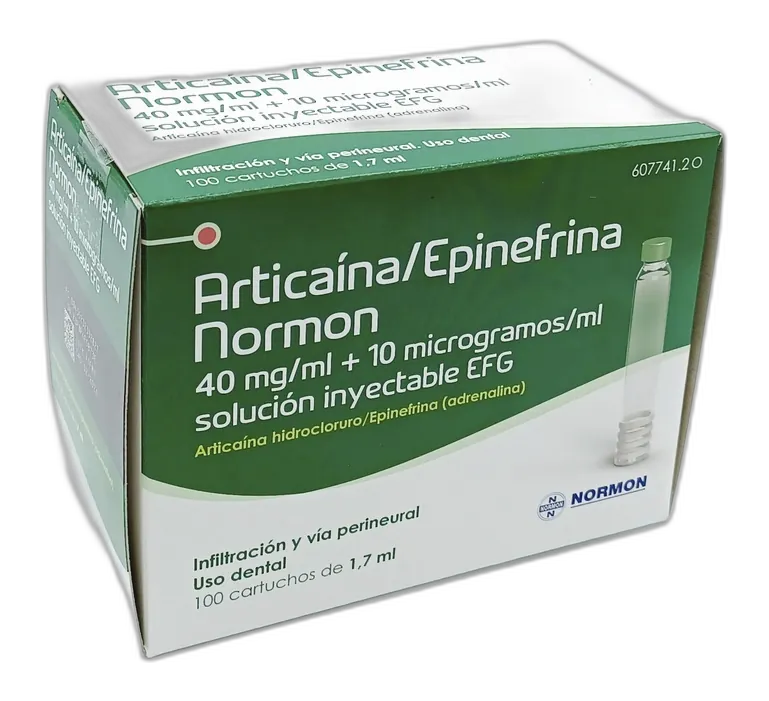
Illustrative image Image: AEMPS – CIMA - Country of registration
- Dosage formINJECTABLE, 40 mg/ml + 10 micrograms/ml
- ATC codeN01BB58
- Active substance
- Prescription requiredYes
- Manufacturer
- CompositionCLORURO DE SODIO (1,00 mg/ml mg), SODIO, METABISULFITO DE (E 223) (0,500 mg/ml mg)
- This information is for reference only and does not constitute medical advice. Always consult a doctor before taking any medication. Oladoctor is not responsible for medical decisions based on this content.
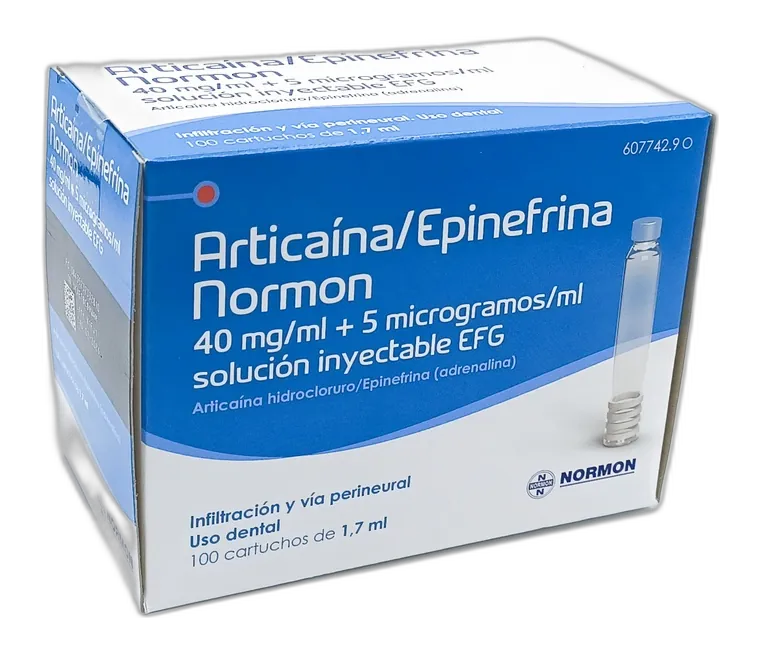
- Alternatives to ARTICAINE/EPINEPHRINE NORMON 40 mg/mL + 10 micrograms/mL Injectable SolutionDosage form: INJECTABLE, 4%; articaine; 0.001% epinephrine bitartrateActive substance: articaine, combinationsManufacturer: Farmalider S.A.Prescription requiredDosage form: INJECTABLE, 4%; articaine; 0.0005% epinephrine bitartrateActive substance: articaine, combinationsManufacturer: Farmalider S.A.Prescription requiredDosage form: INJECTABLE, 40 mg/ml + 5 micrograms/mlActive substance: articaine, combinationsManufacturer: Laboratorios Normon S.A.Prescription required
Online doctors for ARTICAINE/EPINEPHRINE NORMON 40 mg/mL + 10 micrograms/mL Injectable Solution
Discuss questions about ARTICAINE/EPINEPHRINE NORMON 40 mg/mL + 10 micrograms/mL Injectable Solution, including use, safety considerations and whether a prescription is appropriate, subject to medical assessment and local regulations.









Frequently Asked Questions
ARTICAINE/EPINEPHRINE NORMON 40 mg/mL + 10 micrograms/mL Injectable Solution requires a prescription in Spain. You can check with a doctor online whether this medicine may be appropriate for your situation.
The active ingredient in ARTICAINE/EPINEPHRINE NORMON 40 mg/mL + 10 micrograms/mL Injectable Solution is articaine, combinations. This information helps identify medicines with the same composition but different brand names.
ARTICAINE/EPINEPHRINE NORMON 40 mg/mL + 10 micrograms/mL Injectable Solution is manufactured by Laboratorios Normon S.A.. Pharmacy brands and packaging may differ depending on the distributor.
Doctors such as Psychiatrists, Neurologists, General medicine doctors, Pain medicine doctors, Anaesthesiologists may assess whether ARTICAINE/EPINEPHRINE NORMON 40 mg/mL + 10 micrograms/mL Injectable Solution is appropriate, depending on your situation and local regulations. You can book an online consultation to discuss your symptoms and possible next steps.
The prescription is issued by a doctor after assessing your health. In Spain, ARTICAINE/EPINEPHRINE NORMON 40 mg/mL + 10 micrograms/mL Injectable Solution is then dispensed in pharmacies with that prescription. An online consultation does not guarantee that a prescription will be issued: the decision always rests with the doctor.
To request an assessment, you can use Oladoctor:
Other medicines with the same active substance (articaine, combinations) include ARTICAINE / EPINEPHRINE DERMOGEN 40 mg/mL + 10 micrograms/mL Injectable Solution, ARTICAINE / EPINEPHRINE DERMOGEN 40 mg/mL + 5 micrograms/mL Injectable Solution, ARTICAINE/EPINEPHRINE NORMON 40 mg/mL + 5 micrograms/mL Injectable Solution. These may have different brand names or formulations but contain the same therapeutic ingredient. Always consult a doctor before switching or starting a new medicine.
