



APADIN 1 mg /Ml Eye Drops

Prescription review online
A doctor will review your case and decide whether a prescription is medically appropriate.

Talk to a doctor about this medicine
Discuss your symptoms and possible next steps in a quick online consultation.



How to use APADIN 1 mg/ml EYE DROPS SOLUTION
Contents of the leaflet
- Introduction
- What is Apadin and what is it used for
- What you need to know before you start using Apadin
- N
- A
- How to use Apadin
- Possible side effects
- Storage of Apadin
- Contents of the pack and further information
Introduction
Package Leaflet: Information for the Patient
Apadin 1 mg/ml eye drops in solution.
Olopatadine
Read this package leaflet carefully before you start using this medicine, because it contains important information for you.
- Keep this package leaflet, you may need to read it again.
- If you have any further questions, ask your doctor or pharmacist.
- This medicine has been prescribed for you only. Do not pass it on to others. It may harm them, even if their symptoms are the same as yours.
- If you experience any side effects, talk to your doctor or pharmacist. This includes any possible side effects not listed in this package leaflet. See section 4.
Contents of the package leaflet
- What is Apadin and what is it used for
- What you need to know before you start using Apadin
- How to use Apadin
- Possible side effects
- Storage of Apadin
- Contents of the pack and further information
1. What is Apadin and what is it used for
Apadin is indicated for the treatment of the signs and symptoms of seasonal allergic conjunctivitis.
Allergic conjunctivitis.Some elements (called allergens) such as pollen, house dust, or animal hair can cause allergic reactions that lead to itching and redness as well as inflammation of the surface of your eyes.
Olopatadine belongs to the group of medicines usedfor the treatment of allergic eye conditions. It works by reducing the intensity of the allergic reaction.

Not sure if this medicine is right for you?
Discuss your symptoms and treatment with a doctor online.
2. What you need to know before you start using Apadin
Do not useApadin
If you are allergic(hypersensitive) to olopatadina or any of the other ingredients of this medicine (listed in section 6).
Do not use Apadin if you are breastfeeding.
Warnings and precautions
Talk to your doctor or pharmacist before you start using Olopatadina.
You should remove your contact lenses before using Olopatadina.
N
Do not use Apadin in children under 3 years of age. Do not give this medicine to children under 3 years of age because there is no data to indicate that it is safe and effective in children under 3 years of age.
Using Apadin with other medicines
Tell your doctor or pharmacist if you are using, have recently used, or might use other medicines.
If you are using another eye drop or ointment, wait at least 5 minutes between applying each medicine. Eye ointments should be applied last.
Pregnancy, breastfeeding, and fertility
If you are pregnant or breastfeeding, think you might be pregnant, or plan to become pregnant, talk to your doctor or pharmacist before using this medicine.
Do not use Apadin if you are breastfeeding. Talk to your doctor before using this medicine.
Driving and using machines
Immediately after applying Apadin, you may notice that your vision is blurred. Do not drive or use machines until this effect has disappeared.
Apadin contains benzalkonium chloride
This medicine contains 0.5 mg of benzalkonium chloride in every 5 ml, which is equivalent to 0.1 mg/ml.
The preservative in Apadin, benzalkonium chloride, can be absorbed by soft contact lenses and may alter the color of the contact lenses. Remove your contact lenses before using this medicine and wait 15 minutes before putting them back in.
Benzalkonium chloride can cause eye irritation, especially if you have dry eyes or other corneal diseases (the transparent layer on the front of the eye). Talk to your doctor if you feel any unusual sensation, itching, or pain in the eye after using this medicine.

Started taking the medicine and have questions?
Discuss your symptoms and treatment with a doctor online.
A
This medicine contains 16.72 mg of phosphates (in 63.05 mg of disodium hydrogen phosphate dodecahydrate) in every 5 ml bottle, which is equivalent to 3.34 mg/ml.
If you have severe damage to the transparent layer on the front of the eye (the cornea), treatment with phosphates, in very rare cases, can cause blurred vision due to calcium accumulation.
3. How to use Apadin
Follow the instructions for administration of this medicine exactly as indicated by your doctor or pharmacist. If you are not sure, talk to your doctor or pharmacist.
The recommended dose is one drop in one eye or in both eyes, twice a day - in the morning and in the afternoon.
Use this amount unless your doctor gives you other instructions. You should only apply Apadin to both eyes if your doctor has told you to do so. Continue the treatment for the period of time indicated by your doctor.
Olopatadina should only be used as eye drops.
Instructions for use

1 2
? Hold the Apadin bottle and stand in front of a mirror.
? Wash your hands.
? Hold the bottle and unscrew the cap.
? After removing the cap, you must remove the plastic ring from the seal before using.
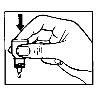
? Hold the bottle, upside down, between your thumb and index finger.
? Tilt your head back. Gently pull down your lower eyelid to form a pocket, where the drop should fall (Figure 1).
? Bring the tip of the bottle close to your eye. You may find it helpful to look in the mirror.
? Do not touch your eye, eyelid, or surrounding areas with the dropper, because the drops that remain in the bottle could become infected.
? Gently press the base of the bottle to release one drop of Apadin at a time.
? Do not squeeze the bottle, it is designed so that a gentle pressure on the base is enough (Figure 2).
? If you are applying drops to both eyes, repeat the above steps for the other eye.
? Replace the cap on the bottle immediately after use.
? Use one bottle before opening the next one.
? If a drop falls outside the eye, try again.
If you use more Apadin than you should
You can rinse your eyes with lukewarm water. Do not apply more drops until the next application.
If you forget to use Apadin
Apply one drop as soon as you remember and continue with your next scheduled dose.
However, if it is almost time for your next dose, do not apply the missed dose. Continue with your next scheduled dose. Do not apply a double dose to make up for the missed dose.
If you stop using Apadin
Do not stop using this medicine without talking to your doctor first.
If you have any further questions about the use of this medicine, talk to your doctor or pharmacist.
4. Possible side effects
Like all medicines, this medicine can cause side effects, although not everybody gets them.
The following side effects have been observed with Olopatadina:
Common: may affect up to 1 in 10 people
Eye effects: eye pain, eye irritation, dry eye, abnormal sensation in the eye, eye discomfort
General effects: headache, fatigue, dry nose, bad taste in the mouth
Uncommon: may affect up to 1 in 100 people
Eye effects:blurred vision, decreased or abnormal vision, corneal disorder, inflammation of the eye surface with or without damage to the surface, infection or inflammation of the conjunctiva, eye discharge, sensitivity to light, increased tear production, eye itching, eye redness, abnormality in the eyelid, itching, redness, swelling, or crust on the eyelid.
General effects:decreased or abnormal sensation, dizziness, runny nose, dry skin, skin inflammation.
Frequency not known: (cannot be estimated from the available data)
Eye effects:eye swelling, corneal swelling, change in pupil size
General effects:difficulty breathing, increased allergic symptoms, facial swelling, numbness, general weakness, nausea, vomiting, sinus infection, redness, and itching of the skin.
In very rare cases, some patients with severe damage to the transparent layer on the front of the eye (the cornea) have developed dark spots on the cornea due to calcium accumulation during treatment.
Reporting of side effects
 If you experience any side effects, talk to your doctor or pharmacist. This includes any possible side effects not listed in this package leaflet. You can also report side effects directly through the Spanish Pharmacovigilance System for Human Use Medicines: https://www.notificaram.es. By reporting side effects, you can help provide more information on the safety of this medicine.
5. Storage of Apadin
Keep this medicine out of the sight and reach of children.
Do not use this medicine after the expiry date which is stated on the bottle and carton after “EXP”. The expiry date is the last day of the month stated.
This medicine does not require any special storage conditions.
To avoid infections, you should discard the bottle four weeks after first opening and use a new bottle. Write the date of opening on the space provided on the label of each bottle and carton.
Do not use this medicine if you notice any change in the color or smell.
Medicines should not be disposed of via wastewater or household waste. Ask your pharmacist how to dispose of medicines no longer required. These measures will help protect the environment.
6. Contents of the pack and further information
Composition of Apadin
- The active ingredient is olopatadine. Each ml of solution contains 1 mg of olopatadine (as hydrochloride).
- The other ingredients are benzalkonium chloride, hydrochloric acid (E507) (pH adjuster), disodium hydrogen phosphate dodecahydrate (E339), sodium chloride, sodium hydroxide (E524) (pH adjuster), and water for injections.
Appearance and pack contents
Apadin is a clear and colorless liquid (a solution), practically free of particles.
It comes in a pack containing a 5 ml bottle of low-density polyethylene (LDPE) with a dropper of LDPE and a screw cap of high-density polyethylene (HDPE) with a child-resistant closure.
Packs
1 x 5 ml (1 bottle, containing 5 ml of solution).
Marketing authorisation holder and manufacturer
Marketing authorisation holder:
TIEDRA FARMACÉUTICA, S.L.
C/ Colón, 7, 30510 Yecla (Murcia)
Spain
Manufacturer:
actrevo GmbH
Großer Burstah 25, 20457 Hamburg
Germany
DRUGSRUS Ltd.,
5 Sandridge Close, Harrow, Middlesex, HA1 1XD,
United Kingdom
This medicine is authorised in the Member States of the European Economic Area under the following names:
ES: Apadin 1mg/ml eye drops in solution
Date of last revision of this package leaflet: 04/2023.
Detailed and up-to-date information on this medicine is available on the website of the Spanish Agency for Medicines and Health Products (AEMPS): http://www.aemps.gob.es
- Country of registration
- Dosage formEYEDROP, 1 mg/ml
- ATC codeS01GX09
- Average pharmacy price7.74 EUR
- Active substance
- Prescription requiredYes
- Manufacturer
- CompositionBENZALCONIO, CLORURO DE (0,10 mg mg), CLORURO DE SODIO (6,00 mg mg), HIDROGENOFOSFATO DE SODIO DODECAHIDRATO (12,61 mg mg), HIDROXIDO DE SODIO (E 524) (C.S.P PH5.0-8.0 pH mg)
- This information is for reference only and does not constitute medical advice. Always consult a doctor before taking any medication. Oladoctor is not responsible for medical decisions based on this content.
- Alternatives to APADIN 1 mg/ml EYE DROPS SOLUTIONDosage form: EYEDROP, 1 mg/mlActive substance: olopatadineManufacturer: Qualix Pharma S.L.Prescription requiredDosage form: EYE DROP, 1mg/ml mg/mlActive substance: olopatadineManufacturer: Juta Pharma GmbhPrescription requiredDosage form: EYE DROP, 1 mg/mlActive substance: olopatadineManufacturer: Novartis Europharm LimitedPrescription required
Online doctors for APADIN 1 mg/ml EYE DROPS SOLUTION
Discuss questions about APADIN 1 mg/ml EYE DROPS SOLUTION, including use, safety considerations and prescription review, subject to medical assessment and local regulations.









Get APADIN 1 mg/ml EYE DROPS SOLUTION Prescription Online
Fill in a 2-min form
Tell us your symptoms, history, and what medicine you're requesting.
Pick a doctor or let us assign
Choose a specialist or we'll match you with the next available doctor.
Doctor reviews your case
Usually within 30 minutes. They may ask follow-up questions via chat.
Collect from any pharmacy
Electronic prescription sent to your email — valid across Spain.
Frequently Asked Questions
APADIN 1 mg/ml EYE DROPS SOLUTION requires a prescription in Spain. You can check with a doctor online whether this medicine may be appropriate for your situation.
The active ingredient in APADIN 1 mg/ml EYE DROPS SOLUTION is olopatadine. This information helps identify medicines with the same composition but different brand names.
The average pharmacy price for APADIN 1 mg/ml EYE DROPS SOLUTION is around 7.74 EUR. Prices may vary depending on the manufacturer and dosage form.
APADIN 1 mg/ml EYE DROPS SOLUTION is manufactured by Tiedra Farmaceutica S.L.. Pharmacy brands and packaging may differ depending on the distributor.
Doctors such as Family doctors, Psychiatrists, Dermatologists, Cardiologists, Endocrinologists, Gastroenterologists, Pulmonologists, Nephrologists, Rheumatologists, Hematologists, Infectious disease physicians, Allergists, Geriatricians, Paediatricians, Oncologists may assess whether APADIN 1 mg/ml EYE DROPS SOLUTION is appropriate, depending on your situation and local regulations. You can book an online consultation to discuss your symptoms and possible next steps.
Spain has a well-developed healthcare infrastructure across major cities such as Madrid, Barcelona, Valencia, and Seville. Pharmacies are widely available and operate under strict regulations, ensuring access to prescribed medications.
You can buy APADIN 1 mg/ml EYE DROPS SOLUTION in Madrid, Barcelona, Seville, or Valencia at any local pharmacy with a valid prescription.
To obtain a prescription, you can use Oladoctor:
Other medicines with the same active substance (olopatadine) include OLOPATADINE ABAMED 1 mg/ml EYE DROPS SOLUTION, OLOPATADINE JUTA 1 mg/ml EYE DROPS SOLUTION, OPATANOL 1 mg/ml EYE DROPS SOLUTION. These may have different brand names or formulations but contain the same therapeutic ingredient. Always consult a doctor before switching or starting a new medicine.
