


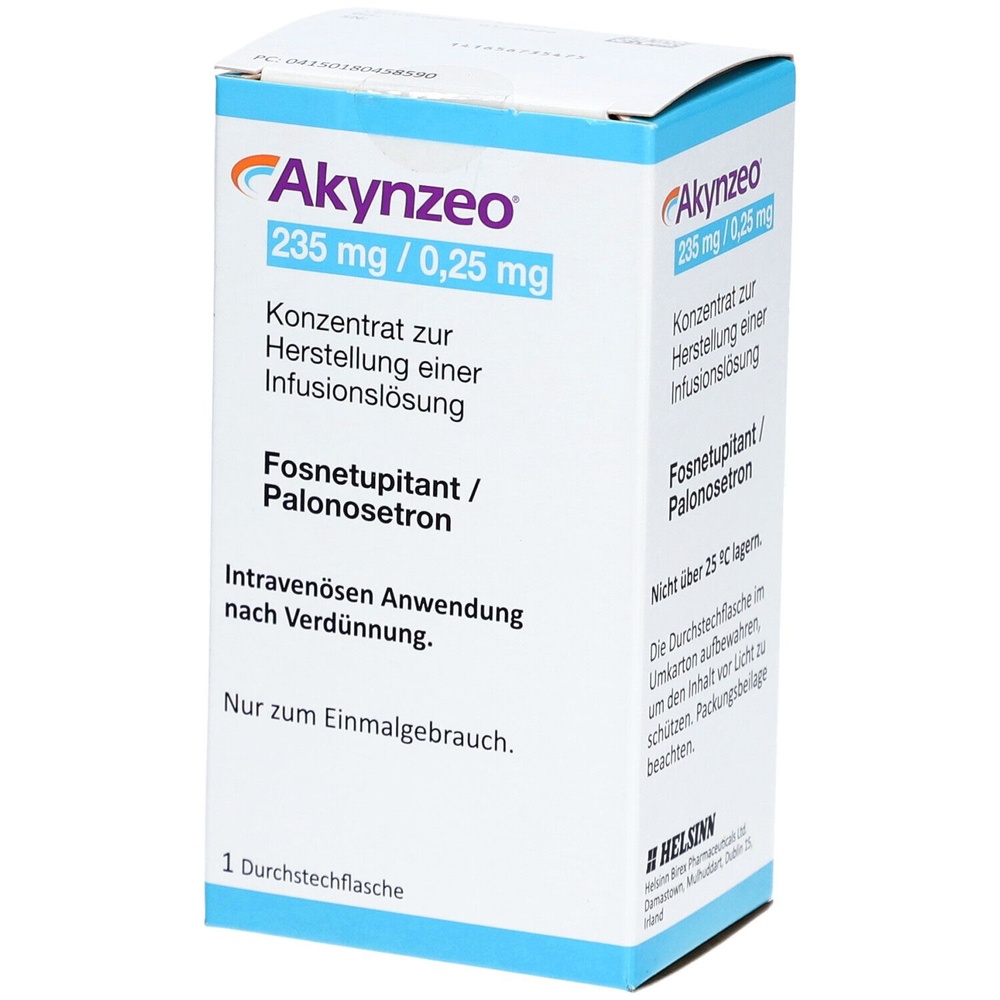
Akynzeo 235 mg/0,25 mg injectable perfusión

Prescription review online
A doctor will review your case and decide whether a prescription is medically appropriate.

Talk to a doctor about this medicine
Discuss your symptoms and possible next steps in a quick online consultation.



How to use AKYNZEO 235 mg/0.25 mg POWDER FOR CONCENTRATE FOR SOLUTION FOR INFUSION
Contents of the leaflet
- Introduction
- What is Akynzeo and what is it used for
- What you need to know before you are given Akynzeo
- How Akynzeo is given
- Possible side effects
- How to store Akynzeo
- Container contents and additional information
Introduction
Package Leaflet: Information for the Patient
Akynzeo 235 mg/0.25 mg powder for concentrate for solution for infusionfosnetupitant/palonosetron
Read all of this leaflet carefully before you are given this medicine because it contains important information for you.
- Keep this leaflet, you may need to read it again.
- If you have any further questions, ask your doctor, pharmacist, or nurse.
- If you experience any side effects, talk to your doctor, pharmacist, or nurse, even if they are not listed in this leaflet. See section 4.
Contents of the pack
- What is Akynzeo and what is it used for
- What you need to know before you are given Akynzeo
- How Akynzeo is given
- Possible side effects
- How to store Akynzeo
- Contents of the pack and other information
1. What is Akynzeo and what is it used for
What is Akynzeo
Akynzeo contains two active substances (active ingredients) called:
- fosnetupitant;
- palonosetron.
What Akynzeo is used for
Akynzeo is used to help prevent nausea (feeling sick) and vomiting in adults with cancer while they are receiving cancer treatment called chemotherapy.
How Akynzeo works
Chemotherapy medicines can cause the body to release substances called serotonin and substance P. These substances stimulate the vomiting centre in the brain, which makes you feel sick or vomit. The medicines in Akynzeo work by blocking the action of serotonin and substance P on the brain: fosnetupitant which is converted into netupitant (an NK1 receptor antagonist) in your body blocks the receptors for substance P and palonosetron (a 5-HT3 receptor antagonist) blocks certain serotonin receptors. By blocking the actions of substance P and serotonin in this way, the medicines help prevent the stimulation of the vomiting centre and the resulting nausea.

Not sure if this medicine is right for you?
Discuss your symptoms and treatment with a doctor online.
2. What you need to know before you are given Akynzeo
Akynzeo must not be given to you:
- if you are allergic to fosnetupitant, netupitant, or palonosetron or any of the other ingredients of this medicine (listed in section 6). If you are not sure, ask your doctor, pharmacist, or nurse before you are given this medicine;
- if you are pregnant.
Warnings and precautions
Talk to your doctor, pharmacist, or nurse before you are given Akynzeo:
- if you have liver problems;
- if you have a blockage in your intestines or a history of constipation;
- if you or a close family member have ever had a heart problem called “prolonged QT interval”;
- if you have other heart problems;
- if you have been told you have an imbalance of certain minerals in your blood, such as potassium and magnesium, that has not been corrected.
If any of the above applies to you (or if you are not sure), talk to your doctor, pharmacist, or nurse before you are given Akynzeo.
Children and adolescents
Akynzeo must not be given to children and adolescents under 18 years.
Other medicines and Akynzeo
Tell your doctor, pharmacist, or nurse if you are taking, have recently taken, or might take any other medicines.
In particular, tell your doctor, pharmacist, or nurse if you are taking any of the following medicines:
- medicines for depression or anxiety called SSRIs (selective serotonin reuptake inhibitors), such as fluoxetine, paroxetine, sertraline, fluvoxamine, citalopram, or escitalopram;
- medicines for depression or anxiety called SNRIs (serotonin and noradrenaline reuptake inhibitors), such as venlafaxine and duloxetine.
Talk to your doctor, pharmacist, or nurse if you are taking any of the following medicines, because your doctor may need to change the dose of these medicines:
- medicines that can cause an abnormal heart rhythm, such as amiodarone, nicardipine, quinidine, moxifloxacin, haloperidol, chlorpromazine, quetiapine, thioridazine, or domperidone;
- medicines with a narrow therapeutic index that are mainly metabolized by CYP3A4, such as cyclosporin, tacrolimus, sirolimus, everolimus, alfentanil, dihydroergotamine, ergotamine, fentanyl, or quinidine;
- certain chemotherapy medicines, such as docetaxel or etoposide;
- erythromycin, to treat bacterial infections;
- midazolam, a sedative used to treat anxiety;
- dexamethasone, which may be used to treat nausea and vomiting;
- ketoconazole, to treat Cushing's syndrome;
- rifampicin, to treat tuberculosis (TB) and other infections.
If any of the above applies to you (or if you are not sure), talk to your doctor, pharmacist, or nurse before you are given Akynzeo.
Pregnancy and breast-feeding
If you are pregnant or breast-feeding, think you may be pregnant, or are planning to have a baby, ask your doctor for advice before you are given this medicine.
Akynzeo must not be given to you if you are pregnant or if you are a woman of childbearing age and not using contraceptive methods.
Do not breast-feed if you are given Akynzeo. This is because it is not known whether the medicine passes into breast milk.
Driving and using machines
You may feel dizzy or tired after you are given Akynzeo. If this happens, do not drive or use tools or machines.
This medicine contains 24.8 mg of sodium (the main component of common/table salt) in each vial. This is equivalent to 1.24% of the maximum recommended daily intake of sodium for an adult. If it is reconstituted and diluted with sodium chloride 9 mg/ml (0.9%) injection solution, the final solution contains approximately 202 mg of sodium per dose. This is equivalent to 10.1% of the maximum recommended daily intake of sodium for an adult.
3. How Akynzeo is given
The recommended dose of Akynzeo is one vial (each vial contains 235 mg of fosnetupitant and 0.25 mg of palonosetron) on day 1 of chemotherapy.
- The powder is reconstituted and diluted before use.
- A doctor or nurse will give you Akynzeo.
- Akynzeo is given as an infusion into a vein (intravenous infusion) about 30 minutes before your chemotherapy treatment starts.
Your doctor will ask you to take other medicines, including a corticosteroid (such as dexamethasone), to prevent nausea and vomiting. If you are not sure, ask your doctor or nurse again.
If you stop being given Akynzeo
Akynzeo is given to help prevent nausea and vomiting when you are receiving chemotherapy. If you do not want to be given Akynzeo, talk to your doctor. If you decide not to be given Akynzeo (or a similar medicine), it is likely that the chemotherapy will make you feel sick or vomit.
If you have any further questions on the use of this medicine, ask your doctor, pharmacist, or nurse.

Started taking the medicine and have questions?
Discuss your symptoms and treatment with a doctor online.
4. Possible side effects
Like all medicines, this medicine can cause side effects, although not everybody gets them.
Serious side effects
Stop receiving Akynzeo and tell your doctor immediately if you notice the following serious side effect; you may need urgent medical treatment:
Very rare(may affect up to 1 in 10,000 people)
- severe allergic reaction: the signs include hives, skin rash, itching, difficulty breathing or swallowing, swelling of the mouth, face, lips, tongue, or throat, and sometimes a drop in blood pressure.
Other side effects
Tell your doctor, pharmacist, or nurse if you notice any of the following side effects:
Common(may affect up to 1 in 10 people)
- headache;
- constipation;
- fatigue.
Uncommon(may affect up to 1 in 100 people)
- hair loss;
- lack of energy (weakness);
- decreased appetite;
- high blood pressure;
- skin rash with itching and raised patches (hives);
- heart muscle problems (cardiomyopathy);
- feeling of spinning (vertigo), dizziness, or sleep problems (insomnia);
- stomach problems including stomach upset, feeling bloated, nausea, pain, indigestion, belching, gas, or diarrhea;
- high levels of certain enzymes, including alkaline phosphatase and liver blood transaminases (detected in blood tests);
- high levels of creatinine, which measures kidney function (detected in blood tests);
- abnormalities on the ECG (electrocardiogram) (“prolonged QT and PR intervals”, “conduction disorder”, “tachycardia”, and “first-degree atrioventricular block”);
- low levels of “neutrophils”, a type of white blood cell that fights infection (detected in blood tests);
- high levels of white blood cells (detected in blood tests).
Rare(may affect up to 1 in 1,000 people)
- back pain, joint pain;
- feeling of warmth, flushing of the face or other areas of the skin (hot flushes);
- skin rash with itching;
- drowsiness;
- sleep problems;
- ringing in the ears;
- vomiting;
- low blood pressure;
- chest pain (not related to the heart);
- numbness, blurred vision;
- sudden nervous breakdown, mood change;
- bladder infection and inflammation (cystitis);
- hemorrhoids;
- conjunctivitis (a type of eye inflammation);
- low levels of potassium (detected in blood tests);
- heart rhythm disorders;
- heart valve problems (mitral valve insufficiency);
- coated tongue, difficulty swallowing, dry mouth, belching, unusual taste after taking the medicine;
- reduced blood flow to the heart muscle (myocardial ischemia);
- high levels of creatine phosphokinase/creatine phosphokinase MB, indicating a sudden reduction in blood flow to the heart muscle (detected in blood tests);
- high levels of troponin, indicating heart muscle failure (detected in blood tests);
- high levels of the pigment bilirubin, indicating liver failure (detected in blood tests);
- high levels of myoglobin, indicating muscle damage (detected in blood tests);
- high levels of urea in the blood, indicating kidney failure (detected in blood tests);
- high levels of “lymphocytes”, a type of white blood cell that helps the body fight disease (detected in blood tests);
- low levels of white blood cells (detected in blood tests);
- abnormalities on the ECG (electrocardiogram) (“ST segment depression”, “ST-T segment abnormality”, “right/left bundle branch block”, and “second-degree atrioventricular block”).
Reporting of side effects
If you experience any side effects, talk to your doctor, pharmacist, or nurse, even if they are not listed in this leaflet. You can also report side effects directly via the national reporting system listed in Appendix V. By reporting side effects, you can help provide more information on the safety of this medicine.
5. How to store Akynzeo
- Keep this medicine out of the sight and reach of children.
- Do not use this medicine after the expiry date which is stated on the carton and vial after EXP. The expiry date is the last day of the month stated.
- Store in a refrigerator (between 2°C and 8°C).
- Keep the vial in the outer packaging to protect it from light.
- The total time from reconstitution to the start of infusion must not exceed 24 hours. Store the reconstituted solution and the final diluted solution below 25°C.
- Medicines should not be disposed of via wastewater or household waste. Ask your pharmacist how to dispose of medicines no longer required. This will help protect the environment.
6. Container contents and additional information
Akynzeo composition
- The active ingredients are fosnetupitant and palonosetron. Each vial contains 235 mg of fosnetupitant and 0.25 mg of palonosetron.
- The other components are mannitol, disodium edetate (E386), sodium hydroxide (E524), and diluted hydrochloric acid (E507) (for pH adjustment).
Product appearance and container contents
Akynzeo powder for concentrate for solution for infusion is a sterile, lyophilized powder, white to off-white in color, and is supplied in a Type I glass vial with a siliconized chlorobutyl rubber stopper and an aluminum seal cap. Each vial contains one dose.
Packs of 1 vial.
Marketing authorization holder and manufacturer
Helsinn Birex Pharmaceuticals Ltd.
Damastown
Mulhuddart
Dublin 15
Ireland
Further information about this medicinal product can be obtained from the local representative of the marketing authorization holder:
België/Belgique/Belgien Vifor Pharma Tel: +32(0)32 182070 | Lietuva PharmaSwiss Tel: +370 5 279 07 62 |
България Angelini Pharma Bulgaria EOOD Tel: +359 2 975 13 95 | Luxembourg/Luxemburg Vifor Pharma Tél/Tel: +32(0)32 182070 |
Česká republika Angelini Pharma Česká republika s.r.o. Tel: (+420) 546 123 111 | Magyarország Angelini Pharma Magyarország Kft Tel.: + 36 1 336 1614 |
Danmark Swedish Orphan Biovitrum A/S Tlf: + 45 32 96 68 69 | Malta Helsinn Birex Pharmaceuticals Ltd. Tel.: + 353 1 822 5404 |
Deutschland RIEMSER Pharma GmbH Tel: + 49 30 338427-0 | Nederland Vifor Pharma Tel: +31(0)88 8484300 |
Eesti PharmaSwiss Tel: +372 6827 400 | Norge Swedish Orphan Biovitrum AS Tlf: +47 66 82 34 00 |
Ελλάδα Galenica A.E. Τηλ: +30 210 52 81 700 | Österreich Angelini Pharma Österreich GmbH Tel: +43-5-9-606-0 |
España Vifor Pharma España, S.L. Tel: +34 902 121 111 | Polska Angelini Pharma Polska Sp. z o.o. Tel: +48 22 70 28 200 |
France Vifor France Tél: +33 (0)1 41 06 58 90 | Portugal OM Pharma Tel: +351 21 470 85 00 |
Hrvatska PharmaSwiss Tel: +385 1 6311 833 | România Angelini Pharmaceuticals Romania Srl Tel: +40 21 331 67 67 |
Ireland Chugai Pharma France Tel: +33 1 79 36 36 18 | Slovenija PharmaSwiss Tel: +386 1 2364 700 |
Ísland Swedish Orphan Biovitrum A/S Tlf: + 45 32 96 68 69 | Slovenská republika Angelini Pharma Slovenská republika s.r.o. Tel: +421 2 5920 7320 |
Italia Italfarmaco Tel: + 39 02 64431 | Suomi/Finland Oy Swedish Orphan Biovitrum Ab Puh./Tel: +358 201 558 840 |
Κύπρος Galenica A.E. Τηλ: +30 210 52 81 700 | Sverige Swedish Orphan Biovitrum AB (publ) Tel: +46 8 697 20 00 |
Latvija PharmaSwiss Tel: +371 6750 2185 | United Kingdom Chugai Tel: +44 1748 827 276 |
Date of last revision of this leaflet:
Other sources of information
Detailed information on this medicinal product is available on the European Medicines Agency website: http://www.ema.europa.eu.
-----------------------------------------------------------------------------------------------------------------
This information is intended for healthcare professionals only:
Instructions for the reconstitution and dilution of AKYNZEO 235 mg/0.25 mg Preparation of Akynzeo
Step 1 | Inject aseptically 20 ml of 5% dextrose injection solution or 9 mg/ml (0.9%) sodium chloride injection solution into the vial. Ensure that the solvent is added to the vial along the vial wall and not as a jet to prevent foam formation. Gently move the vial for 3 minutes. The powder should be dissolved before diluting the solution in the infusion bag. |
Step 2 | Prepare aseptically a vial or infusion bag containing 30 ml of 5% dextrose injection solution or 9 mg/ml (0.9%) sodium chloride injection solution. |
Step 3 | After reconstitution, immediately dilute (according to step 1). Aseptically withdraw the entire volume of the reconstituted solution from the AKYNZEO vial and transfer it to the vial or infusion bag containing 30 ml of 5% dextrose injection solution or 9 mg/ml (0.9%) sodium chloride injection solution to obtain a total volume of 50 ml. |
Step 4 | Invert the vial or bag gently until complete dissolution. |
Step 5 | Before administration, inspect the final diluted solution for particles or color change. Discard the vial or bag if particles or color change are observed. |
The reconstituted and diluted solution is stable for 24 hours at 25°C.
Before administration, whenever the solution and container permit, parenteral drugs should be inspected visually for particles or color change.
The reconstituted solution has the same appearance as the diluent.
Discard any remaining solution and materials that have come into contact with it. The disposal of unused medicinal products and all materials that have come into contact with them should be carried out in accordance with local regulations.
This medicinal product should not be reconstituted or mixed with other solutions with which physical and chemical compatibility has not been established (see Summary of Product Characteristics or package leaflet, section 6.2).
- Country of registration
- Dosage formINJECTABLE PERFUSION, 235 mg / 0.25 mg
- ATC codeA04AA55
- Active substance
- Prescription requiredYes
- Manufacturer
- CompositionEDETATO DISODICO DIHIDRATADO (6,4 mg mg), MANITOL (E-421) (760 mg mg), HIDROXIDO DE SODIO (E 524) (c.s C.S mg)
- This information is for reference only and does not constitute medical advice. Always consult a doctor before taking any medication. Oladoctor is not responsible for medical decisions based on this content.
- Alternatives to AKYNZEO 235 mg/0.25 mg POWDER FOR CONCENTRATE FOR SOLUTION FOR INFUSIONDosage form: CAPSULE, Netupitant 300 mg / Palonosetron 0.5 mgActive substance: palonosetron, combinationsManufacturer: Helsinn Birex Pharmaceuticals LimitedPrescription requiredDosage form: INJECTABLE, 50 µgActive substance: palonosetronManufacturer: Helsinn Birex Pharmaceuticals LimitedPrescription requiredDosage form: INJECTABLE, 250 microgramsActive substance: palonosetronManufacturer: Medochemie LimitedPrescription required
Online doctors for AKYNZEO 235 mg/0.25 mg POWDER FOR CONCENTRATE FOR SOLUTION FOR INFUSION
Discuss questions about AKYNZEO 235 mg/0.25 mg POWDER FOR CONCENTRATE FOR SOLUTION FOR INFUSION, including use, safety considerations and prescription review, subject to medical assessment and local regulations.









Frequently Asked Questions
AKYNZEO 235 mg/0.25 mg POWDER FOR CONCENTRATE FOR SOLUTION FOR INFUSION requires a prescription in Spain. You can check with a doctor online whether this medicine may be appropriate for your situation.
The active ingredient in AKYNZEO 235 mg/0.25 mg POWDER FOR CONCENTRATE FOR SOLUTION FOR INFUSION is palonosetron, combinations. This information helps identify medicines with the same composition but different brand names.
AKYNZEO 235 mg/0.25 mg POWDER FOR CONCENTRATE FOR SOLUTION FOR INFUSION is manufactured by Helsinn Birex Pharmaceuticals Limited. Pharmacy brands and packaging may differ depending on the distributor.
Doctors such as Family doctors, Psychiatrists, Dermatologists, Cardiologists, Endocrinologists, Gastroenterologists, Pulmonologists, Nephrologists, Rheumatologists, Hematologists, Infectious disease physicians, Allergists, Geriatricians, Paediatricians, Oncologists may assess whether AKYNZEO 235 mg/0.25 mg POWDER FOR CONCENTRATE FOR SOLUTION FOR INFUSION is appropriate, depending on your situation and local regulations. You can book an online consultation to discuss your symptoms and possible next steps.
The prescription is issued by a doctor after assessing your health. In Spain, AKYNZEO 235 mg/0.25 mg POWDER FOR CONCENTRATE FOR SOLUTION FOR INFUSION is then dispensed in pharmacies with that prescription. An online consultation does not guarantee that a prescription will be issued: the decision always rests with the doctor.
To request a review, you can use Oladoctor:
Other medicines with the same active substance (palonosetron, combinations) include AKYNZEO 300 mg/0.5 mg HARD CAPSULES, ALOXI 250 micrograms INJECTABLE SOLUTION, FERANT 250 micrograms injectable solution. These may have different brand names or formulations but contain the same therapeutic ingredient. Always consult a doctor before switching or starting a new medicine.
