



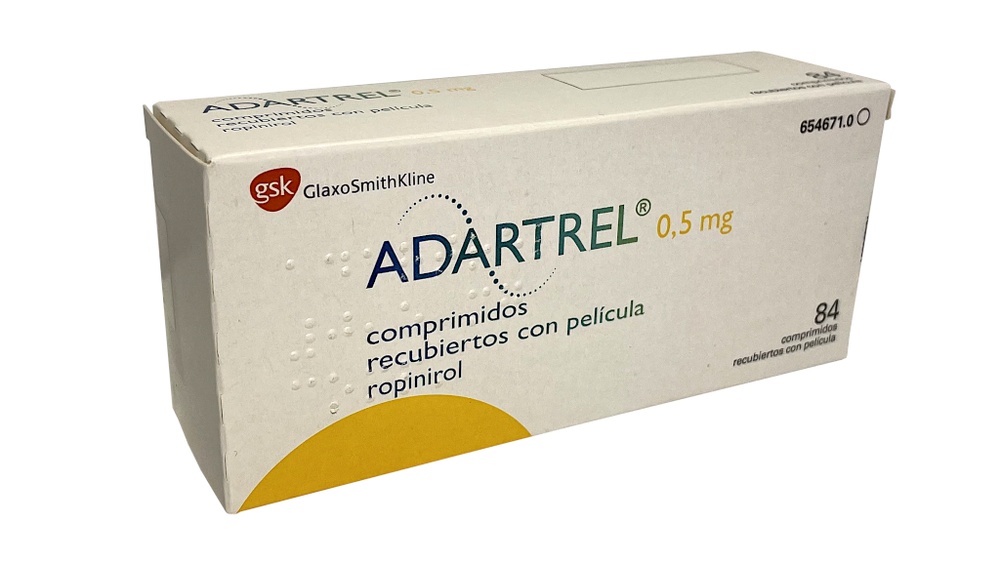
ADARTREL 0.5 mg Film-coated tablets

Prescription review online
A doctor will review your case and decide whether a prescription is medically appropriate.

Talk to a doctor about this medicine
Discuss your symptoms and possible next steps in a quick online consultation.



How to use ADARTREL 0.5 mg FILM-COATED TABLETS
Contents of the leaflet
- Introduction
- What Adartrel is and what it is used for
- What you need to know before you take Adartrel
- Pregnancy and breast-feeding
- Adartrel should not be used during pregnancy, unless your doctor advises you that the benefit for you is greater than the possible risk to the baby.Adartrel should not be used during breast-feeding, as milk production may be affected.
- While taking Adartrel
- Driving and using machines
- How to take Adartrel
- How to take your dose of Adartrel
- Possible side effects
- Storing Adartrel
- Packaging Contents and Additional Information
Introduction
Package Leaflet: Information for the User
Adartrel 0.5 mg film-coated tablets
ropinirol (as hydrochloride)
Read all of this leaflet carefully before you start taking this medicine because it contains important information for you.
- Keep this leaflet, you may need to read it again.
- If you have any further questions, ask your doctor or pharmacist.
- This medicine has been prescribed for you only. Do not pass it on to others. It may harm them, even if their signs of illness are the same as yours.
- If you experience any side effects, talk to your doctor or pharmacist. This includes any possible side effects not listed in this leaflet.See section 4.
Contents of the pack
- What Adartrel is and what it is used for
- What you need to know before you take Adartrel
- How to take Adartrel
- Possible side effects
- Storing Adartrel
- Contents of the pack and other information
1. What Adartrel is and what it is used for
The active substance in Adartrel is ropinirol, which belongs to a group of medicines called dopamine agonists. Dopamine agonists work in a similar way to a natural substance in the brain called dopamine.
Adartrel is used to treat the symptoms of moderate to severe Restless Legs Syndrome.
Restless Legs Syndrome (RLS) is also known as Ekbom syndrome. People with RLS have an irresistible urge to move their legs, and sometimes their arms and other parts of their body. They often have unpleasant sensations in their limbs, such as tingling, burning, or itching, which can start as soon as they sit or lie down and may only be relieved by movement. These people often have difficulty sitting still and especially have difficulty sleeping.
Adartrel relieves the unpleasant sensations by reducing the urge to move the legs and other parts of the body.

Not sure if this medicine is right for you?
Discuss your symptoms and treatment with a doctor online.
2. What you need to know before you take Adartrel
Do not take Adartrel
- if you are allergicto ropinirol or any of the other ingredients of this medicine (listed in section 6)
- if you have severe kidney disease
- if you have severe liver disease
- Tell your doctorif you think you may have any of these conditions.
Warnings and precautions
Talk to your doctor or pharmacist before starting Adartrel:
- if you are pregnantor think you may be pregnant
- if you are breast-feeding
- if you are under 18 years old
- if you have liver disease
- if you have serious heart disease
- if you have serious mental health problems
- if you have impulsive behaviour and/or abnormal behaviour(such as an excessive urge to gambleor excessive sexual behaviour)
- if you have intolerance to some sugars(such as lactose monohydrate)
Tell your doctor if you notice symptoms such as depression, apathy, anxiety, fatigue, sweating, or painwhen you stop or reduce treatment with Adartrel (called dopamine agonist withdrawal syndrome or DAWS). If the problems persist after a few weeks, your doctor may need to adjust your treatment.
Tell your doctor if you or your family/carer notice that you are developing impulses or desires to behave in ways that are unusual for you and that you cannot resist the impulse, desire, or temptation to carry out certain activities that could harm you or others. This is known as impulse control disorders and can include behaviours such as pathological gambling, excessive eating, or excessive spending, abnormal sexual behaviour, or an increase in sexual thoughts or feelings. Your doctor may need to adjust or stop your treatment.
Tell your doctor if you or your family/carer notice that you are developing episodes of overactivity, euphoria, or irritability (symptoms of mania). These can occur with or without symptoms of impulse control disorders (see above). Your doctor may need to adjust or stop your treatment.
- Tell your doctorif you think you may have any of these conditions. Your doctor will decide if your treatment with Adartrel is suitable for you, or if you need any additional monitoring while taking it.
Other medicines and Adartrel
Tell your doctor or pharmacist if you are taking, have recently taken, or might take any other medicines, including medicines obtained without a prescription. Remember to tell your doctor or pharmacist if you start taking a new medicine while taking Adartrel.
Some medicines may affect how Adartrel works, or make it more likely that you will have side effects. Adartrel may also affect how other medicines work.
These medicines include:
- the antidepressant fluvoxamine
- medicines for other mental health problems, such as sulpiride
- metoclopramide, which is used to treat nausea and vomitingand heartburn
- hormone replacement therapy (HRT)
- the antibiotics ciprofloxacinor enoxacin
- any other medicine that blocks the action of dopamine in the brain
- Tell your doctorif you are taking, or have recently taken, any of these medicines.
If you are taking the following medicines with Adartrel, you may need to have extra blood tests:
- Vitamin K antagonists (used to prevent blood clotting) such as Warfarin.
Pregnancy and breast-feeding

Started taking the medicine and have questions?
Discuss your symptoms and treatment with a doctor online.
Adartrel should not be used during pregnancy, unless your doctor advises you that the benefit for you is greater than the possible risk to the baby.Adartrel should not be used during breast-feeding, as milk production may be affected.
? Tell your doctor immediatelyif you are pregnant, think you may be pregnant, or plan to become pregnant. Your doctor will advise you on what to do if you are breast-feeding or plan to breast-feed. Your doctor may recommend that you stop treatment with Adartrel.
While taking Adartrel
Tell your doctorif you or your family notice that you are developing abnormal behaviour(such as an excessive urge to gambleor an increase in sexual desires and/or behaviour) while taking Adartrel. Your doctor may need to adjust or stop your treatment.
Driving and using machines
Adartrel can make you feel drowsy. In rare cases, Adartrel can make you feel extremely drowsy, and sometimes you may fall asleep suddenly without warning.
Adartrel can cause hallucinations (seeing, hearing, or feeling things that are not there). If this happens, do not drive or use machines.
If you experience this: do not drive, do not use machines, and do notput yourself in situations where feeling drowsy or falling asleep could put you (or others) at risk of serious harm or death. Do not do these activities until you are no longer affected.
? Consult your doctorif this may affect you.
Smoking and Adartrel
Tell your doctorif you start or stop smoking while taking Adartrel. Your doctor may need to adjust your dose.
Taking Adartrel with food and drink
If you take Adartrel with food, you are less likely to feel sick or vomit. If possible, take it with food.
If your symptoms get worse
Some patients who take Adartrel may experience a worsening of their RLS symptoms, for example, symptoms may start earlier than usual or be more intense, or affect other parts of the body not previously affected, such as the arms, or come back earlier in the morning.
? Tell your doctor as soon as possibleif you think you have any of these symptoms.
Adartrel contains lactose and sodium
This medicine contains lactose monohydrate. If your doctor has told you that you have an intolerance to some sugars, consult your doctor before taking this medicine.
This medicine contains less than 23 mg of sodium (1 mmol) per tablet; this is essentially “sodium-free”.
3. How to take Adartrel
Follow the instructions for administration of this medicine exactly as told by your doctor or pharmacist. If you are not sure, consult your doctor or pharmacist again.
Do not give Adartrel to children. Adartrel is not normally prescribed for people under 18 years old.
What dose of Adartrel should you take?
It may take some time to find the best dose of Adartrel for you.
The usual starting dose is 0.25 mg once a day. After two days, your doctor may increase your dose to 0.5 mg a day for the rest of the week. Then your doctor may gradually increase your dose over the next three weeks, to a daily dose of 2 mg.
If the dose of 2 mg is not enough to improve your RLS symptoms, your doctor may gradually increase your dose, up to a maximum of 4 mg a day. After you have taken Adartrel for three months, your doctor may adjust your dose or recommend that you stop treatment.
If you experience that the effects of Adartrel are too strong or too weak, talk to your doctor or pharmacist. Do not take more tablets than your doctor has recommended.
Keep taking Adartrel as your doctor has told you, even if you do not feel better. Adartrel may take a few weeks to work.
How to take your dose of Adartrel
Take Adartrel once a day.
Swallow the tablets with a glass of water.
You can take Adartrel with or without food. If you take it with food, you are less likely to feel sick.
Adartrel is usually taken before bedtime, but you can take it up to 3 hours before you go to bed.
If you take more Adartrel than you should
In case of overdose or accidental ingestion, consult a doctor or pharmacist immediatelyor call the Toxicology Information Service, telephone 91 562 04 20, stating the medicine and the amount taken.
Someone who has taken an overdose of Adartrel may have some of the following symptoms: nausea, vomiting, dizziness (feeling like the room is spinning), drowsiness, fatigue (mental or physical tiredness), feeling faint, or hallucinations.
If you forget to take Adartrel
Do not take extra tablets or a double dose to make up for forgotten doses. Take the next dose at the usual time.
If you have forgotten to take your dose for several days, consult your doctor for advice on how to start taking it again.
If you stop taking Adartrel
Do not stop taking Adartrel without talking to your doctor first.
Take Adartrel for as long as your doctor tells you. Do not stop treatment unless your doctor tells you to.
If you stop taking Adartrel suddenly, your RLS symptoms may get much worse.
Suddenly stopping treatment may cause you to develop a condition called neuroleptic malignant syndrome, which can be life-threatening. The symptoms include: loss of muscle movement (akinesia), muscle stiffness, fever, unstable blood pressure, rapid heart rate (tachycardia), confusion, decreased level of consciousness (such as coma).
If you need to stop your treatment with Adartrel, your doctor will reduce your dose gradually.
If you have any other questions about your medicine, ask your doctor or pharmacist.
4. Possible side effects
Like all medicines, this medicine can cause side effects, although not everybody gets them.
It is more likely that the side effects of this medicine will occur when you first start treatment or when your dose is increased. They are usually mild and may decrease after you have taken your medicine for a while.
If you experience any side effects, talk to your doctor or pharmacist, even if they are not listed in this leaflet.
Very common side effects
These may affect more than 1 in 10 peoplewho take Adartrel:
- nausea
- vomiting
Common side effects
These may affect up to 1 in 10 peoplewho take Adartrel:
- nervousness
- fainting
- drowsiness
- fatigue (physical or mental tiredness)
- dizziness (feeling like the room is spinning)
- stomach pain
- worsening of RLS symptoms (symptoms may start earlier than usual or be more intense, or affect other parts of the body not previously affected, such as the arms, or come back earlier in the morning)
- swelling of the legs, feet, or hands
Uncommon side effects
These may affect up to 1 in 100 peoplewho take Adartrel:
- confusion
- hallucinations (seeing things that are not really there)
- dizziness or fainting, especially when standing up quickly (this is due to low blood pressure)
- low blood pressure (hypotension)
- hypothermia
Rare side effects
A very small number of peoplewho take Adartrel (less than 1 in 10,000) have experienced:
- changes in liver function, which have appeared in blood tests
- extreme drowsiness during the day (excessive daytime sleepiness)
- sudden sleep attacks (falling asleep suddenly without warning)
Some people may have the following side effects (frequency not known: cannot be estimated from the available data)
- allergic reactions such as redness, inflammation of the skin with itching (urticaria), swelling of the face, lips, mouth, tongue, or throat that can cause difficulty swallowing or breathing, rash, or intense itching
- other psychotic reactions in addition to hallucinations, such as severe confusion (delirium), irrational ideas (delusional ideas), or irrational suspicions (paranoia)
- aggression
- excessive use of Adartrel (anxiety about taking too much of the dopaminergic medicine, more than needed to control motor symptoms, known as dopamine dysregulation syndrome)
- after stopping or reducing treatment with Adartrel: depression, apathy, anxiety, fatigue, sweating, or pain (known as dopamine agonist withdrawal syndrome or DAWS)
- spontaneous penile erection
You may experience the following side effects:
- inability to resist the impulse, desire, or temptation to perform certain actions that may be harmful to you or others, which may include:
- strong urge to gamble excessively, despite significant personal or family consequences
- altered or increased sexual interest and behaviour, and behaviour that is very worrying for you or others, for example, excessive sexual behaviour
- uncontrollable excessive shopping or spending
- binge eating (eating large amounts of food in a short period) or compulsive eating (eating more food than needed to satisfy hunger)
- episodes of overactivity, euphoria, or irritability
Tell your doctor if you experience any of these behaviours; they will advise you on ways to manage or reduce the symptoms.
Reporting of side effects
If you experience any side effects, talk to your doctor or pharmacist, even if they are not listed in this leaflet. You can also report side effects directly to the Spanish Medicines Surveillance System for Human Use: www.notificaRAM.es. By reporting side effects, you can help provide more information on the safety of this medicine.
5. Storing Adartrel
Keep this medicine out of the sight and reach of children.
Do not use this medicine after the expiry date which is stated on the carton and blister after EXP. The expiry date refers to the last day of the month shown.
Do not store above 25°C. Store in the original package to protect from light.
Medicines should not be disposed of via wastewater or household waste. Return any unused medicine to a pharmacy for disposal. Ask your pharmacist how to dispose of medicines no longer required. This will help protect the environment.
6. Packaging Contents and Additional Information
Composition of Adartrel
The active ingredient of Adartrel is ropinirol (as hydrochloride).
Each tablet contains 0.5 mg of ropinirol (as hydrochloride).
The other components are:
- Tablet core: lactose monohydrate, microcrystalline cellulose, sodium croscarmellose, magnesium stearate.
- Coating film: hypromellose, macrogol 400, titanium dioxide (E171), yellow iron oxide (E172), red iron oxide (E172), indigo carmine (indigo dye) (E132).
Appearance of the Product and Packaging Contents
Adartrel 0.5 mg is presented in the form of film-coated tablets, pentagonal, yellow in color, engraved with "SB" on one side and "4891" on the other.
Each pack contains 28 or 84 tablets.
Only some pack sizes may be marketed.
Marketing Authorization Holder and Manufacturer
Marketing Authorization Holder | GlaxoSmithKline, S.A. P.T.M. C/ Severo Ochoa, 2 28760 Tres Cantos (Madrid) Tel: +34 900 202 700 |
Manufacturer | Glaxo Wellcome S.A., Avenida de Extremadura 3, 09400 Aranda de Duero, Burgos Spain |
This medicinal product is authorized in the Member States of the European Economic Area and in the United Kingdom (Northern Ireland) under the following names:
Germany, Slovakia, Spain, France, Poland, Portugal, United Kingdom (Northern Ireland), Sweden: Adartrel
Date of the last revision of this leaflet:June 2023
Detailed and updated information on this medicinal product is available on the website of the Spanish Agency for Medicines and Health Products (AEMPS) http://www.aemps.gob.es/
- Country of registration
- Dosage formTABLET, 0.5 mg
- ATC codeN04BC04
- Average pharmacy price6.74 EUR
- Active substance
- Prescription requiredYes
- Manufacturer
- CompositionLACTOSA HIDRATADA (47,43 mg mg), CROSCARMELOSA SODICA (6,00 mg mg)
- This information is for reference only and does not constitute medical advice. Always consult a doctor before taking any medication. Oladoctor is not responsible for medical decisions based on this content.
- Alternatives to ADARTREL 0.5 mg FILM-COATED TABLETSDosage form: TABLET, 0.25 mgActive substance: ropiniroleManufacturer: Glaxosmithkline S.A.Prescription requiredDosage form: TABLET, 2 mgActive substance: ropiniroleManufacturer: Glaxosmithkline S.A.Prescription requiredDosage form: TABLET, 0.25 mgActive substance: ropiniroleManufacturer: Glaxosmithkline S.A.Prescription required
Online doctors for ADARTREL 0.5 mg FILM-COATED TABLETS
Discuss questions about ADARTREL 0.5 mg FILM-COATED TABLETS, including use, safety considerations and prescription review, subject to medical assessment and local regulations.



Get ADARTREL 0.5 mg FILM-COATED TABLETS Prescription Online
Fill in a 2-min form
Tell us your symptoms, history, and what medicine you're requesting.
Pick a doctor or let us assign
Choose a specialist or we'll match you with the next available doctor.
Doctor reviews your case
Usually within 30 minutes. They may ask follow-up questions via chat.
Collect from any pharmacy
Electronic prescription sent to your email — valid across Spain.
Frequently Asked Questions
ADARTREL 0.5 mg FILM-COATED TABLETS requires a prescription in Spain. You can check with a doctor online whether this medicine may be appropriate for your situation.
The active ingredient in ADARTREL 0.5 mg FILM-COATED TABLETS is ropinirole. This information helps identify medicines with the same composition but different brand names.
The average pharmacy price for ADARTREL 0.5 mg FILM-COATED TABLETS is around 6.74 EUR. Prices may vary depending on the manufacturer and dosage form.
ADARTREL 0.5 mg FILM-COATED TABLETS is manufactured by Glaxosmithkline S.A.. Pharmacy brands and packaging may differ depending on the distributor.
Doctors such as Family doctors, Psychiatrists, Dermatologists, Cardiologists, Endocrinologists, Gastroenterologists, Pulmonologists, Nephrologists, Rheumatologists, Hematologists, Infectious disease physicians, Allergists, Geriatricians, Paediatricians, Oncologists may assess whether ADARTREL 0.5 mg FILM-COATED TABLETS is appropriate, depending on your situation and local regulations. You can book an online consultation to discuss your symptoms and possible next steps.
Spain has a well-developed healthcare infrastructure across major cities such as Madrid, Barcelona, Valencia, and Seville. Pharmacies are widely available and operate under strict regulations, ensuring access to prescribed medications.
You can buy ADARTREL 0.5 mg FILM-COATED TABLETS in Madrid, Barcelona, Seville, or Valencia at any local pharmacy with a valid prescription.
To obtain a prescription, you can use Oladoctor:
Other medicines with the same active substance (ropinirole) include ADARTREL 0.25 mg FILM-COATED TABLETS, ADARTREL 2 mg FILM-COATED TABLETS, REQUIP 0.25 mg FILM-COATED TABLETS. These may have different brand names or formulations but contain the same therapeutic ingredient. Always consult a doctor before switching or starting a new medicine.
