


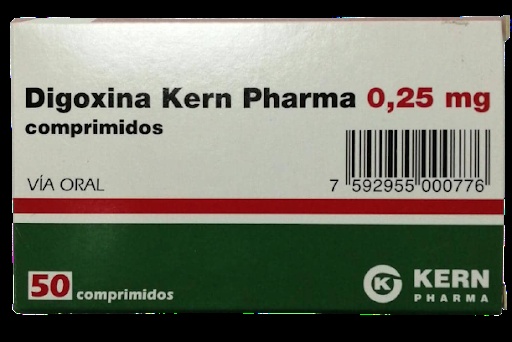
DIGOXIN KERN PHARMA 0.25 mg TABLETS



How to use DIGOXIN KERN PHARMA 0.25 mg TABLETS
Translated with AI
This page provides general information and does not replace a doctor’s consultation. Always consult a doctor before taking any medication. Seek urgent medical care if symptoms are severe.
Show originalContents of the leaflet
Introduction
Package Leaflet: Information for the User
Digoxina Kern Pharma 0.25 mg tablets
Read all of this leaflet carefully before you start taking this medicine.
|
Contents of the pack:
- What Digoxina Kern Pharma is and what it is used for
- What you need to know before you take Digoxina Kern Pharma
- How to take Digoxina Kern Pharma
- Possible side effects
- Storing Digoxina Kern Pharma
- Contents of the pack and other information
1. What Digoxina Kern Pharma is and what it is used for
Digoxina Kern Pharma belongs to a group of medicines called cardiac glycosides. Its active ingredient is digoxin, which increases the strength of the heart muscle's contractions by specifically inhibiting an enzyme called Na+/K+-dependent adenosine triphosphatase.
This medicine is indicated for the treatment of certain heart problems, such as:
- Chronic heart failure where the main problem is systolic dysfunction (alterations in the heart's contraction),
- When heart failure is accompanied by atrial fibrillation (abnormal heart rhythm or frequency that originates when the muscle of the heart's upper chambers does not contract uniformly),
- In the treatment of certain supraventricular arrhythmias (disorders of heart rate or rhythm that originate in the upper chambers), especially atrial flutter and atrial fibrillation, with the main benefit being the reduction of ventricular rate (slower heart rate).

2. What you need to know before you take Digoxina Kern Pharma
Do not take Digoxina Kern Pharma
- if you are allergic to digoxin, other digitalis glycosides, or any of the other ingredients of this medicine,
- if you have been told you have any of the following heart problems:
- Intermittent cardiac block or second-degree atrioventricular block (alterations in the transmission of the electrical impulse between the upper and lower chambers of the heart), especially if there is a history of a heart condition called Stokes-Adams syndrome,
- Certain types of supraventricular arrhythmias, such as Wolff-Parkinson-White syndrome (a hereditary heart disease),
- Ventricular tachycardia (rapid heartbeat that starts in the ventricles) or ventricular fibrillation (very abnormal heart rhythm that can be fatal),
- Hypertrophic obstructive cardiomyopathy (a disease in which there is excessive growth of the heart muscle),
- in case of arrhythmias caused by poisoning with other cardiac glycosides (heart medicines),
- if you know or suspect you have an accessory pathway (abnormal electrical communication between the atrium and ventricle) and there is no history of previous supraventricular arrhythmias, this medicine is also contraindicated.
Warnings and precautions
This medicine should only be used under the supervision and control of a doctor. Consult your doctor or pharmacist before starting to take this medicine in any of the following cases:
- if you have recently had a myocardial infarction, digoxin should be taken with caution,
- if you are being treated with diuretics and an ACE inhibitor (heart and hypertension medicines), or only diuretics, as when the administration of digoxin is stopped, it may worsen your disease,
- if you have taken cardiac glycosides (heart medicines) two weeks before starting treatment with digoxin, your doctor should consider reducing the initial dose,
- if it is administered to the elderly or in patients with decreased renal function, the doctor should consider reducing both the initial and maintenance doses,
- when you are already being treated with digoxin, your doctor should periodically check your serum electrolytes and renal function (concentration of an enzyme called serum creatinine). The frequency of checks will depend on the severity of the case,
- if you have severe respiratory disease, as the heart muscle may be more sensitive to digoxin,
- if you have low potassium levels in the blood, as this causes the heart muscle to be more sensitive to the actions of digoxin,
- if you have hypoxia (low oxygen levels in the blood), hypomagnesemia (low magnesium levels in the blood), and marked hypercalcemia (high calcium levels in the blood), as these increase the sensitivity of the heart muscle to digoxin,
- if you have thyroid disease, you should be cautious when using this medicine. The initial and maintenance doses of digoxin should be reduced when thyroid function is deficient. In the case of hyperthyroidism (high levels of thyroid hormone in the blood), there is a relative resistance to digoxin (lower activity of this medicine) and the dose may need to be increased. During the treatment of thyrotoxicosis (excess of thyroid hormones), the dose should be reduced as the disease is controlled,
- patients with malabsorption syndrome (difficulty absorbing vitamins, minerals, and other nutrients from food) or gastrointestinal reconstructions may require higher doses of digoxin.
Using Digoxina Kern Pharma with other medicines
Tell your doctor or pharmacist that you are using or have recently used or may need to use any other medicine.
Agents that cause hypokalemia or intracellular potassium deficiency may increase sensitivity to Digoxina; these include some diuretics (medicines to facilitate fluid elimination), lithium salts, corticosteroids (anti-inflammatory medicines), and carbenoxolone (medicine for the treatment of mouth ulcers).
Digoxin blood levels may increase with the concomitant administration of the following medicines:
- Amiodarone, flecainide, prazosin, propafenone, quinidine, spironolactone (heart medicines).
- Calcium channel blockers and ACE inhibitors (hypertension medicines).
- Erythromycin, tetracycline, gentamicin, itraconazole, trimethoprim (antibiotic medicines).
- Quinine (medicine for the treatment of malaria).
- Alprazolam, lithium salts (medicine for depression).
- Diphenoxylate with atropine (association of medicines used as an antidiarrheal).
- Indomethacin.
- Propantheline (medicine for the treatment of ulcers).
Digoxin blood levels may decrease with the concomitant administration of the following medicines:
- Antacids.
- Some laxatives.
- Kaolin-pectin (antidiarrheal medicine).
- Neomycin, penicillamine, rifampicin (antibiotic medicines).
- Some cytostatics (cancer treatment medicines).
- Metoclopramide (medicine for the treatment of vomiting).
- Sulfasalazine (anti-inflammatory medicine for the stomach).
- Adrenaline (a hormone).
- Salbutamol (medicine for the treatment of asthma).
- Colestyramine (medicine for the treatment of cholesterol).
- Phenytoin (medicine for the treatment of epilepsy).
- Tell your doctor if you are taking a medicine that contains enzalutamide (for the treatment of prostate cancer). It may interfere with your digoxin tests.
Pregnancy, breastfeeding, and fertility
If you are pregnant or breastfeeding, or think you may be pregnant or are planning to have a baby, ask your doctor or pharmacist for advice before taking this medicine.
As with all medicines, the use of digoxin in pregnancy should only be considered when the expected clinical benefit to the mother outweighs any possible risk to the fetus.
Although digoxin passes into breast milk, the amounts are minimal.
Driving and using machines
No data are available on how digoxin affects the ability to drive or use machines. Therefore, be careful not to perform tasks that require special attention until you know how you tolerate the medicine.
Digoxina Kern Pharma contains lactose
This medicine contains lactose. If your doctor has told you that you have an intolerance to some sugars, consult with them before taking this medicine.
3. How to take Digoxina Kern Pharma
Follow exactly the administration instructions of this medicine indicated by your doctor or pharmacist. If in doubt, consult your doctor or pharmacist again.
The dose of digoxin for each patient must be established individually according to age, body weight, and renal function. The suggested doses are only intended to serve as an initial guide.
Your doctor should take into account the difference in effects between the administration of digoxin in oral and injectable forms when changing from one pharmaceutical form to another. For example, if a patient is switched from the oral formulation to the intravenous formulation, the dose should be reduced by at least 33%.
The normal dose is:
Adults and children over 10 years:
Loading dose (initial dose):
- Rapid oral administration:
750 to 1500 micrograms (0.75 to 1.5 mg) as a single dose.
- Slow oral administration:
250 to 750 micrograms (0.25 to 0.75 mg) should be administered daily for 1 week.
Maintenance dose:
Your doctor will indicate what your maintenance dose is, depending on the response to the initial treatment with this medicine.
On average, most patients will be maintained on 125 to 750 micrograms (0.125 to 0.75 mg) of digoxin per day. However, in those who show greater sensitivity to adverse reactions of digoxin, a dose of 62.5 micrograms (0.0625 mg) per day or lower may be sufficient.
Newborns, infants, and children under 10 years (if they have not received cardiac glycosides in the preceding two weeks):
Oral loading dose:
The doses in children depend on their weight.
However, these doses are between 25 and 45 micrograms over 24 hours.
The loading dose should be administered in divided doses, with approximately half of the total dose given as the first dose and additional fractions of the total dose at intervals of 4 to 8 hours, evaluating the clinical response before administering each additional dose.
Maintenance dose:
Your doctor will indicate what the maintenance dose is, depending on the child's response to the initial treatment with this medicine.
On average, most patients will be maintained between 20% and 25% of the loading dose, administered every 24 hours.
If you take more Digoxina Kern Pharma than you should
In case of overdose or accidental ingestion, consult your doctor or pharmacist immediately or call the Toxicology Information Service, phone: 91 562 04 20, indicating the medicine and the amount ingested.
If you forget to take Digoxina Kern Pharma
Do not take a double dose to make up for forgotten doses.
If you have any further questions on the use of this product, ask your doctor or pharmacist.

4. Possible side effects
Like all medicines, digoxin can cause side effects, although not everybody gets them.
In general, adverse reactions to digoxin depend on the dose and occur at doses higher than those required to achieve a therapeutic effect. Consequently, adverse reactions are less common when digoxin is used within the recommended dose range or within the therapeutic concentration range in serum and careful attention is paid to the conditions and medication administered concurrently.
Cardiac disorders:
Cardiac arrhythmias and alterations in the electrical conduction of the heart, including:
- Ventricular contractions that precede the normal heart rhythm and can evolve into bigeminism (alteration of the heart rhythm in which normal heartbeats alternate with premature beats) or even trigeminism (alteration of the heart rhythm in which two normal heartbeats alternate with a premature beat).
- Atrial tachycardias (disorder of heart rhythm, such as rapid heartbeats that originate in the upper chambers of the heart). It is common for them to be accompanied by atrioventricular block (disorder in the electrical conduction between the atria and ventricles) and not always is the pulse rapid (see section 2).
- Alterations in the electrocardiogram result.
- Sinus bradycardia (disorder that produces a decrease in heart rate). Especially in children, it can be a sign of digoxin intoxication.
- In children, the use of digoxin can produce any type of arrhythmia. The most common are alterations in the conduction of the electrical impulse or supraventricular tachyarrhythmias (alterations of the heart rhythm not originating in the ventricles).
Gastrointestinal disorders:
Anorexia, nausea, and vomiting that disappear a few hours after taking the medicine.
Diarrhea may also appear.
Digoxin administered orally has also been related to intestinal ischemia (interruption of blood supply to the intestine) and, rarely, to intestinal necrosis (death of part of the intestine due to interruption of blood supply).
Reproductive system and breast disorders:
Gynecomastia (development of breasts in a male) may occur with long-term administration.
Nervous system disorders:
Weakness, apathy, fatigue, malaise, headache, vision changes, depression, and even psychosis have been reported.
Skin and subcutaneous tissue disorders:
Urticaria-like or scarlatiform rashes (red rashes on the skin that cause itching or generalized redness of the skin with small raised lesions).
Blood and lymphatic system disorders:
Marked eosinophilia (increase in the amount of white blood cells in the blood).
Thrombocytopenia (decrease in the amount of platelets in the blood).
If you experience side effects, consult your doctor or pharmacist, even if it is a side effect not listed in this leaflet.
5. Storing Digoxina Kern Pharma
Keep this medicine out of the sight and reach of children.
No special storage conditions are required.
Do not use this medicine after the expiry date which is stated on the packaging after "EXP". The expiry date is the last day of the month indicated.
Medicines should not be disposed of via wastewater or household waste. Place the packaging and any unused medicine in the pharmacy's SIGRE collection point. If in doubt, ask your pharmacist how to dispose of the packaging and any unused medicine. This will help protect the environment.
6. Container Content and Additional Information
Composition of Digoxina Kern Pharma
- The active ingredient is digoxin.
- The other components are: lactose, rice starch, hydrolyzed corn starch, and magnesium stearate.
Product Appearance and Container Content
Round, biconvex tablets, white in color and with a score on both sides. The score serves to fractionate and facilitate swallowing but not to divide the tablet into equal doses.
Containers containing 50 tablets or 500 tablets.
Other Presentations
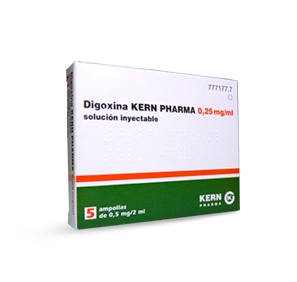
- Digoxina Kern Pharma 0.25 mg/ml injectable solution. Each container contains 5 ampoules of 2 ml.
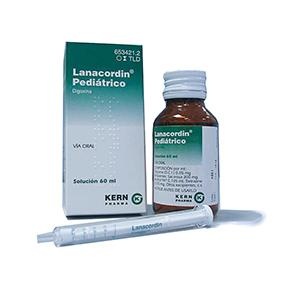
- Digoxina 0.05 mg/ml pediatric oral solution marketed under the name of Lanacordin Pediátrico. 60 ml container provided with a dosing syringe.
Marketing Authorization Holder and Manufacturer
Kern Pharma, S.L.
Pol. Ind. Colón II, C/Venus, 72
08228 Terrassa (Barcelona)
Spain
Date of the Last Revision of this Prospectus: August 2025
Detailed and updated information on this medication is available on the website of the Spanish Agency for Medicines and Health Products (AEMPS) http://www.aemps.gob.es/
___________________________________________________________________________
This information is intended solely for doctors or healthcare professionals:
The greatest therapeutic benefit of digoxin is obtained in patients with ventricular dilation.
METHOD OF ADMINISTRATION:
The intramuscular route is painful and is associated with muscle necrosis (death of cardiac muscle cells). This route cannot be recommended.
Rapid intravenous injection can cause vasoconstriction, producing hypertension and/or reduced coronary flow. Therefore, slow injection speed is important in hypertensive heart failure and acute myocardial infarction.
Adults and Children Over 10 Years:
Loading Dose (Initial Dose):
- Rapid Oral Administration:
750 to 1500 micrograms (0.75 to 1.5 mg) as a single dose.
In less urgent cases, or when there is a greater risk of toxicity, for example in the elderly, the oral loading dose should be administered in divided doses every six hours, administering approximately half of the total dose in the first dose. The clinical response should be evaluated before administering each additional dose (see section 2).
- Slow Oral Administration:
250 to 750 micrograms (0.25 to 0.75 mg) should be administered daily for 1 week, followed by an adequate maintenance dose. A clinical response should be observed within a week.
NOTE: The choice between a rapid or slow oral digitalization regimen will depend on the patient's clinical condition and the urgency of the clinical indication.
Maintenance Dose:
Your doctor will indicate what your maintenance dose is, depending on the response to initial treatment with this medication.
On average, most patients will be maintained on 125 to 750 micrograms (0.125 to 0.75 mg) of digoxin per day. However, in those who show greater sensitivity to digoxin's adverse reactions, a dose of 62.5 micrograms (0.0625 mg) per day or lower may be sufficient.
The maintenance dose should be based on the percentage of body reserves lost each day by elimination. The following formula has had widespread clinical use:
Maintenance Dose = Maximum Body Reserves x Daily Loss (percentage)
100
Where:
- Maximum Body Reserves = Loading Dose
Daily Loss (percentage) = 14 + creatinine clearance (Ccr) / 5
- Ccr is the creatinine clearance corrected based on a body weight of 70 kg or 1.73 m2 of body surface area. If only serum creatinine concentrations (Scr) are available, a Ccr (corrected based on a body weight of 70 kg) can be estimated in men as:
Ccr = (140 - age)
Scr (in mg/100 ml)
NOTE: When serum creatinine values are obtained in μmol/L, they can be converted to mg/100 ml (mg%) as follows:
Scr (mg/100 ml) = Scr (μmol/L) x 113.12
10,000
= Scr (μmol/L)
88.4
- Where 113.12 is the molecular weight of creatinine.
- In women, this result should be multiplied by 0.85.
- These formulas cannot be used for creatinine clearance in children.
In practice, this means that most patients will be maintained on 125 to 750 micrograms (0.125 to 0.75 mg) of digoxin per day. However, in those who show greater sensitivity to digoxin's adverse reactions, a dose of 62.5 micrograms (0.0625 mg) per day or lower may be sufficient.
Newborns, Infants, and Children Under 10 Years (if they have not received cardiac glycosides in the preceding two weeks):
Oral Loading Dose:
Doses in children depend on their weight.
However, these doses are between 25 and 45 micrograms over 24 hours.
The loading dose should be administered in divided doses, with approximately half of the total dose given as the first dose and the additional fractions of the total dose at intervals of 4 to 8 hours, evaluating the clinical response before administering each additional dose.
Maintenance:
Your doctor will indicate what the maintenance dose is, depending on the child's response to initial treatment with this medication.
On average, most patients will be maintained between 20% and 25% of the loading dose, administered every 24 hours.
In newborns, especially premature infants, the renal clearance of digoxin is decreased, and appropriate dose reductions should be considered, beyond the general dosing instructions.
After the newborn phase, children generally require proportionally higher doses than adults based on weight or body surface area, as indicated in the following table. Children over 10 years require adult doses proportional to their body weight.
- Oral Loading Dose:
This should be administered according to the following program:
Premature newborns <1.5 kg: 25 micrograms/kg over 24 hours.
Premature newborns 1.5 kg - 2.5 kg: 30 micrograms/kg over 24 hours.
Full-term newborns up to 2 years: 45 micrograms/kg over 24 hours.
2 to 5 years: 35 micrograms/kg over 24 hours.
5 to 10 years: 25 micrograms/kg over 24 hours.
The loading dose should be administered in divided doses, with approximately half of the total dose given as the first dose and the additional fractions of the total dose at intervals of 4 to 8 hours, evaluating the clinical response before administering each additional dose.
- Maintenance:
The maintenance dose should be administered according to the following program:
Premature newborns:
- daily dose = 20% of the 24-hour loading dose (intravenous or oral).
Full-term newborns and children up to 10 years:
- daily dose = 25% of the 24-hour loading dose (intravenous or oral).
These dosing schemes are designed to be a guideline, and careful clinical observation and control of digoxin serum levels (see Control) should be performed to adjust the dose in these pediatric patient groups.
If cardiac glycosides have been administered in the two weeks preceding the start of treatment with this medication, it should be anticipated that the optimal loading doses of digoxin will be lower than those recommended above.
Digitalis glycosides are a significant cause of accidental poisoning in children. The tolerance of newborns to digitalis glycosides is variable since the renal clearance of the medication is reduced. Premature and immature newborns are especially sensitive.
Elderly:
The tendency towards altered renal function and low net body mass in the elderly influences the pharmacokinetics of this medication such that elevated digoxin serum levels and associated toxicity may easily appear, unless lower doses of digoxin are used than those used in non-elderly patients. Digoxin serum levels should be regularly monitored, and hypokalemia should be avoided.
Dosing Recommendations in Specific Patient Groups:
See the "Warnings and Precautions" section.
Control:
Digoxin serum concentrations can be expressed in conventional units of ng/ml or in SI units of nmol/l. To convert ng/ml to nmol/l, multiply ng/ml by 1.28.
Digoxin serum concentration can be determined by radioimmunoassay. Blood should be drawn 6 hours or more after the last dose of this medication. There are no strict guidelines on the interval of serum concentrations that are most effective, but most patients will benefit, with minimal risk of developing signs and symptoms of toxicity, with digoxin concentrations between 0.8 ng/ml (1.02 nmol/l) and 2.0 ng/ml (2.56 nmol/l). Above this interval, signs and symptoms of toxicity may be more frequent, and levels above 3.0 ng/ml (3.84 nmol/l) are likely to be toxic. However, to decide if a patient's symptoms are due to digoxin, the clinical condition, along with the serum potassium level and thyroid function, are important factors to consider.
Other glycosides, including digoxin metabolites, may interfere with available assays, so caution should be exercised with values that do not seem to be in line with the patient's clinical condition.
SYMPTOMS OF OVERDOSAGE AND TREATMENT:
Adults:
In adults without heart disease, clinical observation indicates that a digoxin overdose of 10-15 mg was the dose that led to death in half of the patients. If an adult without heart disease ingested more than 25 mg of digoxin, death or progressive toxicity that would only respond to the administration of digoxin-binding antibody fragments would occur.
Children:
In children from 1 to 3 years without heart disease, clinical observation suggests that a digoxin overdose of 6 to 10 mg was the dose that led to death in half of the patients. If more than 10 mg of digoxin were ingested by a child from 1 to 3 years without heart disease, the outcome would invariably be fatal if digoxin-binding antibody fragments were not administered.
After recent ingestion, either by accident or deliberate self-poisoning, the available load for absorption could be reduced by gastric lavage.
In cases of massive digitalis ingestion, patients should receive large doses of activated charcoal to prevent absorption and to bind digoxin in the intestine during enteroenteric recirculation.
If hypokalemia exists, it should be corrected with potassium supplements either orally or intravenously, depending on the urgency of the situation. In cases where a large amount of digoxin has been ingested, hyperkalemia may appear due to potassium release from skeletal muscle. Before administering potassium in cases of digoxin overdose, the serum potassium level should be known.
Bradycardias may respond to atropine, but a temporary cardiac pacemaker may be required. Ventricular arrhythmias may respond to lignocaine (anesthesia medication) or phenytoin (epilepsy treatment medication).
Dialysis is not particularly effective for eliminating digoxin from the body in cases of life-threatening toxicity.
After the intravenous administration of specific digoxin antibody fragments (of ovine origin), there is a rapid reversal of the complications associated with severe digoxin, digitoxin, and related glycoside poisoning.
- Country of registration
- Average pharmacy price2.5 EUR
- Active substance
- Prescription requiredYes
- Manufacturer
- This information is for reference only and does not constitute medical advice. Always consult a doctor before taking any medication. Oladoctor is not responsible for medical decisions based on this content.
- Alternatives to DIGOXIN KERN PHARMA 0.25 mg TABLETSDosage form: INJECTABLE, 0.25 mg digoxin/mlActive substance: digoxinManufacturer: Kern Pharma S.L.Prescription requiredDosage form: TABLET, 0.25 mgActive substance: digoxinManufacturer: Teofarma S.R.L.Prescription requiredDosage form: ORAL SOLUTION/SUSPENSION, 0.05 mg digoxin/mlActive substance: digoxinManufacturer: Kern Pharma S.L.Prescription required
Online doctors for DIGOXIN KERN PHARMA 0.25 mg TABLETS
Discuss questions about DIGOXIN KERN PHARMA 0.25 mg TABLETS, including use, safety considerations and prescription review, subject to medical assessment and local regulations.







Frequently Asked Questions
