



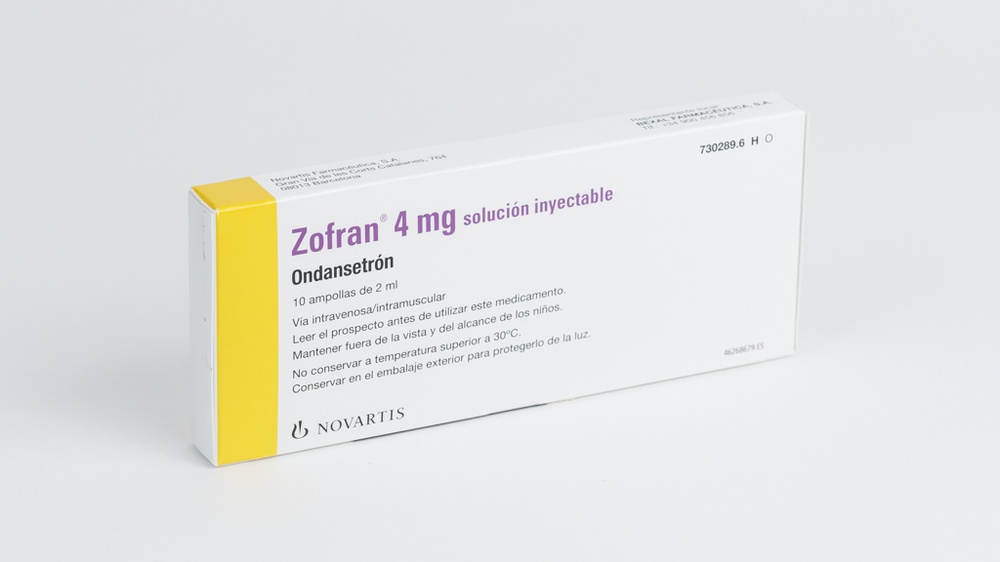
ZOFRAN 4 mg Solucion Inyectable

Revisión de receta online
Un médico revisará tu caso y determinará si la prescripción es médicamente apropiada.

Habla con un médico sobre este medicamento
Comenta tus síntomas y las opciones de tratamiento en una consulta online.



Cómo usar ZOFRAN 4 mg SOLUCION INYECTABLE
Contenido del prospecto
- Introducción
- Qué es Zofran y para qué se utiliza
- Qué necesita saber antes de que le administren Zofran
- Embarazo, lactancia y fertilidad
- Cómo se administra Zofran
- Posibles efectos adversos
- Conservación de Zofran
- Contenido del envase e información adicional
Introducción
Prospecto: información para el paciente
Zofran 4mg solución inyectable
ondansetrón hidrocloruro dihidrato
Lea todo el prospecto detenidamente antes de empezar a usar este medicamento, porque contiene información importante para usted.
- Conserve este prospecto, ya que puede tener que volver a leerlo.Si tiene alguna duda, consulte a su médico, farmacéutico o enfermero.
- Este medicamento se le ha recetado solamente a usted, y no debe dárselo a otras personas aunque tengan los mismos síntomas que usted, ya que puede perjudicarles.
- Si experimenta efectos adversos, consulte a su médico, farmacéutico o enfermero, incluso si se trata de efectos adversos que no aparecen en este prospecto. Ver sección 4.
Contenido del prospecto
- Qué es Zofran y para qué se utiliza
- Qué necesita saber antes de que le administren Zofran
- Cómo se administra Zofran
- Posibles efectos adversos
- Conservación de Zofran
- Contenido del envase e información adicional
1. Qué es Zofran y para qué se utiliza
Zofran pertenece al grupo de medicamentos denominados antieméticos. Ondansentrón es un antagonista del receptor 5HT3. Actúa inhibiendo los receptores 5HT3 en las neuronas ubicadas en el sistema nervioso central y periférico.
Ondansetrón se utiliza para:
- prevenir las náuseas y los vómitos causados por:
- la quimioterapia en el tratamiento del cáncer en adultos y niños mayores de 6 meses de edad.
- la radioterapia en el tratamiento del cáncer en adultos.
- prevenir y tratar las náuseas y vómitos postoperatorios en adultos y niños mayores de 1 mes de edad.

¿No estás seguro de si este medicamento es adecuado para ti?
Comenta tus síntomas y tratamiento con un médico online.
2. Qué necesita saber antes de que le administren Zofran
- No useZofran
- Si es alérgico(hipersensible) a ondansetrón o a alguno de los demás componentes de este medicamento (incluidos en la sección 6).
- Si tiene o ha tenido alguna reacción alérgica(hipersensibilidad) con otros antieméticos (por ejemplo, granisetrón o dolasetrón).
- Si está tomando apomorfina (medicamento usado para tratar la enfermedad de Parkinson).
Si considera que esto le aplica, no use Zofran y consulte a su médico.
Advertencias y precauciones
- Consulte a su médico, farmacéutico o enfermedor antes de empezar a usar ZofranSi padece un bloqueo en el intestino o si sufre de estreñimiento grave. Zofran puede aumentar el bloqueo o el estreñimiento.
- Si alguna vez ha tenido problema de corazón, incluyendo ritmo cardiaco irregular (arritmia).
- Si está siendo sometido a una operación de amígdalas.
- Si tiene problemas de higádo.
Si le van a realizar alguna prueba diagnóstica (incluidos análisis de sangre, orina, pruebas cutáneas que utilizan alérgenos, etc.) comunique a su médico que está tomando este medicamento, ya que puede alterar los resultados.
Otros medicamentos y Zofran
Informe a su médico o farmacéutico si está utilizando, ha utilizado recientemente o pudiera tener que utilizar cualquier otro medicamento.
En particular, es importante informar al médico si está tomando cualquiera de los siguientes medicamentos, ya que puede ser necesario interrumpir el tratamiento o ajustar la dosis de alguno de ellos:
- rifampicina(antibiótico usado para tratar infecciones tales como la tuberculosis),
- tramadolo buprenorfina(medicamentos usados para tratar el dolor grave),
- fenitoínao carbamacepina(medicamentos utilizados para tratar la epilepsia),
- medicamentos utilizados para tratar problemas del corazóncomo alteraciones en los latidos (antiarrítmicos) y/o para tratar la tensión alta(betabloqueantes),
- haloperidolo metadona(medicamentos que pueden afectar al corazón),
- antraciclinasy trastuzumab(medicamentos utilizados para tratar el cáncer),
- fluoxetina, paroxetina, sertralina, fluvoxamina, citalopram, escitalopram(Inhibidores selecivos de la recaptación de serotonina, empleados para tratar la depresión y/o ansiedad),
- venlafaxina, duloxetina(Inhibidores de la recaptación de serotonina y noradrenalina, empleados para tratar la depresión y/o ansiedad).
→ Informe a su médico o farmacéuticosi está tomando alguno de estos medicamentos.
Informe a su médico o farmacéutico inmediatamente si nota alguno de estos síntomas durante o después del tratamiento
- si nota un dolor repentino u opresión en el pecho (isquemia miocárdica).
Zofran solución inyectable no se debe administrar en la misma jeringa o perfusión que otros medicamentos.
Ondansetrón sólo debe mezclarse con aquellas soluciones para perfusión recomendadas .
Embarazo, lactancia y fertilidad
Si está embarazada o en periodo de lactancia, cree que podría estar embarazada o tiene intención de quedarse embarazada, consulte a su médico o farmacéutico antes de utilizar este medicamento.
Zofran no debe utilizarse durante el primer trimestre del embarazo. Esto se debe a que Zofran puede aumentar ligeramente el riesgo de que un bebé nazca con labio leporino y/o fisura del palatina (aberturas o hendiduras en el labio superior o en el paladar). Si ya está embarazada o en periodo de lactancia, cree que podría estar embarazada o tiene intención de quedarse embarazada, consulte a su médico o farmacéutico antes de utilizar Zofran, ya que Zofran puede causar daño en el feto.
Si usted es una mujer en edad fértil, su médico o enfermero deberá comprobar si está embarazada y le realizará una prueba de embarazo antes de comenzar el tratamiento con Zofran.
Las mujeres en edad fértil deben usar un método anticonceptivo eficaz durante el tratamiento con Zofran. Consulte a su médico acerca de las opciones de métodos anticonceptivos.
Si se queda embarazada durante el tratamiento con Zofran,informe a su médico.
No se recomienda dar el pecho durante el tratamiento con Zofran. Los ingredientes de Zofran (ondansetrón) pueden pasar a la leche materna y pueden afectar a su bebé.
Conducción y uso de máquinas
Es poco probable que Zofran pueda afectar la capacidad para conducir y utilizar máquinas.
Zofran contiene sodio
Este medicamento contiene menos de 1 mmol de sodio (23 mg) por ampolla, esto es esencialmente "exento de sodio". Si su médico utiliza una solución salina para diluir Zofran, entonces la cantidad de sodio recibida sería mayor.

¿Has empezado a tomar el medicamento y tienes preguntas?
Comenta tus síntomas y tratamiento con un médico online.
3. Cómo se administra Zofran
Zofran debe ser administrado siempre por un profesional sanitario cualificado y nunca por uno mismo.
Zofran se administra como inyección intravenosa, inyección intramuscular, o después de su dilución, como perfusión intravenosa (durante un tiempo más prolongado).
Dosis
Su médico decidirá sobre la correcta dosis de tratamiento con Zofran.
La dosis varía en función de su tratamiento médico (quimioterapia o cirugía), del funcionamiento de su hígado y de si la administración es por inyección o perfusión.
Náuseas y vómitos inducidos por quimioterapia o radioterapia
Adultos
El día en que se someta a quimioterapia o radioterapia le administrarán la dosis habitual en adultos de 8 mg mediante una inyección en una vena inmediatamente antes de su tratamiento, y otros 8 mg doce horas más tarde.
En los días siguientes:
- la dosis intravenosa o intramuscular habitual en adultos no superará los 8 mg.
- la administración oral puede comenzar doce horas después de la quimioterapia o radioterapia y puede continuar durante un periodo de hasta 5 días. La dosis habitual es 8 mg dos veces al día.
Si es probable que su quimioterapia o radioterapia cause náuseas y vómitos intensos, le podrán administrar una dosis de Zofran mayor de lo habitual. Su médico decidirá qué hacer. No se debe administrar una dosis única mayor de 16 mg debido al incremento del riesgo dosis-dependiente de prolongación del intervalo QT.
Náuseas y vómitos inducidos por quimioterapia
Niños mayores de 6meses y adolescentes
El médico decidirá la dosis en función del peso o de la superficie corporal de su hijo.
El día de la quimioterapia: la primera dosis se administra mediante una inyección en una vena, inmediatamente antes del tratamiento de su hijo.
Normalmente, doce horas después de la quimioterapia su hijo recibirá ondansetrón por vía oral. La dosis habitual es de 4 mg dos veces al día y puede continuar durante un periodo de hasta 5 días.
Náuseas y vómitos postoperatorios
Para prevenir las náuseas y vómitos después de una intervención quirúrgica
Adultos
La dosis habitual es de 4 mg, administrada mediante una inyección en una vena o inyección intramuscular. Esta dosis se le administrará inmediatamente antes de la intervención.
Niños mayores de 1 mes de edad y adolescentes
El médico decidirá la dosis. La dosis máxima es de 4 mg, administrada mediante una inyección en una vena. Esta dosis se le administrará inmediatamente antes de la intervención.
Para tratar las náuseas y vómitos después de una intervención quirúrgica
Adultos
La dosis habitual en adultos es de 4 mg, administrada mediante una inyección en una vena o inyección intramuscular
Niños mayores de 1 mes de edad y adolescentes.
El médico decidirá la dosis. Se puede administrar una dosis única de ondansetrón mediante inyección intravenosa lenta (no menos de 30 segundos) con dosis de 0,1 mg/kg hasta un máximo de 4 mg antes, durante o después de la inducción de la anestesia.
Ajustes de la dosis
Insuficiencia hepática
En los pacientes con problemas hepáticos, la dosis debe ajustarse a un máximo de 8 mg diarios de Zofran.
Edad avanzada, insuficiencia renal o metabolizadores lentos de esparteína/debrisoquina
No es necesario modificar la dosis diaria o la frecuencia de la dosis o la vía de administración.
Duración del tratamiento
Su médico decidirá la duración de su tratamiento con Zofran. No suspenda el tratamiento antes.
Si estima que la acción de Zofran es demasiado fuerte o débil, comuníqueselo a su médico o farmacéutico.
Si le administran más Zofran del que debe
Este medicamento le será administrado en el hospital. Su médico o enfermera le administrará Zofran a usted o a su hijo por lo que es improbable que usted o su hijo reciba más cantidad. Si cree que a usted o a su hijo le han administrado más cantidad o no le han dado una dosis, informe al médico o enfermera. Los síntomas de sobredosis pueden incluir problemas de visión, presión baja de la sangre (lo que puede causar mareos o desmayos) y palpitaciones (latido irregular del corazón). En caso de sobredosis o ingestión accidental, consulte inmediatamente a su médico o farmacéutico o llame al servicio de Información Toxicológica (Teléfono: 91 5620420) indicando el medicamento y la cantidad administrada.
Si tiene cualquier duda sobre la administración de Zofran, consulte con el médico que se lo está administrando.
4. Posibles efectos adversos
Al igual que todos los medicamentos Zofran puede producir efectos adversos, aunque no todas las personas los sufran.
Efectos adversos muy frecuentes
Pueden afectar a más de 1 de cada 10 pacientes
- dolor de cabeza.
Efectos adversos frecuentes
Pueden afectar hasta 1 de cada 10 pacientes
- sensación de calor o rubor,
- irritación en el lugar donde se administró la inyección, así como dolor, sensación de ardor, hinchazón, enrojecimiento o picor,
- estreñimiento.
Efectos adversos poco frecuentes
Pueden afectar hasta 1 de cada 100 pacientes
- movimientos giratorios ascendentes de los ojos, rigidez muscular anormal, movimientos del cuerpo, temblor,
- convulsiones,
- latidos lentos o irregulares del corazón,
- presión sanguínea más baja de lo normal (hipotensión),
- hipo,
- aumento de los niveles en los resultados de pruebas sanguíneas de comprobación de funcionamiento del hígado.
- Informe inmediatamente a su médico o farmacéuticosi presenta alguno de estos síntomas.
Efectos adversos raros
Pueden afectar a menos de 1 de cada 1.000 pacientes
- visión borrosa,
- vértigo,
- alteración del ritmo cardiaco (en ocasiones puede causar una pérdida repentina del conocimiento),
- reacciones alérgicas (algunas veces graves):
- aparición repentina de pitidos y dolor u opresión en el pecho,
- hinchazón de párpados, cara, labios, boca o lengua,
- erupción de la piel o urticaria en cualquier parte del cuerpo.
- Si experimenta alguno de estos síntomas, deje de tomar el medicamento inmediatamente y avise a su médico.
Efectos adversos muy raros
Pueden afectar a menos de 1 de cada 10.000 pacientes
- ceguera transitoria, que normalmente se resuelve en 20 minutos,
- alteraciones en el electrocardiograma,
- erupción extensa en la piel con ampollas y descamación, que afecta una gran parte la superficie corporal (necrolisis epidérmica tóxica).
- Informe inmediatamente a su médicosi presenta alguno de estos síntomas.
Efectos adversos de frecuencia no conocida
No puede estimarse su frecuencia
- isquemia miocárdica
- aparición de dolor repentino en el pecho u,
- opresión en el pecho.
- Si experimenta alguno de estos síntomas, deje de tomar el medicamento inmediatamente y avise a su médico.
Comunicación de efectos adversos
Si experimenta cualquier tipo de efecto adverso, consulte a su médico o farmacéutico, incluso si se trata de posibles efectos adversos que no aparecen en este prospecto. También puede comunicarlos directamente a través del Sistema Español de Farmacovigilancia de Medicamentos de Uso Humano: www.notificaram.es. Mediante la comunicación de efectos adversos usted puede contribuir a proporcionar más información sobre la seguridad de este medicamento.
5. Conservación de Zofran
Mantener este medicamento fuera de la vista y del alcance de los niños.
Conservar en el embalaje original para protegerlo de la luz. No conservar a temperatura superior a 30 ºC.
No utilice este medicamento después de la fecha de caducidad que aparece en la etiqueta después de CAD. La fecha de caducidad es el último día del mes que se indica.
Los medicamentos no se deben tirar por los desagües ni a la basura. En caso de duda pregunte a su farmacéutico cómo deshacerse de los envases y de los medicamentos que no necesita. De esta forma, ayudará a proteger el medio ambiente.
6. Contenido del envase e información adicional
Composición de Zofran 4mg solución inyectable
- El principio activo es ondansetrón hidrocloruro dihidrato. Cada ampolla contiene 4 mg de ondansetrón (como hidrocloruro dihidrato).
- Los demás componentes (excipientes) son: ácido cítrico monohidrato (E330), citrato de sodio dihidrato (E331), cloruro de sodio y agua para preparaciones inyectables.
Aspecto del producto y contenido del envase
Zofran 4 mg solución inyectable se presenta en forma de solución inyectable, transparente e incolora, envasada en ampollas estériles de 2 ml. Cada envase contiene 5, 10 o 50 ampollas.
Puede que solamente estén comercializados algunos tamaños de envases.
Titular de la autorización de comercialización
BEXAL FARMACÉUTICA, S.A.
Centro Empresarial Parque Norte
Edificio Roble
C/Serrano Galvache 56,
28033 Madrid
España
Responsable de la fabricación
Novartis Pharma GmbH
Roonstraße 25
D-90429 Nuremberg
Alemania
o
Novartis Farmacéutica, S.A.
Gran Via de les Corts Catalanes, 764
08013 Barcelona
España
o
LEK Pharmaceuticals d.d.,
Verovškova ulica 57,
1526 Ljubljana,
Eslovenia
Fecha de la última revisión de este prospecto:mayo 2024
La información detallada de este medicamento está disponible en la página web de la Agencia Española de Medicamentos y Productos Sanitarios (AEMPS) http: //www.aemps.gob.es
Esta información está destinada únicamente a profesionales del sector sanitario:
Instrucciones de uso
Para inyección intravenosa o intramuscular o para perfusión intravenosa después de su dilución.
La solución para inyección no contiene conservantes y debe ser utilizada inmediatamente después de ser abierta. La solución no utilizada debe ser rechazada.
La solución para inyección no se debe esterilizar en autoclave.
Compatibilidad con fluidos intravenosos
Estudios de compatibilidad han demostrado que Zofran solución inyectable es estable durante siete días a temperatura inferior a 25 ºC bajo luz fluorescente o conservada en frigorífico, con las siguientes soluciones para perfusión recomendadas:
- Solución para perfusión intravenosa BP de cloruro sodio 0,9 % p/v.
- Solución para perfusión intravenosa BP de glucosa 5 % p/v.
- Solución parra perfusión intravenosa BP de manitol 10 % p/v.
- Soluciones de Ringer para perfusión intravenosa.
- Solución para perfusión intravenosa BP de cloruro potásico 0,3 % p/v y cloruro sodio 0,9 % p/v.
- Solución para perfusión intravenosa BP de cloruro potásico 0,3 % p/v y glucosa 5 % p/v.
Compatibilidad con otros fármacos
Los siguientes fármacos pueden administrarse mediante el conector en Y del equipo de administración intravenosa de ondansetrón, a fin de proporcionar fluidos con concentraciones de 16-160 ?g/ml (8 mg/500 ml, 8 mg/50 ml):
Cisplatino | concentraciones de hasta 0,48 mg/ml (240 mg en 500 ml). Tiempo de administración de 1 a 8 horas. |
5-Fluorouracilo | concentraciones de hasta 0,8 mg/ml (2,4 g en 3 l o 400 mg en 500 ml) administrados a una velocidad de por lo menos 20 ml/hora (500 ml/24 horas). Concentraciones superiores de 5-fluorouracilo pueden causar la precipitación de ondansetrón. La solución de 5-fluorouracilo puede contener hasta un 0,045% p/v de cloruro magnésico además de otros excipientes compatibles. |
Carboplatino | concentraciones de 0,18 mg/ml - 9,9 mg/ml (90 mg en 500 ml a 990 mg en 100 ml). Tiempo de administración 10-60 minutos. |
Etopósido | concentraciones de 0,144 mg/ml - 0,25 mg/ml (72 mg en 500 ml a 250 mg en 1 l). Tiempo de administración 30-60 minutos. |
Ceftazidima | administrar por vía intravenosa dosis de 250 mg-2000 mg reconstituidos con agua para inyección siguiendo las instrucciones del prospecto (2,5 ml para 250 mg y 10 ml para 2 g de ceftazidima). Tiempo de administración unos 5 minutos. |
Ciclofosfamida | administrar por vía intravenosa dosis de 100 mg-1 g reconstituidos con agua para inyección (5 ml por cada 100 mg de ciclofosfamida) siguiendo las instrucciones del prospecto. Tiempo de administración unos 5 minutos. |
Doxorrubicina | administrar por vía intravenosa dosis de 10 mg-100 mg reconstituidos con agua para inyección (5 ml por cada 10 mg de doxorrubicina) siguiendo las instrucciones del prospecto. Tiempo de administración unos 5 minutos. |
Dexametasona | pueden administrarse 20 mg de fosfato sódico de dexametasona en forma de inyección intravenosa lenta de 2-5 minutos de duración, a través del conector en Y de un equipo de perfusión que proporciona de 8 a 16 mg de ondansetrón diluidos en 50-100 ml de un fluido para perfusión compatible en unos 15 minutos. Se ha demostrado la compatibilidad entre el fosfato sódico de dexametasona y ondansetrón, lo que apoya la administración de estos fármacos utilizando el mismo equipo de administración, produciendo concentraciones en el fluido administrado de 32 ?g - 2,5 mg/ml de fosfato sódico de dexametasona y de 8 ?g - 1 mg/ml de ondansetrón. |
- País de registro
- Forma farmacéuticaINYECTABLE, 4 mg
- Código ATCA04AA01
- Disponibilidad en farmaciasProblema de suministro reportado
- Principio activo
- Requiere recetaSí
- Fabricante
- ComposiciónCITRATO DE SODIO (E-331) (0,5 mg mg), CLORURO DE SODIO (18 mg mg)
- Esta información es de carácter general y no sustituye la consulta con un profesional sanitario.
- Alternativas a ZOFRAN 4 mg SOLUCION INYECTABLEForma farmacéutica: INYECTABLE, 2 MG/MLPrincipio activo: OndansetronFabricante: Accord Healthcare S.L.U.Requiere recetaForma farmacéutica: COMPRIMIDO BUCODISPERSABLE/LIOTAB, 4 MGPrincipio activo: OndansetronFabricante: Aristo Pharma Iberia S.L.Requiere recetaForma farmacéutica: COMPRIMIDO BUCODISPERSABLE/LIOTAB, 8 MGPrincipio activo: OndansetronFabricante: Aristo Pharma Iberia S.L.Requiere receta
Médicos online para ZOFRAN 4 mg SOLUCION INYECTABLE
Comenta la dosis, los posibles efectos secundarios, interacciones, contraindicaciones o la revisión de receta de ZOFRAN 4 mg SOLUCION INYECTABLE, sujeto a valoración médica y a la normativa local.









Obtén una receta de ZOFRAN 4 mg SOLUCION INYECTABLE online
Rellena un formulario de 2 minutos
Cuéntanos tus síntomas, historial y el medicamento que necesitas.
Elige un médico o nosotros te asignamos uno
Escoge un especialista o te conectamos con el próximo médico disponible.
El médico revisa tu caso
Normalmente en 30 minutos. Puede hacerte preguntas adicionales por chat.
Recógela en cualquier farmacia
Receta electrónica enviada a tu correo, válida en toda España.
Preguntas frecuentes
ZOFRAN 4 mg SOLUCION INYECTABLE requiere receta en España. Puedes confirmarlo con un médico online según tu caso.
El principio activo de ZOFRAN 4 mg SOLUCION INYECTABLE es Ondansetron. Esta información ayuda a identificar medicamentos con la misma composición pero con diferentes nombres comerciales.
ZOFRAN 4 mg SOLUCION INYECTABLE es fabricado por Bexal Farmaceutica S.A.. La marca y el envase pueden variar según el distribuidor.
Los Médicos de familia, Psiquiatras, Dermatólogos, Cardiólogos, Endocrinólogos, Gastroenterólogos, Neumólogos, Nefrólogos, Reumatólogos, Hematólogos, Infectólogos, Alergólogos, Geriatras, Pediatras, Oncólogos pueden valorar la prescripción de ZOFRAN 4 mg SOLUCION INYECTABLE cuando esté clínicamente indicado. Puedes reservar una videoconsulta para comentar tu caso y las opciones de tratamiento.
España cuenta con una infraestructura sanitaria bien desarrollada en ciudades principales como Madrid, Barcelona, Valencia y Sevilla. Las farmacias están ampliamente disponibles y operan bajo estrictas regulaciones, garantizando el acceso a medicamentos con receta.
Puedes comprar ZOFRAN 4 mg SOLUCION INYECTABLE en Madrid, Barcelona, Sevilla o Valencia en cualquier farmacia local con una receta válida.
Para obtener una receta, puedes utilizar Oladoctor:
Otros medicamentos con el mismo principio activo (Ondansetron) incluyen ONDANSETRON ACCORD 2 mg/ml SOLUCION INYECTABLE EFG, ONDANSETRON ARISTO 4 MG COMPRIMIDOS BUCODISPERSABLES EFG, ONDANSETRON ARISTO 8 MG COMPRIMIDOS BUCODISPERSABLES EFG. Pueden tener diferentes nombres comerciales o formulaciones, pero contienen el mismo componente terapéutico. Consulta siempre con un médico antes de cambiar o iniciar un nuevo medicamento.
