



VOTRIENT 200 mg Film-Coated Tablets

Prescription review online
A doctor will review your case and decide whether a prescription is medically appropriate.

Talk to a doctor about this medicine
Discuss your symptoms and possible next steps in a quick online consultation.



How to use VOTRIENT 200 mg FILM-COATED TABLETS
Contents of the leaflet
- Introduction
- What is Votrient and what is it used for
- What you need to know before you take Votrient
- How to take Votrient
- Possible Adverse Effects
- Storage of Votrient
- Container contents and additional information
Introduction
Package Leaflet: Information for the User
Votrient 200mg film-coated tablets
Votrient 400mg film-coated tablets
pazopanib
Read all of this leaflet carefully before you start taking this medicine because it contains important information for you.
- Keep this leaflet, you may need to read it again.
- If you have any further questions, ask your doctor or pharmacist.
- This medicine has been prescribed for you only. Do not pass it on to others. It may harm them, even if their signs of illness are the same as yours.
- If you get any side effects, talk to your doctor or pharmacist. This includes any possible side effects not listed in this leaflet. See section 4.
Contents of the pack
- What is Votrient and what is it used for
- What you need to know before you take Votrient
- How to take Votrient
- Possible side effects
- Storing Votrient
- Contents of the pack and other information
1. What is Votrient and what is it used for
Votrient is a type of medicine called a protein kinase inhibitor. It works by stopping the activity of proteins involved in the growth and spread of cancer cells.
Votrient is used in adults to treat:
- advanced or spreading kidney cancer to other organs.
- certain types of soft tissue sarcoma, which is a type of cancer that affects the connective tissue of the body. It can occur in muscles, blood vessels, fatty tissue, or other tissues that connect, surround, and protect organs.

Not sure if this medicine is right for you?
Discuss your symptoms and treatment with a doctor online.
2. What you need to know before you take Votrient
Do not take Votrient
Consult your doctorif you think this may apply to you.
Warnings and precautions
Talk to your doctor before you start taking Votrient:
Consult your doctorif you think you might have any of these problems. Your doctor will decide if Votrient is suitable for you. You may need additional teststo check that your kidneys, heart, and liver are working properly.
High blood pressure and Votrient
Votrient may increase your blood pressure. Your doctor will check your blood pressure before you take Votrient and while you are taking it. If you have high blood pressure, you will receive treatment with medicines to help lower it.
- Tell your doctorif you have high blood pressure.
If you are going to have an operation
Your doctor will tell you to stop taking Votrient at least 7 days before your operation, as this may affect wound healing. Your treatment will be restarted when your wounds have healed properly.
Conditions that require your attention
Votrient may make other conditions worse or cause serious side effects. You should be aware of certain symptoms while taking Votrient to reduce the risk of any problems. See section4.
Children and adolescents
Votrient is not recommended for people under 18 years of age. It is not known how Votrient works in this age group. Additionally, it should not be used in children under 2 years of age due to safety concerns.
Other medicines and Votrient
Tell your doctor or pharmacist if you are taking, have recently taken, or might take any other medicines. This includes herbal medicines and medicines bought without a prescription.
Some medicines may affect how Votrient works or increase the chance of you having side effects. Votrient may also affect how other medicines work. These include:
- clarithromycin, ketoconazole, itraconazole, rifampicin, telithromycin, voriconazole (used to treat infections).
- atazanavir, indinavir, nelfinavir, ritonavir, saquinavir (used to treat HIV).
- nefazodone (used to treat depression).
- simvastatin and possibly other statins (used to treat high cholesterol levels).
- medicines that reduce stomach acidity. The type of medicine you are taking to reduce stomach acidity (e.g., a proton pump inhibitor, H2 receptor antagonists, or antacids) may affect how you take Votrient. Consult your doctor or nurse for more information.
Tell your doctoror pharmacist if you are taking any of these medicines.
Taking Votrient with food and drinks
Do not take Votrient with food, as food affects the absorption of the medicine. Take it at least 2 hours after a meal or 1 hour before a meal (see section 3).
Do not drink grapefruit juicewhile being treated with Votrient, as this may increase the chance of side effects.
Pregnancy, breastfeeding, and fertility
Votrient is not recommended if you are pregnant.The effect of Votrient during pregnancy is not known.
- Tell your doctor if you are pregnantor are planning to become pregnant.
- Use a reliable method of contraceptionwhile taking Votrient and for at least 2 weeks after, to prevent pregnancy.
- If you become pregnant during treatmentwith Votrient, tell your doctor.
Do not breastfeed while taking Votrient. It is not known if the components of Votrient pass into breast milk. Inform your doctor of this.
Male patients(including those who have had a vasectomy) who have partners who are pregnant or may become pregnant (including those using other contraceptive methods) must use condoms during sexual intercourse while taking Votrient and for at least 2 weeks after the last dose.
Fertility may be affectedby treatment with Votrient. Consult your doctor about this.
Driving and using machines
Votrient may cause side effects that may affect your ability to drive or use machines.
- Avoid driving or using machines if you feel dizzy, tired, or weak, or if you are low on energy.
Votrient contains sodium
This medicine contains less than 1 mmol of sodium (23 mg) per film-coated tablet; this is essentially “sodium-free”.
3. How to take Votrient
Always take this medicine exactly as your doctor has told you. If you are not sure, check with your doctor or pharmacist.
How much to take
The usual doseis 800 mg taken once a day. The dose can be taken as 2 tablets of 400 mg or as 4 tablets of 200 mg. The dose of 800 mg once a day is the maximum dose per day. Your doctor may need to reduce your dose if you have side effects.
When to take it
Do not take Votrient with food.Take it at least 2 hours after a meal or 1 hour before a meal. For example, you can take it 2 hours after breakfast or 1 hour before lunch. Take Votrient at the same time each day.
Swallow the tablets whole with water, one after the other. Do not break or crush the tablets, as this affects how the medicine is absorbed and may increase the chance of side effects.
If you take more Votrient than you should
If you take more tablets than you should, ask your doctor or pharmacist for advice.If possible, show them the pack or this leaflet.
If you forget to take Votrient
Do not take a double dose to make up for forgotten doses. Just take your next dose at the usual time.
Do not stop taking Votrient
Take Votrient for as long as your doctor recommends. Do not stop treatment unless your doctor advises you to.

Started taking the medicine and have questions?
Discuss your symptoms and treatment with a doctor online.
4. Possible Adverse Effects
Like all medicines, this medicine can cause adverse effects, although not all people suffer from them.
Possible Serious Adverse Effects
Brain Inflammation(Posterior Reversible Leukoencephalopathy Syndrome).
Rarely, Votrient can cause brain inflammation, which can put your life at risk. Symptoms include:
- loss of speech
- changes in vision
- seizures (epileptic fits)
- confusion
- high blood pressure
Stop taking Votrient and seek immediate medical attentionif you experience any of these symptoms or if you have a headache accompanied by any of these symptoms.
Hypertensive Crises(sudden and severe increase in blood pressure)
Votrient can cause a sudden and severe increase in blood pressure in some cases. This is known as a hypertensive crisis. Your doctor will monitor your blood pressure while you are taking Votrient. Signs and symptoms of a hypertensive crisis may include:
- severe chest pain
- severe headache
- blurred vision
- confusion
- nausea
- vomiting
- severe anxiety
- difficulty breathing
- seizures
- fainting
Stop taking Votrient and seek immediate medical attentionif you experience a hypertensive crisis.
Heart Problems
The risk of experiencing these problems may be higher in people who have a heart problem or are taking other medicines. While you are taking Votrient, you will be monitored for any heart problems.
Cardiac Disorder/Heart Failure, Cardiac Arrest
Votrient can affect the way the heart pumps blood or can increase the likelihood of suffering a cardiac arrest.
Signs and symptoms include:
- irregular or rapid heartbeat
- rapid heart palpitations
- fainting
- chest pain or pressure
- pain in the arms, back, neck, or jaw
- difficulty breathing
- swelling in the legs
Seek immediate medical attentionif you experience any of these symptoms.
Changes in Heart Rhythm (Prolonged QT Interval)
Votrient can affect the heart rhythm, which in some people can trigger a potentially serious heart condition known as torsades de pointes. This can cause a rapid heartbeat that can lead to loss of consciousness.
Tell your doctorif you notice any unusual change in your heartbeat, such as beats that are too fast or too slow.
Stroke
Votrient can increase the likelihood of experiencing a stroke. Signs and symptoms of a stroke may include:
- numbness or weakness on one side of the body
- difficulty speaking
- headache
- dizziness
Seek immediate medical attentionif you experience any of these symptoms.
Bleeding
Votrient can cause severe bleeding in the digestive tract (in the stomach, esophagus, rectum, or intestine), or in the lungs, kidneys, mouth, vagina, and brain, although this is rare. Symptoms include:
- blood in the stool or black stools
- blood in the urine
- stomach pain
- coughing or vomiting blood
Seek immediate medical attentionif you experience any of these symptoms.
Perforation and Fistula
Votrient can cause a perforation in the stomach or intestinal wall or the formation of an abnormal connection between two parts of the digestive tract (a fistula). Signs and symptoms may include:
- severe stomach pain
- nausea and/or vomiting
- fever
- development of a perforation in the stomach or intestine from which bloody or foul-smelling pus is released
Seek immediate medical attentionif you experience any of these symptoms.
Liver Problems
Votrient can cause liver problems that can become serious diseases such as liver failure or liver damage, which can be fatal. Your doctor will monitor your liver enzymes while you are taking Votrient. Signs that your liver may not be working properly may include:
- yellowing of the skin or the white part of the eyes (jaundice)
- dark-colored urine
- fatigue
- nausea
- vomiting
- loss of appetite
- pain in the right side of the stomach area (abdomen)
- easy bruising
Seek immediate medical attentionif you experience any of these symptoms.
Blood Clots
Deep Vein Thrombosis (DVT) and Pulmonary Embolism
Votrient can cause blood clots in the veins, especially in the legs (deep vein thrombosis or DVT), which can travel to the lungs (pulmonary embolism). Signs and symptoms may include:
- sharp chest pain
- difficulty breathing
- rapid breathing
- leg pain
- swelling of the arms and hands or legs and feet
Thrombotic Microangiopathy (TMA)
Votrient can cause blood clots in the small blood vessels of the kidneys and brain, accompanied by a reduction in red blood cells and cells involved in blood clotting (thrombotic microangiopathy, TMA). Signs and symptoms may include:
- easy bruising
- high blood pressure
- fever
- confusion
- drowsiness
- seizures
- decreased urine output
Seek immediate medical attentionif you experience any of these symptoms.Tumor Lysis Syndrome
Votrient can cause rapid destruction of cancer cells, leading to tumor lysis syndrome, which in some people can be fatal. Symptoms may include irregular heartbeat, seizures, confusion, muscle cramps or spasms, or decreased urine output. Seek immediate medical attentionif you experience any of these symptoms.
Infections
Infections that occur while taking Votrient can become serious. Symptoms of infections may include:
- fever
- flu-like symptoms, such as cough, fatigue, and body pain that does not go away
- difficulty breathing and/or wheezing
- painful urination
- cuts, scratches, or wounds that are red, hot, swollen, or painful
Seek immediate medical attentionif you experience any of these symptoms.
Lung Inflammation
Votrient can rarely cause lung inflammation (interstitial lung disease, pneumonitis), which in some people can be fatal. Symptoms include difficulty breathing or cough that does not go away. You will be monitored for any lung problems while taking Votrient.
Seek immediate medical attentionif you experience any of these symptoms.
Thyroid Problems
Votrient can decrease the amount of thyroid hormone produced in your body. This can cause weight gain and fatigue. Your thyroid hormone levels will be monitored while you are taking Votrient.
Tell your doctorif you notice significant weight gain or fatigue.
Blurred Vision or Vision Changes
Votrient can cause separation or tearing of the back of the eye (retinal detachment or tear). This can cause blurred vision or changes in vision.
Tell your doctorif you notice any changes in your vision.
Possible Adverse Effects (including possible serious adverse effects under the category of relevant frequency).
Very Common Adverse Effects(may affect more than 1 in 10people):
- high blood pressure
- diarrhea
- feeling or being dizzy (nausea or vomiting)
- stomach pain
- loss of appetite
- weight loss
- taste changes or loss of taste
- mouth irritation
- headache
- tumor pain
- lack of energy, feeling weak or tired
- changes in hair color
- unusual hair loss or fragility
- loss of skin pigmentation
- skin rash, possibly with skin peeling
- redness and inflammation on the palms of the hands and soles of the feet
Tell your doctor or pharmacistif any of these adverse effects become problematic.
Very Common Adverse Effects that may appear in your blood or urine tests:
- increased liver enzymes
- decrease in blood albumin
- protein in the urine
- decrease in platelet count (blood cells involved in blood clotting)
- decrease in white blood cell count
Common Adverse Effects(may affect up to 1 in 10people):
- indigestion, feeling bloated, flatulence
- nosebleeds
- dry mouth or mouth ulcers
- infections
- abnormal numbness
- difficulty sleeping
- chest pain, difficulty breathing, leg pain, swelling of the legs/feet. These may be signs of blood clots in the body (thromboembolism). If the clot breaks loose, it can travel to the lungs and can be life-threatening or even fatal.
- reduced heart function (heart failure)
- slow heart rate
- bleeding from the mouth, rectum, or lungs
- dizziness
- blurred vision
- hot flashes
- swelling caused by fluid retention in the face, hands, ankles, feet, or eyelids
- tingling, weakness, or numbness in the hands, arms, legs, or feet
- skin disorders, redness, itching, dry skin
- nail disorders
- burning, itching, or tingling sensation on the skin
- feeling cold, with chills
- excessive sweating
- dehydration
- muscle, joint, tendon, or chest pain, muscle spasms
- hoarseness
- difficulty breathing
- coughing
- coughing up blood
- hiccups
- collapsed lungs with air trapped in the space between the lungs and the chest, often causing difficulty breathing (pneumothorax)
Tell your doctoror pharmacist if any of these adverse effects become problematic.
Common Adverse Effects that may appear in your blood or urine tests:
- low thyroid activity
- liver function changes
- increased bilirubin (substance produced by the liver)
- increased lipase (enzyme involved in digestion)
- increased creatinine (substance produced in the muscles)
- changes in other blood chemical/enzyme levels. Your doctor will inform you of the results of your blood tests.
Uncommon Adverse Effects(may affect up to 1 in 100people):
- stroke
- temporary reduction in blood supply to the brain (transient ischemic attack)
- interruption of blood supply to a part of the heart or heart attack (myocardial infarction)
- partial interruption of blood supply to a part of the heart (myocardial ischemia)
- blood clots accompanied by a decrease in red blood cells and other cells involved in blood clotting (thrombotic microangiopathy, TMA). These can cause damage to organs such as the brain and kidneys.
- increase in red blood cell count
- sudden difficulty breathing, especially when accompanied by sharp chest pain and/or rapid breathing (pulmonary embolism)
- severe bleeding in the digestive tract (in the stomach, esophagus, or intestine), or in the kidneys, vagina, and brain
- heart rhythm changes (prolonged QT interval)
- hole (perforation) in the stomach or intestine
- abnormal connections between parts of the intestine (fistula)
- heavy or irregular menstrual periods
- sudden increases in blood pressure (hypertensive crisis)
- pancreatitis (inflammation of the pancreas)
- inflamed, poorly functioning, or damaged liver
- yellowing of the skin or the white part of the eyes (jaundice)
- inflammation of the lining of the abdominal cavity (peritonitis)
- snoring
- rashes that may itch or become inflamed (flat or raised patches, or blisters)
- frequent bowel movements
- increased sensitivity of the skin to sunlight
- decreased sensitivity, especially in the skin
- skin wound that does not heal (skin ulcer)
Rare Adverse Effects(may affect up to 1 in 1,000people):
- lung inflammation (pneumonitis)
- increase and weakening of the wall of a blood vessel or tear in the wall of a blood vessel (aneurysms and arterial dissections)
Frequency Not Known(cannot be estimated from the available data):
- tumor lysis syndrome, resulting from rapid destruction of cancer cells
- liver failure
Reporting of Adverse Effects
If you experience any adverse effects, consult your doctor or pharmacist, even if it is a possible adverse effect that is not listed in this leaflet. You can also report them directly through the national reporting system included in Appendix V. By reporting adverse effects, you can help provide more information on the safety of this medicine.
5. Storage of Votrient
Keep this medicine out of the sight and reach of children.
Do not use this medicine after the expiry date that appears on the bottle and carton after EXP and CAD. The expiry date is the last day of the month indicated.
This medicine does not require special storage conditions.
Medicines should not be disposed of via wastewater or household waste. Ask your pharmacist how to dispose of the packaging and any unused medicine. This will help protect the environment.
6. Container contents and additional information
Votrient composition
- The active ingredient is pazopanib (as hydrochloride).
Each Votrient 200 mg film-coated tablet contains 200 mg of pazopanib.
Each Votrient 400 mg film-coated tablet contains 400 mg of pazopanib.
- The other ingredients in the 200 and 400 mg tablets are: hypromellose, macrogol 400, magnesium stearate, microcrystalline cellulose, polysorbate 80, povidone (K30), sodium starch glycolate, titanium dioxide (E171). The 200 mg tablets also contain red iron oxide (E172).
Product appearance and container contents
Votrient 200 mg film-coated tablets are capsule-shaped, pink, marked with “GS JT” on one side. They are supplied in bottles of 30 or 90 tablets.
Votrient 400 mg film-coated tablets are capsule-shaped, white, marked with “GS UHL” on one side. They are supplied in bottles of 30 or 60 tablets.
Only certain pack sizes may be marketed.
Marketing authorization holder
Novartis Europharm Limited
Vista Building
Elm Park, Merrion Road
Dublin 4
Ireland
Manufacturer
Lek Pharmaceuticals d.d.
Verovškova 57
1526 Ljubljana
Slovenia
Novartis Pharmaceutical Manufacturing LLC
Verovškova ulica 57
1000 Ljubljana
Slovenia
Novartis Pharma GmbH
Roonstraße 25
D-90429 Nuremberg
Germany
Glaxo Wellcome, S.A.
Avda. Extremadura, 3
09400 Aranda de Duero, Burgos
Spain
Novartis Farmacéutica S.A.
Gran Via de les Corts Catalanes, 764
08013 Barcelona
Spain
Novartis Pharma GmbH
Sophie-Germain-Strasse 10
90443 Nürnberg
Germany
For further information about this medicinal product, please contact the local representative of the marketing authorization holder:
Belgium/Belgique/Belgien Novartis Pharma N.V. Tel: +32 2 246 16 11 | Lithuania SIA Novartis Baltics Lietuvos filialas Tel: +370 5 269 16 50 |
| Luxembourg/Luxemburg Novartis Pharma N.V. Tel: +32 2 246 16 11 |
Czech Republic Novartis s.r.o. Tel: +420 225 775 111 | Hungary Novartis Hungária Kft. Tel: +36 1 457 65 00 |
Denmark Novartis Healthcare A/S Tel: +45 39 16 84 00 | Malta Novartis Pharma Services Inc. Tel: +356 2122 2872 |
Germany Novartis Pharma GmbH Tel: +49 911 273 0 | Netherlands Novartis Pharma B.V. Tel: +31 88 04 52 555 |
Estonia SIA Novartis Baltics Eesti filiaal Tel: +372 66 30 810 | Norway Novartis Norge AS Tel: +47 23 05 20 00 |
Greece Novartis (Hellas) A.E.B.E. Tel: +30 210 281 17 12 | Austria Novartis Pharma GmbH Tel: +43 1 86 6570 |
Spain Novartis Farmacéutica, S.A. Tel: +34 93 306 42 00 | Poland Novartis Poland Sp. z o.o. Tel: +48 22 375 4888 |
France Novartis Pharma S.A.S. Tel: +33 1 55 47 66 00 | Portugal Novartis Farma - Produtos Farmacêuticos, S.A. Tel: +351 21 000 8600 |
Croatia Novartis Hrvatska d.o.o. Tel: +385 1 6274 220 | Romania Novartis Pharma Services Romania SRL Tel: +40 21 31299 01 |
Ireland Novartis Ireland Limited Tel: +353 1 260 12 55 | Slovenia Novartis Pharma Services Inc. Tel: +386 1 300 75 50 |
Iceland Vistor hf. Tel: +354 535 7000 | Slovakia Novartis Slovakia s.r.o. Tel: +421 2 5542 5439 |
Italy Novartis Farma S.p.A. Tel: +39 02 96 54 1 | Finland Novartis Finland Oy Tel: +358 (0)10 6133 200 |
Cyprus Novartis Pharma Services Inc. Tel: +357 22 690 690 | Sweden Novartis Sverige AB Tel: +46 8 732 32 00 |
Latvia SIA Novartis Baltics Tel: +371 67 887 070 |
Date of last revision of this leaflet:
Other sources of information
Detailed information on this medicinal product is available on the European Medicines Agency website http://www.ema.europa.eu/.
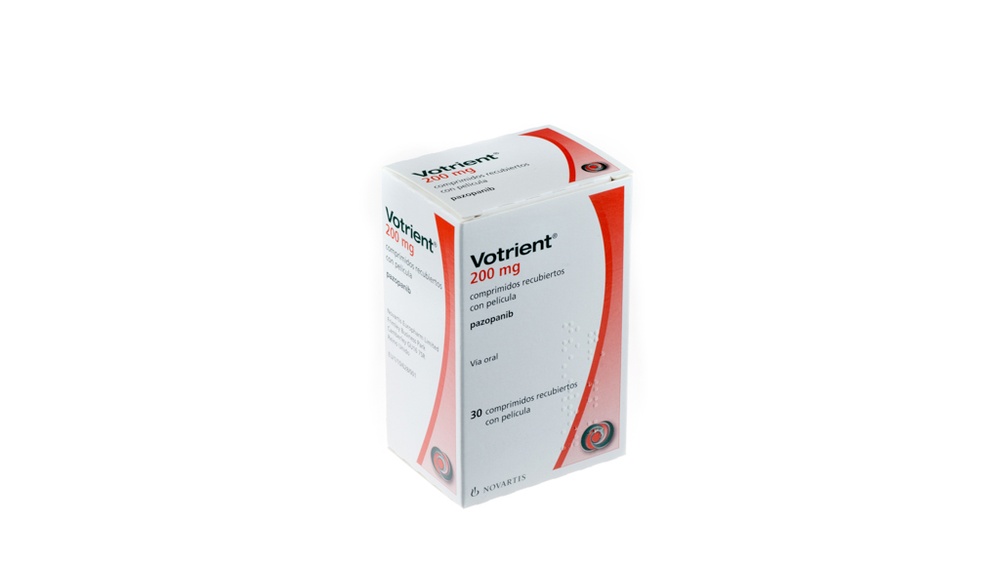
- Country of registration
- Dosage formTABLET, 200 mg
- ATC codeL01EX03
- Active substance
- Prescription requiredYes
- Manufacturer
- CompositionCARBOXIMETILALMIDON SODICO (0 - mg), POLISORBATO 80 (0 - mg)
- This information is for reference only and does not constitute medical advice. Always consult a doctor before taking any medication. Oladoctor is not responsible for medical decisions based on this content.
- Alternatives to VOTRIENT 200 mg FILM-COATED TABLETSDosage form: TABLET, 200 mgActive substance: pazopanibManufacturer: Accord Healthcare S.L.U.Prescription requiredDosage form: TABLET, 400 mgActive substance: pazopanibManufacturer: Accord Healthcare S.L.U.Prescription requiredDosage form: TABLET, 200 mgActive substance: pazopanibManufacturer: Reddy Pharma Iberia S.A.Prescription required
Online doctors for VOTRIENT 200 mg FILM-COATED TABLETS
Discuss questions about VOTRIENT 200 mg FILM-COATED TABLETS, including use, safety considerations and prescription review, subject to medical assessment and local regulations.
Get VOTRIENT 200 mg FILM-COATED TABLETS Prescription Online
Fill in a 2-min form
Tell us your symptoms, history, and what medicine you're requesting.
Pick a doctor or let us assign
Choose a specialist or we'll match you with the next available doctor.
Doctor reviews your case
Usually within 30 minutes. They may ask follow-up questions via chat.
Collect from any pharmacy
Electronic prescription sent to your email — valid across Spain.
Frequently Asked Questions
VOTRIENT 200 mg FILM-COATED TABLETS requires a prescription in Spain. You can check with a doctor online whether this medicine may be appropriate for your situation.
The active ingredient in VOTRIENT 200 mg FILM-COATED TABLETS is pazopanib. This information helps identify medicines with the same composition but different brand names.
VOTRIENT 200 mg FILM-COATED TABLETS is manufactured by Novartis Europharm Limited. Pharmacy brands and packaging may differ depending on the distributor.
Doctors such as Family doctors, Psychiatrists, Dermatologists, Cardiologists, Endocrinologists, Gastroenterologists, Pulmonologists, Nephrologists, Rheumatologists, Hematologists, Infectious disease physicians, Allergists, Geriatricians, Paediatricians, Oncologists may assess whether VOTRIENT 200 mg FILM-COATED TABLETS is appropriate, depending on your situation and local regulations. You can book an online consultation to discuss your symptoms and possible next steps.
Spain has a well-developed healthcare infrastructure across major cities such as Madrid, Barcelona, Valencia, and Seville. Pharmacies are widely available and operate under strict regulations, ensuring access to prescribed medications.
You can buy VOTRIENT 200 mg FILM-COATED TABLETS in Madrid, Barcelona, Seville, or Valencia at any local pharmacy with a valid prescription.
To obtain a prescription, you can use Oladoctor:
Other medicines with the same active substance (pazopanib) include PAZOPANIB ACCORD 200 mg FILM-COATED TABLETS, PAZOPANIB ACCORD 400 mg FILM-COATED TABLETS, PAZOPANIB DR. REDDYS 200 mg FILM-COATED TABLETS. These may have different brand names or formulations but contain the same therapeutic ingredient. Always consult a doctor before switching or starting a new medicine.
