



VELETRI 0.5 mg Injectable Perfusion

Prescription review online
A doctor will review your case and decide whether a prescription is medically appropriate.

Talk to a doctor about this medicine
Discuss your symptoms and possible next steps in a quick online consultation.



How to use VELETRI 0.5 mg POWDER AND SOLVENT FOR SOLUTION FOR INFUSION
Contents of the leaflet
- Introduction
- What is VELETRI and what is it used for
- What you need to know before you use VELETRI
- How to use VELETRI
- Possible side effects
- Storage of VELETRI
- Container Contents and Additional Information
Introduction
Package Leaflet: Information for the User
VELETRI 0.5mg powder and solvent for solution for infusion
VELETRI 1.5 mg powder and solvent for solution for infusion
epoprostenol
Read all of this leaflet carefully before you start using this medicine because it contains important information for you.
- Keep this leaflet, you may need to read it again.
- If you have any further questions, ask your doctor, pharmacist, or nurse.
- This medicine has been prescribed for you only, and you should not pass it on to others. It may harm them, even if their signs of illness are the same as yours.
- If you experience any side effects, talk to your doctor, pharmacist, or nurse, even if they are not listed in this leaflet. See section 4.
Contents of the pack
- What is VELETRI and what is it used for
- What you need to know before you use VELETRI
- How to use VELETRI
- Possible side effects
- Storage of VELETRI
- Contents of the pack and other information
1. What is VELETRI and what is it used for
VELETRI contains the active substance epoprostenol, which belongs to a group of medicines called prostaglandins that prevent blood from clotting and widen blood vessels.
VELETRI is used to treat a lung disease known as "pulmonary arterial hypertension". This occurs when the pressure in the blood vessels of the lungs is high. VELETRI widens the blood vessels to decrease blood pressure in the lungs.
VELETRI is used to prevent blood clotting during kidney dialysis when heparin cannot be used.

Not sure if this medicine is right for you?
Discuss your symptoms and treatment with a doctor online.
2. What you need to know before you use VELETRI
Do not use VELETRI
- if you are allergicto VELETRI or any of the other ingredients of this medicine (listed in section 6).
- if you have heart failure.
- if you start to develop fluid accumulation in the lungs that causes difficulty breathing after starting treatment.
If you think you are in any of these situations, do not use VELETRIuntil you have talked to your doctor.
Warnings and precautions
Talk to your doctor before you start using VELETRI.
Before VELETRI is administered to you, your doctor needs to know:
- if you have bleeding problems.
Skin lesions at the injection site
VELETRI is injected into a vein. It is essential that the medicine does not leak or spill from the vein into the surrounding tissues. If it does, the skin may be damaged. The symptoms are:
- sensitivity
- burning
- itching
- swelling
- redness.
This can continue with blistering and peeling of the skin. It is essential that you check the injection site while receiving treatment with VELETRI.
Contact the hospital immediatelyif the injection site becomes painful, itchy, or swollen, or if you notice any blistering or peeling.
Effect of VELETRI on blood pressure and heart rate
VELETRI may speed up or slow down your heart rate. Your blood pressure may also become very low. While you are being treated with VELETRI, your heart rate and blood pressure should be monitored. The symptoms of low blood pressure include dizzinessand fainting.
Tell your doctorif you have these symptoms. It may be necessary to decrease the dose or stop the infusion.
Children and adolescents
The safety and efficacy of VELETRI in children have not been established yet.
Other medicines and VELETRI
Tell your doctor or pharmacist if you are taking, have recently taken, or might take any other medicines, including those bought without a prescription.
Some medicines may affect how VELETRI works or make it more likely that you will experience side effects. VELETRI may also affect how other medicines work if taken at the same time. These medicines include:
- medicines used to treat high blood pressure
- medicines used to prevent blood clots
- medicines used to dissolve blood clots
- medicines used to treat inflammation or pain(also called NSAIDs)
- digoxin (used to treat heart conditions).
Tell your doctor or pharmacistif you are taking any of these medicines.
Pregnancy and breastfeeding
If you are pregnant or breastfeeding, think you may be pregnant, or plan to become pregnant, consult your doctor or pharmacist before using this medicine, as your symptoms may worsen during pregnancy.
It is not knownif the components of VELETRI can pass into breast milk. You must stop breastfeeding while being treated with VELETRI.
Driving and using machines
Treatment may affect your ability to drive and use machines.
Do not drive or use machinesunless you feel well.
VELETRI contains sodium
This medicine contains less than 1 mmol of sodium (23 mg) per vial; this is essentially "sodium-free".
3. How to use VELETRI
Follow exactly the administration instructions of this medicine given by your doctor or pharmacist. If you are unsure, consult your doctor or pharmacist again.
VELETRI comes as a powder in a small glass vial. The powder must be dissolved before use.
VELETRI should not be administered by rapid injection into a vein. It should always be administered by intravenous infusion.
Your doctor will decide what dose of VELETRI is suitable for you. The dose you are given is based on your body weight and the type of disease you have. It may be necessary to increase or decrease the dose depending on how well you respond to treatment.
VELETRI is administered by slow infusion (drip) into a vein.
Pulmonary arterial hypertension
The first treatment will be given to you in a hospital. This is because your doctor needs to monitor you and identify the best dose for you.
You will start with an infusion of VELETRI. The dose will be increased until your symptoms are relieved and side effects are controlled. Once the best dose has been identified, a permanent catheter (line) will be placed in one of your veins. You can then be treated using an infusion pump.
Kidney dialysis
You will be given an infusion of VELETRI during dialysis.
Using VELETRI at home (only for the treatment of Pulmonary Arterial Hypertension)
If you are being treated at home, your doctor or nurse will teach you how to prepare and use VELETRI. They will also tell you how to stop treatment if necessary. Stopping VELETRI should be done gradually. It is very important that you carefully follow allthe instructions.
VELETRI comes as a powder in a glass vial. The powder must be dissolved in a liquid before use. The liquid does not contain preservatives. You must discard any unused liquid.
Catheter care
If a catheter has been placed in a vein, it is very importantto keep the area clean; otherwise, it may become infected. Your doctor or nurse will teach you how to clean the catheter and the area around it. It is very important that you carefully follow allthe instructions. It is also very importantthat you carefully follow all the instructions for changing the drug delivery system of the pump (cassette) and that you always use an infusion set with an in-line filter, as your doctor has told you, to reduce the risk of infection. When you reconnect your infusion set, always make sure to clean the residual dropsso that there is no liquid in the space outside the infusion set and the catheter connectors, as this can damage the materials.
If you use more VELETRI than you should
Seek urgent medical attentionif you think you have used or been given too much VELETRI. The symptoms of overdose may include headache, nausea, vomiting, fast heart rate, warmth, or tingling or feeling like you may faint (dizziness/vertigo).
If you forget to use VELETRI
Do not take a double dose to make up for forgotten doses.
If you stop treatment with VELETRI
Stopping VELETRI should be done gradually. If treatment is stopped too quickly, you may have severe side effects, including dizziness, weakness, and difficulty breathing. If you have problems with the infusion pump or catheter because it stops or prevents treatment with VELETRI, contact your doctor, nurse, or hospital immediately.
If you have any other questions about the use of this medicine, ask your doctor, pharmacist, or nurse.

Started taking the medicine and have questions?
Discuss your symptoms and treatment with a doctor online.
4. Possible side effects
Like all medicines, this medicine can cause side effects, although not everybody gets them.
Very common side effects
May affect more than 1 in 10people:
- headache
- jaw pain
- pain
- feeling sick (vomiting)
- feeling unwell (nausea)
- diarrhea
- redness of the face (flushing)
Common side effects
May affect up to 1 in 10people:
- blood infection (septicemia)
- fast heart rate
- slow heart rate
- low blood pressure
- bleeding at various sites and increased tendency to bruise, for example, nosebleeds or bleeding gums
- upset stomach or stomach pain
- chest pain
- joint pain
- feeling anxious or nervous
- skin rash
- pain at the injection site
Common side effects that may appear in blood tests
- decrease in the number of platelets in the blood (cells that help blood clotting)
Uncommon side effects
May affect up to 1 in 100people:
- sweating
- dry mouth
Rare side effects
May affect up to 1 in 1,000people:
- infection at the injection site
Very rare side effects
May affect up to 1 in 10,000people:
- feeling of tightness around the chest
- fatigue, weakness
- agitation
- pallor
- redness at the injection site
- overactive thyroid gland
- blockage of the intravenous catheter
Other side effects
Frequency not known:
- increase in the size or activity of the spleen
- fluid accumulation in the lungs (pulmonary edema)
- increase in blood sugar levels
- fluid accumulation in the abdomen (ascites)
- excessive blood flow from the heart leading to difficulty breathing, fatigue, swelling of the legs and abdomen due to fluid accumulation, persistent cough
- hives (urticaria)
Reporting of side effects
Tell your doctor or nurse immediately, as these may be signs of blood infection, low blood pressure, or severe bleeding:
- You feel like your heart is beating faster, or you have chest pain or difficulty breathing.
- You feel dizzy or faint, especially when standing up.
- You have a fever or chills.
- You bleed more often or for longer periods.
If you experience any side effects, talk to your doctor, pharmacist, or nurse, even if they are not listed in this leaflet. You can also report side effects directly through the Spanish Medicines Agency's website: www.notificaRAM.es. By reporting side effects, you can help provide more information on the safety of this medicine.
5. Storage of VELETRI
Keep this medicine out of the sight and reach of children.
Do not use this medicine after the expiry date which is stated on the carton of powder vial and solvent vial, after EXP. The expiry date is the last day of the month shown.
Do not freeze.
The solvent does not contain preservatives; therefore, each vial should only be used once and then discarded.
The reconstituted solution should be immediately diluted to the final concentration (see Information for Healthcare Professionals).
For storage conditions after reconstitution and dilution of the medicinal product, see Information for Healthcare Professionals.
Do not use this medicine if you notice any particles in the reconstituted solution.
Medicines should not be disposed of via wastewater or household waste. Ask your pharmacist how to dispose of medicines no longer required. This will help protect the environment.
6. Container Contents and Additional Information
Composition of VELETRI
VELETRI 0.5 mg powder and solvent for solution for infusion
- The active ingredient is epoprostenol (as epoprostenol sodium).
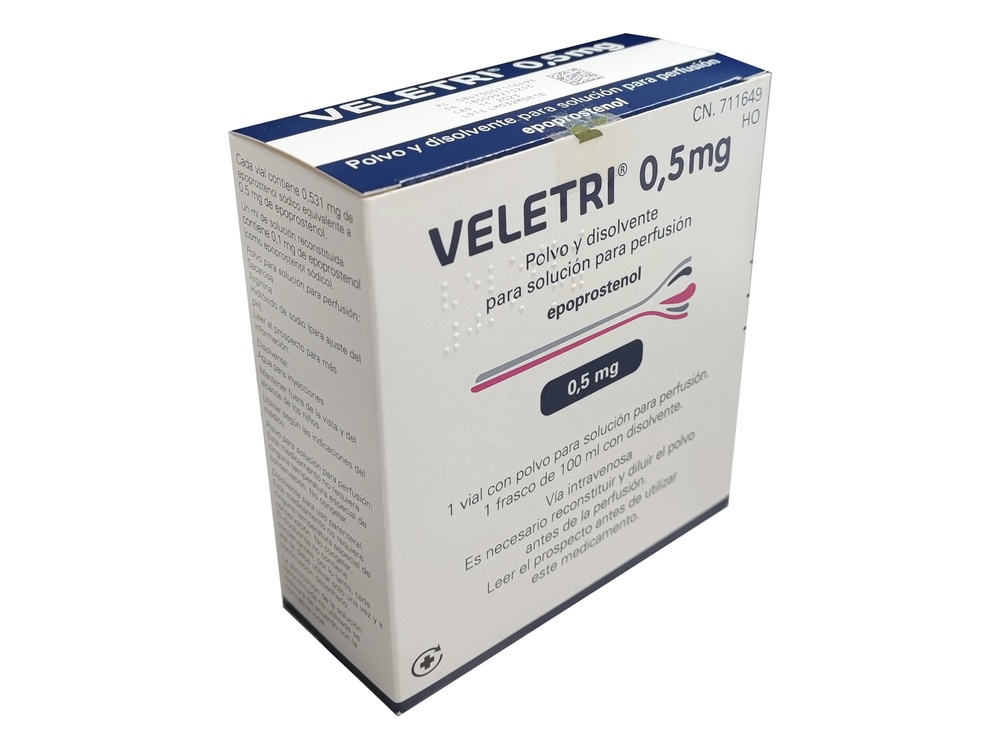
Each vial contains 0.531 mg of epoprostenol sodium equivalent to 0.5 mg of epoprostenol
1 ml of reconstituted solution contains 0.1 mg of epoprostenol (as epoprostenol sodium).
VELETRI 1.5 mg powder and solvent for solution for infusion
- The active ingredient is epoprostenol (as epoprostenol sodium).
Each vial contains 1.593 mg of epoprostenol sodium equivalent to 1.5 mg of epoprostenol.
1 ml of reconstituted solution contains 0.3 mg of epoprostenol (as epoprostenol sodium).
- The other components are Sucrose, Arginine, and Sodium Hydroxide (for pH adjustment).
Solvent:
Each vial of solvent contains 100 ml of water for injections.
Appearance and Container Contents
White or off-white powder in a transparent glass vial with a rubber stopper and aluminum seal.
Each pack contains a vial of 0.5 mg of powder.
Each pack contains a vial of 1.5 mg of powder.
Each pack contains a 100 ml vial of solvent. The solvent is a clear and colorless solution.
Marketing Authorization Holder and Manufacturer
Marketing Authorization Holder:
Janssen-Cilag International NV
Turnhoutseweg 30
B-2340 Beerse
Belgium
Manufacturer:
Janssen Pharmaceutica NV
Turnhoutseweg 30
B-2340 Beerse
Belgium
For further information on this medicinal product, please contact the local representative of the Marketing Authorization Holder:
Janssen-Cilag, S.A.
Paseo del Club Deportivo 1, Edificio 16
28223 Pozuelo de Alarcón (Madrid)
Spain
This medicinal product is authorized in the Member States of the European Economic Area and in the United Kingdom (Northern Ireland) under the following names:
Belgium, Czech Republic, France, Germany, Greece, Hungary, Ireland, Luxembourg, Netherlands, Poland, Portugal, Slovakia, Spain, United Kingdom (Northern Ireland): VELETRI
Italy: CARIPUL
Date of last revision of this leaflet: July 2025.
------------------------------------------------------------------------------------------------------------------
This information is intended solely for healthcare professionals:
INFORMATION FOR HEALTHCARE PROFESSIONALS
Renal Dialysis
Two pack sizes are available for use in the treatment of renal dialysis:
- 1 vial containing VELETRI sterile lyophilized, equivalent to 0.5 mg of VELETRI, supplied with a 100 ml vial of solvent.
- 1 vial containing VELETRI sterile lyophilized, equivalent to 0.5 mg of VELETRI, supplied alone.
Reconstitution:
Withdraw 5 ml of diluent into a sterile syringe, inject the contents of the syringe into the vial containing VELETRI, and gently agitate until the powder is dissolved. The reconstituted solution should be inspected before proceeding to dilution. Its use is prohibited if it presents particles or color alteration. The disposal of the unused reconstituted solution will be carried out in accordance with local regulations.
Dilution:
The reconstituted solution should be diluted immediately to the final concentration. Any subsequent dilution should be performed with the same diluent used for the reconstitution of the sterile lyophilized powder.
Infusion Rate Calculation:
The infusion rate can be calculated from the following formula:
Infusion rate (ml/min) = | Dose (ng/kg/min) × body weight (kg) |
Concentration of the solution (ng/ml) |
Infusion rate (ml/h) = Infusion rate (ml/min) × 60
Pulmonary Arterial Hypertension
Four pack sizes are available for use in the treatment of pulmonary arterial hypertension:
- 1 vial containing VELETRI sterile lyophilized, equivalent to 0.5 mg of VELETRI, supplied with a 100 ml vial of solvent.
- 1 vial containing VELETRI sterile lyophilized, equivalent to 1.5 mg of VELETRI, supplied with a 100 ml vial of solvent.
- 1 vial containing VELETRI sterile lyophilized, equivalent to 0.5 mg of VELETRI, supplied alone.
- 1 vial containing VELETRI sterile lyophilized, equivalent to 1.5 mg of VELETRI, supplied alone.
Initially, the pack containing the solvent for parenteral use should be used. During chronic treatment with VELETRI, the final concentration of the solution can be increased by adding another vial of 0.5 mg or 1.5 mg of VELETRI lyophilized.
Reconstitution:
Withdraw 5 ml of diluent into a sterile syringe, inject the contents of the syringe into the vial containing VELETRI, and gently agitate until the powder is dissolved. The reconstituted solution should be inspected before proceeding to dilution. Its use is prohibited if it presents particles or color alteration. The disposal of the unused reconstituted solution will be carried out in accordance with local regulations.
Dilution:
The reconstituted solution should be diluted immediately to the final concentration. Any subsequent dilution should be performed with the same diluent used for the reconstitution of the sterile lyophilized powder.
When VELETRI is administered chronically, it should be prepared in a suitable drug administration reservoir for the infusion pump.
The ambulatory pumps suitable for use in the administration of VELETRI include:
- CADD-Legacy 1
- CADD-Legacy PLUS
- CADD-Solis VIP (variable infusion profile)
Manufactured by Smiths Medical.
The pump accessories compatible with the administration of VELETRI include:
- Medication Casete CADD disposable reservoirs of 50 ml and 100 ml from Smiths Medical.
- CADD infusion set with 0.2 micras in-line filter (CADD extension set with male luer, 0.2 micras air-eliminating filter, clamp, and integral anti-reflux valve with male luer) from Smiths Medical.
Based on available data from internal testing and manufacturer's instructions for use of the accessories, the materials that may be compatible for preparation and administration include:
- Acrylics
- Acrylonitrile butadiene styrene (ABS)
- Polycarbonate
- Polyethersulfone
- Polypropylene
- Polytetrafluoroethylene (PTFE)
- Polyurethane
- Polyvinyl chloride (PVC) (plasticized with DEHP)
- Silicone
It is unknown whether polyethylene terephthalate (PET) and polyethylene terephthalate glycol (PETG) are compatible with VELETRI, as these materials have not been tested with VELETRI, so their use is not recommended.
Only infusion equipment with a 0.22 micras in-line filter located between the infusion pump and the catheter should be used. Filters with hydrophilic polyethersulfone membrane are recommended. The infusion equipment and in-line filter should be changed at least every 48 hours.
The vial containing 0.5 mg of epoprostenol should be used for the preparation of solutions with final concentrations below 15,000 ng/ml.
Table 1 provides examples for the preparation of frequently used concentrations of VELETRI solutions. Each vial is for single use.
Table1: Frequently Used Concentrations - Examples of Reconstitution and Dilution | |
Final concentration (ng/ml) | Instructions: |
3,000 ng/ml | Dissolve the contents of a 0.5 mg vial with 5 ml of solvent. Withdraw 3 ml of the vial contents and make up to a total of 100 ml with the same diluent. |
5,000 ng/ml | Dissolve the contents of a 0.5 mg vial with 5 ml of solvent. Withdraw the entire contents of the vial and make up to a total of 100 ml with the same diluent. |
10,000 ng/ml | Dissolve the contents of two 0.5 mg vials with 5 ml of solvent each. Withdraw the entire contents of the vial and make up to a total of 100 ml with the same diluent. |
15,000 ng/ml* | Dissolve the contents of a 1.5 mg vial with 5 ml of solvent Withdraw the entire contents of the vial and add to a sufficient volume of the same diluent to make up a total of 100 ml. |
30,000 ng/ml* | Dissolve the contents of two 1.5 mg vials with 5 ml of solvent each Withdraw the entire contents of the vial and make up to a total of 100 ml with the same diluent. |
30,000 ng/ml* | Dissolve the contents of a 1.5 mg vial with 5 ml of solvent Withdraw the entire contents of the vial and make up to a total of 50 ml with the same diluent. |
|
VELETRI diluted to the final concentration in the drug administration reservoir as indicated can be administered immediately at room temperature (25 °C) or, if stored, for a maximum of 8 days at a temperature of 2 °C to 8 °C, according to the conditions of use indicated in Table 2.
Table2: Maximum Administration Duration (hours) at Room Temperature (25°C) of Fully Diluted Solutions Stored in the Drug Administration Reservoir | ||
Final concentration range | Immediate administration | If stored for a maximum of 8 days at a temperature of 2°C to 8°C |
> 3,000 ng/ml and < 15,000 ng/ml | 48 hours | 24 hours |
> 15,000 ng/ml | 48 hours | 48 hours |
Do not expose the fully diluted solution to direct sunlight.
Special Precautions for Storage
Do not freeze.
The reconstituted solution should be diluted immediately to the final concentration.
Reconstitution and dilution should be performed immediately before administration.
Newly prepared epoprostenol solutions for the treatment of pulmonary arterial hypertension can be administered immediately at 25 °C or stored in the drug administration reservoir to protect from light for a maximum of 8 days at a temperature of 2 °C to 8 °C, according to the conditions of use indicated in Table 2.
Detailed and updated information on this medicinal product is available on the website of the Spanish Agency for Medicines and Health Products (AEMPS) http://www.aemps.es/
- Country of registration
- Dosage formINJECTABLE PERFUSION, 0.5 mg
- ATC codeB01AC09
- Active substance
- Prescription requiredYes
- Manufacturer
- CompositionSACAROSA (100 mg mg), HIDROXIDO DE SODIO (E 524) (C.S.P. pH 13,20 mg mg)
- This information is for reference only and does not constitute medical advice. Always consult a doctor before taking any medication. Oladoctor is not responsible for medical decisions based on this content.
- Alternatives to VELETRI 0.5 mg POWDER AND SOLVENT FOR SOLUTION FOR INFUSIONDosage form: INJECTABLE INFUSION, 1.5 mgActive substance: epoprostenolManufacturer: Laboratorios Normon S.A.Prescription requiredDosage form: INJECTABLE PERFUSION, 1.5 mgActive substance: epoprostenolManufacturer: Sun Pharmaceutical Industries (Europe) B.V.Prescription requiredDosage form: INJECTABLE PERFUSION, 0.5 mg sodium epoprostenolActive substance: epoprostenolManufacturer: Glaxosmithkline S.A.Prescription required
Online doctors for VELETRI 0.5 mg POWDER AND SOLVENT FOR SOLUTION FOR INFUSION
Discuss questions about VELETRI 0.5 mg POWDER AND SOLVENT FOR SOLUTION FOR INFUSION, including use, safety considerations and prescription review, subject to medical assessment and local regulations.









Get VELETRI 0.5 mg POWDER AND SOLVENT FOR SOLUTION FOR INFUSION Prescription Online
Fill in a 2-min form
Tell us your symptoms, history, and what medicine you're requesting.
Pick a doctor or let us assign
Choose a specialist or we'll match you with the next available doctor.
Doctor reviews your case
Usually within 30 minutes. They may ask follow-up questions via chat.
Collect from any pharmacy
Electronic prescription sent to your email — valid across Spain.
Frequently Asked Questions
VELETRI 0.5 mg POWDER AND SOLVENT FOR SOLUTION FOR INFUSION requires a prescription in Spain. You can check with a doctor online whether this medicine may be appropriate for your situation.
The active ingredient in VELETRI 0.5 mg POWDER AND SOLVENT FOR SOLUTION FOR INFUSION is epoprostenol. This information helps identify medicines with the same composition but different brand names.
VELETRI 0.5 mg POWDER AND SOLVENT FOR SOLUTION FOR INFUSION is manufactured by Janssen-Cilag International N.V. Pharmacy brands and packaging may differ depending on the distributor.
Doctors such as Family doctors, Psychiatrists, Dermatologists, Cardiologists, Endocrinologists, Gastroenterologists, Pulmonologists, Nephrologists, Rheumatologists, Hematologists, Infectious disease physicians, Allergists, Geriatricians, Paediatricians, Oncologists may assess whether VELETRI 0.5 mg POWDER AND SOLVENT FOR SOLUTION FOR INFUSION is appropriate, depending on your situation and local regulations. You can book an online consultation to discuss your symptoms and possible next steps.
Spain has a well-developed healthcare infrastructure across major cities such as Madrid, Barcelona, Valencia, and Seville. Pharmacies are widely available and operate under strict regulations, ensuring access to prescribed medications.
You can buy VELETRI 0.5 mg POWDER AND SOLVENT FOR SOLUTION FOR INFUSION in Madrid, Barcelona, Seville, or Valencia at any local pharmacy with a valid prescription.
To obtain a prescription, you can use Oladoctor:
Other medicines with the same active substance (epoprostenol) include EPOPROSTENOL NORMON 1.5 mg POWDER FOR SOLUTION FOR INFUSION, EPOPROSTENOL SUN 1.5 mg POWDER FOR SOLUTION FOR INFUSION, FLOLAN 0.5 mg POWDER AND SOLVENT FOR SOLUTION FOR INFUSION. These may have different brand names or formulations but contain the same therapeutic ingredient. Always consult a doctor before switching or starting a new medicine.
