



TRAGLASIN 40 MICROGRAMOS/ML COLIRIO

Revisión de receta online
Un médico revisará tu caso y determinará si la prescripción es médicamente apropiada.

Habla con un médico sobre este medicamento
Comenta tus síntomas y las opciones de tratamiento en una consulta online.



Cómo usar TRAGLASIN 40 MICROGRAMOS/ML COLIRIO EN SOLUCION EN ENVASE UNIDOSIS
Contenido del prospecto
- Introducción
- Prospecto: información para el usuario
- Lea todo el prospecto detenidamente antes de empezar a usar este medicamento, porque contiene información importante para usted.
- Contenido del prospecto
- Qué es Traglasin y para qué se utiliza
- Qué necesita saber antes de empezar a usar Traglasin
- Advertencias y precauciones
- Niños y adolescentes
- Otros medicamentos yTraglasin
- Embarazo, lactancia y fertilidad
- Conducción y uso de máquinas
- Traglasincontiene propilenglicol
- Traglasincontiene hidroxiestearato de macrogolglicerol
- Cómo usar Traglasin
- La dosis recomendada es
- Si recibe usted o el niño másTraglasindel que debe
- Si olvidó usarTraglasin
- Si interrumpe el tratamiento conTraglasin
- Posibles efectos adversos
- Efectos adversos muy frecuentes: pueden afectar a más de 1 de cada 10 personas
- Efectos adversos frecuentes: pueden afectar hasta 1 de cada 10 personas
- Efectos adversos poco frecuentes: pueden afectar hasta 1 de cada 100 personas
- Raros: pueden afectar hasta 1 de cada 1.000 personas
- Frecuencia no conocida: no puede estimarse a partir de los datos disponibles
- Comunicación de efectos adversos
- Conservación de Traglasin
- Contenido del envase e información adicional
- Aspecto del producto y contenido del envase
- Titular de la autorización de comercialización y responsable de la fabricación
- Responsable de la fabricación
- Este medicamento está autorizado en los Estados Miembros del Espacio Económico Europeo con los siguientes nombres:
- Fecha de la última revisión de este prospecto: Febrero 2021
Introducción
Prospecto: información para el usuario
Traglasin40 microgramos/ml colirio en solución en envase unidosis
travoprost

¿No estás seguro de si este medicamento es adecuado para ti?
Comenta tus síntomas y tratamiento con un médico online.
Lea todo el prospecto detenidamente antes de empezar a usar este medicamento, porque contiene información importante para usted.
- Conserve este prospecto, ya que puede tener que volver a leerlo.
- Si tiene alguna duda, consulte a su médico o farmacéutico.
- Este medicamento se le ha recetado solamente a usted, y no debe dárselo a otras personas, aunque tengan los mismos síntomas que usted, ya que puede perjudicarles.
- Si experimenta efectos adversos, consulte a su médico o farmacéutico, incluso si se trata de efectos adversos que no aparecen en este prospecto. Ver sección 4.
Contenido del prospecto
- Qué es Traglasin y para qué se utiliza
- Qué necesita saber antes de empezar a usar Traglasin
- Cómo usar Traglasin
- Posibles efectos adversos
- Conservación de Traglasin
- Contenido del envase e información adicional

¿Has empezado a tomar el medicamento y tienes preguntas?
Comenta tus síntomas y tratamiento con un médico online.
1. Qué es Traglasin y para qué se utiliza
Traglasin contiene travoprost que forma parte de un grupo de medicamentos llamados análogos de las prostaglandinas. Actúa disminuyendo la presión en el ojo. Se puede utilizar solo o con otras gotas oftálmicas, por ejemplo con betabloqueantes, que también reducen la presión en el ojo.
Traglasin se utiliza para reducir la presión elevada en el ojo en adultos, adolescentes y niños a partir de 2 meses de edad. Esta presión puede dar lugar a una enfermedad llamada glaucoma.
Este medicamento no contiene conservantes.
2. Qué necesita saber antes de empezar a usar Traglasin
No useTraglasin
- Si es alérgico al travoprost o a alguno de los demás componentes de este medicamento (incluidos en la sección 6).
Consulte a su médico si se encuentra en esta situación.
Advertencias y precauciones
Consulte a su médico o farmacéutico antes de empezar a usar Traglasin.
- Traglasin puede aumentar la longitud, el grosor, color y/o número de sus pestañas. También se han observado cambios como crecimiento inusual del vello en los párpados o en los tejidos de alrededor del ojo.
- Traglasin puede alterar el color del iris (la parte coloreada del ojo). Este cambio puede ser permanente. También puede producir un cambio de color de la piel alrededor del ojo.
- Si se ha sometido a una operación de cataratas, consulte a su médico antes de empezar a usar Traglasin.
- Si sufre o ha sufrido anteriormente una inflamación del ojo (iritis y uveítis), consulte a su médico antes de empezar a usar Traglasin.
- Traglasin puede, en raras ocasiones, causar falta de aliento o respiración ruidosa o aumentar los síntomas del asma. Si está preocupado por los cambios en su respiración mientras utiliza Traglasin consulte a su médico lo antes posible.
- Travoprost puede absorberse a través de la piel. En caso de contacto del medicamento con la piel, debe eliminarse lavando inmediatamente. Esto es especialmente importante en mujeres embarazadas o que estén intentando quedarse embarazadas.
- Si lleva lentes de contacto blandas, no se aplique las gotas mientras las lleve puestas. Después de aplicar las gotas, espere 15 minutos antes de volver a colocarse las lentes.
Niños y adolescentes
Se puede usar Traglasin en niños desde los 2 meses de edad a menores de 18 años con la misma dosis que en adultos. No se recomienda el uso de Traglasin en niños menores de 2 meses de edad.
Otros medicamentos yTraglasin
Informe a su médico o farmacéutico si está utilizando, ha utilizado recientemente o podría tener que utilizar cualquier otro medicamento.
Embarazo, lactancia y fertilidad
Si está embarazada o en período de lactancia, cree que podría estar embarazada o tiene intención de quedarse embarazada, consulte a su médico antes de utilizar cualquier medicamento.
Embarazo
No utilice Traglasin si está embarazada. Si piensa que puede estar embarazada dígaselo en seguida a su médico. Si usted puede quedarse embarazada debe utilizar un método anticonceptivo adecuado mientras esté utilizando Traglasin.
Lactancia
No utilice Traglasin si está amamantando. Traglasin puede pasar a la leche materna.
Consulte a su médico antes de utilizar cualquier medicamento.
Conducción y uso de máquinas
Inmediatamente después de la aplicación de Traglasin puede notar que su visión se vuelve borrosa. No conduzca ni utilice máquinas hasta que hayan desaparecido estos efectos.
Traglasincontiene propilenglicol
Este medicamento contiene 7,5 mg de propilenglicol en cada ml de solución. El propilenglicol puede provocar irritación en la piel.
Traglasincontiene hidroxiestearato de macrogolglicerol
Este medicamento puede causar reacciones en la piel porque contiene hidroxiestearato de macrogolglicerol.
3. Cómo usar Traglasin
Siga exactamente las instrucciones de administración de este medicamento indicadas por su médico o el médico que trata al niño. En caso de duda, consulte de nuevo a su médico, al médico que trata al niño o farmacéutico.
La dosis recomendada es
Una gota en el ojo u ojos afectados, una vez al día - por la noche.
Sólo debe aplicarse Traglasin en los dos ojos si su médico así se lo indica. Siga el tratamiento durante todo el periodo de tiempo indicado por su médico o el médico que trata al niño.
Traglasin sólo debe utilizarse como gotas para sus ojos o los de los niños.
Lávese las manos antes de utilizarlo. Asegúrese de que el envase unidosis está intacto antes de utilizar este medicamento. La solución debe utilizarse inmediatamente después de abrir el envase. Para evitar contaminación, no deje que la punta del envase unidosis toque el ojo ni ninguna otra superficie.
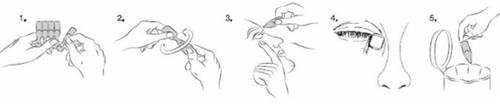
- Coja un envase unidosis de la tira.
- Mantenga el envase unidosis en posición vertical (con el tapón hacia arriba) y gire el tapón hasta que se desprenda.
- Incline la cabeza o la cabeza del niño suavemente hacia atrás. Tire suavemente del párpado inferior hacia abajo para formar una bolsa, entre el párpado y el ojo. Invierta el envase unidosis y apriete hasta que caiga una gota en el ojo o los ojos afectados.
- Después de utilizar Traglasin, cierre suavemente los ojos, con suavidad presione con el dedo el borde del ojo, junto a la nariz durante al menos 1 minuto. Esto ayuda a evitar que Traglasin pase al resto del cuerpo.
- Si se aplica gotas en ambos ojos, repita los puntos anteriores para el otro ojo.
- Deseche el envase unidosis después de su uso, aunque quede solución en su interior.
Si una gota cae fuera del ojo, inténtelo de nuevo.
Si está usted o el niño utilizando otros medicamentos oftálmicos, como colirios o pomadas para los ojos, espere por lo menos 5 minutos entre la aplicación de Traglasin y de los otros medicamentos oftálmicos.
Si recibe usted o el niño másTraglasindel que debe
Puede eliminarlo lavando los ojos con agua templada. No se aplique más gotas hasta que le toque la siguiente dosis.
En caso de sobredosis o ingestión accidental consulte a su médico o farmacéutico o llame al Servicio de Información Toxicológica, teléfono: 91 562 04 20, indicando el medicamento y la cantidad ingerida.
Si olvidó usarTraglasin
Continúe con la siguiente dosis que estaba prevista. No se aplique una dosis doble para compensar la dosis olvidada. Nunca aplique más de una gota en el ojo(s) afectado(s) en un solo día.
Si interrumpe el tratamiento conTraglasin
No deje de utilizar Traglasin sin consultar antes con su médico o el médico que trata al niño, la presión en su ojo o del ojo del niño no estará controlada lo que podría provocar pérdida de visión.
Si tiene cualquier otra duda sobre el uso de este medicamento, pregunte a su médico, al médico que trata al niño o farmacéutico.
4. Posibles efectos adversos
Al igual que todos los medicamentos, este medicamento puede producir efectos adversos, aunque no todas las personas los sufran.
Puede seguir normalmente el tratamiento a no ser que los efectos adversos sean graves. Si estos efectos le preocupan, consulte a su médico o farmacéutico. No deje de aplicarse Traglasin sin consultar a su médico.
Con travoprost se han observado los siguientes efectos adversos.
Efectos adversos muy frecuentes: pueden afectar a más de 1 de cada 10 personas
Efectos en el ojo:enrojecimiento del ojo.
Efectos adversos frecuentes: pueden afectar hasta 1 de cada 10 personas
Efectos en el ojo:cambios en el color del iris (parte coloreada del ojo), dolor en el ojo, molestia en el ojo, ojo seco, picor en el ojo, irritación en el ojo.
Efectos adversos poco frecuentes: pueden afectar hasta 1 de cada 100 personas
Efectos en el ojo:alteración corneal, inflamación del ojo, inflamación del iris, inflamación dentro del ojo, inflamación con o sin daño de la superficie del ojo, sensibilidad a la luz, secreción del ojo, inflamación del párpado, enrojecimiento del párpado, hinchazón alrededor del ojo, picor en el párpado, visión borrosa, aumento de la producción de lágrimas, infección o inflamación de la conjuntiva (conjuntivitis), vuelta anormal hacia fuera del párpado inferior, visión ensombrecida, costras en el párpado, crecimiento de las pestañas.
Otros efectos:aumento de los síntomas alérgicos, dolor de cabeza, frecuencia cardiaca irregular, tos, nariz taponada, irritación de garganta, oscurecimiento de la piel alrededor de los ojos, oscurecimiento de la piel, textura anormal del pelo, aumento excesivo del crecimiento del vello.
Raros: pueden afectar hasta 1 de cada 1.000 personas
Efectos en el ojo:percepción de destellos de luz, eczema de los párpados, pestañas anormalmente posicionadas que crecen hacia dentro del ojo, hinchazón del ojo, visión reducida, halo visual, sensación disminuida en el ojo, inflamación de las glándulas de los párpados, pigmentación dentro del ojo, aumento en el tamaño de la pupila, engrosamiento de las pestañas, cambio en el color de las pestañas, ojos cansados.
Otros efectos:infección vírica en el ojo, mareo, mal sabor de boca, frecuencia cardiaca irregular o disminuida, presión sanguínea aumentada o disminuida, falta de aliento, asma, inflamación o alergia nasal, sequedad nasal, cambios de voz, úlcera o malestar gastrointestinal, estreñimiento, boca seca, enrojecimiento o picor de la piel, erupción, cambio del color del vello, pérdida de pestañas, dolor articular, dolor musculo esquelético, debilidad generalizada.
Frecuencia no conocida: no puede estimarse a partir de los datos disponibles
Efectos en el ojo:inflamación de la parte posterior del ojo, ojos hundidos.
Otros efectos:depresión, ansiedad, insomnio, sensación falsa de movimiento, pitidos en oídos, dolor en el pecho, ritmo cardiaco anormal, aumento de la frecuencia cardiaca, empeoramiento del asma, diarrea, sangrados de nariz, dolor abdominal, nausea, vómitos, picor, crecimiento anormal del pelo, micción dolorosa o involuntaria (orinar de forma involuntaria o dolor al orinar), aumento del marcador del cáncer de próstata.
En niños y adolescentes, los efectos adversos más frecuentes observados con travoprost son enrojecimiento del ojo y crecimiento de las pestañas. Ambos efectos adversos se observaron con una incidencia mayor en niños y adolescentes comparado con adultos.
Comunicación de efectos adversos
Si experimenta cualquier tipo de efecto adverso, consulte a su médico o farmacéutico, incluso si se trata de posibles efectos adversos que no aparecen en este prospecto. También puede comunicarlos directamente a través del Sistema Español de Farmacovigilancia de Medicamentos de Uso Humano: https://www.notificaram.es. Mediante la comunicación de efectos adversos usted puede contribuir a proporcionar más información sobre la seguridad de este medicamento.
5. Conservación de Traglasin
Mantener este medicamento fuera de la vista y del alcance de los niños.
Desechar el envase unidosis abierto inmediatamente después de su uso.
No utilice este medicamento después de la fecha de caducidad que aparece en el envase unidosis, la bolsa y en la caja después de la fecha de caducidad (CAD). La fecha de caducidad es el último día del mes que se indica.
Este medicamento no requiere ninguna temperatura especial de conservación.
Traslaapertura de la bolsa:no conservar a temperatura superior a 30ºC.
Conservar los envases unidosis en la bolsa y el embalaje exterior, para protegerlos de la luz.
Una vez abierta la bolsa, los envases unidosis deben utilizarse en el plazo de 30 días.
Los medicamentos no se deben tirar por los desagües ni a la basura. Deposite los envases y los medicamentos que no necesita en el Punto SIGRE de la farmacia. En caso de duda pregunte a su farmacéutico cómo deshacerse de los envases y de los medicamentos que no necesita. De esta forma ayudará a proteger el medio ambiente.
6. Contenido del envase e información adicional
Composición de Traglasin
- El principio activo es travoprost 40 microgramos/ml. Una gota contiene aproximadamente 1,2 microgramos de travoprost.
- Los demás componentes son: propilenglicol (E1520), hidroxiestearato de macrogolglicerol 40, cloruro de sodio, manitol (E421), ácido bórico (E284), hidróxido de sodio y/o ácido clorhídrico (para ajustar el pH), agua para preparaciones inyectables.
Aspecto del producto y contenido del envase
Traglasin es una solución incolora y transparente que se suministra en envases unidosis de plástico, cada uno de los cuales contiene 0,2 ml de solución.
Cada bolsa contiene 10 envases unidosis.
La caja contiene 30 (3x10), 60 (6x10) or 90 (9x10) envases unidosis.
Puede que solamente estén comercializados algunos tamaños de envases.
Titular de la autorización de comercialización y responsable de la fabricación
Titular de la autorización de comercialización
OmniVision GmbH
Lindberghstrasse 9
82178 Puchheim
Alemania
Responsable de la fabricación
Actrevo GmbH
Großer Burstah 25
20457 Hamburg
Alemania
Representante local
OmniVision Farma España S.L.
C/ Josep Irla i Bosch, 1-3
Pl: 6 Pt: 2
08034 Barcelona
España
Este medicamento está autorizado en los Estados Miembros del Espacio Económico Europeo con los siguientes nombres:
AT: | Traglasin 40 Mikrogramm/ml Augentropfen, Lösung im Einzeldosisbehältnis |
ES: | Traglasin 40 microgramos/ml colirio en solución en envase unidosis |
IT: | Traglasin 40 microgrammi/ml collirio, soluzione, in contenitore monodose |
FR: | Traglasin 40 microgrammes/ml collyre en solution en récipient unidose |
Fecha de la última revisión de este prospecto: Febrero 2021
La información detallada de este medicamento está disponible en la página web de la Agencia Española de Medicamentos y Productos Sanitarios (AEMPS) (http://www.aemps.gob.es)
- País de registro
- Forma farmacéuticaCOLIRIO, 0,04 mg/ml
- Código ATCS01EE04
- Precio medio en farmacia32.03 EUR
- Principio activo
- Requiere recetaSí
- Fabricante
- ComposiciónPROPILENGLICOL (7,5 mg/ml mg), CLORURO DE SODIO (3,5 mg/ml mg), MANITOL (E-421) (3 mg/ml mg), ACIDO BORICO (3 mg/ml mg), MACROGOLGLICEROL, HIDROXIESTEARATO DE (2 mg/ml mg), HIDROXIDO DE SODIO (E 524) (c.s pH mg)
- Esta información es de carácter general y no sustituye la consulta con un profesional sanitario.
- Alternativas a TRAGLASIN 40 MICROGRAMOS/ML COLIRIO EN SOLUCION EN ENVASE UNIDOSISForma farmacéutica: COLIRIO, 40 microgramos/mlPrincipio activo: travoprostFabricante: Alfred E. Tiefenbacher Gmbh & Co. KgRequiere recetaForma farmacéutica: COLIRIO, 40 microgramos/mlPrincipio activo: travoprostFabricante: Horus PharmaRequiere recetaForma farmacéutica: COLIRIO, 40 MICROGRAMOS/MLPrincipio activo: travoprostFabricante: Laboratorio Stada S.L.Requiere receta
Médicos online para TRAGLASIN 40 MICROGRAMOS/ML COLIRIO EN SOLUCION EN ENVASE UNIDOSIS
Comenta la dosis, los posibles efectos secundarios, interacciones, contraindicaciones o la revisión de receta de TRAGLASIN 40 MICROGRAMOS/ML COLIRIO EN SOLUCION EN ENVASE UNIDOSIS, sujeto a valoración médica y a la normativa local.









Obtén una receta de TRAGLASIN 40 MICROGRAMOS/ML COLIRIO EN SOLUCION EN ENVASE UNIDOSIS online
Rellena un formulario de 2 minutos
Cuéntanos tus síntomas, historial y el medicamento que necesitas.
Elige un médico o nosotros te asignamos uno
Escoge un especialista o te conectamos con el próximo médico disponible.
El médico revisa tu caso
Normalmente en 30 minutos. Puede hacerte preguntas adicionales por chat.
Recógela en cualquier farmacia
Receta electrónica enviada a tu correo, válida en toda España.
Preguntas frecuentes
TRAGLASIN 40 MICROGRAMOS/ML COLIRIO EN SOLUCION EN ENVASE UNIDOSIS requiere receta en España. Puedes confirmarlo con un médico online según tu caso.
El principio activo de TRAGLASIN 40 MICROGRAMOS/ML COLIRIO EN SOLUCION EN ENVASE UNIDOSIS es travoprost. Esta información ayuda a identificar medicamentos con la misma composición pero con diferentes nombres comerciales.
El precio medio en farmacia de TRAGLASIN 40 MICROGRAMOS/ML COLIRIO EN SOLUCION EN ENVASE UNIDOSIS es de aproximadamente 32.03 EUR. Puede variar según el fabricante y la forma farmacéutica.
TRAGLASIN 40 MICROGRAMOS/ML COLIRIO EN SOLUCION EN ENVASE UNIDOSIS es fabricado por Omnivision Gmbh. La marca y el envase pueden variar según el distribuidor.
Los Médicos de familia, Psiquiatras, Dermatólogos, Cardiólogos, Endocrinólogos, Gastroenterólogos, Neumólogos, Nefrólogos, Reumatólogos, Hematólogos, Infectólogos, Alergólogos, Geriatras, Pediatras, Oncólogos pueden valorar la prescripción de TRAGLASIN 40 MICROGRAMOS/ML COLIRIO EN SOLUCION EN ENVASE UNIDOSIS cuando esté clínicamente indicado. Puedes reservar una videoconsulta para comentar tu caso y las opciones de tratamiento.
España cuenta con una infraestructura sanitaria bien desarrollada en ciudades principales como Madrid, Barcelona, Valencia y Sevilla. Las farmacias están ampliamente disponibles y operan bajo estrictas regulaciones, garantizando el acceso a medicamentos con receta.
Puedes comprar TRAGLASIN 40 MICROGRAMOS/ML COLIRIO EN SOLUCION EN ENVASE UNIDOSIS en Madrid, Barcelona, Sevilla o Valencia en cualquier farmacia local con una receta válida.
Para obtener una receta, puedes utilizar Oladoctor:
Otros medicamentos con el mismo principio activo (travoprost) incluyen LEACHIM 40 MICROGRAMOS/ML COLIRIO EN SOLUCION, SINETRAV 40 MICROGRAMOS/ML COLIRIO EN SOLUCION, TAVLIANT 40 MICROGRAMOS/ML COLIRIO EN SOLUCION. Pueden tener diferentes nombres comerciales o formulaciones, pero contienen el mismo componente terapéutico. Consulta siempre con un médico antes de cambiar o iniciar un nuevo medicamento.
