



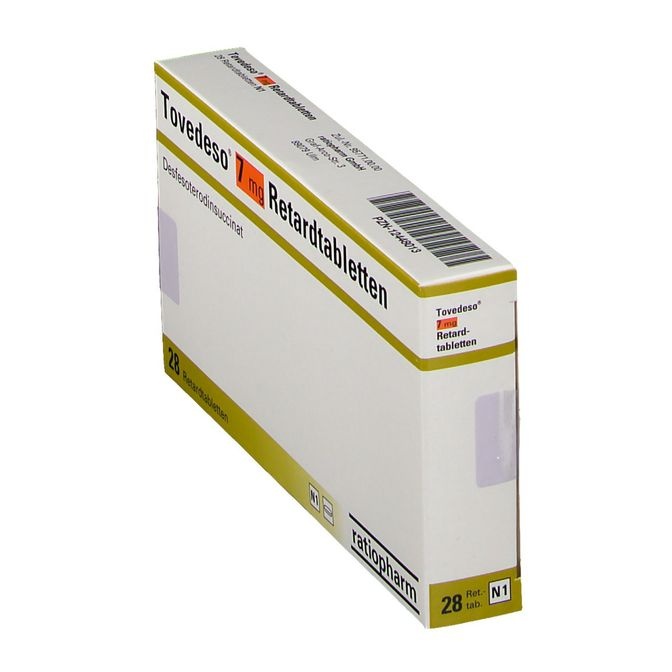
TOVEDESO 7 mg Comprimidos De Liberación Prolongada

Revisión de receta online
Un médico revisará tu caso y determinará si la prescripción es médicamente apropiada.

Habla con un médico sobre este medicamento
Comenta tus síntomas y las opciones de tratamiento en una consulta online.



Cómo usar TOVEDESO 7 MG COMPRIMIDOS DE LIBERACION PROLONGADA
Contenido del prospecto
- Introducción
- Qué es Tovedeso y para qué se utiliza
- Qué necesita saber antes de empezar a tomar Tovedeso
- Cómo tomar Tovedeso
- Posibles efectos adversos
- Conservación de Tovedeso
- Contenido del envase e información adicional
Introducción
Prospecto: información para el paciente
Tovedeso 3,5 mg comprimidos de liberación prolongada
Tovedeso 7 mg comprimidos de liberación prolongada
Desfesoterodina, succinato
Lea todo el prospecto detenidamente antes de empezar a tomar este medicamento, porque contiene información importante para usted.
- Conserve este prospecto, ya que puede tener que volver a leerlo.
- Si tiene alguna duda, consulte a su médico o farmacéutico.
- Este medicamento se le ha recetado solamente a usted, y no debe dárselo a otras personas aunque tengan los mismos síntomas que usted, ya que puede perjudicarles.
- Si experimenta efectos adversos, consulte a su médico o farmacéutico, incluso si se trata de efectos adversos que no aparecen en este prospecto. Ver sección 4.
Contenido del prospecto
- Qué es Tovedeso y para qué se utiliza
- Qué necesita saber antes de empezar a tomar Tovedeso
- Cómo tomar Tovedeso
- Posibles efectos adversos
- Conservación de Tovedeso
- Contenido del envase e información adicional
1. Qué es Tovedeso y para qué se utiliza
Tovedeso contiene un principio activo denominado desfesoterodina succinato, y es un tratamiento de los denominados antimuscarínicos, que reducen la actividad de la vejiga hiperactiva y se utiliza en adultos para tratar los síntomas.
Tovedeso trata los síntomas de la vejiga hiperactiva, como son:
- no poder controlar cuándo orinar (incontinencia de urgencia)
- la necesidad repentina de orinar (urgencia)
- tener que orinar con mayor frecuencia de lo habitual (aumento de la frecuencia urinaria).

¿No estás seguro de si este medicamento es adecuado para ti?
Comenta tus síntomas y tratamiento con un médico online.
2. Qué necesita saber antes de empezar a tomar Tovedeso
No tome Tovedeso:
- si es alérgico a la desfesoterodina, fesoterodina o a alguno de los demás componentes de este medicamento (incluidos en la sección 6) (ver sección 2, Tovedeso contiene lactosa)
- no puede vaciar completamente la vejiga urinaria (retención urinaria)
- su estómago se vacía lentamente (retención gástrica)
- padece una enfermedad ocular llamada glaucoma (aumento de la presión ocular) de ángulo estrecho, que no está controlada (tratada adecuadamente)
- padece una excesiva debilidad de los músculos (miastenia gravis)
- padece ulceración e inflamación del colon (colitis ulcerosa grave)
- tiene un colon anormalmente largo o dilatado (megacolon tóxico)
- tiene algún problema grave del hígado
- tiene algún problema en los riñones o problema moderado o grave del hígado y está tomando medicamentos que contengan alguna de las siguientes sustancias activas: itraconazol o ketoconazol (utilizados para tratar infecciones por hongos), ritonavir, atazanavir, indinavir, saquinavir o nelfinavir (medicamentos antivirales para tratar la infección por el VIH), claritromicina o telitromicina (utilizados para tratar infecciones bacterianas) y nefazodona (utilizada para tratar la depresión) (Ver otros medicamentos y Tovedeso)
Advertencias y precauciones
Desfesoterodina puede no ser siempre adecuada para usted. Hable con su médico antes de tomar Tovedeso en cualquiera de los siguientes casos:
- si usted tiene dificultad para vaciar completamente la vejiga urinaria (por ejemplo, debido al agrandamiento de la próstata)
- si usted ha sufrido alguna vez disminución de los movimientos intestinales o si padece estreñimiento grave
- si usted recibe tratamiento por una enfermedad ocular llamada glaucoma de ángulo estrecho
- si usted tiene problemas graves de riñón o hígado ya que su médico podría tener que ajustar la dosis que recibe
- si usted tiene una enfermedad llamada neuropatía autónoma que le produce síntomas como cambios en su tensión arterial o alteraciones en el intestino o en su función sexual
- si usted sufre una enfermedad gastrointestinal que afecte al paso y/o a la digestión de los alimentos
- si usted sufre ardor de estómago o eructos
- si tiene una infección del tracto urinario, su médico puede necesitar prescribirle antibióticos
Problemas cardiacos: Informe a su médico si padece cualquiera de las siguientes condiciones:
- tiene una anomalía del ECG (registro de la actividad del corazón) conocida como prolongación del intervalo QT o si está tomando algún medicamento que se sabe que produce este efecto
- su ritmo cardiaco es lento (bradicardia)
- padece una enfermedad del corazón como isquemia miocárdica (reducción del riego de sangre al corazón), latidos irregulares o insuficiencia cardiaca
- tiene hipocaliemia, que es una manifestación de niveles anormalmente bajos de potasio en la sangre
Niños y adolescentes
No dé este medicamento a niños y adolescentes menores de 18 años de edad porque aún no se ha establecido si puede funcionar y si sería seguro para ellos.
Otros medicamentos y Tovedeso
Informe a su médico o farmacéutico si está tomando, ha tomado recientemente o pudiera tener que tomar cualquier otro medicamento. Su médico le dirá si puede tomar Tovedeso junto con otros medicamentos.
Por favor, informe a su médico si está tomando medicamentos de la lista que se detalla a continuación. La toma de estos medicamentos al mismo tiempo que desfesoterodina puede producir efectos adversos como boca seca, estreñimiento, dificultad para vaciar completamente la vejiga urinaria o somnolencia más grave o más frecuente de lo habitual.
- medicamentos que contienen el principio activo amantadina (utilizado para tratar la enfermedad de Parkinson).
- ciertos medicamentos utilizados para aumentar la motilidad gastrointestinal o para aliviarlos calambres o espasmos del estómago y los que evitan los mareos en los viajes como los medicamentos que contienen metoclopramida.
- ciertos medicamentos utilizados para tratar trastornos psiquiátricos, como los antidepresivos y los neurolépticos.
Por favor, indique a su médico si está tomando cualquiera de los siguientes medicamentos:
- medicamentos que contienen cualquiera de los siguientes principios activos que pueden aumentar el metabolismo de desfesoterodina y, por tanto, disminuir su efecto: Hierba de San Juan (hipérico), rifampicina (utilizada para el tratamiento de infecciones bacterianas), carbamazepina, fenitoina y fenobarbital (utilizados, entre otros, para tratar la epilepsia)
- medicamentos que contienen cualquiera de los siguientes principios activos que pueden aumentar los niveles de desfesoterodina en la sangre: Itraconazol o ketoconazol (utilizados para tratar infecciones por hongos), ritonavir, atazanavir, indinavir, saquinavir o nelfinavir (medicamentos antiviral utilizado para tratar la infección por el VIH), claritromicina o telitromicina (utilizados para tratar infecciones por bacterias), nefazodona (utilizado para tratar la depresión), fluoxetina o paroxetina (utilizados para tratar la depresión o la ansiedad), bupropion (utilizado para dejar de fumar o para tratar la depresión), quinidina (utilizado para tratar las arritmias) y cinacalcet (utilizado para tratar el hiperparatiroidismo).
- medicamentos que contienen el principio activo metadona (utilizado para el tratamiento del dolor intenso y en problemas de drogodependencia).
Embarazo y lactancia
Si está embarazada o en periodo de lactancia, cree que podría estar embarazada o tiene intención de quedarse embarazada, consulte a su médico o farmacéutico antes de utilizar este medicamento.
Usted no debe tomar Tovedeso si está embarazada, ya que se desconocen los efectos de la desfesoterodina en el embarazo y en el neonato.
Se desconoce si la desfesoterodina se excreta en la leche humana; por lo tanto, no amamante durante el tratamiento con Tovedeso.
Conducción y uso de máquinas
Tovedeso puede causar visión borrosa, mareos y somnolencia. Si sufre alguno de estos efectos, no conduzca ni maneje herramientas o máquinas.
Tovedeso contiene lactosa
Si su médico le ha indicado que padece una intolerancia a ciertos azúcares, consulte con él antes de tomar este medicamento.
3. Cómo tomar Tovedeso
Siga exactamente las instrucciones de administración de este medicamento indicadas por su médico o farmacéutico. En caso de duda, consulte de nuevo a su médico o farmacéutico.
La dosis inicial recomendada de Tovedeso es de un comprimido de 3,5 mg al día. Según cómo responda al medicamento, su médico puede recetarle una dosis más alta; un comprimido de 7 mg al día.
Deberá tragar el comprimido entero con un vaso de agua. No mastique el comprimido. Tovedeso se puede tomar con o sin alimentos.
Para ayudar a recordar la toma de su medicamento, le puede resultar más facil si usted toma el medicamento a la misma hora todos los días.
Si toma más Tovedeso del que debe
Si ha tomado más comprimidos de los que le han indicado que tome o si alguna otra persona toma accidentalmente sus comprimidos, contacte inmediatamentecon su médico u hospital. Muéstreles el envase de los comprimidos.
En caso de sobredosis o ingestión accidental, consulte inmediatamente a su médico o farmacéutico o llame al Servicio de Información Toxicológica, teléfono: 91 562 04 20, indicando el medicamento y la cantidad ingerida.
Si olvidó tomar Tovedeso
Si ha olvidado tomar un comprimido, tómelo nada más recordarlo, pero no tome más de un comprimido al día. No tome una dosis doble para compensar las dosis olvidadas.
Si interrumpe el tratamiento con Tovedeso
No interrumpa el tratamiento con Tovedeso sin hablar antes con su médico, ya que los síntomas de vejiga hiperactiva pueden volver o empeorar cuando interrumpa el tratamiento con Tovedeso.
Si tiene cualquier otra duda sobre el uso de este medicamento, pregunte a su médico o farmacéutico.

¿Has empezado a tomar el medicamento y tienes preguntas?
Comenta tus síntomas y tratamiento con un médico online.
4. Posibles efectos adversos
Al igual que todos los medicamentos, este medicamento puede producir efectos adversos, aunque no todas las personas los sufran.
Algunos efectos adversos pueden ser graves
En raras ocasiones pueden producirse reacciones alérgicas graves incluyendo angioedema. Debe dejar de tomar Tovedeso y contactar inmediatamente con su médicosi desarrolla hinchazón en la cara, boca o garganta ya que esto puede poner en riesgo su vida.
Otros efectos adversos
Muy frecuentes(pueden afectar a más de 1 de cada 10 personas):
Puede notar la boca seca. Este efecto suele ser leve o moderado. Esto puede producir un mayor riesgo de caries dentales. Por tanto, debe cepillarse los dientes de forma habitual dos veces al día y visitar a un dentista en caso de duda.
Frecuentes(pueden afectar a hasta 1 de cada 10 personas)
- sequedad de ojos
- estreñimiento
- trastornos de la digestión (dispepsia)
- dolor o molestia al orinar (disuria)
- mareos
- dolor de cabeza
- dolor de estómago
- diarrea
- malestar (náuseas)
- dificultad para dormir (insomnio)
- sequedad de garganta
Poco frecuentes(pueden afectar a hasta 1 de cada 100 personas)
- infección del tracto urinario
- somnolencia
- dificultad para saborear (disgeusia)
- vértigo
- erupción cutánea
- piel seca
- picazón
- sensación de molestia en el estómago
- gases (flatulencia)
- dificultad para vaciar completamente la vejiga urinaria (retención urinaria)
- retraso para orinar (retardo)
- cansancio intenso (fatiga)
- aumento de la frecuencia cardiaca (taquicardia)
- palpitaciones
- problemas en el hígado
- tos
- sequedad en la nariz
- dolor de garganta
- reflujo ácido del estómago
- visión borrosa
Raros(pueden afectar a hasta 1 de cada 1.000 personas)
- urticaria
- confusión
- entumecimiento alrededor de la boca (hipoestesia oral)
Comunicación de efectos adversos
Si experimenta cualquier tipo de efecto adverso, consulte a su médico o farmacéutico, incluso si se trata de posibles efectos adversos que no aparecen en este prospecto. También puede comunicarlos directamente a través del Sistema Español de Farmacovigilancia de medicamentos de Uso Humano http://www.notificaram.es . Mediante la comunicación de efectos adversos usted puede contribuir a proporcionar más información sobre la seguridad de este medicamento.
5. Conservación de Tovedeso
Mantener este medicamento fuera de la vista y del alcance de los niños.
No utilice este medicamento después de la fecha de caducidad que aparece en el envase y en el blíster después de “CAD”. La fecha de caducidad es el último día del mes que se indica.
Conservar por debajo de 30ºC. Conservar en el embalaje original para protegerlo de la humedad.
Los medicamentos no se deben tirar por los desagües ni a la basura. Deposite los envases y los medicamentos que no necesita en el Punto SIGRE de la farmacia. En caso de duda pregunte a su farmacéutico cómo deshacerse de los envases y de los medicamentos que no necesita. De esta forma ayudará a proteger el medio ambiente.
6. Contenido del envase e información adicional
Composición de Tovedeso
- El principio activo es desfesoterodina succinato
Tovedeso 3,5 mg.Cada comprimido de liberación prolongada contiene 3,5 mg de desfesoterodina succinato, equivalente a 2,6 mg de desfesoterodina.
Tovedeso 7 mg.Cada comprimido de liberación prolongada contiene 7 mg de desfesoterodina succinato, equivalente a 5,2 mg de desfesoterodina.
Los demás componentes son: celulosa microcristalina, povidona, hipromelosa 2208, Microcelac 100, estearato magnésico, hipromelosa 2910, glicerol, dióxido de titanio (E171) y Laca aluminio índigo carmín (E132).
Aspecto del producto y contenido del envase
Tovedeso 3,5 mg comprimidos de liberación prolongada son comprimidos recubiertos, ovalados, biconvexos, de color azul claro, cuyas dimensiones son 11,6 mm x 6,35 mm y marcados en un lado con “3,5”.
Tovedeso 7 mg comprimidos de liberación prolongada son comprimidos recubiertos, ovalados, biconvexos, de color azul, cuyas dimensiones son 11,6 mm x 6,35 mm y marcados en un lado con “7”.
Tovedeso está disponible en formato blíster en envases de 14, 28, 56, 84, 98, 100 y 112 comprimidos de liberación prolongada.
Puede que solamente estén comercializados algunos tamaños de envases.
Titular de la autorización de comercialización y responsable de la fabricación
Titular de la autorización de comercialización
Teva Pharma, S.L.U.
C/ Anabel Segura, 11, Edificio Albatros B,
1ª planta, Alcobendas,
28108 Madrid (España)
Responsable de la fabricación
Merckle GmbH
Ludwig-Merckle-Strasse 3,
Blaubeuren, Baden-Wuerttemberg
89143 Alemania
o
PLIVA Hrvatska d.o.o. (PLIVA Croatia Ltd.)
Prilaz baruna Filipovica 25
Zagreb
10000 Croacia
Pueden solicitar más información respecto a este medicamento dirigiéndose al representante local del titular de la autorización de comercialización:
Laboratorios Gebro Pharma, S.A.
Av. Tibidabo, 29
08022 Barcelona
España
Fecha de la última revisión de este prospecto:junio 2024
La información detallada de este medicamento está disponible en la página web de la Agencia Española de Medicamentos y Productos Sanitarios (AEMPS) http://www.aemps.gob.es
- País de registro
- Forma farmacéuticaCOMPRIMIDO LIBERACION MODIFICADA, 7 mg
- Código ATCG04BD13
- Precio medio en farmacia45.29 EUR
- Principio activo
- Requiere recetaSí
- Fabricante
- ComposiciónGLICEROL (85%) (1,25 mg mg)
- Esta información es de carácter general y no sustituye la consulta con un profesional sanitario.
- Alternativas a TOVEDESO 7 MG COMPRIMIDOS DE LIBERACION PROLONGADAForma farmacéutica: COMPRIMIDO LIBERACION MODIFICADA, 3,5 mgPrincipio activo: desfesoterodineFabricante: Teva Pharma S.L.U.Requiere recetaForma farmacéutica: COMPRIMIDO LIBERACION MODIFICADA, 50 mgPrincipio activo: mirabegronFabricante: Laboratorios Alter S.A.Requiere recetaForma farmacéutica: COMPRIMIDO LIBERACION MODIFICADA, 50 MGPrincipio activo: mirabegronFabricante: Astellas Pharma Europe B.V.Requiere receta
Médicos online para TOVEDESO 7 MG COMPRIMIDOS DE LIBERACION PROLONGADA
Comenta la dosis, los posibles efectos secundarios, interacciones, contraindicaciones o la revisión de receta de TOVEDESO 7 MG COMPRIMIDOS DE LIBERACION PROLONGADA, sujeto a valoración médica y a la normativa local.

Obtén una receta de TOVEDESO 7 MG COMPRIMIDOS DE LIBERACION PROLONGADA online
Rellena un formulario de 2 minutos
Cuéntanos tus síntomas, historial y el medicamento que necesitas.
Elige un médico o nosotros te asignamos uno
Escoge un especialista o te conectamos con el próximo médico disponible.
El médico revisa tu caso
Normalmente en 30 minutos. Puede hacerte preguntas adicionales por chat.
Recógela en cualquier farmacia
Receta electrónica enviada a tu correo, válida en toda España.
Preguntas frecuentes
TOVEDESO 7 MG COMPRIMIDOS DE LIBERACION PROLONGADA requiere receta en España. Puedes confirmarlo con un médico online según tu caso.
El principio activo de TOVEDESO 7 MG COMPRIMIDOS DE LIBERACION PROLONGADA es desfesoterodine. Esta información ayuda a identificar medicamentos con la misma composición pero con diferentes nombres comerciales.
El precio medio en farmacia de TOVEDESO 7 MG COMPRIMIDOS DE LIBERACION PROLONGADA es de aproximadamente 45.29 EUR. Puede variar según el fabricante y la forma farmacéutica.
TOVEDESO 7 MG COMPRIMIDOS DE LIBERACION PROLONGADA es fabricado por Teva Pharma S.L.U.. La marca y el envase pueden variar según el distribuidor.
Los Médicos de familia, Psiquiatras, Dermatólogos, Cardiólogos, Endocrinólogos, Gastroenterólogos, Neumólogos, Nefrólogos, Reumatólogos, Hematólogos, Infectólogos, Alergólogos, Geriatras, Pediatras, Oncólogos pueden valorar la prescripción de TOVEDESO 7 MG COMPRIMIDOS DE LIBERACION PROLONGADA cuando esté clínicamente indicado. Puedes reservar una videoconsulta para comentar tu caso y las opciones de tratamiento.
España cuenta con una infraestructura sanitaria bien desarrollada en ciudades principales como Madrid, Barcelona, Valencia y Sevilla. Las farmacias están ampliamente disponibles y operan bajo estrictas regulaciones, garantizando el acceso a medicamentos con receta.
Puedes comprar TOVEDESO 7 MG COMPRIMIDOS DE LIBERACION PROLONGADA en Madrid, Barcelona, Sevilla o Valencia en cualquier farmacia local con una receta válida.
Para obtener una receta, puedes utilizar Oladoctor:
Otros medicamentos con el mismo principio activo (desfesoterodine) incluyen TOVEDESO 3,5 MG COMPRIMIDOS DE LIBERACION PROLONGADA, BAXIRTO 50 MG COMPRIMIDOS DE LIBERACION PROLONGADA EFG, BETMIGA 50mg comprimidos de liberacion prolongada. Pueden tener diferentes nombres comerciales o formulaciones, pero contienen el mismo componente terapéutico. Consulta siempre con un médico antes de cambiar o iniciar un nuevo medicamento.
