



SONOVUE 8 MICROLITROS/ml INYECTABLE

Revisión de receta online
Un médico revisará tu caso y determinará si la prescripción es médicamente apropiada.

Habla con un médico sobre este medicamento
Comenta tus síntomas y las opciones de tratamiento en una consulta online.



Cómo usar SONOVUE 8 MICROLITROS/ml POLVO Y DISOLVENTE PARA DISPERSION INYECTABLE
Contenido del prospecto
- Introducción
- Qué es SonoVue y para qué se utiliza
- Qué necesita saber antes de empezar a usar SonoVue
- Cómo usar SonoVue
- Posibles efectos adversos
- Conservación de SonoVue
- Contenido del envase e información adicional
Introducción
Prospecto: información para el paciente
SonoVue 8 microlitros/ml polvo y disolvente para dispersión inyectable
Hexafluoruro de azufre
|
Contenido del prospecto
- Qué es SonoVue y para qué se utiliza
- Qué necesita saber antes de empezar a usar SonoVue
- Cómo usar SonoVue
- Posibles efectos adversos
- Conservación de SonoVue
- Contenido del envase e información adicional
1. Qué es SonoVue y para qué se utiliza
SonoVue está indicado únicamente para uso diagnóstico.
SonoVue es un agente de contraste para ecografías que contiene microburbujas rellenas de un gas denominado hexafluoruro de azufre.
Si usted es un adulto, SonoVue le ayuda a obtener ecografías más nítidas del corazón, de vasos sanguíneos y/o de tejidos del hígado y la mama.
SonoVue ayuda a obtener imágenes más claras del tracto urinario en niños.

¿No estás seguro de si este medicamento es adecuado para ti?
Comenta tus síntomas y tratamiento con un médico online.
2. Qué necesita saber antes de empezar a usar SonoVue
No use SonoVue:
- Si es alérgico a hexafluoruro de azufre o a alguno de los demás componentes de este medicamento (incluidos en la sección 6).
- Si el médico le ha dicho que tiene una derivación cardíaca de derecha a izquierda.
- Si padece hipertensión pulmonar grave (presión arterial pulmonar > 90 mm Hg).
- Si padece hipertensión no controlada.
- Si padece un síndrome de distressrespiratorio del adulto (una enfermedad grave que se caracteriza por una inflamación diseminada en los pulmones).
- Si le han indicado que no tome dobutamina (un medicamento que estimula el corazón) debido a la enfermedad cardíaca grave que padece.
Advertencias y precauciones
Consulte a su médico si en los últimos 2 días ha padecido:
- episodios de angina o dolor en el pecho (torácico) frecuentes y/o repetidos, especialmente si usted tiene una historia de enfermedad cardiaca,
- cambios recientes en su electrocardiograma.
Consulte a su médico antes de que le administren SonoVue si:
- ha padecido recientemente un infarto de miocardio o se ha sometido recientemente a una intervención coronaria,
- padece angina de pecho, dolor en el pecho o cardiopatía grave,
- padece trastornos graves del ritmo cardiaco,
- la cardiopatía que padece ha empeorado últimamente,
- padece una inflamación cardíaca aguda de la membrana del corazón (endocarditis),
- tiene implantadas válvulas cardíacas artificiales,
- padece una inflamación o infección generalizadas agudas,
- tiene problemas conocidos de coagulación de la sangre,
- padece una enfermedad renal o hepática graves,
Si le administran SonoVue de forma conjunta con un medicamento, un ejercicio o un dispositivo que estimulen el corazón para visualizar su actividad en situación de esfuerzo, monitorizarán su actividad cardíaca, tensión arterial y ritmo cardíaco.
Niños y adolescentes
Para pacientes menores de 18 años, SonoVue solo puede utilizarse para ultrasonido del tracto urinario.
Uso de SonoVue con otros medicamentos
Informe a su médico si está tomando, ha tomado recientemente o podría tener que tomar cualquier otro medicamento.
En concreto, informe a su médico si está tomando beta bloqueantes (medicamentos para tratar las cardiopatías y la hipertensión o que se administran en forma de colirios para tratar el glaucoma).
Embarazo y lactancia
Si está embarazada o en periodo de lactancia, cree que podría estar embarazada o tiene intención de quedarse embarazada, consulte a su médico o farmacéutico antes de utilizar este medicamento.
Se desconoce si SonoVue pasa a la leche materna. No obstante, se debe interrumpir la lactancia durante dos o tres horas después de la ecocardiografía.
Conducción y uso de máquinas
SonoVue no afecta a la capacidad para conducir y utilizar máquinas.
SonoVue contiene sodio
Este medicamento contiene menos de 23 mg (1 mmol) de sodio por dosis, por lo que se considera esencialmente “exento de sodio”.
3. Cómo usar SonoVue

¿Has empezado a tomar el medicamento y tienes preguntas?
Comenta tus síntomas y tratamiento con un médico online.
SonoVue se lo administrará el personal médico o sanitario debidamente cualificado en este tipo de exploraciones.
Para la ecografía del corazón o de sus vasos sanguíneos y/o los tejidos del hígado y la mama en adultos: la dosis que se administrará en una vena se calculará en función de la parte del cuerpo que le vayan a examinar. La dosis recomendada es de 2 o 2,4 ml por paciente. Esta dosis puede repetirse en caso necesario hasta un máximo de 4,8 ml.
Para la ecografía del tracto urinario en niños: la dosis recomendada es de 1 ml por paciente, para administrarse en la vejiga como se indica a continuación:
Tras el vaciado de su vejiga, se introducirá una solución salina dentro de su vejiga a través de un tubo delgado. A continuación, SonoVue se administrará a través del tubo delgado y seguidamente se administrará la solución salina para continuar llenando la vejiga. El llenado y vaciado de la vejiga con solución salina puede repetirse si es necesario.
Si usted padece un problema pulmonar o cardíaco serio el personal médico le vigilará estrechamente durante la inyección de SonoVue y durante al menos 30 minutos después de esta.
Si usa más SonoVue del que debe
Es improbable que se produzca una sobredosis, puesto que SonoVue lo administra el facultativo médico. En caso de que se produzca una sobredosis, el médico tomará las medidas adecuadas.
4. Posibles efectos adversos
Al igual que todos los medicamentos, este medicamento puede producir efectos adversos, aunque no todas las personas los sufran.
La mayoría de los efectos secundarios de SonoVue son raros y no suelen ser graves. Sin embargo, algunos pacientes pueden experimentar efectos adversos graves y pueden necesitar tratamiento.
Informe a su médico inmediatamentesi aprecia cualquiera de los siguientes efectos adversos,
porque podría necesitar tratamiento médico: hinchazón de cara, labios, boca o garganta que pueda dificultar tragar o respirar; erupción cutánea; urticaria; hinchazón de las manos, pies o tobillos.
A continuación, se indican los efectos adversos que se han comunicado con el uso de SonoVue:
Efectos adversos poco frecuentes(pueden afectar hasta 1 de cada 100 personas):
- Dolor de cabeza,
- Entumecimiento,
- Mareos,
- Extraño sabor en la boca,
- Enrojecimiento,
- Malestar en el pecho,
- Sensación de malestar (náuseas),
- Dolor abdominal,
- Erupción cutánea,
- Sensación de calor,
- Reacciones locales donde se aplicó la inyección, tales como: dolor o una sensación inusual en el lugar de la inyección.
Efectos adversos raros(pueden afectar hasta 1 de cada 1.000 personas):
- Visión borrosa,
- Disminución de la presión arterial,
- Prurito,
- Dolor de espalda,
- Dolor en general,
- Dolor en el pecho,
- Fatiga,
- Reacciones alérgicas graves y menos graves (incluyendo enrojecimiento de la piel, disminución de la frecuencia cardiaca, disminución de la presión arterial, falta de aire, pérdida de consciencia, paro cardiaco/cardio-respiratorio o reacción más grave acompañada de dificultad para respirar y mareo).
Frecuencia no conocida(no puede estimarse a partir de los datos disponibles):
- Dolor de pecho, que se extiende hasta el cuello o al brazo izquierdo, ya que podría ser síntoma de una reacción alérgica potencialmente grave llamada síndrome de Kounis.
- Desmayo,
- En alguno de los casos de reacciones alérgicas en pacientes con angiocardiopatía se han comunicado casos de falta de aporte de oxígeno al corazón o parada cardíaca,
- Vómitos.
Comunicación de efectos adversos
Si experimenta cualquier tipo de efecto adverso, consulte a su médico o farmacéutico, incluso si se trata de posibles efectos adversos que no aparecen en este prospecto. También puede comunicarlos directamente a través del sistema nacional de notificación incluido en el Apéndice V. Mediante la comunicación de efectos adversos usted puede contribuir a proporcionar más información sobre la seguridad de este medicamento.
5. Conservación de SonoVue
Mantener este medicamento fuera de la vista y del alcance de los niños.
No utilice este medicamento después de la fecha de caducidad que aparece en la etiqueta después de CAD. La fecha de caducidad es el último día del mes que se indica.
Este medicamento no requiere condiciones especiales de conservación.
La dispersión de SonoVue se le debe administrar en 6 horas desde su preparación.
6. Contenido del envase e información adicional
Contenido de SonoVue
- El principio activo es hexafluoruro de azufre en forma de microburbujas.
- Los demás componentes son: macrogol 4000, distearoilfosfatidilcolina, dipalmitoilfosfatidilglicerol de sodio, ácido palmítico.
La jeringa de vidrio contiene una solución inyectable de cloruro de sodio 9 mg/ml (0,9 %). Aspecto del producto y tamaño del envase
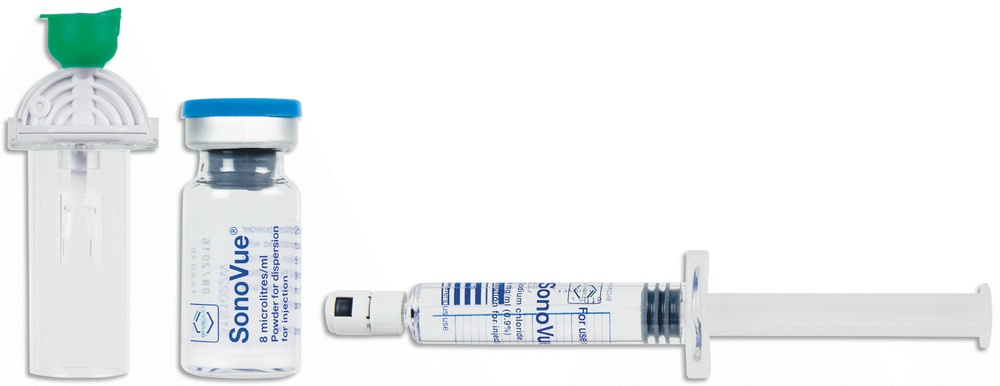
SonoVue es un kit que incluye un vial de vidrio con polvo blanco, una jeringa de vidrio que contiene el disolvente y un sistema de transferencia.
Titular de la autorización de comercialización y responsable de la fabricación:
Titular de la autorización de comercialización
Bracco International B.V.
Strawinskylaan 3051
NL-1077 ZX Ámsterdam
Países Bajos
Responsable de la fabricación:
Bracco Imaging S.p.A.
Via Ribes 5, Bioindustry Park
Colleretto Giacosa-10010 (TO)
Italia
Fecha de la última revisión de este prospecto:
Otras fuentes de información
La información detallada de este medicamento está disponible en la página web de la Agencia Europea de Medicamentos: http://www.ema.europa.eu.
Esta información está destinada únicamente a profesionales del sector sanitario:
Si no se usa de inmediato SonoVue tras su reconstitución, la dispersión se agitará de nuevo antes de extraerla con la jeringa.
El medicamento es únicamente para una sola exploración. Todo volumen restante sin usar al final de una exploración se debe desechar.
Instrucciones de reconstitución:
|
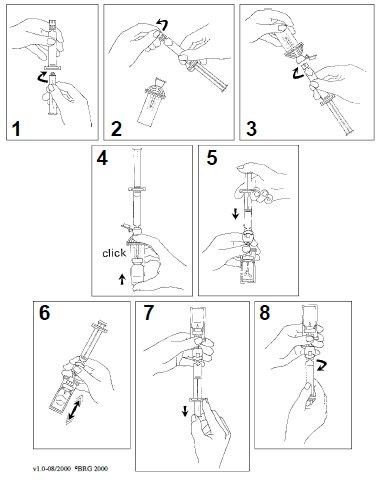
- Conectar el émbolo a la jeringa, enroscándolo en el sentido de las agujas del reloj.
- Abrir el blíster del sistema de transferencia MiniSpike y extraer el tapón de la jeringa.
- Abrir el tapón del sistema de transferencia y conectar la jeringa enroscándola en el sentido de las agujas del reloj.
- Retirar el disco protector del vial. Deslizar el vial en la lámina transparente del sistema de transferencia y presionar firmemente para ajustar el vial en su sitio.
- Vaciar el contenido de la jeringa en el vial, empujando el émbolo.
- Agitar vigorosamente durante 20 segundos para mezclar los contenidos del vial para obtener un líquido lechoso homogéneo.
- Invertir el sistema y extraer cuidadosamente SonoVue en la jeringa.
- Desenroscar la jeringa del sistema de transferencia.
Después de la reconstitución, SonoVue es una dispersión homogénea de color blanco lechoso.
No utilizar si el líquido obtenido es transparente y/o si se observan partes sólidas del liofilizado en la suspensión.
La dispersión inyectable SonoVue se debe administrar en las seis horas posteriores a su preparación.
Los medicamentos no se deben tirar por los desagües. Pregunte a su farmacéutico cómo deshacerse de los envases y de los medicamentos que ya no necesita. De esta forma, ayudará a proteger el medio ambiente.
- País de registro
- Forma farmacéuticaINYECTABLE, 8 µl/ml
- Código ATCV08DA05
- Principio activo
- Requiere recetaSí
- Fabricante
- ComposiciónCLORURO DE SODIO (0 - mg)
- Esta información es de carácter general y no sustituye la consulta con un profesional sanitario.
- Alternativas a SONOVUE 8 MICROLITROS/ml POLVO Y DISOLVENTE PARA DISPERSION INYECTABLEPrincipio activo: perflutren, phospholipid microspheresFabricante: Lantheus Eu LimitedRequiere recetaForma farmacéutica: INYECTABLE, 0,19 mg/mlPrincipio activo: perflutren, human albumin microspheresFabricante: Ge Healthcare AsRequiere recetaForma farmacéutica: INYECTABLE, 0,19 mg/mlPrincipio activo: perflutren, human albumin microspheresFabricante: Ge Healthcare AsRequiere receta
Médicos online para SONOVUE 8 MICROLITROS/ml POLVO Y DISOLVENTE PARA DISPERSION INYECTABLE
Comenta la dosis, los posibles efectos secundarios, interacciones, contraindicaciones o la revisión de receta de SONOVUE 8 MICROLITROS/ml POLVO Y DISOLVENTE PARA DISPERSION INYECTABLE, sujeto a valoración médica y a la normativa local.









Obtén una receta de SONOVUE 8 MICROLITROS/ml POLVO Y DISOLVENTE PARA DISPERSION INYECTABLE online
Rellena un formulario de 2 minutos
Cuéntanos tus síntomas, historial y el medicamento que necesitas.
Elige un médico o nosotros te asignamos uno
Escoge un especialista o te conectamos con el próximo médico disponible.
El médico revisa tu caso
Normalmente en 30 minutos. Puede hacerte preguntas adicionales por chat.
Recógela en cualquier farmacia
Receta electrónica enviada a tu correo, válida en toda España.
Preguntas frecuentes
SONOVUE 8 MICROLITROS/ml POLVO Y DISOLVENTE PARA DISPERSION INYECTABLE requiere receta en España. Puedes confirmarlo con un médico online según tu caso.
El principio activo de SONOVUE 8 MICROLITROS/ml POLVO Y DISOLVENTE PARA DISPERSION INYECTABLE es sulfur hexafluoride, phospholipid microspheres. Esta información ayuda a identificar medicamentos con la misma composición pero con diferentes nombres comerciales.
SONOVUE 8 MICROLITROS/ml POLVO Y DISOLVENTE PARA DISPERSION INYECTABLE es fabricado por Bracco International B.V.. La marca y el envase pueden variar según el distribuidor.
Los Médicos de familia, Psiquiatras, Dermatólogos, Cardiólogos, Endocrinólogos, Gastroenterólogos, Neumólogos, Nefrólogos, Reumatólogos, Hematólogos, Infectólogos, Alergólogos, Geriatras, Pediatras, Oncólogos pueden valorar la prescripción de SONOVUE 8 MICROLITROS/ml POLVO Y DISOLVENTE PARA DISPERSION INYECTABLE cuando esté clínicamente indicado. Puedes reservar una videoconsulta para comentar tu caso y las opciones de tratamiento.
España cuenta con una infraestructura sanitaria bien desarrollada en ciudades principales como Madrid, Barcelona, Valencia y Sevilla. Las farmacias están ampliamente disponibles y operan bajo estrictas regulaciones, garantizando el acceso a medicamentos con receta.
Puedes comprar SONOVUE 8 MICROLITROS/ml POLVO Y DISOLVENTE PARA DISPERSION INYECTABLE en Madrid, Barcelona, Sevilla o Valencia en cualquier farmacia local con una receta válida.
Para obtener una receta, puedes utilizar Oladoctor:
Otros medicamentos con el mismo principio activo (sulfur hexafluoride, phospholipid microspheres) incluyen LUMINITY 150 MICROLITROS/ML GAS Y DISOLVENTE PARA SOLUCIÓN PARA DISPERSIÓN INYECTABLE Y PARA PERFUSIÓN, OPTISON SUSPENSION INYECTABLE, OPTISON SUSPENSION INYECTABLE. Pueden tener diferentes nombres comerciales o formulaciones, pero contienen el mismo componente terapéutico. Consulta siempre con un médico antes de cambiar o iniciar un nuevo medicamento.
