



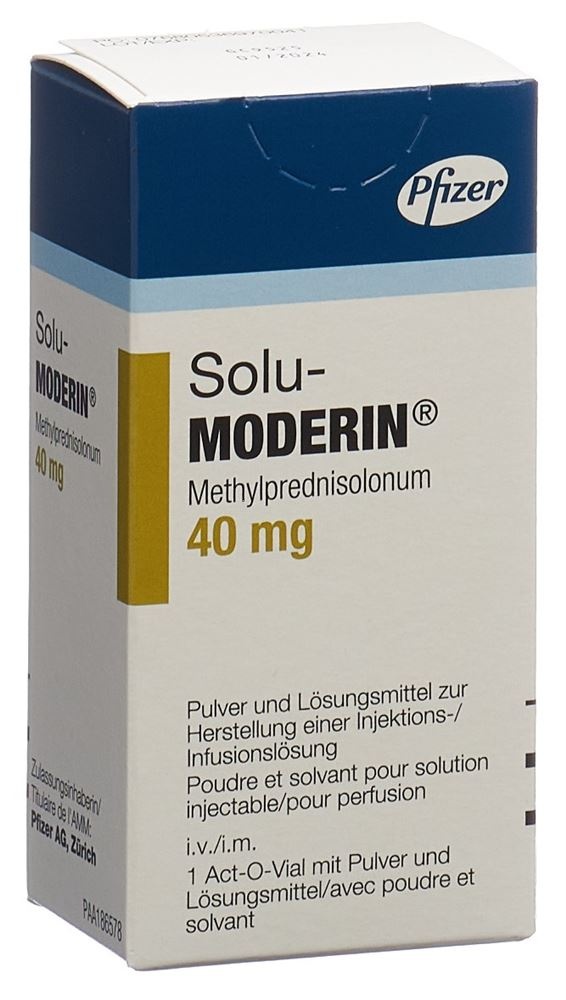
SOLU-MODERIN 1 g Solución Inyectable

Revisión de receta online
Un médico revisará tu caso y determinará si la prescripción es médicamente apropiada.

Habla con un médico sobre este medicamento
Comenta tus síntomas y las opciones de tratamiento en una consulta online.



Cómo usar SOLU-MODERIN 1 G POLVO Y DISOLVENTE PARA SOLUCIÓN INYECTABLE
Contenido del prospecto
- Introducción
- Qué es Solu-Moderín y para qué se utiliza
- Qué necesita saber antes de empezar a usar Solu-Moderín
- Cómo usar Solu-Moderín
- Posibles efectos adversos
- Conservación de Solu-Moderín
- Contenido del envase e información adicional
Introducción
Prospecto: información para el usuario
Solu-Moderín 500 mg polvo y disolvente para solución inyectable
Solu-Moderín 1 g polvo y disolvente para solución inyectable
metilprednisolona
Lea todo el prospecto detenidamente antes de empezar a usar este medicamento, porque contiene información importante para usted.
- Conserve este prospecto, ya que puede tener que volver a leerlo.
- Si tiene alguna duda, consulte a su médico, farmacéutico o enfermero.
- Este medicamento se le ha recetado solamente a usted, y no debe dárselo a otras personas aunque tengan los mismos síntomas que usted, ya que puede perjudicarles.
- Si experimenta efectos adversos, consulte a su médico, farmacéutico o enfermero, incluso si se trata de efectos adversos que no aparecen en este prospecto. Ver sección 4.
Contenido del prospecto
- Qué es Solu-Moderín y para qué se utiliza
- Qué necesita saber antes de empezar a usar Solu-Moderín
- Cómo usar Solu-Moderín
- Posibles efectos adversos
- Conservación de Solu-Moderín
- Contenido del envase e información adicional
1. Qué es Solu-Moderín y para qué se utiliza
Solu-Moderín 500 mg y Solu-Moderín 1 g contienen metilprednisolona como principio activo, que pertenece a un grupo de medicamentos denominados corticosteroides que actúa disminuyendo la producción de sustancias que producen inflamación o alergia.
Solu-Moderín se utiliza en aquellas situaciones que requieran tratamiento corticoide inmediato, en casos graves o cuando la administración por vía oral no es posible, entre ellas:
- Crisis por insuficiencias suprarrenales primarias o secundarias, shock secundario a la insuficiencia adrenocortical.
- Shock anafiláctico (reacción alérgica grave) y situaciones clínicas mediadas por mecanismos de hipersensibilidad inmediata que puedan suponer un peligro para la vida del paciente tales como angioedema (urticaria generalizada acompañada de inflamación de pies, manos, garganta, labios y vías respiratorias), edema laríngeo (hinchazón de la zona de la garganta por acumulación de líquidos).
- Como prevención del shock anafiláctico en intoxicaciones accidentales, como por ejemplo picaduras de insectos y picaduras de serpientes.
- Enfermedades respiratorias inflamatorias graves como exacerbaciones agudas de asma bronquial o junto a la quimioterapia antituberculosa apropiada para el tratamiento de la tuberculosis fulminante o diseminada.
- Como coadyuvante de la quimioterapia antineoplásica.
- Exacerbaciones agudas de esclerosis múltiple (enfermedad caracterizada por lesiones en las membranas protectoras de las neuronas, neurodegenerativas y crónicas del sistema nervioso central), edema cerebral (inflamación del cerebro por acumulación de líquido)
- Lesiones de la médula espinal producidas como máximo 8 horas antes.
Tratamiento del rechazo agudo de trasplantes de órganos.

¿No estás seguro de si este medicamento es adecuado para ti?
Comenta tus síntomas y tratamiento con un médico online.
2. Qué necesita saber antes de empezar a usar Solu-Moderín
No use Solu-Moderín
- si es alérgico a la metilprednisolona o a alguno de los demás componentes de este medicamento (incluidos en la sección 6).
- si padece infecciones por hongos en diferentes órganos del cuerpo.
- por vía intratecal (inyección realizada dentro de la capa que cubre el cerebro y la médula espinal).
- por vía epidural (inyección realizada alrededor de la médula espinal).
- antes y después de la vacunación con microorganismos vivos o vivos atenuados si se van a administrar dosis inmunosupresoras de corticosteroides.
Advertencias y precauciones
Consulte a su médico, farmacéutico o enfermero antes de empezar a usar Solu-Moderín,
- si padece úlceras gástricas o duodenales,
- si padece enfermedades del intestino debido al riesgo de perforación intestinal con peritonitis, como por ejemplo colitis ulcerosa no específica con riesgo inminente de perforación, abscesos u otras infecciones piógenas, así como diverticulitis (inflamación de pequeños sacos en la pared del intestino), anastomosis intestinal (reconstitución mediante sutura del intestino) o úlcera péptica,
- si padece alguna infección, el tratamiento con Solu-Moderín puede disminuir su resistencia a diferentes infecciones, enmascarar algunos signos de infección, empeorar infecciones existentes o hacer que infecciones antiguas y latentes reaparezcan o se agraven. También pueden aparecer nuevas infecciones durante el uso de Solu-Moderín. Su médico lo supervisará de cerca para detectar el desarrollo de infecciones y considerará interrumpir el tratamiento o reducir la dosis según sea necesario,
- si padece poliomielitis (enfermedad infecciosa que afecta al sistema nervioso), excepto la bulboencefálica,
- si padece tuberculosis activa, latente o presenta reactividad a la tuberculina,
- si se le van a administrar vacunas de microorganismos muertos o inactivados y usa dosis inmunosupresoras de corticosteroides ya que la respuesta a estas vacunas puede verse reducida,
- si durante el tratamiento con Solu-Moderín pudiera estar en contacto con personas con infecciones como varicela o herpes zoster, incluso si no presenta ningún síntoma,
- si padece osteoporosis (desmineralización ósea grave),
- si padece miastenia gravis ya que puede necesitar un ajuste de la dosis,
- si padece diabetes ya que puede aumentar los niveles de glucosa en sangre,
- si padece insuficiencia cardiaca congestiva (enfermedad en la que el corazón no puede bombear sangre rica en oxígeno),
- si padece herpes ocular simple debido al riesgo de perforación de la córnea,
- si durante el tratamiento con este medicamento observa algún trastorno visual, incluida la pérdida de visión, visión borrosa u otras alteraciones visuales,
- si padece el síndrome Cushing (cara redondeada, acumulación de grasa en la zona cervical, obesidad en el tronco, etc.) ya que este medicamento puede producir o agravar la enfermedad,
- si padece hipotiroidismo o cirrosis hepática ya que puede necesitar una reducción de la dosis.
- en caso de hipertiroidismo se pueden reducir los niveles de corticosteroide,
- si tiene hiperactividad de la glándula tiroidea (hipertiroidismo),
- si se le detecta algún síntoma de pancreatitis durante el tratamiento,
- si tras la administración de este medicamento en inyección intravenosa (normalmente en una dosis inicial de ≥ 1 g/día) se le detecta algún síntoma de lesión hepática, como hepatitis aguda o enzimas hepáticas aumentadas ya que, en estos casos, se requiere un seguimiento adecuado,
- si padece trombosis o tiene predisposición a padecerla,
- si padece hipertensión,
- si padece enfermedad de los riñones,
- si padece escleroderma (también denominado esclerosis sistémica, un trastorno autoinmune), ya que puede aumentar el riesgo de una complicación grave llamada crisis renal esclerodérmica,
- si padece inestabilidad emocional o tendencias psicóticas,
- si se sospecha o le han diagnosticado feocromocitoma (tumor poco común del tejido de la glándula suprarrenal),
- si se administra Solu-Moderín a un recién nacido prematuro, puede ser necesario controlar la función y la estructura del corazón,
El síndrome de lisis tumoral puede ocurrir cuando se usan corticoesteroides durante el tratamiento del cáncer. Informe a su médico si tiene cáncer y síntomas del síndrome de lisis tumoral tales como calambres musculares, debilidad muscular, confusión, latidos cardíacos irregulares, pérdida de visión o alteraciones visuales y dificultad para respirar.
Los anticoagulantes orales (medicamentos administrados por vía oral para prevenir la coagulación sanguínea), si se usan junto con Solu-Moderín, pueden aumentar el riesgo de hemorragia. En algunos casos, el efecto de los anticoagulantes orales también puede verse reducido. Su médico podría necesitar controlar con mayor frecuencia su riesgo de sangrado mediante análisis de sangre adicionales mientras esté en tratamiento con Solu-Moderín. También podría ajustar la dosis de Solu-Moderín si fuera necesario.
Póngase en contacto con su médico inmediatamente si experimenta debilidad muscular, dolores musculares, calambres y rigidez mientras utiliza metilprednisolona. Estos pueden ser síntomas de una enfermedad llamada parálisis periódica tirotóxica que puede ocurrir en pacientes con hiperactividad de la glándula tiroidea (hipertiroidismo) tratados con metilprednisolona. Es posible que necesite tratamiento adicional para aliviar esta afección.
Interferencias con pruebas analíticas
Si le van a realizar alguna prueba diagnóstica (incluidos análisis de sangre, orina, pruebas cutáneas que utilizan alergenos, etc...) durante la administración de dosis medias y altas de glucocorticoides comunique al médico que está usando este medicamento, ya que puede alterar los resultados,
Uso en deportistas
Si le van a realizar pruebas de control del dopaje ya que la metilprednisolona puede favorecer un resultado positivo.
Niños y adolescentes
Con el uso prolongado de corticoides se ha observado retraso en el crecimiento y desarrollo en niños. Por lo tanto, sólo será empleado cuando existan importantes razones médicas para ello.
Cuando los corticoides se utilizan en periodos prolongados en lactantes y niños, existe un mayor riesgo de sufrir presión dentro del cráneo (presión intracraneal).
Si se administra dosis altas de corticosteroides en esta población, puede producir pancreatitis aguda grave.
Otros medicamentos y Solu-Moderín
Informe a su médico o farmacéutico si está utilizando, ha utilizado recientemente o pudiera tener que utilizar cualquier otro medicamento.
Puede ser necesario ajustar la dosis de alguno de sus medicamentos y vigilar la aparición de reacciones adversas. Esto es especialmente importante si está tomando:
Medicamentos que pueden aumentar los niveles de metilprednisolona:aprepitant, fosaprepitant, ciclosporina, diltiazem, eritromicina, claritromicina, etinilestradiol, noretindrona, itraconazol, ketoconazol, troleandomicina y activadores farmacocinéticos (cobicistat).
Medicamentos que pueden disminuir los niveles de metilprednisolona:fenobarbital, fenitoína, primidona, carbamazepina, rifampicina.
Medicamentos que pueden aumentar o disminuir los niveles de metilprednisolona:tacrolimus, ciclofosfamida, carbamazepina, aprepitant, fosaprepitant, itraconazol, ketoconazol, diltiazem, etinilestradiol, noretindrona, eritromicina, claritromicina, fenobarbital, ciclosporina.
Medicamentos cuyos niveles en la sangre y/o cuyos efectos pueden verse afectados con la administración de metilprednisolona:anfotericina B, xantenos o agonistas beta 2, anticoagulantes orales (medicamentos administrados por via oral para prevenir la formación de coágulos sanguíneos), anticolinesterasas, isoniazida, antidiabéticos, antiinflamatorios no esteroideos, salicilatos, anticolinérgicos (bloqueantes neuromusculares), inhibidores de la proteasa del VIH, inhibidores de la aromatasa, inmunosupresores, eliminadores de potasio, antihipertensivos, toxoides y vacunas.
Algunos medicamentos pueden aumentar los efectos de Solu-Moderín, por lo que su médico puede decidir hacerle controles minuciosos si está tomando medicamentos, tales como antivirales (ritonavir, indinavir) y activadores farmacocinéticos (cobicistat), usados para tratar el VIH.
Uso de Solu-Moderín con los alimentos y bebidas
Debe evitar la ingesta de zumo de pomelo ya que podría interferir con este medicamento.
Embarazo, lactancia y fertilidad
Si está embarazada o en periodo de lactancia, cree que podría estar embarazada o tiene intención de quedarse embarazada, consulte a su médico o farmacéutico antes de utilizar este medicamento, valorando la relación riesgo-beneficio.
Embarazo
Este medicamento puede usarse durante el embarazo sólo si su médico lo considera necesario.
Los niños nacidos de madres que recibieron dosis elevadas de corticosteroides durante el embarazo, deberán ser observados cuidadosamente debido a posibles signos de insuficiencia suprarrenal. Se han observado cataratas en niños nacidos de madres tratadas con corticosteroides de forma prolongada durante el embarazo.
El riesgo de bajo peso al nacer se ha relacionado con la dosis y puede minimizarse mediante la administración de dosis bajas de corticosteroides.
Lactancia
Solu-Moderín pasa a la leche materna.
Conducción y uso de máquinas
El tratamiento con corticosteroides puede producir mareo, vértigo, alteraciones visuales y fatiga.
Por lo tanto, no conduzca ni maneje máquinas si durante el tratamiento con Solu-Moderín experimenta estos efectos.
Solu-Moderín 500 mg contiene sodio
Este medicamento contiene 58,3 mg de sodio (componente principal de la sal de mesa/para cocinar) en cada vial. Esto equivale al 2,92 % de la ingesta diaria máxima de sodio recomendada para un adulto.
Solu-Moderín 1g contiene sodio
Este medicamento contiene 116,8 mg de sodio (componente principal de la sal de mesa/para cocinar) en cada vial. Esto equivale al 5,84 % de la ingesta diaria máxima de sodio recomendada para un adulto.
3. Cómo usar Solu-Moderín
Siga exactamente las instrucciones de administración de este medicamento indicadas por su médico o farmacéutico. En caso de duda, consulte de nuevo a su médico o farmacéutico.
Solu-Moderín puede ser administrado por vía intravenosa (mediante inyección o perfusión) o por vía intramuscular (mediante inyección).
La vía intravenosa es la vía de administración preferente en caso de shock u otra situación aguda.
La vía abierta para la administración de metilprednisolona no debe utilizarse para la administración de ningún otro fármaco. Debe utilizarse otra vía intravenosa distinta a la inyección en bolo para la administración en perfusión.
La dosis será individual para cada paciente y podrá ser modificada dependiendo de la gravedad del cuadro y la respuesta del paciente. Debe utilizarse la dosis eficaz menor para controlar la enfermedad y el tratamiento se prolongará durante el menor tiempo posible.
También deberá evaluarse si la administración se realizará de forma diaria o intermitente.
La reducción de la dosis se hará gradualmente, particularmente con dosis relativamente altas.
Su médico decidirá cuándo debe cambiarse a terapia oral.
En situaciones que suponen una amenaza para la vida del paciente, se recomienda comenzar el tratamiento con dosis de 250 mg a 1.000 mg de metilprednisolona.
- Insuficiencias suprarrenales: de 16 a 32 mg en perfusión intravenosa, seguidos de otros 16 mg durante 24 horas.
En estas crisis y en el Síndrome de Waterhouse/Friderichsen, está indicada la administración simultánea de mineralocorticoides.
- Shock anafiláctico y situaciones mediadas por mecanismos de hipersensibilidad inmediata: de 250 mg a 500 mg de metilprednisolona.
- Enfermedades respiratorias inflamatorias graves: de 30 a 90 mg/día.
En status asthmaticusse recomienda de 250 a 500 mg de metilprednisolona.
- Brotes agudos de esclerosis múltiple: administrar 500 mg/día o 1 g/día durante 3 o 5 días, inyección intravenosa.
- Edema cerebral: de 250 a 500 mg de metilprednisolona.
- Lesión aguda de médula espinal: 30 mg de metilprednisolona por kg de peso corporal en una dosis en bolo IV durante un periodo mínimo de 15 minutos. Tras una pausa de 45 minutos, se administrará una perfusión intravenosa continua de 5,4 mg/kg/hora durante 23 horas para pacientes en los que el tratamiento se inició antes de transcurridas 3 horas desde que se produjo la lesión y durante 47 horas para aquellos pacientes en los que el tratamiento se inició transcurridas 3-8 horas desde que se produjo la lesión.
- Crisis de rechazo: hasta 30 mg/kg de peso corporal.
Uso en niños y adolescentes
La dosis deberá basarse en la gravedad de la enfermedad y en la respuesta del paciente, más que en su edad o peso.
En cualquier caso, la dosis pediátrica no debe ser inferior a 0,5 mg/kg cada 24 horas.
En situaciones que comporten un riesgo vital para el paciente, se recomienda comenzar el tratamiento con dosis únicas de 4 a 20 mg/kg de peso corporal en niños.
Si usa más Solu-Moderín del que debe
En caso de sobredosis o ingestión accidental, consulte inmediatamente a su médico o farmacéutico o llame al Servicio de Información Toxicológica, teléfono 91 562 04 20, indicando el medicamento y la cantidad ingerida.
Si olvidó usar Solu-Moderín
No use una dosis doble para compensar las dosis olvidadas.
Si interrumpe el tratamiento con Solu-Moderín
No deje de usar este medicamento sin consultar con su médico.
Si tiene cualquier otra duda sobre el uso de este medicamento, pregunte a su médico, farmacéutico o enfermero.

¿Has empezado a tomar el medicamento y tienes preguntas?
Comenta tus síntomas y tratamiento con un médico online.
4. Posibles efectos adversos
Al igual que todos los medicamentos, este medicamento puede producir efectos adversos, aunque no todas las personas los sufran.
Se han notificado las siguientes reacciones adversas con las siguientes vías de administración contraindicadas: intratecal/epidural: aracnoiditis, trastornos gastrointestinales funcionales/disfunción vesical, cefalea, meningitis, paraparesia/paraplejia, crisis epilépticas, alteraciones sensitivas.
Los efectos adversos notificados se clasifican según su orden de frecuencias en efectos adversos frecuentes (pueden afectar hasta 1 de cada 10 personas) y de frecuencia no conocida (no puede estimarse a partir de los datos disponibles).
Infecciones e infestaciones
Frecuentes: infección.
Frecuencia no conocida: infección oportunista, peritonitis (puede ser el primer signo o síntoma presente en un trastorno del aparato digestivo tal como perforación, obstrucción o pancreatitis).
Trastornos de la sangre y del sistema linfático
Frecuencia no conocida: recuento elevado de leucocitos (leucocitosis).
Trastornos del sistéma inmunológico
Frecuencia no conocida: hipersensibilidad al fármaco, reacción anafiláctica, reacción anafilactoide.
Trastornos endocrinos
Frecuentes: cushinoide.
Frecuencia no conocida: supresión del eje hipotalámico-hipofisario suprarrenal, síndrome de supresión de esteroides.
Trastornos del metabolismo y de la nutrición
Frecuentes: retención de sodio, retención de líquidos.
Frecuencia no conocida: acidosis metabólica, lipomatosis epidural, alcalosis hipopotasémica, dislipidemia, tolerancia a glucosa disminuida, necesidad aumentada de insulina (o de hipoglucemiantes orales en los diabéticos), acumulación de tejido adiposo en partes localizadas del cuerpo (lipomatosis), apetito aumentado (que puede dar lugar a peso aumentado).
Trastornos psiquiátricos
Frecuentes: trastorno afectivo (incluyendo estado de ánimo deprimido, estado de ánimo eufórico).
Frecuencia no conocida: trastorno afectivo (incluyendo labilidad afectiva, dependencia a drogas, ideación suicida), trastorno psicótico (incluyendo manía, trastorno delirante, alucinación y esquizofrenia), trastorno mental, cambio de personalidad, estado confusional, ansiedad, cambios del estado de ánimo, comportamiento anormal, insomnio, irritabilidad.
Trastornos del sistema nervioso
Frecuencia no conocida: presión intracraneal aumentada (con papiledema [hipertensión intracraneal benigna]), crisis epilépticas, amnesia, trastorno cognoscitivo, mareo, cefalea.
Trastornos oculares
Frecuentes: catarata.
Frecuencia no conocida: enfermedad de la retina y de la membrana coroidea (coriorretinopatía), glaucoma, exoftalmos, visión borrosa.
Trastornos del oído y del laberinto
Frecuencia no conocida: vértigo.
Trastornos cardiacos
Frecuencia no conocida: insuficiencia cardiaca congestiva (en pacientes susceptibles), arritmia.
Trastornos vasculares
Frecuentes: hipertensión.
Frecuencia no conocida: coágulos en la sangre (acontecimientos trombóticos), hipotensión, calor y enrojecimiento de la piel (rubefacción).
Trastornos respiratorios, torácicos y mediastínicos
Frecuencia no conocida: embolia pulmonar, hipo.
Trastornos gastrointestinales
Frecuentes: úlcera péptica (con posible perforación y hemorragia).
Frecuencia no conocida: perforación intestinal, hemorragia gástrica, pancreatitis, esofagitis ulcerativa, esofagitis, distensión abdominal, dolor abdominal, diarrea, dispepsia, náuseas.
Trastornos hepatobiliares
Frecuencia no conocida: la metilprednisolona puede dañar su hígado; se han comunicado casos de hepatitis y enzimas hepáticas aumentadas.
Trastornos de la piel y del tejido subcutáneo
Frecuentes: equimosis, atrofia de la piel, acné.
Frecuencia no conocida: angioedema, hirsutismo, petequias, eritema, hiperhidrosis, estrías en la piel, erupción, prurito, urticaria, hipopigmentación de la piel.
Trastornos musculoesqueléticos y del tejido conjuntivo
Frecuentes: debilidad muscular, osteoporosis, retraso en el crecimiento.
Frecuencia no conocida: mialgia, miopatía, atrofia muscular, osteonecrosis, fractura patológica, artropatía neuropática, artralgia.
Trastornos del aparato reproductor y de la mama
Frecuencia no conocida: menstruación irregular.
Trastornos generales y alteraciones en el lugar de administración
Frecuentes: alteración de la cicatrización.
Frecuencia no conocida: edema periférico, fatiga, malestar general, reacción en la zona de la inyección.
Exploraciones complementarias
Frecuentes: potasio disminuido en sangre.
Frecuencia no conocida: presión intraocular aumentada, tolerancia disminuida a los carbohidratos, calcio elevado en orina, alanina aminotransferasa (ALT) elevada, aspartato aminotransferasa (AST) elevada, fosfatasa alcalina (FA) en sangre aumentada, urea elevada en sangre.
Lesiones traumáticas, intoxicaciones y complicaciones de procedimientos terapéuticos
Frecuencia no conocida: fractura por compresión de la columna vertebral, rotura de tendón (especialmente del tendón de Aquiles).
Otros efectos adversos en niños
Las siguientes reacciones fueron más frecuentes en niños: cambios del estado de ánimo, comportamiento anormal, insomnio, irritabilidad.
Comunicación de efectos adversos
Si experimenta cualquier tipo de efecto adverso, consulte a su médico o farmacéutico o enfermero, incluso si se trata de posibles efectos adversos que no aparecen en este prospecto. También puede comunicarlos directamente a través del Sistema Español de Farmacovigilancia de Medicamentos de Uso Humano: https://www.notificaram.es. Mediante la comunicación de efectos adversos usted puede contribuir a proporcionar más información sobre la seguridad de este medicamento.
5. Conservación de Solu-Moderín
No requiere condiciones especiales de conservación.
Periodo de validez tras la reconstitución: 48 horas.
Mantener este medicamento fuera de la vista y del alcance de los niños.
No utilice este medicamento después de la fecha de caducidad que aparece en el estuche después de CAD. La fecha de caducidad es el último día del mes que se indica.
Los medicamentos no se deben tirar por los desagües ni a la basura. Deposite los envases y los medicamentos que no necesita en el Punto SIGRE de la farmacia. En caso de duda pregunte a su farmacéutico cómo deshacerse de los envases y de los medicamentos que no necesita. De esta forma ayudará a proteger el medio ambiente.
6. Contenido del envase e información adicional
Composición de Solu-Moderín 500 mg y Solu-Moderín 1 gpolvo y disolvente para solución inyectable
- El principio activo es metilprednisolona (succinato de sodio). Cada vial de polvo contiene 500 mg y 1 g (1000 mg), respectivamente, de metilprednisolona (como succinato de sodio)
- Los demás componentes (excipientes) son: fosfato sódico monobásico monohidratado, fosfato sódico dibásico anhidro y agua para preparaciones inyectables.
Aspecto del producto y contenido del envase
Solu-Moderín 500 mg y Solu-Moderín 1 g se presentan en polvo y disolvente para solución inyectable.
Vial de polvo liofilizado de color blanco y vial de disolvente transparente e incoloro.
Solu-Moderín 500 mg y Solu-Moderín 1 g se acondicionan en envases de 1 vial con polvo y 1 vial con disolvente y envases de 50 viales con polvo y 50 viales con disolvente.
Titular de la autorización de comercialización y responsable de la fabricación
Titular de la autorización de comercialización
Pfizer, S.L.
Avda. de Europa, 20-B. Parque Empresarial La Moraleja - 28108 Alcobendas (Madrid)
Responsable de la fabricación
Pfizer Manufacturing Belgium NV
Rijksweg 12
2870 Puurs-Sint-Amands
Bélgica
Fecha de la última revisión de este prospecto: julio 2024
La información detallada y actualizada de este medicamento está disponible en la página web de la Agencia Española de Medicamentos y Productos Sanitarios (AEMPS) http://www.aemps.gob.es/.
--------------------------------------------------------------------------------------------------------------------
Esta información está destinada únicamente a profesionales del sector sanitario:
Solu-Moderin debe ser reconstituido antes de ser utilizado. Para su preparación se requiere una técnica aséptica.
- Reconstitución de la solución para inyección:
El polvo contenido en el vial debe reconstituirse con el disolvente que se incluye en el vial de disolvente. Agitar bien hasta obtener una solución clara.
- Reconstitución de la solución para perfusión:
En primer lugar, el polvo contenido en el vial debe reconstituirse como se ha indicado con anterioridad. La solución reconstituida puede ser administrada en soluciones diluidas de dextrosa al 5% en agua, solución salina isotónica o solución de dextrosa al 5% en 0,45% ó 0,9% de cloruro de sodio.
- País de registro
- Forma farmacéuticaINYECTABLE, 1 g metilprednisolona
- Código ATCH02AB04
- Precio medio en farmacia14.11 EUR
- Principio activo
- Requiere recetaSí
- Fabricante
- ComposiciónFOSFATO DE SODIO MONOBASICO MONOHIDRATADO (14,8 mg mg), FOSFATO SODICO DIBASICO ANHIDRO (139,2 mg mg)
- Esta información es de carácter general y no sustituye la consulta con un profesional sanitario.
- Alternativas a SOLU-MODERIN 1 G POLVO Y DISOLVENTE PARA SOLUCIÓN INYECTABLEForma farmacéutica: INYECTABLE, 20 mgPrincipio activo: MetilprednisolonaFabricante: Laboratorios Normon S.A.Requiere recetaForma farmacéutica: INYECTABLE, 40 mgPrincipio activo: MetilprednisolonaFabricante: Laboratorios Normon S.A.Requiere recetaForma farmacéutica: COMPRIMIDO, 16 mgPrincipio activo: MetilprednisolonaFabricante: Orion CorporationRequiere receta
Médicos online para SOLU-MODERIN 1 G POLVO Y DISOLVENTE PARA SOLUCIÓN INYECTABLE
Comenta la dosis, los posibles efectos secundarios, interacciones, contraindicaciones o la revisión de receta de SOLU-MODERIN 1 G POLVO Y DISOLVENTE PARA SOLUCIÓN INYECTABLE, sujeto a valoración médica y a la normativa local.

Obtén una receta de SOLU-MODERIN 1 G POLVO Y DISOLVENTE PARA SOLUCIÓN INYECTABLE online
Rellena un formulario de 2 minutos
Cuéntanos tus síntomas, historial y el medicamento que necesitas.
Elige un médico o nosotros te asignamos uno
Escoge un especialista o te conectamos con el próximo médico disponible.
El médico revisa tu caso
Normalmente en 30 minutos. Puede hacerte preguntas adicionales por chat.
Recógela en cualquier farmacia
Receta electrónica enviada a tu correo, válida en toda España.
Preguntas frecuentes
SOLU-MODERIN 1 G POLVO Y DISOLVENTE PARA SOLUCIÓN INYECTABLE requiere receta en España. Puedes confirmarlo con un médico online según tu caso.
El principio activo de SOLU-MODERIN 1 G POLVO Y DISOLVENTE PARA SOLUCIÓN INYECTABLE es Metilprednisolona. Esta información ayuda a identificar medicamentos con la misma composición pero con diferentes nombres comerciales.
El precio medio en farmacia de SOLU-MODERIN 1 G POLVO Y DISOLVENTE PARA SOLUCIÓN INYECTABLE es de aproximadamente 14.11 EUR. Puede variar según el fabricante y la forma farmacéutica.
SOLU-MODERIN 1 G POLVO Y DISOLVENTE PARA SOLUCIÓN INYECTABLE es fabricado por Pfizer S.L.. La marca y el envase pueden variar según el distribuidor.
Los Médicos de familia, Psiquiatras, Dermatólogos, Cardiólogos, Endocrinólogos, Gastroenterólogos, Neumólogos, Nefrólogos, Reumatólogos, Hematólogos, Infectólogos, Alergólogos, Geriatras, Pediatras, Oncólogos pueden valorar la prescripción de SOLU-MODERIN 1 G POLVO Y DISOLVENTE PARA SOLUCIÓN INYECTABLE cuando esté clínicamente indicado. Puedes reservar una videoconsulta para comentar tu caso y las opciones de tratamiento.
España cuenta con una infraestructura sanitaria bien desarrollada en ciudades principales como Madrid, Barcelona, Valencia y Sevilla. Las farmacias están ampliamente disponibles y operan bajo estrictas regulaciones, garantizando el acceso a medicamentos con receta.
Puedes comprar SOLU-MODERIN 1 G POLVO Y DISOLVENTE PARA SOLUCIÓN INYECTABLE en Madrid, Barcelona, Sevilla o Valencia en cualquier farmacia local con una receta válida.
Para obtener una receta, puedes utilizar Oladoctor:
Otros medicamentos con el mismo principio activo (Metilprednisolona) incluyen METILPREDNISOLONA NORMON 20 mg POLVO Y DISOLVENTE PARA SOLUCION INYECTABLE EFG, METILPREDNISOLONA NORMON 40 mg POLVO Y DISOLVENTE PARA SOLUCION INYECTABLE EFG, METILPREDNISOLONA ORION 16 MG COMPRIMIDOS EFG. Pueden tener diferentes nombres comerciales o formulaciones, pero contienen el mismo componente terapéutico. Consulta siempre con un médico antes de cambiar o iniciar un nuevo medicamento.
