


Salbuair 2,5 mg solución para inhalación por nebulizador

Revisión de receta online
Un médico revisará tu caso y determinará si la prescripción es médicamente apropiada.

Habla con un médico sobre este medicamento
Comenta tus síntomas y las opciones de tratamiento en una consulta online.



Cómo usar SALBUAIR 2.5 mg SOLUCION PARA INHALACION POR NEBULIZADOR
Contenido del prospecto
- Introducción
- Qué es SALBUAIR 2.5 mg y para qué se utiliza
- ANTES DE USAR SALBUAIR 2.5 mg.
- Cómo usar SALBUAIR 2.5 mg
- Posibles efectos adversos
- Conservación de SALBUAIR 2.5 mg.
- INFORMACIÓN ADICIONAL
Introducción
Prospecto: información para el usuario
Salbuair 2.5 mg solución para inhalación por nebulizador
Salbutamol sulfato
Lea todo el prospecto detenidamente antes de empezar a tomar este medicamento, porque contiene información importante para usted.
- Conserve este prospecto, ya que puede tener que volver a leerlo.Si tiene alguna duda, consulte a su médico o farmacéutico.
- Este medicamento se le ha recetado solamente a usted, y no debe dárselo a otras personas aunque tengan los mismos síntomas que usted, ya que puede perjudicarles.
- Si experimenta efectos adversos, consulte a su médico o farmacéutico, incluso si se trata de efectos adversos que no aparecen en este prospecto. Ver sección 4.
Contenido del prospecto
- Qué esSalbuair 2.5 mg y para qué se utiliza
- Qué necesita saber antes de empezar a tomarSalbuair 2.5 mg
- Cómo tomarSalbuair 2.5 mg
- Posibles efectos adversos
- Conservación deSalbuair 2.5 mg
- Contenido del envase e información adicional
1. Qué es SALBUAIR 2.5 mg y para qué se utiliza
Este medicamento se presenta en ampollas que contienen una solución acuosa para inhalación por nebulizador. Salbuair 2.5 mg contiene 2.5 mg de salbutamol (equivalentes a 3 mg de sulfato de salbutamol) disueltos en 2.5 ml de solución salina isotónica estéril.
El principio activo de este medicamento, salbutamol, pertenece a un grupo de medicamentos llamados broncodilatadores, que relajan los músculos de las paredes de los conductos aéreos de los pulmones. Esto facilita la apertura de los conductos de aire para que se pueda respirar más fácilmente.
Está indicado en el tratamiento del broncoespasmo crónico (cierre de los conductos de aire en los pulmones) que no responde a la terapia convencional y en el tratamiento de asma grave agudo.

¿No estás seguro de si este medicamento es adecuado para ti?
Comenta tus síntomas y tratamiento con un médico online.
2. ANTES DE USAR SALBUAIR 2.5 mg.
No useSalbuair2.5 mg:
- Si es alérgico (hipersensible) al salbutamol o a cualquiera de los demás componentes de Salbuair 2.5 mg.
- No debe usarse durante el parto prematuro o en la amenaza de aborto.
Tenga especial cuidado con Salbuair2.5 mg
Informe a su médico antes de iniciar el tratamiento con este medicamento:
- Si tiene alguna enfemedad cardiaca, ritmo cardiaco irregular o angina de pecho.
- Si tiene una glándula tiroide demasiado activa.
- Si tiene niveles elevados de potasio en sangre.
- Si padece diabetes.
- Si tiene los niveles de lactato en sangre elevados (acidosis láctica), ya que un aumento de estos niveles puede empeorar los problemas respiratorios.
- Si usa conjuntamente salbutamol y bromuro de ipratropio ya que esta combinación puede producir alteraciones oculares como, glaucoma de ángulo cerrado.
Uso de otros medicamentos
Informe a su médico o farmacéutico si está tomando o ha tomado recientemente otros medicamentos, incluso los adquiridos sin receta.
Algunos medicamentos pueden interaccionar con Salbuair 2.5 mg. Es importante que informe a su médico si está tomando alguno de los siguientes medicamentos:
- Medicamentos que contengan beta-bloqueantes no selectivos, como el propranolol.
- Ciertos medicamentos para tratar la depresión (conocidos como inhibidores de la monoamino oxidasa y antidepresivos tricíclicos).
- Medicamentos que contengan anticolinérgicos (usados para tratar el asma, síndrome del intestino irritable, enfermedad de Parkinson e incontinencia).
- Otros medicamentos que ayudan a respirar más fácilmente, como la terbutalina.
Embarazo y lactancia
Consulte a su médico o farmacéutico antes de utilizar cualquier medicamento.
Si es necesario administrar Salbuair 2.5 mg durante el embarazo o en la fase de lactancia, su médico valorará cuidadosamente los beneficios y riesgos potenciales en función de la gravedad del cuadro clínico.
Conducción y uso de máquinas
No se han descrito los efectos de Salbuair 2.5 mg sobre la conducción y el uso de máquinas.
Uso en deportistas
Este medicamento contiene salbutamol que puede producir un resultado positivo en las pruebas de control de dopaje (ver referencias en la sección 4.4 de ficha técnica).
3. Cómo usar SALBUAIR 2.5 mg
Siga exactamente las instrucciones de administración de Salbuair 2.5 mg indicadas por su médico. Consulte a su médico o farmacéutico si tiene dudas.
Salbuair se debe utilizar a demanda y no de forma regular.
Si su asma está activa (por ejemplo, tiene síntomas o crisis frecuentes, como dificultad para respirar que le dificulta hablar, comer o dormir, tos, sibilancias, opresión en el pecho o capacidad física limitada), debe informar inmediatamente a su médico, que le puede empezar a administrar un medicamento o aumentar la dosis de tratamiento, como un corticosteroide inhalado, para controlar su asma.
Informe a su médico lo antes posible si su medicamento parece no estar funcionando tan bien como de costumbre (por ejemplo, si necesita dosis más altas para aliviar sus problemas respiratorios o si su inhalador no le proporciona alivio durante al menos 3 horas), ya que su asma puede estar empeorando y usted puede necesitar un medicamento diferente.
Si utiliza Salbuair 2.5 mg más de dos veces por semana para tratar sus síntomas asmáticos, sin incluir el uso preventivo antes del ejercicio, esto indica un asma mal controlada y puede aumentar el riesgo de ataques de asma graves (empeoramiento del asma) que pueden tener complicaciones serias y pueden poner en riesgo su vida o incluso ser mortales. Se debe poner en contacto con su médico lo antes posible para revisar su tratamiento del asma.
Si utiliza a diario un medicamento contra la inflamación de sus pulmones, p.ej., un “corticosteroide inhalado”, es importante que siga utilizándolo con regularidad, aunque se sienta mejor.
Uso en adultos y niños:
La dosis recomendada es de 2.5 mg hasta cuatro veces al día. Su médico puede incrementar esta dosis a 5 mg hasta cuatro veces al día. Su médico puede decirle que use su nebulizador cada día regularmente o sólo cuando tenga sibilancias o falta de respiración.
Salbuair 2.5 mg debe utilizarse con dispositivos nebulizadores adecuados. La neblina que se produce es inhalada a través de la mascarilla o la boquilla. Su médico le indicará cuál es el nebulizador adecuado y cómo debe usarlo.
Instrucciones para la correcta administración del preparado:
Su medicación es para inhalación mediante un nebulizador, por lo que no debe inyectarse ni tragarse.
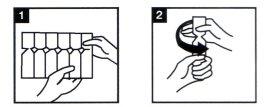
- Prepare su nebulizador siguiendo las instrucciones dadas por el fabricante y su médico. Asegúrese de que el dispositivo nebulizador está limpio.
- Saque de la caja una tira de plástico con ampollas, ábrala y saque una de las ampollas (Fig. 1). Deje el resto de las ampollas en la tira y devuélvala a la caja.
- Coja la ampolla y ábrala girando la parte superior (Fig. 2).
- A menos que su médico le dé otras indicaciones, añada todo el líquido de la ampolla de plástico en el contenedor de solución del nebulizador.
- Utilice el nebulizador de acuerdo con las instrucciones del médico. Tire la ampolla de plástico vacía.
- Tras usar el nebulizador, límpielo de acuerdo con las instrucciones del fabricante.
Si estima que la acción de Salbuair 2.5 mg es demasiado fuerte o débil, comuníqueselo a su médico o farmacéutico.
Si usa másSalbuair2.5 mg del que debiera
Si usa más del que debiera, podrían aparecer alteraciones del ritmo cardiaco, palpitaciones, temblor, aumento o descenso de la presión arterial, alteraciones del pulso, angina de pecho, sofocos, sequedad de boca y trastornos de la acomodación visual.
En caso de sobredosis o ingestión accidental, consulte inmediatamente a su médico o farmacéutico o llame al Servicio de Información Toxicológica, teléfono 91 562 04 20 indicando el medicamento y la cantidad administrada. Contacte con su médico o Servicio de Urgencias Hospitalarias más cercano. Lleve consigo este prospecto o una ampolla de este medicamento, para que el médico que le trate sepa lo que está tomando.
Si olvidó usar Salbuair 2.5 mg
Si olvidó usar Salbuair 2.5 mg, use la siguiente dosis cuando corresponda o antes, en caso de empezar a respirar con dificultad.
No tome una dosis doble para compensar las dosis olvidadas.

¿Has empezado a tomar el medicamento y tienes preguntas?
Comenta tus síntomas y tratamiento con un médico online.
4. Posibles efectos adversos
Al igual que todos los medicamentos, Salbuair 2.5 mg puede producir efectos adversos, aunque no todas las personas los sufran.
Aunque no se conoce exactamente con qué frecuencia ocurre, algunas personas pueden experimentar ocasionalmente dolor en el pecho (debido a problemas de corazón tales como angina de pecho). Avise a su médico si desarrolla estos síntomas mientras está siendo tratado con Salbuair 2.5 mg, pero no deje de tomar este medicamento a menos que así lo indique su médico.
Se han comunicado los siguientes efectos adversos:
Frecuentes(afectan a 1 de cada 10 personas)
- Dolor de cabeza (cefaleas)
- Temblor
- Taquicardia
Poco frecuentes(afectan a menos de 1 de cada 100 personas)
- Palpitaciones
- Irritación de la boca y la garganta
- Calambres musculares
Raros(afectan a menos de 1 de cada 1000 personas)
- Niveles bajos de potasio en sangre (hipopotasemia).
- Dilatación del tamaño de los vasos sanguíneos periféricos (vasodilatación periférica).
Muy raros(afectan a menos de 1 de cada 10000 personas)
- Reacciones alérgicas (hipersensibilidad) incluyendo angioedema y urticaria, broncoespasmo, hipotensión y colapso.
- Hiperactividad.
- Arritmias cardiacas, incluyendo fibrilación auricular, taquicardia supraventricular y extrasístoles (trastornos del ritmo del corazón).
- Broncoespasmo paradójico.
No conocidas
- Isquemia miocárdica (falta de riego sanguineo a una parte del músculo del corazón).
- Acidosis láctica.
Comunicación de efectos adversos
Si experimenta cualquier tipo de los efectos adversos, consulte a su médico o farmacéutico, incluso si se trata de efectos adversos que no aparecen en este prospecto. También puede comunicarlos directamente a través del Sistema Español de Farmacovigilancia de Medicamentos de Uso Humano, Website: www.notificaram.es
5. Conservación de SALBUAIR 2.5 mg.
Mantener este medicamento fuera de la vista y del alcance de los niños.
No conservar a temperatura superior a 25ºC. Conservar en el embalaje exterior para protegerlo de la luz.
Desechar las ampollas a los 3 meses de la apertura del sobre de aluminio.
Las ampollas deben abrirse inmediatamente antes de su uso y debe desecharse cualquier resto de solución sobrante.
No utilice Salbuair 2.5 mg después de la fecha de caducidad que aparece en el frasco después de Cad.. La fecha de caducidad es el último día del mes que se indica.
Los medicamentos no se deben tirar por los desagües ni a la basura. Pregunte a su farmacéutico cómo deshacerse de los envases y de los medicamentos que no necesita. De esta forma ayudará a proteger el medio ambiente.
6. INFORMACIÓN ADICIONAL
Composición desalbuair2.5 mg
- El principio activo es salbutamol sulfato. Cada ampolla contiene 2.5 mg de salbutamol (equivalentes a 3 mg de sulfato de salbutamol) disueltos en 2.5 ml de solución salina isotónica estéril.
- Los demás componentes son: cloruro sódico, agua para inyectables y ácido sulfúrico.
Aspecto del producto y contenido del envase:
Salbuair 2.5 mg se presenta en tiras de 10 ampollas conteniendo una solución incolora o amarillo pálido en el interior de un sobre de aluminio.
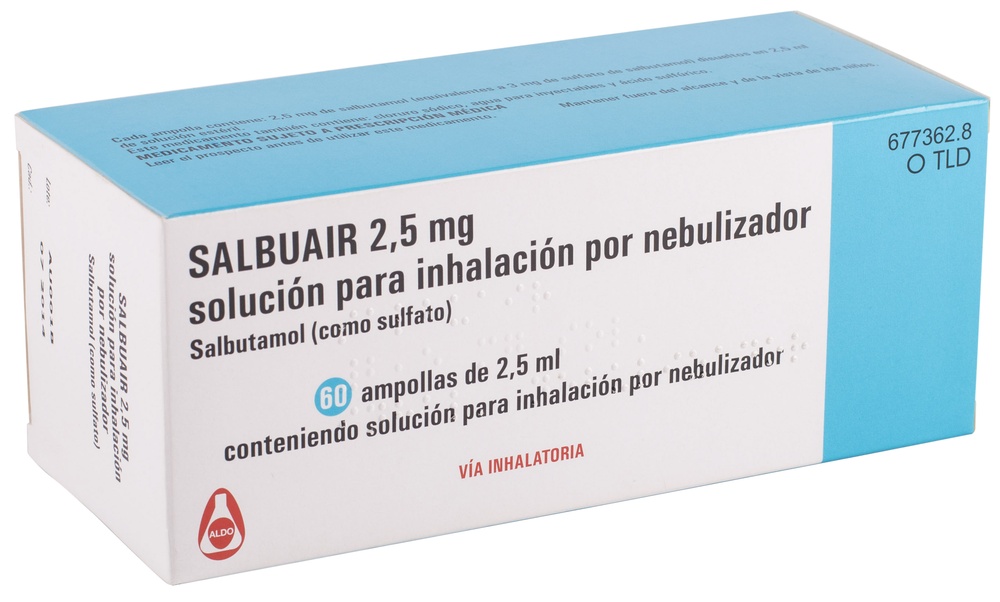
Cada caja contiene 60 ampollas.
Titular de la autorización de comercialización:
Laboratorio ALDO-UNIÓN, S.L.
Baronesa de Maldá, 73
08950 Esplugues de Llobregat
Barcelona (España)
Responsable de la fabricación:
Laboratoire Unither
Espace Industriel Nord
151 rue André Durouchez–CS 28028
80084 AMIENS Cedex 2
Francia
Otras presentaciones:
Salbuair 5 mg solución para inhalación por nebulizador.
Este prospecto ha sido aprobado en junio de 2013
- País de registro
- Forma farmacéuticaINHALACIÓN PULMONAR, 0.12% P/V SALBUTAMOL SULFATO
- Código ATCR03AC02
- Precio medio en farmacia18.37 EUR
- Principio activo
- Requiere recetaSí
- Fabricante
- ComposiciónCLORURO DE SODIO (0.90 % P/V mg)
- Esta información es de carácter general y no sustituye la consulta con un profesional sanitario.
- Alternativas a SALBUAIR 2.5 mg SOLUCION PARA INHALACION POR NEBULIZADORForma farmacéutica: INHALACIÓN PULMONAR, 0.24% P/V SALBUTAMOL SULFATOPrincipio activo: salbutamolFabricante: Laboratorio Aldo Union S.L.Requiere recetaForma farmacéutica: INHALACIÓN PULMONAR, 100 microgramos/aplicaciónPrincipio activo: salbutamolFabricante: Laboratorio Aldo Union S.L.Requiere recetaForma farmacéutica: INHALACIÓN PULMONAR, 2,5 mg/2,5 mlPrincipio activo: salbutamolFabricante: Neutec Inhaler Ireland LimitedRequiere receta
Médicos online para SALBUAIR 2.5 mg SOLUCION PARA INHALACION POR NEBULIZADOR
Comenta la dosis, los posibles efectos secundarios, interacciones, contraindicaciones o la revisión de receta de SALBUAIR 2.5 mg SOLUCION PARA INHALACION POR NEBULIZADOR, sujeto a valoración médica y a la normativa local.









Preguntas frecuentes
SALBUAIR 2.5 mg SOLUCION PARA INHALACION POR NEBULIZADOR requiere receta en España. Puedes confirmarlo con un médico online según tu caso.
El principio activo de SALBUAIR 2.5 mg SOLUCION PARA INHALACION POR NEBULIZADOR es salbutamol. Esta información ayuda a identificar medicamentos con la misma composición pero con diferentes nombres comerciales.
El precio medio en farmacia de SALBUAIR 2.5 mg SOLUCION PARA INHALACION POR NEBULIZADOR es de aproximadamente 18.37 EUR. Puede variar según el fabricante y la forma farmacéutica.
SALBUAIR 2.5 mg SOLUCION PARA INHALACION POR NEBULIZADOR es fabricado por Laboratorio Aldo Union S.L.. La marca y el envase pueden variar según el distribuidor.
Los Médicos de familia, Psiquiatras, Dermatólogos, Cardiólogos, Endocrinólogos, Gastroenterólogos, Neumólogos, Nefrólogos, Reumatólogos, Hematólogos, Infectólogos, Alergólogos, Geriatras, Pediatras, Oncólogos pueden valorar la prescripción de SALBUAIR 2.5 mg SOLUCION PARA INHALACION POR NEBULIZADOR cuando esté clínicamente indicado. Puedes reservar una videoconsulta para comentar tu caso y las opciones de tratamiento.
La receta la emite un médico tras valorar tu estado de salud. En España, SALBUAIR 2.5 mg SOLUCION PARA INHALACION POR NEBULIZADOR se dispensa en las farmacias con esa receta médica. Una consulta online no garantiza su emisión: la decisión corresponde siempre al médico.
Para solicitar una valoración puedes usar Oladoctor:
Otros medicamentos con el mismo principio activo (salbutamol) incluyen SALBUAIR 5 mg SOLUCION PARA INHALACION POR NEBULIZADOR, SALBUTAMOL ALDO-UNION 100 microgramos/dosis SUSPENSION PARA INHALACION EN ENVASE A PRESION, SALBUTAMOL NEUTEC 2,5 MG SOLUCION PARA INHALACION POR NEBULIZADOR. Pueden tener diferentes nombres comerciales o formulaciones, pero contienen el mismo componente terapéutico. Consulta siempre con un médico antes de cambiar o iniciar un nuevo medicamento.
