



ROPIVACAINA 2 mg /Ml Injectable Perfusion

Prescription review online
A doctor will review your case and decide whether a prescription is medically appropriate.

Talk to a doctor about this medicine
Discuss your symptoms and possible next steps in a quick online consultation.



How to use ROPIVACAINE KABI 2 mg/ml SOLUTION FOR INFUSION
Contents of the leaflet
- Introduction
- What Ropivacaína Kabi is and what it is used for
- What you need to know before you are given Ropivacaína Kabi
- How to use Ropivacaína Kabi
- Possible side effects
- Storage of Ropivacaína Kabi
- Container Content and Additional Information
Introduction
Package Leaflet: Information for the User
Ropivacaína Kabi 2 mg/ml solution for infusion EFG
Ropivacaína, hydrochloride
Read all of this leaflet carefully before you are given this medicine because it contains important information for you.
- Keep this leaflet, you may need to read it again.
- If you have any further questions, ask your doctor, nurse or any other healthcare professional.
- If you experience any side effects, talk to your doctor, nurse or any other healthcare professional, even if they are not listed in this leaflet. See section 4.
The name of this medicine is “Ropivacaína Kabi 2 mg/ml solution for infusion EFG”, but in the rest of this leaflet it will be called “Ropivacaína Kabi”.
Contents of the pack:
- What Ropivacaína Kabi is and what it is used for
- What you need to know before you are given Ropivacaína Kabi
- How to use Ropivacaína Kabi
- Possible side effects
- Storage of Ropivacaína Kabi
- Contents of the pack and other information
1. What Ropivacaína Kabi is and what it is used for
- Ropivacaína Kabi contains ropivacaína hydrochloride
- It belongs to a group of medicines called local anesthetics
Ropivacaína Kabi 2 mg/ml solution for infusion is indicated in adults and children of all ages for the treatment of acute pain. It numbs (anesthetizes) parts of the body, e.g., after surgery.

Not sure if this medicine is right for you?
Discuss your symptoms and treatment with a doctor online.
2. What you need to know before you are given Ropivacaína Kabi
You will not be given Ropivacaína Kabi
- if you are allergic (hypersensitive) to ropivacaína hydrochlorideor to any of the other ingredients of this medicine (listed in section 6)
- if you are allergic to any other local anesthetic of the same class (such as lidocaine or bupivacaine)
- if you have been told that you have a decrease in plasma volume(hypovolemia)
- directly into the bloodstreamto numb a specific area of your body
- or in the neck of the uterusto relieve pain during childbirth
If you are not sure if any of the above applies to you, talk to your doctor before you are given Ropivacaína Kabi.
Warnings and precautions
Special care should be taken to avoid any injectionof Ropivacaína Kabi directly into the bloodstreamto prevent any immediate toxic effects. It should not be injected into inflamed areas.
Tell your doctor, nurse or any other healthcare professional before you are given Ropivacaína Kabi:
- if your state of health is not gooddue to age or other factors
- if you have heart problems(complete or partial blockage of heart conduction)
- if you have advanced liver disease
- if you have severe kidney problems
Tell your doctor if you have any of these problems, as it may be necessary to adjust the dose of Ropivacaína Kabi.
Tell your doctor, nurse or any other healthcare professional before you are given Ropivacaína Kabi:
- if you have acute porphyria(problems with the production of red blood cell pigment, which can sometimes cause neurological symptoms)
Tell your doctor if you or a family member has porphyria, as it may be necessary to use another anesthetic.
Tell your doctor about any illness or medical condition you have before starting treatment.
Children
Special care should be taken:
- In newborns as they are more susceptible to Ropivacaína Kabi 2 mg/ml solution for infusion
- In children under 12 years of age as some injections of Ropivacaína Kabi 2 mg/ml solution for infusion to numb parts of the body have not been established
Using Ropivacaína Kabi with other medicines
Tell your doctor or healthcare professional that you are using, have recently used or may need to use any other medicine. This is because Ropivacaína Kabi may affect how some medicines work, and other medicines may affect Ropivacaína Kabi.
In particular, tell your doctor if you are using any of the following medicines:
- Other local anesthetics
- Potent pain-relieving medicines, such as morphine or codeine
- Medicines used to treat irregular heartbeats(arrhythmias), such as lidocaine or mexiletine
Your doctor needs to know this to calculate the correct dose of Ropivacaína Kabi to give you.
Also, tell your doctor if you are using any of the following medicines:
- Medicines for depression (such as fluvoxamine)
- Antibiotics to treat bacterial infections (such as enoxacine)
This is because your body takes longer to eliminate Ropivacaína Kabi if you are using these medicines. If you are using any of these medicines, prolonged use of Ropivacaína Kabi should be avoided.
Pregnancy and breastfeeding
If you are pregnant or breastfeeding, think you may be pregnant or are planning to have a baby, ask your doctor for advice before taking this medicine.
It is not known if ropivacaína affects pregnancy or if it passes into breast milk.
Ask your doctor or pharmacist for advice before taking any medicine.
Driving and using machines
Ropivacaína Kabi may cause drowsiness and affect your reaction speed. Do not drive or use tools or machines after taking Ropivacaína Kabi, until the next day.
Ropivacaína Kabi contains sodium chloride.
This medicine contains 3.4 mg of sodium (main component of table/cooking salt) per milliliter. This is equivalent to 0.17% of the maximum recommended daily sodium intake for an adult.
3. How to use Ropivacaína Kabi
Ropivacaína Kabi will be given to you by a doctor. The dose that your doctor gives you will depend on the type of pain relief you need. It will also depend on your size, age, and physical condition.
Ropivacaína Kabi will be given to you as an infusion. The part of the body where it will be used will depend on why you are being given Ropivacaína Kabi. Your doctor will give you Ropivacaína Kabi in one of the following places:
- The part of the body that needs to be numbed
- Near the part of the body that needs to be numbed
- In an area away from the part of the body that needs to be numbed. This is the case if you are given an epidural infusion (in the area near the spine)
When Ropivacaína Kabi is used in one of these ways, it prevents nerves from sending pain messages to the brain. It prevents you from feeling pain, heat, or cold where it is used, however, you may still have other sensations such as pressure or touch.
Your doctor knows the correct way to give you this medicine.
Dosage
The dose used will depend on why you are being given the medicine and your health, age, and weight.
Duration of treatment
The administration of ropivacaína usually lasts between 0.5 and 6 hours, but may last up to 72 hoursin case of pain reliefduring and after surgery.
If you are given more Ropivacaína Kabi than you should
Severe side effects due to the administration of more Ropivacaína Kabi than necessary require special treatment and the doctor treating you is prepared to handle these situations.
The first signs that you have been given too much Ropivacaína Kabi are usually the following:
- problems with your ears and eyes (vision)
- numbness of lips, tongue, and around the mouth
- dizziness or lightheadedness
- tingling
- speech disturbances characterized by poor articulation (dysarthria)
- muscle stiffness, muscle twitching, convulsions
- low blood pressure
- slow or irregular heartbeat
These symptoms can precede cardiac arrest, respiratory arrest, or severe convulsions.
To reduce the risk of severe side effects, your doctor will stop the administration of Ropivacaína Kabi as soon as these signs appear. This means that if any of these signs occur to you, or if you think you may have received too much Ropivacaína Kabi, tell your doctor or healthcare professional immediately.
More severe side effects from receiving too much Ropivacaína Kabi include problems with speech, muscle stiffness, tremors, agitation, seizures, and loss of consciousness.
Tell your doctor or healthcare professional if you notice any of the above symptoms.

Started taking the medicine and have questions?
Discuss your symptoms and treatment with a doctor online.
4. Possible side effects
Like all medicines, this medicine can cause side effects, although not everybody gets them.
Important side effects to look out for:
Sudden allergic reactionsthat can be life-threatening(such as anaphylaxis, including anaphylactic shock) are rare, affecting between 1 and 10 patients in every 10,000. Possible symptoms include:
- sudden appearance of rash,
- itching or irritation (urticaria),
- swelling of the face, lips, tongue, or other parts of the body,
- shortness of breath, difficulty breathing,
- feeling of loss of consciousness.
If you think you are having an allergic reaction to Ropivacaína Kabi, tell your doctor or healthcare professional immediately.
Other possible side effects:
Very common(may affect more than 1 in 10 people)
- Low blood pressure (hypotension). This can make you feel dizzy or lightheaded
- Nausea
Common(may affect up to 1 in 10 people)
- Tingling (paresthesia)
- Dizziness
- Headache
- Slow or fast heartbeat (bradycardia, tachycardia)
- High blood pressure (hypertension)
- Vomiting
- Difficulty urinating (urinary retention)
- High temperature (fever), shivering (chills)
- Muscle stiffness (rigor)
- Back pain
Uncommon(may affect up to 1 in 100 people)
Anxiety
Decreased skin sensitivity
Fainting
Breathing difficulties
Low body temperature (hypothermia)
Some symptoms may occur if the infusion is given into a blood vessel by mistake, or if you have been given too much Ropivacaína Kabi (see also section 3 “If you are given more Ropivacaína Kabi than you should” above). This includes seizures, dizziness or lightheadedness, numbness of the lips and around the mouth, tongue numbness, hearing problems, vision problems, speech problems, muscle stiffness, and tremors
Rare(may affect up to 1 in 1,000 people)
- Heart attack (cardiac arrest)
- Irregular heartbeat (cardiac arrhythmias)
Frequency not known(cannot be estimated from the available data):
- Horner's syndrome
Other possible side effects include:
- Numbness, due to nerve irritation caused by the needle or injection. This usually does not last long
- Involuntary muscle movements (dyskinesia)
Possible side effects detected with other local anesthetics that may also be caused by Ropivacaína Kabi include:
- Nerve damage. Rarely (affecting between 1 and 10 patients in every 10,000), this can cause permanent problems
- If Ropivacaína Kabi is given into the spinal fluid, the entire body may become numb (anesthetized)
- Receiving an epidural injection (injection into the space around the spinal nerves) can cause an interruption of a nerve pathway from the brain to the head and neck, especially in pregnant women, which can sometimes cause a condition called Horner's syndrome. This is characterized by a decrease in pupil size, drooping of the upper eyelid, and lack of production of sweat from the sweat glands. It will resolve on its own when treatment is stopped
Children
In children, the side effects are the same as in adults except for low blood pressure, which occurs less frequently in children (affecting between 1 and 10 children in every 100) and general discomfort, which occurs more frequently in children (affecting more than 1 in 10).
Reporting of side effects:
If you experience any side effects, talk to your doctor or nurse, even if they are not listed in this leaflet. You can also report side effects directly through the Spanish Medicines Monitoring System for Human Use: https://www.notificaram.es. By reporting side effects, you can help provide more information on the safety of this medicine.
5. Storage of Ropivacaína Kabi
Keep out of sight and reach of children.
Do not use this medicine after the expiry date which is stated on the bag. The expiry date is the last day of the month stated.
Store below 30°C.
Do not use this medicine if you notice a precipitate in the solution for infusion.
Normally, your doctor or hospital will store Ropivacaína Kabi and are responsible for the quality of the product once opened if it is not used immediately. They are also responsible for disposing of any unused Ropivacaína Kabi correctly.
Medicines should not be disposed of via wastewater or household waste. Ask your pharmacist how to dispose of medicines no longer required. This will help protect the environment.
6. Container Content and Additional Information
Composition of Ropivacaína Kabi
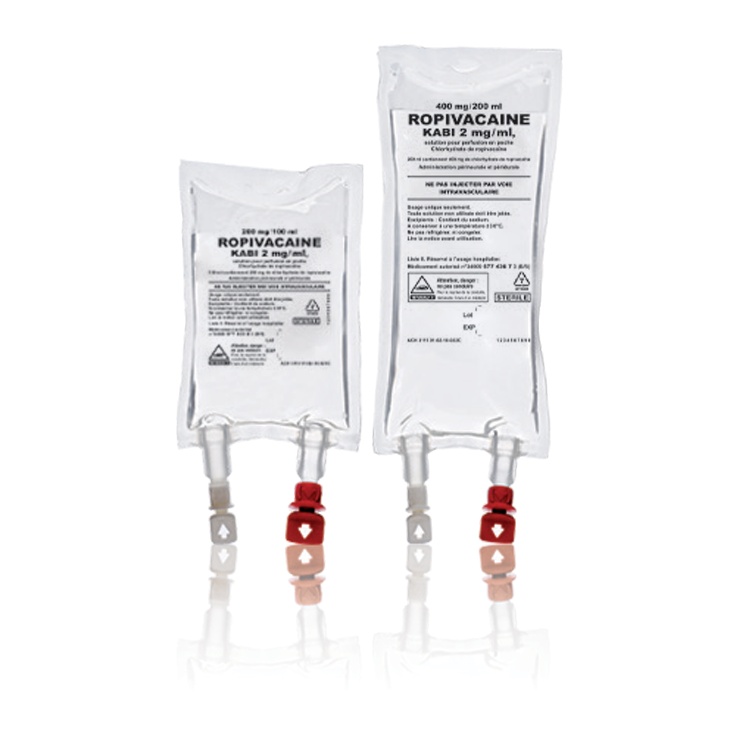
- The active ingredient is ropivacaine hydrochloride 2 mg/ml. Each 100 ml plastic bag contains 200 mg of ropivacaine (hydrochloride).
Each 200 ml plastic bag contains 400 mg of ropivacaine (hydrochloride).
- The excipients are sodium chloride, hydrochloric acid (for pH adjustment), sodium hydroxide (for pH adjustment), and water for injectable preparations.
Appearance of the Product and Container Content
Ropivacaína Kabi solution for infusion is a clear and colorless solution for infusion.
Ropivacaína Kabi 2 mg/ml solution for infusion is available in transparent plastic bags of 100 ml and 200 ml.
Package sizes:
1 bag with overwrap
5 bags with overwrap
10 bags with overwrap
Only some package sizes may be marketed.
Marketing Authorization Holder and Manufacturer
Marketing Authorization Holder
Fresenius Kabi España S.A.U.
C/ Marina 16-18
08005 Barcelona
Spain
Manufacturer
HP Halden Pharma AS
Svinesundsveien 80
1788 Halden
Norway
This medicinal product is authorized in the Member States of the European Economic Area and in the United Kingdom (Northern Ireland) under the following names:
Netherlands | Ropivacaine HCl Fresenius Kabi 2 mg/ml solution for infusion |
Austria | Ropivacaine hydrochloride Kabi 2 mg/ml infusion solution |
Belgium | Ropivacaine Fresenius Kabi 2 mg/ml solution for infusion |
Cyprus | Ropivacaine/Kabi 2 mg/ml, solution for infusion |
Germany | Ropivacaine hydrochloride Kabi 2 mg/ml infusion solution |
Denmark | Ropivacaine Fresenius Kabi, infusion bag, solution, 2 mg/ml |
Estonia | Ropivacaine Kabi |
Greece | Ropivacaine/Kabi 2 mg/ml, solution for infusion |
Spain | Ropivacaine Kabi 2 mg/ml solution for infusion EFG |
Finland | Ropivacaine Fresenius Kabi 2 mg/ml infusion solution, liquid |
France | Ropivacaine Kabi 2 mg/ml, solution for perfusion in bag |
Hungary | Ropivacaine Fresenius Kabi 2 mg/ml solution for infusion |
Italy | Ropivacaine Kabi |
Latvia | Ropivacaine Kabi 2 mg/ml solution for infusion |
Lithuania | Ropivacaine hydrochloride Kabi 2 mg/ml infusion solution |
Luxembourg | Ropivacaine Fresenius Kabi 2 mg/ml infusion solution |
Malta | Ropivacaine Kabi 2 mg/ml |
Norway | Ropivacaine Fresenius Kabi 2 mg/ml infusion solution, liquid |
Poland | Ropivacaine Kabi |
Portugal | Ropivacaine Kabi |
Slovenia | Ropivacaine hydrochloride Kabi 2 mg/ml solution for infusion |
Sweden | Ropivacaine Fresenius Kabi 2 mg/ml, infusion solution, liquid |
United Kingdom (Northern Ireland) | Ropivacaine 2 mg/ml solution for infusion |
Date of the last revision of this leaflet: November 2024
“Detailed and updated information on this medicinal product is available on the website of the Spanish Agency for Medicines and Health Products (AEMPS) http://www.aemps.gob.es/”
------------------------------------------------------------------------------------------------------------------------------
This information is intended only for healthcare professionals:
Handling
Ropivacaína Kabi should only be used by, or under the supervision of, clinical personnel with experience in regional anesthesia (see section 3)
Shelf life after opening: Use immediately.
Ropivacaína Kabi products are intended for single use. Discard any unused solution.
The medicinal product should be visually inspected before use. The solution should only be used if it is clear, practically free of particles, and if the container is not damaged.
The intact container should not be re-autoclaved. A blister pack should be chosen when a sterile environment is required.
Incompatibilities
Compatibility with other solutions, apart from those mentioned below, has not been investigated.
Precipitation may occur in alkaline solutions, as ropivacaine has limited solubility at pH > 6.0.
Compatibility
Ropivacaine solution for infusion in plastic bags for infusion is chemically and physically compatible with the following medicinal products:
Concentration of Ropivacaína Kabi: 1-2 mg/ml | |
Additive | Concentration* |
Fentanyl citrate | 1.0 – 10.0 µg/ml |
Sufentanil citrate | 0.4 – 4.0 µg/ml |
Morphine sulfate | 20.0 – 100.0 µg/ml |
Clonidine hydrochloride | 5.0 – 50 µg/ml |
- The concentration ranges listed in the table are broader than those used in clinical practice. The epidural infusion of Ropivacaína Kabi/citrato de sufentanilo, Ropivacaína Kabi/sulfato de morfina, and Ropivacaína/clonidina has not been evaluated in clinical studies.
The mixtures are chemically and physically stable for 30 days at 20 to 30°C. From a microbiological point of view, the mixtures should be used immediately. If not used immediately, the storage and conditions prior to use are the responsibility of the user and are not usually more than 24 hours at 2 – 8°C.
Disposal
Disposal of unused medicinal products and all materials that have come into contact with them should be carried out in accordance with local regulations.
- Country of registration
- Dosage formINJECTABLE PERFUSION, 2 mg/ml
- ATC codeN01BB09
- Availability in pharmaciesSupply issue reported
- Active substance
- Prescription requiredYes
- Manufacturer
- CompositionCLORURO DE SODIO (8,62 mg mg), HIDROXIDO DE SODIO (E 524) (0-0,012 mg mg)
- This information is for reference only and does not constitute medical advice. Always consult a doctor before taking any medication. Oladoctor is not responsible for medical decisions based on this content.
- Alternatives to ROPIVACAINE KABI 2 mg/ml SOLUTION FOR INFUSIONDosage form: INJECTABLE, 100 mgActive substance: ropivacaineManufacturer: Altan Pharmaceuticals SaPrescription requiredDosage form: INJECTABLE PERFUSION, 2 mg/mlActive substance: ropivacaineManufacturer: Altan Pharmaceuticals SaPrescription requiredDosage form: INJECTABLE, 75 mgActive substance: ropivacaineManufacturer: Altan Pharmaceuticals SaPrescription required
Online doctors for ROPIVACAINE KABI 2 mg/ml SOLUTION FOR INFUSION
Discuss questions about ROPIVACAINE KABI 2 mg/ml SOLUTION FOR INFUSION, including use, safety considerations and prescription review, subject to medical assessment and local regulations.









Get ROPIVACAINE KABI 2 mg/ml SOLUTION FOR INFUSION Prescription Online
Fill in a 2-min form
Tell us your symptoms, history, and what medicine you're requesting.
Pick a doctor or let us assign
Choose a specialist or we'll match you with the next available doctor.
Doctor reviews your case
Usually within 30 minutes. They may ask follow-up questions via chat.
Collect from any pharmacy
Electronic prescription sent to your email — valid across Spain.
Frequently Asked Questions
ROPIVACAINE KABI 2 mg/ml SOLUTION FOR INFUSION requires a prescription in Spain. You can check with a doctor online whether this medicine may be appropriate for your situation.
The active ingredient in ROPIVACAINE KABI 2 mg/ml SOLUTION FOR INFUSION is ropivacaine. This information helps identify medicines with the same composition but different brand names.
ROPIVACAINE KABI 2 mg/ml SOLUTION FOR INFUSION is manufactured by Fresenius Kabi España, S.A.U.. Pharmacy brands and packaging may differ depending on the distributor.
Doctors such as Family doctors, Psychiatrists, Dermatologists, Cardiologists, Endocrinologists, Gastroenterologists, Pulmonologists, Nephrologists, Rheumatologists, Hematologists, Infectious disease physicians, Allergists, Geriatricians, Paediatricians, Oncologists may assess whether ROPIVACAINE KABI 2 mg/ml SOLUTION FOR INFUSION is appropriate, depending on your situation and local regulations. You can book an online consultation to discuss your symptoms and possible next steps.
Spain has a well-developed healthcare infrastructure across major cities such as Madrid, Barcelona, Valencia, and Seville. Pharmacies are widely available and operate under strict regulations, ensuring access to prescribed medications.
You can buy ROPIVACAINE KABI 2 mg/ml SOLUTION FOR INFUSION in Madrid, Barcelona, Seville, or Valencia at any local pharmacy with a valid prescription.
To obtain a prescription, you can use Oladoctor:
Other medicines with the same active substance (ropivacaine) include ROPIVACAINE ALTAN 10 mg/ml INJECTABLE SOLUTION, ROPIVACAINE ALTAN 2 mg/ml SOLUTION FOR INFUSION, ROPIVACAINE ALTAN 7.5 mg/ml INJECTABLE SOLUTION. These may have different brand names or formulations but contain the same therapeutic ingredient. Always consult a doctor before switching or starting a new medicine.
