



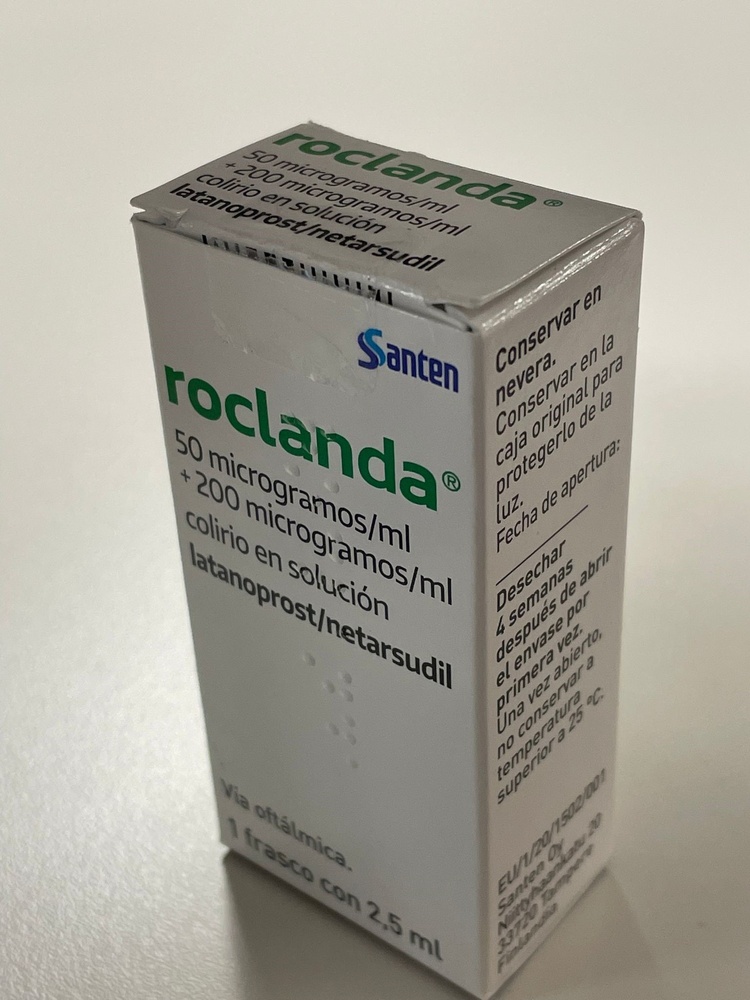
ROCLANDA 50 MICROGRAMOS/ML + 200 MICROGRAMOS/ML COLIRIO EN SOLUCION

Revisión de receta online
Un médico revisará tu caso y determinará si la prescripción es médicamente apropiada.

Habla con un médico sobre este medicamento
Comenta tus síntomas y las opciones de tratamiento en una consulta online.



Cómo usar ROCLANDA 50 MICROGRAMOS/ML + 200 MICROGRAMOS/ML COLIRIO EN SOLUCION
Contenido del prospecto
- Introducción
- Qué es Roclanda y para qué se utiliza
- Qué necesita saber antes de empezar a usar Roclanda
- Cómo usar Roclanda
- Posibles efectos adversos
- Conservación de Roclanda
- Contenido del envase e información adicional
Introducción
Prospecto: información para el paciente
Roclanda 50 microgramos/ml + 200 microgramos/ml colirio en solución
latanoprost/netarsudil
Este medicamento está sujeto a seguimiento adicional, lo que agilizará la detección de nueva información sobre su seguridad. Puede contribuir comunicando los efectos adversos que pudiera usted tener. La parte final de la sección 4 incluye información sobre cómo comunicar estos efectos adversos.
Lea todo el prospecto detenidamente antes de empezar a usar este medicamento, porque contiene información importante para usted.
- Conserve este prospecto, ya que puede tener que volver a leerlo.
- Si tiene alguna duda, consulte a su médico o farmacéutico.
- Este medicamento se le ha recetado solamente a usted, y no debe dárselo a otras personas aunque tengan los mismos síntomas que usted, ya que puede perjudicarles.
- Si experimenta efectos adversos, consulte a su médico o farmacéutico, incluso si se trata de efectos adversos que no aparecen en este prospecto. Ver sección 4.
Contenido del prospecto
- Qué es Roclanda y para qué se utiliza
- Qué necesita saber antes de empezar a usar Roclanda
- Cómo usar Roclanda
- Posibles efectos adversos
- Conservación de Roclanda
- Contenido del envase e información adicional
1. Qué es Roclanda y para qué se utiliza
Roclanda contiene los principios activos latanoprost y netarsudil. Latanoprost pertenece a un grupo de medicamentos llamados «análogos de prostaglandinas». Netarsudil pertenece a un grupo de medicamentos llamados «inhibidores de la Rho cinasa». Actúan de maneras distintas para reducir la cantidad de líquido del interior del ojo y disminuir así la presión.
Roclanda se utiliza para reducir la presión ocular en adultos que padecen una enfermedad ocular llamada «glaucoma» o que presentan hipertensión ocular. Si la presión en el ojo es demasiado alta, puede dañar la visión.

¿No estás seguro de si este medicamento es adecuado para ti?
Comenta tus síntomas y tratamiento con un médico online.
2. Qué necesita saber antes de empezar a usar Roclanda
No use Roclanda:
- si es alérgico a latanoprost, a netarsudil o a alguno de los demás componentes de este medicamento (incluidos en la sección 6).
Advertencias y precauciones
Consulte a su médico o farmacéutico antes de empezar a usar Roclanda si cree que su caso se corresponde con alguna de las siguientes situaciones:
- padece ojo seco;
- padece asma grave o asma mal controlado;
- ha padecido o padece una infección vírica ocular provocada por el virus del herpes simple.
No use Roclanda más de una vez al día, ya que puede padecer más efectos adversos.
Niños y adolescentes
Roclanda no se debe utilizar en niños y adolescentes menores de 18 años de edad, ya que se desconoce su seguridad y eficacia en este grupo de edad.
Otros medicamentos y Roclanda
Roclanda puede interactuar con otros medicamentos. Informe a su médico o farmacéutico si está utilizando, ha utilizado recientemente o pudiera tener que utilizar cualquier otro medicamento, especialmente si contienen otro análogo de prostaglandinas, como latanoprost.
Embarazo y lactancia
Si está embarazada o en periodo de lactancia, cree que podría estar embarazada o tiene intención de quedarse embarazada, consulte a su médico o farmacéutico antes de utilizar este medicamento. No use Roclanda si está embarazada.
Conducción y uso de máquinas
Puede notar visión borrosa o alterada justo después de usar Roclanda. No conduzca ni utilice máquinas hasta que desaparezcan los síntomas.
Roclanda contiene cloruro de benzalconio
Este medicamento contiene cloruro de benzalconio, que se puede absorber por las lentes de contacto blandas y puede alterar el color de las lentes de contacto. Retirar las lentes de contacto antes de usar este medicamento y esperar 15 minutos antes de volver a colocarlas.
El cloruro de benzalconio puede causar irritación ocular, especialmente si padece de ojo seco u otras enfermedades de la córnea (capa transparente de la zona frontal del ojo). Consulte a su médico si siente una sensación extraña, escozor o dolor en el ojo después de usar este medicamento.
3. Cómo usar Roclanda
Siga exactamente las instrucciones de administración de este medicamento indicadas por su médico o farmacéutico. En caso de duda, consulte de nuevo a su médico o farmacéutico.
Roclanda solo se debe aplicar en los ojos (vía oftálmica).
La dosis recomendada es de una gota en cada ojo afectado una vez al día, por la noche. Utilice el medicamento a la misma hora aproximadamente todos los días. No lo use más de una vez al día.
Modo de empleo
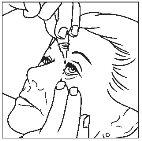
- Lávese las manos antes de usar el medicamento.
- No toque la punta del cuentagotas con los dedos al abrir o cerrar el frasco, ya que el colirio se podría infectar.
- Desenrosque el tapón del frasco y déjelo de lado sobre una superficie limpia. Siga sujetando el frasco, asegurándose de que la punta no entre en contacto con nada.
- Sujete el frasco, apuntando hacia abajo, entre el pulgar y el resto de los dedos.
- Incline la cabeza hacia atrás.
- Tire hacia abajo del párpado inferior con el dedo limpio para formar un «bolsillo» entre el párpado y el ojo. La gota se introducirá en este bolsillo.
- Acerque la punta del cuentagotas al ojo. Si le sirve de ayuda, puede hacerlo frente a un espejo.
- No se toque los ojos, los párpados, las zonas circundantes ni otras superficies con la punta del cuentagotas, ya que el colirio se podría infectar.
- Apriete suavemente el frasco para instilar una gota de Roclanda en el ojo.
- Instile una sola gota en el ojo cada vez. Si la gota no entra en el ojo, vuelva a intentarlo.
- Presione con un dedo el borde del ojo, junto a la nariz, durante 1 minuto. Mantenga el ojo cerrado.
- Si necesita usar el colirio en los dos ojos, repita los pasos en el otro ojo mientras el frasco está abierto.
- Vuelva a colocar el tapón del frasco para cerrarlo.
- Vuelva a colocar el frasco en la caja para protegerlo de la luz hasta que necesite volver a utilizar el colirio.
Si está utilizando otros colirios, espere al menos cinco minutos después de usarlos y luego use Roclanda. Si utiliza pomadas oftálmicas, debe utilizarlas en último lugar.
Si usa más Roclanda del que debe
Enjuáguese los ojos con agua tibia. No se aplique más gotas hasta que corresponda la siguiente dosis habitual.
Si olvidó usar Roclanda
Continúe con la siguiente dosis según lo previsto. No use una dosis doble para compensar las dosis olvidadas.
No utilice más de una gota una vez al día en el ojo afectado.
Si interrumpe el tratamiento con Roclanda
No debe interrumpir el tratamiento con Roclanda sin hablar antes con su médico. Si deja de usar Roclanda, la presión ocular no estará controlada, lo que podría provocar pérdida de visión.
Si tiene cualquier otra duda sobre el uso de este medicamento, pregunte a su médico o farmacéutico.

¿Has empezado a tomar el medicamento y tienes preguntas?
Comenta tus síntomas y tratamiento con un médico online.
4. Posibles efectos adversos
Al igual que todos los medicamentos, este medicamento puede producir efectos adversos, aunque no todas las personas los sufran.
Se han observado los siguientes efectos adversos con Roclanda y otros medicamentos que contienen latanoprost o netarsudil solos:
- Muy frecuentes (pueden afectar a más de 1 de cada 10 personas)
- Efectos oculares:
- enrojecimiento ocular; depósitos finos en la parte anterior del ojo y dolor en el lugar de instilación de las gotas; aumento gradual de pigmentación marrón en la parte coloreada del ojo (el iris) que provoca una alteración del color del ojo; aumento gradual del color (oscurecimiento), de la longitud, del grosor y del número de pestañas.
- Frecuentes (pueden afectar hasta a 1 de cada 10 personas)
- Efectos oculares:
- infección o inflamación del ojo; sequedad ocular o pequeñas roturas en la película lagrimal de la superficie del ojo; secreción ocular; picor de párpados; turbidez ocular y ligera disminución de la visión; dolor ocular; sensación de arenilla o de tener un cuerpo extraño en el ojo; enrojecimiento general de los ojos poco después de ponerse las gotas; manchas o zonas de enrojecimiento ocular; conjuntivitis causada por una reacción alérgica (inflamación ocular o vasos sanguíneos prominentes); ojos llorosos; hinchazón alrededor del ojo; costras en el párpado y visión borrosa.
- Efectos adversos generales:
- enrojecimiento o picor de la piel del rostro.
- Poco frecuentes (pueden afectar hasta a 1 de cada 100 personas)
- Efectos oculares:
- aumento de la presión del líquido del interior del ojo; inflamación de la parte coloreada del ojo (el iris); abultamiento del iris; aumento de las arrugas de la capa transparente situada en la parte anterior del ojo, donde coincide con el párpado inferior; ceguera; visión borrosa, visión doble o halo visual; bloqueo del conducto lagrimal; pequeñas manchas coloreadas en la superficie ocular; sequedad de los párpados; sequedad ocular causada por la inflamación de las glándulas de los párpados; alergia en el ojo; ojos brillantes/vidriosos; ojos cansados; entumecimiento o quemazón en el ojo; eversión anormal del párpado inferior; pérdida de pestañas y enfermedad ocular relacionada con la diabetes; aumento de la sensibilidad a la luz; descoloración de la piel del párpado.
- Efectos adversos en otras partes del cuerpo:
- obstrucción nasal; hemorragia nasal; molestias y dolor nasales; dolor de cabeza; mareos; vómitos; enrojecimiento o picor de la piel; piel seca; engrosamiento de la piel; dolor o espasmo o debilidad muscular; dolor en las articulaciones; dolor de mandíbula; escozor de la piel; inflamación del cartílago; dolor torácico (angina de pecho); sentir los latidos del corazón (palpitaciones); asma y dificultad respiratoria (disnea).
- Raros (pueden afectar hasta a 1 de cada 1000 personas)
- Efectos oculares:
- hinchazón o picor que provoca daño a la superficie del ojo; hinchazón alrededor del ojo (edema periorbital); crecimiento desviado de las pestañas o crecimiento de otra hilera de pestañas; cicatrización de la superficie del ojo; acumulación de líquido en la parte coloreada del ojo (quiste del iris); reacciones en la piel de los párpados; oscurecimiento de la piel de los párpados e infección vírica del ojo provocada por el virus del herpes simple.
- Efectos adversos en otras partes del cuerpo:
- empeoramiento del asma; picor intenso de la piel.
- Muy raros (pueden afectar hasta a 1 de cada 10.000 personas)
- Efectos oculares:
- apariencia de ojos hundidos (mayor profundidad del surco del ojo).
- Efectos adversos en otras partes del cuerpo:
- empeoramiento de la angina de pecho en pacientes que padezcan enfermedades cardíacas.
Comunicación de efectos adversos
Si experimenta cualquier tipo de efecto adverso, consulte a su médico o farmacéutico, incluso si se trata de posibles efectos adversos que no aparecen en este prospecto. También puede comunicarlos directamente a través del sistema nacional de notificación incluido en el Apéndice V. Mediante la comunicación de efectos adversos usted puede contribuir a proporcionar más información sobre la seguridad de este medicamento.
5. Conservación de Roclanda
Mantener este medicamento fuera de la vista y del alcance de los niños.
No utilice este medicamento después de la fecha de caducidad que aparece en el frasco y la caja después de CAD. La fecha de caducidad es el último día del mes que se indica.
Frasco sin abrir: conservar en nevera (entre 2 ºC y 8 ºC).
Una vez abierto el frasco: no conservar a temperatura superior a 25 ºC.
Conservar en la caja original para protegerlo de la luz.
Para evitar infecciones, deseche el frasco 4 semanas después de abrirlo por primera vez y utilice un frasco nuevo.
Los medicamentos no se deben tirar por los desagües ni a la basura. Pregunte a su farmacéutico cómo deshacerse de los envases y de los medicamentos que ya no necesita. De esta forma, ayudará a proteger el medio ambiente.
6. Contenido del envase e información adicional
Composición de Roclanda
- Los principios activos son latanoprost y netarsudil. Cada ml de solución contiene 50 microgramos de latanoprost y 200 microgramos de netarsudil (como mesilato).
- Los demás excipientes son cloruro de benzalconio (ver «Roclanda contiene cloruro de benzalconio» en la sección 2), manitol, ácido bórico, hidróxido de sodio (para ajuste del pH) y agua para preparaciones inyectables.
Aspecto del producto y contenido del envase
Roclanda es un colirio líquido transparente que se presenta en un frasco de plástico. Cada frasco contiene 2,5 ml del medicamento y cada envase contiene 1 ó 3 frascos con tapón de rosca. Puede que solamente estén comercializados algunos tamaños de envases.
Titular de la autorización de comercialización
Santen Oy
Niittyhaankatu 20, 33720 Tampere, Finlandia
Responsable de la fabricación
Aerie Pharmaceuticals Ireland, Limited
Athlone Business and Technology Park, Dublin Road,
Garrycastle, Athlone, Co Westmeath, N37 DW40, Irlanda
y
Santen Oy
Kelloportinkatu 1, 33100 Tampere, Finlandia
Pueden solicitar más información respecto a este medicamento dirigiéndose al representante local del titular de la autorización de comercialización:
België/Belgique/Belgien Santen Oy Tél/Tel: +32 (0) 24019172 | Lietuva Santen Oy Tel: +370 37 366628 |
Santen Oy Teπ.: +359 (0) 888 755 393 | Luxembourg/Luxemburg Santen Oy Tél/Tel: +352 (0) 27862006 |
Ceská republika Santen Oy Tel: +358 (0) 3 284 8111 | Magyarország Santen Oy Tel: +358 (0) 3 284 8111 |
Danmark Santen Oy Tlf: +45 898 713 35 | Malta Santen Oy Tel: +358 (0) 3 284 8111 |
Deutschland Santen GmbH Tel: +49 (0) 3030809610 | Nederland Santen Oy Tel: +31 (0) 207139206 |
Eesti Santen Oy Tel: +372 5067559 | Norge Santen Oy Tlf: +47 21939612 |
Ελλáδα Santen Oy Τηλ: +358 (0) 3 284 8111 | Österreich Santen Oy Tel: +43 (0) 720116199 |
España Santen Pharmaceutical Spain S.L. Tel: +34 914 142 485 | Polska Santen Oy Tel.: +48(0) 221042096 |
France Santen S.A.S. Tél: +33 (0) 1 70 75 26 84 | Portugal Santen Oy Tel: +351 308 805 912 |
Hrvatska Santen Oy Tel: +358 (0) 3 284 8111 | Ireland Santen Oy Tel: +353 (0) 16950008 |
România Santen Oy Tel: +358 (0) 3 284 8111 | Slovenija Santen Oy Tel: +358 (0) 3 284 8111 |
Ísland Santen Oy Sími: +358 (0) 3 284 8111 | Slovenská republika Santen Oy Tel: +358 (0) 3 284 8111 |
Italia Santen Italy S.r.l. Tel: +39 0236009983 | Suomi/Finland Santen Oy Puh/Tel: +358 (0) 974790211 |
Κúπρος Santen Oy Τηλ: +358 (0) 3 284 8111 | Sverige Santen Oy Tel: +46 (0) 850598833 |
Latvija Santen Oy Tel: +371 677 917 80 | United Kingdom (Northern Ireland) Santen Oy Tel: +353 (0) 16950008 (UK Tel: +44 (0) 345 075 4863) |
Fecha de la última revisión de este prospecto:
Otras fuentes de información
La información detallada de este medicamento está disponible en la página web de la Agencia Europea de Medicamentos: http://www.ema.europa.eu.
- País de registro
- Forma farmacéuticaCOLIRIO, 50 MICROGRAMOS/ML + 200 MICROGRAMOS/ML
- Código ATCS01EE51
- Principio activo
- Requiere recetaSí
- Fabricante
- ComposiciónMANITOL (E-421) (47 mg mg), ACIDO BORICO (0,5 mg mg), BENZALCONIO, CLORURO DE (0,2 mg mg), HIDROXIDO DE SODIO (E 524) (c.s.p. pH mg)
- Esta información es de carácter general y no sustituye la consulta con un profesional sanitario.
- Alternativas a ROCLANDA 50 MICROGRAMOS/ML + 200 MICROGRAMOS/ML COLIRIO EN SOLUCIONForma farmacéutica: COLIRIO, 0.3 mg/mlPrincipio activo: BimatoprostFabricante: Tiedra Farmaceutica S.L.Requiere recetaForma farmacéutica: COLIRIO, 0.3 mg/mlPrincipio activo: BimatoprostFabricante: Sifi S.P.A.Requiere recetaForma farmacéutica: COLIRIO, 0,3 mg/mlPrincipio activo: BimatoprostFabricante: Laboratorio Stada S.L.Requiere receta
Médicos online para ROCLANDA 50 MICROGRAMOS/ML + 200 MICROGRAMOS/ML COLIRIO EN SOLUCION
Comenta la dosis, los posibles efectos secundarios, interacciones, contraindicaciones o la revisión de receta de ROCLANDA 50 MICROGRAMOS/ML + 200 MICROGRAMOS/ML COLIRIO EN SOLUCION, sujeto a valoración médica y a la normativa local.









Obtén una receta de ROCLANDA 50 MICROGRAMOS/ML + 200 MICROGRAMOS/ML COLIRIO EN SOLUCION online
Rellena un formulario de 2 minutos
Cuéntanos tus síntomas, historial y el medicamento que necesitas.
Elige un médico o nosotros te asignamos uno
Escoge un especialista o te conectamos con el próximo médico disponible.
El médico revisa tu caso
Normalmente en 30 minutos. Puede hacerte preguntas adicionales por chat.
Recógela en cualquier farmacia
Receta electrónica enviada a tu correo, válida en toda España.
Preguntas frecuentes
ROCLANDA 50 MICROGRAMOS/ML + 200 MICROGRAMOS/ML COLIRIO EN SOLUCION requiere receta en España. Puedes confirmarlo con un médico online según tu caso.
El principio activo de ROCLANDA 50 MICROGRAMOS/ML + 200 MICROGRAMOS/ML COLIRIO EN SOLUCION es latanoprost and netarsudil. Esta información ayuda a identificar medicamentos con la misma composición pero con diferentes nombres comerciales.
ROCLANDA 50 MICROGRAMOS/ML + 200 MICROGRAMOS/ML COLIRIO EN SOLUCION es fabricado por Santen Oy. La marca y el envase pueden variar según el distribuidor.
Los Médicos de familia, Psiquiatras, Dermatólogos, Cardiólogos, Endocrinólogos, Gastroenterólogos, Neumólogos, Nefrólogos, Reumatólogos, Hematólogos, Infectólogos, Alergólogos, Geriatras, Pediatras, Oncólogos pueden valorar la prescripción de ROCLANDA 50 MICROGRAMOS/ML + 200 MICROGRAMOS/ML COLIRIO EN SOLUCION cuando esté clínicamente indicado. Puedes reservar una videoconsulta para comentar tu caso y las opciones de tratamiento.
España cuenta con una infraestructura sanitaria bien desarrollada en ciudades principales como Madrid, Barcelona, Valencia y Sevilla. Las farmacias están ampliamente disponibles y operan bajo estrictas regulaciones, garantizando el acceso a medicamentos con receta.
Puedes comprar ROCLANDA 50 MICROGRAMOS/ML + 200 MICROGRAMOS/ML COLIRIO EN SOLUCION en Madrid, Barcelona, Sevilla o Valencia en cualquier farmacia local con una receta válida.
Para obtener una receta, puedes utilizar Oladoctor:
Otros medicamentos con el mismo principio activo (latanoprost and netarsudil) incluyen ABIPROST 0.3 MG/ML COLIRIO EN SOLUCION EN ENVASE UNIDOSIS, AMIRIOX 0,3 MG/ML COLIRIO EN SOLUCION, BIMATOPROST STADA 0,3 MG/ML COLIRIO EN SOLUCIÓN EN ENVASE UNIDOSIS. Pueden tener diferentes nombres comerciales o formulaciones, pero contienen el mismo componente terapéutico. Consulta siempre con un médico antes de cambiar o iniciar un nuevo medicamento.
