



RISEDRONATO CINFAMED 75 mg Comprimidos recubiertos con película

Revisión de receta online
Un médico revisará tu caso y determinará si la prescripción es médicamente apropiada.

Habla con un médico sobre este medicamento
Comenta tus síntomas y las opciones de tratamiento en una consulta online.



Cómo usar RISEDRONATO CINFAMED 75 MG COMPRIMIDOS RECUBIERTOS CON PELICULA EFG
Contenido del prospecto
- Introducción
- Qué es Risedronato cinfamed y para qué se utiliza
- Qué necesita saber antes de empezar a tomar Risedronato cinfamed
- Cómo tomar Risedronato cinfamed
- Posibles efectos adversos
- Conservación de Risedronato cinfamed
- Contenido del envase e información adicional
Introducción
Prospecto: información para el paciente
Risedronato cinfamed 75 mg comprimidos recubiertos con película EFG
Risedronato de sodio
Lea todo el prospecto detenidamente antes de empezar a tomar este medicamento, porque contiene información importante para usted.
- Conserve este prospecto, ya que puede tener que volver a leerlo.
- Si tiene alguna duda, consulte a su médico o farmacéutico.
- Este medicamento se le ha recetado solamente a usted, y no debe dárselo a otras personas aunque tengan los mismos síntomas que usted, ya que puede perjudicarles.
- Si experimenta efectos adversos, consulte a su médico o farmacéutico, incluso si se trata de efectos adversos que no aparecen en este prospecto. Ver sección 4.
Contenido del prospecto
- Qué es Risedronato cinfamed y para qué se utiliza
- Qué necesita saber antes de empezar a tomar Risedronato cinfamed
- Cómo tomar Risedronato cinfamed
- Posibles efectos adversos
- Conservación de Risedronato cinfamed
- Contenido del envase e información adicional
1. Qué es Risedronato cinfamed y para qué se utiliza
Qué es Risedronato cinfamed
Este medicamento pertenece a un grupo de medicamentos no hormonales denominados bifosfonatos, que se utilizan para el tratamiento de enfermedades óseas. Este medicamento actúa directamente sobre los huesos fortaleciéndolos y, por tanto, reduce la probabilidad de fracturas.
El hueso es un tejido vivo. El hueso viejo del esqueleto está renovándose constantemente y remplazándose por hueso nuevo.
La osteoporosis posmenopáusica aparece en mujeres después de la menopausia cuando el hueso comienza a debilitarse, es más frágil y son más probables las fracturas después de una caída o torcedura.
Las fracturas óseas más probables son las de vértebras, cadera y muñeca, si bien pueden producirse en cualquier hueso del cuerpo. Las fracturas asociadas a osteoporosis también pueden producir dolor de espalda, disminución de altura y espalda curvada. Algunos pacientes con osteoporosis no tienen síntomas y puede que ni siquiera sepan que la padecen.
Para qué se utiliza Risedronato cinfamed
Este medicamento está indicado para el tratamiento de la osteoporosis en mujeres después de la menopausia.

¿No estás seguro de si este medicamento es adecuado para ti?
Comenta tus síntomas y tratamiento con un médico online.
2. Qué necesita saber antes de empezar a tomar Risedronato cinfamed
No tome Risedronato cinfamed
- si es alérgico al risedronato de sodio o a alguno de los demás componentes de este medicamento (incluidos en la sección 6)
- si su médico le ha dicho que usted padece una enfermedad denominada hipocalcemia (niveles bajos
de calcio en sangre)
- si pudiera estar embarazada, si está embarazada o si planea quedarse embarazada
- si está amamantando
- si padece enfermedad grave del riñón.
Advertencias y precauciones
Consulte a su médico o farmacéutico antes de empezar a tomar Risedronato cinfamed:
- Si no puede permanecer en posición erguida, ya sea sentado o de pie, durante al menos 30 minutos.
- Si tiene problemas óseos o en el metabolismo de minerales (por ejemplo, deficiencia de vitamina D, alteraciones de la hormona paratiroidea, ambos produciendo un nivel bajo de calcio en sangre).
- Si tiene o ha tenido problemas en el pasado con su esófago (el conducto que une la boca con el estómago). En algún momento usted podría tener o haber tenido dolor o dificultad en tragar la comida o le han informado previamente que usted tiene esófago de Barrett (una condición asociada con cambios en las células que recubren la parte inferior del esófago).
- Si ha tenido o tiene dolor, hinchazón o insensibilidad en el maxilar o “una molestia fuerte en el maxilar” o se le mueve un diente.
- Si usted está en tratamiento dental o va a sufrir cirugía dental, informe a su dentista que usted está recibiendo tratamiento con risedronato de sodio.
Su médico le aconsejará qué hacer si toma este medicamento y tiene alguno de los problemas mencionados anteriormente.
Niños y adolescentes
No se recomienda el uso de risedronato de sodio en niños y adolescentes (menores de 18 años) debido a que no hay suficientes datos acerca de su seguridad y eficacia.
Otros medicamentos y Risedronato cinfamed
Los medicamentos que contienen alguna de las sustancias siguientes reducen el efecto de risedronato de sodio cuando se toman al mismo tiempo:
- calcio
- magnesio
- aluminio (por ejemplo algún medicamento para la indigestión)
- hierro
Tome estos medicamentos al menos 30 minutos después de haber tomado Risedronato cinfamed.
Informe a su médico o farmacéutico si está utilizando, ha utilizado recientemente o pudiera tener que utilizar cualquier otro medicamento.
Toma de Risedronato cinfamed con los alimentos y bebidas
Es muy importante que NO tome risedronato de sodio junto con alimentos o con bebidas (diferentes al agua corriente) porque pueden interferir. En particular, no tome este medicamento al mismo tiempo que productos lácteos (como la leche) ya que contiene calcio (ver sección 2, “Otros medicamentos y Risedronato cinfamed”).
Tome alimentos y bebidas (diferentes al agua corriente) al menos 30 minutos después de haber tomado este medicamento.
Embarazo, lactancia y fertilidad
Si está embarazada o en periodo de lactancia, cree que podría estar embarazada o tiene intención de quedarse embarazada, consulte a su médico o farmacéutico antes de utilizar esta medicamento.
NO tome risedronato de sodio si usted pudiera estar embarazada, está embarazada o planea quedarse embarazada (ver sección 2, “No tome Risedronato cinfamed”). Se desconoce el riesgo potencial asociado del uso de risedronato de sodio (principio activo de Risedronato cinfamed) en mujeres embarazadas.
NO tome risedronato de sodio si está amamantando (ver sección 2, “No tome Risedronato cinfamed”). Risedronato de sodio sólo puede utilizarse en mujeres posmenopáusicas.
Conducción y uso de máquinas
Se desconoce si risedronato de sodio afecta a la capacidad para conducir y utilizar máquinas.
Risedronato cinfamed contiene sodio
Este medicamento contiene menos de 1 mmol de sodio (23 mg) por comprimido recubierto con película; esto es, esencialmente “exento de sodio”.
3. Cómo tomar Risedronato cinfamed
Siga exactamente las instrucciones de administración de este medicamento indicadas por su médico o farmacéutico. En caso de duda, consulte de nuevo a su médico o farmacéutico.
Dosis recomendada:
Los comprimidos de risedronato de sodio se deben tomar los MISMOS dos días consecutivos de cada mes, por ejemplo, los días 1 y 2 ó 15 y 16 del mes.
Elija los DOS días consecutivos que mejor se adapten a su horario. Tome UN comprimido de Risedronato cinfamed por la mañana del primer día elegido. Tome el SEGUNDO comprimido la mañana del día siguiente.
Repetir cada mes manteniendo los mismos dos días consecutivos. Para ayudarle a recordar cuándo debe tomar de nuevo los comprimidos, puede marcarlo en su calendario con un bolígrafo o una pegatina.
CUÁNDO tomar los comprimidos de Risedronato cinfamed
Tome el comprimido de risedronato de sodio al menos 30 minutos antes de la primera comida, bebida del día (excepto en el caso de que esta bebida fuera agua corriente) u otro medicamento del día.
CÓMO tomar Risedronato cinfamed comprimidos
- Tome el comprimido estando en posición erguida, ya sea sentado o de pie, para evitar ardor de
estómago.
- Trague el comprimido con al menos un vaso (120 ml) de agua corriente. No tome el comprimido con agua mineral u otras bebidas que no sean agua corriente.
- Trague el comprimido entero. No lo chupe ni mastique.
- No debe tumbarse al menos durante 30 minutos después de haber tomado el comprimido.
El médico le indicará si debe tomar calcio y suplementos vitamínicos, si la cantidad que toma usted de éstos en su dieta no es suficiente.
Siga exactamente las instrucciones de administración del medicamento contenidas en este prospecto o las indicadas por su médico o farmacéutico. En caso de duda pregunte a su médico o farmacéutico.
Si toma más Risedronato cinfamed del que debe
Si usted o alguien accidentalmente ha tomado más comprimidos de risedronato de sodio que los prescritos, beba un vaso de leche lleno y acuda al médico.
En caso de sobredosis o ingestión accidental consulte inmediatamente a su médico o farmacéutico o llame al Servicio de Información Toxicológica, teléfono 91 562 04 20, indicando el medicamento y la cantidad ingerida.
Si olvidó tomar Risedronato cinfamed
Usted olvidó | Cuándo | Qué hacer |
1er y 2º comprimidos | Faltan más de 7 días para la siguiente dosis mensual | Tome el 1er comprimido la mañana siguiente y el 2º comprimido la mañana del día siguiente |
La siguiente dosis mensual es dentro de los 7 días siguientes | No tome los comprimidos que ha olvidado | |
2º comprimido sólo | Faltan más de 7 días para la siguiente dosis mensual | Tome el 2º comprimido la mañana siguiente |
La siguiente dosis mensual es dentro de los 7 días siguientes | No tome el comprimido que ha olvidado | |
Al mes siguiente, tome los comprimidos otra vez del modo normal |
En cualquier caso:
- Si olvidó su dosis de risedronato de sodio por la mañana, NO la tome más tarde durante el día
- NO tome tres comprimidos en la misma semana.
Si interrumpe el tratamiento con Risedronato cinfamed
Si deja de tomar el tratamiento usted podría comenzar a perder masa ósea. Por favor, consulte con su médico antes de decidir interrumpir el tratamiento.
Si tiene cualquier otra duda sobre el uso de este medicamento, pregunte a su médico o farmacéutico.

¿Has empezado a tomar el medicamento y tienes preguntas?
Comenta tus síntomas y tratamiento con un médico online.
4. Posibles efectos adversos
Al igual que todos los medicamentos, este medicamento puede producir efectos adversos, aunque no todas las personas los sufran.
Deje de tomar risedronato de sodio y acuda al médico inmediatamentesi experimenta cualquiera de los siguientes síntomas:
- Síntomas de reacción alérgica grave como:
- Hinchazón de cara, lengua o garganta.
- Dificultad para tragar.
- Ronchas y dificultad para respirar.
La frecuencia de este efecto adverso es no conocida (no puede estimarse a partir de los datos disponibles).
- Reacciones graves cutáneas que pueden causar la aparición de ampollas en la piel. La frecuencia de este efecto adverso es no conocida (no puede estimarse a partir de los datos disponibles).
Informe a su médico rápidamentesi experimentara los siguientes efectos adversos:
- Inflamación de los ojos, normalmente con dolor, enrojecimiento y sensibilidad a la luz. La frecuencia de este efecto adverso es no conocida (no puede estimarse a partir de los datos disponibles).
- Inflamación orbital – inflamación de las estructuras que rodean el globo ocular. Los síntomas pueden incluir: dolor, hinchazón, enrojecimiento, protrusión del globo ocular y alteraciones de la visión. Se desconoce la frecuencia de este efecto adverso (no puede estimarse a partir de los datos disponibles).
- Necrosis ósea de la mandíbula (osteonecrosis) asociadas con retraso de la cicatrización e infección, frecuentemente tras la extracción de un diente (véase sección 2 “Advertencias y precauciones”). La frecuencia de este efecto adverso es no conocida (no puede estimarse a partir de los datos disponibles).
- Síntomas del esófago como dolor al tragar, dificultades al tragar, dolor en el pecho y aparición o empeoramiento de acidez de estómago. Este efecto adverso es poco frecuente (puede afectar hasta 1 de cada 100 personas).
Fracturas atípicas del fémur (hueso del muslo) que pueden ocurrir en raras ocasiones sobre todo en pacientes en tratamiento prolongado para la osteoporosis. Informe a su médico si nota dolor, debilidad o molestias en el muslo, la cadera o la ingle, ya que pueden ser síntomas precoces e indicativos de una posible fractura del fémur.
Sin embargo en estudios clínicos los efectos adversos que se observaron fueron generalmente leves y no causaron que el paciente interrumpiera el tratamiento.
Efectos adversos frecuentes(pueden afectar hasta 1 de cada 10 pacientes):
- Indigestión, náuseas, vómitos, dolor de estómago, malestar o calambres en el estómago, digestión pesada, estreñimiento, sensación de plenitud, distensión abdominal, diarrea.
- Dolor en sus huesos, músculos o articulaciones.
- Dolor de cabeza.
Efectos adversos poco frecuentes(pueden afectar hasta 1 de cada 100 pacientes):
- Inflamación o úlcera del esófago (el conducto que une la boca con el estómago) causando dificultad y dolor al tragar (ver también sección 2, “Advertencias y precauciones”), inflamación del estómago y el duodeno (intestino donde desemboca el estómago).
- Inflamación de la parte coloreada del ojo (el iris) (ojos enrojecidos doloridos con posibles cambios en la visión).
- Fiebre y/o síntomas de gripe.
Efectos adversos raros(pueden afectar hasta 1 de cada 1000 pacientes):
- Inflamación de la lengua (enrojecida, hinchada, posiblemente con dolor), estrechamiento del esófago (conducto que une la boca con el estómago).
- Se han comunicado pruebas anormales del hígado. Esto sólo puede ser diagnosticado mediante análisis de sangre.
Durante su uso postcomercialización, se han comunicado:
- Muy raros: Consulte a su médico si usted tiene dolor de oído, el oído le supura o sufre una infección de oído. Estos podrían ser síntomas de daño en los huesos del oído.
- Frecuencia no conocida:
- Casos de caída del cabello.
- Alteraciones del hígado, en algunos casos graves.
Raramente, al inicio del tratamiento se ha observado una disminución leve de los niveles de fosfato y calcio en sangre en algunos pacientes. Estos cambios son habitualmente pequeños y no causan síntomas.
Comunicación de efectos adversos
Si experimenta cualquier tipo de efecto adverso, consulte a su médico o farmacéutico, incluso si se trata de posibles efectos adversos que no aparecen en este prospecto. También puede comunicarlos directamente a través del Sistema Español de Farmacovigilancia de Medicamentos de Uso Humano: https://www.notificaram.es. Mediante la comunicación de efectos adversos usted puede contribuir a proporcionar más información sobre la seguridad de este medicamento.
5. Conservación de Risedronato cinfamed
Mantener este medicamento fuera de la vista y del alcance de los niños.
No utilice este medicamento después de la fecha de caducidad que aparece en el envase después de CAD. La fecha de caducidad es el último día del mes que se indica.
Este medicamento no requiere condiciones especiales de conservación.
Los medicamentos no se deben tirar por los desagües ni a la basura. Deposite los envases y los medicamentos que no necesita en el Punto SIGRE de la farmacia. Pregunte a su farmacéutico cómo deshacerse de los envases y de los medicamentos que ya no necesita. De esta forma, ayudará a proteger el medio ambiente.
6. Contenido del envase e información adicional
Composición de Risedronato cinfamed
- El principio activo es risedronato de sodio. Cada comprimido recubierto con película contiene 75 mg de risedronato de sodio (en forma de hemipentahidrato).
- Los demás componentes (excipientes) son:
Núcleo del comprimido: celulosa microcristalina, crospovidona, sílice coloidal anhidra, povidona, fumarato de estearilo y sodio y estearato de magnesio.
Recubrimiento del comprimido: hipromelosa, macrogol, polisorbato 80, dióxido de titanio (E171) y óxido de hierro rojo (E172).
Aspecto del producto y contenido del envase
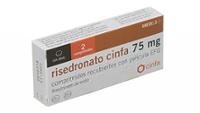
Comprimidos recubiertos con película redondos, biselados, biconvexos, de color rosa con la inscripción “75” en una cara y lisos en la otra, con un diámetro aproximado de 9 mm. Los comprimidos se presentan en blíster, en cajas de 2 comprimidos.
Titular de la autorización de comercialización y responsable de la fabricación
Titular de la autorización de comercialización
Laboratorios Cinfa, S.A.
Carretera Olaz-Chipi, 10. Polígono Industrial Areta
31620 Huarte (Navarra) – España
Responsable de la fabricación
Laboratorios Cinfa, S.A.
Carretera Olaz-Chipi, 10. Polígono Industrial Areta
31620 Huarte (Navarra) – España
NETPHARMALAB CONSULTING SERVICES
Carretera de Fuencarral 22,
Alcobendas, 28108
Madrid, España
Fecha de la última revisión de este prospecto: Julio 2025
La información detallada de este medicamento está disponible en la página web de la Agencia Española de Medicamentos y Productos Sanitarios (AEMPS) (http://www.aemps.gob.es/)
Puede acceder a información detallada y actualizada sobre este medicamento escaneando con su teléfono móvil (smartphone) el código QR incluido en el prospecto y el cartonaje. También puede acceder a esta información en la siguiente dirección de internet: https://cima.aemps.es/cima/dochtml/p/90449/P_90449.html
Código QR a: https://cima.aemps.es/cima/dochtml/p/90449/P_90449.html
- País de registro
- Forma farmacéuticaCOMPRIMIDO, 75 mg
- Código ATCM05BA07
- Principio activo
- Requiere recetaSí
- Fabricante
- ComposiciónFUMARATO DE ESTEARILO Y SODIO (4 mg mg), POLISORBATO 80 (0,050 mg mg)
- Esta información es de carácter general y no sustituye la consulta con un profesional sanitario.
- Alternativas a RISEDRONATO CINFAMED 75 MG COMPRIMIDOS RECUBIERTOS CON PELICULA EFGForma farmacéutica: COMPRIMIDO, 75 mgPrincipio activo: risedronic acidFabricante: Theramex Ireland LimitedRequiere recetaForma farmacéutica: COMPRIMIDO, 35 mgPrincipio activo: risedronic acidFabricante: Theramex Ireland LimitedRequiere recetaForma farmacéutica: COMPRIMIDO, 30 mgPrincipio activo: risedronic acidFabricante: Theramex Ireland LimitedRequiere receta
Médicos online para RISEDRONATO CINFAMED 75 MG COMPRIMIDOS RECUBIERTOS CON PELICULA EFG
Comenta la dosis, los posibles efectos secundarios, interacciones, contraindicaciones o la revisión de receta de RISEDRONATO CINFAMED 75 MG COMPRIMIDOS RECUBIERTOS CON PELICULA EFG, sujeto a valoración médica y a la normativa local.


Obtén una receta de RISEDRONATO CINFAMED 75 MG COMPRIMIDOS RECUBIERTOS CON PELICULA EFG online
Rellena un formulario de 2 minutos
Cuéntanos tus síntomas, historial y el medicamento que necesitas.
Elige un médico o nosotros te asignamos uno
Escoge un especialista o te conectamos con el próximo médico disponible.
El médico revisa tu caso
Normalmente en 30 minutos. Puede hacerte preguntas adicionales por chat.
Recógela en cualquier farmacia
Receta electrónica enviada a tu correo, válida en toda España.
Preguntas frecuentes
RISEDRONATO CINFAMED 75 MG COMPRIMIDOS RECUBIERTOS CON PELICULA EFG requiere receta en España. Puedes confirmarlo con un médico online según tu caso.
El principio activo de RISEDRONATO CINFAMED 75 MG COMPRIMIDOS RECUBIERTOS CON PELICULA EFG es risedronic acid. Esta información ayuda a identificar medicamentos con la misma composición pero con diferentes nombres comerciales.
RISEDRONATO CINFAMED 75 MG COMPRIMIDOS RECUBIERTOS CON PELICULA EFG es fabricado por Laboratorios Cinfa S.A.. La marca y el envase pueden variar según el distribuidor.
Los Médicos de familia, Psiquiatras, Dermatólogos, Cardiólogos, Endocrinólogos, Gastroenterólogos, Neumólogos, Nefrólogos, Reumatólogos, Hematólogos, Infectólogos, Alergólogos, Geriatras, Pediatras, Oncólogos pueden valorar la prescripción de RISEDRONATO CINFAMED 75 MG COMPRIMIDOS RECUBIERTOS CON PELICULA EFG cuando esté clínicamente indicado. Puedes reservar una videoconsulta para comentar tu caso y las opciones de tratamiento.
España cuenta con una infraestructura sanitaria bien desarrollada en ciudades principales como Madrid, Barcelona, Valencia y Sevilla. Las farmacias están ampliamente disponibles y operan bajo estrictas regulaciones, garantizando el acceso a medicamentos con receta.
Puedes comprar RISEDRONATO CINFAMED 75 MG COMPRIMIDOS RECUBIERTOS CON PELICULA EFG en Madrid, Barcelona, Sevilla o Valencia en cualquier farmacia local con una receta válida.
Para obtener una receta, puedes utilizar Oladoctor:
Otros medicamentos con el mismo principio activo (risedronic acid) incluyen ACREL 75 mg COMPRIMIDOS RECUBIERTOS CON PELICULA, ACREL SEMANAL 35 mg COMPRIMIDOS RECUBIERTOS CON PELICULA, ACTONEL 30 mg COMPRIMIDOS RECUBIERTOS CON PELICULA. Pueden tener diferentes nombres comerciales o formulaciones, pero contienen el mismo componente terapéutico. Consulta siempre con un médico antes de cambiar o iniciar un nuevo medicamento.
