


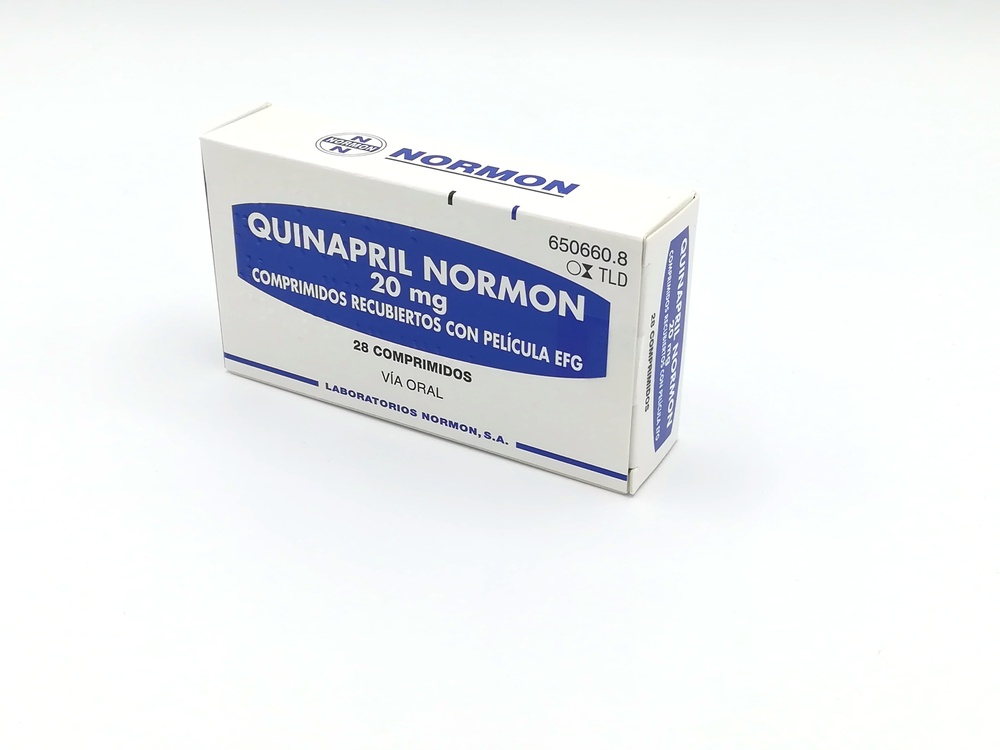
Quinapril Normon 20 mg comprimidos recubiertos con película

Revisión de receta online
Un médico revisará tu caso y determinará si la prescripción es médicamente apropiada.

Habla con un médico sobre este medicamento
Comenta tus síntomas y las opciones de tratamiento en una consulta online.



Cómo usar QUINAPRIL NORMON 20 MG COMPRIMIDOS RECUBIERTOS CON PELICULA EFG
Contenido del prospecto
- Introducción
- Qué es Quinapril Normon y para qué se utiliza
- Qué necesita saber antes de empezar a tomar Quinapril Normon
- Cómo tomar Quinapril Normon
- Posibles efectos adversos
- Conservación de Quinapril Normon
- Contenido del envase e información adicional
Introducción
Prospecto: información para el usuario
Quinapril Normon 20 mg comprimidos recubiertos con película EFG
Lea todo el prospecto detenidamente antes de empezar a tomar este medicamento, porque contiene información importante para usted.
- Conserve este prospecto, ya que puede tener que volver a leerlo.
- Si tiene alguna duda, consulte a su médico o farmacéutico.
- Este medicamento se le ha recetado solamente a usted, y no debe dárselo a otras personas aunque tengan los mismos síntomas que usted, ya que puede perjudicarles.
- Si experimenta efectos adversos, consulte a su médico o farmacéutico, incluso si se trata de efectos adversos que no aparecen en este prospecto. Ver sección 4.
Contenido del prospecto:
- Qué es Quinapril Normon y para qué se utiliza
- Qué necesita saber antes de empezar a tomar Quinapril Normon
- Cómo tomar Quinapril Normon
- Posibles efectos adversos
- Conservación de Quinapril Normon
- Contenido del envase e información adicional
1. Qué es Quinapril Normon y para qué se utiliza
Quinapril pertenece a los inhibidores de la enzima de conversión de la angiotensina (inhibidores de la ECA). Actúa dilatando los vasos sanguíneos. Con ello facilita al corazón la tarea de bombear sangre a todas las partes del cuerpo y ayuda a reducir la tensión arterial alta.
Su médico le ha recetado quinapril para el tratamiento de:
- hipertensión arterial.
- insuficiencia cardíaca congestiva.

¿No estás seguro de si este medicamento es adecuado para ti?
Comenta tus síntomas y tratamiento con un médico online.
2. Qué necesita saber antes de empezar a tomar Quinapril Normon
El tratamiento con Quinapril Normon requiere el control periódico por su médico.
No tome Quinapril Normon
- Si es alérgico al quinapril o a alguno de los demás componentes de este medicamento (incluidos en la sección 6).
- Si ha padecido anteriormente reacciones alérgicas graves como inflamación de la cara, labios, lengua y/o garganta con dificultad para respirar, tragar y hablar (angioedema de cabeza y cuello) o inflamación en el tracto intestinal (angioedema intestinal).
- Si tiene una enfermedad llamada edema angioneurótico (una hinchazón de la cara, lengua o garganta que produce dificultad para respirar).
- Si tiene un estrechamiento en la salida de la sangre del corazón.
- Si tiene diabetes o insuficiencia renal y le están tratando con un medicamento para bajar la presión arterial que contiene aliskirén.
- Si está tomando sacubitril/valsartan, medicamentos para la insuficiencia cardíaca.
- Si tiene problemas de riñón (insuficiencia renal).
- Si está embarazada de más de 3 meses (también es mejor evitar tomar Quinapril Normon al principio del embarazo – ver sección de Embarazo).
Advertencias y precauciones
Consulte a su médico o farmacéutico antes de empezar a tomar Quinapril Normon:
- Si durante el tratamiento, incluso tras la primera toma, aparecen cualquiera de los siguientes síntomas: hinchazón de cara, ojos, labios, lengua o dificultad para respirar. Deje de tomar este medicamento y acuda a su médico inmediatamente.
- Son signos de procesos inflamatorios de la zona profunda de la piel (angioedema), que pueden ser potencialmente mortales y que son más frecuentes en los pacientes de raza negra. Ciertos medicamentos para el cáncer o la diabetes pueden aumentar el riesgo de presentar esta patología.
- Si es usted diabético debe controlar cuidadosamente sus niveles de glucosa en sangre (sobre todo durante el primer mes de tratamiento).
- Si va a ser operado, avise a su médico de que está tomando Quinapril Normon.
- Si sigue una dieta baja en sal. No utilice sustitutos de la sal que contengan potasio sin consultar con su médico.
- Si está usted embarazada o pudiera estarlo o planea quedarse embarazada. Quinapril Normon no se recomienda al principio del embarazo, y no se debe tomar si está embarazada de más de 3 meses, ya que puede causar daños graves a su bebé si se utiliza en ese momento (ver sección Embarazo).
- Si está tomando o ha tomado recientemente alguno de los siguientes medicamentos utilizados para tratar la presión arterial alta (hipertensión):
- Un antagonista de los receptores de angiotensina II (ARA) (también conocidos como “sartanes” – por ejemplo, valsartán, telmisartán, irbesartán), en particular si sufre problemas renales relacionados con la diabetes.
- Aliskirén.
- Si está tomando otros medicamentos para bajar la tensión arterial, ya que ésta podría bajar demasiado.
- Si está tomando medicamentos que aumentan el potasio en sangre.
- Si tiene enfermedades de riñón, sigue sesiones de diálisis o le han trasplantado un riñón.
- Si tiene enfermedades del hígado.
- Si tiene síntomas de infección (por ejemplo, dolor de garganta o fiebre) o algún sangrado inusual.
- Si va a someterse a una desensibilización (vacuna para la alergia) contra el veneno de himenópteros (abejas, avispas…).
- Si se le va a extraer colesterol de la sangre por medio de una máquina (aféresis de lipoproteínas de baja densidad (LDL)).
- Si está tomando Quinapril Normon junto con medicamentos para aliviar el dolor y la inflamación (antiinflamatorios no esteroideos). Su médico puede hacerle diversas pruebas, de forma periódica, para comprobar si sus riñones funcionan bien. Además, Quinapril Normon puede tener menos efecto sobre su tensión arterial.
- Si se encuentra mal o tiene mareos, consulte a su médico antes de tomar la siguiente dosis. Procesos como vómitos, diarrea, deshidratación y sudoración excesiva pueden bajar demasiado la tensión arterial.
- Si tiene insuficiencia renal o es mayor de 65 años y está tomando un medicamento que contiene sulfametoxazol/trimetoprim.
- Si esta tomando medicamentos o tiene enfermedades que pueden reducir los niveles de sodio en la sangre.
- Los pacientes que por motivos terapéuticos estén recibiendo simultáneamente un inhibidor de mTOR (inhibidor de la diana de rapamicina en células de mamífero, por ejemplo temsirolimus) o un inhibidor de DPP-4 (dipeptidil-peptidasa 4, por ejemplo, vildagliptin) o un inhibidor neutral de endopeptidasa (por ejemplo, racecadotril), pueden tener un riesgo aumentado de sufrir edema angioneurótico.
Consulte con su médico si sufre mareos y vértigo. Si apareciera mareo, túmbese hasta que pase esta sensación. Después de estar echado, incorpórese siempre lentamente para evitar la sensación de mareo. Si se desmaya o marea, avise a su médico.
Como ocurre con otros IECA, al tomar Quinapril Normon puede aparecer tos seca, que desaparece al interrumpir el tratamiento. En este caso, consulte con su médico.
Consulte a su médico si cualquiera de las circunstancias anteriormente mencionadas le hubieran ocurrido alguna vez.
Puede que su médico le controle la función renal, la presión arterial y los niveles de electrolitos en la sangre (por ejemplo, potasio), a intervalos regulares.
Ver también la información bajo el encabezado “No tome Quinapril Normon”.
Consulte a su médico o farmacéutico antes de tomar un medicamento.
Pacientes mayores de 65 años
Si usted tiene edad avanzada puede ser más sensible a los efectos mencionados anteriormente. Si alguno de estos efectos apareciese avise a su médico inmediatamente.
Uso de Quinapril Normon con otros medicamentos
Informe a su médico o farmacéutico si está tomando, ha tomado recientemente o pudiera tener que tomar cualquier otro medicamento, incluso los adquiridos sin receta médica.
Puede que su médico deba modificar su dosis y/o tomar otras precauciones:
Si está tomando un antagonista de los receptores de angiotensina II (ARA) o aliskirén (ver también la información bajo los encabezados “No tome Quinqpril Normon” y “Advertencias y precauciones”).
Si usted es hospitalizado o visita a otro médico, dentista o farmacéutico, comuníqueles que está tomando Quinapril Normon o cualquier otro medicamento. Avise a su médico de que recibe tratamiento con Quinapril Normon si va a ser sometido a algún procedimiento quirúrgico.
Quinapril Normon puede interaccionar con los medicamentos relacionados a continuación. Es especialmente importante que informe a su médico si está tomando:
- Litio (medicamento para tratar la depresión y los trastornos bipolares).
- Tetraciclinas (un tipo de antibióticos).
- Diuréticos (medicamentos que aumentan la producción de orina).
- Suplementos de potasio, o medicamentos que aumenten los niveles de potasio en sangre, o medicamentos o sustitutos de la sal que contengan potasio.
- Medicamentos que contengan sulfametoxazol/trimetoprim (antibiótico).
- Medicamentos para la diabetes (insulina o hipoglucemiantes orales).
- Medicamentos para aliviar el dolor y la inflamación (antiinflamatorios no esteroideos o AINE).
- Ciertos medicamentos para el cáncer o la diabetes.
- Medicamentos que contengan oro.
- Medicamentos utilizados después de los trasplantes (inmunosupresores) y medicamentos para el tratamiento del cáncer (citostáticos).
- Alcohol, barbitúricos y narcóticos.
- Medicamentos para reducir la tensión arterial (antihipertensivos).
- Antiácidos.
- Alopurinol (para tratar la gota).
- Procainamida (para corregir los latidos irregulares del corazón).
- Corticosteroides sistémicos.
- Los inhibidores de mTOR (por ejemplo temsirolimus) o inhibidores de DPP-4 (por ejemplo, vildagliptin) o inhibidores neutral de endopeptidasa (por ejemplo, racecadotril), posiblemente pueden aumentar el riesgo de sufrir edema angioneurótico.
Si tiene cualquier duda sobre tomar otros medicamentos con Quinapril Normon, consúlteselo a su médico.
Uso de Quinapril Normon con los alimentos y bebidas
Quinapril Normon puede tomarse con o sin alimentos.
Embarazo, lactancia y fertilidad
Si está embarazada o en periodo de lactancia, cree que podría estar embarazada o tiene intención de quedarse embarazada, consulte a su médico antes de utilizar este medicamento.
Embarazo:
Avise a su médico si cree que está o puede estar embarazada. Normalmente, su médico le indicará que deje de tomar Quinapril Normon antes de que se quede embarazada o tan pronto como sepa que está embarazada y le indicará que tome otro medicamento en lugar de Quinapril Normon. No se recomienda Quinapril Normon al principio del embarazo y no debe tomarse a partir del tercer mes del embarazo, ya que puede causar graves daños a su bebé si lo utiliza después del tercer mes de embarazo.
Lactancia:
Consulte a su médico o farmacéutico antes de utilizar un medicamento.
Informe a su médico si está en el periodo de lactancia o a punto de comenzar la lactancia. No se recomienda tomar este medicamento durante la lactancia materna en recién nacidos (primeras semanas después del nacimiento) y especialmente en bebés prematuros. En el caso de bebés mayores su médico le aconsejará sobre los beneficios y los riesgos de la administración de este medicamento durante la lactancia, en comparación con otros tratamientos.
Conducción y uso de máquinas
Quinapril Normon puede causar una repentina caída de la tensión arterial, provocando mareos y en algunos casos desmayos. Esto puede ocurrir sobre todo durante los primeros días de tratamiento. Por ello, al principio del tratamiento no debe realizar tareas que puedan requerir una atención especial (por ejemplo conducir un automóvil o manejar maquinaria peligrosa) hasta que sepa cómo tolera el tratamiento.
3. Cómo tomar Quinapril Normon
Siga exactamente las instrucciones de administración de este medicamento indicadas por su médico. En caso de duda, consulte de nuevo a su médico.
Recuerde tomar su medicamento.
Su médico le indicará la duración de su tratamiento con Quinapril Normon. Su médico podrá aumentar o disminuir la dosis si fuera necesario hasta que encuentre la dosis que usted necesita No suspenda el tratamiento antes, ya que podría elevarse su tensión arterial o empeorar la función de su corazón.
Este tratamiento ha sido indicado por su médico específicamente para usted y su enfermedad. La dosis será establecida por el médico en función de las necesidades de cada paciente. Dependiendo de la respuesta individual, el médico puede modificar la dosificación de quinapril. Siga fielmente las instrucciones de su médico en cuanto a la dosis y modo de empleo.
Quinapril se administra por vía oral. Su médico le indicará cuantos comprimidos debe usted tomar cada día.
Uso en niños:la seguridad y eficacia de quinapril en niños no ha sido establecida. No debe administrarse a niños sin consultar con un médico.
Instrucciones para el uso correcto del medicamento
El comprimido de Quinapril Normon 20 mg se administra por vía oral y debe tragarse sin masticar. Ingiera los comprimidos con una cantidad suficiente de líquido (un vaso de agua). Puede tomarse con las comidas o fuera de ellas.
Si estima que la acción de este medicamento es demasiado fuerte o débil, no cambie usted mismo la dosis y comuníqueselo a su médico o farmacéutico.
Si toma más Quinapril Normon del que debe
En caso de sobredosis o ingestión accidental, consultar a su médico o al Servicio de Información Toxicológica, Teléfono 91 562 04 20. Lleve este prospecto con usted.
Una sobredosis grave puede provocar una marcada y probablemente prolongada bajada de la tensión arterial. Se procederá al tratamiento sintomático compensando los efectos de este medicamento.
En casos severos se adoptarán las medidas pertinentes; además del mantenimiento del volumen sanguíneo, puede ser necesario administrar medicamentos que restauren adecuadamente su tensión arterial.
Si olvidó tomar Quinapril Normon
No tome una dosis doble para compensar las dosis olvidadas.
Si tiene cualquier otra duda sobre el uso de este medicamento, pregunte a su médico o farmacéutico.
Si interrumpe el tratamiento con Quinapril Normon
Su médico le indicará la duración de su tratamiento con Quinapril Normon. No deje de tomar Quinapril Normon sin consultar con él. Normalmente, los medicamentos para tratar la tensión arterial alta o la insuficiencia cardiaca deben tomarse durante toda la vida. Si deja de tomar Quinapril Normon puede empeorar.
Si tiene cualquier otra duda sobre el uso de este medicamento, pregunte a su médico o farmacéutico.

¿Has empezado a tomar el medicamento y tienes preguntas?
Comenta tus síntomas y tratamiento con un médico online.
4. Posibles efectos adversos
Al igual que todos los medicamentos, este medicamento puede producir efectos adversos, aunque no todas las personas los sufran.
Las reacciones adversas de quinapril varían en intensidad de un individuo a otro, y deben tenerse en cuenta especialmente al inicio del tratamiento, al modificar la dosis o al cambiar de medicación.
Deje de tomar Quinapril Normon y contacte inmediatamente con su médico si:
- Aparece dificultad para respirar con o sin inflamación de la cara, labios, lengua y/o garganta.
- Aparece inflamación de cara, labios, lengua y/o garganta que le pueda causar dificultad al tragar.
A continuación se indican los posibles efectos adversos durante el tratamiento con Quinapril Normon, según su frecuencia.
Efectos adversosfrecuentes(pueden afectar entre 1 a 10 personas por cada 100)son: Dolor de cabeza, mareos, inflamación de la mucosa de la nariz (rinitis), tos, fatiga, debilidad (astenia), náuseas y/o vómitos, dolor muscular (mialgia), diarrea, dolor en el pecho, dolor abdominal, molestias en la digestión (dispepsia), dificultad para respirar (disnea), dolor de espalda, inflamación de la faringe (faringitis), dificultad para conciliar el sueño (insomnio), niveles más altos de lo normal de algunas sustancias en el análisis de sangre (potasio, creatinina y nitrógeno ureico), concentraciones de sodio en sangre disminuidas, tensión arterial baja (hipotensión) y hormigueo (parestesias).
Efectos adversos poco frecuentes (pueden afectar entre 1 a 10 personas de cada 1.000)son: Palpitaciones, dilatación de los vasos sanguíneos (vasodilatación), dolor opresivo en el tórax (angina de pecho), aumento de la frecuencia cardíaca (taquicardia), infarto de miocardio, flatulencia, sequedad de boca o garganta, depresión, nerviosismo, confusión, somnolencia, interrupción temporal del suministro sanguíneo a un área del cerebro (ataques isquémicos transitorios), vértigo, zumbido de oído, inflamación de los senos nasales (sinusitis), infección de las vías respiratorias altas, inflamación de los bronquios (bronquitis), reacción alérgica con hinchazón de la cara, lengua o garganta que puede producir dificultad para respirar (angioedema), infecciones del tracto urinario, alteración de la función del riñón, proteínas en la orina, impotencia, disminución de la agudeza visual (ambliopía), fiebre y acumulación excesiva de líquido en el cuerpo (edemas).
Efectos adversos raros (pueden afectar hasta 1 persona de cada 1.000)son: alteración del equilibrio, síncope, afección respiratoria (neumonía eosinofílica), alteración del gusto, estreñimiento, inflamación de la lengua, urticaria y diversas lesiones de la piel que pueden ser graves (eritema multiforme, pénfigo)..
Efectos adversos muy raros (pueden afectar hasta 1 persona de cada 10.000)son: visión borrosa, obstrucción intestinal provocada (íleo), inflamación en el tracto intestinal (angioedema intestinal) y erupción en la piel tipo psoriasis.
Efectosadversoscon frecuencia no conocida(no puede estimarse a partir de los datos disponibles) son: disminución del número de glóbulos blancos que puede favorecer las infecciones (agranulocitosis), disminución del número de los glóbulos rojos (anemia), disminución del número de un tipo de glóbulos blancos (neutropenia), disminución del número de plaquetas (trombocitopenia), reacción alérgica que puede ser grave (reacción anafilactoide), orina oscura, náuseas, vómitos, calambres musculares, confusión y convulsiones. Estos pueden ser síntomas de una afección llamada SIADH (secreción inadecuada de hormona antidiurética), accidente cerebrovascular, disminución de la tensión arterial al ponerse de pie que puede provocar mareos (hipotensión postural), estrechamiento de los bronquios que impide la respiración (broncoespasmo), en casos individuales obstrucción de las vías aéreas superiores por angioedema (que puede ser mortal), inflamación del páncreas (pancreatitis), inflamación del hígado (hepatitis), ictericia (ictericia colestática), enfermedad grave de la piel con formación de ampollas y pérdida de la piel (necrolisis epidérmica), diversas lesiones de la piel que pueden ser graves (dermatitis exfoliativa, síndrome de Stevens-Johnson), pérdida de pelo (alopecia), reacción de sensibilidad a la luz solar (fotosensibilidad), inflamación de tejidos serosos, cambios en la piel asociados a fiebre, dolor muscular y articular (mialgias, artralgias, artritis), inflamación de los vasos sanguíneos (vasculitis), ciertos cambios en los valores de los análisis de sangre (eosinofilia, leucocitosis y/o niveles elevados de anticuerpos antinucleares y velocidad de sedimentación de los eritrocitos), psoriasis o empeoramiento de la psoriasis existente (enfermedad de la piel caracterizada por placas enrojecidas cubiertas con escamas plateadas), reducción del hematocrito, reducción de la hemoglobina y elevación de enzimas del hígado y de la bilirrubina. En algunos pacientes que tienen una enfermedad de nacimiento por falta de un enzima (deficiencia congénita de glucosa- 6- fosfato deshidrogenasa) se han comunicado casos de anemia por destrucción de los glóbulos rojos (anemia hemolítica).
Comunicación de efectos adversos
Si experimenta cualquier tipo de efecto adverso, consulte a su médico o farmacéutico, incluso si se trata de posibles efectos adversos que no aparecen en este prospecto. También puede comunicarlos directamente a través del Sistema Español de Farmacovigilancia de Medicamentos de Uso Humano: https://www.notificaram.es. Mediante la comunicación de efectos adversos usted puede contribuir a proporcionar más información sobre la seguridad de este medicamento.
5. Conservación de Quinapril Normon
Mantener este medicamento fuera de la vista y del alcance de los niños.
No utilice este medicamento después de la fecha de caducidad que aparece en el envase después de CAD. La fecha de caducidad es el último día del mes que se indica.
Conservar por debajo de 30ºC.
Los medicamentos no se deben tirar por los desagües ni a la basura. Deposite los envases y los medicamentos que no necesita en el punto SIGRE de la farmacia. En caso de duda pregunte a su farmacéutico cómo deshacerse de los envases y de los medicamentos que ya no necesita. De esta forma, ayudará a proteger el medio ambiente.
6. Contenido del envase e información adicional
Composición de Quinapril Normon 20 mg comprimidos recubiertos con película EFG
- El principio activo es quinapril. Cada comprimido recubierto con película contiene 20 mg de quinapril.
- Los demás componentes son: carbonato magnésico, hidroxipropilcelulosa, crospovidona, estearato de magnesio, Eudragit E 12,5%, dióxido de titanio (E-171), talco, macrogol 6000 y óxido de hierro amarillo (E-172).
Aspecto del producto y contenido del envase
Comprimidos de color ocre, de forma redonda biconvexa y ranurados en una cara.
Los comprimidos están envasados en blísteres de 28.
Titular de la autorización de comercialización y responsable de la fabricación
Laboratorios Normon, S.A.
Ronda de Valdecarrizo, 6
28760 – Tres Cantos
Madrid (España)
Fecha de la última revisión de este prospecto: febrero 2023
La información detallada de este medicamento está disponible en la página Web de la Agencia Española de Medicamentos y Productos Sanitarios (AEMPS) http://www.aemps.gob.es/.
- País de registro
- Forma farmacéuticaCOMPRIMIDO, 20 mg
- Código ATCC09AA06
- Precio medio en farmacia4.65 EUR
- Principio activo
- Requiere recetaSí
- Fabricante
- Esta información es de carácter general y no sustituye la consulta con un profesional sanitario.
- Alternativas a QUINAPRIL NORMON 20 MG COMPRIMIDOS RECUBIERTOS CON PELICULA EFGForma farmacéutica: COMPRIMIDO, 20 mgPrincipio activo: quinaprilFabricante: Lacer S.A.Requiere recetaForma farmacéutica: COMPRIMIDO, 40 mgPrincipio activo: quinaprilFabricante: Lacer S.A.Requiere recetaForma farmacéutica: COMPRIMIDO, 5 mgPrincipio activo: quinaprilFabricante: Lacer S.A.Requiere receta
Médicos online para QUINAPRIL NORMON 20 MG COMPRIMIDOS RECUBIERTOS CON PELICULA EFG
Comenta la dosis, los posibles efectos secundarios, interacciones, contraindicaciones o la revisión de receta de QUINAPRIL NORMON 20 MG COMPRIMIDOS RECUBIERTOS CON PELICULA EFG, sujeto a valoración médica y a la normativa local.
Preguntas frecuentes
QUINAPRIL NORMON 20 MG COMPRIMIDOS RECUBIERTOS CON PELICULA EFG requiere receta en España. Puedes confirmarlo con un médico online según tu caso.
El principio activo de QUINAPRIL NORMON 20 MG COMPRIMIDOS RECUBIERTOS CON PELICULA EFG es quinapril. Esta información ayuda a identificar medicamentos con la misma composición pero con diferentes nombres comerciales.
El precio medio en farmacia de QUINAPRIL NORMON 20 MG COMPRIMIDOS RECUBIERTOS CON PELICULA EFG es de aproximadamente 4.65 EUR. Puede variar según el fabricante y la forma farmacéutica.
QUINAPRIL NORMON 20 MG COMPRIMIDOS RECUBIERTOS CON PELICULA EFG es fabricado por Laboratorios Normon S.A.. La marca y el envase pueden variar según el distribuidor.
Los Médicos de familia, Psiquiatras, Dermatólogos, Cardiólogos, Endocrinólogos, Gastroenterólogos, Neumólogos, Nefrólogos, Reumatólogos, Hematólogos, Infectólogos, Alergólogos, Geriatras, Pediatras, Oncólogos pueden valorar la prescripción de QUINAPRIL NORMON 20 MG COMPRIMIDOS RECUBIERTOS CON PELICULA EFG cuando esté clínicamente indicado. Puedes reservar una videoconsulta para comentar tu caso y las opciones de tratamiento.
La receta la emite un médico tras valorar tu estado de salud. En España, QUINAPRIL NORMON 20 MG COMPRIMIDOS RECUBIERTOS CON PELICULA EFG se dispensa en las farmacias con esa receta médica. Una consulta online no garantiza su emisión: la decisión corresponde siempre al médico.
Para solicitar una valoración puedes usar Oladoctor:
Otros medicamentos con el mismo principio activo (quinapril) incluyen LIDALTRIN 20 mg COMPRIMIDOS RECUBIERTOS CON PELICULA, LIDALTRIN 40 mg COMPRIMIDOS RECUBIERTOS CON PELICULA, LIDALTRIN 5 mg COMPRIMIDOS RECUBIERTOS CON PELICULA. Pueden tener diferentes nombres comerciales o formulaciones, pero contienen el mismo componente terapéutico. Consulta siempre con un médico antes de cambiar o iniciar un nuevo medicamento.
