


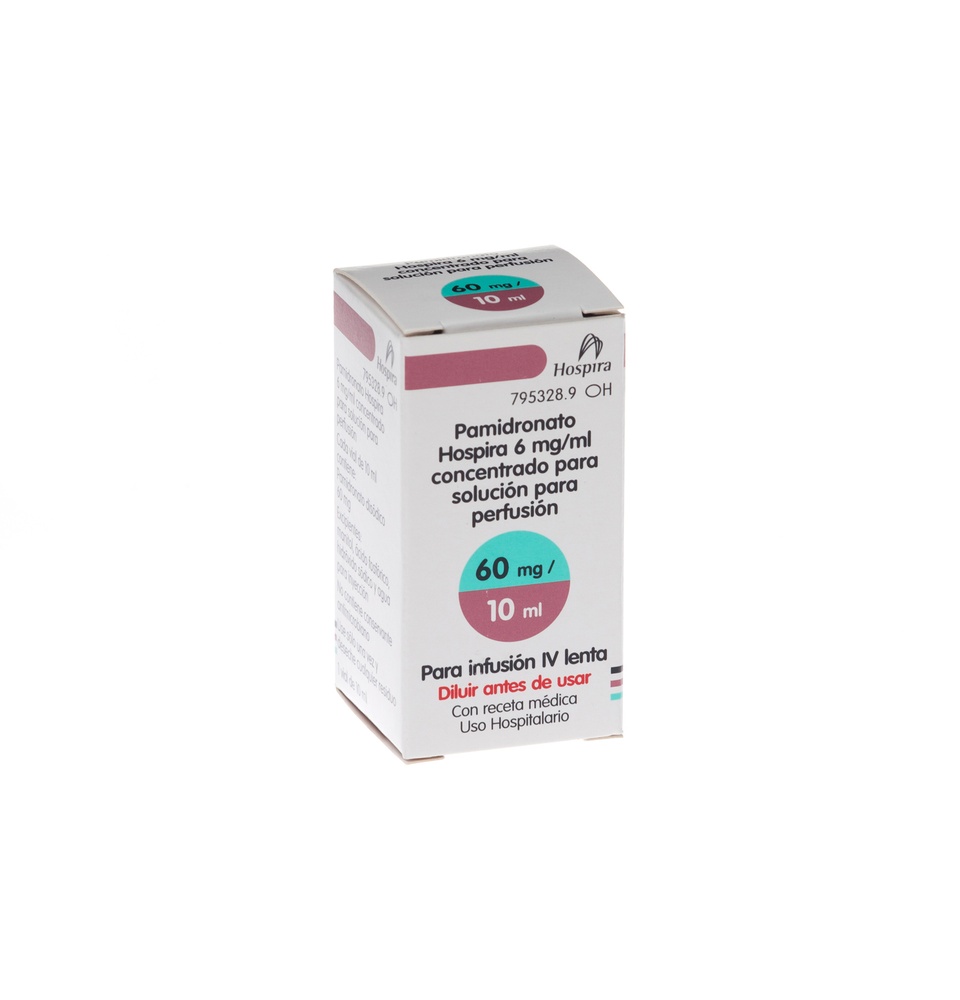
Pamidronato Pfizer 6 mg/ml concentrado para solución para perfusión

Solicitud de receta online
Un médico revisará tu caso y determinará si la prescripción es médicamente apropiada.

Habla con un médico sobre este medicamento
Comenta tus síntomas y las opciones de tratamiento en una consulta online.



Cómo usar PAMIDRONATO HOSPIRA 6 mg/ml CONCENTRADO PARA SOLUCION PARA PERFUSION
Contenido del prospecto
- Introducción
- Qué es Pamidronato Hospira y para qué se utiliza
- Qué necesita saber antes de empezar a usar Pamidronato Hospira
- Cómo usar Pamidronato Hospira
- Posibles efectos adversos
- Conservación de Pamidronato Hospira
- Contenido del envase e información adicional
Introducción
Prospecto: información para el usuario
Pamidronato Hospira 3 mg/ml concentrado para solución para perfusión
Pamidronato Hospira 6 mg/ml concentrado para solución para perfusión
Pamidronato Hospira 9 mg/ml concentrado para solución para perfusión
Pamidronato disódico
Lea todo el prospecto detenidamente antes de empezar a usar este medicamento, porque contiene información importante para usted.
- Conserve este prospecto. Puede tener que volver a leerlo.
- Si tiene alguna duda, consulte a su médico o farmacéutico.
- Este medicamento se le ha recetado solamente a usted y no debe dárselo a otras personas, aunque tengan los mismos síntomas que usted, ya que puede perjudicarles.
- Si experimenta efectos adversos, consulte a su médico o farmacéutico, incluso si se trata de efectos adversos que no aparecen en este prospecto. Ver sección 4.
Contenido del prospecto:
- Qué es Pamidronato Hospira y para qué se utiliza
- Qué necesita saber antes de empezar a usar Pamidronato Hospira
- Cómo usar Pamidronato Hospira
- Posibles efectos adversos
- Conservación de Pamidronato Hospira
- Contenido del envase e información adicional
1. Qué es Pamidronato Hospira y para qué se utiliza
Pamidronato Hospira pertenece al grupo de medicamentos denominados bifosfonatos. El mecanismo de acción del pamidronato es que se une al hueso y reduce la destrucción del hueso.
Este medicamento se usa para ayudar a disminuir los niveles de calcio en la sangre causados por tumores, reducir la pérdida de hueso que puede ocurrir en pacientes con ciertos tipos de cáncer, por ejemplo, cáncer de mama o mieloma múltiple. Si no está seguro de por qué le están administrando este medicamento, pregunte a su médico.

¿No estás seguro de si este medicamento es adecuado para ti?
Comenta tus síntomas y tratamiento con un médico online.
2. Qué necesita saber antes de empezar a usar Pamidronato Hospira
No use Pamidronato Hospira:
- ?Si es alérgico al pamidronato disódico o a cualquiera de los excipientes de este medicamento (ver sección 6) o a otros bifosfanatos (el grupo al que pertenece Pamidronato Hospira).
Advertencias y precauciones:
Consulte a su médico, farmacéutico o enfermero antes de empezar a usar Pamidronato Hospira
- Si tiene o ha tenido alguna vez problemas de tiroides.
- Si padece alguna enfermedad en los riñones.
- Si padece algún problema de corazón.
- Si tiene enfermedades sanguíneas (anemia, leucopenia (bajo número de glóbulos blancos) y trombocitopenia (bajo número de plaquetas).
- Pamidronato Hospira puede causar irritación en los ojos.
- No se recomienda el uso de Pamidronato Hospira en niños.
- Si tiene o ha tenido dolor, hinchazón o entumecimiento de la mandíbula, sensación de pesadez en la mandíbula o se le ha aflojado un diente. Su médico podría recomendarle realizar una revisión odontológica antes de comenzar el tratamiento con Pamidronato Hospira.
- Si está recibiendo tratamiento odontológico o va a someterse a una intervención odontológica, informe a su dentista de que está recibiendo tratamiento con Pamidronato Hospira e informe a su médico acerca de su tratamiento odontológico.
Mientras esté recibiendo tratamiento con Pamidronato Hospira, debe mantener una buena higiene bucal (incluido el cepillado habitual de los dientes) y acudir a revisiones odontológicas periódicas.
Póngase en contacto con su médico y su dentista de inmediato si experimenta algún problema bucal o dental, como un diente suelto, dolor o hinchazón, llagas que no curan o supuraciones, ya que podrían ser signos de osteonecrosis de la mandíbula.
Los pacientes que reciben quimioterapia y/o radioterapia, toman esteroides, se están sometiendo a intervenciones odontológicas, no reciben cuidados dentales habituales, padecen una enfermedad gingival, son fumadores o recibieron tratamiento con un bisfosfonato (utilizado para tratar o prevenir los trastornos óseos) pueden tener un mayor riesgo de desarrollar osteonecrosis de la mandíbula.
Mientras esté en tratamiento con Pamidronato Hospira su médico comprobará su respuesta al tratamiento a intervalos regulares.
Niños y adolescentes
No hay datos clínicos en población pediátrica y adolescentes (menores de 18 años)
Uso de Pamidronato Hospira con otros medicamentos
- Pamidronato Hospira no debe emplearse con otros bifosfonatos (grupo al que pertenece Pamidronato Hospira) o con otros medicamentos que disminuyan los niveles de calcio.
- Otros medicamentos que afecten a sus riñones (su médico o enfermero sabrán cuales son)
- Talidomida (utilizado en el tratamiento de mieloma múltiple)
Informe a su médico o farmacéutico si está utilizando, ha utilizado recientemente o podría tener que utilizar cualquier otro medicamento
Embarazo, lactancia y fertilidad
Si está embarazada o en período de lactancia, cree que podría estar embarazada o tiene intención de quedarse embarazada, consulte a su médico o farmacéutico antes de utilizar este medicamento.
No existen datos clínicos de la utilización de Pamidronato Hospira concentrado para solución para perfusión durante el embarazo. Los estudios en animales han mostrado efectos perjudiciales en la descendencia (alteraciones en el esqueleto). El riesgo potencial para humanos es desconocido.
Si está embarazada no debería ser tratada con pamidronato, salvo que sea extremadamente necesario.
No se recomienda la lactancia mientras está siendo tratada con Pamidronato Hospira concentrado para solución para perfusión.
Conducción y uso de máquinas
Si se siente somnoliento o mareado después de ser tratado con pamidronato disódico, no conduzca ni maneje maquinaria que requiera una especial atención hasta que los efectos desaparezcan.
Pamidronato Hospira contiene sodio:
Este medicamento contiene menos de 1 mmol de sodio (23 mg) por dosis máxima (90 mg); esto es, esencialmente “exento de sodio”.
Sin embargo, si se utiliza una solución salina (solución de cloruro de sodio al 0,9% p/v) para la dilución de Pamidronato Hospira antes de su administración, la dosis de sodio recibida sería mayor.
3. Cómo usar Pamidronato Hospira
Pamidronato Hospira le será administrado por perfusión intravenosa lenta (en una vena), nunca por inyección rápida. Su médico decidirá la dosis correcta según su condición. La perfusión puede tardar desde una a varias horas, según la dosis. El médico decidirá cuántas perfusiones necesita y con qué frecuencia se le deben administrar.
La dosis recomendada por tratamiento completo es de entre 15 mg y 90 mg.
Si tiene cualquier otra duda sobre el uso de este producto, pregunte a su médico o farmacéutico.

¿Has empezado a tomar el medicamento y tienes preguntas?
Comenta tus síntomas y tratamiento con un médico online.
4. Posibles efectos adversos
Al igual que todos los medicamentos, este medicamento puede tener efectos adversos, aunque no todas las personas lo sufran.
Los efectos adversos más frecuentes son una disminución de los niveles de calcio en sangre, síntomas como de gripe y fiebre (un aumento de la temperatura corporal de 1 ?C - 2 ºC) que aparece al inicio del tratamiento y que puede durar unas 48 horas.
Algunos pacientes sienten más dolor de los huesos al iniciar el tratamiento. Por regla general, esto mejora a los pocos días. Si no mejora, dígaselo al médico.
Su médico puede interrumpir inmediatamente la administración de Pamidronato Hospira si experimenta síntomas de angioedema, tales como inflamación en la cara, lengua o faringe, dificultad al tragar, urticaria y dificultades para respirar (poco frecuentes: pueden afectar hasta a 1 de cada 100 personas).
Si experimenta cualquiera de los siguientes efectos adversos, síntomas de un shock anafiláctico (reacción alérgica grave) llame a su médico de inmediato:
- Opresión en el pecho, dificultades respiratorias, erupción extensa, urticaria, hinchazón de la piel y las membranas mucosas, bajada repentina de la tensión. (Efecto adverso poco frecuente que puede afectar hasta a 1 de cada 10 .000 personas).
Otros efectos adversos que pueden ocurrir son:
Muy frecuentes (pueden afectar a más de 1 de cada 10personas):
- Fiebre y síntomas parecidos a la gripe, algunos de ellos acompañados de sensación de estar enfermo, rigidez, cansancio y sensación de sofoco.
- Disminución de los niveles de calcio y fosfatasa en la sangre.
Frecuentes (puedenafectar hasta 1de cada 10personas):
- Descenso del número de células blancas (linfocitopenia),
- Anemia, reducción del número de plaquetas en la sangre (trombocitopenia),
- Reducción del nivel de potasio y magnesio en la sangre,
- Dolor de cabeza,
- Insomnio,
- Adormecimiento,
- Sensación de estar enfermo,
- Vómitos,
- Diarrea,
- Estreñimiento, dolor de estómago, pérdida de apetito,
- Dolor de huesos transitorio, dolor en las articulaciones, dolor muscular, espasmos musculares, dolor generalizado, dolor,
- Enrojecimiento o inflamación en el lugar de la inyección,
- Venas sensibles o dolorosas, a veces al mismo tiempo aparecen como manchas locales de sangre,
- Presión sanguínea alta,
- Sensación de hormigueo en manos y pies,
- Entumecimiento,
- Conjuntivitis, erupción cutánea,
- Aumento de la creatinina sérica (test sanguíneo para medir la función de los riñones).
Poco frecuentes(pueden afectar hastaa1 de cada100personas):
- Reacción alérgica,
- Broncoespasmo,
- Convulsiones (temblores),
- Agitación,
- Mareos,
- Letargia,
- Inflamación del ojo que puede causar dolor y enrojecimiento,
- Presión sanguínea baja,
- Sensación de estómago lleno, indigestión,
- Picores,
- Calambres musculares,
- Muerte de tejido óseo (osteonecrosis),
- Función hepática alterada,
- Incremento de la urea sérica y sanguínea,
- Insuficiencia renal aguda.
Raros(pueden afectar hasta 1 de cada 1000personas):
- Problemas renales
- Fracturas atípicas del hueso del muslo, que pueden ocurrir en raras ocasiones sobre todo en pacientes en tratamiento prolongado para la osteoporosis.
Informe a su médicosi nota dolor, debilidad o molestias en el muslo, la cadera o la ingle, ya que pueden ser síntomas precoces e indicativos de una posible fractura del fémur.
Muy raros(pueden afectar hasta a 1 de cada 10000personas):
- Aparición de escoceduras, llagas y herpes (reactivación del Virus Herpes)
- Disminución del número de células blancas de la sangre (leucopenia),
- Incremento de los niveles de potasio y de sodio en la sangre,
- Confusión,
- Fallo cardiaco,
- Problemas respiratorios,
- Enfermedad pulmonar,
- Problema con los riñones (especialmente en pacientes con problemas previos en los riñones),
- Sangre en la orina,
- Alucinaciones visuales (ver cosas donde no las hay),
- Problemas de visión /dolor de ojos,
- Inflamación de los pulmones que puede causar tos, dificultades al respirar y sibilancias,
- Shock anafiláctico (reacción alérgica grave).
- Hable con su médico su presenta dolor de oído, secreciones del oído, y/o infección. Esto puede significar daño en el oído.
Frecuencia no conocida: la frecuencia no puede ser estimada a partir de los datos disponibles
- Ritmo del corazón irregular (fibrilación atrial) se ha observado en los pacientes que recibieron pamidronato. No está lo suficientemente claro si el pamidronato causa este ritmo del corazón irregular. Debe informar a su médicosi experimenta un ritmo cardiaco irregular durante el tratamiento con pamidronato.
- Enrojecimiento alrededor del área de los ojos.
- Pseudotumor cerebral, un trastorno asociado con el sistema nervioso.
- Dolor en la boca, dientes y/o mandíbula, hinchazón o llagas que no curan dentro de la boca o la mandíbula, supuraciones, entumecimiento o sensación de pesadez en la mandíbula, o aflojamiento de un diente. Estos podrían ser signos de daño óseo en la mandíbula (osteonecrosis). Informe de inmediato a su médico y a su dentista, si experimenta estos síntomas mientras está recibiendo tratamiento con Pamidronato Hospira o después de interrumpir el tratamiento
Comunicación de efectos adversos
Si experimenta cualquier tipo de efecto adverso, consulte a su médico o farmacéutico, incluso si se trata de posibles efectos adversos que no aparecen en este prospecto. También puede comunicarlos directamente a través Sistema Español de Farmacovigilancia de Medicamentos de Uso Humano: www.notificaRAM.es. Mediante la comunicación de efectos adversos usted puede contribuir a proporcionar más información sobre la seguridad de este medicamento.
5. Conservación de Pamidronato Hospira
Mantener este medicamento fuera de la vista y del alcance de los niños
No utilizarse este medicamento después de la fecha de caducidad que aparece en el envase después de CAD. La fecha de caducidad es el último día del mes que se indica.
No conservar a temperatura superior a 25ºC.
El producto diluido debe ser empleado inmediatamente. Si no es así, los tiempos de almacenamiento no deberían exceder de 24 horas a una temperatura de 2ºC-8ºC.
Los medicamentos no se deben tirar por los desagües ni a la basura. Pregunte a su farmacéutico cómo deshacerse de los envases y de los medicamentos que no necesita. De esta forma ayudará a proteger el medio ambiente.
6. Contenido del envase e información adicional
Composición de Pamidronato Hospira
- El principio activo es pamidronato disódico . Cada mililitro (ml) de solución contiene 3 mg , 6 mg o 9 mg de pamidronato disódico.
- Los demás componentes son: manitol, ácido fosfórico, hidróxido sódico y agua para preparaciones inyectables.
Aspecto del producto y contenido del envase
Pamidronato Hospira concentrado para solución para perfusión (concentrado estéril) es una solución transparente e incolora.
Pamidronato Hospira 3 mg/ml
Viales transparentes de 5 ml que se presentan en estuches de 5 viales o 4 viales (5 × 5 ml).
Viales transparentes de 10 ml que se presentan en estuches de 1 vial o 4 viales (1 × 10 ml).
Pamidronato Hospira 6 mg/ml y 9 mg/ml
Viales transparentes de 10 ml que se presentan en estuches de 1 vial o 4 viales (1 × 10 ml).
Puede que no estén comercializados todos los tamaños de envases.
Titular de la autorización de comercialización
Pfizer, S.L.
Avenida de Europa, 20 B
Parque Empresarial La Moraleja
28108 Alcobendas (Madrid)
España
Responsable de la fabricación
Pfizer Service Company BV
Hoge Wei 10
1930 Zaventem
Bélgica
Este medicamento está autorizado en los estados miembros del Espacio Económico Europeo con los siguientes nombres:
Austria | Pamidronat Dinatrium Pfizer | Luxemburgo | Pamidronate disodique Hospira 3 mg/ml, 6 mg/ml, 9 mg/ml solution à diluer pour perfusion | |
Bélgica | Pamidronate disodique Hospira 3 mg/ml, 6 mg/ml, 9 mg/ml concentraat voor oplossing voor infusie Pamidronate disodique Hospira 3 mg/ml, 6 mg/ml, 9 mg/ml solution à diluer pour perfusion Pamidronate disodique Hospira 3 mg/ml, 6 mg/ml, 9 mg/ml Konzentrat zur Herstellung einer Infusionslösung | Noruega | Pamidronatdinatrium Pfizer | |
Dinamarca | Pamidronatdinatrium Pfizer | Portugal | Pamidran | |
Francia | Pamidronate de sodium Hospira | España | Pamidronato Hospira | |
Islandia | Pamidronatdinatrium Pfizer | Suecia | Pamidronatdinatrium Pfizer |
Este prospecto fue revisado en 06/2024
La información detallada y actualizada de este medicamento está disponible en la página Web de la Agencia Española de Medicamentos y Productos Sanitarios (AEMPS) http://www.aemps.gob.es/
Esta información está destinada únicamente a profesionales del sector sanitario
Administración:
Solamente para administración intravenosa como perfusión. El pamidronato disódico nunca debe ser administrado como inyección en bolo. La solución debe ser diluida antes de su uso y debe ser infundida lentamente. La concentración de pamidronato disódico en la solución para perfusión no debe ser superior a 90 mg/250 ml. Solamente deben usarse soluciones transparentes libre de partículas. Para un solo uso. Desechar cualquier parte de la solución no usada.
Incompatibilidades:
El pamidronato forma complejos con cationes divalentes y no debe ser añadido a soluciones intravenosas que contengan calcio.
Conservación y caducidad:
Se ha demostrado estabilidad química y física en cloruro sódico al 0,9% y glucosa al 5% durante 24 horas cuando se almacena a 2 – 8ºC. Desde el punto de vista microbiológico, el producto debería ser usado inmediatamente. Si no se utiliza inmediatamente, el tiempo y las condiciones de conservación antes de su utilización, son responsabilidad del usuario y normalmente no deberían ser superiores a 24 horas a una temperatura entre 2ºC y 8ºC.
- País de registro
- Forma farmacéuticaINYECTABLE PERFUSION, 6 mg pamidronato disodio/ ml
- Código ATCM05BA03
- Principio activo
- Requiere recetaSí
- Fabricante
- ComposiciónHIDROXIDO DE SODIO (E 524) (1,72 mg mg), MANITOL (E-421) (40,0 mg mg)
- Esta información es de carácter general y no sustituye la consulta con un profesional sanitario.
- Alternativas a PAMIDRONATO HOSPIRA 6 mg/ml CONCENTRADO PARA SOLUCION PARA PERFUSIONForma farmacéutica: INYECTABLE PERFUSION, 3 mg pamidronato disodio/mlPrincipio activo: Pamidronico acidoFabricante: Pfizer S.L.Requiere recetaForma farmacéutica: INYECTABLE PERFUSION, 9 mg pamidronato disodio/ mlPrincipio activo: Pamidronico acidoFabricante: Pfizer S.L.Requiere recetaForma farmacéutica: COMPRIMIDO, 150 mgPrincipio activo: Ibandronico acidoFabricante: Especialidades Farmaceuticas Centrum S.A.Requiere receta
Médicos online para PAMIDRONATO HOSPIRA 6 mg/ml CONCENTRADO PARA SOLUCION PARA PERFUSION
Comenta la dosis, los posibles efectos secundarios, interacciones, contraindicaciones o si una receta es apropiada para PAMIDRONATO HOSPIRA 6 mg/ml CONCENTRADO PARA SOLUCION PARA PERFUSION, sujeto a valoración médica y a la normativa local.


Preguntas frecuentes
PAMIDRONATO HOSPIRA 6 mg/ml CONCENTRADO PARA SOLUCION PARA PERFUSION requiere receta en España. Puedes confirmarlo con un médico online según tu caso.
El principio activo de PAMIDRONATO HOSPIRA 6 mg/ml CONCENTRADO PARA SOLUCION PARA PERFUSION es Pamidronico acido. Esta información ayuda a identificar medicamentos con la misma composición pero con diferentes nombres comerciales.
PAMIDRONATO HOSPIRA 6 mg/ml CONCENTRADO PARA SOLUCION PARA PERFUSION es fabricado por Pfizer S.L.. La marca y el envase pueden variar según el distribuidor.
Los Médicos de familia, Psiquiatras, Dermatólogos, Cardiólogos, Endocrinólogos, Gastroenterólogos, Neumólogos, Nefrólogos, Reumatólogos, Hematólogos, Infectólogos, Alergólogos, Geriatras, Pediatras, Oncólogos pueden valorar la prescripción de PAMIDRONATO HOSPIRA 6 mg/ml CONCENTRADO PARA SOLUCION PARA PERFUSION cuando esté clínicamente indicado. Puedes reservar una videoconsulta para comentar tu caso y las opciones de tratamiento.
La receta la emite un médico tras valorar tu estado de salud. En España, PAMIDRONATO HOSPIRA 6 mg/ml CONCENTRADO PARA SOLUCION PARA PERFUSION se dispensa en las farmacias con esa receta médica. Una consulta online no garantiza su emisión: la decisión corresponde siempre al médico.
Para solicitar una valoración puedes usar Oladoctor:
Otros medicamentos con el mismo principio activo (Pamidronico acido) incluyen PAMIDRONATO HOSPIRA 3 mg/ml CONCENTRADO PARA SOLUCION PARA PERFUSION, PAMIDRONATO HOSPIRA 9 mg/ml CONCENTRADO PARA SOLUCION PARA PERFUSION, ABRION 150 mg COMPRIMIDOS RECUBIERTOS CON PELICULA EFG. Pueden tener diferentes nombres comerciales o formulaciones, pero contienen el mismo componente terapéutico. Consulta siempre con un médico antes de cambiar o iniciar un nuevo medicamento.
