


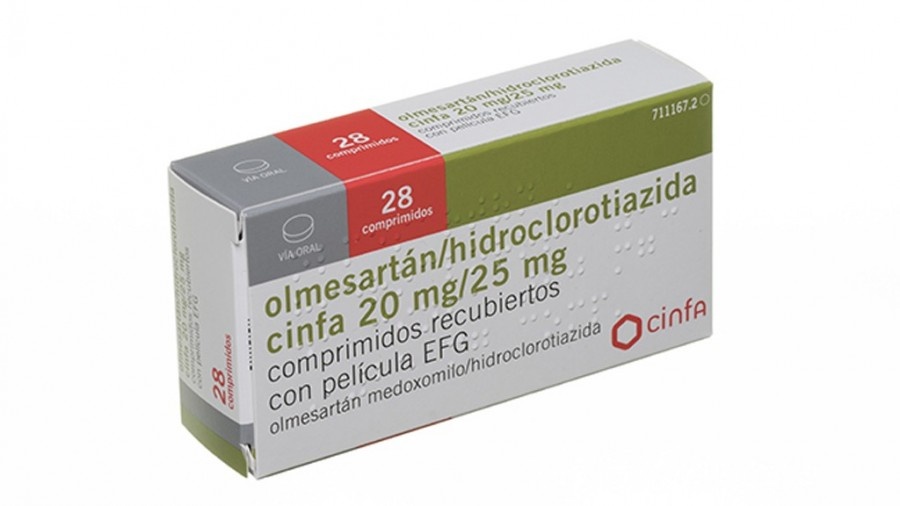
Olmesartan Mabo 20 mg/25 mg comprimidos recubiertos con película

Revisión de receta online
Un médico revisará tu caso y determinará si la prescripción es médicamente apropiada.

Habla con un médico sobre este medicamento
Comenta tus síntomas y las opciones de tratamiento en una consulta online.



Cómo usar OLMESARTAN/HIDROCLOROTIAZIDA MABO 20 MG/25 MG COMPRIMIDOS RECUBIERTOS CON PELICULA EFG
Contenido del prospecto
- Introducción
- Qué es Olmesartán/Hidroclorotiazida MABO y para qué se utiliza
- Qué necesita saber antes de empezar a tomar Olmesartán/Hidroclorotiazida MABO
- Cómo tomar Olmesartán/Hidroclorotiazida MABO
- Posibles efectos adversos
- Conservación de Olmesartán/Hidroclorotiazida MABO
- Contenido del envase e información adicional
Introducción
Prospecto: información para el usuario
Olmesartán/Hidroclorotiazida MABO 20 mg/25 mg comprimidos recubiertos con película EFG
Olmesartán medoxomilo/hidroclorotiazida
Lea todo el prospecto detenidamente antes de empezar a tomar este medicamento,
porque contiene información importante para usted.
- Conserve este prospecto, ya que puede tener que volver a leerlo.
- Si tiene alguna duda, consulte a su médico o farmacéutico.
- Este medicamento se le ha recetado solamente a usted, y no debe dárselo a otras
personas aunque tengan los mismos síntomas que usted, ya que puede perjudicarles.
- Si experimenta efectos adversos, consulte a su médico o farmacéutico, incluso si se trata
de efectos adversos que no aparecen en este prospecto. Ver sección 4.
Contenido del prospecto
- Qué es Olmesartán/Hidroclorotiazida MABO y para qué se utiliza
- Qué necesita saber antes de empezar a tomar Olmesartán/Hidroclorotiazida MABO
- Cómo tomar Olmesartán/Hidroclorotiazida MABO
- Posibles efectos adversos
- Conservación de Olmesartán/Hidroclorotiazida MABO
- Contenido del envase e información adicional
1. Qué es Olmesartán/Hidroclorotiazida MABO y para qué se utiliza
Olmesartán/Hidroclorotiazida MABO contiene dos principios activos, olmesartán medoxomilo e hidroclorotiazida, que se utilizan en el tratamiento de la presión arterial alta (hipertensión):
- Olmesartán medoxomilo pertenece a un grupo de medicamentos llamados antagonistas de
los receptores de la angiotensina II. Disminuye la presión arterial relajando los vasos
sanguíneos.
- Hidroclorotiazida pertenece a un grupo de medicamentos llamados diuréticos tiazídicos.
Disminuye la presión arterial contribuyendo a la eliminación del exceso de líquidos,
aumentando la producción de orina por los riñones.
Solamente se dará Olmesartán/Hidroclorotiazida MABO si el tratamiento con olmesartán medoxomilo solo no ha controlado adecuadamente su presión arterial. La administración conjunta de ambas sustancias activas en Olmesartán/Hidroclorotiazida MABO contribuye a reducir la presión arterial más que si cada una de las sustancias se administrara sola.
Puede ser que ya esté tomando medicamentos para tratar la presión arterial alta, pero su
médico puede creer necesario que usted tome Olmesartán/Hidroclorotiazida MABO para bajarla más.
La presión arterial alta se puede controlar con medicamentos como Olmesartán/Hidroclorotiazida MABO comprimidos. Probablemente, su médico también le ha recomendado que haga algunos cambios en su estilo de vida para ayudar a bajar la presión arterial (por ejemplo, perder peso, dejar de fumar, reducir el consumo de alcohol y reducir la cantidad de sal en su dieta). Su médico también le ha podido recomendar que haga ejercicio de forma regular, como caminar o nadar. Es importante seguir el consejo de su médico.

¿No estás seguro de si este medicamento es adecuado para ti?
Comenta tus síntomas y tratamiento con un médico online.
2. Qué necesita saber antes de empezar a tomar Olmesartán/Hidroclorotiazida MABO
No tome Olmesartán/Hidroclorotiazida MABO
- Si es alérgico a olmesartán medoxomilo o a hidroclorotiazida, o a cualquiera de los demás componentes de este medicamento (incluidos en la sección 6) o a sustancias similares a hidroclorotiazida (sulfonamidas).
- Si está embarazada de más de 3 meses. (También es mejor evitar Olmesartán/Hidroclorotiazida MABO al inicio del embarazo - ver sección Embarazo).
- Si tiene problemas renales graves.
- Si tiene diabetes o insuficiencia renal y le están tratando con un medicamento para bajar la presión arterial que contiene aliskirén
- Si tiene niveles bajos de potasio o de sodio en sangre, niveles altos de calcio o de ácido úrico en sangre (con síntomas de gota o piedras en los riñones), que no mejoran al ser tratados.
- Si tiene problemas hepáticos graves, o color amarillento de piel y ojos (ictericia), o problemas con el drenaje de bilis de la vesícula biliar (obstrucción biliar, por ejemplo, por cálculos biliares).
Si cree que le sucede alguno de estos casos, o no está seguro, no tome los comprimidos. Hable con su médico y siga su consejo.
Advertencias y precauciones
Consulte a su médico antes de empezar a usar Olmesartán/Hidroclorotiazida MABO.
Antes de tomar los comprimidos, dígale a su médicosi está tomando alguno de los siguientes medicamentos utilizados para tratar la presión arterial alta (hipertensión):
- un inhibidor de la enzima convertidora de angiotensina (IECA) (por ejemplo enalapril, lisinopril, ramipril), en particular si sufre problemas renales relacionados con la diabetes.
- aliskirén.
Puede que su médico le controle la función renal, la presión arterial y los niveles de electrolitos en la sangre (por ejemplo, potasio), a intervalos regulares.
Ver también la información bajo el encabezado “No tome Olmesartán/Hirdoclorotiazida MABO”.
Antes de tomar los comprimidos, dígale a su médicosi tiene alguno de los problemas de salud siguientes:
- Problemas renales de leves a moderados o si se le ha realizado recientemente un trasplante de riñón.
- Enfermedades hepáticas.
- Insuficiencia cardiaca o problemas con las válvulas cardiacas o del músculo cardiaco.
- Vómitos (estando mareado) o diarrea, que es grave o se prolonga durante varios días.
- Tratamiento con dosis elevadas de medicamentos que aumentan la eliminación de orina (diuréticos), o si está tomando una dieta baja en sal.
- Problemas con las glándulas suprarrenales (por ejemplo, hiperaldosteronismo primario).
- Diabetes.
- Lupus eritematoso (una enfermedad autoinmune).
- Alergia o asma.
- Si experimenta una disminución de la visión o dolor ocular, podrían ser síntomas de acumulación de líquido en la capa vascular del ojo (derrame coroideo) o un aumento de la presión en el ojo y se pueden producir en un plazo de entre unas horas y una semana después de tomar Olmesartán/Hidroclorotiazida Mabo. Esto puede conducir a una pérdida de visión permanente si no se trata. Si anteriormente ha tenido alergia a la penicilina o sulfonamida, puede tener un mayor riesgo de desarrollarla.
- Si ha tenido cáncer de piel o si le aparece una lesión de la piel inesperada durante el tratamiento. El tratamiento con hidroclorotiazida, en particular su uso a largo plazo a dosis altas, puede aumentar el riesgo de algunos tipos de cáncer de piel y labios (cáncer de piel no- melanoma). Proteja la piel de la exposición al sol y a los rayos UV mientras esté tomando Olmesartán/Hidroclorotiazida MABO.
- Si ha tenido problemas respiratorios o pulmonares (como inflamación o líquido en los pulmones) tras la toma de hidroclorotiazida en el pasado. Si presenta disnea o dificultad para respirar grave después de tomar este medicamento, acuda al médico inmediatamente
Contacte con su médico si sufre una diarrea grave, persistente y que le cause una pérdida de peso importante. Su médico evaluará sus síntomas y decidirá cómo seguir con su tratamiento para la presión arterial.
Su médico puede querer verle más a menudo y hacer algunos análisis si tiene alguno de estos problemas.
Olmesartán/Hidroclorotiazida MABO puede causar un aumento de los niveles de grasas y de ácido úrico (que produce gota – hinchazón dolorosa de las articulaciones) en sangre. Su médico probablemente querrá hacer un análisis de sangre de vez en cuando para controlar estas posibles alteraciones.
Se puede producir un cambio de los niveles en sangre de ciertas sustancias químicas llamadas electrolitos. Su médico probablemente querrá hacer un análisis de sangre de vez en cuando para controlar esta posible alteración. Algunos signos de cambios electrolíticos son: sed, sequedad de boca, dolor muscular o calambres, músculos cansados, presión arterial baja (hipotensión), sensación de debilidad, lentitud, cansancio, somnolencia o inquietud, náuseas, vómitos, menor necesidad de orinar, frecuencia cardíaca rápida. Dígale a su médico si nota alguno de estos síntomas.
Al igual que ocurre con cualquier otro medicamento que reduzca la presión arterial, una disminución excesiva de la presión arterial en pacientes con alteraciones del flujo sanguíneo en el corazón o en el cerebro, puede producir un ataque al corazón o un accidente cerebrovascular. Por eso su médico controlará cuidadosamente su presión arterial.
Si usted se va a hacer pruebas de la función paratiroidea, debe dejar de tomar Olmesartán/Hidroclorotiazida MABO antes de que estas pruebas se realicen.
Se informa a los deportistas que este medicamento contiene un componente que puede establecer un resultado analítico de control de dopaje como positivo.
Debe informar a su médico si está embarazada, cree que podría estar embarazada o tiene intención de quedarse embarazada. No se recomienda el uso de Olmesartán/Hidroclorotiazida MABO al inicio del embarazo, y no se debe tomar si usted está embarazada de más de 3 meses, ya que puede causar daños graves a su bebé si lo toma en esta etapa (ver sección Embarazo).
Consulte a su médico si presenta dolor abdominal, náuseas, vómitos o diarrea después de tomar Olmesartán/Hidroclorotiazida MABO. Su médico decidirá si continuar con el tratamiento. No deje de tomar Candesartán Mabo por su cuenta.
Niños y adolescentes
Olmesartán/Hidroclorotiazida MABO no está recomendado para niños y adolescentes menores de 18 años.
Uso de Olmesartán/Hidroclorotiazida MABOcon otros medicamentos
Comunique a su médico o farmacéutico si está utilizando, ha utilizado recientemente o podría tener que utilizar cualquier otro medicamento.
En particular, informe a su médico o farmacéutico sobre cualquiera de los siguientes medicamentos:
- Otros medicamentos reductores de la presión arterial (antihipertensivos), porque pueden incrementar el efecto de Olmesartán/Hidroclorotiazida MABO.
Puede que su médico deba modificar su dosis y/o tomar otras precauciones:
Si está tomando un inhibidor de la enzima convertidora de angiotensina (IECA) o aliskirén (ver también la información bajo los encabezados “No tome Olmesartán/Hidroclorotiazida MABO” y “Advertencias y precauciones”).
- Medicamentos que pueden alterar los niveles de potasio en sangre si se usan a la misma vez que Olmesartán/Hidroclorotiazida MABO. Estos incluyen:
- Suplementos de potasio (así como sustitutos de la sal que contienen potasio).
- Medicamentos que aumentan la eliminación de orina (diuréticos).
- Heparina (para fluidificar la sangre).
- Laxantes.
- Esteroides.
- Hormona adrenocorticotropa (ACTH).
- Carbenoxolona (medicamento para el tratamiento de úlceras de boca y estómago).
- Penicilina G sódica (antibiótico también llamado bencilpenicilina sódica).
- Algunos analgésicos como aspirina o salicilatos.
- El litio (medicamento utilizado para tratar los cambios del estado de ánimo y algunos
tipos de depresión) si se utiliza a la vez que Olmesartán/Hidroclorotiazida MABO puede verse incrementada la toxicidad del litio. Si usted tiene que tomar litio, su médico medirá los niveles de litio en sangre.
- Los medicamentos antiinflamatorios no esteroideos (AINE) (medicamentos utilizados
para aliviar el dolor, hinchazón y otros síntomas de la inflamación, incluyendo artritis),
utilizados a la misma vez que Olmesartán/Hidroclorotiazida MABO pueden incrementar el riesgo de insuficiencia renal y disminuir el efecto de Olmesartán/Hidroclorotiazida MABO.
- Medicamentos inductores del sueño, sedantes y antidepresivos, usados junto con Olmesartán/Hidroclorotiazida MABO pueden causar una caída repentina de la presión arterial al ponerse de pie.
- Algunos medicamentos como baclofeno y tubocurarina, empleados como relajantes musculares.
- Amifostina y otros medicamentos utilizados para el tratamiento del cáncer, como ciclofosfamida o metotrexato.
- Colesevelam hidrocloruro, un medicamento que disminuye el nivel de colesterol en sangre, ya que puede disminuir el efecto de Olmesartán/Hidroclorotiazida MABO. Puede ser que su médico le aconseje tomar Olmesartán/Hidroclorotiazida MABO al menos 4 horas antes de colesevelam hidrocloruro.
- Colestiramina y colestipol, medicamentos para disminuir los niveles de grasa en sangre.
- Medicamentos anticolinérgicos, como atropina y biperideno.
- Medicamentos como tioridazina, clorpromazina, levomepromazina, trifluoperazina, ciamemazina, sulpirida, amisulprida, pimozida, sultoprida, tiaprida, droperidol o haloperidol, empleados para tratar ciertos trastornos psiquiátricos.
- Algunos medicamentos como quinidina, hidroquinidina, disopiramida, amiodarona, sotalol o digital, utilizados en el tratamiento de problemas de corazón.
- Medicamentos como mizolastina, pentamidina, terfenadina, dofetilida, ibutilida o eritromicina inyectable, que pueden cambiar el ritmo cardiaco.
- Medicamentos antidiabéticos orales, como metformina, o insulina, usados para disminuir los niveles de azúcar en sangre.
- Beta-bloqueantes y diazóxido, medicamentos utilizados en el tratamiento de la presión arterial alta o de los niveles bajos de azúcar en sangre, respectivamente, puesto que Olmesartán/hidroclorotiazida, puede intensificar el efecto de aumentar el azúcar en sangre que producen estos medicamentos.
- Metildopa, un medicamento utilizado para tratar la presión arterial elevada.
- Medicamentos como noradrenalina, utilizados para aumentar la presión arterial y disminuir la frecuencia cardiaca.
- Difemanilo, utilizado para tratar el latido del corazón lento o reducir la sudoración.
- Medicamentos como probenecid, sulfinpirazona y alopurinol, usados en el tratamiento de la gota.
- Suplementos de calcio.
- Amantadina, un medicamento antiviral.
- Ciclosporina, un medicamento usado para evitar el rechazo de los trasplantes de órganos.
- Antibióticos del grupo de las tetraciclinas, o esparfloxacino.
- Amfotericina, un medicamento usado en el tratamiento de infecciones por hongos.
- Algunos antiácidos, usados en el tratamiento del exceso de ácido del estómago, tales
como hidróxido de aluminio y magnesio, ya que pueden reducir ligeramente el efecto de
Olmesartán/Hidroclorotiazida MABO.
- Cisaprida, utilizada para aumentar el movimiento del alimento en el estómago e intestino.
- Halofantrina, utilizada para la malaria.
Toma de Olmesartán/Hidroclorotiazida MABO con los alimentos y bebidas
Olmesartán/Hidroclorotiazida MABO se puede tomar con o sin alimentos.
Tenga cuidado cuando beba alcohol mientras esté tomando Olmesartán/Hidroclorotiazida MABO, ya que algunas personas sienten desmayo o mareo. Si esto le sucede, no tome nada de alcohol, incluido vino, cerveza o refrescos con alcohol.
Pacientes de raza negra
Como sucede con otros medicamentos similares, el efecto reductor de la presión arterial de Olmesartán/Hidroclorotiazida MABO es algo menor en pacientes de raza negra.
Embarazo y lactancia
Embarazo
Debe informar a su médico si está embarazada, cree que podría estar embarazada o tiene intención de quedarse embarazada. Su médico generalmente le recomendará que deje de tomar Olmesartán/Hidroclorotiazida MABO antes de quedarse embarazada o tan pronto como sepa que está embarazada, y le recomendará que tome otro medicamento en lugar de Olmesartán/Hidroclorotiazida MABO. No se recomienda utilizar Olmesartán/Hidroclorotiazida MABO durante el embarazo, y en ningún caso debe administrarse a partir del tercer mes de embarazo, ya que puede causar daños graves a su bebé si se administra a partir de ese momento.
Lactancia
Informe a su médico si está en periodo de lactancia o va a comenzar con el mismo. No se recomienda el uso de Olmesartán/Hidroclorotiazida MABO durante la lactancia materna, y su médico puede elegir otro tratamiento para usted si desea dar de mamar.
Si está embarazada o en periodo de lactancia, cree que podría estar embarazada o tiene
intención de quedarse embarazada, consulte a su médico o farmacéutico antes de utilizar este medicamento.
Uso en deportistas
Se informa a los deportistas que este medicamento contiene un componente (hidroclorotiazida) que puede establecer un resultado analítico de control de dopaje como positivo.
Conducción y uso de máquinas
Usted puede sentirse somnoliento o mareado mientras esté en tratamiento para la presión arterial alta. Si esto sucede, no conduzca ni utilice máquinas hasta que los síntomas hayan desaparecido. Consulte a su médico.
Olmesartán/Hidroclorotiazida MABOcontiene lactosa
Este medicamento contiene lactosa. Si su médico le ha indicado que padece una intolerancia a ciertos azúcares, consulte con él antes de tomar este medicamento.
3. Cómo tomar Olmesartán/Hidroclorotiazida MABO
Siga exactamente las instrucciones de administración de este medicamento indicadas por su
médico. En caso de duda, consulte de nuevo a su médico o farmacéutico.
La dosis recomendada es de 1 comprimido de Olmesartán/Hidroclorotiazida MABO 20 mg/12,5 mg al día. En el caso de que la presión arterial no se controle adecuadamente, su médico puede cambiar la dosis a 1 comprimido de Olmesartán/Hidroclorotiazida MABO 20 mg/25 mg al día.
Tome los comprimidos con agua. Si es posible, tome su dosis a la misma hora cada día, por
ejemplo, a la hora del desayuno. Es importante que siga tomando Olmesartán/Hidroclorotiazida MABO hasta que su médico le diga que deje de tomarlo.
Si toma más Olmesartán/Hidroclorotiazida MABOdel que debe
Si toma más comprimidos de los que debe tomar o si un niño ingiere accidentalmente uno o
más comprimidos, contacte inmediatamente con el médico o vaya al centro de urgencias del
hospital más próximo y lleve con usted el envase del medicamento.
En caso de sobredosis o ingestión accidental, consulte inmediatamente a su médico,
farmacéutico o llame al Servicio de Información Toxicológica, teléfono 91 562 04 20
indicando el medicamento y la cantidad tomada.
Si olvidó tomar Olmesartán/Hidroclorotiazida MABO
Si olvidó tomar una dosis diaria, tome la dosis habitual al día siguiente. No tome una dosis
doble para compensar las dosis olvidadas.
Si interrumpe el tratamiento con Olmesartán/Hidroclorotiazida MABO
Es importante continuar tomando Olmesartán/Hidroclorotiazida MABO, salvo que su médico le diga que interrumpa el tratamiento.
Si tiene cualquier otra duda sobre el uso de este medicamento, pregunte a su médico o
farmacéutico.

¿Has empezado a tomar el medicamento y tienes preguntas?
Comenta tus síntomas y tratamiento con un médico online.
4. Posibles efectos adversos
Al igual que todos los medicamentos, este medicamento puede producir efectos adversos,
aunque no todas las personas los sufran.
No obstante, los siguientes efectos adversos pueden ser graves:
- En casos raros pueden ocurrir reacciones alérgicas que pueden afectar todo el cuerpo, con
inflamación de la cara, boca y/o laringe, junto con picor y erupción cutánea. Si esto le sucede, deje de tomar Olmesartán/Hidroclorotiazida MABO y consulte inmediatamente con su médico.
- Olmesartán/Hidroclorotiazida MABO puede causar una bajada demasiado pronunciada de la presión arterial en pacientes susceptibles o como resultado de una reacción alérgica. De forma poco frecuente se puede producir desvanecimiento o mareo. Si esto le sucede, deje de tomar Olmesartán/Hidroclorotiazida MABO consulte inmediatamente con su médico y permanezca tumbado en posición horizontal.
- Frecuencia no conocida: Si experimenta coloración amarillenta del blanco de los ojos, orina oscura, picor de la piel, incluso si comenzó el tratamiento con Olmesartán/Hidroclorotiazida MABO hace tiempo, póngase en contacto con su médico inmediatamente quien evaluará sus síntomas y decidirá cómo continuar con el tratamiento para la presión arterial.
Olmesartán/Hidroclorotiazida MABO es una combinación de dos principios activos. La información siguiente, en primer lugar, describe los efectos adversos notificados hasta ahora con la combinación Olmesartán/Hidroclorotiazida (además de los ya mencionados) y, en segundo lugar, los efectos adversos conocidos de los dos principios activos por separado.
Estos son otros efectos adversos conocidos hasta ahora con Olmesartán/Hidroclorotiazida:
Si estos efectos se producen, a menudo son leves y no es necesario que interrumpa el tratamiento.
Efectos adversos frecuentes (pueden afectar hasta 1 de cada 10 personas):
Mareos, debilidad, dolor de cabeza, cansancio, dolor de pecho, hinchazón de tobillos, pies,
piernas, manos o brazos.
Efectos adversos poco frecuentes (pueden afectar hasta 1 de cada 100 personas):
Latido del corazón rápido e intenso (palpitaciones), sarpullido, eczema, vértigo, tos,
indigestión, dolor abdominal, náuseas, vómitos, diarrea, calambres musculares y dolor
muscular, dolor en las articulaciones, brazos y piernas, dolor de espalda, problemas de
erección en el hombre, sangre en orina.
También se han observado poco frecuentemente algunos cambios en las pruebas sanguíneas
que incluyen:
Aumento de los niveles de grasa en sangre, aumento de urea ó ácido úrico en sangre, aumento
de la creatinina, aumento o disminución de los niveles de potasio en sangre, aumento de los
niveles de calcio en sangre, aumento de azúcar en sangre, aumento en los valores de las
pruebas de la función hepática. Su médico le controlará mediante un análisis de sangre y le
dirá si debe tomar alguna medida.
Efectos adversos raros (pueden afectar hasta 1 de cada 1.000 personas):
Sensación de malestar, alteraciones de la conciencia, hinchazón de la piel (ronchas),
insuficiencia renal aguda.
También se han observado en casos raros algunos cambios en los resultados de pruebas
analíticas en sangre que incluyen:
Aumento de nitrógeno de urea en sangre, disminución de los valores de hemoglobina y de
hematocrito. Su médico le controlará mediante un análisis de sangre y le dirá si debe tomar
alguna medida.
Angioedema intestinal: hinchazón en el intestino que presenta síntomas como dolor abdominal, náuseas, vómitos y diarrea.
Efectos adversos adicionales notificados con el uso de olmesartán medoxomilo o hidroclorotiazida solos, pero no con Olmesartán/Hidroclorotiazida MABOo en una mayor frecuencia:
Olmesartán medoxomilo:
Efectos adversos frecuentes (pueden afectar hasta 1 de cada 10 personas):
Bronquitis, tos, congestión o secreción nasal, dolor de garganta, dolor abdominal, indigestión, diarrea, náuseas, gastroenteritis, dolor en las articulaciones o en los huesos, dolor de espalda, sangre en orina, infección del tracto urinario, síntomas parecidos a los de la gripe, dolor.
También se han observado frecuentemente algunos cambios en los resultados de pruebas
analíticas en sangre que incluyen:
Aumento de los niveles de grasa en sangre, aumento de urea o ácido úrico en sangre, aumento
en los niveles de la función del hígado o de los músculos.
Efectos adversos poco frecuentes (pueden afectar hasta 1 de cada 100 personas):
Reacciones alérgicas rápidas que pueden afectar a todo el cuerpo y pueden causar problemas
de respiración, así como una rápida disminución de la presión arterial que puede llevar
incluso al desmayo (reacciones anafilácticas), inflamación de la cara, angina (dolor o
sensación de malestar en el pecho, conocido como angina de pecho), sensación de malestar,
erupción alérgica cutánea, picor, exantema (erupción de la piel), hinchazón de la piel
(ronchas).
También se han observado poco frecuentemente algunos cambios en los resultados de pruebas
analíticas en sangre que incluyen:
Reducción del número de un tipo de células sanguíneas, llamadas plaquetas (trombocitopenia).
Efectos adversos raros (pueden afectar hasta 1 de cada 1.000 personas):
Deterioro de la función renal, falta de energía.
También se han observado raramente algunos cambios en los resultados de pruebas analíticas
en sangre que incluyen:
Aumento de potasio en sangre.
Hidroclorotiazida:
Efectos adversos muy frecuentes (pueden afectar a más de 1 de cada 10 personas):
Cambios en las pruebas sanguíneas incluyendo: aumento de grasa en sangre y de los niveles
de acido úrico.
Efectos adversos frecuentes (pueden afectar hasta 1 de cada 10 personas):
Sensación de confusión, dolor abdominal, malestar de estómago, sensación de hinchazón,
diarrea, náusea, vómitos, estreñimiento, excreción de glucosa en orina.
También se han observado algunos cambios en los resultados de pruebas analíticas en sangre
que incluyen:
Aumento de los niveles de creatinina, urea, calcio y azúcar en sangre, disminución de los
niveles de cloruro, potasio, magnesio y sodio en sangre. Aumento de la amilasa sérica
(hiperamilasemia).
Efectos adversos poco frecuentes (pueden afectar hasta 1 de cada 100 personas):
Disminución o pérdida de apetito, dificultad grave para respirar, reacciones anafilácticas de la
piel (reacciones de hipersensibilidad), empeoramiento de miopía preexistente, eritema,
reacciones cutáneas por sensibilidad a la luz, picor, puntos o manchas de color morado en la
piel debidas a pequeñas hemorragias (púrpura), hinchazón de la piel (ronchas).
Efectos adversos raros (pueden afectar hasta 1 de cada 1.000 personas):
Inflamación y dolor de las glándulas salivales, disminución del número de glóbulos blancos,
disminución del número de plaquetas en sangre, anemia, depresión de la médula ósea, inquietud, depresión, problemas para dormir, sensación de pérdida de interés (apatía), hormigueo y entumecimiento, convulsiones, percepción amarillenta de los objetos al mirarlos, visión borrosa, sequedad de ojos, latido irregular del corazón, inflamación de los vasos sanguíneos, coágulos de sangre (trombosis o embolia), inflamación del pulmón, acumulación de líquido en los pulmones, inflamación del páncreas, ictericia, infección en la vesícula biliar, síntomas de lupus eritematoso como erupción cutánea, dolores articulares y frío en manos y dedos, reacciones alérgicas cutáneas, descamación y ampollas en la piel, inflamación no-infecciosa del riñón (nefritis intersticial), fiebre, debilidad muscular (que causa a veces alteración del movimiento).
Efectos adversos muy raros (pueden afectar hasta 1 de cada 10.000 personas):
Desequilibrio electrolítico que puede causar un nivel anormalmente reducido de cloruro en
sangre (alcalosis hipoclorémica), obstrucción en el intestino (íleo paralítico).
Dificultad respiratoria aguda (los signos incluyen dificultad respiratoria grave, fiebre, debilidad y confusión).
Frecuencia «no conocida»:
Disminución de la visión o dolor en los ojos debido a una presión elevada (signos posibles de acumulación de líquido en la capa vascular del ojo (derrame coroideo) o glaucoma agudo de ángulo cerrado), cáncer de piel y labios (cáncer de piel no-melanoma).
Comunicación de efectos adversos
Si experimenta cualquier tipo de efecto adverso, consulte a su médico o farmacéutico, incluso
si se trata de posibles efectos adversos que no aparecen en este prospecto. También puede
comunicarlos directamente a través del Sistema Español de Farmacovigilancia de
Medicamentos de Uso Humano: https://www.notificaram.es. Mediante la comunicación de
efectos adversos usted puede contribuir a proporcionar más información sobre la seguridad de
este medicamento.
5. Conservación de Olmesartán/Hidroclorotiazida MABO
Mantener este medicamento fuera de la vista y del alcance de los niños.
No requiere condiciones especiales de conservación
No utilice este medicamento después de la fecha de caducidad que aparece en el envase y en
el blister (después de “CAD.:”). La fecha de caducidad es el último día del mes que se indica.
Los medicamentos no se deben tirar por los desagües ni a la basura. Deposite los envases y
los medicamentos que no necesita en el punto SIGRE de la farmacia. En caso de duda
pregunte a su farmacéutico cómo deshacerse de los envases y de los medicamentos que no
necesita. De esta forma ayudará a proteger el medio ambiente.
6. Contenido del envase e información adicional
Composición de Olmesartán/Hidroclorotiazida MABO
Los principios activos son olmesartán medoxomilo e hidroclorotiazida. Cada comprimido recubierto con película contiene 20 mg de olmesartán medoxomilo y 25 mg de hidroclorotiazida.
Los demás componentes (excipientes) son: lactosa monohidrato, hidroxipropilcelulosa de baja sustitución, hidroxipropilcelulosa, celulosa microcristalina, estearato de magnesio, dióxido de titanio (E 171), macrogol, triacetina, hipromelosa, óxido de hierro amarillo (E 172) y óxido de hierro rojo (E172).
Aspecto del producto y contenido del envase:
Olmesartán/Hidroclorotiazida MABO 20 mg/25 mg se presenta en forma de comprimidos recubiertos con película, rosáceos, redondos, de 8,5 mm, con la inscripción OH 22 en una cara.
Olmesartán/Hidroclorotiazida MABO comprimidos recubiertos con película se presenta en blisters de aluminio, en envases de 28 comprimidos.
Titular de la autorización de comercialización:
MABO-FARMA, S.A
Calle Vía de los Poblados 3,
Edificio 6, 28033, Madrid,
España.
Responsable de la fabricación:
Actavis Ltd.,
BLB 016 Bulebel Industrial Estate,
Zejtun ZTN 3000,
Malta
Fecha de la última revisión de este prospecto: Febrero 2025
La información detallada y actualizada de este medicamento está disponible en la página Web
de la Agencia Española de Medicamentos y Productos Sanitarios (AEMPS)
http://www.aemps.gob.es/
- País de registro
- Forma farmacéuticaCOMPRIMIDO, 20 mg/25 mg
- Código ATCC09DA08
- Precio medio en farmacia10.1 EUR
- Principio activo
- Requiere recetaSí
- Fabricante
- ComposiciónLACTOSA MONOHIDRATO (126,05 mg mg)
- Esta información es de carácter general y no sustituye la consulta con un profesional sanitario.
- Alternativas a OLMESARTAN/HIDROCLOROTIAZIDA MABO 20 MG/25 MG COMPRIMIDOS RECUBIERTOS CON PELICULA EFGForma farmacéutica: COMPRIMIDO, 20 mg/12,5 mgPrincipio activo: olmesartan medoxomil and diureticsFabricante: Laboratorios Alter S.A.Requiere recetaForma farmacéutica: COMPRIMIDO, 20MG/25MGPrincipio activo: olmesartan medoxomil and diureticsFabricante: Laboratorios Alter S.A.Requiere recetaForma farmacéutica: COMPRIMIDO, 40MG/12,5MGPrincipio activo: olmesartan medoxomil and diureticsFabricante: Laboratorios Alter S.A.Requiere receta
Médicos online para OLMESARTAN/HIDROCLOROTIAZIDA MABO 20 MG/25 MG COMPRIMIDOS RECUBIERTOS CON PELICULA EFG
Comenta la dosis, los posibles efectos secundarios, interacciones, contraindicaciones o la revisión de receta de OLMESARTAN/HIDROCLOROTIAZIDA MABO 20 MG/25 MG COMPRIMIDOS RECUBIERTOS CON PELICULA EFG, sujeto a valoración médica y a la normativa local.
Preguntas frecuentes
OLMESARTAN/HIDROCLOROTIAZIDA MABO 20 MG/25 MG COMPRIMIDOS RECUBIERTOS CON PELICULA EFG requiere receta en España. Puedes confirmarlo con un médico online según tu caso.
El principio activo de OLMESARTAN/HIDROCLOROTIAZIDA MABO 20 MG/25 MG COMPRIMIDOS RECUBIERTOS CON PELICULA EFG es olmesartan medoxomil and diuretics. Esta información ayuda a identificar medicamentos con la misma composición pero con diferentes nombres comerciales.
El precio medio en farmacia de OLMESARTAN/HIDROCLOROTIAZIDA MABO 20 MG/25 MG COMPRIMIDOS RECUBIERTOS CON PELICULA EFG es de aproximadamente 10.1 EUR. Puede variar según el fabricante y la forma farmacéutica.
OLMESARTAN/HIDROCLOROTIAZIDA MABO 20 MG/25 MG COMPRIMIDOS RECUBIERTOS CON PELICULA EFG es fabricado por Mabo Farma S.A.. La marca y el envase pueden variar según el distribuidor.
Los Médicos de familia, Psiquiatras, Dermatólogos, Cardiólogos, Endocrinólogos, Gastroenterólogos, Neumólogos, Nefrólogos, Reumatólogos, Hematólogos, Infectólogos, Alergólogos, Geriatras, Pediatras, Oncólogos pueden valorar la prescripción de OLMESARTAN/HIDROCLOROTIAZIDA MABO 20 MG/25 MG COMPRIMIDOS RECUBIERTOS CON PELICULA EFG cuando esté clínicamente indicado. Puedes reservar una videoconsulta para comentar tu caso y las opciones de tratamiento.
La receta la emite un médico tras valorar tu estado de salud. En España, OLMESARTAN/HIDROCLOROTIAZIDA MABO 20 MG/25 MG COMPRIMIDOS RECUBIERTOS CON PELICULA EFG se dispensa en las farmacias con esa receta médica. Una consulta online no garantiza su emisión: la decisión corresponde siempre al médico.
Para solicitar una valoración puedes usar Oladoctor:
Otros medicamentos con el mismo principio activo (olmesartan medoxomil and diuretics) incluyen ATOLME PLUS 20 MG/12,5 MG COMPRIMIDOS RECUBIERTOS CON PELICULA EFG, ATOLME PLUS 20 MG/25 MG COMPRIMIDOS RECUBIERTOS CON PELICULA EFG, ATOLME PLUS 40 MG/12,5 MG COMPRIMIDOS RECUBIERTOS CON PELICULA EFG. Pueden tener diferentes nombres comerciales o formulaciones, pero contienen el mismo componente terapéutico. Consulta siempre con un médico antes de cambiar o iniciar un nuevo medicamento.
