



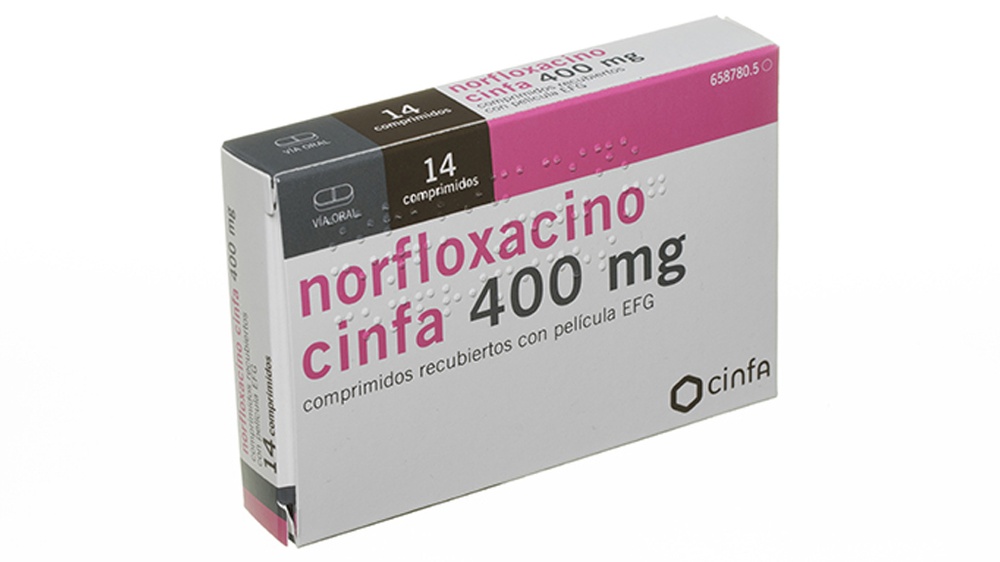
NORFLOXACINO 400 mg Comprimidos Recubiertos Con Película

Revisión de receta online
Un médico revisará tu caso y determinará si la prescripción es médicamente apropiada.

Habla con un médico sobre este medicamento
Comenta tus síntomas y las opciones de tratamiento en una consulta online.



Cómo usar NORFLOXACINO CINFA 400 mg COMPRIMIDOS RECUBIERTOS CON PELICULA EFG
Contenido del prospecto
- Introducción
- Qué es norfloxacino cinfa y para qué se utiliza
- Qué necesita saber antes de empezar a tomar norfloxacino cinfa
- Cómo tomar norfloxacino cinfa
- Posibles efectos adversos
- Conservación de norfloxacino cinfa
- Contenido del envase e información adicional
Introducción
Prospecto: información para el usuario
norfloxacino cinfa 400 mg comprimidos recubiertos con película EFG
Lea todo el prospecto detenidamente antes de empezar a tomar este medicamento, porque contiene información importante para usted.
- Conserve este prospecto, ya que puede tener que volver a leerlo.
- Si tiene alguna duda, consulte a su médico o farmacéutico.
- Este medicamento se le ha recetado solamente a usted, y no debe dárselo a otras personas aunque tengan los mismos síntomas que usted, ya que puede perjudicarles.
- Si experimenta efectos adversos, consulte a su médico o farmacéutico, incluso si se trata de efectos adversos que no aparecen en este prospecto. Ver sección 4.
Contenido del prospecto
- Qué es norfloxacino cinfa y para qué se utiliza
- Qué necesita saber antes de empezar a tomar norfloxacino cinfa
- Cómo tomar norfloxacino cinfa
- Posibles efectos adversos
- Conservación de norfloxacino cinfa
- Contenido del envase e información adicional
1. Qué es norfloxacino cinfa y para qué se utiliza
Norfloxacino cinfa contiene la sustancia activa norfloxacino.
Norfloxacino pertenece a un grupo de antibióticos conocidos como fluoroquinolonas. Norfloxacino es un antibiótico de amplio espectro y actúa contra una amplia gama de infecciones.
Los antibióticos se utilizan para tratar infecciones bacterianas y no sirven para tratar infecciones víricas como la gripe o el catarro. Es importante que siga las instrucciones relativas a la dosis, el intervalo de administración y la duración del tratamiento indicadas por su médico. No guarde ni reutilice este medicamento. Si una vez finalizado el tratamiento le sobra antibiótico, devuélvalo a la farmacia para su correcta eliminación. No debe tirar los medicamentos por el desagüe ni a la basura. |
Este medicamento está indicado en el tratamiento en adultos de infecciones agudas y crónicas, complicadas y no complicadas del tracto urinario superior e inferior (excepto complicaciones de pielonefritis: ciertas complicaciones inflamatorias de los riñones, causadas por una infección).

¿No estás seguro de si este medicamento es adecuado para ti?
Comenta tus síntomas y tratamiento con un médico online.
2. Qué necesita saber antes de empezar a tomar norfloxacino cinfa
Antes de empezar a tomar este medicamento
No debe tomar medicamentos antibacterianos que contengan fluoroquinolonas o quinolonas, incluido norfloxacino, si ha experimentado alguna reacción adversa grave con anterioridad al tomar una quinolona o una fluoroquinolona. Si este es su caso, debe informar a su médico lo antes posible.
No tomenorfloxacino cinfa
- si es alérgico al norfloxacino, a antibióticos de este tipo denominados quinolonas, o a alguno de los demás componentes de este medicamento (incluidos en la sección 6).
- si usted es hipersensible (alérgico) a cualquier otro antibiótico del grupo de las quinolonas (su médico lo sabrá)
- si tiene antecedentes de inflamación (tendinitis) y/o rotura de tendones, relacionadas con el tratamiento con fluoroquinolonas
- si usted es un niño o un adolescente menor de 18 años
- si está usted embarazada o en periodo de lactancia
- si usted está tomando tizanidina (ver sección 2: “Otros medicamentos y norfloxacino cinfa”)
Advertencias y precauciones
Consulte a su médico o farmacéutico antes de empezar a tomar norfloxacino cinfa.
Informe a su médico de cualquier enfermedad que tenga o haya tenido, especialmente si sufre o ha sufrido alguna de las siguientes circunstancias o enfermedades:
- si le han diagnosticado un aumento de tamaño o un “bulto” de un vaso sanguíneo de gran tamaño (aneurisma aórtico o aneurisma de un vaso de gran tamaño periférico).
- si ha sufrido un episodio previo de disección aórtica (desgarro de la pared de la aorta).
- si se le ha diagnosticado una insuficiencia de la válvula cardíaca (regurgitación de las válvulas cardíacas).
- si tiene antecedentes familiares de disección o aneurisma aórticos, enfermedad congénita de las válvulas cardíacas u otros factores de riesgo o condiciones predisponentes (p. ej., trastornos del tejido conjuntivo como el síndrome de Marfan, el síndrome de Ehlers-Danlos, el síndrome de Turner o el síndrome de Sjögren (una enfermedad autoinmune inflamatoria), o trastornos vasculares como la arteritis de Takayasu, la arteritis de células gigantes, la enfermedad de Behçet, hipertensión, aterosclerosis conocida, artritis reumatoide (una enfermedad de las articulaciones) o endocarditis (una infección del corazón)).
Mientras toma norfloxacino cinfa:
- Si siente un dolor repentino e intenso en el abdomen, el pecho o la espalda, que pueden ser síntomas de disección o aneurisma aórticos, acuda inmediatamente a un servicio de urgencias. Puede aumentar el riesgo si está recibiendo un tratamiento con corticoesteroides sistémicos.
- Si empieza a experimentar una aparición repentina de disnea, especialmente cuando se tumba en la cama, o si observa hinchazón en los tobillos, los pies o el abdomen o la aparición de palpitaciones cardíacas (sensación de latido cardíaco rápido o irregular), debe informar a su médico inmediatamente.
Efectos adversos graves incapacitantes, de duración prolongada, y potencialmente irreversibles
Los medicamentos antibacterianos que contienen fluoroquinolonas o quinolonas, incluido norfloxacino, se han asociado a efectos adversos muy raros pero graves, algunos de ellos fueron de larga duración (persistentes durante meses o años), incapacitantes o potencialmente irreversibles. Esto incluye dolor en los tendones, los músculos y las articulaciones de las extremidades superiores e inferiores, dificultad para caminar, sensaciones anómalas tales como pinchazos, hormigueo, cosquilleo, entumecimiento o quemazón (parestesia), trastornos sensitivos tales como disminución de la visión, del gusto, del olfato y de la audición, depresión, disminución de la memoria, fatiga intensa y trastornos graves del sueño.
Si experimenta cualquiera de estos efectos adversos después de tomar norfloxacino, póngase en contacto de forma inmediata con su médico, antes de continuar con el tratamiento. Usted y su médico decidirán si continuar o no el tratamiento, considerando también el uso de un antibiótico de otro clase.
Reacciones de hipersensibilidad:Algunos pacientes han tenido reacciones alérgicas graves que han sido ocasionalmente mortales, cuando reciben tratamiento con antibióticos del grupo de las quinolonas. Los síntomas de una reacción alérgica pueden incluir hinchazón de la piel de la cara, extremidades, lengua o garganta, y dificultades para respirar. Si usted tiene una reacción alérgica:
- deje de tomar norfloxacino
- vea a su médico inmediatamente, para un tratamiento de emergencia
Enfermedad hepática:
Durante el uso de norfloxacino se han dado casos de insuficiencia hepática (posible incapacidad del hígado para realizar sus funciones metabólicas normales y grave peligro para la vida) (ver sección 4). Si usted observa cualquier síntoma, tales como pérdida de apetito, ictericia (coloración amarillenta de la piel), orina oscura, picor, o dolor del estómago, deje de tomar norfloxacino y consulte a su médico de inmediato.
Tendones inflamados y/o ruptura de tendones:
En raras ocasiones pueden aparecer dolor e hinchazón en las articulaciones e inflamación o rotura de los tendones. El riesgo es mayor si usted es una persona de edad avanzada (mayor de 60 años), ha recibido un trasplante de un órgano, tiene problemas de riñón o está en tratamiento con corticosteroides. La inflamación y la rotura de tendones se puede producir en las primeras 48 horas de tratamiento e incluso hasta varios meses después de interrumpir el tratamiento con norfloxacino. Al primer signo de dolor o inflamación de un tendón (por ejemplo, en el tobillo, la muñeca, el codo, el hombro o la rodilla), deje de tomar norfloxacino, póngase en contacto con su médico y mantenga en reposo la zona dolorosa. Evite cualquier ejercicio innecesario, ya que este podría aumentar el riesgo de rotura de un tendón.
Epilepsia u otros trastornos del sistema nervioso central:
- epilepsia o convulsiones (ataques). Estos pueden empeorar.
- trastornos mentales, por ejemplo, alucinaciones y/o confusión. Estos pueden empeorar.
- trastornos del sistema nervioso central, tales como reducción del flujo sanguíneo al cerebro o un derrame cerebral.
Si sus síntomas empeoran, debe interrumpir el tratamiento y consultar a su médico inmediatamente.
Neuropatía periférica
En raras ocasiones, puede experimentar síntomas de lesión en los nervios (neuropatía) como dolor, quemazón, hormigueo, entumecimiento y/o debilidad, en especial en pies y piernas o en manos y brazos. Si esto sucede, deje de tomar norfloxacino e informe a su médico de forma inmediata para prevenir el desarrollo de un trastorno potencialmente irreversible.
Colitis pseudomembranosa:La colitis pseudomembranosa es una infección que causa inflamación del intestino grueso. Esto puede dar lugar a la aparición de diarrea grave y persistente durante o después del tratamiento. Si usted tiene estos síntomas:
- debe dejar el tratamiento con norfloxacino inmediatamente y ver a su médico.
- no tome medicamentos que enlentezca el paso normal de alimentos o que inhiban el peristaltismo. Su médico le recetará otro medicamento para tratar sus síntomas.
Problemascardiacos
Debe tenerse precaución al usar este tipo de medicamento, si nació con o tiene antecedentes familiares de intervalo QT prolongado (observado en el ECG, registro de la actividad eléctrica del corazón), tiene un desequilibrio de sal en la sangre (especialmente niveles bajos de potasio o magnesio en la sangre), tiene un ritmo cardíaco muy lento (llamado 'bradicardia'), tiene un corazón débil (insuficiencia cardíaca), tiene antecedentes de ataque al corazón (infarto de miocardio), es una mujer o tiene edad avanzada o está tomando otros medicamentos que provocan cambios anormales en el ECG (consulte la sección "Otros medicamentos y norfloxacino cinfa").
Déficit de la enzima G6FD (glucosa-6-fosfato-deshidrogenasa):Usted puede desarrollar un trastorno de sus glóbulos rojos. Esto puede suceder si usted no tiene suficiente enzima conocida como G6PD.
Miastenia gravis (enfermedad que causa debilidad muscular):Si usted está tomando norfloxacino, puede aparecer miastenia gravis o pueden empeorar los síntomas. Esto puede debilitar peligrosamente sus músculos respiratorios, dando lugar a insuficiencia respiratoria. Si sus síntomas empeoran, debe consultar a su médico inmediatamente.
Alteración de la visión:Si su visión empeora o si sus ojos parecen estar afectados de alguna manera, consulte inmediatamente a un especialista de la vista (ver sección 4 "Posibles efectos adversos").
Fotosensibilidad:Puede manifestarse fotosensibilidad en pacientes tratados con norfloxacino u otros medicamentos del grupo de las quinolonas. Usted debe evitar la exposición prolongada al sol y a la luz solar intensa. Debe evitar también el uso de solariums mientras tome norfloxacino.
Enfermedad renal:si usted tiene insuficiencia renal, norfloxacino puede no funcionar correctamente.
Cristaluria (cristales en su orina):Si usted toma norfloxacino durante un tiempo prolongado, pueden aparecer cristales en la orina. Para ayudar a evitar estos síntomas:
- no tome más que la dosis recomendada de norfloxacino
- beba muchos líquidos (p. ej., agua, nunca alcohol)
Disglucemia:Los antibióticos quinolona pueden causar un aumento de su nivel de azúcar en sangre por encima de los niveles normales (hiperglucemia), o disminución de su nivel de azúcar en sangre por debajo de los niveles normales (hipoglucemia), que en casos graves puede provocar una pérdida de conocimiento (coma hipoglucémico). Esto es importante para las personas que tengan diabetes. Si usted sufre de diabetes, su nivel de azúcar en sangre debe ser controlado cuidadosamente.
Otros medicamentos y norfloxacino cinfa
Informe a su médico o farmacéutico si está tomando, ha tomado recientemente o pudiera tener que tomar cualquier otro medicamento.
NO tome norfloxacino si está tomando tizanidina (para la relajación muscular en la esclerosis múltiple). Los siguientes medicamentos pueden afectar o ser afectados por norfloxacino:
- nitrofurantoína (un antibiótico)
- probenecid (utilizado en el tratamiento de la gota)
- teofilina (utilizado para tratar el asma y enfermedad pulmonar). El riesgo de efectos secundarios se puede incrementar con el tratamiento con teofilina .
- cafeína (que se encuentra en algunos medicamentos para el dolor). Usted no debe tomar medicamentos que contengan cafeína (p. ej., algunos analgésicos), mientras que usted esté tomando norfloxacino - consulte a su médico.
- ciclosporina (utilizado para prevenir el rechazo de trasplantes de órganos)
- warfarina (utilizada para diluir la sangre)
- medicamentos antiinflamatorios no esteroideos (medicamentos utilizados para el dolor y otras enfermedades)
- fenbufen (antiinflamatorio no esteroide, AINE, utilizado para aliviar el dolor)
Debe informar a su médico si está tomando medicamentos que pueden alterar su ritmo cardiaco: medicamentos que pertenecen al grupo de antiarrítmicos (p. ej.: quinidina, hidroquinidina, disopiramida, amiodarona, sotalol, dofetilida, ibutilida), antidepresivos tricíclicos, algunos antimicrobianos (que pertenecen al grupo de los macrólidos), algunos antipsicóticos.
Anticonceptivos orales:Debe tener en cuenta que las píldoras anticonceptivas orales disminuyen su efecto cuando se toma norfloxacino.
Productos que contienen hierro, antiácidos, magnesio, aluminio o zinc:Los productos que contienen algunas de estas sustancias (p. ej.: multivitaminas, sucralfato), pueden reducir la concentración de norfloxacino en sangre y orina.
Los comprimidos de norfloxacino deberán tomarse 2 horas antes, o por lo menos 4 horas después de haber ingerido dichos productos.
Productos que contienen calcio:
Los productos que contienen calcio pueden reducir la concentración de norfloxacino en sangre y orina. Por ejemplo, soluciones para nutrición oral y productos lácteos (leche o productos lácteos líquidos, tales como el yogur). Norfloxacino deberá tomarse 1 hora antes o por lo menos 2 horas después de haber ingerido dichos productos.
Toma de norfloxacino cinfa con alimentos, bebidas y alcohol
Se debe tomar norfloxacino con el estómago vacío, 1 hora antes o 2 horas después de una comida o de la ingestión de leche u otros productos lácteos.
No debe beber alcohol mientras esté tomando norfloxacino.
Embarazo y lactancia
Si está embarazada o en periodo de lactancia, cree que podría estar embarazada o tiene intención de quedarse embarazada, consulte a su médico o farmacéutico antes de utilizar este medicamento.
Este medicamento puede dañar al feto. Por lo tanto, no debe tomar norfloxacino:
- si está embarazada
- si cree que puede estar embarazada
- si está intentando quedarse embarazada.
Si usted se queda embarazada mientras toma norfloxacino, debe comunicárselo a su médico inmediatamente.
Debe utilizar métodos anticonceptivos eficaces mientras esté tomando norfloxacino. Si tiene dudas, consulte a su médico.
No debe amamantar si está tomando norfloxacino.
Conducción y uso de máquinas
Norfloxacino puede afectar a su capacidad de reacción, especialmente:
- al comienzo del tratamiento.
- al aumentar la dosis
- si se cambia la medicación
- si usted también bebe alcohol
Por lo tanto, debe siempre tener cuidado al conducir o utilizar máquinas. Si se ve afectado, no debe conducir.
norfloxacino cinfa contiene aceite de ricino hidrogenado.
Este medicamento puede producir molestias de estómago y diarrea porque contiene aceite de ricino hidrogenado.
norfloxacino cinfa contiene lactosa.
Este medicamento contiene lactosa. Si su médico le ha indicado que padece una intolerancia a ciertos azúcares, consulte con él antes de tomar este medicamento.
norfloxacino cinfa contiene sodio.
Este medicamento contiene menos de 23 mg de sodio (1 mmol) por comprimido; esto es, esencialmente “exento de sodio”.
3. Cómo tomar norfloxacino cinfa
Siga exactamente las instrucciones de administración de este medicamento indicadas por su médico o farmacéutico. En caso de duda, consulte de nuevo a su médico o farmacéutico.
Su médico le puede prescribir dos dosis al día. Si es así, es mejor tomar una dosis por la mañana y otra por la noche. Si usted tiene que tomar una sola dosis al día, tómela siempre en el mismo momento del día.
La ranura no se debe utilizar para partir el comprimido.
Si está tomando antiácidos, multivitaminas o soluciones nutricionales, debe tomar norfloxacino 2 horas antes o al menos 4 horas después de tomar estos productos.
Debe tragar los comprimidos de norfloxacino enteros, sin romperlos, aplastarlos o masticarlos. Trague los comprimidos con líquido, por ejemplo, un vaso de agua. Esto debe ser al menos 1 hora antes o 2 horas después de una comida o de tomar un producto lácteo.
La dosis recomendada es:
Infecciones del tracto urinario
Un comprimido de 400 mg dos veces al día. La duración del tratamiento, depende del tipo de infección que tenga.
? Cistitis aguda no complicada (en mujeres):el tratamiento es normalmente de 3 días.
- Infecciones del tracto urinario:el tratamiento es generalmente de 7 a 10 días.
Los síntomas pueden mejorar rápidamente. Aun así, debe seguir tomando el medicamento durante el tiempo que su médico le recomiende.
- Infecciones complicadas del tracto urinario:el tratamiento normalmente es de 2-3 semanas. Su médico puede aumentar la duración, dependiendo de la gravedad y la localización de la infección.
Si usted tiene enfermedad renal
Su médico puede comprobar el funcionamiento de sus riñones midiendo el aclaramiento de creatinina. Si usted tiene enfermedad renal grave (aclaramiento de creatinina = 30 ml/min x 1.73m2), su médico puede reducir la dosis a 400 mg, una vez al día.
Pacientes de edad avanzada
Si usted es de edad avanzada y la función renal no está alterada, las dosis indicadas arriba son adecuadas para usted.
Uso en niños y adolescentes
Los niños y adolescentes en fase de crecimiento (menores de 18 años) no deben tomar norfloxacino.
Si toma más norfloxacino cinfa del que debe
En caso de sobredosis o ingestión accidental consulte inmediatamente a su médico o farmacéutico o llame al Servicio de Información Toxicológica, teléfono: 91 562 04 20, indicando el medicamento y la cantidad ingerida. Se recomienda llevar el envase y el prospecto del medicamento al profesional sanitario.
Se le puede recomendar que tome soluciones que contengan calcio. Esto evitará que su sistema absorba más norfloxacino.
Si olvidó tomar norfloxacino cinfa
No se preocupe. Simplemente tome la siguiente dosis a la hora acostumbrada. No tome una dosis doble para compensar las dosis olvidadas.
Si interrumpe el tratamiento con norfloxacino cinfa
No deje de tomar el medicamento bruscamente, incluso si sus síntomas han mejorado rápidamente. Usted debe seguir tomando el medicamento durante el tiempo que su médico le recomiende, de lo contrario, la infección puede reaparecer de nuevo.
Si tiene cualquier otra duda sobre el uso de este medicamento, pregunte a su médico o farmacéutico.

¿Has empezado a tomar el medicamento y tienes preguntas?
Comenta tus síntomas y tratamiento con un médico online.
4. Posibles efectos adversos
Al igual que todos los medicamentos, este medicamento puede producir efectos adversos, aunque no todas las personas los sufran.
Se han notificado los siguientes efectos adversos:
Deje de tomar el medicamento y consulte a su médico inmediatamente si usted tiene:
- síntomas de angioedema (reacción potencialmente mortal), tales como:
- hinchazón de la cara, lengua o garganta
- dificultad para tragar
- urticaria y dificultad para respirar
- una reacción grave de la piel
- decoloración amarillenta del blanco del ojo o la piel, que puede ser un síntoma de una inflamación del hígado (hepatitis) o insuficiencia hepática.
Otros efectos adversos incluyen:
Frecuentes (pueden afectar hasta 1 de cada 10 personas)
- leucopenia (bajo número de glóbulos blancos)
- neutropenia ( bajo número de glóbulos blancos, llamados neutrófilos)
- eosinofilia (elevado número de glóbulos blancos, llamados eosinófilos)
- elevación de las enzimas hepáticas (AST, ALT, fosfatasa alcalina). Estas son pruebas de sangre que indican cambios en el funcionamiento del hígado.
- dolor de cabeza
- vértigos
- mareo
- somnolencia
- dolor abdominal y espasmos
- náuseas (malestar)
- erupción cutánea
Poco frecuentes (pueden afectar hasta 1 de cada 100 personas):
- trombocitopenia (disminución del número de plaquetas en la sangre)
- reducción de hematocrito ( bajo número de glóbulos rojos)
- cristaluria (cristales que aparecen en la orina)
- tiempo de protrombina prolongado (cuando su sangre tarda más tiempo en coagular)
- anemia hemolítica (descenso en el número de glóbulos rojos en la sangre, debido a su destrucción anormal, lo que puede dar lugar a palidez de la piel, debilidad y dificultad para respirar). Esto algunas veces, se relaciona con tener bajos niveles de la enzima glucosa-6-fosfato-deshidrogenasa.
- reacciones de hipersensibilidad (alérgicas),tales como:
- anafilaxia (reacción alérgica grave, ver punto 2. "Advertencias y precauciones")
- angioedema (reacción alérgica grave, que causa hinchazón de la cara, lengua o garganta, lo que puede poner en peligro la vida)
- urticaria (ronchas)
- nefritis intersticial (inflamación renal)
- petequias (pequeñas manchas de color rojo o púrpura en el cuerpo)
- bullas hemorrágicas (sangrado ampollas)
- pápulas con vasculitis (pequeños bultos en la piel con inflamación de los vasos sanguíneos)
- cansancio
- cambios de humor
- parestesia (hormigueo, entumecimiento)
- insomnio (dificultad para dormir)
- alteraciones del sueño
- depresión (sentirse triste)
- ansiedad
- nerviosismo
- irritabilidad
- euforia (sentimiento de extrema felicidad)
- desorientación
- alucinaciones (ver u oír cosas que no existen)
- confusión
- polineuropatía (cuando el sistema nervioso no funciona correctamente en los brazos y las piernas), incluyendo síndrome de Guillain-Barré (caracterizada por la debilidad que afecta a las extremidades. Esto puede causar entumecimiento y parálisis) (ver sección 2 “Advertencias y precauciones”)
- convulsiones (ataques)
- trastornos psíquicos, trastornos y reacciones psicóticas (trastornos mentales graves)
- miastenia gravis (enfermedad que causa debilidad muscular) puede aparecer o agravarse (véase punto 2. "Advertencias y precauciones")
- trastornos de visión
- aumento del lagrimeo (producción de lágrimas)
- tinnitus (zumbidos en los oídos)
- palpitaciones (sensación de latidos del corazón)
- acidez
- diarrea
- vómitos
- anorexia (pérdida de apetito)
- pancreatitis (inflamación del páncreas)
- hepatitis (inflamación del hígado)
- aumento de la bilirrubina sérica (producto químico en la sangre)
- reacciones cutáneas graves:
- dermatitis exfoliativa (inflamación, pitiriasis)
- síndrome de Lyell (grave enfermedad de la piel con un intenso enrojecimiento, ampollas y descamación de la piel, más bien como una quemadura)
- eritema multiforme (síndrome de Stevens-Johnson, una enfermedad grave con ampollas en la piel, boca, ojos y genitales)
- fotosensibilidad (aumento de la sensibilidad a la luz del sol)
- prurito (picor)
- artritis (articulaciones inflamadas)
- mialgia (dolor muscular)
- artralgia (dolor articular)
- tendinitis (inflamación tendones)
- tendovaginitis (inflamación del tendón y la vaina del tendón)
- aumento de urea y creatinina sérica (indicadores de empeoramiento de la función renal)
- candidiasis vaginal (muguet)
Raros (pueden afectar hasta 1 de cada 1.000 personas):
- colitis pseudomembranosa (inflamación del intestino que causa fiebre, dolor abdominal o diarrea (consulte la sección 2 "Advertencias y precauciones”)
- en algunos casos, se observó inflamación del tendón de Aquiles. Esto puede dar lugar a la ruptura del tendón de Aquiles (ver sección 2." Advertencias y precauciones").
Muy raros (pueden afectar hasta 1 de cada 10.000 personas):
- hepatitis colestásica (inflamación del hígado, donde la bilis no fluye correctamente)
- necrosis del hígado (muerte de tejido hepático)
- rabdomiólisis (enfermedad muscular causada por la ruptura de las células musculares que pueden conducir a problemas renales)
Frecuencia no conocida (no puede estimarse a partir de los datos disponibles):
- reducción del sentido del tacto (hipoestesia)
- insuficiencia hepática, incluyendo casos mortales (ver sección 2. “Advertencias y precauciones”)
- ritmo del corazón anormalmente rápido, ritmo del corazón irregular que puede poner en peligro la vida, alteración del ritmo del corazón (llamado “prolongación del intervalo QT”, observada en el ECG, actividad eléctrica del corazón)
La administración de antibióticos que contienen quinolonas y fluoroquinolonas se ha asociado a casos muy raros de reacciones adversas de larga duración (incluso meses o años) o permanentes, tales como inflamación de tendones, rotura de tendones, dolor en las articulaciones, dolor en las extremidades, dificultad para caminar, sensaciones anómalas tales como pinchazos, hormigueo, cosquilleo, quemazón, entumecimiento o dolor (neuropatía), fatiga, disminución de la memoria y la concentración, efectos sobre la salud mental (que pueden incluir trastornos del sueño, ansiedad, ataques de pánico, depresión e ideas suicidas), así como disminución de la audición, la visión, el gusto y el olfato, en algunos casos con independencia de la presencia de factores de riesgo preexistentes.
Se han notificado casos de aumento de tamaño y debilitamiento o desgarro de la pared aórtica (aneurismas y disecciones), lo que podría producir una rotura y llegar a ser mortal, e insuficiencia de válvulas cardíacas en pacientes que han recibido fluoroquinolonas. Ver también la sección 2.
Comunicación de efectos adversos
Si experimenta cualquier tipo de efecto adverso, consulte a su médico o farmacéutico, incluso si se trata de posibles efectos adversos que no aparecen en este prospecto. También puede comunicarlos directamente a través del Sistema Español de Farmacovigilancia de Medicamentos de Uso Humano: https://www.notificaram.es. Mediante la comunicación de efectos adversos usted puede contribuir a proporcionar más información sobre la seguridad de este medicamento.
5. Conservación de norfloxacino cinfa
Mantener este medicamento fuera de la vista y del alcance de los niños.
No utilice este medicamento después de la fecha de caducidad que aparece en el envase después de CAD. La fecha de caducidad es el último día del mes que se indica.
Este medicamento no requiere condiciones especiales de conservación.
Los medicamentos no se deben tirar por los desagües ni a la basura. Deposite los envases y los medicamentos que no necesita en el Punto SIGRE de la farmacia. En caso de duda pregunte a su farmacéutico cómo deshacerse de los envases y de los medicamentos que no necesita. De esta forma, ayudará a proteger el medio ambiente.
6. Contenido del envase e información adicional
Composición denorfloxacino cinfa
- El principio activo es norfloxacino. Cada comprimido recubierto contiene 400 mg de norfloxacino.
- Los demás componentes son: lactosa monohidrato, aceite de ricino hidrogenado, carboximetilalmidón sódico (tipo A) (de patata), celulosa microcristalina, sílice coloidal anhidra, crospovidona, estearato de magnesio, hidroxipropilcelulosa (E-463) y Opadry blanco OY-L28900 (lactosa monohidrato, hipromelosa, dióxido de titanio y macrogol 4000).
Aspecto del producto y contenido del envase
norfloxacino cinfa 400 mg son comprimidos recubiertos con película, de color blanco, oblongos, biconvexos, ranurados en una cara y con el código “N400” en la otra cara.
Se presenta en blíster de Aluminio/Aluminio. Cada envase contiene 1, 14 o 500 (envase clínico) comprimidos.
Puede que solamente estén comercializados algunos tamaños de envases.
Titular de la autorización de comercialización y responsable de la fabricación
Laboratorios Cinfa, S.A.
Carretera Olaz-Chipi, 10. Polígono Industrial Areta
31620 Huarte (Navarra) - España
Fecha de la última revisión de este prospecto:mayo 2025
La información detallada de este medicamento está disponible en la página web de la Agencia Española de Medicamentos y Productos Sanitarios (AEMPS) http://www.aemps.gob.es/
Puede acceder a información detallada y actualizada sobre este medicamento escaneando con su teléfono móvil (smartphone) el código QR incluido en prospecto y cartonaje. También puede acceder a esta información en la siguiente dirección de internet: https://cima.aemps.es/cima/dochtml/p/68627/P_68627.html
Código QR a: https://cima.aemps.es/cima/dochtml/p/68627/P_68627.html
- País de registro
- Forma farmacéuticaCOMPRIMIDO, 400 mg norfloxacino
- Código ATCJ01MA06
- Precio medio en farmacia4.67 EUR
- Principio activo
- Requiere recetaSí
- Fabricante
- ComposiciónLACTOSA HIDRATADA (93,00 mg mg), CARBOXIMETILALMIDON SODICO (54,40 mg mg), ALCOHOL ETILICO (ETANOL) (0,00 ml mg)
- Esta información es de carácter general y no sustituye la consulta con un profesional sanitario.
- Alternativas a NORFLOXACINO CINFA 400 mg COMPRIMIDOS RECUBIERTOS CON PELICULA EFGForma farmacéutica: COMPRIMIDO, 400 MGPrincipio activo: norfloxacinoFabricante: Dari Pharma S.L.Requiere recetaForma farmacéutica: COMPRIMIDO, 400 mg norfloxacinoPrincipio activo: norfloxacinoFabricante: Laboratorios Normon S.A.Requiere recetaForma farmacéutica: COMPRIMIDO, 400 mg por comprimido recubiertoPrincipio activo: norfloxacinoFabricante: Towa Pharmaceutical S.A.Requiere receta
Médicos online para NORFLOXACINO CINFA 400 mg COMPRIMIDOS RECUBIERTOS CON PELICULA EFG
Comenta la dosis, los posibles efectos secundarios, interacciones, contraindicaciones o la revisión de receta de NORFLOXACINO CINFA 400 mg COMPRIMIDOS RECUBIERTOS CON PELICULA EFG, sujeto a valoración médica y a la normativa local.









Obtén una receta de NORFLOXACINO CINFA 400 mg COMPRIMIDOS RECUBIERTOS CON PELICULA EFG online
Rellena un formulario de 2 minutos
Cuéntanos tus síntomas, historial y el medicamento que necesitas.
Elige un médico o nosotros te asignamos uno
Escoge un especialista o te conectamos con el próximo médico disponible.
El médico revisa tu caso
Normalmente en 30 minutos. Puede hacerte preguntas adicionales por chat.
Recógela en cualquier farmacia
Receta electrónica enviada a tu correo, válida en toda España.
Preguntas frecuentes
NORFLOXACINO CINFA 400 mg COMPRIMIDOS RECUBIERTOS CON PELICULA EFG requiere receta en España. Puedes confirmarlo con un médico online según tu caso.
El principio activo de NORFLOXACINO CINFA 400 mg COMPRIMIDOS RECUBIERTOS CON PELICULA EFG es norfloxacino. Esta información ayuda a identificar medicamentos con la misma composición pero con diferentes nombres comerciales.
El precio medio en farmacia de NORFLOXACINO CINFA 400 mg COMPRIMIDOS RECUBIERTOS CON PELICULA EFG es de aproximadamente 4.67 EUR. Puede variar según el fabricante y la forma farmacéutica.
NORFLOXACINO CINFA 400 mg COMPRIMIDOS RECUBIERTOS CON PELICULA EFG es fabricado por Laboratorios Cinfa S.A.. La marca y el envase pueden variar según el distribuidor.
Los Médicos de familia, Psiquiatras, Dermatólogos, Cardiólogos, Endocrinólogos, Gastroenterólogos, Neumólogos, Nefrólogos, Reumatólogos, Hematólogos, Infectólogos, Alergólogos, Geriatras, Pediatras, Oncólogos pueden valorar la prescripción de NORFLOXACINO CINFA 400 mg COMPRIMIDOS RECUBIERTOS CON PELICULA EFG cuando esté clínicamente indicado. Puedes reservar una videoconsulta para comentar tu caso y las opciones de tratamiento.
España cuenta con una infraestructura sanitaria bien desarrollada en ciudades principales como Madrid, Barcelona, Valencia y Sevilla. Las farmacias están ampliamente disponibles y operan bajo estrictas regulaciones, garantizando el acceso a medicamentos con receta.
Puedes comprar NORFLOXACINO CINFA 400 mg COMPRIMIDOS RECUBIERTOS CON PELICULA EFG en Madrid, Barcelona, Sevilla o Valencia en cualquier farmacia local con una receta válida.
Para obtener una receta, puedes utilizar Oladoctor:
Otros medicamentos con el mismo principio activo (norfloxacino) incluyen NORFLOXACINO DARI PHARMA 400 MG COMPRIMIDOS RECUBIERTOS CON PELÍCULA EFG, NORFLOXACINO NORMON 400 MG COMPRIMIDOS RECUBIERTOS CON PELICULA EFG, NORFLOXACINO PENSA 400 mg COMPRIMIDOS RECUBIERTOS CON PELICULA EFG. Pueden tener diferentes nombres comerciales o formulaciones, pero contienen el mismo componente terapéutico. Consulta siempre con un médico antes de cambiar o iniciar un nuevo medicamento.
