



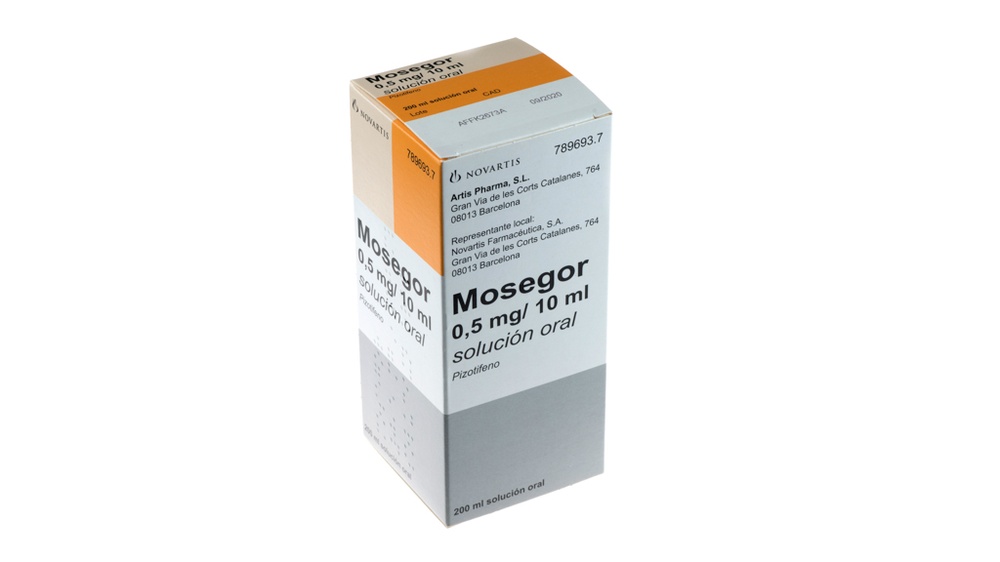
MOSEGOR 0,5 mg/10 ml SOLUCIÓN ORAL

Revisión de receta online
Un médico revisará tu caso y determinará si la prescripción es médicamente apropiada.

Habla con un médico sobre este medicamento
Comenta tus síntomas y las opciones de tratamiento en una consulta online.



Cómo usar MOSEGOR 0,5 mg/10 ml SOLUCION ORAL
Contenido del prospecto
- Introducción
- Qué es Mosegor y para qué se utiliza
- Qué necesita saber antes de empezar a tomar Mosegor
- Cómo tomar Mosegor
- Posibles efectos adversos
- Conservación de Mosegor
- Contenido del envase e información adicional
Introducción
Prospecto: información para el usuario
Mosegor0,5 mg/10 ml solución oral
pizotifeno
Lea todo el prospecto detenidamente antes de empezar a tomar este medicamento porque contiene información importante para usted.
- Conserve este prospecto, ya que puede tener que volver a leerlo.
- Si tiene alguna duda, consulte a su médico o farmacéutico.
- Este medicamento se le ha recetado solamente a usted y no debe dárselo a otras personas, aunque presenten los mismos síntomas de enfermedad que usted, ya que puede perjudicarles.
- Si experimenta efectos adversos, consulte a su médico o farmacéutico, incluso si se trata de efectos adversos que no aparecen en este prospecto. Ver sección 4.
Contenido del prospecto
- Qué es Mosegor y para qué se utiliza
- Qué necesita saber antes de empezar a tomar Mosegor
- Cómo tomar Mosegor
- Posibles efectos adversos
- Conservación de Mosegor
- Contenido del envase e información adicional
1. Qué es Mosegor y para qué se utiliza
El principio activo de Mosegor es pizotifeno, que tiene un efecto estimulante del apetito que promueve el aumento de peso en pacientes con bajo peso corporal (cuyo apetito se ha reducido o lo han perdido).
Mosegor se utiliza para el tratamiento de la pérdida del apetito en pacientes con peso corporal bajo como complemento del tratamiento de la enfermedad que causa la disminución de peso.

¿No estás seguro de si este medicamento es adecuado para ti?
Comenta tus síntomas y tratamiento con un médico online.
2. Qué necesita saber antes de empezar a tomar Mosegor
Siga detenidamente las instrucciones de su médico. Puede que éstas difieran de la información general incluida en este prospecto.
No tome Mosegor
- si es alérgico (hipersensible) al pizotifeno o a cualquiera de los demás componentes de este medicamento (incluidos en la sección 6).
Advertencias y precauciones
Informe a su médico si tiene o ha tenido alguna de estas condiciones:
- si tiene problemas de hígado. Se ha asociado este medicamento con algunos casos de resultados anormales en las pruebas de la función del hígado. Puede que no note ningún síntoma pero si observa que su piel o el blanco de los ojos se vuelven amarillos, la orina se oscurece o presenta náuseas, vómitos y cansancio, informe a su médico inmediatamente. Su médico puede pedir que le hagan un análisis de sangre para comprobar y vigilar el funcionamiento del hígado y puede decirle que interrumpa el tratamiento si el problema es grave.
Si mientras toma Mosegor se presentan los síntomas descritos anteriormente, informe a su médico de forma inmediata.
- si padece alteraciones en la visión debidas al incremento de la presión en el ojo (signos de glaucoma de ángulo estrecho), excepto si ha sido operado con éxito.
- si padece retención urinaria (dificultad para orinar como en el caso de la hipertrofia de próstata).
- si presenta convulsiones.
Si se encuentra en alguna de las situaciones descritas, informe a su médico antes de tomar el medicamento.
Niños y adolescentes
Mosegor no debe administrarse a niños menores de 2 años.
Interacción de Mosegor con otros medicamentos
Informe a su médico o farmacéutico si está tomando, ha tomado recientemente o podría tener que tomar cualquier otro medicamento.
Es importante que su médico sepa si está tomando:
- Sedantes o hipnóticos (tranquilizantes, medicamentos para dormir o para tratar la ansiedad) ya que pueden aumentar los efectos sedantes de Mosegor.
- Antihistamínicos (medicamentos utilizados contra la alergia o el resfriado común) ya que pueden aumentar los efectos sedantes de Mosegor.
- Cisaprida (medicamento utilizado para tratar la acidez).
Mosegor con alimentos, bebida y alcohol
El consumo de alcohol puede aumentar los efectos sedantes de este medicamento.
Embarazo y lactancia
Embarazo
Informe a su médico si está o piensa quedar embarazada.
La experiencia con Mosegor en el embarazo es limitada por lo que sólo debe utilizarse en circunstancias especiales, que su médico discutirá con usted.
Lactancia
No debe tomar el medicamento mientras esté dando el pecho.
Conducción y uso de máquinas
Este medicamento puede producir somnolencia, mareos y otros efectos sobre el cerebro por lo que debe conducir y manejar máquinas con precaución. Si tiene sueño, no conduzca ni realice ninguna actividad que requiera estar en alerta (por ejemplo utilizar herramientas o máquinas) hasta que se sienta bien para evitar cualquier riesgo para usted y los demás.
Mosegor contiene etanol
- Este medicamento contiene un 2% de etanol (alcohol), que se corresponde con una cantidad de 200 mg por 10 ml, lo que equivale a 4 ml de cerveza o 1,7 ml de vino. Este medicamento es perjudicial para personas que padecen alcoholismo. El contenido en alcohol debe tenerse en cuenta en el caso de mujeres embarazadas o en periodo de lactancia, niños y poblaciones de alto riesgo, como pacientes con enfermedades hepáticas o epilepsia.
Mosegor contiene sacarosa
- Si su médico le ha indicado que padece una intolerancia a ciertos azúcares, consulte con él antes de tomar este medicamento. Puede producir caries.
Mosegor contiene parahidroxibenzoato de propilo y parahidroxibenzoato de metilo
- Puede producir reacciones alérgicas (posiblemente retardadas).
Mosegor contiene sorbitol
Este medicamento contiene 10 g de sorbitol por cada dosis de 20 ml. El sorbitol es una fuente de fructosa. Si su médico le ha indicado que usted (o su hijo) padecen una intolerancia a ciertos azúcares, o se les ha diagnosticado intolerancia hereditaria a la fructosa (IHF), una enfermedad genética rara, en la que el paciente no puede descomponer la fructosa, consulte usted (o su hijo) con su médico antes de tomar este medicamento. El sorbitol puede provocar malestar gastrointestinal y un ligero efecto laxante.
3. Cómo tomar Mosegor
Siga exactamente las instrucciones de administración de Mosegor indicadas por su médico. En caso de duda, consulte de nuevo a su médico o farmacéutico. No tome una dosis mayor que la que le ha indicado su médico.
La dosis inicial en adultos es de 0,5 mg (10 ml de la solución) al día, que puede aumentarse gradualmente hasta 0,5 mg (10 ml de la solución) tres veces al día.
Uso en niños (de2 a12 años)
Las dosis iniciales bajas se aumentarán de forma gradual hasta alcanzar una dosis de mantenimiento de 0,025 mg/kg por día. La dosis total resultante puede repartirse en 2 o 3 tomas al día, según le haya recetado su médico.
Éstas son las dosis diarias aproximadas:
- Niños de 2 a 6 años: de 5 a 10 ml de solución (0,25 mg a 0,5 mg) en dosis divididas (repartidas en 2 o 3 tomas, según le indique el médico). Por ejemplo, para niños de 2 años o 14 kg de peso, 7 ml; para niños de 3 años o 16 kg de peso, 8 ml; para niños de 4 años o 18 kg de peso, 9 ml; para niños de 5 años o 20 kg de peso, 10 ml; para niños de 6 años y con un peso inferior a 23 kg, 10 ml.
- Niños de 6 a 12 años: de 10 a 20 ml de solución (0,5 mg a 1 mg) en dosis divididas. Por ejemplo, para niños de 6 años o más de 23 kg de peso, 11 ml; para niños de 7 años o 26 kg de peso, 13 ml; para niños de 8 años o 30 kg de peso, 15 ml; para niños de 9 años o 35 kg de peso, 17 ml; para niños de 10 a 12 años o con un peso aproximado de 40 kg, 20 ml.
En adolescentes mayores de 13 años con un peso corporal superior a 40 kg, se puede administrar la misma dosis que a un adulto, es decir, empezar con 0,5 mg al día y aumentar progresivamente la dosis alcanzar 0,5 mg tres veces al día.
Si toma más Mosegor del que debe
Si accidentalmente se ha tomado demasiada cantidad de solución de Mosegor, contacte con el médico inmediatamente ya que pueden ser necesarios cuidados médicos. También se puede llamar al Servicio de Información Toxicológica, teléfono, 91 562 04 20 indicando el medicamento y la cantidad tomada.
Si olvidó tomar Mosegor
Si se olvida tomar una dosis de Mosegor, ésta debe tomarse lo antes posible. Si sólo faltan 4 horas o menos para la próxima toma, debe esperarse hasta que cumpla la hora y tomar el medicamento con arreglo a la pauta inicial. No deben tomarse dosis dobles para compensar las dosis olvidadas. Si tiene dudas, consulte con el médico.
Si interrumpe el tratamiento con Mosegor
No cambie ni interrumpa la medicación sin preguntárselo al médico. El médico puede recomendar reducir la dosis de forma gradual antes de dejar el tratamiento. Esto se hace para evitar un empeoramiento del estado de salud y reducir el riesgo de aparición de síntomas de la retirada tales como depresión, temblores, náuseas, ansiedad, sensación de malestar, mareos, trastornos del sueño y pérdida de peso.
Si tiene cualquier duda sobre el uso de este medicamento, pregunte al médico o farmacéutico.

¿Has empezado a tomar el medicamento y tienes preguntas?
Comenta tus síntomas y tratamiento con un médico online.
4. Posibles efectos adversos
Al igual que todos los medicamentos, Mosegor puede producir efectos adversos, aunque no todas las personas los sufran.
Estos efectos adversos pueden ocurrir con determinadas frecuencias, las cuales se describen a continuación:
Muy frecuentes | Afectan a más de 1 de cada 10 pacientes |
Frecuentes | Afectan entre 1 y 10 de cada 100 pacientes |
Poco frecuentes | Afectan entre 1 y 10 de cada 1.000 pacientes |
Raros | Afectan entre 1 y 10 de cada 10.000 pacientes |
Muy raros | Afectan a menos de 1 de cada 10.000 pacientes |
Frecuencia desconocida | No puede estimarse la frecuencia con los datos disponibles |
Algunos efectos adversos pueden ser graves. Si nota alguno de ellos, informe inmediatamente a su médico:
Raros:
- Signos de alergia como prurito, picor o ampollas en la piel; hinchazón de la cara.
Muy raros:
- Convulsiones.
Frecuencia desconocida:
- La piel o el blanco de los ojos amarillean, la orina se oscurece y aparecen náuseas, vómitos y cansancio (signos de ictericia o hepatitis).
Otros efectos adversos:
Muy frecuentes:
- Aumento del apetito, aumento de peso.
Frecuentes:
- Somnolencia, cansancio, mareos, sequedad de boca, náuseas.
Poco frecuentes:
- Estreñimiento.
Raros:
- Depresión, excitabilidad, alucinaciones (escuchar, ver u oír cosas no reales), dificultad para dormir, ansiedad, hormigueo y sensación de insensiblidad en las manos y pies, dolor muscular.
Frecuencia desconocida:
- Calambres musculares.
Si experimenta efectos adversos, consulte a su médico o farmacéutico, incluso si se trata de efectos adversos que no aparecen en este prospecto.
5. Conservación de Mosegor
- Mantener fuera del alcance y de la vista de los niños.
- No utilice este medicamento después de la fecha de caducidad que aparece en la caja. La fecha de caducidad es el último día del mes que se indica.
- No requiere condiciones especiales de conservación.
- No utilice este medicamento si observa signos visibles de deterioro.
- Los medicamentos no se deben tirar por los desagües ni a la basura. Deposite los envases y los medicamentos que no necesita en el Punto SIGRE de la farmacia. En caso de duda pregunte a su farmacéutico cómo deshacerse de los envases y de los medicamentos que no necesita. De esta forma, ayudará a proteger el medio ambiente.
6. Contenido del envase e información adicional
Composición deMosegor
- El principio activo es pizotifeno. Cada 10 ml de solución contienen 0,5 mg de pizotifeno.
- Los demás componentes son: parahidroxibenzoato de propilo (E216), parahidroxibenzoato de metilo (E218), ácido cítrico, hidrogenofosfato de disodio, etanol 96%, sacarosa, sorbitol 70%, aroma de frambuesa, aroma de maraschino y agua purificada.
Aspecto del producto y contenido del envase
Frasco con 200 ml y vasito dosificador.
Titular de la autorización de comercialización
ETHYX PHARMACEUTICALS
19 rue Duquesne
69006 Lyon
Francia
Responsable de la fabricación
DELPHARM ORLEANS
5 avenue de concyr
45071 Orleans
Francia
Este prospecto ha sido aprobado en
Mayo 2022
La información detallada y actualizada de este medicamento está disponible en la página Web de la Agencia Española de Medicamentos y Productos Sanitarios (AEMPS)http:/www.aemps.es/
- País de registro
- Forma farmacéuticaSOLUCIÓN/SUSPENSIÓN ORAL, 0,25 mg pizotifeno
- Código ATCN02CX01
- Principio activo
- Requiere recetaNo
- Fabricante
- ComposiciónALCOHOL ETILICO (ETANOL) (100 mg mg), METILPARABENO (E 218) (1,67 mg mg), SOLUCION DE SORBITOL 70% (2500 mg mg), SACAROSA (1500 mg mg), FOSFATO DISODICO (9,79 mg mg), PROPILPARABENO (E 216) (0,84 mg mg)
- Esta información es de carácter general y no sustituye la consulta con un profesional sanitario.
- Alternativas a MOSEGOR 0,5 mg/10 ml SOLUCION ORALForma farmacéutica: INYECTABLE, 140 mgPrincipio activo: ErenumabFabricante: Novartis Europharm LimitedRequiere recetaForma farmacéutica: INYECTABLE, 70 mgPrincipio activo: ErenumabFabricante: Novartis Europharm LimitedRequiere recetaForma farmacéutica: INYECTABLE, 225 mgPrincipio activo: FremanezumabFabricante: Teva GmbhRequiere receta
Médicos online para MOSEGOR 0,5 mg/10 ml SOLUCION ORAL
Comenta la dosis, los posibles efectos secundarios, interacciones, contraindicaciones o la revisión de receta de MOSEGOR 0,5 mg/10 ml SOLUCION ORAL, sujeto a valoración médica y a la normativa local.









Obtén una receta de MOSEGOR 0,5 mg/10 ml SOLUCION ORAL online
Rellena un formulario de 2 minutos
Cuéntanos tus síntomas, historial y el medicamento que necesitas.
Elige un médico o nosotros te asignamos uno
Escoge un especialista o te conectamos con el próximo médico disponible.
El médico revisa tu caso
Normalmente en 30 minutos. Puede hacerte preguntas adicionales por chat.
Recógela en cualquier farmacia
Receta electrónica enviada a tu correo, válida en toda España.
Preguntas frecuentes
MOSEGOR 0,5 mg/10 ml SOLUCION ORAL no requiere receta en España. Puedes confirmarlo con un médico online según tu caso.
El principio activo de MOSEGOR 0,5 mg/10 ml SOLUCION ORAL es pizotifen. Esta información ayuda a identificar medicamentos con la misma composición pero con diferentes nombres comerciales.
MOSEGOR 0,5 mg/10 ml SOLUCION ORAL es fabricado por Ethyx Pharmaceuticals. La marca y el envase pueden variar según el distribuidor.
Los Médicos de familia, Psiquiatras, Dermatólogos, Cardiólogos, Endocrinólogos, Gastroenterólogos, Neumólogos, Nefrólogos, Reumatólogos, Hematólogos, Infectólogos, Alergólogos, Geriatras, Pediatras, Oncólogos pueden valorar la prescripción de MOSEGOR 0,5 mg/10 ml SOLUCION ORAL cuando esté clínicamente indicado. Puedes reservar una videoconsulta para comentar tu caso y las opciones de tratamiento.
España cuenta con una infraestructura sanitaria bien desarrollada en ciudades principales como Madrid, Barcelona, Valencia y Sevilla. Las farmacias están ampliamente disponibles y operan bajo estrictas regulaciones, garantizando el acceso a medicamentos con receta.
Puedes comprar MOSEGOR 0,5 mg/10 ml SOLUCION ORAL en Madrid, Barcelona, Sevilla o Valencia en cualquier farmacia local con una receta válida.
Para obtener una receta, puedes utilizar Oladoctor:
Otros medicamentos con el mismo principio activo (pizotifen) incluyen AIMOVIG 140 MG SOLUCIÓN INYECTABLE EN PLUMA PRECARGADA, AIMOVIG 70 MG SOLUCION INYECTABLE EN PLUMA PRECARGADA, AJOVY 225 MG SOLUCION INYECTABLE EN JERINGA PRECARGADA. Pueden tener diferentes nombres comerciales o formulaciones, pero contienen el mismo componente terapéutico. Consulta siempre con un médico antes de cambiar o iniciar un nuevo medicamento.
