



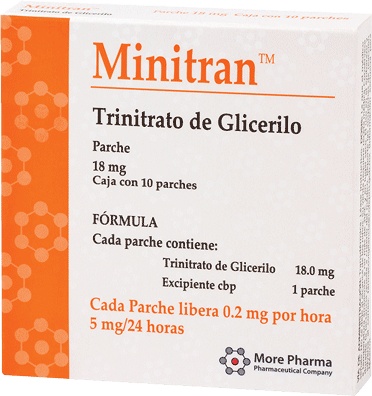
MINITRAN 15 mg /24 H Parches Transdérmicos

Revisión de receta online
Un médico revisará tu caso y determinará si la prescripción es médicamente apropiada.

Habla con un médico sobre este medicamento
Comenta tus síntomas y las opciones de tratamiento en una consulta online.



Cómo usar MINITRAN 15 mg/24 H PARCHES TRANSDÉRMICOS
Contenido del prospecto
- Introducción
- Qué es MINITRAN y para qué se utiliza
- Qué necesita saber antes de empezar a usar MINITRAN
- Uso de MINITRAN con otros medicamentos
- Embarazo, lactancia y fertilidad
- Conducción y uso de máquinas
- Cómo usar MINITRAN
- Instrucciones para la correcta administración
- Si usa más MINITRAN del que debe
- Posibles efectos adversos
- Conservación de MINITRAN
- Contenido del envase e información adicional
- Fecha de la última revisión de este prospecto:octubre de 2017
Introducción
PROSPECTO : INFORMACIÓN PARA EL USUARIO
MINITRAN 15 mg/24 h parches transdérmicos
Trinitrato de glicerilo
Lea todo el prospecto detenidamente antes de empezar a usar el medicamento, porque contiene información importante para usted.
- Conserve este prospecto, ya que puede tener que volver a leerlo.
- Si tiene alguna duda, consulte a su médico o farmacéutico.
- Este medicamento se le ha recetado solamente a usted, y no debe dárselo a otras personas aunque tengan los mismos síntomas que usted, ya que puede perjudicarles.
- Si experimenta efectos adversos, consulte a su médico o farmacéutico, incluso si se trata de efectos adversos que no aparecen en este prospecto. Ver sección 4.
Contenido del prospecto:
- Qué es MINITRAN y para qué se utiliza
- Qué necesita saber antes de empezar a usar MINITRAN
- Cómo usar MINITRAN
- Posibles efectos adversos
5 Conservación de MINITRAN
- Contenido del envase e información adicional
1. Qué es MINITRAN y para qué se utiliza
Los parches de MINITRAN son sistemas transdérmicos consistentes en una película fina y transparente de polietileno de baja densidad, cubierta por una matriz adhesiva que contiene trinitrato de glicerilo. La matriz controla la velocidad de liberación del principio activo, permitiendo la liberación continuada de trinitrato de glicerilo en cantidad suficiente para asegurar unos niveles constantes durante 24 horas. El parche está recubierto por una película protectora de poliéster que se despega y desecha antes de su uso.
MINITRAN está indicado para la prevención de la angina de pecho de esfuerzo y de reposo, asociada o consecuente a insuficiencia coronaria.

¿No estás seguro de si este medicamento es adecuado para ti?
Comenta tus síntomas y tratamiento con un médico online.
2. Qué necesita saber antes de empezar a usar MINITRAN
No use MINITRAN
- Si es alérgico al trinitrato de glicerilo y nitratos orgánicos, o a alguno de los demás componentes de este medicamento (incluidos en la sección 6).
- Si padece insuficiencia cardiaca debida a obstrucción valvular (estrechamiento de las válvulas del corazón) o inflamación del pericardio que comprime el corazón.
- Si padece enfermedades asociadas a hipertensión intracraneal (como hemorragia cerebral o traumatismos craneoencefálicos) o presión intraocular aumentada (glaucoma).
- En casos de disminución de la circulación sanguínea asociada a tensión arterial muy baja (como en caso de shock).
- Si tiene la tensión arterial muy baja (inferior a 90 mm Hg).
- En casos de hipovolemia grave (si ha perdido recientemente mucha sangre).
- Si toma medicamentos del grupo de inhibidores de la fosfodiesterasa tipo 5, como sildenafilo, tadalafilo, vardenafilo (medicamentos utilizados para tratar la impotencia o la hipertensión pulmonar). Estos medicamentos nunca se deben tomar conjuntamente con Minitran.
- Si está tomando medicamentos con riociguat, un estimulador de la guanilato ciclasa soluble.
Para mayor información consulte con su médico o farmacéutico.
Advertencias y precauciones
Consulte a su médico o farmacéutico antes de empezar a usar MINITRAN.
- MINITRAN debe utilizarse bajo estricta vigilancia médica en casos de infarto de miocardio reciente o de insuficiencia cardiaca congestiva (incapacidad del corazón para bombear suficiente sangre al resto del cuerpo).
- Informe a su médico si tiene o ha tenido:
- alguna enfermedad de corazón o trastornos de los vasos sanguíneos distintos a una angina,
- alguna enfermedad de pulmón. En pacientes con angina de pecho, infarto de miocardio o isquemia cerebral, pueden sufrir alteraciones de las vías respiratorias pequeñas,
- anemia.
- En pacientes con angina de pecho producida por el engrosamiento de su corazón (miocardiopatía hipertrófica), el tratamiento con Minitran puede empeorarla.
- MINITRAN no está indicado en el tratamiento de ataques agudos de angina (dolor en el tórax), requiriendo la asociación de nitroderivados de acción rápida por vía sublingual.
- En caso de suspender el tratamiento, la dosis y frecuencia de la aplicación del parche MINITRAN debe reducirse gradualmente durante un periodo de 4-6 semanas para evitar las reacciones de retirada de esta clase de fármacos vasodilatadores. Si comienza con otro tratamiento para la angina de pecho, durante un periodo de tiempo, puede que tenga que utilizar ambos medicamentos.
- El producto puede ocasionar hipotensión postural, especialmente en pacientes ansiosos, siendo por este motivo necesario advertir a los pacientes de este riesgo con el fin de evitar cambios bruscos de postura.
- Es posible la aparición de acostumbramiento al medicamento o a otros nitroderivados. Por este motivo, el médico puede recomendarle aplicar MINITRAN diariamente con un intervalo sin parche de 8 a 12 horas al día.
Uso de MINITRAN con otros medicamentos
Informe a su médico o farmacéutico si está utilizando, ha utilizado recientemente o pudiera tener que utilizar cualquier otro medicamento.
Los pacientes en tratamiento con Minitran no deben tomar nunca (ni aunque se hayan quitado el parche) medicamentos inhibidores de la fosfodiesterasa 5 (PDE5) como aquellos que contengan sildenafilo, vardenafilo o tadalafilo (medicamentos usados para tratar la impotencia y la hipertensión arterial pulmonar). Para mayor información, consulte con su médico o farmacéutico.
Debe evitarse el tratamiento simultáneo con riociguat, un estimulador de la guanilato ciclasa soluble, dado que el uso simultáneo puede causar hipotensión (ver “No use Minitran”).
Es conveniente que el médico conozca si está bajo tratamiento con otros medicamentos, ya que pueden aumentar o disminuir el efecto de bajada de la tensión arterial de MINITRAN.
La administración junto con otros vasodilatadores, como el alcohol y algunos medicamentos (antagonistas del calcio, betabloqueantes, diuréticos, antihipertensivos, antidepresivos tricíclicos, tranquilizantes mayores), debe hacerse con prudencia, con el objeto de evitar la adición de efectos.
Los medicamentos antiinflamatorios no esteroideos (AINE), excepto el ácido acetilsalicílico (aspirina), pueden reducir la acción de Minitran.
El uso al mismo tiempo de Minitran con dihidroergotamina (medicamento utilizado para el tratar la migraña), puede aumentar la cantidad dihidroergotamina en sangre. Esto es importante en pacientes con enfermedad arterial coronaria, ya que la dihidroergotamina contrarresta la acción de Minitran.
La administración conjunta de Minitran con amifostina y ácido acetilsalicílico puede potenciar los efectos hipotensores de MINITRAN.
Interferencia con pruebas de diagnóstico
El trinitrato de glicerilo puede interferir en la medición de ciertos análisis clínicos (catecolaminas y ácido vanilicomandélico en la orina incrementando su excreción).
Uso de MINITRAN con alimentos y bebidas
Se desaconseja la ingesta de bebidas alcohólicas durante el tratamiento.

¿Has empezado a tomar el medicamento y tienes preguntas?
Comenta tus síntomas y tratamiento con un médico online.
Embarazo, lactancia y fertilidad
Si está embarazada o en periodo de lactancia, cree que podría estar embarazada o tiene intención de quedarse embarazada, consulte a su médico o farmacéutico antes de utilizar cualquier medicamento.
MINITRAN debe emplearse con precaución durante el embarazo, especialmente durante los 3 primeros meses del embarazo. En estas circunstancias, el medicamento resulta adecuado únicamente en caso de necesidad y bajo el control directo de un médico. Si se está usando regularmente este medicamento y se produce embarazo, notifíquelo inmediatamente a su médico.
Si se encuentra en periodo de lactancia, deberá advertir al médico, ya que debe decidir si es necesario interrumpir la lactancia o interrumpir el tratamiento, tras considerar el beneficio de la lactancia para el niño y el beneficio del tratamiento para la madre.
Conducción y uso de máquinas
MINITRAN puede producir hipotensión y mareos, especialmente al inicio del tratamiento. Si nota alguno de estos efectos evite conducir vehículos o utilizar máquinas.
3. Cómo usar MINITRAN
Siga exactamente las instrucciones de administración de este medicamento indicadas por su médico. En caso de duda, consulte de nuevo a su médico o farmacéutico antes de utilizar este medicamento.
La respuesta a los nitroderivados varía según el individuo y se debe prescribir en cada caso la dosis mínima eficaz. Debido a que la cantidad de trinitrato de glicerilo que libera el parche de MINITRAN es constante, la dosis administrada depende únicamente del área de contacto del parche.
Como regla general, es aconsejable iniciar el tratamiento con un parche de MINITRAN 5 mg/24 h al día. Si es necesario, y en función de la tolerancia demostrada, se puede incrementar el tratamiento a un parche de MINITRAN 10 mg/24 h o incluso de MINITRAN 15 mg/24 h al día.
La aplicación puede ser por un periodo de tiempo continuado de 24 horas, o intermitentemente, incorporando un intervalo sin parche de 8 a 12 horas (normalmente por la noche).
Uso en niños y adolescentes:La seguridad y eficacia en menores de 18 años no ha sido establecida. Por tanto su uso no está recomendado.
Uso en ancianos:Los pacientes geriátricos suelen ser más sensibles a los efectos hipotensores (bajadas de tensión arterial).
Instrucciones para la correcta administración
Cada parche de MINITRAN está contenido en una pequeña bolsa protectora sellada. La zona adhesiva está recubierta por una película protectora, que debe extraerse justo antes de la aplicación sobre la piel.
Aplicar el parche MINITRAN sobre la piel en una zona limpia, seca, sana (sin restos de cremas) y poco provista de vello.
El procedimiento correcto de aplicación es el siguiente:
- Abrir la bolsa, rasgándola por la marca y extraer el parche de su interior.

- Doblar ligeramente el parche con las marcas punteadas mirando hacia Vd., tirar la lengüeta y desechar la película protectora.

- Aplicar la superficie con adhesivo en la parte superior del brazo o en el tórax. Separar con cuidado la otra parte punteada de la película protectora.

- Presionar sobre el parche para asegurar su buena colocación.

Retirar el parche MINITRAN a las 24 horas, salvo otra recomendación del médico. Los parches MINITRAN son desechables. Deben mantenerse fuera del alcance de los niños.
Aplicar un nuevo parche MINITRAN siguiendo el método expuesto. Este nuevo parche debe aplicarse en una zona distinta a la del anterior, p.e. en el lado opuesto del pecho.
No aplicar el sistema en la misma zona durante días consecutivos. El parche MINITRAN se adhiere con facilidad a la piel y no se desprende con el baño, la ducha o el ejercicio físico.
Si usa más MINITRAN del que debe
Dosis elevadas de trinitrato de glicerilo pueden, en algunos casos, inducir un rápido descenso de la presión arterial y provocar shock, taquicardia, metahemoglobinemia, cianosis, coma y convulsiones.
Debido a la liberación controlada de trinitrato de glicerilo con MINITRAN, el riesgo de sobredosificación es muy raro.
El efecto del nitrato de Minitran puede ser rápidamente eliminado retirando simplemente el/los parche(s) transdérmico(s).
Cualquier reducción de la presión arterial y síntomas de colapso pueden tratarse elevando las piernas y si es necesario, vendándolas.
La metahemoglobinemia (aumento de metahemoglobina en sangre) grave puede tratarse con una inyección de metiltionina o tolonio.
En caso de sobredosis o ingestión accidental, acudir inmediatamente a un centro médico, o llamar al Servicio de Información Toxicológica. Teléfono (91) 562 04 20, indicando el medicamento y la cantidad ingerida.
Si olvidó usar MINITRAN
No use una dosis doble para compensar las dosis olvidadas
Si interrumpe el tratamiento con MINITRAN
En caso de suspender el tratamiento la dosis y frecuencia de la aplicación del parche debe reducirse gradualmente durante un periodo de 4-6 semanas para evitar las reacciones de retirada de esta clase de medicamentos vasodilatadores.
Si tiene cualquier otra duda sobre el uso de este producto, pregunte a su médico o farmacéutico.
4. Posibles efectos adversos
Al igual que todos los medicamentos, MINITRAN puede producir efectos adversos, aunque no todas las personas los sufran.
La tolerancia al trinitrato de glicerilo es, en general, buena. Los siguientes efectos adversos pueden aparecer y desaparecer durante el tratamiento.
Muy frecuentes (pueden afectar a más de 1 de cada 10 personas): náuseas y vómitos.
Frecuentes (pueden afectar hasta 1 de cada 10 personas): dolor de cabeza que suele remitir a los pocos días y puede ser tratado con analgésicos suaves. En casos particularmente intensos puede ser necesario reducir la dosis o interrumpir el tratamiento.
Poco frecuentes (pueden afectar hasta 1 de cada 100 personas): Dermatitis (inflamación de la piel). Irritación de la piel (picor, escozor y ligero enrojecimiento) que suele desaparecer pocas horas después de retirar el parche. Si experimenta una reacción generalizada de la piel, que abarque un área amplia zona, comuníqueselo a su médico.
Raros (pueden afectar hasta 1 de cada 1000 personas): enrojecimiento de la cara. Mareos, especialmente al levantarse rápidamente, por lo que se recomienda hacerlo despacio y, si se marea, sentarse o estirarse. Bajada de la presión arterial. Desmayos. Aceleración del ritmo del corazón.
Muy raros (pueden afectar hasta 1 de cada 10.000 personas): Mareos
Desconocidos (el número de pacientes afectados no puede calcularse con la información disponible): palpitaciones (sensación anormal del ritmo del corazón), erupción en la piel y síncope.
Es importante que informe a su médico, ya que puede tener que bajarle la dosis o suspender el tratamiento, al menos temporalmente.
Comunicación de efectos adversos
Si experimenta cualquier tipo de efecto adverso, consulte a su médico o farmacéutico, incluso si se trata de posibles efectos adversos que no aparecen en este prospecto. También puede comunicarlos directamente a través del Sistema Español de Farmacovigilancia de Medicamentos de Uso Humano www.notificaRAM.es
Mediante la comunicación de efectos adversos usted puede contribuir a proporcionar más información sobre la seguridad de este medicamento.
5. Conservación de MINITRAN
No almacenar por encima de 25ºC. Conservar en lugar fresco y seco.
Mantener fuera del alcance y de la vista de los niños.
No utilice este medicamento después de la fecha de caducidad que aparece en el envase. La fecha de caducidad es el último día del mes que se indica.
Los medicamentos no se deben tirar por los desagües ni a la basura. Deposite los envases y los medicamentos que no necesita en el Punto SIGRE de la farmacia. En caso de duda pregunte a su farmacéutico cómo deshacerse de los envases y de los medicamentos que no necesita. De esta forma, ayudará a proteger el medio ambiente.
6. Contenido del envase e información adicional
Composición de MINITRAN 15 mg/24 h
- El principio activo es trinitrato de glicerilo, 54 mg por parche. La cantidad media liberada en 24 horas es de 15 mg.
- Los demás componentes son:
Copolímero de isooctilo/acrilamida: oleato de etilo; monolaureato de glicerilo.
Soporte: película oval de polietileno de baja densidad; película de poliéster recubierta por un lado con silicona.
Aspecto del producto y contenido del envase
MINITRAN 15 mg son parches transdérmicos consistentes en una película fina y transparente de polietileno de baja densidad, cubierta por una matriz adhesiva que contiene trinitrato de glicerilo. La matriz controla la velocidad de liberación del principio activo. El parche está recubierto por una película protectora de poliéster que se despega y desecha antes de su uso.
Cada parche tiene un área superficial de 20 cm2 y se presenta en cajas de 7 y 30 parches.
Titular de la autorización de comercialización y responsable de la fabricación
Titular de la autorización de comercialización:
Viatris Healthcare Limited
Damastown Industrial Park
Mulhuddart, Dublín 15
Dublín
Irlanda
Responsable de la fabricación:
Meda Pharma GmbH & Co. KG
Benzstrasse 1
61352 Bad Homburg
Alemania
o
Mylan Hungary Kft.
Mylan utca 1
2900 Komárom
Hungría
Pueden solicitar más información respecto a este medicamento dirigiéndose al representante local del titular de la autorización de comercialización:
Viatris Pharmaceuticals, S.L.
C/ General Aranaz, 86
28027 - Madrid
España
Fecha de la última revisión de este prospecto:octubre de 2017
La información detallada y actualizada de este medicamento está disponible en la página web de la Agencia Española de Medicamentos y Productos Sanitarios (AEMPS) https://www.aemps.gob.es
- País de registro
- Forma farmacéuticaPARCHE TRANSDERMICO, 15 mg nitroglicerina/ 24 h.
- Código ATCC01DA02
- Precio medio en farmacia23.14 EUR
- Principio activo
- Requiere recetaSí
- Fabricante
- Esta información es de carácter general y no sustituye la consulta con un profesional sanitario.
- Alternativas a MINITRAN 15 mg/24 H PARCHES TRANSDÉRMICOSForma farmacéutica: PARCHE TRANSDERMICO, 37,4 mg nitroglicerinaPrincipio activo: Trinitrato de gliceriloFabricante: Merus Labs Luxco Ii S.À.R.L.Requiere recetaForma farmacéutica: PARCHE TRANSDERMICO, 18,7 mg nitroglicerinaPrincipio activo: Trinitrato de gliceriloFabricante: Merus Labs Luxco Ii S.À.R.L.Requiere recetaForma farmacéutica: PARCHE TRANSDERMICO, 31,37 mgPrincipio activo: Trinitrato de gliceriloFabricante: Casen Recordati S.L.Requiere receta
Médicos online para MINITRAN 15 mg/24 H PARCHES TRANSDÉRMICOS
Comenta la dosis, los posibles efectos secundarios, interacciones, contraindicaciones o la revisión de receta de MINITRAN 15 mg/24 H PARCHES TRANSDÉRMICOS, sujeto a valoración médica y a la normativa local.
Obtén una receta de MINITRAN 15 mg/24 H PARCHES TRANSDÉRMICOS online
Rellena un formulario de 2 minutos
Cuéntanos tus síntomas, historial y el medicamento que necesitas.
Elige un médico o nosotros te asignamos uno
Escoge un especialista o te conectamos con el próximo médico disponible.
El médico revisa tu caso
Normalmente en 30 minutos. Puede hacerte preguntas adicionales por chat.
Recógela en cualquier farmacia
Receta electrónica enviada a tu correo, válida en toda España.
Preguntas frecuentes
MINITRAN 15 mg/24 H PARCHES TRANSDÉRMICOS requiere receta en España. Puedes confirmarlo con un médico online según tu caso.
El principio activo de MINITRAN 15 mg/24 H PARCHES TRANSDÉRMICOS es Trinitrato de glicerilo. Esta información ayuda a identificar medicamentos con la misma composición pero con diferentes nombres comerciales.
El precio medio en farmacia de MINITRAN 15 mg/24 H PARCHES TRANSDÉRMICOS es de aproximadamente 23.14 EUR. Puede variar según el fabricante y la forma farmacéutica.
MINITRAN 15 mg/24 H PARCHES TRANSDÉRMICOS es fabricado por Viatris Healthcare Limited. La marca y el envase pueden variar según el distribuidor.
Los Médicos de familia, Psiquiatras, Dermatólogos, Cardiólogos, Endocrinólogos, Gastroenterólogos, Neumólogos, Nefrólogos, Reumatólogos, Hematólogos, Infectólogos, Alergólogos, Geriatras, Pediatras, Oncólogos pueden valorar la prescripción de MINITRAN 15 mg/24 H PARCHES TRANSDÉRMICOS cuando esté clínicamente indicado. Puedes reservar una videoconsulta para comentar tu caso y las opciones de tratamiento.
España cuenta con una infraestructura sanitaria bien desarrollada en ciudades principales como Madrid, Barcelona, Valencia y Sevilla. Las farmacias están ampliamente disponibles y operan bajo estrictas regulaciones, garantizando el acceso a medicamentos con receta.
Puedes comprar MINITRAN 15 mg/24 H PARCHES TRANSDÉRMICOS en Madrid, Barcelona, Sevilla o Valencia en cualquier farmacia local con una receta válida.
Para obtener una receta, puedes utilizar Oladoctor:
Otros medicamentos con el mismo principio activo (Trinitrato de glicerilo) incluyen CORDIPLAST 10 mg/24 h PARCHES TRANSDERMICOS, CORDIPLAST 5 mg/24 h PARCHES TRANSDERMICOS, DERMATRANS 10 mg/24 H PARCHE TRANSDERMICO. Pueden tener diferentes nombres comerciales o formulaciones, pero contienen el mismo componente terapéutico. Consulta siempre con un médico antes de cambiar o iniciar un nuevo medicamento.
