



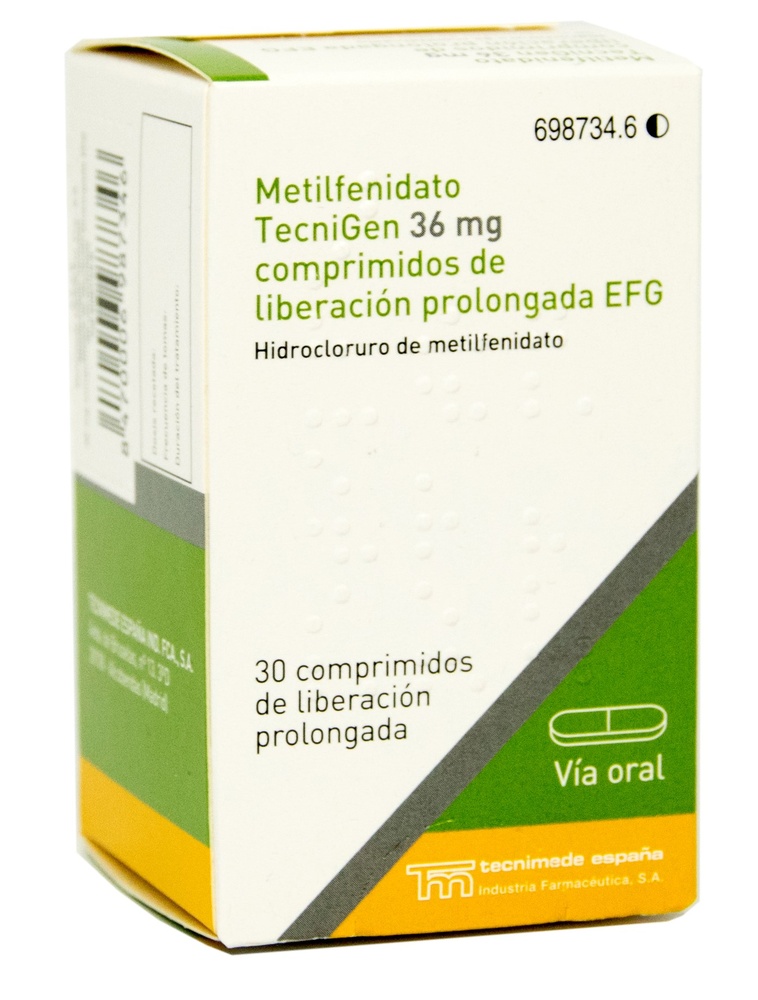
METILFENIDATO TECNIGEN 36 mg Comprimidos de liberación prolongada

Revisión de receta online
Un médico revisará tu caso y determinará si la prescripción es médicamente apropiada.

Habla con un médico sobre este medicamento
Comenta tus síntomas y las opciones de tratamiento en una consulta online.



Cómo usar METILFENIDATO TECNIGEN 36 MG COMPRIMIDOS DE LIBERACION PROLONGADA EFG
Contenido del prospecto
- Introducción
- Qué es Metilfenidato Tecnigen y para qué se utiliza
- Qué necesita saber antes de empezar a tomar Metilfenidato Tecnigen
- Cómo tomar Metilfenidato Tecnigen
- Posibles efectos adversos
- Conservación de Metilfenidato Tecnigen
- Contenido del envase e información adicional
Introducción
Prospecto: información para el usuario
Metilfenidato Tecnigen 36 mg comprimidos de liberación prolongada EFG
Hidrocloruro de metilfenidato
Lea todo el prospecto detenidamente antes de que usted o su hijo empiecen a tomar este medicamento, porque contiene información importante para usted.
- Conserve este prospecto, ya que puede tener que volver a leerlo.
- Si tiene alguna duda, consulte a su médico o farmacéutico.
- Este medicamento se le ha recetado solamente a usted o a su hijo, y no debe dárselo a otras personas aunque tengan los mismos síntomas de enfermedad que usted o su hijo, ya que puede perjudicarles.
- Si experimenta efectos adversos, consulte a su médico o farmacéutico, incluso si se trata de efectos adversos que no aparecen en este prospecto. Ver sección 4.
Contenido del prospecto
- Qué es Metilfenidato Tecnigen y para qué se utiliza.
- Qué necesita saber antes de que usted o su hijo tomen Metilfenidato Tecnigen.
- Cómo tomar Metilfenidato Tecnigen.
- Posibles efectos adversos.
- Conservación de Metilfenidato Tecnigen.
- Contenido del envase e información adicional.
1. Qué es Metilfenidato Tecnigen y para qué se utiliza
Para qué se utiliza
Metilfenidato Tecnigen se utiliza para tratar el trastorno por déficit de atención con hiperactividad (TDAH)
- se utiliza en niños y adolescentes de edades comprendidas entre 6 y 18 años,
- se utiliza solo tras haber probado antes tratamientos que no incluyan medicamentos, así como la terapia de comportamiento y asesoramiento.
Metilfenidato Tecnigen no está indicado en el tratamiento de TDAH en niños menores de 6 años o para el inicio del tratamiento en adultos.
Cuando el tratamiento se inicia a una corta edad, puede ser adecuado seguir tomando Metilfenidato Tecnigen hasta que sea adulto. Su médico le aconsejará sobre esto.
Cómo actúa
Metilfenidato Tecnigen mejora la actividad de ciertas partes del cerebro que se encuentran con baja actividad. El medicamento puede ayudar a mejorar la atención (nivel de atención), concentración y reducir el comportamiento impulsivo.
El medicamento se administra como parte de un programa integral de tratamiento, que normalmente incluye:
- terapia psicológica,
- terapia educativa y
- terapia social
y su objetivo es estabilizar a los niños con TDAH con síntomas que pueden incluir antecedentes crónicos de bajo grado de atención, distraibilidad, inestabilidad emocional, impulsividad, hiperactividad de moderada a grave, signos neurológicos leves y anomalías en la electroencefalografía (EEG). La capacidad de aprendizaje puede verse o no verse afectada. No se puede establecer el diagnóstico únicamente con la presencia de uno o más síntomas. Un diagnóstico adecuado requiere el uso de recursos médicos y psicológicos, educativos y sociales especializados.
Sólo se receta por médicos que tengan experiencia en problemas de comportamiento de niños o adolescentes.Aunque el TDAH no tiene cura, se puede controlar utilizando los programas integrales de tratamiento.
Acerca del TDAH
Los niños y adolescentes que presentan TDAH tienen dificultades para:
- quedarse quietos,
- concentrarse.
No es culpa de ellos el no poder hacer estas cosas.
Muchos niños y adolescentes luchan por hacerlas. Sin embargo, los pacientes con TDAH pueden presentar problemas en la vida cotidiana. Los niños y los adolescentes con TDAH pueden tener dificultades para aprender y para hacer los deberes. Tienen dificultad para comportarse bien en casa, en el colegio o en otros lugares.
El TDAH no afecta a la inteligencia del niño ni del adolescente.
El tratamiento con metilfenidato no está indicado en todos los niños con TDAH y la decisión de utilizar el medicamento debe basarse en una evaluación muy completa de la gravedad y cronicidad de los síntomas del niño en relación con su edad. El metilfenidato siempre debe utilizarse conforme a su indicación autorizada y de acuerdo con las directrices de prescripción y diagnóstico.

¿No estás seguro de si este medicamento es adecuado para ti?
Comenta tus síntomas y tratamiento con un médico online.
2. Qué necesita saber antes de empezar a tomar Metilfenidato Tecnigen
No tome Metilfenidato Tecnigen si usted o su hijo:
- son alérgicos a metilfenidato o a cualquiera de los demás componentes de este medicamento (ver sección 6),
- tienen un problema de tiroides,
- tienen glaucoma (tensión ocular elevada),
- tienen feocromocitoma (un tumor en las glándulas suprarrenales),
- tienen un trastorno de la alimentación, no tienen hambre o no quieren comer, como en la “anorexia nerviosa”,
- tienen la tensión arterial muy alta o un estrechamiento de los vasos sanguíneos, que puede causar dolor en los brazos y las piernas,
- han tenido alguna vez problemas de corazón como un infarto, irregularidad de los latidos del corazón, dolor y molestias en el pecho, insuficiencia cardíaca, enfermedad cardíaca o un problema cardíaco de nacimiento,
- han tenido un problema en los vasos sanguíneos del cerebro como un derrame cerebral, dilatación o debilidad de parte de un vaso sanguíneo (aneurisma), estrechamiento o bloqueo de los vasos sanguíneos o inflamación de los vasos sanguíneos (vasculitis),
- están tomando o han tomado en los últimos 14 días algún antidepresivo (conocido como inhibidor de la monoaminooxidasa) (ver la sección “Toma de Metilfenidato Tecnigen con otros medicamentos”),
- tienen problemas de salud mental como:
- un trastorno psicopático o un trastorno límite de la personalidad,
- pensamientos o visiones anormales o una enfermedad llamada “esquizofrenia”,
- signos de un trastorno del estado de ánimo grave como:
- sentimiento suicida,
- depresión grave, sintiéndose muy triste, despreciado y desesperado,
- manía, sintiéndose excepcionalmente exaltado, más activo de lo normal y desinhibido,
- diagnóstico o antecedentes de trastorno bipolar (afectivo) grave y episódico (tipo I).
No tome metilfenidato si usted o su hijo presentan algo de lo indicado arriba. Si no está seguro, informe a su médico o farmacéutico antes de que usted o su hijo tomen metilfenidato, debido a que el metilfenidato puede empeorar estos problemas.
Advertencias y precauciones
Consulte a su médico o farmacéutico antes de empezar a tomar Metilfenidato Tecnigen si usted o su hijo:
- tienen problemas de hígado o de riñón,
- tienen problemas para tragar o al tragar los comprimidos enteros,
- tienen un estrechamiento o un bloqueo en el aparato digestivo,
- han tenido crisis (ataques, convulsiones, epilepsia) o cualquier alteración en el electroencefalograma (EEG/un estudio del cerebro),
- han abusado alguna vez o han sido dependientes del alcohol, medicamentos con receta médica o drogas,
- es una mujer y ha empezado a tener el periodo (ver más abajo la sección de “Embarazo y lactancia”),
- tienen dificultad para controlar, movimientos repetidos de algunas partes del cuerpo (tics) o sonidos y palabras repetidas,
- tiene la tensión arterial alta,
- tiene un problema de corazón no incluido en la sección anterior “No tome Metilfenidato Tecnigen si usted o su hijo...”,
- tiene un problema de salud mental no incluido en la sección anterior “No tome Metilfenidato Tecnigen si usted o su hijo...”.
Otros problemas de salud mental incluyen:
- cambios del estado de ánimo (de ser maníaco a estar depresivo, lo que se conoce como “trastorno bipolar”),
- experimentar un comportamiento agresivo u hostil, o que la agresividad empeore,
- ver, oír o sentir cosas que no están allí (alucinaciones),
- creer cosas que no son reales (delirios),
- sentirse extrañamente desconfiado (paranoia),
- sentirse agitado, ansioso o tenso,
- sentirse deprimido o culpable.
Informe a su médico o farmacéutico si usted o su hijo presentan algo de lo indicado arriba antes de iniciar el tratamiento, debido a que metilfenidato puede empeorar estos problemas. Su médico querrá hacer un seguimiento de cómo los medicamentos le afectan a usted o a su hijo.
Controles que su médico hará antes de que usted o su hijo empiecen el tratamiento con metilfenidato:
Para poder decidir si metilfenidato es el medicamento idóneo para usted o su hijo, su médico hablará con ustedes de:
- los medicamentos que usted o su hijo estén tomando,
- si tienen antecedentes familiares de muerte súbita inexplicable,
- otras enfermedades que usted o su familia (como problemas de corazón) puedan sufrir,
- cómo se encuentran, si tienen altibajos, tienen pensamientos extraños o si han tenido sentimientos de este tipo en el pasado,
- si ha habido casos de tics en su familia (dificultad para controlar movimientos repetidos de algunas partes del cuerpo o sonidos y palabras repetidas),
- posibles problemas de comportamiento o de salud mental, que hayan tenido alguna vez usted o su hijo u otros familiares. Su médico les explicará concretamente si usted o su hijo corren el riesgo de sufrir cambios del estado de ánimo (de ser maníaco a estar depresivo, lo que se conoce como “trastorno bipolar”). Su médico comprobará los antecedentes de salud mental, suyo o de su hijo, y comprobará si algún familiar tiene antecedentes de suicidio, trastorno bipolar o depresión,
- determinar la altura, el peso, la frecuencia cardíaca y la tensión arterial, de usted o de su hijo, y anotar los resultados en una tabla.
Es importante que facilite toda la información que pueda. De esta manera ayudará a su médico a decidir si metilfenidato es el medicamento idóneo para usted o para su hijo. Es posible que su médico decida que usted o su hijo necesitan otras pruebas médicas antes de empezar a tomar este medicamento.
Toma de Metilfenidato Tecnigen con otros medicamentos
Comunique a su médico o farmacéutico que está tomando, ha tomado recientemente o podría tener que tomar cualquier otro medicamento.
No tome metilfenidato si usted o su hijo:
- están tomando un medicamento llamado “inhibidor de la monoaminooxidasa” (IMAO) que se usa para la depresión o han tomado un IMAO en los últimos 14 días. El uso de un IMAO con metilfenidato puede provocar un aumento repentino de la tensión arterial.
Si usted o su hijo están tomando otros medicamentos, metilfenidato puede afectar al mecanismo de acción de dichos medicamentos o causar efectos adversos. Si usted o su hijo están tomando alguno de los medicamentos siguientes, consúltelo con su médico o farmacéutico antes de tomar metilfenidato:
- otros medicamentos para la depresión,
- medicamentos para los problemas de salud mental graves,
- medicamentos para la epilepsia,
- medicamentos usados para disminuir o aumentar la tensión arterial,
- algunos remedios contra la tos y el resfriado que contienen medicamentos que pueden afectar a la tensión arterial. Es importante que consulte a su farmacéutico cuando adquiera alguno de estos medicamentos,
- medicamentos que diluyen la sangre para evitar que se formen coágulos.
Si tiene alguna duda sobre si alguno de los medicamentos que usted o su hijo están tomando están incluidos en la lista anterior, consulte a su médico o farmacéutico para que le aconsejen antes de tomar metilfenidato.
Ante una operación
Informe a su médico si usted o su hijo van a someterse a una operación. No se debe tomar metilfenidato el día de la operación con determinados tipos de anestésicos, debido a que se puede producir un aumento repentino de la tensión arterial durante la intervención.
Uso en deportistas
Se debe advertir a los pacientes que este medicamento contiene metilfenidato, que puede producir un resultado positivo en las pruebas de control del dopaje
Toma de Metilfenidato Tecnigen con alcohol
No beba alcohol mientras toma este medicamento. El alcohol puede agravar los efectos adversos de este medicamento. Recuerde que algunos alimentos y medicamentos contienen alcohol.
Embarazo y lactancia
Si está embarazada o en periodo de lactancia, cree que podría estar embarazada o tiene intención de quedarse embarazada, consulte a su médico antes de utilizar este medicamento.
Los datos disponibles no sugieren un aumento del riesgo de anomalías congénitas totales, aunque no se pudo descartar un pequeño aumento del riesgo de malformaciones cardiacas durante su uso en los tres primeros meses de embarazo. Su médico le dará más información sobre este riesgo.
. Consulte a su médico o farmacéutico antes de utilizar metilfenidato si usted o su hija:
- tienen relaciones sexuales. Su médico le hablará de los métodos anticonceptivos,
- está embarazada o cree que puede estarlo. Su médico decidirá si debe usar metilfenidato,
- está dando el pecho o tiene previsto dar el pecho. Es posible que metilfenidato pase a la leche materna. Por tanto, su médico decidirá si usted o su hija deben dar el pecho mientras usan metilfenidato.
Conducción y uso de máquinas
Usted o su hijo pueden tener mareos, problemas para enfocar o visión borrosa cuando toman metilfenidato. Si esto ocurre, puede ser peligroso realizar ciertas actividades como conducir, manejar máquinas, montar en bicicleta o a caballo o trepar a los árboles.
Metilfenidato Tecnigen contiene sacarosa
Este medicamento contiene sacarosa. Si su médico le ha indicado que padece una intolerancia a ciertos azúcares, consulte con él antes de tomar este medicamento.
Este medicamento contiene menos de 23 mg de sodio (1mmol) por comprimido; esto es, esencialmente “exento de sodio”.
3. Cómo tomar Metilfenidato Tecnigen
Antes de que usted o su hijo inicien el tratamiento, su médico le realizará varios controles en cada cambio de dosis, después cada seis meses o en cada visita, para asegurarse de que Metilfenidato Tecnigen continua siendo seguro y beneficioso. Estos incluirán:
- Medición y registro en un gráfico de la presión sanguínea y de la frecuencia cardíaca, cada vez que su dosis o la de su hijo cambien y al menos cada seis meses o en cada visita.
- Medición de la altura, peso y apetito, registrándolos en una gráfica, cada vez que su dosis o la de su hijo cambien y al menos cada seis meses o en cada visita.
- Evaluación de los problemas psiquiátricos, cada vez que su dosis o la de su hijo cambien y al menos cada seis meses o en cada visita.
Ajuste de la dosis
Es necesario ajustar la dosis cuidadosamente al comenzar el tratamiento con metilfenidato. El ajuste de la dosis se debe iniciar con la dosis más baja posible.
Cuánto tomar
Siga exactamente las instrucciones de administración de este medicamento indicadas por su médico. En caso de duda, consulte de nuevo a su médico o farmacéutico.
- Su médico normalmente iniciará el tratamiento con una dosis baja y la irá aumentando gradualmente según lo requiera.
- La dosis máxima diaria es de 54 miligramos.
- Usted o su hijo deben tomar Metilfenidato Tecnigen una vez al día por la mañana con un vaso de agua. El comprimido se debe tragar entero y no masticar o triturar.El comprimido se puede tomar con o sin comida.
Si usted o su hijo no se encuentran mejor después de un 1 mes de tratamiento
Si usted o su hijo no se encuentran mejor, informen a su médico. Él puede decidir si se necesita un tratamiento diferente. Comunique a su médico si usted o su hijo no notan mejoría después de 1 mes de tratamiento con Metilfenidato Tecnigen.
Tratamiento a largo plazo
El tratamiento con Metilfenidato Tecnigen no necesita ser indefinido. Si Metilfenidato Tecnigen se toma durante más de un año, su médico debe interrumpir su tratamiento o el de su hijo durante un corto periodo de tiempo una vez al año, para comprobar si se sigue necesitando el medicamento. Usted o su hijo pueden continuar observando un beneficio cuando el tratamiento con Metilfenidato se interrumpe temporal o permanentemente. Esto puede suceder durante las vacaciones escolares.
Los pacientes en tratamiento a largo plazo (por ejemplo, 12 meses) deben monitorizarse cuidadosamente, especialmente en cuanto a su estado cardiovascular, crecimiento, apetito, desarrollo de nuevos síntomas psiquiátricos o empeoramiento de los pre-existentes.
Uso inadecuado de Metilfenidato Tecnigen
Debe controlar a su hijo en cuanto al riesgo de desvío al tráfico ilícito, mal uso o abuso de metilfenidato. El abuso continuado de metilfenidato puede provocar tolerancia marcada, dependencia psicológica, comportamiento anormal y episodios psicóticos.
Informe a su médico si usted o su hijo han abusado o han sido alguna vez dependientes del alcohol, medicamentos con receta médica o drogas.
Este medicamento es sólo para usted o para su hijo. No dé este medicamento a nadie más, incluso si presenta síntomas similares.
Si usted o su hijo toman más Metilfenidato Tecnigen del que debiera
En caso de sobredosis o ingestión accidental, consulte inmediatamente a su médico o farmacéutico o llame al Servicio de Información Toxicológica (teléfono 915620420), indicando el medicamento y la cantidad tomada.
Los signos de sobredosis pueden incluir: estar enfermo, agitación, temblores, aumento de los movimientos no controlados, contracciones musculares, ataques (pueden estar seguidos de coma), sensación de mucha felicidad, confusión, alucinaciones (ver, sentir u oír cosas que no son reales), sudor, rubor, dolor de cabeza, fiebre alta, cambios en los latidos del corazón (lentos, rápidos o irregulares), tensión arterial alta, pupilas dilatadas y sequedad de nariz y boca.
Si usted o su hijo olvidan tomar Metilfenidato Tecnigen
No tome una dosis doble para compensar las dosis olvidadas. Si usted o su hijo olvidan una dosis, esperen a tomar la siguiente dosis a la hora prevista.
Si usted o su hijo interrumpen el tratamiento con Metilfenidato Tecnigen
Este medicamento no se debe dejar de tomar de forma repentina. Si usted o su hijo dejan de tomar este medicamento de forma repentina, pueden reaparecer los síntomas de TDAH o efectos no deseados como la depresión. Su médico puede que quiera disminuir gradualmente la cantidad de medicamento que toma cada día, antes de interrumpirlo completamente. Consulte a su médico antes de interrumpir el tratamiento con Metilfenidato Tecnigen.
Si tiene cualquier otra duda sobre el uso de este medicamento, pregunte a su médico o farmacéutico.

¿Has empezado a tomar el medicamento y tienes preguntas?
Comenta tus síntomas y tratamiento con un médico online.
4. Posibles efectos adversos
Al igual que todos los medicamentos, este medicamento puede producir efectos adversos, aunque no todas las personas los sufran. Aunque algunas personas presenten efectos adversos, a la mayoría de la gente metilfenidato les ayuda. Su médico le informará sobre estos efectos adversos.
Algunos efectos adversos pueden ser graves. Si usted o su hijo tienen algunos de los efectos adversos indicados a continuación, acudan inmediatamente a su médico:
Frecuentes (puede afectar hasta 1 de cada 10 pacientes)
- latidos del corazón irregulares (palpitaciones),
- cambios o alteraciones del estado de ánimo o cambios de humor o cambios de personalidad.
Poco frecuentes (puede afectar hasta 1 de cada 100 pacientes)
- pensamientos o sentimientos suicidas,
- ver, sentir u oír cosas que no son reales (alucinaciones); estos son síntomas de psicosis,
- habla y movimientos del cuerpo descontrolados (síndrome de Tourette),
- signos de alergia como sarpullido, picor o urticaria en la piel, hinchazón de la cara, labios, lengua u otras partes del cuerpo, respiración entrecortada, ruidos respiratorios, dificultad o problemas para respirar.
Raros (puede afectar hasta 1 de cada 1.000 pacientes)
- sentirse excepcionalmente exaltado, más activo de lo normal y desinhibido (manía)
Muy raros (puede afectar hasta 1 de cada 10.000 pacientes)
- infarto,
- muerte súbita,
- intención de suicidio,
- crisis (ataques, convulsiones, epilepsia),
- descamación de la piel o manchas rojas purpurinas,
- inflamación o bloqueo de las arterias en el cerebro,
- espasmos musculares incontrolados, que afectan a los ojos, la cabeza, el cuello, el cuerpo y el sistema nervioso como consecuencia de la falta de circulación sanguínea al cerebro,
- disminución del número de células sanguíneas (glóbulos rojos, glóbulos blancos y plaquetas) que puede causar mayor riesgo de coger infecciones, y provocar más fácilmente sangrado y moratones,
- aumento repentino de la temperatura corporal, tensión arterial muy alta y convulsiones graves (“Síndrome Neuroléptico Maligno”). No es totalmente seguro que este efecto adverso sea causado por metilfenidato u otros medicamentos tomados en combinación con metilfenidato.
Frecuencia no conocida (la frecuencia no puede estimarse a partir de los datos disponibles)
- pensamientos no deseados que reaparecen,
- desvanecimiento inexplicado, dolor en el pecho, respiración entrecortada (pueden ser signos de problemas cardíacos),
- parálisis o problemas con el movimiento y la vista, dificultades en el habla (pueden ser signos de problemas de los vasos sanguíneos en su cerebro).
Si usted o su hijo tienen alguno de los efectos adversos indicados anteriormente, acudan a su médico inmediatamente.
Se indican a continuación otros efectos adversos; y si llegan a ser graves, por favor informe a su médico o farmacéutico:
Muy frecuentes (puede afectar a más de 1 de cada 10 pacientes)
- dolor de cabeza,
- sensación de nerviosismo,
- dificultad para dormir.
Frecuentes (puede afectar hasta 1 de cada 10 pacientes)
- dolor de las articulaciones,
- visión borrosa,
- dolor de cabeza por tensión muscular,
- sequedad de boca, sed,
- problemas para quedarse dormido,
- temperatura alta (fiebre),
- disminución del interés sexual,
- pérdida de pelo fuera de lo normal o disminución del grosor del mismo (pelo más fino),
- tensión muscular, calambres musculares,
- pérdida del apetito o disminución del apetito,
- incapacidad para tener o mantener una erección,
- picor, erupción o erupciones rojizas que pican (ronchas),
- somnolencia o adormecimiento fuera de lo normal, sentirse cansado,
- apretar o rechinar los dientes, sensación de pánico,
- sensación de hormigueo, picor o entumecimiento de la piel,
- aumento de los niveles de alanina aminotransferasa en sangre (enzima del hígado),
- tos, garganta dolorida e irritación de garganta o nariz; infección de la parte alta del aparato respiratorio, sinusitis,
- tensión arterial elevada, latido rápido del corazón (taquicardia),
- mareos (vértigo), sensación de debilidad, movimientos descontrolados, actividad fuera de lo normal,
- agresividad, agitación, ansiedad, depresión, irritabilidad, tensión, nerviosismo y comportamiento anormal,
- malestar de estómago o indigestión, dolor de estómago, diarrea, sentirse mareado, molestias en el estómago y vómitos.
- rechinar de dientes excesivo (bruxismo)
- sudoración excesiva
Poco frecuentes (puede afectar hasta 1 de cada 100pacientes)
- sequedad de ojos,
- estreñimiento,
- molestias en el pecho,
- sangre en la orina,
- apatía,
- agitación o temblor,
- dolor muscular, sacudidas musculares,
- respiración entrecortada o dolor en el pecho,
- sensación de calor,
- aumento de los resultados de los análisis hepáticos (se ve en un análisis de sangre),
- reacción de ira (enfadado), inquieto o lloroso, excesiva consciencia del entorno, problemas para dormir.
Raras (puede afectar hasta 1 de cada 1.000 pacientes)
- sentirse desorientado o confundido,
- problemas de la vista o visión doble,
- hinchazón del pecho en los hombres,
- enrojecimiento de la piel, aumento del enrojecimiento de los sarpullidos de la piel.
Muy raras (puede afectar hasta 1 de cada 10.000 pacientes)
- calambres musculares,
- pequeñas manchas rojas en la piel,
- función hepática anormal incluyendo insuficiencia hepática y coma,
- cambios en los resultados de los análisis; incluyendo los análisis hepáticos y de sangre,
- pensamientos anormal, ausencia de sentimientos o emoción, hacer las cosas una y otra vez, obsesión con algo,
- dedos de los pies y de las manos entumecidas, hormigueo y cambio de color con el frío (de blanco a azul, luego rojo) (“fenómeno de Raynaud”).
Frecuencia no conocida (su frecuencia no puede estimarse a partir de los datos disponibles)
- migraña,
- pupilas dilatadas,
- fiebre muy alta,
- latidos lentos del corazón, rápidos o palpitaciones,
- crisis epiléptica mayor (“convulsiones de tipo gran mal”),
- creer cosas que no son verdad,
- dolor grave de estómago, con sensación de malestar y vómitos.
- incapacidad de controlar la eliminación de orina (incontinencia)
- espasmo de los músculos de la mandíbula que dificulta la apertura de la boca (trismus)
- tartamudez
- Sangrado de nariz
Efectos en el crecimiento
Cuando se usa durante más de un año, metilfenidato puede reducir el crecimiento en algunos niños. Esto afecta a menos de 1 de cada 10 niños
- puede impedir el aumento de peso o de estatura,
- su médico comprobará cuidadosamente la estatura y el peso de usted o de su hijo, así como la alimentación,
- si usted o su hijo no crecen tanto como se esperaba, entonces se puede interrumpir el tratamiento con metilfenidato durante un corto período de tiempo.
Comunicación de efectos adversos
Si experimenta cualquier tipo de efecto adverso, consulte a su médico o farmacéutico, incluso si se trata de posibles efectos adversos que no aparecen en este prospecto. También puede comunicarlos directamente a través del sistema nacional de notificación: Sistema Español de Farmacovigilancia de Medicamentos de Uso Humano. Website: www.notificaRAM.es .
Mediante la comunicación de efectos adversos usted puede contribuir a proporcionar más información sobre la seguridad de este medicamento.
5. Conservación de Metilfenidato Tecnigen
Mantener este medicamento fuera de la vista y del alcance de los niños.
No utilice este medicamento después de la fecha de caducidad (CAD) que aparece en el envase. La fecha de caducidad es el último día del mes que se indica.
Este medicamento no requiere condiciones especiales de conservación.
No utilice este medicamento si observa que el comprimido está dañado.
Los medicamentos no se deben tirar por los desagües ni a la basura. Deposite los envases y los medicamentos que no necesita en el Punto SIGRE de la farmacia. En caso de duda pregunte a su farmacéutico cómo deshacerse de los envases y de los medicamentos que no necesita. De esta forma, ayudará a proteger el medio ambiente.
6. Contenido del envase e información adicional
Composición de Metilfenidato Tecnigen
- El principio activo es hidrocloruro de metilfenidato. Cada comprimido de liberación prolongada contiene 36 mg de hidrocloruro metilfenidato equivalente a 31,13 mg de metilfenidato.
- Los demás componentes son:
Núcleo del comprimido:Esferas de azúcar (sacarosa, almidón de maíz), hipromelosa, talco, etilcelulosa, hidroxipropilcelulosa, citrato de trietilo, succinato acetato de hipromelosa, carmelosa de sodio, celulosa microcristalina, estearato de magnesio, sílice coloidal anhidra, ácido hidroclórico.
Recubrimiento del comprimido:Opadry II blanco consistente en: alcohol polivinílico, talco, dióxido de titanio (E171), macrogol 3350.
Aspecto del producto y contenido del envase
Metilfenidato Tecnigen 36 mg son comprimidos oblongos, biconvexos, de color blanco a blanquecino de 11,3 x 5,3 mm con ranuras en ambos lados. El comprimido se puede dividir en dosis iguales.
Los comprimidos de liberación prolongada están disponibles en frascos con tapa de rosca a prueba de niños.
Tamaños de envase:
Frascos que contienen 28 ó 30 comprimidos de liberación prolongada.
Puede que solamente estén comercializados algunos tamaños de envase.
Titular de la autorización de comercialización y responsable de la fabricación
Titular de la autorización:
Tecnimede España Industria Farmaceutica, S.A.
Avda. de Bruselas, 13, 3º D.Edificio América. Polígono Arroyo de la Vega,
28108– Alcobendas (Madrid)
España
Responsable de la fabricación:
Develco Pharma GmbH
Grienmatt 42
79650 Schopfheim
Alemania
Fecha de la última revisión de este prospecto: Septiembre 2022
La información detallada y actualizada de este medicamento está disponible en la página Web de la Agencia Española de Medicamentos y Productos Sanitarios (AEMPS) http: //www.aemps.gob.es/
- País de registro
- Forma farmacéuticaCOMPRIMIDO LIBERACION MODIFICADA, 36 mg
- Código ATCN06BA04
- Precio medio en farmacia20.01 EUR
- Principio activo
- Requiere recetaSí
- Fabricante
- ComposiciónAZUCAR , ESFERAS DE (24.60 mg mg), ALCOHOL ETILICO (ETANOL) (187.00 mg mg), CARMELOSA SODICA (78.00 mg mg)
- Esta información es de carácter general y no sustituye la consulta con un profesional sanitario.
- Alternativas a METILFENIDATO TECNIGEN 36 MG COMPRIMIDOS DE LIBERACION PROLONGADA EFGForma farmacéutica: COMPRIMIDO LIBERACION MODIFICADA, 18 mgPrincipio activo: methylphenidateFabricante: Exeltis Healthcare S.L.Requiere recetaForma farmacéutica: COMPRIMIDO LIBERACION MODIFICADA, 27 mgPrincipio activo: methylphenidateFabricante: Exeltis Healthcare S.L.Requiere recetaForma farmacéutica: COMPRIMIDO LIBERACION MODIFICADA, 36 mgPrincipio activo: methylphenidateFabricante: Exeltis Healthcare S.L.Requiere receta
Médicos online para METILFENIDATO TECNIGEN 36 MG COMPRIMIDOS DE LIBERACION PROLONGADA EFG
Comenta la dosis, los posibles efectos secundarios, interacciones, contraindicaciones o la revisión de receta de METILFENIDATO TECNIGEN 36 MG COMPRIMIDOS DE LIBERACION PROLONGADA EFG, sujeto a valoración médica y a la normativa local.









Obtén una receta de METILFENIDATO TECNIGEN 36 MG COMPRIMIDOS DE LIBERACION PROLONGADA EFG online
Rellena un formulario de 2 minutos
Cuéntanos tus síntomas, historial y el medicamento que necesitas.
Elige un médico o nosotros te asignamos uno
Escoge un especialista o te conectamos con el próximo médico disponible.
El médico revisa tu caso
Normalmente en 30 minutos. Puede hacerte preguntas adicionales por chat.
Recógela en cualquier farmacia
Receta electrónica enviada a tu correo, válida en toda España.
Preguntas frecuentes
METILFENIDATO TECNIGEN 36 MG COMPRIMIDOS DE LIBERACION PROLONGADA EFG requiere receta en España. Puedes confirmarlo con un médico online según tu caso.
El principio activo de METILFENIDATO TECNIGEN 36 MG COMPRIMIDOS DE LIBERACION PROLONGADA EFG es methylphenidate. Esta información ayuda a identificar medicamentos con la misma composición pero con diferentes nombres comerciales.
El precio medio en farmacia de METILFENIDATO TECNIGEN 36 MG COMPRIMIDOS DE LIBERACION PROLONGADA EFG es de aproximadamente 20.01 EUR. Puede variar según el fabricante y la forma farmacéutica.
METILFENIDATO TECNIGEN 36 MG COMPRIMIDOS DE LIBERACION PROLONGADA EFG es fabricado por Tecnimede España Industria Farmaceutica S.A.. La marca y el envase pueden variar según el distribuidor.
Los Médicos de familia, Psiquiatras, Dermatólogos, Cardiólogos, Endocrinólogos, Gastroenterólogos, Neumólogos, Nefrólogos, Reumatólogos, Hematólogos, Infectólogos, Alergólogos, Geriatras, Pediatras, Oncólogos pueden valorar la prescripción de METILFENIDATO TECNIGEN 36 MG COMPRIMIDOS DE LIBERACION PROLONGADA EFG cuando esté clínicamente indicado. Puedes reservar una videoconsulta para comentar tu caso y las opciones de tratamiento.
España cuenta con una infraestructura sanitaria bien desarrollada en ciudades principales como Madrid, Barcelona, Valencia y Sevilla. Las farmacias están ampliamente disponibles y operan bajo estrictas regulaciones, garantizando el acceso a medicamentos con receta.
Puedes comprar METILFENIDATO TECNIGEN 36 MG COMPRIMIDOS DE LIBERACION PROLONGADA EFG en Madrid, Barcelona, Sevilla o Valencia en cualquier farmacia local con una receta válida.
Para obtener una receta, puedes utilizar Oladoctor:
Otros medicamentos con el mismo principio activo (methylphenidate) incluyen ATENZA 18 MG COMPRIMIDOS DE LIBERACION PROLONGADA EFG, ATENZA 27 MG COMPRIMIDOS DE LIBERACION PROLONGADA EFG, ATENZA 36 MG COMPRIMIDOS DE LIBERACION PROLONGADA EFG. Pueden tener diferentes nombres comerciales o formulaciones, pero contienen el mismo componente terapéutico. Consulta siempre con un médico antes de cambiar o iniciar un nuevo medicamento.
