


Ledaga 160 microgramos/g gel

Revisión de receta online
Un médico revisará tu caso y determinará si la prescripción es médicamente apropiada.

Habla con un médico sobre este medicamento
Comenta tus síntomas y las opciones de tratamiento en una consulta online.



Cómo usar LEDAGA 160 MICROGRAMOS/G GEL
Contenido del prospecto
- Introducción
- Qué es Ledaga y para qué se utiliza
- Qué necesita saber antes de empezar a usar Ledaga
- Cómo usar Ledaga
- Posibles efectos adversos
- Conservación de Ledaga
- Contenido del envase e información adicional
Introducción
Prospecto: Información para el paciente
Ledaga 160 microgramos/g gel
clormetina
Lea todo el prospecto detenidamente antes de empezar a usar este medicamento, porque contiene información importante para usted.
- Conserve este prospecto, ya que puede tener que volver a leerlo.
- Si tiene alguna duda, consulte a su médico o farmacéutico.
- Este medicamento se le ha recetado solamente a usted, y no debe dárselo a otras personas aunque tengan los mismos síntomas, ya que puede perjudicarles.
- Si experimenta efectos adversos, consulte a su médico o farmacéutico, incluso si se trata de efectos adversos que no aparecen en este prospecto. Ver sección 4.
Contenido del prospecto
- Qué es Ledaga y para qué se utiliza
- Qué necesita saber antes de empezar a usar Ledaga
- Cómo usar Ledaga
- Posibles efectos adversos
- Conservación de Ledaga
- Contenido del envase e información adicional
1. Qué es Ledaga y para qué se utiliza
Ledaga contiene el principio activo clormetina. Se trata de un medicamento contra el cáncer, que se aplica sobre la piel para tratar el linfoma cutáneo de células T de tipo micosis fungoide (LCCT-MF).
El LCCT -MF es una enfermedad en la que determinadas células del sistema inmunitario del organismo, llamadas célulasT, se vuelven cancerosas y afectan a la piel. Clormetina es un tipo de medicamento contra el cáncer denominado «agente alquilante». Este medicamento impide la multiplicación y proliferación de las células que se están dividiendo (como las células del cáncer), uniéndose al ADN.
El uso de Ledaga solo está indicado en adultos.

¿No estás seguro de si este medicamento es adecuado para ti?
Comenta tus síntomas y tratamiento con un médico online.
2. Qué necesita saber antes de empezar a usar Ledaga
No use Ledaga
- Si es alérgico (hipersensible) a clormetina o a alguno de los demás componentes de este medicamento (incluidos en la sección 6).
Advertencias y precauciones
Consulte a su médico o farmacéutico antes de empezar a usar Ledaga.
- Se debe evitar el contacto con los ojos. No se aplique el medicamento cerca de los ojos, en los labios, ni dentro de los orificios nasales o de los oídos.
- Al contacto con los ojos, Ledaga puede provocar dolor, quemazón, hinchazón, enrojecimiento, sensibilidad a la luz y visión borrosa. También ceguera y lesiones oculares graves y permanentes. En caso de contacto de Ledaga con los ojos, láveselos inmediatamente durante un mínimo de 15 minutos con gran cantidad de agua, con una «solución de cloruro sódico al 0,9 %» o con una solución oftálmica, y solicite asistencia médica (incluida la consulta con un oftalmólogo) lo antes posible.
- Si el medicamento entra en contacto con la boca o la nariz puede provocar dolor, enrojecimiento y úlceras que podrían ser graves. Lávese inmediatamente la zona afectada durante un mínimo de 15 minutos con gran cantidad de agua, y solicite asistencia médica lo antes posible.
- Este medicamento puede causar reacciones cutáneas, como inflamación (enrojecimiento e hinchazón), picor, ampollas, úlceras e infecciones (ver sección 4). El riesgo de inflamación de la piel aumenta cuando Ledaga se aplica en la cara, el área genital, el ano o los pliegues cutáneos.
- Informe a su médico si alguna vez ha tenido una reacción alérgica a clormetina. Consulte a su médico o solicite atención médica de urgencias si sufre reacciones alérgicas a Ledaga (ver sección 4).
- Se han comunicado casos de cáncer de piel (crecimiento anormal de las células de la piel) después de la aplicación cutánea de clormetina, aunque se desconoce si este medicamento fue la causa. Su médico le examinará la piel para detectar un posible cáncer durante y tras el tratamiento con Ledaga. Informe a su médico si detecta nuevas zonas dañadas o úlceras en la piel.
- Toda persona (por ejemplo, el cuidador) a excepción del paciente debe evitar el contacto de la piel con Ledaga. Los riesgos del contacto directo con la piel son inflamación (dermatitis), lesiones en los ojos, la boca o la nariz y cáncer de piel. Los cuidadores que accidentalmente se expongan a Ledaga deben lavarse la zona afectada de inmediato durante un mínimo de 15 minutos. Quitarse toda la ropa contaminada y lavarla. Obtenga atención médica de inmediato si Ledaga entra en contacto con los ojos, la boca o la nariz.
Niños y adolescentes
No administre este medicamento a niños y adolescentes menores de 18 años ya que no se ha establecido su seguridad y eficacia en este grupo de edad.
Otros medicamentos y Ledaga
Informe a su médico o farmacéutico si está utilizando, ha utilizado recientemente o pudiera tener que utilizar cualquier otro medicamento.
Embarazo y lactancia
Si está embarazada o en periodo de lactancia, cree que podría estar embarazada o tiene intención de quedarse embarazada, consulte a su médico antes de utilizar este medicamento.
No hay datos o estos son limitados relativos al uso de clormetina en mujeres embarazadas. Por tanto, no se recomienda utilizar Ledaga durante el embarazo, ni en mujeres en edad fértil que no estén utilizando métodos anticonceptivos.
Se desconoce si Ledaga pasa a la leche materna y existe el riesgo de que el lactante esté expuesto a Ledaga a través del contacto con la piel de la madre. Por tanto, no está recomendada la lactancia durante el uso de este medicamento. Debe hablar con su médico antes de comenzar la lactancia para decidir si es mejor comenzarla o utilizar Ledaga.
Conducción y uso de máquinas
No se espera que este medicamento tenga ningún efecto sobre su capacidad para conducir y utilizar máquinas.
Ledaga contiene propilenglicol y butilhidroxitolueno
El propilenglicol puede provocar irritación en la piel. El butilhidroxitolueno puede provocar reacciones locales en la piel (como dermatitis de contacto) o irritación de los ojos y membranas mucosas.
3. Cómo usar Ledaga
Siga exactamente las instrucciones de administración de este medicamento indicadas por su médico o farmacéutico. En caso de duda, consulte a su médico o farmacéutico.
Ledaga solo está indicado para utilizarlo sobre la piel.
La dosis recomendada es la aplicación de una fina capa una vez al día en las zonas afectadas. La dosis es la misma para los pacientes de edad avanzada (de 65 años en adelante) que para los adultos de menor edad (de 18 años en adelante).
Es posible que el médico interrumpa su tratamiento si presentase una inflamación grave de la piel (enrojecimiento e hinchazón), ampollas y úlceras. Una vez que mejoren los síntomas, su médico podría indicarle que reanude el tratamiento.
Instrucciones de uso:
- Siga exactamente las instrucciones de administración de Ledaga indicadas por su médico o farmacéutico.
- Los cuidadores deben usar guantes desechables de nitrilo (un tipo especial de guantes; en caso de duda, consulte a su médico o farmacéutico) para aplicar este medicamento a los pacientes.
- Quítele el tapón al tubo justo antes de utilizarlo. Perfore el precinto con el tapón.
- Aplique Ledaga justo después de sacarlo de la nevera o en los 30 minutos posteriores.
- Aplique una fina capa del medicamento en la piel completamente seca, como mínimo 4 horas antes o 30 minutos después de ducharse o lavarse.
- Aplique Ledaga en las zonas de la piel afectadas. En caso que Ledaga entre en contacto con zonas de la piel no afectadas, los pacientes deben lavar las zonas expuestas con agua y jabón.
- Deje secar la zona de 5 a 10 minutos tras aplicar el medicamento antes de cubrirla con ropa.
- Si es el paciente el que se aplica el gel, lávese las manos con agua y jabón inmediatamente después de la aplicación.
- Si es el cuidador el que aplica el gel, quítese los guantes con cuidado (dándoles la vuelta a la hora de extraerlos para evitar el contacto con Ledaga) y después, lávese bien las manos con agua y jabón.
- Ledaga es suministrado con una bolsa de plástico, transparente con cierre y a prueba de niños. Si no es así, consulte con su farmacéutico.
- Con las manos limpias, vuelva a colocar Ledaga en su caja original y esta, en la bolsa de plástico. Vuelva a meter el medicamento en la nevera después de cada uso.
- No se debe cubrir la zona tratada con vendajes herméticos al agua ni al aire después de haber aplicado este medicamento.
- Hasta que Ledaga se haya secado sobre la piel, evite aproximarse a llamas directas o cigarrillos encendidos. Ledaga contiene alcohol y, por tanto, se considera inflamable.
- No se aplique cremas hidratantes ni ningún otro producto sobre la piel (ni siquiera medicamentos) en las 2 horas previas ni en las 2 horas posteriores a la aplicación diaria de Ledaga.
- Mantenga Ledaga fuera del alcance de los niños y del contacto con alimentos, guardándolo en la caja dentro de la bolsa de plástico.
Si usa más Ledaga del que debe
No se aplique Ledaga más de una vez al día. Si se aplica más cantidad de la recomendada, consulte a su médico.
Si olvidó usar Ledaga
No utilice una dosis doble para compensar las dosis olvidadas. Aplíquese la siguiente dosis cuando le corresponda.
Si interrumpe el tratamiento con Ledaga
Su médico determinará cuánto tiempo debe utilizar Ledaga y cuándo se puede interrumpir el tratamiento. No debe interrumpir el tratamiento con este medicamento a menos que se lo indique su médico.
Si tiene cualquier otra duda sobre el uso de este medicamento, pregunte a su médico o farmacéutico.

¿Has empezado a tomar el medicamento y tienes preguntas?
Comenta tus síntomas y tratamiento con un médico online.
4. Posibles efectos adversos
Al igual que todos los medicamentos, este medicamento puede producir efectos adversos, aunque no todas las personas los sufran.
DEJE de utilizar Ledaga e informe a su médico inmediatamentesi padece una reacción alérgica (de hipersensibilidad)
Una reacción alérgica puede cursar con todos o algunos de los siguientes síntomas:
- Hinchazón de los labios, la cara, la garganta o la lengua.
- Erupción cutánea.
- Dificultad para respirar.
Otros efectos adversos son los siguientes:
Informe a su médico lo antes posible si padece alguno de los siguientes efectos
adversos:
Efectos adversos muy frecuentesen la zona tratada (pueden afectar a más de 1 de cada 10 pacientes):
- Inflamación de la piel
- Infecciones cutáneas
- Picor (prurito)
Efectos adversos frecuentesen la zona tratada (pueden afectar hasta 1 de cada 10 pacientes):
- Úlceras en la piel
- Ampollas
- Oscurecimiento de la piel
Comunicación de efectos adversos
Si experimenta cualquier tipo de efecto adverso, consulte a su médico o, farmacéutico, incluso si se trata de posibles efectos adversos que no aparecen en este prospecto.También puede comunicarlos directamente a través del Sistema Español de Farmacovigilancia de Medicamentos de Uso Humano: https://www.notificaRAM.es. Mediante la comunicación de efectos adversos usted puede contribuir a proporcionar más información sobre la seguridad de este medicamento.
5. Conservación de Ledaga
Mantener este medicamento fuera de la vista y del alcance de los niños.
No utilice este medicamento después de la fecha de caducidad que aparece en la etiqueta del tubo y en la caja después de CAD. La fecha de caducidad es el último día del mes que se indica.
Conservar en nevera (entre 2 °C y 8 °C) en todo momento, asegurando que el tubo está en la caja dentro de la bolsa de plástico transparente con cierre y a prueba de niños.
No utilice el tubo de Ledaga, esté abierto o sin abrir, si han pasado más de 60 días de conservación en la nevera.
Pregunte a su farmacéutico cómo deshacerse de los guantes de nitrilo, de la bolsa de plástico y de los medicamentos que ya no necesita. Los medicamentos no se deben tirar por los desagües ni a la basura. De esta forma, ayudará a proteger el medio ambiente.
6. Contenido del envase e información adicional
Composición de Ledaga
- El principio activo es clormetina. Cada gramo de gel contiene 160 microgramos de clormetina.
- Los demás componentes son: dietilenglicol monoetiléter, propilenglicol (E 1520), alcohol isopropílico, glicerol (E 422), ácido láctico (E 270), hidroxipropilcelulosa (E 463), cloruro de sodio, mentol racémico, edetato disódico y butilhidroxitolueno (E 321).
Ver el final de la sección 2 para más información sobre el propilenglicol y el butilhidroxitolueno.
Aspecto del producto y contenido del envase
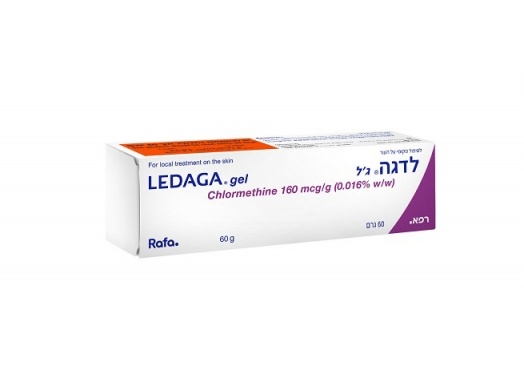
Ledaga es un gel transparente incoloro.
Cada tubo de aluminio contiene 60 gramos de gel y tiene un tapón de rosca de color blanco.
Titular de la autorización de comercialización y responsable de la fabricación:
Helsinn Birex Pharmaceuticals Ltd.
Damastown
Mulhuddart
Dublin 15
Irlanda
Pueden solicitar más información respecto a este medicamento dirigiéndose al representante local del titular de la autorización de comercialización
België/Belgique/Belgien Recordati Tél/Tel: +32 2 46101 36 | Lietuva Recordati AB. Tel: + 46 8 545 80 230 Švedija |
| Luxembourg/Luxemburg Recordati Tél/Tel: +32 2 46101 36 Belgique/Belgien |
Ceská republika Recordati Rare Diseases Tel: +33 (0)1 47 73 64 58 Francie | Magyarország Recordati Rare Diseases Tel: +33 (0)1 47 73 64 58 Franciaország |
Danmark Recordati AB. Tlf: + 46 8 545 80 230 Sverige | Malta Recordati Rare Diseases Tel: +33 1 47 73 64 58 Franza |
Deutschland Recordati Rare Diseases Germany GmbH Tel: +49 731 140 554 0 | Nederland Recordati Tel: +32 2 46101 36 België |
Eesti Recordati AB. Tel: + 46 8 545 80 230 Rootsi | Norge Recordati AB. Tlf: + 46 8 545 80 230 Sverige |
Ελλ?δα Recordati Hellas Τηλ: +30 210 6773822 | Österreich Recordati Rare Diseases Germany GmbH Tel: +49 731 140 554 0 Deutschland |
España Recordati Rare Diseases Spain S.L.U. Tel: + 34 91 659 28 90 France Recordati Rare Diseases Tél: +33 (0)1 47 73 64 58 Hrvatska Recordati Rare Diseases Tél: +33 (0)1 47 73 64 58 Francuska Ireland Recordati Rare Diseases Tél: +33 (0)1 47 73 64 58 France Ísland Recordati AB. Simi: + 46 8 545 80 230 Svíþjóð Italia Recordati Rare Diseases Italy Srl Tel: +39 02 487 87 173 Κ?pρος Recordati Rare Diseases Τηλ : +33 1 47 73 64 58 Gaλλ?a Latvija Recordati AB. Tel: + 46 8 545 80 230 Zviedrija | Polska Recordati Rare Diseases Tel: +33 (0)1 47 73 64 58 Francja Portugal Jaba Recordati S.A. Tel: +351 21 432 95 00 România Recordati Rare Diseases Tel: +33 (0)1 47 73 64 58 Franta Slovenija Recordati Rare Diseases Tel: +33 (0)1 47 73 64 58 Francija Slovenská republika Recordati Rare Diseases Tel: +33 (0)1 47 73 64 58 Francúzsko Suomi/Finland Recordati AB. Puh/Tel : +46 8 545 80 230 Sverige Sverige Recordati AB. Tel : +46 8 545 80 230 United Kingdom Recordati Rare Diseases UK Ltd. Tel: +44 (0)1491 414333 |
Fecha de la última revisión de este prospecto:
La información detallada de este medicamento está disponible en la página web de la Agencia Europea de Medicamentos: http://www.ema.europa.eu
.
- País de registro
- Forma farmacéuticaGEL, 160 µg/g
- Código ATCL01AA05
- Principio activo
- Requiere recetaSí
- Fabricante
- ComposiciónPROPILENGLICOL (10,542 g mg), GLICEROL (E 422) (6,798 g mg), CLORURO DE SODIO (0,108 g mg), EDETATO DE DISODIO (0,006 g mg), BUTILHIDROXITOLUENO (E321) (0,006 g mg)
- Esta información es de carácter general y no sustituye la consulta con un profesional sanitario.
- Alternativas a LEDAGA 160 MICROGRAMOS/G GELForma farmacéutica: COMPRIMIDO, 2 mgPrincipio activo: MelfalanFabricante: Aspen Pharma Trading LimitedRequiere recetaForma farmacéutica: INYECTABLE PERFUSION, 50 mgPrincipio activo: MelfalanFabricante: Aspen Pharma Trading LimitedRequiere recetaForma farmacéutica: INYECTABLE PERFUSION, 2,5 mg/mlPrincipio activo: bendamustineFabricante: Accord Healthcare S.L.U.Requiere receta
Médicos online para LEDAGA 160 MICROGRAMOS/G GEL
Comenta la dosis, los posibles efectos secundarios, interacciones, contraindicaciones o la revisión de receta de LEDAGA 160 MICROGRAMOS/G GEL, sujeto a valoración médica y a la normativa local.
Preguntas frecuentes
LEDAGA 160 MICROGRAMOS/G GEL requiere receta en España. Puedes confirmarlo con un médico online según tu caso.
El principio activo de LEDAGA 160 MICROGRAMOS/G GEL es chlormethine. Esta información ayuda a identificar medicamentos con la misma composición pero con diferentes nombres comerciales.
LEDAGA 160 MICROGRAMOS/G GEL es fabricado por Helsinn Birex Pharmaceuticals Limited. La marca y el envase pueden variar según el distribuidor.
Los Médicos de familia, Psiquiatras, Dermatólogos, Cardiólogos, Endocrinólogos, Gastroenterólogos, Neumólogos, Nefrólogos, Reumatólogos, Hematólogos, Infectólogos, Alergólogos, Geriatras, Pediatras, Oncólogos pueden valorar la prescripción de LEDAGA 160 MICROGRAMOS/G GEL cuando esté clínicamente indicado. Puedes reservar una videoconsulta para comentar tu caso y las opciones de tratamiento.
La receta la emite un médico tras valorar tu estado de salud. En España, LEDAGA 160 MICROGRAMOS/G GEL se dispensa en las farmacias con esa receta médica. Una consulta online no garantiza su emisión: la decisión corresponde siempre al médico.
Para solicitar una valoración puedes usar Oladoctor:
Otros medicamentos con el mismo principio activo (chlormethine) incluyen ALKERAN 2 MG COMPRIMIDOS RECUBIERTOS CON PELICULA, ALKERAN 50 MG POLVO Y DISOLVENTE PARA SOLUCION PARA PERFUSION, BENDAMUSTINA ACCORD 2,5 MG/ML POLVO PARA CONCENTRADO PARA SOLUCION PARA PERFUSION EFG. Pueden tener diferentes nombres comerciales o formulaciones, pero contienen el mismo componente terapéutico. Consulta siempre con un médico antes de cambiar o iniciar un nuevo medicamento.
