



KILEZA 250 mg Solución Inyectable

Revisión de receta online
Un médico revisará tu caso y determinará si la prescripción es médicamente apropiada.

Habla con un médico sobre este medicamento
Comenta tus síntomas y las opciones de tratamiento en una consulta online.



Cómo usar KILEZA 250 MG SOLUCION INYECTABLE EN JERINGA PRECARGADA EFG
Contenido del prospecto
- Introducción
- Qué es Kileza y para qué se utiliza
- Qué necesita saber antes de empezar a usar Kileza
- Cómo Kileza
- Posibles efectos adversos
- Conservación de Kileza
- Contenido del envase e información adicional
Introducción
Prospecto: información para el usuario
Kileza 250mg solución inyectable en jeringa precargada EFG
Fulvestrant
Lea todo el prospecto detenidamente antes de empezar a usar este medicamento, porque contiene información importante para usted.
- Conserve este prospecto, ya que puede tener que volver a leerlo.
- Si tiene alguna duda, consulte a su médico o farmacéutico.
- Este medicamento se le ha recetado solamente a usted y no debe dárselo a otras personas, aunque tengan los mismos síntomas que usted, ya que puede perjudicarles.
- Si experimenta efectos adversos, consulte a su médico o farmacéutico, incluso si se trata de efectos adversos que no aparecen en este prospecto. Ver sección 4.
Contenido del prospecto:
- Qué es Kilezay para qué se utiliza
- Qué necesita saber antes de empezar a usar Kileza
- Cómo usar Kileza
- Posibles efectos adversos
- Conservación de Kileza
- Contenido del envase e información adicional
1. Qué es Kileza y para qué se utiliza
Kilezacontiene el principio activo fulvestrant, que pertenece al grupo de bloqueantes de estrógeno. Los estrógenos, un tipo de hormonas sexuales femeninas, pueden estar en algunos casos implicados en el desarrollo del cáncer de mama.
Fulvestrant se utiliza:
- solo, para tratar mujeres posmenopáusicas con un tipo de cáncer de mama llamado cáncer de mama con receptor de estrógeno positivo, que es localmente avanzado o que se ha extendido a otras partes del cuerpo (metastásico) o,
- en combinación con palbociclib para tratar a mujeres con un tipo de cáncer de mama llamado cáncer de mama con receptor hormonal positivo, cáncer de mama con receptor 2 del factor de crecimiento epidérmico humano negativo, que está localmente avanzado o que se ha extendido a otras partes del cuerpo (metastásico). Las mujeres que no hayan llegado a la menopausia también serán tratadas con un medicamento llamado agonista de la hormona liberadora de hormona luteinizante (LHRH).
Fulvestrant puede ser administrado en combinación con palbociclib. Es importante que usted lea también el prospecto de palbociclib. Si tiene alguna pregunta sobre palbociclib, consulte a su médico.

¿No estás seguro de si este medicamento es adecuado para ti?
Comenta tus síntomas y tratamiento con un médico online.
2. Qué necesita saber antes de empezar a usar Kileza
No use Kileza:
- si es alérgica a fulvestrant o a cualquiera de los demás componentes de este medicamento (incluidos en la sección 6 )
- si está embarazada o en periodo de lactancia
- si presenta problemas hepáticos graves
Advertencias y precauciones
Consulte a su médico, farmacéutico o enfermero antes de empezar a usar este medicamento si algo de esto le aplica:
- problemas de riñón o hígado
- recuento bajo de plaquetas (que ayudan a la coagulación de la sangre) o alteraciones hemorrágicas
- problemas previos de coágulos sanguíneos
- osteoporosis (pérdida de densidad ósea)
- alcoholismo
Niños y adolescentes
Fulvestrant no está indicado en niños y adolescentes menores de 18 años.
Uso de Kileza con otros medicamentos
Informe a su médico o farmacéutico si está tomando, ha tomado recientemente o pudiera tener que tomar cualquier otro medicamento.
En particular, debe decir a su médico si está utilizando anticoagulantes (medicamentos para prevenir los coágulos sanguíneos).
Embarazo y lactancia
No debe utilizar este medicamento si está usted embarazada. Si puede quedarse embarazada, debe utilizar un método anticonceptivo eficaz mientras esté en tratamiento con este medicamento y durante dos años después de su última dosis.
Si está embarazada o en periodo de lactancia, cree que podría estar embarazada o tiene intención de quedarse embarazada, consulte con su médico o farmacéutico antes de tomar este medicamento.
No debe dar el pecho mientras esté en tratamiento con este medicamento.
Conducción y uso de máquinas
No se espera que este medicamento afecte a su capacidad para conducir o utilizar máquinas. Sin embargo, si se siente cansada después del tratamiento no conduzca ni utilice máquinas.
Uso en deportistas
Este medicamento contiene fulvestrant que puede producir un resultado positivo en las pruebas de control de dopaje.
Este medicamento contiene500 mg de alcohol (etanol)por jeringa precargada, lo cual es equivalente a 100 mg/ ml (10% w/v). La cantidad en cada jeringa precargada de este medicamento es equivalente a 13 ml de cerveza o 5 ml de vino.
No es probable que la cantidad de alcohol de este medicamento tenga efecto en adultos y adolescentes.
El alcohol de este medicamento puede alterar los efectos de otros medicamentos. Hable con su médico o farmacéutico si está tomando otros medicamentos.
Si es adicto al alcohol, hable con su médico o farmacéutico antes de tomar este medicamento.
Este medicamentom contiene 500 mg de alcohol bencílico en cada jeringa precargada, equivalente a 100 mg/ml.
El alcohol bencílico puede provocar reacciones alérgicas.
Consulte a su médico o farmacéutico si está embarazada o en periodo de lactancia. Esto es debido a que se pueden acumular grandes cantidades de alcohol bencílico en su organismo y provocar efectos adversos (acidosis metabólica).
Consultes a su médico o farmacéutico si tiene enfermedades de hígado o riñón. Esto es debido a que se pueden acumular en el organismo grandes cantidades de alcohol bencílico y provocar efectos adversos (acidosis metabólica).
Este medicamento contiene 750 mg de benzoato de bencilo en cada inyección, equivalente a 150 mg/ml
Este medicamento puede producir reacciones alérgicas graves porque contiene aceite de ricino refinado.
3. Cómo Kileza
Siga exactamente las instrucciones de administración de este medicamento indicadas por su médico o farmacéutico. En caso de duda, consulte de nuevo a su médico o farmacéutico.
Su médico o enfermero le administrará Kilezamediante una inyección intramuscular lenta en cada uno de sus glúteos.
La dosis recomendada es 500 mg de fulvestrant (dos inyecciones de 250 mg/5 ml) administrada una vez al mes con una dosis adicional de 500 mg administrada 2 semanas después de la dosis inicial.
Si tiene cualquier otra duda sobre el uso de este medicamento, pregunte a su médico, farmacéutico o enfermero.

¿Has empezado a tomar el medicamento y tienes preguntas?
Comenta tus síntomas y tratamiento con un médico online.
4. Posibles efectos adversos
Al igual que todos los medicamentos, este medicamento puede producir efectos adversos, aunque no todas las personas los sufran.
Efectos adversos graves
Puede necesitar tratamiento médico urgente si experimenta alguno de los siguientes efectos adversos:
- Reacciones alérgicas (hipersensibilidad), incluyendo hinchazón de la cara, labios, lengua y/o garganta, que pueden ser síntomas de reacciones anafilácticas
- Tromboembolismo (aumento del riesgo de coágulos sanguíneos)*
- Inflamación del hígado (hepatitis)
- Fallo hepático
Informe inmediatamente a su médico, farmacéutico o enfermero si nota alguno de los siguientes efectos adversos:
Efectos adversos muy frecuentes(puede afectar a más de 1 de cada 10 personas)
- Reacciones en el lugar de la inyección, como dolor y/o inflamación
- Niveles anormales de enzimas hepáticos (en análisis de sangre)*
- Náuseas (sensación de malestar)
- Debilidad, cansancio*
- Dolor articular y musculoesquelético
- Sofocos
- Erupción cutánea
- Reacciones alérgicas (hipersensibilidad), incluyendo hinchazón de la cara, labios, lengua y/o garganta
Todos los efectos adversos restantes:
Efectos adversos frecuentes(puede afectar hasta a 1 de cada 10 personas)
- Dolor de cabeza
- Vómitos, diarrea o pérdida del apetito*
- Infecciones del tracto urinario
- Dolor de espalda*
- Aumento de bilirrubina (un pigmento de la bilis producido por el hígado)
- Tromboembolismo (aumento del riesgo de coágulos sanguíneos)*
- Niveles disminuidos de plaquetas (trombocitopenia)
- Hemorragia vaginal
- Dolor lumbar que se refleja en un lado de la pierna (ciática)
- Debilidad repentina, entumecimiento, hormigueo o pérdida de movimiento en su pierna, especialmente en un solo lado del cuerpo, problemas repentinos para caminar o de equilibrio (neuropatía periférica)
Efectos adversos poco frecuentes(puede afectar hasta a 1 de cada 100 personas)
- Flujo vaginal espeso, blanquecino y candidiasis (infección)
- Hematoma y hemorragia en el lugar de la inyección
- Aumento de gamma-GT, un enzima hepático que se identifica en un análisis de sangre
- Inflamación del hígado (hepatitis)
- Fallo hepático
- Entumecimiento, hormigueo y dolor
- Reacciones anafilácticas
- Incluye efectos adversos para los cuales no se puede evaluar el papel exacto de este medicamento debido a la enfermedad subyacente.
Comunicación de efectos adversos
Si experimenta cualquier tipo de efecto adverso, consulte a su médico o farmacéutico, incluso si se trata de posibles efectos adversos que no aparecen en este prospecto. También puede comunicarlos directamente a través del Sistema Español de Farmacovigilancia de Medicamentos de Uso Humano: https:// www.notificaram.es. Mediante la comunicación de efectos adversos usted puede contribuir a proporcionar más información sobre la seguridad de este medicamento.
5. Conservación de Kileza
Mantener este medicamento fuera de la vista y del alcance de los niños.
No utilice este medicamento después de la fecha de caducidad que aparece en el envase o en las etiquetas de las jeringas después de CAD. La fecha de caducidad es el último día del mes que se indica.
Este producto no requiere condiciones especiales de conervación.
Conservar la jeringa precargada en el embalaje original para protegerla de la luz.
Su profesional sanitario será el responsable de la conservación, uso y eliminación correctos de Kileza.
Los medicamentos no se deben tirar por los desagües ni a la basura. Deposite los envases y los medicamentos que no necesita en el Punto SIGRE de la farmacia. En caso de duda pregunte a su farmacéutico cómo deshacerse de los envases y de los medicamentos que ya no necesita. De esta forma, ayudará a proteger el medio ambiente.
6. Contenido del envase e información adicional
Composición deKileza
- El principio activo es fulvestrant. Cada jeringa precargada (5 ml) contiene 250 mg de fulvestrant.
- Los demás componentes (excipientes) son: etanol (96 %), alcohol bencílico (E1519), benzoato de bencilo y aceite de ricino refinado.
Aspecto del producto y contenido del envase
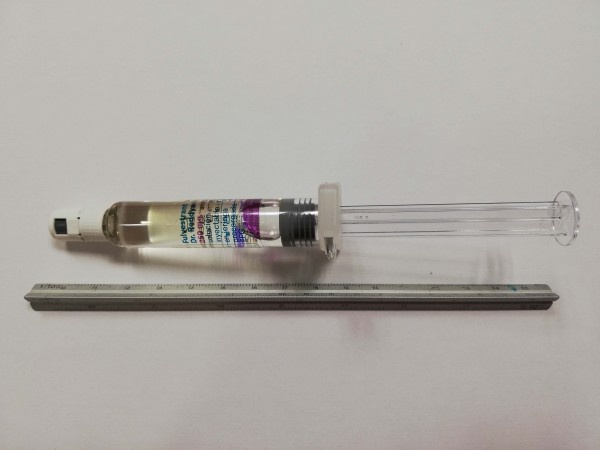
Kileza es una solución viscosa, transparente, de incolora a amarilla en una jeringa precargada, que contiene 5 ml de solución inyectable. Deben administrarse dos jeringas para recibir la dosis mensual recomendada de 500 mg.
Kileza presenta 3 formatos, bien un envase que contiene 1 jeringa de vidrio precargada, un envase que contiene 2 jeringas de vidrio precargadas y un pack que contiene 6 jeringas de vidrio precargadas. Se proporcionan además, una, dos o seis agujas con sistema de seguridad (“BD SafetyGlide”) para su conexión al cuerpo de cada jeringa.
Puede que solamente estén comercializados algunos tamaños de envases.
Titular de la autorización de comercialización
Exeltis Healthcare, S.L
Avda. Miralcampo, 7.
Pol. Ind. Miralcampo.
19200 Azuqueca de Henares (Guadalajara)
España
Responsable de la fabricación
Laboratorios Farmalán, S.A.
Calle La Vallina, s/n, Edificio 2
Polígono Industrial Navatejera
Villaquilambre, León, 24193, España
Este medicamento está autorizado en los estados miembros del Espacio Económico Europeo con los siguientes nombres:
NL – Fulvestrant Xiromed 250 mg oplossing voor injectie in een voorgevulde spuit
DE – Fulvestrant Axiromed 250 mg Injektionslösung in siner Fertigspritze.
DK – Fulvestrant Medical Valley 250 mg injektionsvæske, opløsning I fyldt injektionssprøjte.
IS – Fulvestrant Medical Valley 250 mg stungulyf, lausn, áfyllt sprauta
NO – Fulvstrant Medical Valley
SE – Fulvestrant Medical Valley 250 mg imjekionsvätska, lösning I förfylld spruta
ES – Kileza 250 mg solución inyectable en jeringa precargada.
UK – Fulvestrant 250 mg, solution for injection in pre-filled syringe.
Fecha de la última revisión de este prospecto: Octubre 2024
La información detallada y actualizada de este medicamento está disponible en la página web de la Agencia Española de Medicamentos y Productos Sanitarios (AEMPS) http://www.aemps.gob.es/
--------------------------------------------------------------------------------------------------------------------------------
Esta información está destinada únicamente a profesionales del sector sanitario:
Kileza 500 mg (2 x 250 mg/ 5 ml solución inyectable) se debe administrar usando dos jeringas precargadas. Ver sección 3.
Instrucciones de administración
Advertencia – No esterilizar en autoclave la aguja con sistema de seguridad (BD SafetyGlide® o Terumo SurGuard®) antes de su uso. Las manos deben permanecer por detrás de la aguja en todo momento durante su uso y eliminación.
Para cada una de las dos jeringas:
- Retire la tapa protectora de la parte superior del tubo de la jeringa de vidrio y asegúrese de que no está dañada.
- Abra retirando el acondicionamiento exterior de la aguja con sistema de seguridad
- Las soluciones parenterales deben inspeccionarse visualmente para detectar partículas y decoloración antes de su administración.
- Sostenga la jeringa en posición vertical sobre la parte acanalada (C). Con la otra mano, agarre el tapón (A) y gire con cuidado el tapón de punta rígida de plástico en sentido antihorario. (ver Figura 1):
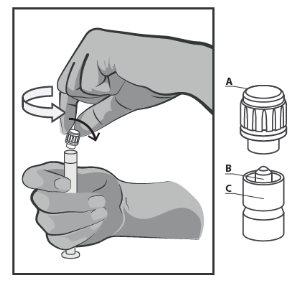
Figura 1
- Retire la tapa de la punta rígida de plástico (A) en dirección recta hacia arriba. Para mantener la esterilidad, no toque la punta de la jeringa (B) (consulte la Figura 2).
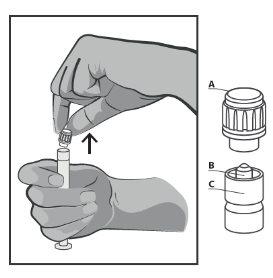
Figura 2
Acople la aguja con sistema de seguridad al “Luer-Lok” y girela hasta que quede firmemente acoplada.
- Compruebe que la aguja queda acoplada al conector Luer antes de desplazarla de la posición vertical.
- Tire del capuchón de la aguja en línea recta para no dañar el extremo de la misma.
- Situe la jeringa en el punto de administración.
- Retire el capuchón de la aguja.
- Expulsar el exceso de gas de la jeringa.
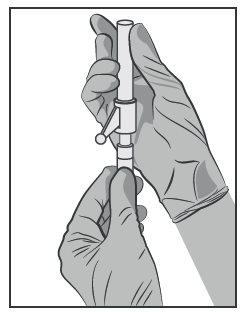
Figura 3
- Administre lentamente vía intramuscular en el glúteo (de 1 a 2 minutos/inyección). Para una mayor comodidad, la posición de la aguja con el bisel hacia arriba tiene la misma orientación que el brazo de la palanca levantado (ver Figura 4).
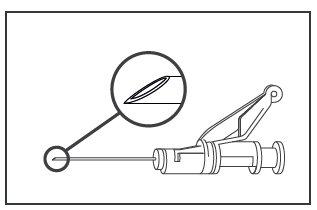
Figura 4
- Tras la inyección, dé inmediatamente un solo toque con el dedo en el brazo de la palanca para activar el mecanismo de protección (ver Figura 5).
NOTA: Actívelo alejado de su cuerpo y de los demás. Escuche el clic y confirme visualmente que la punta de la aguja está totalmente protegida.
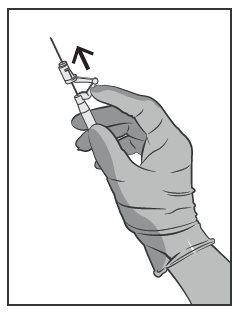
Figura 5
Eliminación
Las jeringas precargadas son para un únicouso.
Este medicamento puede suponer un riesgo para el medio acuático. Cualquier medicamento no utilizado o material de desecho debe eliminarse de acuerdo con la normativa local.
- País de registro
- Forma farmacéuticaINYECTABLE, 250 MG
- Código ATCL02BA03
- Principio activo
- Requiere recetaSí
- Fabricante
- ComposiciónETANOL AL 96% (100 mg/ml mg), ALCOHOL BENCILICO (100 mg/ml mg), BENZIL BENZOATO (150 mg/ml mg)
- Esta información es de carácter general y no sustituye la consulta con un profesional sanitario.
- Alternativas a KILEZA 250 MG SOLUCION INYECTABLE EN JERINGA PRECARGADA EFGForma farmacéutica: INYECTABLE, 250 mg/5 mlPrincipio activo: FulvestrantFabricante: Bexal Farmaceutica S.A.Requiere recetaForma farmacéutica: INYECTABLE, 250 mgPrincipio activo: FulvestrantFabricante: Ever Valinject GmbhRequiere recetaForma farmacéutica: INYECTABLE, 250 mgPrincipio activo: FulvestrantFabricante: Astrazeneca AbRequiere receta
Médicos online para KILEZA 250 MG SOLUCION INYECTABLE EN JERINGA PRECARGADA EFG
Comenta la dosis, los posibles efectos secundarios, interacciones, contraindicaciones o la revisión de receta de KILEZA 250 MG SOLUCION INYECTABLE EN JERINGA PRECARGADA EFG, sujeto a valoración médica y a la normativa local.


Obtén una receta de KILEZA 250 MG SOLUCION INYECTABLE EN JERINGA PRECARGADA EFG online
Rellena un formulario de 2 minutos
Cuéntanos tus síntomas, historial y el medicamento que necesitas.
Elige un médico o nosotros te asignamos uno
Escoge un especialista o te conectamos con el próximo médico disponible.
El médico revisa tu caso
Normalmente en 30 minutos. Puede hacerte preguntas adicionales por chat.
Recógela en cualquier farmacia
Receta electrónica enviada a tu correo, válida en toda España.
Preguntas frecuentes
KILEZA 250 MG SOLUCION INYECTABLE EN JERINGA PRECARGADA EFG requiere receta en España. Puedes confirmarlo con un médico online según tu caso.
El principio activo de KILEZA 250 MG SOLUCION INYECTABLE EN JERINGA PRECARGADA EFG es Fulvestrant. Esta información ayuda a identificar medicamentos con la misma composición pero con diferentes nombres comerciales.
KILEZA 250 MG SOLUCION INYECTABLE EN JERINGA PRECARGADA EFG es fabricado por Exeltis Healthcare S.L.. La marca y el envase pueden variar según el distribuidor.
Los Médicos de familia, Psiquiatras, Dermatólogos, Cardiólogos, Endocrinólogos, Gastroenterólogos, Neumólogos, Nefrólogos, Reumatólogos, Hematólogos, Infectólogos, Alergólogos, Geriatras, Pediatras, Oncólogos pueden valorar la prescripción de KILEZA 250 MG SOLUCION INYECTABLE EN JERINGA PRECARGADA EFG cuando esté clínicamente indicado. Puedes reservar una videoconsulta para comentar tu caso y las opciones de tratamiento.
España cuenta con una infraestructura sanitaria bien desarrollada en ciudades principales como Madrid, Barcelona, Valencia y Sevilla. Las farmacias están ampliamente disponibles y operan bajo estrictas regulaciones, garantizando el acceso a medicamentos con receta.
Puedes comprar KILEZA 250 MG SOLUCION INYECTABLE EN JERINGA PRECARGADA EFG en Madrid, Barcelona, Sevilla o Valencia en cualquier farmacia local con una receta válida.
Para obtener una receta, puedes utilizar Oladoctor:
Otros medicamentos con el mismo principio activo (Fulvestrant) incluyen AFULTRANT 250 MG SOLUCION INYECTABLE EN JERINGA PRECARGADA EFG, AMBIFUL 250 MG SOLUCION INYECTABLE EN JERINGA PRECARGADA EFG, FASLODEX 250 mg/5 ml SOLUCION INYECTABLE. Pueden tener diferentes nombres comerciales o formulaciones, pero contienen el mismo componente terapéutico. Consulta siempre con un médico antes de cambiar o iniciar un nuevo medicamento.
