


Kerendia 10 mg comprimidos recubiertos con película

Prescription review online
A doctor will review your case and decide whether a prescription is medically appropriate.

Talk to a doctor about this medicine
Discuss your symptoms and possible next steps in a quick online consultation.



How to use KERENDIA 10 mg FILM-COATED TABLETS
Contents of the leaflet
- Introduction
- What is Kerendia and what is it used for
- What you need to know before you take Kerendia
- How to take Kerendia
- Possible side effects
- Storage of Kerendia
- Contents of the pack and other information
Introduction
Package Leaflet: Information for the Patient
Kerendia 10 mg Film-Coated Tablets
Kerendia 20 mg Film-Coated Tablets
finerenone
This medicinal product is subject to additional monitoring, which will allow for quick identification of new safety information. You can help by reporting any side effects you may get. The last section of section 4 will tell you how to report side effects.
Read all of this leaflet carefully before you start taking this medicine, because it contains important information for you.
- Keep this leaflet, you may need to read it again.
- If you have any further questions, ask your doctor or pharmacist.
- This medicine has been prescribed for you only. Do not pass it on to others. It may harm them, even if their signs of illness are the same as yours.
- If you get any side effects, talk to your doctor or pharmacist. This includes any possible side effects not listed in this leaflet. See section 4.
Contents of the pack
- What is Kerendia and what is it used for
- What you need to know before you take Kerendia
- How to take Kerendia
- Possible side effects
- Storage of Kerendia
- Contents of the pack and other information
1. What is Kerendia and what is it used for
Kerendia contains the active substance finerenone. Finerenone works by blocking the action of certain hormones (mineralocorticoids) that can damage the kidneys and heart.
Kerendia is used to treat adults with chronic kidney disease(with an abnormal presence of the protein albumin in the urine) associated with type 2 diabetes.
Chronic kidney disease is a long-term disease. The kidneys are gradually failing to remove waste and fluids from the blood.
Type 2 diabetes occurs when the body cannot maintain normal blood sugar levels. The body does not produce enough insulin or cannot use insulin properly. This leads to high blood sugar levels.

Not sure if this medicine is right for you?
Discuss your symptoms and treatment with a doctor online.
2. What you need to know before you take Kerendia
Do not take Kerendia
- if you are allergicto finerenone or any of the other ingredients of this medicine (listed in section 6).
- if you are taking medicines that belong to the group of "strong CYP3A4 inhibitors", for example
- itraconazoleor ketoconazole(to treat fungal infections)
- ritonavir, nelfinaviror cobicistat(to treat HIV infection)
- clarithromycin, telithromycin(to treat bacterial infections)
- nefazodone(to treat depression).
- if you have Addison's disease(when your body does not produce enough "cortisol" and "aldosterone" hormones).
Warnings and precautions
Tell your doctor or pharmacist before you start taking Kerendia if
- you have ever been told you have a high level of potassium in your blood.
- you have severe kidney impairment or kidney failure.
- you have moderate or severe liver problems.
- you have mild, moderate or severe heart failure. This occurs when your heart does not pump blood as well as it should. It does not pump enough blood out of the heart with each beat.
Blood tests
These tests check your potassium level and your kidney function.
Based on the results of your blood tests, your doctor will decide if you can start taking Kerendia.
After 4 weeks of taking Kerendia, you will have new blood tests.
Your doctor may also have your blood tested at other times, for example when you take certain medicines.
Children and adolescents
Do not give this medicine to children and adolescents under 18 years of age because it is not known if it is safe and effective in this age group.
Other medicines and Kerendia
Tell your doctor or pharmacist if you are taking, have recently taken or might take any other medicines. Your doctor will tell you which medicines you can take. Your doctor may need to do a blood test to make sure.
Do not takemedicines that belong to the group of "strong CYP3A4 inhibitors" while you are taking Kerendia (see section 2 "Do not take Kerendia...").
Ask your doctoror pharmacist if you are takingother medicines while taking Kerendia, especially
- if you take, for example
- amilorideor triamterene(to remove excess water from the body through urine),
- eplerenone, esaxerenone, spironolactone or canrenone (medicines similar to finerenone),
- trimethoprim, or a combination of trimethoprim and sulfamethoxazole(to treat bacterial infections),
- potassium supplements, including some salt substitutes,
or if you take other medicines that may increase your potassium level in the blood. These medicines may not be safe for you.
- if you take, for example
- erythromycin(to treat bacterial infections),
- verapamil(to treat high blood pressure, chest pain and rapid heartbeats),
- fluvoxamine(to treat depression and "obsessive-compulsive disorder"),
- rifampicin(to treat bacterial infections),
- carbamazepine, phenytoinor phenobarbital(to treat epilepsy),
- St. John's Wort(Hypericum perforatum) (a herbal medicine to treat depression),
- efavirenz(to treat HIV infection),
or if you take other medicines that belong to the same groups of medicines as those mentioned above (certain "inhibitors" and "inducers" of CYP3A4). You may have more side effects or Kerendia may not work as expected.
- if you take other medicines to lower blood pressure. Your doctor may need to check your blood pressure.
Taking Kerendia with food and drinks
Do not eat grapefruit or drink grapefruit juicewhile you are taking Kerendia.
If you do, you may have too much finerenone in your blood. You may have more side effects(the possible side effects are listed in section 4).
Pregnancy and breast-feeding
If you are pregnant or breast-feeding, think you may be pregnant or are planning to have a baby, ask your doctor or pharmacist for advice before taking this medicine.
Pregnancy
Do not takethis medicine during pregnancy unless your doctor considers it clearly necessary. There may be a risk for your unborn baby. Your doctor will discuss this with you.
You should use a reliable method of contraceptionif you can become pregnant. Your doctor will tell you which contraceptive method you can use.
Breast-feeding
Do not breast-feedwhile you are taking this medicine. It may harm your baby.
Driving and using machines
Kerendia does not affect your ability to drive or use machines.
Kerendia contains lactose
If your doctor has told you that you have an intolerance to some sugars, contact them before taking this medicine.
Kerendia contains sodium
This medicine contains less than 1 mmol sodium (23 mg) per tablet, which is essentially "sodium-free".
3. How to take Kerendia
Always take this medicine exactly as your doctor or pharmacist has told you. If you are not sure, check with your doctor or pharmacist.
How much to take
The recommended dose and maximum daily dose of this medicine is 1 tablet of 20 mg.
- Always take 1 tablet once a day. Each tablet contains 10 mg or 20 mg of finerenone.
- The initial dosedepends on how well your kidneys are working. To check this, your doctor will do a blood test. The results will help your doctor decide if you can start with 1 tablet of 20 mg or 10 mgonce a day.
- After 4 weeks, your doctor will do another blood test. Your doctor will decide the correct dose for you. This may be 1 tablet of 20 mg or 10 mgonce a day. Your doctor may also tell you to stop or interrupt taking Kerendia.
Your doctor may decide to change your treatmentafter having your blood tested. See "Blood tests" in section 2 for more information.
How to take this medicine
Kerendia is taken by mouth. Take Kerendia at the same time every day. This will help you remember it.
Swallow the tablet whole.
- You can take it with a glass of water.
- You can take it with or without food.
- Do not take it with grapefruit juice or grapefruit. See "Taking Kerendia with food and drinks" in section 2 for more information.
If you cannot swallow the tablet whole, you can crush it.
- Mix it with water or with soft foods, such as apple sauce.
- Take it immediately.
If you take more Kerendia than you should
Ask your doctor or pharmacist for advice if you think you have taken too much of this medicine.
If you forget to take Kerendia
If you forget to take the tablet at the usual time that day
take the tablet as soon as you remember that day.
If you miss a day
take the next tablet the following day, at the usual time.
Do not take 2 tablets to make up for a forgotten tablet.
If you stop taking Kerendia
Only stop taking Kerendia if your doctor has told you to do so. Your doctor may decide this after having your blood tested.
If you have any other questions about the use of this medicine, ask your doctor or pharmacist.

Started taking the medicine and have questions?
Discuss your symptoms and treatment with a doctor online.
4. Possible side effects
Like all medicines, this medicine can cause side effects, although not everybody gets them.
Side effects that your doctor may see in your blood test results
Very common(may affect more than 1 in 10 people)
- high level of potassium (hyperkalemia)
- The possible signs of a high level of potassium in the blood may be weakness or tiredness, nausea, numbness of the hands and lips, muscle cramps or decreased heart rate.
Common(may affect up to 1 in 10 people)
- low level of sodium (hyponatremia)
- The possible signs of a low level of sodium in the blood may include nausea, tiredness, headache, confusion; muscle weakness, spasms or cramps.
- decreased kidney function (decreased glomerular filtration rate)
- high level of uric acid (hyperuricemia).
Uncommon(may affect up to 1 in 100 people)
- decreased level of a protein (hemoglobin) found in red blood cells.
Other side effects
Common(may affect up to 1 in 10 people)
- low blood pressure (hypotension)
- The possible signs of low blood pressure may be dizziness, lightheadedness or fainting.
- itching (pruritus)
Reporting of side effects
If you get any side effects, talk to your doctor or pharmacist. This includes any possible side effects not listed in this leaflet. You can also report side effects directly via the national reporting system listed in Appendix V. By reporting side effects, you can help provide more information on the safety of this medicine.
5. Storage of Kerendia
Keep this medicine out of the sight and reach of children.
Do not use this medicine after the expiry date which is stated on the blister, label of the bottle and the carton after EXP/CAD. The expiry date is the last day of the month shown.
This medicine does not require any special storage conditions.
Medicines should not be disposed of via wastewater or household waste. Ask your pharmacist how to dispose of medicines no longer required. These measures will help to protect the environment.
6. Contents of the pack and other information
What Kerendia contains
- The active substance is finerenone.
- Each Kerendia 10 mg film-coated tabletcontains 10 mg of finerenone.
- Each Kerendia 20 mg film-coated tabletcontains 20 mg of finerenone.
- The other ingredients are:
- Tablet core: microcrystalline cellulose, sodium croscarmellose, hypromellose 2910, lactose monohydrate, magnesium stearate, sodium lauryl sulfate. See "Kerendia contains lactose" and "Kerendia contains sodium" in section 2 for more information.
- Tablet coating: hypromellose 2910, titanium dioxide, talc, red iron oxide (E 172, only in Kerendia 10 mg film-coated tablets) and yellow iron oxide (E 172, only in Kerendia 20 mg film-coated tablets).
Appearance and packaging
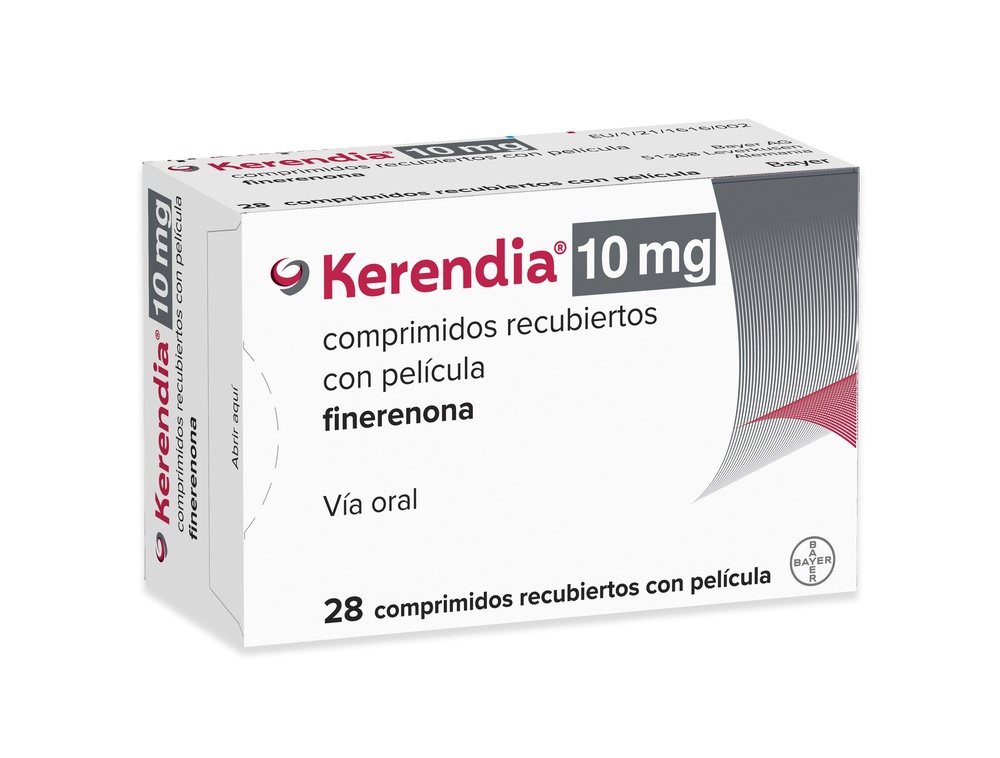
Kerendia 10 mg film-coated tabletsare pink, oval, 10 mm long and 5 mm wide, marked with "10" on one side and "FI" on the other.
Kerendia 20 mg film-coated tabletsare yellow, oval, 10 mm long and 5 mm wide, marked with "20" on one side and "FI" on the other.
Kerendia is available in packs containing
- 14, 28 or 98 film-coated tablets.
Each transparent calendar blister pack contains 14 film-coated tablets.
- 100 x 1 film-coated tablet.
Each transparent unit-dose blister pack contains 10 film-coated tablets.
- 100 film-coated tablets in a plastic bottle.
Not all pack sizes may be marketed.
Marketing authorisation holder
Bayer AG
51368 Leverkusen
Germany
Manufacturer
Bayer AG
Kaiser-Wilhelm-Allee
51368 Leverkusen
Germany
You can ask for more information about this medicine from the representative of the marketing authorisation holder:
België/Belgique/Belgien Bayer SA-NV Tél/Tel: +32-(0)2-535 63 11 | Lietuva UAB Bayer Tel. +37 05 23 36 868 |
| Luxembourg/Luxemburg Bayer SA-NV Tél/Tel: +32-(0)2-535 63 11 |
Ceská republika Bayer s.r.o. Tel: +420 266 101 111 | Magyarország Bayer Hungária KFT Tel: +36 14 87-41 00 |
Danmark Bayer A/S Tlf: +45 45 23 50 00 | Malta Alfred Gera and Sons Ltd. Tel: +35 621 44 62 05 |
Deutschland Bayer Vital GmbH Tel: +49 (0)214-30 513 48 | Nederland Bayer B.V. Tel: +31-(0) 23-799 1000 |
Eesti Bayer OÜ Tel: +372 655 8565 | Norge Bayer AS Tlf: +47 23 13 05 00 |
Ελλáδα Bayer Ελλáς ΑΒΕΕ Τηλ: +30-210-61 87 500 | Österreich Bayer Austria Ges.m.b.H. Tel: +43-(0)1-711 46-0 |
España Bayer Hispania S.L. Tel: +34-93-495 65 00 | Polska Bayer Sp. z o.o. Tel: +48 22 572 35 00 |
France Bayer HealthCare Tél (Nº vert): +33-(0)800 87 54 54 | Portugal Bayer Portugal, Lda. Tel: +351 21 416 42 00 |
Hrvatska Bayer d.o.o. Tel: +385-(0)1-6599 900 | România SC Bayer SRL Tel: +40 21 529 59 00 |
Ireland Bayer Limited Tel: +353 1 216 3300 | Slovenija Bayer d. o. o. Tel: +386 (0)1 58 14 400 |
Ísland Icepharma hf. Sími: +354 540 8000 | Slovenská republika Bayer spol. s r.o. Tel. +421 2 59 21 31 11 |
Italia Bayer S.p.A. Tel: +39 02 397 8 1 | Suomi/Finland Bayer Oy Puh/Tel: +358- 20 785 21 |
Κúπρος NOVAGEM Limited Τηλ: +357 22 48 38 58 | Sverige Bayer AB Tel: +46 (0) 8 580 223 00 |
Latvija SIA Bayer Tel: +371 67 84 55 63 | United Kingdom (Northern Ireland) Bayer AG Tel: +44-(0)118 206 3000 |
Date of last revision of this leaflet:
Detailed information on this medicine is available on the European Medicines Agency web site: http://www.ema.europa.eu.
- Country of registration
- Dosage formTABLET, 10 mg
- ATC codeC03DA05
- Average pharmacy price71.26 EUR
- Active substance
- Prescription requiredYes
- Manufacturer
- CompositionCROSCARMELOSA SODICA (4,5 mg mg), LACTOSA MONOHIDRATO (45 mg mg), LAURILSULFATO DE SODIO (0,4 mg mg)
- This information is for reference only and does not constitute medical advice. Always consult a doctor before taking any medication. Oladoctor is not responsible for medical decisions based on this content.
- Alternatives to KERENDIA 10 mg FILM-COATED TABLETSDosage form: TABLET, 20 mgActive substance: finerenoneManufacturer: Bayer AgPrescription requiredDosage form: TABLET, 100 mg spironolactoneActive substance: spironolactoneManufacturer: Pfizer S.L.Prescription requiredDosage form: TABLET, 25 mg spironolactoneActive substance: spironolactoneManufacturer: Pfizer S.L.Prescription required
Online doctors for KERENDIA 10 mg FILM-COATED TABLETS
Discuss questions about KERENDIA 10 mg FILM-COATED TABLETS, including use, safety considerations and prescription review, subject to medical assessment and local regulations.
Frequently Asked Questions
KERENDIA 10 mg FILM-COATED TABLETS requires a prescription in Spain. You can check with a doctor online whether this medicine may be appropriate for your situation.
The active ingredient in KERENDIA 10 mg FILM-COATED TABLETS is finerenone. This information helps identify medicines with the same composition but different brand names.
The average pharmacy price for KERENDIA 10 mg FILM-COATED TABLETS is around 71.26 EUR. Prices may vary depending on the manufacturer and dosage form.
KERENDIA 10 mg FILM-COATED TABLETS is manufactured by Bayer Ag. Pharmacy brands and packaging may differ depending on the distributor.
Doctors such as Family doctors, Psychiatrists, Dermatologists, Cardiologists, Endocrinologists, Gastroenterologists, Pulmonologists, Nephrologists, Rheumatologists, Hematologists, Infectious disease physicians, Allergists, Geriatricians, Paediatricians, Oncologists may assess whether KERENDIA 10 mg FILM-COATED TABLETS is appropriate, depending on your situation and local regulations. You can book an online consultation to discuss your symptoms and possible next steps.
The prescription is issued by a doctor after assessing your health. In Spain, KERENDIA 10 mg FILM-COATED TABLETS is then dispensed in pharmacies with that prescription. An online consultation does not guarantee that a prescription will be issued: the decision always rests with the doctor.
To request a review, you can use Oladoctor:
Other medicines with the same active substance (finerenone) include KERENDIA 20 mg FILM-COATED TABLETS, ALDACTONE 100 mg FILM-COATED TABLETS, ALDACTONE 25 mg FILM-COATED TABLETS. These may have different brand names or formulations but contain the same therapeutic ingredient. Always consult a doctor before switching or starting a new medicine.
