



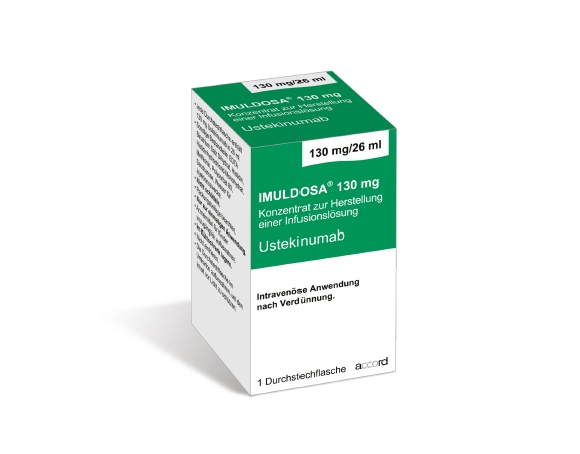
IMULDOSA 130 mg Concentrado Para Solución Para Perfusión

Revisión de receta online
Un médico revisará tu caso y determinará si la prescripción es médicamente apropiada.

Habla con un médico sobre este medicamento
Comenta tus síntomas y las opciones de tratamiento en una consulta online.



Cómo usar IMULDOSA 130 MG CONCENTRADO PARA SOLUCION PARA PERFUSION
Contenido del prospecto
- Introducción
- Qué es IMULDOSA y para qué se utiliza
- Que necesita saber antes de empezar a usar IMULDOSA
- Cómo usar IMULDOSA
- Posibles efectos adversos
- Conservación de IMULDOSA
- Contenido del envase e información adicional
Introducción
Prospecto: información para el paciente
IMULDOSA 130 mg concentrado para solución para perfusión
ustekinumab
Este medicamento está sujeto a seguimiento adicional, lo que agilizará la detección de nueva información sobre su seguridad. Se invita a los profesionales sanitarios a notificar las sospechas de reacciones adversas. Ver la sección 4.8, en la que se incluye información sobre cómo notificarlas.
Lea todo el prospecto detenidamente antes de empezar a usar este medicamento, porque contiene información importante para usted.
Este prospecto ha sido redactado para la persona que hace uso del medicamento.
- Conserve este prospecto, ya que puede tener que volver a leerlo.
- Si tiene alguna duda, consulte a su médico o farmacéutico.
- Si experimenta efectos adversos, consulte a su médico o farmacéutico, incluso si se trata de efectos adversos que no aparecen en este prospecto. Ver sección 4.
Contenido del prospecto
- Qué es IMULDOSA y para qué se utiliza
- Qué necesita saber antes de empezar a usar IMULDOSA
- Cómo usar IMULDOSA
- Posibles efectos adversos
- Conservación de IMULDOSA
- Contenido del envase e información adicional
1. Qué es IMULDOSA y para qué se utiliza
Qué es IMULDOSA
IMULDOSA contiene el principio activo “ustekinumab”, un anticuerpo monoclonal. Los anticuerpos monoclonales son proteínas que identifican y se unen específicamente a ciertas proteínas del cuerpo.
IMULDOSA pertenece a un grupo de medicamentos llamados “inmunosupresores”. Estos medicamentos actúan debilitando parte del sistema inmune.
Para qué se utiliza IMULDOSA
IMULDOSA se utiliza para el tratamiento de las siguientes enfermedades inflamatorias:
- Enfermedad de Crohn de moderada a grave - en adultos
Enfermedad de Crohn
La enfermedad de Crohn es una enfermedad inflamatoria del intestino. Si padece la enfermedad de Crohn, le administrarán primero otros medicamentos. Si no responde de manera adecuada o no tolera esos medicamentos, puede que le administren IMULDOSA para reducir los signos y síntomas de su enfermedad.

¿No estás seguro de si este medicamento es adecuado para ti?
Comenta tus síntomas y tratamiento con un médico online.
2. Que necesita saber antes de empezar a usar IMULDOSA
No use IMULDOSA
- Si es alérgico a ustekinumabo a alguno de los demás componentes de este medicamento (incluidos en la sección 6).
- Si tiene una infección activaque su médico piense que es importante.
Si no está seguro si alguno de los puntos anteriores le concierne, hable con su médico o farmacéutico antes de usar IMULDOSA.
Advertencias y precauciones
Consulte a su médico o farmacéutico antes de empezar a usar IMULDOSA. Su médico comprobará cómo se encuentra antes de cada tratamiento. Asegúrese de informar a su médico sobre cualquier enfermedad que sufra antes del tratamiento. También informe a su médico si recientemente ha estado cerca de alguien que pudiera tener tuberculosis. Su médico le examinará y le hará un test para detección de la tuberculosis, antes de usar IMULDOSA. Si su médico cree que usted está en riesgo de tuberculosis, puede darle medicamentos para tratarla.
Observe los efectos adversos graves
IMULDOSA puede causar efectos adversos graves, incluyendo reacciones alérgicas e infecciones. Usted debe prestar atención a ciertos signos de enfermedad mientras esté utilizando IMULDOSA. Ver la lista completa de estos efectos adversos en “Efectos adversos graves” de la sección 4.
Antes de utilizar IMULDOSA dígale a su médico:
- Si usted ha tenido alguna vez una reacción alérgica a IMULDOSA.Consulte con su médico si no está seguro.
- Si usted alguna vez ha tenido algún tipo de cáncer– esto es porque los inmunosupresores del tipo de IMULDOSA debilitan parte del sistema inmunitario. Esto puede aumentar el riesgo de tener cáncer.
- Si usted ha recibido tratamiento para la psoriasis con otros biológicos (un medicamento producido a partir de una fuente biológica y que suele administrarse mediante inyección)– el riesgo de padecer cáncer puede ser mayor.
- Si tiene o ha tenido una infección reciente o tiene alguna grieta en la piel (fístula).
- Si tiene cualquier lesión nueva o cambio de las lesionesdentro del área de psoriasis o sobre la piel intacta.
- Si usted está tomando cualquier otro tratamiento para la psoriasis y/o artritis psoriásica– como cualquier otro inmunosupresor o fototerapia (cuando su cuerpo es tratado con un tipo de luz ultravioleta (UV)). Estos tratamientos pueden también debilitar parte del sistema inmunitario. No se ha estudiado el uso de estos tratamientos de manera conjunta con IMULDOSA. Sin embargo, es posible que pueda aumentar la probabilidad de sufrir enfermedades relacionadas con un sistema inmune más débil.
- Si usted está recibiendo o ha recibido alguna vez inyecciones para tratar las alergias– se desconoce si IMULDOSA puede afectar a estos tratamientos.
- Si usted tiene 65 años o más– usted tiene más probabilidades de adquirir infecciones.
Si no está seguro de no padecer alguno de estos trastornos, hable con su médico o farmacéutico antes de usar IMULDOSA.
Algunos pacientes han experimentado reacciones similares al lupus durante el tratamiento con ustekinumab, incluido lupus cutáneo o síndrome tipo lupus. Hable con su médico de inmediato si experimenta erupción cutánea roja, elevada y escamosa, a veces con un borde más oscuro, en zonas de la piel expuestas al sol o si van acompañadas de dolores articulares.
Ataques al corazón e ictus
En un estudio realizado en pacientes con psoriasis tratados con IMULDOSA se han observado ataques al corazón e ictus. Su médico comprobará periódicamente sus factores de riesgo de enfermedad cardíaca e ictus para garantizar que se tratan adecuadamente. Busque atención médica de inmediato si presenta dolor torácico, debilidad o sensación anormal en un lado del cuerpo, parálisis facial o anomalías en el habla o la vista.
Niños y adolescentes
No se recomienda el uso de IMULDOSA en niños menores de 18 años de edad con enfermedad de Crohn o colitis ulcerosa, ya que no ha sido estudiado en este grupo de edad.
Uso de IMULDOSA con otros medicamentos, vacunas
Informe a su médico o farmacéutico:
- Si está utilizando, ha utilizado recientemente o puede utilizar otros medicamentos.
- Si ha sido vacunado recientemente o va a recibir una vacuna. No se deben administrar determinados tipos de vacunas (vacunas vivas) mientras se utilice IMULDOSA.
Si recibió IMULDOSA durante el embarazo, informe al médico de su lactante sobre su tratamiento con IMULDOSA antes de que el lactante reciba cualquier vacuna, incluidas las vacunas vivas, como la vacuna BCG (utilizada para prevenir la tuberculosis). No se recomiendan las vacunas vivas para su lactante en los primeros doce meses después del nacimiento si usted recibió IMULDOSA durante el embarazo, a menos que el médico de su lactante recomiende lo contrario.
Embarazo y lactancia
- Si está embarazada, cree que podría estar embarazada o tiene intención de quedarse embarazada, consulte a su médico antes de utilizar este medicamento.
- No se ha observado un mayor riesgo de defectos de nacimiento en bebés expuestos a Imuldosa en el útero. Sin embargo, existe experiencia limitada con Imuldosa en mujeres embarazadas. Por tanto, es preferible evitar el uso de Imuldosa durante el embarazo.
- Si es una mujer en edad fértil, se le recomienda que evite quedarse embarazada y use medidas anticonceptivas adecuadas mientras esté utilizando Imuldosa y durante al menos 15 semanas tras el último tratamiento con Imuldosa.
- Imuldosa puede pasar a través de la placenta al feto. Si recibió Imuldosa durante el embarazo, su lactante podría tener un mayor riesgo de contraer una infección.
- Es importante que informe a los médicos de su lactante y a otros profesionales de la salud si recibió Imuldosa durante su embarazo antes de que el lactante reciba cualquier vacuna. No se recomiendan las vacunas vivas, como la vacuna BCG (utilizada para prevenir la tuberculosis) para su lactante en los primeros doce meses después del nacimiento si usted recibió Imuldosa durante el embarazo, a menos que el médico de su lactante recomiende lo contrario.
- Ustekinumab puede excretarse en la leche materna en cantidades muy pequeñas. Informe a su médico si está dando el pecho o tiene previsto hacerlo. Usted y su médico decidirán si debe dar el pecho o utilizar Imuldosa. No haga ambas cosas a la vez.
Conducción y uso de máquinas
La influencia de IMULDOSA sobre la capacidad para conducir y utilizar máquinas es nula o insignificante.
IMULDOSA contiene polisorbato 80
IMULDOSA contiene 11,1 mg de polisorbato 80 (E433) en cada unidad de dosificación, equivalente a 0,40 mg/ml.
Los polisorbatos pueden causar reacciones alérgicas. Informe a su médico si tiene alergias conocidas.
IMULDOSA contiene sodio
IMULDOSA contiene menos de 1 mmol de sodio (23 mg) por dosis; esto es, esencialmente “exento de sodio”. No obstante, antes de que se le administrar IMULDOSA, se mezcla con una solución que contiene sodio. Hable con su médico si sigue una dieta baja en sal.
3. Cómo usar IMULDOSA
IMULDOSA se debe utilizar bajo la guía y supervisión de un médico con experiencia en el diagnóstico y tratamiento de la enfermedad de Crohn.
Su médico le administrará IMULDOSA 130 mg concentrado para solución para perfusión mediante goteo en una vena del brazo (perfusión intravenosa) durante al menos una hora. Pregunte a su médico cuándo deben ponerle las inyecciones y sobre las consultas de seguimiento.
Qué cantidad de IMULDOSA se administra
Su médico decidirá la cantidad de IMULDOSA que necesita recibir y la duración del tratamiento.
Adultos a partir de 18 años de edad
- El médico calculará la dosis de perfusión intravenosa recomendada para usted en función de su peso corporal.
Su peso corporal | Dosis |
≤ 55 kg | 260 mg |
> 55 kg to ≤ 85 kg | 390 mg |
> 85 kg | 520 mg |
- Tras la dosis intravenosa inicial, recibirá la siguiente dosis de 90 mg de IMULDOSA mediante una inyección bajo la piel (inyección subcutánea) 8 semanas después y, posteriormente, cada 12 semanas.
Cómo se administra IMULDOSA
- La primera dosis de IMULDOSA para el tratamiento de la enfermedad de Crohn o colitis ulcerosa es administrada por un médico mediante goteo en la vena de un brazo (perfusión intravenosa).
Consulte con su médico si tiene cualquier pregunta sobre el tratamiento con IMULDOSA.
Si olvidó usar IMULDOSA
Si olvida una dosis o no acude a la cita para que se lo administren, hable con su médico para programar otra cita.
Si interrumpe el tratamiento con IMULDOSA
Dejar de usar IMULDOSA no es peligroso. Sin embargo, si usted lo interrumpe, sus síntomas pueden volver a aparecer.
Si tiene cualquier otra duda sobre el uso de este medicamento, pregunte a su médico o farmacéutico.

¿Has empezado a tomar el medicamento y tienes preguntas?
Comenta tus síntomas y tratamiento con un médico online.
4. Posibles efectos adversos
Al igual que todos los medicamentos, este medicamento puede producir efectos adversos, aunque no todas las personas los sufran.
Efectos adversos graves
Algunos pacientes podrían tener efectos adversos graves que pueden necesitar tratamiento urgente.
Reacciones alérgicas – éstas pueden necesitar tratamiento urgente. Contacte con su médico o consiga ayuda médica de urgencia inmediatamente si nota cualquiera de los siguientes signos.
- Las reacciones alérgicas graves (“anafilaxia”) son raras en la población que utiliza IMULDOSA (pueden afectar hasta 1 de cada 1.000 personas). Los signos incluyen:
- dificultad para respirar y tragar
- tensión arterial baja, que puede causar mareos o ligeros dolores de cabeza
- hinchazón de la cara, labios, boca o garganta
- Los signos comunes de una reacción alérgica incluyen erupción cutánea y urticaria (éstos pueden afectar hasta 1 de cada 100 personas).
Reacciones relacionadas con la perfusión – Si está recibiendo tratamiento para la enfermedad de Crohn, la primera dosis de IMULDOSA se administra mediante goteo en una vena (perfusión intravenosa). Algunos pacientes han experimentado reacciones alérgicas graves durante la perfusión.
En casos raros, se han notificado reacciones alérgicas a nivel del pulmón e inflamación del pulmón en pacientes tratados con ustekinumab. Informe a su médico de forma inmediata si tiene síntomas como tos, dificultad para respirar y fiebre.
Si tiene una reacción alérgica grave, su médico puede decidir que usted no debe utilizar IMULDOSA de nuevo.
Infecciones – éstas pueden necesitar tratamiento urgente. Contacte inmediatamente con su médico si nota cualquiera de estos signos.
- Las infecciones de nariz o garganta y el resfriado común son frecuentes (pueden afectar hasta 1 de cada 10 personas).
- Las infecciones del pecho son poco frecuentes (pueden afectar hasta 1 de cada 100 personas).
- La inflamación de los tejidos situados bajo la piel (“celulitis”) es poco frecuente (puede afectar hasta 1 de cada 100 personas).
- Los Herpes (un tipo de erupción dolorosa con ampollas) son poco frecuentes (pueden afectar hasta 1 de cada 100 personas).
IMULDOSA puede afectar a su capacidad para combatir infecciones. Algunas de ellas podrían llegar a ser graves y estar causadas por virus, hongos, bacterias (incluida la tuberculosis) o parásitos, y entre ellas se incluyen las infecciones que se producen principalmente en personas con un sistema inmunitario debilitado (infecciones oportunistas). Se han notificado infecciones oportunistas del cerebro (encefalitis, meningitis), los pulmones y los ojos en pacientes que reciben tratamiento con ustekinumab.
Debe vigilar los signos de infección mientras esté usando IMULDOSA. Éstos incluyen:
- fiebre, síntomas gripales, sudores nocturnos, pérdida de peso
- sensación de cansancio o dificultad para respirar; tos que no desaparece
- tener la piel caliente, enrojecida y dolorosa o tener una erupción dolorosa de la piel con ampollas
- escozor al orinar
- diarrea
- deterioro visual o pérdida de la visión
- cefalea, contractura de la nuca, fotosensibilidad, náuseas o confusión.
Comuníquese con su médico inmediatamente si usted nota cualquiera de estos signos de infección, ya que pueden ser signos de infecciones como las infecciones del pecho, infecciones de la piel, herpes o infecciones oportunistas que podrían tener complicaciones graves. También debe comunicar a su médico si tiene cualquier tipo de infección que no desaparezca o reaparezca. Su médico puede decidir que usted no debe usar IMULDOSA hasta que la infección desaparezca. También contacte con su médico si tiene algún corte abierto o úlcera que pueda infectarse.
Desprendimiento de la piel – el aumento del enrojecimiento y el desprendimiento de la piel en una superficie amplia del cuerpo pueden ser síntomas de psoriasis eritrodérmica o dermatitis exfoliativa, que son trastornos graves de la piel. Si nota alguno de estos síntomas, debe comunicárselo a su médico inmediatamente.
Otros efectos adversos
Efectos adversos frecuentes(pueden afectar hasta 1 de cada 10 personas):
- Diarrea
- Náuseas
- Vómitos
- Sensación de cansancio
- Sensación de mareo
- Dolor de cabeza
- Picor (“prurito”)
- Dolor de espalda, muscular o articular
- Dolor de garganta
- Enrojecimiento y dolor en el lugar de inyección
- Sinusitis
Efectos adversos poco frecuentes(pueden afectar hasta 1 de cada 100 personas):
- Infecciones dentales
- Infecciones vaginales por levaduras
- Depresión
- Taponamiento o congestión nasal
- Hemorragia, cardenales, endurecimiento, hinchazón y picor en el lugar de la inyección
- Sentirse débil
- Párpado caído y hundimiento de los músculos de un lado de la cara (“parálisis facial” o “parálisis de Bell”), que es normalmente temporal
- Un cambio en la psoriasis con enrojecimiento y con nueva ampolla de la piel pequeña, amarilla o blanca, algunas veces acompañada de fiebre (psoriasis pustular)
- Descamación de la piel (exfoliación de la piel)
- Acné
Efectos adversos raros(pueden afectar hasta 1 de cada 1.000 personas):
- Enrojecimiento y desprendimiento de la piel en una superficie amplia del cuerpo, que puede producir picor o dolor (dermatitis exfoliativa). Pueden desarrollarse síntomas similares como un cambio natural de los síntomas de la psoriasis (psoriasis eritrodérmica)
- Inflamación de pequeños vasos sanguíneos, que puede producir una erupción de la piel con pequeños abultamientos de color rojo o púrpura, fiebre o dolor articular (vasculitis)
Efectos adversos muy raros(pueden afectar hasta 1 de cada 10.000 personas)
- Ampollas en la piel, que pueden ser rojas y producir picor y dolor (penfigoide ampolloso).
- Lupus cutáneo o síndrome tipo lupus (erupción cutánea roja, elevada y escamosa en zonas de la piel expuestas al sol, posiblemente acompañado de dolores articulares).
Comunicación de efectos adversos
Si experimenta cualquier tipo de efecto adverso, consulte a su médico o farmacéutico, incluso si se trata de posibles efectos adversos que no aparecen en este prospecto. También puede comunicarlos directamente a través del sistema nacional de notificación incluido en el Apéndice V. Mediante la comunicación de efectos adversos usted puede contribuir a proporcionar más información sobre la seguridad de este medicamento.
5. Conservación de IMULDOSA
- IMULDOSA 130 mg concentrado para solución para perfusión se administra en un hospital o un centro médico y no es necesario que los pacientes lo conserven o lo manipulen.
- Mantener este medicamento fuera de la vista y del alcance de los niños.
- Conservar en nevera (2 ºC y 8 ºC). No congelar.
- Conservar el vial en el embalaje exterior para protegerlo de la luz.
- No agite los viales de IMULDOSA. La agitación enérgica prolongada puede deteriorar el producto.
No utilice este medicamento:
- Después de la fecha de caducidad que aparece en la etiqueta y el envase después de “CAD”. La fecha de caducidad es el último día del mes que se indica.
- Si el líquido cambia de color, está turbio o presenta partículas extrañas flotando en él (vea la sección 6 “Aspecto de IMULDOSA y contenido del envase”).
- Si sabe o cree que ha estado expuesto a temperaturas extremas (como un calentamiento o una congelación accidental).
- Si el producto se ha agitado enérgicamente.
- Si el precinto está roto.
IMULDOSA es para un único uso. Debe tirar la solución para perfusión diluida sobrante del producto sin usar que quede en el vial o la jeringa de conformidad con las normativas locales.
6. Contenido del envase e información adicional
Composición de IMULDOSA
- El principio activo es ustekinumab. Cada vial contiene 130 mg de ustekinumab en 26 ml.
- Los demás componentes son sal disódica dihidrato de EDTA (E385), L-histidina, clorhidrato de L-histidina monohidratado, L-metionina, polisorbato 80 (E433), sacarosa y agua para preparaciones inyectable.
Aspecto de IMULDOSA y contenido del envase
IMULDOSA es una solución para perfusión transparente a ligeramente opalescnte, entre incolora y levemente amarillenta. Se presenta en un envase que contiene 1 vial de 30 ml de vidrio unidosis. Cada vial contiene 130 mg de ustekinumab en 26 ml de concentrado para solución para perfusión.
Titular de la Autorización de Comercialización
Accord Healthcare S.L.U.
World Trade Center, Moll de Barcelona, s/n
Edifici Est, 6a Planta
08039 Barcelona
España
Responsable de la fabricación
Accord Healthcare Polska Sp. z.o.o. ul.
Lutomierska 50,
95-200, Pabianice, Polonia
Accord Healthcare B.V.
Winthontlaan 200,
3526 KV Utrecht, Países Bajos
Pueden solicitar más información respecto a este medicamento dirigiéndose al representante local del titular de la autorización de comercialización:
AT / BE / BG / CY / CZ / DE / DK / EE / ES / FI / FR / HR / HU / IE / IS / IT / LT / LV / LU / MT / NL / NO / PL / PT / RO / SE / SI / SK
Accord Healthcare S.L.U.
Tel: +34 93 301 00 64
EL
Win Medica Α.Ε.
Τel: +30 210 74 88 821
Fecha de la última revisión de este prospecto: Junio 2025
La información detallada de este medicamento está disponible en la página web de la Agencia Europea de Medicamentos: http://www.ema.europa.eu/.
--------------------------------------------------------------------------------------------------------------------
La siguiente información va dirigida exclusivamente a los profesionales sanitarios:
Trazabilidad:
Con objeto de mejorar la trazabilidad de los medicamentos biológicos, el nombre y el número de lote del medicamento administrado deben estar claramente registrados.
Instrucciones para la dilución:
IMULDOSA concentrado para solución para perfusión debe ser diluido, preparado y perfundido por un profesional sanitario utilizando una técnica aséptica.
- Calcular la dosis y el número de viales de IMULDOSA necesarios en función del peso del paciente (ver sección 3, Tabla 1). Cada vial de 26 ml de IMULDOSA contiene 130 mg de ustekinumab.
- Extraer y luego desechar un volumen de la solución de 9 mg/ml (0,9%) de cloruro sódico de la bolsa de perfusión de 250 ml equivalente al volumen de IMULDOSA que se va a añadir (desechar 26 ml de cloruro sódico por cada vial de IMULDOSA necesario: para 2 viales, desechar 52 ml; para 3 viales, desechar 78 ml; para 4 viales, desechar 104 ml).
- Extraer 26 ml de IMULDOSA de cada vial necesario y añadirlos a la bolsa de perfusión de 250 ml. El volumen final de la bolsa de perfusión debe ser de 250 ml. Mezclar suavemente.
- Hacer una inspección visual de la solución diluida antes de la perfusión. No utilizar si se detectan partículas opacas, cambios de color o partículas extrañas.
- Perfundir la solución diluida a lo largo de un periodo mínimo de una hora. Una vez diluida, se debe completar la perfusión dentro de las 24 horas siguientes a la dilución en la bolsa de perfusión.
- Utilizar únicamente un sistema de perfusión con un filtro en línea, estéril, apirógeno, de baja unión a proteínas (tamaño de poro de 0,2 micrómetros).
- Cada vial es de un solo uso y el medicamento que no se utilice se debe desechar de conformidad con las normativas locales.
Conservación
Si fuera necesario, la solución diluida para perfusión se puede conservar a temperatura ambiente. Se debe completar la perfusión dentro de las 24 horas siguientes tras la dilución en la bolsa de perfusión. No congelar.
- País de registro
- Forma farmacéuticaINYECTABLE PERFUSION, 130 mg
- Código ATCL04AC05
- Disponibilidad en farmaciasProblema de suministro reportado
- Principio activo
- Requiere recetaSí
- Fabricante
- ComposiciónSACAROSA (85 mg/ml mg), POLISORBATO 80 (0,40 mg/ml mg), EDETATO DISODICO DIHIDRATADO (0,02 mg/ml mg)
- Esta información es de carácter general y no sustituye la consulta con un profesional sanitario.
- Alternativas a IMULDOSA 130 MG CONCENTRADO PARA SOLUCION PARA PERFUSIONForma farmacéutica: INYECTABLE PERFUSION, 130 mgPrincipio activo: UstekinumabFabricante: Accord Healthcare S.L.U.Requiere recetaForma farmacéutica: INYECTABLE, 45 mgPrincipio activo: UstekinumabFabricante: Accord Healthcare S.L.U.Requiere recetaForma farmacéutica: INYECTABLE, 90 mgPrincipio activo: UstekinumabFabricante: Accord Healthcare S.L.U.Requiere receta
Médicos online para IMULDOSA 130 MG CONCENTRADO PARA SOLUCION PARA PERFUSION
Comenta la dosis, los posibles efectos secundarios, interacciones, contraindicaciones o la revisión de receta de IMULDOSA 130 MG CONCENTRADO PARA SOLUCION PARA PERFUSION, sujeto a valoración médica y a la normativa local.
Obtén una receta de IMULDOSA 130 MG CONCENTRADO PARA SOLUCION PARA PERFUSION online
Rellena un formulario de 2 minutos
Cuéntanos tus síntomas, historial y el medicamento que necesitas.
Elige un médico o nosotros te asignamos uno
Escoge un especialista o te conectamos con el próximo médico disponible.
El médico revisa tu caso
Normalmente en 30 minutos. Puede hacerte preguntas adicionales por chat.
Recógela en cualquier farmacia
Receta electrónica enviada a tu correo, válida en toda España.
Preguntas frecuentes
IMULDOSA 130 MG CONCENTRADO PARA SOLUCION PARA PERFUSION requiere receta en España. Puedes confirmarlo con un médico online según tu caso.
El principio activo de IMULDOSA 130 MG CONCENTRADO PARA SOLUCION PARA PERFUSION es Ustekinumab. Esta información ayuda a identificar medicamentos con la misma composición pero con diferentes nombres comerciales.
IMULDOSA 130 MG CONCENTRADO PARA SOLUCION PARA PERFUSION es fabricado por Accord Healthcare S.L.U.. La marca y el envase pueden variar según el distribuidor.
Los Médicos de familia, Psiquiatras, Dermatólogos, Cardiólogos, Endocrinólogos, Gastroenterólogos, Neumólogos, Nefrólogos, Reumatólogos, Hematólogos, Infectólogos, Alergólogos, Geriatras, Pediatras, Oncólogos pueden valorar la prescripción de IMULDOSA 130 MG CONCENTRADO PARA SOLUCION PARA PERFUSION cuando esté clínicamente indicado. Puedes reservar una videoconsulta para comentar tu caso y las opciones de tratamiento.
España cuenta con una infraestructura sanitaria bien desarrollada en ciudades principales como Madrid, Barcelona, Valencia y Sevilla. Las farmacias están ampliamente disponibles y operan bajo estrictas regulaciones, garantizando el acceso a medicamentos con receta.
Puedes comprar IMULDOSA 130 MG CONCENTRADO PARA SOLUCION PARA PERFUSION en Madrid, Barcelona, Sevilla o Valencia en cualquier farmacia local con una receta válida.
Para obtener una receta, puedes utilizar Oladoctor:
Otros medicamentos con el mismo principio activo (Ustekinumab) incluyen ABSIMKY 130 MG CONCENTRADO PARA SOLUCION PARA PERFUSION, ABSIMKY 45 MG SOLUCION INYECTABLE EN JERINGA PRECARGADA, ABSIMKY 90 MG SOLUCION INYECTABLE EN JERINGA PRECARGADA. Pueden tener diferentes nombres comerciales o formulaciones, pero contienen el mismo componente terapéutico. Consulta siempre con un médico antes de cambiar o iniciar un nuevo medicamento.
