



IBUPROFENO 600 mg Comprimidos Recubiertos Con Película

Revisión de receta online
Un médico revisará tu caso y determinará si la prescripción es médicamente apropiada.

Habla con un médico sobre este medicamento
Comenta tus síntomas y las opciones de tratamiento en una consulta online.



Cómo usar IBUPROFENO FAIRMED 600 MG COMPRIMIDOS RECUBIERTOS CON PELICULA EFG
Contenido del prospecto
- Introducción
- Prospecto: información para el usuario
- Qué es Ibuprofeno Fairmed y para qué se utiliza
- Qué necesita saber antes de empezar a tomar Ibuprofeno Fairmed
- Cómo tomar Ibuprofeno Fairmed
- Posibles efectos adversos
- Conservación de Ibuprofeno Fairmed
- Contenido del envase e información adicional
Introducción
Prospecto: información para el usuario
Ibuprofeno Fairmed 600 mg comprimidos recubiertos con película EFG
Lea todo el prospecto detenidamente antes de empezar a tomar este medicamento, porque contiene información importante para usted.
- Conserve este prospecto, ya que puede tener que volver a leerlo.
- Si tiene alguna duda, consulte a su médico o farmacéutico.
- Este medicamento se le ha recetado solamente a usted, y no debe dárselo a otras personas aunque tengan los mismos síntomas que usted, ya que puede perjudicarles.
- Si experimenta efectos adversos, consulte a su médico o farmacéutico, incluso si se trata de efectos adversos que no aparecen en este prospecto. Ver sección 4.
Contenido del prospecto
- Qué es Ibuprofeno Fairmed y para qué se utiliza
- Qué necesita saber antes de empezar a tomar Ibuprofeno Fairmed
- Cómo tomar Ibuprofeno Fairmed
- Posibles efectos adversos
- Conservación de Ibuprofeno Fairmed
- Contenido del envase e información adicional

¿No estás seguro de si este medicamento es adecuado para ti?
Comenta tus síntomas y tratamiento con un médico online.
1. Qué es Ibuprofeno Fairmed y para qué se utiliza
Ibuprofen Fairmed contiene el principio activo ibuprofeno. Ibuprofeno pertenece al grupo de los AINEs (antiinflamatorios no esteroideos). Ibuprofeno alivia el dolor y tiene un efecto antiinflamatorio.
En adultos y adolescentes a partir de 15 años de edad (≥50 kg de peso corporal) se utiliza para el tratamiento sintomático del dolor y la inflamación en enfermedades artríticas (p. ej., artritis reumatoide), afecciones artríticas degenerativas (p. ej., artrosis), y en la hinchazón e inflamación dolorosas tras lesiones de tejidos blandos.
2. Qué necesita saber antes de empezar a tomar Ibuprofeno Fairmed
No tome Ibuprofeno Fairmed:
- si es alérgico a ibuprofeno o a alguno de los demás componentes de este medicamento (incluidos en la sección 6),
- ha tenido alguna vez una reacción alérgica (como broncoespasmo [contracción de los músculos de los pulmones que puede causar asma y dificultad para respirar), crisis asmáticas, secreción nasal, inflamación de las fosas nasales, erupción cutánea o hinchazón repentina de la cara) después de tomar ácido acetilsalicílico u otros analgésicos similares (AINEs),
- si padece insuficiencia hepática, renal o cardíaca grave,
- si está en el tercer trimestre del embarazo (ver sección, "Embarazo, lactancia y fertilidad"),
- tiene antecedentes de úlceras (úlceras pépticas) o de hemorragias gástricas/duodenales recurrentes o presencia de esta en la actualidad (al menos 2 episodios distintos con úlceras o hemorragias confirmadas),
- tiene antecedentes de hemorragia o perforación gastrointestinal asociada a un tratamiento previo con AINEs,
- si padece hemorragias cerebrales (hemorragia cerebrovascular) u otras hemorragias,
- si está gravemente deshidratado (p. ej., a causa de vómitos, diarrea o ingesta insuficiente de líquidos),
- si presenta alteraciones no aclaradas de la formación de sangre,
- si padece una enfermedad que aumenta la tendencia a las hemorragias.
Advertencias y precauciones
Los medicamentos antiinflamatorios/analgésicos como ibuprofeno pueden aumentar ligeramente el riesgo de infarto de miocardio o ictus, sobre todo si se utilizan en dosis altas. No supere la dosis recomendada ni la duración del tratamiento.
Con ibuprofeno se han notificado signos de reacción alérgica, como problemas respiratorios, hinchazón de la cara y de la región del cuello (angioedema) y dolor torácico. Deje de tomar inmediatamente ibuprofeno y consulte inmediatamente a su médico o al servicio de urgencias si nota alguno de estos signos.
Preste especial atención con este medicamento:
Se han notificado reacciones cutáneas graves, como dermatitis exfoliativa, eritema multiforme, síndrome de Stevens-Johnson, necrólisis epidérmica tóxica, reacción al fármaco con eosinofilia y síntomas sistémicos (DRESS), pustulosis exantemática generalizada aguda (PEGA) con el tratamiento con ibuprofeno. Deje de usar ibuprofeno y busque inmediatamente atención médica si nota alguno de los síntomas relacionados con estas reacciones cutáneas graves descritas en la sección 4.
Consulte a su médico o farmacéutico antes de empezar a tomar este medicamento:
- tiene problemas de corazón como insuficiencia cardíaca, angina de pecho (dolor torácico) o si ha pasado por un infarto de miocardio, cirugía de derivación, arteriopatía periférica (problemas de circulación en las piernas o los pies debido a un estrechamiento o a un bloqueo de las arterias) o cualquier tipo de ictus (incluidos "miniderrame" o accidente isquémico transitorio "AIT"),
- tiene la presión arterial alta, diabetes, el colesterol alto, antecedentes familiares de enfermedad del corazón o ictus, o si es fumador,
- tiene problemas de funcionamiento del hígado o los riñones. En caso de uso prolongado, es necesario vigilar la función renal, los valores hepáticos y el hemograma. En general, el uso habitual de (varios tipos de) analgésicos puede provocar problemas renales duraderos. Este riesgo puede aumentar en caso de esfuerzo físico con pérdida de sal y deshidratación (p. ej., causada por vómitos, diarrea o ingesta insuficiente de líquidos),
- tiene o ha tenido problemas en el aparato digestivo o una inflamación intestinal crónica, es decir, inflamación del colon (colitis ulcerosa) o enfermedad de Crohn,
- debe tener precaución si está tomando otros medicamentos que puedan aumentar el riesgo de úlcera o hemorragia, como corticoesteroides orales (p. ej., prednisolona), medicamentos para diluir la sangre (p. ej., warfarina), inhibidores selectivos de la recaptación de serotonina (un medicamento para la depresión) o antiagregantes plaquetarios (p. ej., ácido acetilsalicílico),
- está tomando otro AINE (p. ej., inhibidores de la COX-2 como celecoxib o etoricoxib) ya que se debe evitar tomarlos juntos (ver sección "Otros medicamentos e Ibuprofeno Fairmed"),
- padece una enfermedad mixta del tejido conjuntivo (una enfermedad autoinmune) o lupus eritematoso sistémico (una enfermedad autoinmune),
- padece un determinado trastorno hereditario de la formación de sangre (p. ej., porfiria aguda intermitente),
- padece trastornos de la coagulación,
- acaba de someterse a cirugía mayor,
- padece o ha padecido asma o cualquier enfermedad alérgica, ya que puede producirse dificultad para respirar,
- padece fiebre del heno, pólipos nasales o trastornos respiratorios obstructivos crónicos ya que tiene un mayor riesgo de presentar reacciones alérgicas. Las reacciones alérgicas se pueden presentar como crisis asmáticas (el llamado asma por analgésicos), edema de Quincke o urticaria,
- está deshidratado, ya que hay riesgo de insuficiencia renal, especialmente en adolescentes y pacientes de edad avanzada deshidratados,
- tiene una infección; consulte más abajo la sección "Infecciones",
- el uso prolongado de cualquier tipo de analgésicos para el dolor de cabeza puede empeorarlo. Si se experimenta o sospecha esta situación, se deberá obtener asesoramiento médico y suspender el tratamiento.
Reacciones cutáneas
Se han notificado reacciones cutáneas graves con el tratamiento con ibuprofeno. Deberá dejar de tomar ibuprofeno y solicitar asistencia médica inmediata si aparecen erupciones cutáneas, lesiones de las mucosas, ampollas y otros signos de alergia, ya que pueden ser los primeros signos de una reacción cutánea muy grave. Ver sección 4.
El riesgo de efectos adversos se reduce al mínimo utilizando la dosis eficaz mínima durante el menor tiempo posible. Los pacientes de edad avanzada están sujetos a un mayor riesgo de efectos adversos de los AINEs, especialmente hemorragias y perforaciones gastrointestinales, que pueden ser mortales. No utilice diferentes analgésicos al mismo tiempo, a menos que el médico se lo haya indicado.
Se han notificado hemorragias, úlceras o perforación gastrointestinal, eventualmente con desenlace mortal, con todos los AINEs en cualquier momento del tratamiento, con o sin síntomas de advertencia o antecedentes de acontecimientos gastrointestinales graves. Si se produce una hemorragia gastrointestinal o una úlcera, el tratamiento se deberá interrumpir inmediatamente. El riesgo de hemorragia, úlcera o perforación gastrointestinal es mayor con mayores dosis de AINE en pacientes con antecedentes de úlcera, particularmente si se complican con hemorragia o perforación (ver sección 2 "No tome Ibuprofeno Fairmed") y en personas de edad avanzada. Estos pacientes deben comenzar el tratamiento con la dosis mínima disponible. Para estos pacientes debe considerarse el tratamiento combinado con protectores gástricos (p. ej., misoprostol o inhibidores de la bomba de protones), al igual que para pacientes que requieren una dosis concomitante baja de ácido acetilsalicílico o de otros fármacos que pudieran aumentar el riesgo gastrointestinal.
Los pacientes con antecedentes de toxicidad gastrointestinal, y particularmente los pacientes de edad avanzada, deberán notificar la aparición de cualquier síntoma abdominal inusual (especialmente hemorragias gastrointestinales), sobre todo en las etapas iniciales del tratamiento.
Infecciones
El ibuprofeno puede enmascarar signos de infección, como fiebre y dolor. Por lo tanto, es posible que el ibuprofeno retrase el tratamiento adecuado de la infección, lo que podría aumentar el riesgo de complicaciones. Esto se ha observado en la neumonía causada por bacterias y en las infecciones cutáneas bacterianas relacionadas con la varicela. Si toma este medicamento mientras tiene una infección y los síntomas de la infección persisten o empeoran, consulte sin demora a un médico. Durante la varicela se recomienda evitar usar este medicamento.
Consulte a un médico si le concierne alguna de las afecciones mencionadas.
Niños y adolescentes
Hay riesgo de insuficiencia renal en adolescentes deshidratados.
Otros medicamentos e Ibuprofeno Fairmed:
Informe a su médico o farmacéutico si está tomando, ha tomado recientemente o pudiera tener que tomar cualquier otro medicamento.
Ibuprofeno puede afectar otros medicamentos o verse afectado por ellos. Por ejemplo:
- anticoagulantes (es decir, medicamentos para diluir la sangre/evitar la coagulación, p. ej., ácido acetilsalicílico, warfarina, ticlopidina),
- medicamentos que reducen la presión arterial alta (inhibidores de la ECA como el captopril betabloqueantes como el atenolol, antagonistas de los receptores de angiotensina II como el losartán).
Otros medicamentos también pueden afectar o verse afectados por el tratamiento con comprimidos de ibuprofeno .
Por lo tanto, debe consultar siempre a su médico o farmacéutico antes de utilizar comprimidos de ibuprofeno con otros medicamentos.
Especialmente si se trata de uno de los medicamentos siguientes:
Otros AINEs, como inhibidores de la COX-2 | Pueden aumentar el riesgo de efectos adversos |
Digoxina (para la insuficiencia cardíaca) | Se puede potenciar el efecto de la digoxina |
Glucocorticoides (medicamentos que contienen cortisona o sustancias similares) | Pueden aumentar el riesgo de úlceras o hemorragias gastrointestinales |
Antiplaquetarios | Pueden aumentar el riesgo de hemorragia |
Ácido acetilsalicílico (dosis baja) | Puede alterar el efecto anticoagulante |
Medicamentos anticoagulantes (como warfarina) | El ibuprofeno puede potenciar el efecto de estos medicamentos |
Fenitoína (para la epilepsia) | Se puede potenciar el efecto de la fenitoína |
Inhibidores selectivos de la recaptación de serotonina (medicamentos utilizados para la depresión) | Pueden aumentar el riesgo de hemorragias gastrointestinales |
Litio (medicamento para la enfermedad maníacodepresiva y la depresión) | Se puede potenciar el efecto del litio |
Probenecid y sulfinpirazonas (medicamentos para la gota) | Pueden retrasar la excreción del ibuprofeno |
Medicamentos para la hipertensión y comprimidos diuréticos | El ibuprofeno puede reducir los efectos de estos medicamentos y podría aumentar el riesgo para el riñón |
Diuréticos ahorradores de potasio, p. ej., amilorida, canreoato potásico, espironolactona, triamtereno. | Pueden producir hiperpotasemia |
Metotrexato (medicamento contra el cáncer o el reumatismo) | Se puede potenciar el efecto del metotrexato |
Tacrólimus y ciclosporina (medicamentos inmunosupresores) | Se pueden producir lesiones renales |
Zidovudina: (medicamento para tratar el sida/VIH) | El uso de ibuprofeno puede aumentar el riesgo de hemorragia en una articulación o una hemorragia que provoque hinchazón en hemofílicos VIH (+) |
Sulfonilureas (medicamentos antidiabéticos) | Pueden afectar a los niveles de glucemia |
Antibióticos quinolónicos | Pueden aumentar el riesgo de convulsiones (crisis epilépticas) |
Voriconazol y fluconazol (inhibidores de CYP2C9) utilizados para infecciones fúngicas | Pueden potenciar el efecto del ibuprofeno. Se deberá considerar la reducción de la dosis de ibuprofeno, sobre todo si se administran dosis altas de ibuprofeno junto con voriconazol o fluconazol. |
Aminoglucósidos | Los AINEs pueden reducir la excreción de aminoglucósidos |
Baclofeno (medicamento para el tratamiento de la espasticidad) | Puede aparecer toxicidad al baclofeno después de empezar a tomar ibuprofeno |
Ritonavir (medicamento para tratar una infección por VIH) | Ritonavir puede aumentar las concentraciones plasmáticas de los AINEs |
Colestiramina | En caso de administración concomitante de ibuprofeno y colestiramina, la absorción del ibuprofeno se retrasa y disminuye. Los medicamentos se deben administrar en un intervalo de pocas horas. |
Ginkgo biloba | El Ginkgo puede aumentar el riesgo de hemorragias si se administra junto con AINEs |
Mifepristona (para la interrupción del embarazo) | Si se utilizan AINEs en los 8-12 días posteriores a la administración de mifepristona, pueden reducir el efecto de esta. |
Alcohol, bifosfonatos (pentoxifilina) y oxpentifilina | Pueden potenciar los efectos adversos gastrointestinales y el riesgo de hemorragias y úlceras. |
Toma de Ibuprofeno Fairmed con alimentos, bebidas y alcohol
Debe limitar o evitar la ingesta de alcohol mientras esté tomando ibuprofeno , ya que podría aumentar los efectos adversos gastrointestinales.
Embarazo, lactancia y fertilidad
Si está embarazada o en periodo de lactancia, cree que podría estar embarazada o tiene intención de quedarse embarazada, consulte a su médico o farmacéutico antes de utilizar este medicamento.
Embarazo
No tome ibuprofeno si está en los últimos 3 meses del embarazo ya que podría dañar al feto o causar problemas en el parto. Puede provocar problemas renales y cardíacos en el feto. Puede afectar a su tendencia a sangrar y a la de su bebé y retrasar o prolongar el parto más de lo previsto.
No debe tomar ibuprofeno durante los primeros 6 meses del embarazo a menos que sea absolutamente necesario y se lo aconseje el médico. Si necesita tratamiento durante este periodo o mientras esté intentando quedarse embarazada, deberá utilizar la dosis mínima durante el menor tiempo posible. Si se toma durante más de unos pocos días a partir de la semana 20 del embarazo, ibuprofeno puede causar problemas renales en el feto que pueden reducir el nivel líquido amniótico que rodea al bebé (oligohidramnios) o provocar el estrechamiento de un vaso sanguíneo (conducto arterioso) en el corazón del bebé. Si necesita el tratamiento durante más de unos pocos días, su médico puede recomendar un control adicional.
Lactancia
El ibuprofeno se excreta en la leche materna, pero no es probable que tenga efectos en el niño lactante si se utiliza para el tratamiento a corto plazo. No obstante, consulte a un médico si fuera necesario utilizar ibuprofeno más que ocasionalmente durante la lactancia.
Fertilidad
El uso de ibuprofeno puede afectar la fertilidad. No se recomienda el uso de ibuprofeno mientras se intenta concebir o durante la investigación de la infertilidad.
Conducción y uso de máquinas
En general, la influencia de este medicamento sobre la capacidad para conducir y utilizar máquinas es nula o insignificante. Sin embargo, dado que a dosis mayores pueden aparecer efectos adversos nerviosos centrales como cansancio y mareo, la capacidad de reacción y de participar activamente en el tráfico rodado y de manejar máquinas puede verse mermada en casos individuales. Esto se aplica en mayor medida en combinación con alcohol.
Ibuprofeno Fairmed contiene lactosa
Este medicamento contiene lactosa. Si su médico le ha indicado que padece una intolerancia a ciertos azúcares, consulte con él antes de tomar este medicamento.
Ibuprofeno Fairmed contiene sodio
Este medicamento contiene menos de 1 mmol de sodio (23 mg) por comprimido; esto es, esencialmente "exento de sodio".

¿Has empezado a tomar el medicamento y tienes preguntas?
Comenta tus síntomas y tratamiento con un médico online.
3. Cómo tomar Ibuprofeno Fairmed
Siga exactamente las instrucciones de administración de este medicamento indicadas por su médico. En caso de duda, consulte de nuevo a su médico o farmacéutico.
Enfermedades reumáticas e hinchazón e inflamación dolorosas tras lesiones de tejidos blandos
Ibuprofeno Fairmed 600mg comprimidos
Adultos
La dosis única es de 300-600 mg de ibuprofeno. La dosis diaria recomendada es de 1.200-1.800 mg en dosis divididas. Se debe dejar un intervalo de al menos 6 horas entre las dosis. Algunos pacientes se pueden mantener con 600-1.200 mg diarios. En afecciones graves o agudas, puede ser ventajoso aumentar la dosis hasta controlar la fase aguda, siempre que la dosis diaria no supere los 2.400 mg en dosis divididas.
Adolescentes a partir de 15 años (≥50 kg de peso corporal):
La dosis única es de 300-600 mg de ibuprofeno. La dosis diaria recomendada es de 1.200-1.800 mg en dosis divididas. Se debe dejar un intervalo de al menos 6 horas entre las dosis. Algunos pacientes se pueden mantener con 600-1.200 mg diarios. En afecciones graves o agudas, puede ser ventajoso aumentar la dosis hasta controlar la fase aguda, siempre que la dosis diaria no supere los 2.400 mg en dosis divididas.
Niños y adolescentes
Ibuprofeno 600 mg comprimidos recubiertos con película no está indicado en adolescentes con un peso corporal inferior a 50 kg ni en niños o adolescentes menores de 15 años.
Pacientes de edad avanzada
Si es un paciente de edad avanzada, será más propenso a sufrir efectos adversos, sobre todo hemorragias, úlceras y perforaciones en el tracto gastrointestinal, que pueden ser mortales. Su médico le indicará la dosis correcta que debe tomar, que será la mínima posible.
Insuficiencia hepática o renal
Si su función renal o hepática está reducida, el médico le indicará la dosis correcta que debe tomar, que será la dosis mínima posible. No tome este medicamento si padece insuficiencia hepática o renal grave.
Forma de administración
Este medicamento es para vía oral.
Tome los comprimidos con un vaso de agua.
El comprimido se puede partir en dosis iguales.
Se recomienda que los pacientes con estómago sensible tomen ibuprofeno con alimentos.
Duración del tratamiento
La duración del tratamiento la decide el médico responsable.
En las enfermedades reumáticas puede ser necesario utilizar ibuprofeno durante más tiempo.
Si toma más Ibuprofeno Fairmed del que debe
Si toma más ibuprofeno del que debiera, o si un niño ha tomado este medicamento por accidente, consulte a su médico inmediatamente o diríjase al hospital más cercano para que le informen sobre el riesgo y le aconsejen sobre las medidas necesarias a tomar.
Los síntomas de sobredosis pueden incluir náuseas, dolor de estómago, vómitos (que pueden ser sanguinolentos), hemorragia gastrointestinal (ver sección 4 más adelante), diarrea, dolor de cabeza, zumbido de oídos, confusión, movimiento involuntario de los ojos, visión borrosa.
Además, puede ocurrir agitación, somnolencia, desorientación o coma. Ocasionalmente los pacientes desarrollan convulsiones. A dosis elevadas, se ha notificado somnolencia, dolor torácico, palpitaciones, pérdida del conocimiento, convulsiones (principalmente en niños), debilidad y mareos, sangre en la orina, niveles bajos de potasio en la sangre, sensación de frío en el cuerpo y problemas respiratorios. Además, se puede prolongar el tiempo de protrombina/INR, probablemente debido a la interferencia con las acciones de los factores de coagulación circulantes. Se puede producir insuficiencia renal aguda y daño hepático. Es posible la exacerbación del asma en asmáticos. Además, puede producirse hipotensión arterial y disminución de la respiración.
En caso de sobredosis o ingestión accidental, consulte inmediatamente a su médico o farmacéutico o llame al Servicio de Información Toxicológica, teléfono 91 562 04 20 indicando el medicamento y la cantidad ingerida.
Si olvidó tomar Ibuprofeno Fairmed
No tome una dosis doble para compensar las dosis olvidadas.
Si tiene cualquier otra duda sobre el uso de este medicamento, pregunte a su médico o farmacéutico.
4. Posibles efectos adversos
Al igual que todos los medicamentos, este medicamento puede producir efectos adversos, aunque no todas las personas los sufran.
Dolor torácico, que puede ser un signo de una reacción alérgica potencialmente grave denominada síndrome de Kounis.
Se han notificado casos de acumulación de líquido en los tejidos (edema), hipertensión arterial e insuficiencia cardiaca asociados al tratamiento con AINEs. Medicamentos como ibuprofeno pueden aumentar ligeramente el riesgo de sufrir infartos de miocardio o ictus.
Los efectos adversos observados con mayor frecuencia afectan al tubo digestivo. Pueden producirse úlceras de estómago/duodeno (úlceras pépticas), perforación o hemorragia, a veces mortales, especialmente en pacientes de edad avanzada (ver sección 2 "Advertencias y precauciones"). Tras el uso se han notificado náuseas, vómitos, diarrea, flatulencia, estreñimiento, molestias digestivas, dolor abdominal, heces alquitranosas, vómitos de sangre, heridas (úlceras) en la región de la boca y la garganta (estomatitis ulcerosa), empeoramiento de la colitis y de la enfermedad de Crohn (ver sección 2 "Advertencias y precauciones"). Con menor frecuencia, se ha observado inflamación de la mucosa del estómago (gastritis). En particular, el riesgo de desarrollar una hemorragia gastrointestinal depende de la dosis y de la duración del tratamiento.
- Deje de tomar Ibuprofeno Fairmed y consulte inmediatamente a un médicosi presenta uno de los síntomas siguientes
- reacciones graves de hipersensibilidad general (muy raras: puede afectar a hasta 1 de cada 10.000 personas). Se pueden manifestar como: hinchazón de cara, lengua y garganta, dificultad para respirar, aceleración de los latidos del corazón, descenso de la tensión arterial, hasta un choque potencialmente mortal. Si se presenta alguno de estos síntomas, lo que puede ocurrir incluso durante el primer uso, se requiere asistencia médica inmediata.
- dolor intenso de estómago, especialmente cuando empiece a tomar ibuprofeno (poco frecuente: puede afectar a hasta 1 de cada 100 personas);
- heces negras, diarrea sanguinolenta o vómito de sangre (poco frecuentes: pueden afectar a hasta 1 de cada 100 personas);
- fiebre, dolor de garganta y boca, síntomas seudogripales, sensación de cansancio, sangrado de nariz y de piel. Estos síntomas pueden deberse a una reducción de los glóbulos blancos del organismo (agranulocitosis) (muy rara: puede afectar a hasta 1 de cada 10.000 personas);
- dolor de cabeza grave o persistente (muy raro: puede afectar a hasta 1 de cada 10.000 personas).
- manchas rojizas no elevadas, en forma de diana o circulares en el tronco, a menudo con ampollas centrales, descamación de la piel, úlceras de boca, garganta, nariz, genitales y ojos. Estas erupciones cutáneas graves pueden ir precedidas de fiebre y síntomas seudogripales [dermatitis exfoliativa, eritema multiforme, síndrome de Stevens-Johnson, necrólisis epidérmica tóxica] (muy raras: pueden afectar a hasta 1 de cada 10.000 personas).
- erupción cutánea generalizada, temperatura corporal elevada, aumento del tamaño de los ganglios linfáticos y aumento de los eosinófilos (un tipo de glóbulos blancos) (síndrome DRESS). (frecuencia no conocida: no puede estimarse a partir de los datos disponibles).
- Se han notificado alteraciones graves de la piel y las mucosas como necrólisis epidérmica y/o eritema multiforme (muy raras: pueden afectar a hasta 1 de cada 10.000 personas).
- si padece una erupción cutánea o lesiones en las mucosas. Las erupciones graves pueden incluir ampollas en la piel, especialmente en piernas, brazos, manos y pies, que también pueden afectar a la cara y los labios. Esto puede agravarse aún más, ya que las ampollas aumentan de tamaño, se extienden y pueden desprenderse partes de la piel (necrólisis epidérmica tóxica). También se puede producir una infección grave con destrucción (necrosis) de la piel, del tejido subcutáneo y los músculos (muy rara: puede afectar a hasta 1 de cada 10.000 personas).
- Erupción roja, escamosa y generalizada con protuberancias bajo la piel y ampollas, principalmente en los pliegues de la piel, el tronco y las extremidades superiores, acompañada de fiebre al inicio del tratamiento (pustulosis exantemática generalizada aguda). Frecuencia no conocida (no puede estimarse a partir de los datos disponibles). Ver también la sección 2.
Otros posibles efectos adversosque pueden ocurrir
- Muy frecuentes: pueden afectar a hasta 1 de cada 10 personas
- síntomas gastrointestinales como acidez gástrica, dolor abdominal y náuseas, diarrea, vómitos, flatulencia (gases) y estreñimiento,
- hemorragias gastrointestinales leves que, en casos excepcionales, pueden provocar anemia.
- Frecuentes: pueden afectar a hasta 1 de cada 10 personas
- trastornos del sistema nervioso central, como dolor de cabeza, mareo, insomnio, agitación, irritabilidad y cansancio,
- úlceras gastrointestinales, potencialmente con hemorragia y perforación, estomatitis ulcerosa, empeoramiento de enfermedad intestinal existente (colitis o enfermedad de Crohn), gastritis.
- Poco frecuentes: pueden afectar a hasta 1 de cada 100 personas
- reacciones de hipersensibilidad con erupción cutánea y picor, así como crisis asmáticas (posiblemente con descenso de la tensión arterial),
- eliminación de menos orina de lo normal e hinchazón (especialmente en pacientes con hipertensión arterial o función renal reducida); hinchazón (edema) y orina turbia (síndrome nefrótico); enfermedad renal inflamatoria (nefritis intersticial) que puede provocar insuficiencia renal aguda. Si se produce alguno de los síntomas mencionados o si padece malestar general, deje de tomar ibuprofeno y consulte inmediatamente a su médico, ya que podrían ser los primeros signos de lesión o de insuficiencia renal,
- trastornos visuales.
- Raros: pueden afectar a hasta 1 de cada 1.000 personas
- acúfenos, pérdida de audición,
- el dolor en la fosa renal y/o en el abdomen, sangre en la orina y fiebre pueden ser signos de lesión renal (necrosis papilar). Concentraciones elevadas de ácido úrico en sangre, concentraciones elevadas de urea en sangre.
- Muy raros: pueden afectar a hasta 1 de cada 10.000 personas
- Si aparecen signos de infección o estos empeoran durante el uso de ibuprofeno , deberá acudir sin demora al médico. Se debe investigar si hay indicación para una terapia antiinfecciosa/antibiótica. Con ibuprofeno se han observado síntomas de meningitis aséptica con rigidez de nuca, dolor de cabeza, náuseas, vómitos, fiebre u obnubilación. Los pacientes con trastornos autoinmunitarios (lupus eritematoso sistémico [LES], enfermedad mixta del tejido conjuntivo) parecen estar predispuestos a estos efectos adversos,
- problemas en la producción de glóbulos sanguíneos (anemia, leucopenia, trombocitopenia, pancitopenia, agranulocitosis) eosinofilia, coagulopatía (alteraciones de la coagulación), anemia aplásica, anemia hemolítica, neutropenia -los primeros signos son: fiebre, dolor de garganta, úlceras superficiales en la boca, síntomas seudogripales, agotamiento intenso, hemorragias nasales y cutáneas. En estos casos deberá interrumpir inmediatamente el tratamiento y consultar a un médico. No utilice ningún autotratamiento con analgésicos o medicamentos que reduzcan la fiebre (medicamentos antipiréticos),
- hipoglucemia, hiponatremia,
- signos de reacciones alérgicas graves generalizadas (reacciones de hipersensibilidad) pueden ser: hinchazón de cara, lengua y garganta, dificultad para respirar, aceleración de los latidos del corazón, descenso de la tensión arterial, hasta un choque potencialmente mortal. Si se presenta alguno de estos síntomas, lo que puede ocurrir incluso durante el primer uso, se requiere asistencia médica inmediata,
- reacciones psicóticas, alucinaciones, confusión, depresión,
- hormigueo (parestesia) e inflamación del nervio óptico (neuritis óptica),
- se han notificado palpitaciones, insuficiencia cardiaca, infarto de miocardio, edema, hipertensión e insuficiencia cardiaca asociados al tratamiento con AINE a dosis elevadas,
- hipertensión arterial, vasculitis,
- asma, disnea, broncoespasmo,
- esofagitis, pancreatitis, formación de estenosis intestinales de tipo diafragma. En caso de dolor relativamente intenso en la parte superior del abdomen, vómitos de sangre o heces negras, deberá interrumpir el tratamiento y consultar a un médico.
- lesiones en el hígado (los primeros signos pueden ser decoloración de la piel), especialmente en tratamientos prolongados, insuficiencia hepática, hepatitis aguda, alteración de la función hepática.
- Formas graves de reacciones cutáneas como erupciones con enrojecimiento y ampollas, síndrome de Stevens-Johnson y necrólisis epidérmica tóxica (síndrome de Lyell), caída del cabello (alopecia),
- en casos excepcionales se pueden producir durante infección por varicela infecciones graves de la piel y complicaciones de los tejidos blandos.
- Frecuencia no conocida (no puede estimarse a partir de los datos disponibles)
- la piel se vuelve sensible a la luz (fotosensibilidad),
- reacción al fármaco con eosinofilia y síntomas sistémicos (síndrome DRESS),
- pustulosis exantemática generalizada aguda (PEGA),
- inflamación de la mucosa nasal (rinitis),
- síndrome de Kounis,
- trastornos de la función renal.
Comunicación de efectos adversos
Si experimenta efectos adversos, consulte a su médico o farmacéutico, incluso si se trata de efectos adversos que no aparecen en este prospecto. También puede comunicarlos directamente a través del Sistema Español de Farmacovigilancia de Medicamentos de Uso Humano: www.notificaRAM.es . Mediante la comunicación de efectos adversos usted puede contribuir a proporcionar más información sobre la seguridad de este medicamento.
5. Conservación de Ibuprofeno Fairmed
Mantener este medicamento fuera de la vista y del alcance de los niños.
No utilice este medicamento después de la fecha de caducidad que aparece en el blíster o en la caja después de “CAD/EXP”.La fecha de caducidad es el último día del mes que se indica.
Este medicamento no requiere condiciones especiales de conservación.
Los medicamentos no se deben tirar por los desagües ni a la basura. Deposite los envases y los medicamentos que no necesita en el Punto SIGRE de la farmacia. Pregunte a su farmacéutico cómo deshacerse de los envases y de los medicamentos que ya no necesita. De esta forma, ayudará a proteger el medio ambiente.
6. Contenido del envase e información adicional
Composición de Ibuprofeno Fairmed
El principio activo es el ibuprofeno. Cada comprimido recubierto con película contiene 600 mg de ibuprofeno.
Los demás componentes (excipientes) son:
Núcleo del comprimido:
Sílice coloidal anhidra, celulosa microcristalina, almidón de maíz pregelatinizado, carboximetilalmidón sódico, talco, estearato de magnesio.
Material del recubrimiento:
Hipromelosa, dióxido de titanio (E171), lactosa monohidrato, macrogol, citrato de sodio.
Aspecto del producto y contenido del envase
Comprimidos recubiertos con película biconvexos, ovales, de color blanco, con la inscripción "6" en una cara y una ranura en la otra, y una longitud de aprox. 17,7 mm y una anchura de aprox. 10,6 mm.
El comprimido se puede partir en dosis iguales.
Tamaños de envases disponibles con 10, 20, 30, 40, 50, 60, 70, 80, 90 y 100 comprimidos recubiertos con película en blísteres de PVC-aluminio.
Puede que solamente estén comercializados algunos tamaños de envases.
Titular de la autorización de comercialización y responsable de la fabricación
Titular de la autorización de comercialización:
Fairmed Healthcare GmbH
Dorotheenstrasse 48
22301 Hamburgo
Alemania
Responsable de la fabricación:
Fairmed Healthcare GmbH
Maria-Goeppert-Straße 3
23562 Lübeck
Alemania
Este medicamento está autorizado en los estados miembros del Espacio Económico Europeo con los siguientes nombres:
Austria | Ibuprofen FMH 600 mg Filmtabletten |
Alemania | Ibuprofen Fairmed Healthcare 600 mg Filmtabletten |
Finlandia | Ibuprofen Fairmed 600 mg Kalvopäällysteiset tabletit |
Francia España | IBUPROFENE FAIR-MED 600 mg Comprimé pelliculé sécable Ibuprofeno Fairmed 600 mg comprimidos recubiertos con película EFG |
Fecha de la última revisión de este prospecto:diciembre 2024
La información detallada de este medicamento está disponible en la página web de la Agencia Española del Medicamento y Productos Sanitarios (AEMPS) (http://www.aemps.gob.es/).
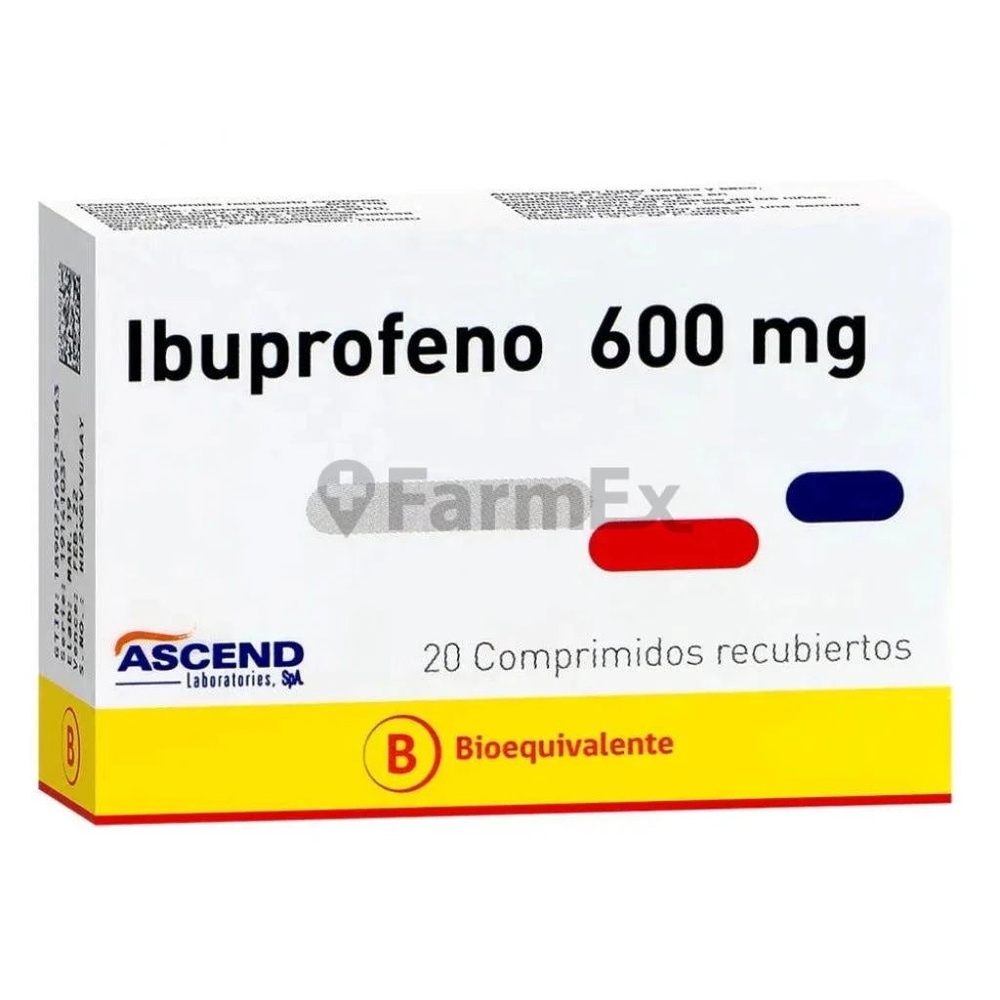
- País de registro
- Forma farmacéuticaCOMPRIMIDO, 600 mg
- Código ATCM01AE01
- Principio activo
- Requiere recetaSí
- Fabricante
- ComposiciónLACTOSA MONOHIDRATO (14,68 mg mg)
- Esta información es de carácter general y no sustituye la consulta con un profesional sanitario.
- Alternativas a IBUPROFENO FAIRMED 600 MG COMPRIMIDOS RECUBIERTOS CON PELICULA EFGForma farmacéutica: SOLUCIÓN/SUSPENSIÓN ORAL, 600 mg ibuprofenoPrincipio activo: IbuprofenoRequiere recetaForma farmacéutica: SOLUCIÓN/SUSPENSIÓN ORAL, 200 mgPrincipio activo: IbuprofenoRequiere recetaForma farmacéutica: SOLUCIÓN/SUSPENSIÓN ORAL, 20 mg/mlPrincipio activo: IbuprofenoRequiere receta
Médicos online para IBUPROFENO FAIRMED 600 MG COMPRIMIDOS RECUBIERTOS CON PELICULA EFG
Comenta la dosis, los posibles efectos secundarios, interacciones, contraindicaciones o la revisión de receta de IBUPROFENO FAIRMED 600 MG COMPRIMIDOS RECUBIERTOS CON PELICULA EFG, sujeto a valoración médica y a la normativa local.









Obtén una receta de IBUPROFENO FAIRMED 600 MG COMPRIMIDOS RECUBIERTOS CON PELICULA EFG online
Rellena un formulario de 2 minutos
Cuéntanos tus síntomas, historial y el medicamento que necesitas.
Elige un médico o nosotros te asignamos uno
Escoge un especialista o te conectamos con el próximo médico disponible.
El médico revisa tu caso
Normalmente en 30 minutos. Puede hacerte preguntas adicionales por chat.
Recógela en cualquier farmacia
Receta electrónica enviada a tu correo, válida en toda España.
Preguntas frecuentes
IBUPROFENO FAIRMED 600 MG COMPRIMIDOS RECUBIERTOS CON PELICULA EFG requiere receta en España. Puedes confirmarlo con un médico online según tu caso.
El principio activo de IBUPROFENO FAIRMED 600 MG COMPRIMIDOS RECUBIERTOS CON PELICULA EFG es Ibuprofeno. Esta información ayuda a identificar medicamentos con la misma composición pero con diferentes nombres comerciales.
IBUPROFENO FAIRMED 600 MG COMPRIMIDOS RECUBIERTOS CON PELICULA EFG es fabricado por Fairmed Healthcare Gmbh. La marca y el envase pueden variar según el distribuidor.
Los Médicos de familia, Psiquiatras, Dermatólogos, Cardiólogos, Endocrinólogos, Gastroenterólogos, Neumólogos, Nefrólogos, Reumatólogos, Hematólogos, Infectólogos, Alergólogos, Geriatras, Pediatras, Oncólogos pueden valorar la prescripción de IBUPROFENO FAIRMED 600 MG COMPRIMIDOS RECUBIERTOS CON PELICULA EFG cuando esté clínicamente indicado. Puedes reservar una videoconsulta para comentar tu caso y las opciones de tratamiento.
España cuenta con una infraestructura sanitaria bien desarrollada en ciudades principales como Madrid, Barcelona, Valencia y Sevilla. Las farmacias están ampliamente disponibles y operan bajo estrictas regulaciones, garantizando el acceso a medicamentos con receta.
Puedes comprar IBUPROFENO FAIRMED 600 MG COMPRIMIDOS RECUBIERTOS CON PELICULA EFG en Madrid, Barcelona, Sevilla o Valencia en cualquier farmacia local con una receta válida.
Para obtener una receta, puedes utilizar Oladoctor:
Otros medicamentos con el mismo principio activo (Ibuprofeno) incluyen ALGIDRIN 600 POLVO PARA SUSPENSION ORAL, ALGIDRIN INFANTIL 200 mg POLVO PARA SUSPENSION ORAL, ALGIDRIN PEDIATRICO 20 MG/ML SUSPENSION ORAL. Pueden tener diferentes nombres comerciales o formulaciones, pero contienen el mismo componente terapéutico. Consulta siempre con un médico antes de cambiar o iniciar un nuevo medicamento.
