



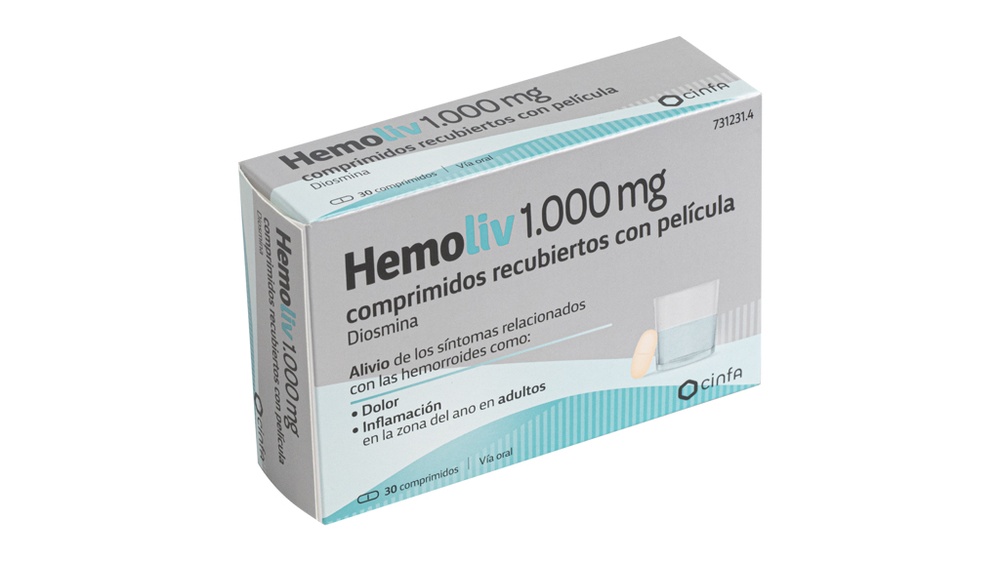
HEMOLIV 1000 mg Comprimidos Recubiertos Con Película

Revisión de receta online
Un médico revisará tu caso y determinará si la prescripción es médicamente apropiada.

Habla con un médico sobre este medicamento
Comenta tus síntomas y las opciones de tratamiento en una consulta online.



Cómo usar HEMOLIV 1.000 MG COMPRIMIDOS RECUBIERTOS CON PELICULA
Contenido del prospecto
- Introducción
- Qué es Hemoliv y para qué se utiliza
- Qué necesita saber antes de empezar a tomar Hemoliv
- Cómo tomar Hemoliv
- Posibles efectos adversos
- Conservación de Hemoliv
- Contenido del envase e información adicional
Introducción
Prospecto: información para el usuario
Hemoliv 1.000 mg comprimidos recubiertos con película
Diosmina
Lea todo el prospecto detenidamente antes de empezar a tomar este medicamento, porque contiene información importante para usted.
Siga exactamente las instrucciones de administración del medicamento contenidas en este prospecto o las indicadas por su médico o farmacéutico.
- Conserve este prospecto, ya que puede tener que volver a leerlo.
- Si necesita consejo o más información, consulte a su farmacéutico.
- Si experimenta efectos adversos, consulte a su médico o farmacéutico, incluso si se trata de efectos adversos que no aparecen en este prospecto. Ver sección 4.
- Debe consultar a un médico si empeora o si no mejora después de 1 semana.
Contenido del prospecto
- Qué es Hemoliv y para qué se utiliza
- Qué necesita saber antes de empezar a tomar Hemoliv
- Cómo tomar Hemoliv
- Posibles efectos adversos
- Conservación de Hemoliv
- Contenido del envase e información adicional
1. Qué es Hemoliv y para qué se utiliza
Hemoliv es un medicamento venotónico: aumenta el tono de las venas y la resistencia de los capilares (pequeños vasos sanguíneos).
Está indicado para el alivio de los síntomas relacionados con las hemorroides como el dolor o la inflamación en la zona del ano en adultos.
Debe consultar a un médico si empeora o si no mejora después de 1 semana de tratamiento.

¿No estás seguro de si este medicamento es adecuado para ti?
Comenta tus síntomas y tratamiento con un médico online.
2. Qué necesita saber antes de empezar a tomar Hemoliv
No tome Hemoliv
Si es alérgico a la diosmina, a otros flavonoides o a alguno de los demás componentes de este medicamento (incluidos en la sección 6).
Advertencias y precauciones
Consulte a su médico o farmacéutico antes de empezar a tomar Hemoliv.
Si los síntomas persisten más de 7 días, debe consultar con su médico.
Niños y adolescentes
Hemoliv no está indicado en niños y adolescentes (menores de 18 años).
Otros medicamentos y Hemoliv
Informe a su médico o farmacéutico si está tomando, ha tomado recientemente o pudiera tener que tomar cualquier otro medicamento.
No se conocen interacciones con los alimentos ni con otros medicamentos, en todo caso nunca debe tomar otro medicamento por iniciativa propia sin que se lo haya recomendado su médico.
Embarazo y lactancia
Si está embarazada o en periodo de lactancia, cree que podría estar embarazada o tiene intención de quedarse embarazada, consulte a su médico o farmacéutico antes de utilizar este medicamento.
Embarazo
Como medida de precaución, es preferible evitar el uso de Hemoliv durante el embarazo.
Lactancia
No se recomienda la lactancia durante el tratamiento por la ausencia de datos sobre la excreción del medicamento en la leche materna.
Conducción y uso de máquinas
No se ha descrito ningún efecto sobre la capacidad de conducción y uso de máquinas con Hemoliv.
Hemoliv contiene lactosa.
Si su médico le ha indicado que padece una intolerancia a ciertos azúcares, consulte con él antes de tomar este medicamento.
Hemoliv contiene sodio.
Este medicamento contiene menos de 23 mg de sodio (1 mmol) por comprimido; esto es, esencialmente “exento de sodio”.
3. Cómo tomar Hemoliv
Siga exactamente las instrucciones de administración del medicamento contenidas en este prospecto o las indicadas por su médico o farmacéutico. En caso de duda, pregunte a su médico o farmacéutico.
Adultos:
La dosis recomendada es de 3 comprimidos al día durante los cuatro primeros días y 2 comprimidos al día durante los próximos 3 días. Después de esto se puede mantener una dosis de 1 comprimido al día. Los comprimidos deben tomarse con agua para facilitar la deglución.
El comprimido se puede partir en dosis iguales.
Si los síntomas no mejoran o empeoran en la primera semana de tratamiento, debe consultar al médico.
Si toma más Hemoliv del que debe
En caso de sobredosis o ingestión accidental consulte inmediatamente a su médico o farmacéutico o llame al Servicio de Información Toxicológica, teléfono 91 562 04 20, indicando el medicamento y la cantidad ingerida.
Si olvidó tomar Hemoliv
Es importante tomar este medicamento cada día. Sin embargo, si olvidó tomar una o más dosis de Hemoliv, tome otra tan pronto como se acuerde y después siga con el tratamiento.
No tome una dosis doble para compensar las dosis olvidadas.

¿Has empezado a tomar el medicamento y tienes preguntas?
Comenta tus síntomas y tratamiento con un médico online.
4. Posibles efectos adversos
Al igual que todos los medicamentos, este medicamento puede producir efectos adversos, aunque no todas las personas los sufran.
Estos efectos adversos incluyen:
- Frecuentes (pueden afectar hasta 1 de cada 10 pacientes): trastornos gastrointestinales (diarrea, indigestión, náuseas, vómitos).
- Poco frecuentes (pueden afectar hasta 1 de cada 100 pacientes): colitis.
- Raros (pueden afectar hasta 1 de cada 1.000 pacientes): trastornos del sistema nervioso (mareos, dolor de cabeza, malestar) y reacciones cutáneas (erupción cutánea, prurito, urticaria).
- Frecuencia no conocida (no puede estimarse a partir de los datos disponibles): dolor abdominal, edema aislado de la cara, labios y párpados (hinchazón). Excepcionalmente edema de Quincke (hinchazón rápida de tejidos tales como la cara, labios, boca, lengua o garganta que puede causar dificultad para respirar).
Comunicación de efectos adversos
Si experimenta cualquier tipo de efecto adverso, consulte a su médico o farmacéutico, incluso si se trata de posibles efectos adversos que no aparecen en este prospecto. También puede comunicarlos directamente a través del Sistema Español de Farmacovigilancia de Medicamentos de Uso Humano: https://www.notificaram.es/. Mediante la comunicación de efectos adversos usted puede contribuir a proporcionar más información sobre la seguridad de este medicamento.
5. Conservación de Hemoliv
Mantener este medicamento fuera de la vista y del alcance de los niños.
No utilice este medicamento después de la fecha de caducidad que aparece en el envase después de CAD. La fecha de caducidad es el último día del mes que se indica.
Conservar en el embalaje original para protegerlo de la luz.
Los medicamentos no se deben tirar por los desagües ni a la basura. Deposite los envases y los medicamentos que no necesita en el Punto SIGRE de la farmacia. En caso de duda, pregunte a su farmacéutico cómo deshacerse de los envases y de los medicamentos que no necesita. De esta forma, ayudará a proteger el medio ambiente.
6. Contenido del envase e información adicional
Composición de Hemoliv
- El principio activo es diosmina (1.000 mg por comprimido).
- Los demás componentes son:
Núcleo del comprimido: celulosa microcristalina (E-460), gelatina, carboximetilalmidón sódico (tipo A) (de patata), talco y estearato de magnesio.
Recubrimiento del comprimido: Opadry OY-L-28900 white (lactosa monohidrato, hipromelosa, dióxido de titanio, macrogol 4000), óxido de hierro amarillo (E-172) y óxido de hierro rojo (E-172).
Aspecto del producto y contenido del envase
Comprimidos recubiertos con película, biconvexos, oblongos, ranurados, de color salmón y marcados con el código “D1000” en una cara.
Los comprimidos se acondicionan en blísteres unidosis de PVC-PVDC/Aluminio. Cada envase contiene 30 comprimidos.
Titular de la autorización de comercialización y responsable de la fabricación
Laboratorios Cinfa, S.A.
Carretera Olaz-Chipi, 10. Polígono Industrial Areta
31620 Huarte (Navarra) - España
Fecha de la última revisión de este prospecto: Junio 2021
La información detallada y actualizada de este medicamento está disponible en la página web de la Agencia Española de Medicamentos y Productos Sanitarios (AEMPS) http://www.aemps.gob.es/
- País de registro
- Forma farmacéuticaCOMPRIMIDO, 1.000 mg
- Código ATCC05CA03
- Principio activo
- Requiere recetaNo
- Fabricante
- ComposiciónLACTOSA MONOHIDRATO (9,25 mg mg)
- Esta información es de carácter general y no sustituye la consulta con un profesional sanitario.
- Alternativas a HEMOLIV 1.000 MG COMPRIMIDOS RECUBIERTOS CON PELICULAForma farmacéutica: COMPRIMIDO, Diosmina 450 mg / Hesperidina 50 mgPrincipio activo: Diosmina, diosmin, combinationsFabricante: Kern Pharma S.L.No requiere recetaForma farmacéutica: COMPRIMIDO, 1000 mgPrincipio activo: DiosminaFabricante: Laboratorios Cinfa S.A.No requiere recetaForma farmacéutica: COMPRIMIDO, 500 mgPrincipio activo: diosmin, combinationsFabricante: Laboratorios Servier S.L.No requiere receta
Médicos online para HEMOLIV 1.000 MG COMPRIMIDOS RECUBIERTOS CON PELICULA
Comenta la dosis, los posibles efectos secundarios, interacciones, contraindicaciones o la revisión de receta de HEMOLIV 1.000 MG COMPRIMIDOS RECUBIERTOS CON PELICULA, sujeto a valoración médica y a la normativa local.









Obtén una receta de HEMOLIV 1.000 MG COMPRIMIDOS RECUBIERTOS CON PELICULA online
Rellena un formulario de 2 minutos
Cuéntanos tus síntomas, historial y el medicamento que necesitas.
Elige un médico o nosotros te asignamos uno
Escoge un especialista o te conectamos con el próximo médico disponible.
El médico revisa tu caso
Normalmente en 30 minutos. Puede hacerte preguntas adicionales por chat.
Recógela en cualquier farmacia
Receta electrónica enviada a tu correo, válida en toda España.
Preguntas frecuentes
HEMOLIV 1.000 MG COMPRIMIDOS RECUBIERTOS CON PELICULA no requiere receta en España. Puedes confirmarlo con un médico online según tu caso.
El principio activo de HEMOLIV 1.000 MG COMPRIMIDOS RECUBIERTOS CON PELICULA es Diosmina. Esta información ayuda a identificar medicamentos con la misma composición pero con diferentes nombres comerciales.
HEMOLIV 1.000 MG COMPRIMIDOS RECUBIERTOS CON PELICULA es fabricado por Laboratorios Cinfa S.A.. La marca y el envase pueden variar según el distribuidor.
Los Médicos de familia, Psiquiatras, Dermatólogos, Cardiólogos, Endocrinólogos, Gastroenterólogos, Neumólogos, Nefrólogos, Reumatólogos, Hematólogos, Infectólogos, Alergólogos, Geriatras, Pediatras, Oncólogos pueden valorar la prescripción de HEMOLIV 1.000 MG COMPRIMIDOS RECUBIERTOS CON PELICULA cuando esté clínicamente indicado. Puedes reservar una videoconsulta para comentar tu caso y las opciones de tratamiento.
España cuenta con una infraestructura sanitaria bien desarrollada en ciudades principales como Madrid, Barcelona, Valencia y Sevilla. Las farmacias están ampliamente disponibles y operan bajo estrictas regulaciones, garantizando el acceso a medicamentos con receta.
Puedes comprar HEMOLIV 1.000 MG COMPRIMIDOS RECUBIERTOS CON PELICULA en Madrid, Barcelona, Sevilla o Valencia en cualquier farmacia local con una receta válida.
Para obtener una receta, puedes utilizar Oladoctor:
Otros medicamentos con el mismo principio activo (Diosmina) incluyen DIOSMINA KERN PHARMA 500 mg COMPRIMIDOS RECUBIERTOS CON PELICULA, VARILIV DIOSMINA FORTE 1.000 MG COMPRIMIDOS RECUBIERTOS CON PELICULA, DAFLON 500 MG COMPRIMIDOS RECUBIERTOS CON PELÍCULA. Pueden tener diferentes nombres comerciales o formulaciones, pero contienen el mismo componente terapéutico. Consulta siempre con un médico antes de cambiar o iniciar un nuevo medicamento.
