



GLUCOSALINO 5000 mg/900 mg Inyectable Perfusión

Revisión de receta online
Un médico revisará tu caso y determinará si la prescripción es médicamente apropiada.

Habla con un médico sobre este medicamento
Comenta tus síntomas y las opciones de tratamiento en una consulta online.



Cómo usar GLUCOSALINO HIPERTONICO PHYSAN SOLUCION PARA PERFUSION
Contenido del prospecto
- Introducción
- Qué es Glucosalino Hipertónico Physan y para qué se utiliza
- Qué necesita saber antes de empezar a usar Glucosalino Hipertónico Physan
- Cómo usar Glucosalino Hipertónico Physan
- Posibles efectos adversos
- Conservación de Glucosalino Hipertónico Physan
- Contenido del envase e información adicional
Introducción
Prospecto: información para el usuario
Glucosalino Hipertónico Physan solución para perfusión
Cloruro de sodio, Glucosa anhidra
Lea todo el prospecto detenidamente antes de empezar a usar el medicamento, porque contiene información importante para usted
- Conserve este prospecto, ya que puede tener que volver a leerlo.
- Si tiene alguna duda, consulte a su médico, farmacéutico o enfermero.
- Si experimenta efectos adversos, consulte a su médico, farmacéutico o enfermero, incluso si se trata de efectos adversos que no aparecen en este prospecto. Ver sección 4
Contenido del prospecto
- Qué es Glucosalino Hipertónico Physan y para qué se utiliza
- Qué necesita saber antes de empezar a usar Glucosalino Hipertónico Physan
- Cómo usar Glucosalino Hipertónico Physan
- Posibles efectos adversos
- Conservación de Glucosalino Hipertónico Physan
- Contenido del envase e información adicional
1. Qué es Glucosalino Hipertónico Physan y para qué se utiliza
Glucosalino Hipertónico Physan pertenece al grupo de medicamentos denominado soluciones que afectan al balance electrolítico. Electrolitos asociados con hidratos de carbono.
Se utiliza como aporte de sales y agua en los casos en los que exista deshidratación con pérdidas moderadas de sales y agua: vómitos, diarreas, fístulas, sudoración excesiva, en casos de necesitar la administración de agua, hidratos de carbono y sales y metabolismo alterado de los azúcares: vómitos acetonémicos, coma insulínico.

¿No estás seguro de si este medicamento es adecuado para ti?
Comenta tus síntomas y tratamiento con un médico online.
2. Qué necesita saber antes de empezar a usar Glucosalino Hipertónico Physan
No use Glucosalino Hipertónico Physan:
Si es alérgico al cloruro de sodio, glucosa anhidra o a alguno de los demás componentes de este medicamento (incluidos en la sección 6).
Si usted padece:
- Hiperhidratación extracelular o hipervolemia
- Retención de líquidos y sodio
- Enfermedades graves de los riñones.
- Enfermedades del corazón.
- Hipernatremia (exceso de sodio en sangre)
- Hipercloremia (exceso de cloro en sangre)
- Edema general o cirrosis ascítica
- No debe administrarse en las 24 horas siguientes tras sufrir un traumatismo craneal.
- Diabetes descompensada u otras intolerancias conocidas a la glucosa, coma hiperosmolar, hiperglucemia e hiperlactacidemia.
Advertencias y precauciones
Consulte a su médico, farmacéutico o enfermero antes de empezar a usar Glucosalino Hipertónico Physan.
La solución es hipertónica con una osmolaridad aproximada de 586 mosmol/l.
La perfusión de grandes volúmenes se debe hacer bajo monitorización específica en pacientes con fallos del corazón, pulmones o riñones.
Si padece descompensación cardiovascular o recibe tratamiento con corticosteroides o corticotropina.
Las sales de sodio deben administrarse con precaución a pacientes con hipertensión, fallo cardiaco, edema periférico o pulmonar, disfunción renal, preeclampsia u otras condiciones asociadas con la retención de sodio.
Debido a una función renal inmadura, prematuros y lactantes a término pueden retener un exceso de sodio. Por lo tanto, en prematuros y lactantes a término, las perfusiones repetidas de cloruro de sodio sólo se deben dar después de la determinación de los niveles de sodio séricos.
La perfusión de soluciones de glucosa está contraindicada en las primeras 24 horas después de traumatismo craneal y la concentración de glucosa en sangre debe ser monitorizada cuidadosamente durante episodios de hipertensión intracraneal.
En caso de haber sufrido ataques isquémicos agudos (disminución o ausencia de circulación en arterias), ya que la hiperglucemia se ha relacionado con un incremento en el daño isquémico cerebral y dificultad en la recuperación.
Si padece diabetes o enfermedades del riñón su médico puede solicitar que se realicen análisis de sangre para monitorizar su estado ya que hay que controlar el balance de agua, glucosa y sales que existen en el organismo.
En diabetes las soluciones de glucosa pueden ser utilizadas siempre que le haya sido instaurado el tratamiento adecuado (insulina). La glucemia debe monitorizarse de forma regular en pacientes diabéticos y modificar los requerimientos de insulina.
Si se produce hiperglucemia, la velocidad de perfusión se deberá ajustar o administrar insulina.
En tratamientos prolongados, se debe proporcionar al paciente un tratamiento nutritivo adecuado.
Para evitar la hipopotasemia producida durante la administración parenteral prolongada de glucosalina, se le podrá adicionar potasio a la solución glucosalina, como medida de seguridad.
No administrar sangre simultáneamente utilizando el mismo equipo de perfusión debido al riesgo de pseudoaglutinación y/o hemólisis.
Las soluciones glucosadas para perfusión intravenosa son generalmente isotónicas. Sin embargo, en el organismo las soluciones glucosadas pueden hacerse extremadamente hipotónicas fisiológicamente debido a la rápida metabolización de la glucosa
Dependiendo de la tonicidad de la solución, el volumen y la velocidad de perfusión y el estado clínico inicial del paciente y su capacidad para metabolizar la glucosa, la administración intravenosa de glucosa puede causar alteraciones electrolíticas, la más importante de las cuales es la hiponatremia hiperosmótica.
Hiponatremia:
Los pacientes con liberación no osmótica de vasopresina (p. ej., en presencia de estados críticos, dolor, estrés posoperatorio, infecciones, quemaduras y enfermedades del SNC), los pacientes con enfermedades del corazón, el hígado y el riñón y los pacientes expuestos a agonistas de la vasopresina tienen un riesgo especial de experimentar hiponatremia aguda tras la perfusión de soluciones hipotónicas.
La hiponatremia aguda puede causar una encefalopatía hiponatrémica aguda (edema cerebral) caracterizada por cefalea, náuseas, convulsiones, letargo y vómitos. Los pacientes con edema cerebral tienen un riesgo especial de sufrir un daño cerebral grave, irreversible y potencialmente mortal.
Los niños, las mujeres en edad fértil y los pacientes con distensibilidad cerebral reducida (p. ej., en caso de meningitis, hemorragia intracraneal y contusión cerebral) tienen un riesgo especial de sufrir edema cerebral grave y potencialmente mortal causado por una hiponatremia aguda.
Uso de Glucosalino Hipertónico Physan con otros medicamentos
Informe a su médico o farmacéutico si está utilizando, ha utilizado recientemente o pudiera tener que utilizar cualquier otro medicamento.
El cloruro de sodio presenta interacción con las sales de litio cuya excreción renal es directamente proporcional a los niveles de sodio en el organismo. De esta manera la administración de soluciones que contengan cloruro de sodio puede acelerar la excreción renal del litio, dando lugar a una disminución de la acción terapéutica de este.
Las soluciones conteniendo glucosa pueden reducir la eficacia terapéutica de la insulina o antidiabéticos orales (biguanidas, sulfonilureas).
La administración junto con corticoides puede dar lugar a niveles altos de glucosa (acción hiperglucemiante) y retención de agua y sodio.
Si la administración de glucosa coincide con un tratamiento con glucósidos digitálicos (digoxina) se puede producir un aumento de la actividad digitálica existiendo el riesgo de desarrollar intoxicaciones por estos medicamentos debido a la hipopotasemia que puede provocar la administración de esta solución si no se añade potasio.
Las soluciones con glucosa no deben administrarse a través del mismo equipo de perfusión que la sangre entera, por el riesgo de que se produzca hemólisis y aglutinación.
En cualquier caso, el médico deberá comprobar la compatibilidad de los medicamentos añadidos.
Medicamentos que potencian el efecto de la vasopresina
Los siguientes medicamentos aumentan el efecto de la vasopresina, lo que hace que se reduzca la excreción renal de agua sin electrolitos y aumenta el riesgo de hiponatremia hospitalaria tras un tratamiento indebidamente equilibrado con soluciones para perfusión i.v.
- Medicamentos que estimulan la liberación de vasopresina; p. ej.: clorpropamida, clofibrato, carbamacepina, vincristina, inhibidores selectivos de la recaptación de serotonina, 3,4metilendioxi-N-metanfetamina, ifosfamida, antipsicóticos, narcoticos
- Medicamentos que potencian la acción de la vasopresina; p. ej.: clorpropamida, AINE, ciclofosfamida
- Análogos de la vasopresina; p. ej.: desmopresina, oxitocina, vasopresina, terlipresina
Otros medicamentos que se sabe que aumentan el riesgo de hiponatremia los diuréticos en general y antiepilépticos como la oxcarbazepina.
Embarazo y lactancia
Glucosalino Hipertónico Physan debe administrarse con especial precaución en mujeres embarazadas durante el parto, especialmente si se administra en combinación con oxitocina, debido al riesgo de hiponatremia.
Si está embarazada o en periodo de lactancia, cree que podría estar embarazada o tiene intención de quedarse embarazada, consulte a su médico o farmacéutico antes de utilizar un medicamento.
Siempre que la administración sea correcta y controlada no se esperan efectos adversos durante el embarazo y la lactancia.
Hasta el momento no se dispone de datos epidemiológicos relevantes por lo que se recomienda que si se utiliza durante este período se haga con precaución.
Conducción y uso de máquinas:
No procede, por las características de su empleo.
3. Cómo usar Glucosalino Hipertónico Physan
Su médico, le indicará la dosis más adecuada para sus necesidades. Por lo general, se recomienda la administración intravenosa gota a gota de acuerdo con su edad, peso corporal, situación clínica, y estado metabólico.
La dosificación recomendada es:
-para adultos, ancianos y adolescentes: 500 ml a 3 litros cada 24 horas.
-para lactantes y niños:
de 0 a 10 kg de peso corporal: 100 ml/kg/24 h.
de 10 a 20 kg de peso corporal: 1000 ml + (50 ml/kg por encima de 10 kg)/24 h.
>20 kg de peso corporal: 1500 ml + (20 ml/kg por encima de 20 kg)/ 24 h.
La velocidad de perfusión es normalmente de 40 ml/kg/24 h en adultos, ancianos y adolescentes.
En pacientes pediátricos la velocidad de perfusión es de 5 ml/kg/h de media, pero este valor varía con la edad: 6-8 ml/kg/h para niños menores de 12 meses, 4-6 ml/kg/h para niños de 12-23 meses y 2-4 ml/kg/h para niños en edad escolar (2-11 años).
La velocidad de perfusión no deberá exceder la capacidad de oxidación de glucosa del paciente con objeto de evitar hiperglucemia (exceso de azúcar en sangre). Por lo tanto, la dosis máxima oscila desde 5 mg/kg/min. para adultos a 10-18 mg/kg/min. para lactantes y niños dependiendo de la edad y la masa total corporal.
Si se administra continuamente en el mismo lugar de perfusión, puede producirse tromboflebitis (inflamación de las venas).
Deberá prestarse especial atención si se usa en pacientes de edad avanzada, debido a que pueden tener afectadas las funciones hepáticas y/o renales.
Las sales de sodio deben administrarse con precaución a pacientes con hipertensión, fallo cardíaco, edema periférico o pulmonar, disfunción del riñón, convulsiones u otras condiciones asociadas con la retención de sodio.
Es recomendable que se realicen controles del balance de agua, sales y glucosa, sobre todo si hay descompensación cardiovascular o si recibe un tratamiento con corticoesteroides o corticotropina.
Si a usted le han administrado más Glucosalino Hipertónico Physan solución para perfusión del que debieran:
- En caso de sobredosis puede aparecer hiperglucemia (alta concentración de azúcar en sangre), glucosuria (azúcar en orina), hiperhidratación o hipernatremia (alta concentración de sodio en sangre) y edema generalizado (acumulación de líquido). Se suspenderá la administración y se recurrirá al tratamiento sintomático.
- La administración prolongada o rápida de grandes volúmenes de soluciones conteniendo glucosa puede dar lugar a hiperosmolaridad (riesgo de pérdida de conciencia o confusión mental), deshidratación, hiperglucemia, hiperglucosuria, y diuresis osmótica (debido a la hiperglucemia).
- La hiperglucemia debe vigilarse especialmente en los casos graves de diabetes mellitus, pudiendo evitarse disminuyendo la dosis y la velocidad de perfusión o bien administrando insulina.
- El abuso o una administración demasiado rápida pueden dar lugar a un exceso de agua y sodio (hipernatremia) con riesgo de edema, particularmente cuando hay una excreción renal defectuosa de sodio. En este caso puede ser necesaria una diálisis renal extra.
- Raramente se produce hipernatremia después de dosis terapéuticas de cloruro de sodio. El efecto más serio de la hipernatremia es la deshidratación del cerebro lo que causa somnolencia y confusión que progresa a convulsiones, coma, insuficiencia respiratoria y muerte. Otros síntomas incluyen sed, salivación y lagrimeo reducidos, fiebre, taquicardia, hipertensión, dolor de cabeza, vértigo, cansancio, irritabilidad y debilidad.
- La administración excesiva de sales de cloro puede producir una pérdida de bicarbonato con efecto acidificante.
En caso de sobredosis o ingestión accidental, consultar al Servicio de Información Toxicológica. Teléfono: 915 620 420.

¿Has empezado a tomar el medicamento y tienes preguntas?
Comenta tus síntomas y tratamiento con un médico online.
4. Posibles efectos adversos
Al igual que todos los medicamentos, este medicamento puede producir efectos adversos, aunque no todas las personas los sufran.
Al administrar esta solución se ha observado que se produce con frecuencia hiperhidratación (retención de líquidos) y fallo del corazón en pacientes con enfermedades del corazón o edema pulmonar y alteraciones electrolíticas asintomáticas
Una administración demasiado rápida puede provocar hiperglucemia y síndrome hiperosmolar (riesgo de pérdida de conciencia o confusión mental) especialmente en intolerantes a la glucosa.
Se pueden producir reacciones adversas asociadas con la técnica de administración, incluyendo fiebre, infección en el lugar de la inyección, reacción o dolor local, irritación venosa, trombosis venosa o flebitis extendiéndose desde el lugar de inyección, extravasación e hipervolemia.
Las reacciones adversas pueden estar asociadas a los medicamentos añadidos a la solución, la naturaleza del medicamento añadido determinará la posibilidad de cualquier otro efecto indeseable.
Reacciones adversas
Trastornos del metabolismo y de la nutrición con hiponatremia hospitalaria** de frecuencia no conocida.
Trastornos del sistema nervioso con encefalopatía hiponatrémica** de frecuencia no conocida.
** La hiponatremia hospitalaria puede causar un daño cerebral irreversible y la muerte debido a la aparición de una encefalopatía hiponatremia aguda
Comunicación de efectos adversos
Si experimenta cualquier tipo de efecto adverso, consulte a su médico, farmacéutico o enfermero, incluso si se trata de posibles efectos adversos que no aparecen en este prospecto. También puede comunicarlos directamente a través del Sistema Español de Farmacovigilancia de Medicamentos de Uso Humano: www.notificaRAM.es. Mediante la comunicación de efectos adversos usted puede contribuir a proporcionar más información sobre la seguridad de este medicamento.
5. Conservación de Glucosalino Hipertónico Physan
Mantener este medicamento fuera de la vista y del alcance de los niños.
Frascos de vidrio: No se requieren condiciones especiales de conservación.
Frascos de polipropileno: Conservar por debajo de 30°C.
No utilice este medicamento después de la fecha de caducidad que aparece en la etiqueta después de CAD. La fecha de caducidad es el último día del mes que se indica.
No utilice este medicamento si observa indicios visibles de deterioro.
Los medicamentos no se deben tirar por los desagües ni a la basura. Pregunte a su farmacéutico cómo deshacerse de los envases y de los medicamentos que ya no necesita. De esta forma, ayudará a proteger el medio ambiente.
6. Contenido del envase e información adicional
Composición de Glucosalino Hipertónico Laphysan
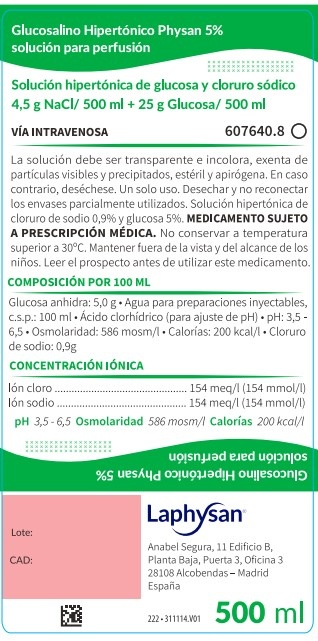
- Los principios activos son: por 100 ml, cloruro de sodio 0,9g, glucosa anhidra 5g.
- Los demás componentes (excipientes) son: agua para preparaciones inyectables y ácido clorhídrico (para ajuste de pH).
La composición electrolítica es:
Ion sodio 154 mmol/l, (154 meq/l).
Ion cloro 154 mmol/l, (154 meq/l).
Osmolaridad teórica: 586 mosm/l.
Calorías teóricas: 200 kcal/l.
pH: 3,5-6,5.
Aspecto del producto y contenido del envase
Solución transparente e incolora, sin partículas visibles, estéril y apirógena.
Glucosalino Hipertónico Physan es una solución para perfusión que se presenta en envases de 100 ml conteniendo 50 ml o 100 ml de solución, envases de 250 ml, 500 ml y 1000 ml.
Se presenta en frascos de vidrio tipo II, Frascos de polipropileno (Tapón Flip Off), Frascos de Polipropileno (Tapón twin head), de las siguientes capacidades:
- Frascos de 100 ml conteniendo 50 ml o 100 ml de solución.
- Frascos de 250 ml
- Frascos de 500 ml
- Frascos de 1000 ml.
Se dispone también de envases clínicos con las siguientes presentaciones:
- 30 frascos de 100 ml conteniendo 50 ml o 100 ml de solución.
- 24 frascos de 250 ml
- 10 frascos de 500 ml
- 20 frascos de 500 ml
- 10 frascos de 1000 ml.
Titular de la autorización de comercialización y responsable de la fabricación
Titular de la autorización de comercialización:
LAPHYSAN, S.A.U.
Anabel Segura, 11 Edificio A, Planta 4, Puerta D
28108 Alcobendas – Madrid, España
Responsable de la fabricación:
S.M. FARMACEUTICI SRL
Zona industriale
85050 TITO – POTENZA, Italia
o
Laboratórios Basi - Indústria Farmacêutica S.A.
Parque Industrial Manuel Lourenço Ferreira, Lotes 8, 15 e 16
3450-232 Mortágua
Portugal
Fecha de la última revisión de este prospecto:Octubre 2022
------------------------------------------------------------------------------------------------------
Esta información está destinada únicamente a profesionales del sector sanitario:
Este medicamento será administrado siempre por personal especializado. Se administrará por perfusión, por una vena central o periférica.
La solución debe ser transparente, sin partículas y no contener precipitados. No administrar en caso contrario.
El contenido de cada frasco es para una sola perfusión, debe desecharse la fracción no utilizada.
Utilizar un método aséptico, para administrar la solución y en caso de preparación de mezclas.
Antes de adicionar medicamentos a la solución o de administrar simultáneamente con otros medicamentos se debe comprobar que no existen incompatibilidades.
Desechar después de un solo uso.
Desechar los envases parcialmente usados.
No reconectar envases parcialmente utilizados.
Puede que se tenga que vigilar el balance hídrico, la glucosa sérica, el sodio sérico y otros electrolitos
antes y durante la administración, especialmente en pacientes con aumento de la liberación no
osmótica de vasopresina (síndrome de secreción inadecuada de la hormona antidiurética, SIADH) y en pacientes que reciban medicación concomitante con agonistas de la vasopresina debido al riesgo de hiponatremia.
La vigilancia del sodio sérico es especialmente importante cuando se administran soluciones
fisiológicamente hipotónicas. Glucosalino hipertónico Physan puede hacerse extremadamente hipotónico tras su administración debido a la metabolización de la glucosa en el cuerpo.
- País de registro
- Forma farmacéuticaINYECTABLE PERFUSION, 5.000 MG GLUCOSA Y 900 MG CLORURO SÓDICO/100 ML SL
- Código ATCB05BB02
- Principio activo
- Requiere recetaSí
- Fabricante
- Esta información es de carácter general y no sustituye la consulta con un profesional sanitario.
- Alternativas a GLUCOSALINO HIPERTONICO PHYSAN SOLUCION PARA PERFUSIONForma farmacéutica: INYECTABLE PERFUSION, 0,09 g / 0,07 g / 1,6 g / 0,17 g / 12,5 g / 0,19 g / 1,23 gPrincipio activo: electrolytes with carbohydratesFabricante: Fresenius Kabi España, S.A.U.Requiere recetaForma farmacéutica: INYECTABLE PERFUSION, 0,31 g / 21,9 mg / 0,03 g / 0,6 gPrincipio activo: electrolytes with carbohydratesFabricante: Fresenius Kabi España, S.A.U.Requiere recetaForma farmacéutica: INYECTABLE PERFUSION, NAPrincipio activo: electrolytes with carbohydratesFabricante: Fresenius Kabi España, S.A.U.Requiere receta
Médicos online para GLUCOSALINO HIPERTONICO PHYSAN SOLUCION PARA PERFUSION
Comenta la dosis, los posibles efectos secundarios, interacciones, contraindicaciones o la revisión de receta de GLUCOSALINO HIPERTONICO PHYSAN SOLUCION PARA PERFUSION, sujeto a valoración médica y a la normativa local.









Obtén una receta de GLUCOSALINO HIPERTONICO PHYSAN SOLUCION PARA PERFUSION online
Rellena un formulario de 2 minutos
Cuéntanos tus síntomas, historial y el medicamento que necesitas.
Elige un médico o nosotros te asignamos uno
Escoge un especialista o te conectamos con el próximo médico disponible.
El médico revisa tu caso
Normalmente en 30 minutos. Puede hacerte preguntas adicionales por chat.
Recógela en cualquier farmacia
Receta electrónica enviada a tu correo, válida en toda España.
Preguntas frecuentes
GLUCOSALINO HIPERTONICO PHYSAN SOLUCION PARA PERFUSION requiere receta en España. Puedes confirmarlo con un médico online según tu caso.
El principio activo de GLUCOSALINO HIPERTONICO PHYSAN SOLUCION PARA PERFUSION es electrolytes with carbohydrates. Esta información ayuda a identificar medicamentos con la misma composición pero con diferentes nombres comerciales.
GLUCOSALINO HIPERTONICO PHYSAN SOLUCION PARA PERFUSION es fabricado por Laphysan S.A.U.. La marca y el envase pueden variar según el distribuidor.
Los Médicos de familia, Psiquiatras, Dermatólogos, Cardiólogos, Endocrinólogos, Gastroenterólogos, Neumólogos, Nefrólogos, Reumatólogos, Hematólogos, Infectólogos, Alergólogos, Geriatras, Pediatras, Oncólogos pueden valorar la prescripción de GLUCOSALINO HIPERTONICO PHYSAN SOLUCION PARA PERFUSION cuando esté clínicamente indicado. Puedes reservar una videoconsulta para comentar tu caso y las opciones de tratamiento.
España cuenta con una infraestructura sanitaria bien desarrollada en ciudades principales como Madrid, Barcelona, Valencia y Sevilla. Las farmacias están ampliamente disponibles y operan bajo estrictas regulaciones, garantizando el acceso a medicamentos con receta.
Puedes comprar GLUCOSALINO HIPERTONICO PHYSAN SOLUCION PARA PERFUSION en Madrid, Barcelona, Sevilla o Valencia en cualquier farmacia local con una receta válida.
Para obtener una receta, puedes utilizar Oladoctor:
Otros medicamentos con el mismo principio activo (electrolytes with carbohydrates) incluyen APIROSERUM NORMAION RESTAURADOR, APIROSERUM RINGER-LACTATO SOLUCION PARA PERFUSION, BENELYTE SOLUCION PARA PERFUSION. Pueden tener diferentes nombres comerciales o formulaciones, pero contienen el mismo componente terapéutico. Consulta siempre con un médico antes de cambiar o iniciar un nuevo medicamento.
