



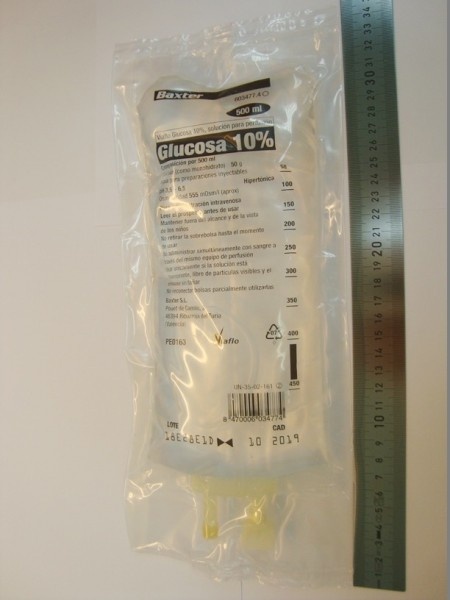
GLUCOSA 11 g/100 ml Solución para perfusión

Revisión de receta online
Un médico revisará tu caso y determinará si la prescripción es médicamente apropiada.

Habla con un médico sobre este medicamento
Comenta tus síntomas y las opciones de tratamiento en una consulta online.



Cómo usar GLUCOSA BAXTER 10% SOLUCIÓN PARA PERFUSIÓN
Contenido del prospecto
- Introducción
- Qué es Glucosa Baxter 10% y para qué se utiliza
- Qué necesita saber antes de que le administren Glucosa Baxter 10%
- Cómo le administrarán Glucosa Baxter 10%
- Posibles efectos adversos
- Conservación de Glucosa Baxter 10%
- Contenido del envase e información adicional
Introducción
Prospecto: información para elusuario
Glucosa Baxter 10%solución para perfusión
Principio activo: Glucosa
Lea todo el prospecto detenidamente antes de empezar a usar este medicamento, porque contiene información importante para usted.
- Conserve este prospecto, ya que puede tener que volver a leerlo.
- Si tiene alguna duda, consulte a su médico, farmacéutico o enfermero.
- Si experimenta efectos adversos consulte a su médico, farmacéutico o enfermero, incluso si se trata de efectos adversos que no aparecen en este prospecto.Ver sección 4.
Este medicamento se denomina “Glucosa Baxter 10% solución para perfusión”, pero se hará referencia al mismo como “Glucosa Baxter 10%” en el resto de este prospecto.
Contenido del prospecto:
- Qué es Glucosa Baxter 10% y para qué se utiliza
- Qué necesita saber antes de que le administren Glucosa Baxter 10%
- Cómo le administrarán Glucosa Baxter 10%
- Posibles efectos adversos
- Conservación de Glucosa Baxter 10%
- Contenido del envase e información adicional
1. Qué es Glucosa Baxter 10% y para qué se utiliza
Glucosa Baxter 10% es una solución de azúcar (glucosa) en agua. La glucosa es una de las principales fuentes de energía corporal. Esta solución para perfusión proporciona 400 kilocalorías por litro.
Glucosa Baxter 10% se utiliza para:
- proporcionar una fuente de azúcar (hidratos de carbono) sola o, si se requiere, para nutrición parenteral. La nutrición parenteral se utiliza para alimentar a los pacientes que no pueden comer. Se realiza mediante una inyección lenta (perfusión) a través de una vena.
- prevenir o tratar el nivel bajo de azúcar en sangre (hipoglucemia, que provoca síntomas pero no es mortal).
- proporcionar al paciente líquido adicional cuando el cuerpo no tiene suficiente agua (deshidratación) y usted necesita azúcar (hidratos de carbono) extra.
- diluir con agua otros medicamentos que se desea administrar por vía intravenosa.

¿No estás seguro de si este medicamento es adecuado para ti?
Comenta tus síntomas y tratamiento con un médico online.
2. Qué necesita saber antes de que le administren Glucosa Baxter 10%
NO le administrarán Glucosa Baxter 10% si sufre alguno de los siguientes trastornos:
- si sufre diabetes que no recibe el tratamiento adecuado, por lo que la concentración sanguínea de glucosa es superior a la normal (diabetes descompensada),
- pérdida del conocimiento (coma hiperosmolar). Se trata de un tipo de coma que se puede producir si padece diabetes y no recibe medicación adecuada,
- fluidificación de la sangre debido a la adición de demasiado líquido (hemodilución),
- cuando hay mucho líquido en los espacios extracelulares del cuerpo (hiperhidratación extracelular),
- cuando hay un mayor volumen de sangre en los vasos sanguíneos del que debería haber (hipervolemia),
- concentración sanguínea de glucosa superior a la normal (hiperglucemia),
- concentración sanguínea de lactato que se encuentra en la sangre, superior a la normal (hiperlactatemia),
- insuficiencia renal grave (cuando los riñones no funcionan bien y se necesita diálisis)
- insuficiencia cardíaca no compensada. Si la insuficiencia cardíaca no se ha tratado adecuadamente y provoca síntomas como:
- dificultad al respirar,
- hinchazón de tobillos,
- si hay acumulación de líquido bajo la piel, que afecta a todo el organismo incluyendo el cerebro y los pulmones (edema generalizado),
- enfermedad hepática que provoca acumulación de líquido en el abdomen (cirrosis ascítica),
- cualquier otra condición que afecte a la forma en la que su organismo controle el nivel de azúcar,
- intolerancia (hipersensibilidad) a la glucosa. Esto puede ocurrir en pacientes con alergia al maíz.
Si se añade otro medicamento a su solución para perfusión, lea su prospecto. De este modo se asegurará de que puede tomar ese medicamento.
Advertencias y precauciones
Glucosa Baxter 10% es una solución hipertónica (concentrada). Su médico tendrá esto en cuenta a la hora de calcular la cantidad de solución que le va a administrar.
Si desarrolla o ha desarrollado cualquiera de las siguientes enfermedades, informe a su médico.
- Diabetes,
- insuficiencia renal,
- una enfermedad incipiente y que puede ser mortal (enfermedad crítica aguda),
- dígale a su médico si ha tenido una lesión en la cabeza en las últimas 24 horas,
- elevación de la presión en el interior del cráneo (hipertensión intracraneal),
- derrame cerebral debido a un coagulo en un vaso sanguíneo (ictus cerebral),
- enfermedad cardíaca (insuficiencia cardiaca),
- enfermedad pulmonar (insuficiencia respiratoria),
- reducción de la producción de orina (oliguria o anuria),
- exceso de agua en el cuerpo (intoxicación por agua),
- niveles bajos de sodio en la sangre (hiponatremia),
- alergia al maíz (Glucosa Baxter 10% contiene azúcar derivado del maíz).
- Si tiene una afección que podría causar niveles elevados de vasopresina, una hormona que regula el líquido de su cuerpo. Puede tener demasiada vasopresina en su cuerpo porque, por ejemplo:
- ha tenido una enfermedad repentina y grave,
- tiene dolor,
- le han operado,
- tiene infecciones, quemaduras o lesión cerebral
- tiene enfermedades relacionadas con su corazón, hígado, riñones o sistema nervioso central,
- está tomando ciertos medicamentos (ver Otros medicamentos y Glucosa Baxter 10%).
Esto puede aumentar el riesgo de que haya niveles bajos de sodio en la sangre y puede causar dolor de cabeza, náuseas, convulsiones, letargo, coma, inflamación del cerebro y la muerte. La inflamación del cerebro aumenta el riesgo de muerte y de daño cerebral. Las personas con mayor riesgo de inflamación cerebral son:
- niños
- mujeres (particularmente si está en edad fértil)
- las personas que tienen problemas con sus niveles de líquido cerebral, por ejemplo, debido a meningitis, sangrado en el cráneo o una lesión cerebral.
Cuando reciba esta perfusión, su médico controlará:
- la cantidad de electrolitos como el sodio y el potasio que hay en la sangre (sus electrolitos plasmáticos),
- la cantidad de azúcar (glucosa),
- la cantidad de líquido en su organismo (su balance hídrico),
- la acidez de su sangre y orina (cambios en el balance ácido-básico).
Su médico ajustará la cantidad de solución para perfusión a administrar de acuerdo a los resultados de los análisis. Estas pruebas le indicarán al médico si necesita potasio adicional, una sustancia química de la sangre. Si es necesario se puede administrar por vía intravenosa.
Como Glucosa Baxter 10% contiene azúcar (glucosa), y puede provocar un nivel alto de azúcar en sangre (hiperglucemia). Si esto ocurre, el médico puede:
- ajustar la velocidad de perfusión,
- administrarle insulina para reducir el nivel de azúcar en sangre,
- en caso necesario, administrarle más potasio.
Esto es muy importante:
- si padece diabetes,
- si sus riñones no funcionan tan bien como normalmente,
- si recientemente ha tenido un accidente cerebrovascular (accidente cerebrovascular isquémico agudo). Los altos niveles de azúcar en la sangre pueden empeorar los efectos del derrame cerebral y afectar a la recuperación,
- si tiene trastornos metabólicos debidos a la inanición o a una dieta que no proporciona la proporción adecuada de los nutrientes necesarios (desnutrición),
- si tiene bajos niveles de tiamina (vitamina B1). Esto puede suceder si usted sufre de alcoholismo crónico.
Esta solución no se administrará utilizando la misma aguja que una transfusión sanguínea, ya que se podrían dañar los glóbulos rojos o provocar la agrupación de éstos.
Niños
Glucosa Baxter 10% debe administrarse con especial cuidado en niños.
Los niños deben recibir Glucosa Baxter 10% de un médico o un enfermero. La cantidad administrada deberá ser determinada por un médico especializado en el tratamiento infantil y dependerá de la edad, peso y estado del niño. Si se utiliza para administrar o diluir otro medicamento, o si se administran otros medicamentos al mismo tiempo, la dosis también podrá verse afectada.
Cuando se administra la perfusión a niños, su médico tomará muestras de sangre y orina para controlar la cantidad de electrolitos como el potasio en la sangre (electrolitos plasmáticos).
Los recién nacidos - en especial los nacidos prematuramente y con bajo peso al nacer - están en mayor riesgo de desarrollar niveles bajos o altos de glucosa en sangre (hipo - o hiperglucemia). Por eso necesitan una estrecha vigilancia durante el tratamiento con soluciones de glucosa por vía intravenosa, que asegure un control de los niveles de azúcar en sangre adecuado para evitar los posibles efectos adversos a largo plazo. Niveles bajos de azúcar en sangre en recién nacidos pueden causar convulsiones prolongadas, coma y daño cerebral. Niveles altos de azúcar en sangre pueden causar hemorragias cerebrales, infecciones bacterianas o por hongos, daño en los ojos (retinopatía del prematuro), infecciones en el tracto intestinal (enterocolitis necrotizante), problemas en el pulmón (displasia broncopulmonar), prolongación de la estancia hospitalaria y muerte.
Cuando se administra a un recién nacido, el frasco de solución podría estar conectado un dispositivo de bomba de perfusión, que permite la administración exacta de la cantidad necesaria a través del intervalo de tiempo definido. Su médico o enfermero estarán controlando el dispositivo para garantizar una administración segura.
Los niños (incluidos los neonatos y los niños mayores) a los que se les administra Glucosa Baxter 10% corren un mayor riesgo de tener un nivel de sodio en la sangre bajo (hiponatremia hipoosmótica) y un trastorno que afecta al cerebro debido a los niveles plasmáticos de sodio bajos (encefalopatía hiponatremática).
Otros medicamentos yGlucosa Baxter 10%
Informe a su médico o enfermero si está utilizando, ha utilizado recientemente o podría tener que utilizar cualquier otro medicamento.
Glucosa Baxter 10% y cualquier otro medicamento tomado a la vez pueden afectarse entre ellos.
No use Glucosa Baxter 10% con ciertas hormonas (catecolaminas) incluyendo adrenalina o esteroides dado que incrementan el nivel de azúcar en su sangre.
Algunos medicamentos actúan sobre la hormona vasopresina. Estos pueden incluir:
- medicación antidiabética (clorpropamida)
- medicación para el colesterol (clofibrato)
- algunos medicamentos contra el cáncer (vincristina, ifosfamida, ciclofosfamida)
- inhibidores selectivos de la recaptación de serotonina (utilizados para tratar la depresión)
- antipsicóticos
- opiáceos para el alivio del dolor grave
- medicamentos para el dolor y/o la inflamación (también conocidos como AINE)
- medicamentos que imitan o fortalecen los efectos de la vasopresina, como desmopresina (utilizada para tratar el aumento de la sed y la micción), terlipresina (utilizada para tratar el sangrado del esófago) y oxitocina (utilizada para inducir el parto)
- medicamentos antiepilépticos (carbamazepina y oxcarbazepina)
- diuréticos
Uso de Glucosa Baxter 10% con los alimentos y bebidas
Deberá preguntarle a su médico lo que puede comer o beber.
Embarazo, lactanciay fertilidad
Si está embarazada o en periodo de lactancia, cree que podría estar embarazada o tiene intención de quedarse embarazada, consulte a su médico antes de utilizar este medicamento.
Embarazo
Glucosa Baxter 10% puede ser utilizado durante el embarazo. Sin embargo, se debe tener precaución cuando se utiliza una solución de glucosa durante el parto.
Fertilidad
No existen datos suficientes sobre el efecto de la glucosa sobre la fertilidad, si bien, no se espera ningún efecto sobre la misma.
Lactancia
No existen datos suficientes sobre el uso de una solución glucosada durante la lactancia, aunque no es de esperar ningún efecto sobre la misma. Glucosa Baxter 10% puede ser utilizado durante la lactancia.
No obstante, si se añadiera otro medicamento a la solución para perfusión durante el embarazo o la lactancia, deberá:
- Consultar a su médico.
- Leer el prospecto del medicamento que se va a añadir.
Conducción y uso de máquinas
Consulte a su médico o enfermero antes de conducir o utilizar máquinas.
3. Cómo le administrarán Glucosa Baxter 10%
Glucosa Baxter 10% le será administrada por un médico o un enfermero. Su médico decidirá cuánta cantidad necesita y cuándo debe administrarse. Esto dependerá de su edad, peso, estado físico y del motivo del tratamiento. La cantidad que reciba también puede verse influida por otros tratamientos que reciba.
Nodebe recibir Glucosa Baxter 10% si hay partículas flotando en la solución o si el envase está dañado de algún modo.
Generalmente, Glucosa Baxter 10% se le administrará mediante un tubo de plástico acoplado a una aguja introducida en una vena. Se suele utilizar una vena del brazo para administrar la perfusión. Sin embargo, su médico puede administrarle el medicamento de otra forma.
Antes y durante la perfusión, su médico controlará:
- la cantidad de líquido en su cuerpo
- la acidez de la sangre y la orina
- la cantidad de electrolitos en su cuerpo (particularmente sodio, en pacientes con alto nivel de la hormona vasopresina, o que están tomando otros medicamentos que aumentan el efecto de la vasopresina).
Cualquier resto no utilizado de la solución deberá ser desechado. NO debe recibir Glucosa Baxter 10% de un frasco empezado.
Si recibe más cantidad de Glucosa Baxter 10% del que debe
Si recibe una cantidad excesiva de Glucosa Baxter 10% (sobredosificación) o si se administra de forma demasiado rápida o con demasiada frecuencia se pueden desencadenar los siguientes síntomas:
- acumulación de líquido en los tejidos que provoca hinchazón (edema) o intoxicación por agua, con unas cantidades de sodio en la sangre inferior a la normal (hiponatremia),
- un nivel más elevado de azúcar en la sangre de lo normal (hiperglucemia),
- concentración excesiva de la sangre (hiperosmolaridad),
- presencia de glucosa en la orina (hiperglucosuria),
- incremento en la cantidad de orina que produce (diuresis osmótica),
- pérdida de agua en el cuerpo (deshidratación),
Si desarrolla cualquiera de estos síntomas, informe a su médico inmediatamente. Su perfusión se detendrá o se reducirá la perfusión. Se deberá administrar insulina y recibirá un tratamiento de acuerdo a los síntomas.
Si se ha añadido algún medicamento a Glucosa Baxter 10% antes de la administración excesiva, dicho medicamento también puede causar síntomas. Debe leer la lista de posibles síntomas en el prospecto del medicamento añadido.
Si interrumpe la perfusión conGlucosa Baxter 10%
El médico decidirá cuándo deberá detener esta perfusión.
Si tiene cualquier otra duda sobre el uso de este producto, pregunte a su médico o enfermero.

¿Has empezado a tomar el medicamento y tienes preguntas?
Comenta tus síntomas y tratamiento con un médico online.
4. Posibles efectos adversos
Al igual que todos los medicamentos, este medicamento puede producir efectos adversos, aunque no todas las personas los sufran.
Los efectos adversos pueden incluir:
- Reacciones de hipersensibilidad, incluyendo una reacción alérgica grave llamada anafilaxis (manifestación potencial en pacientes con alergia al maíz),
- dificultad al respirar,
- inflamación de la piel de la cara y los labios o inflamación de la garganta,
- fiebre,
- ronchas (urticaria),
- erupción cutánea,
- enrojecimiento de la piel (eritema cutáneo),
- escalofríos,
- cambios de los niveles de los electrolitos de la sangre (alteraciones electrolíticas), incluyendo
- bajos niveles de sodio en la sangre que pueden adquirirse durante la hospitalización (hiponatremia nosocomial) y trastorno neurológico relacionado (encefalopatía hiponatrémica aguda). La hiponatremia puede provocar una lesión cerebral irreversible y la muerte debido a un edema/inflamación cerebral (ver también la sección “ Advertencias y precauciones”).
- un nivel de potasio en sangre bajo (hipopotasemia),
- un nivel de magnesio en sangre bajo (hipomagnesemia),
- un nivel de fosfato en sangre bajo (hipofosfatemia),
- un nivel de azúcar en la sangre alto (hiperglucemia),
- exceso de líquido en los vasos sanguíneos (hemodilución e hipervolemia),
- azúcar en orina (glucosuria),
- reacciones relacionadas con la vía de administración:
- fiebre, reacción febril (pirexia),
- infección en la zona de inyección,
- escape de la solución para perfusión a los tejidos que rodean la vena (extravasación). Esto puede dañar los tejidos y provocar cicatrices,
- formación de un coágulo (trombosis venosa) en el lugar de perfusión, que provoca dolor, inflamación o enrojecimiento en la zona del coágulo,
- irritación e inflamación de la vena a través de la que se realiza la perfusión (flebitis). Puede provocar enrojecimiento, dolor o escozor o hinchazón en la vena de la perfusión,
- reacción o dolor local (enrojecimiento o hinchazón en el lugar de perfusión),
- sudoración.
Si se ha adicionado un medicamento a la solución para perfusión, también puede provocar efectos adversos. Éstos dependerán del medicamento añadido. Deberá leer el prospecto de ese medicamento para obtener una lista de los posibles síntomas.
Si se produce algún efecto adverso, deberá detenerse la perfusión.
Comunicación de efectos adversos
Si experimenta cualquier tipo de efecto adverso, consulte a su médico, farmacéutico o enfermero, incluso si se trata de posibles efectos adversos que no aparecen en este prospecto. También puede comunicarlos directamente a través del Sistema Español de Farmacovigilancia de Medicamentos de Uso Humano: https://www.notificaram.es. Mediante la comunicación de efectos adversos usted puede contribuir a proporcionar más información sobre la seguridad de este medicamento.
5. Conservación de Glucosa Baxter 10%
Mantener este medicamento fuera de la vista y del alcance de los niños.
No conservar a temperatura superior a 25ºC.
Glucosa Baxter 10% NO deberá administrarse después de la fecha de caducidad que aparece en el frasco y en la caja después de cad. La fecha de caducidad es el último día del mes que se indica.
No se deberá administrar Glucosa Baxter 10% si hay partículas flotantes en la solución o si la unidad se encuentra dañada de algún modo.
6. Contenido del envase e información adicional
Composición deGlucosa Baxter 10%
El principio activo es la glucosa (como monohidratada): 100 g por litro.
El único otro componente es agua para preparaciones inyectables.
Fórmula por 250 ml
Glucosa (como monohidratada): 25 g
Fórmula por 500 ml
Glucosa (como monohidratada): 50 g
Fórmula por 1000 ml
Glucosa (como monohidratada): 100 g
Aspecto de Glucosa Baxter 10% y contenido del envase
Glucosa Baxter 10% es una solución transparente, sin partículas visibles. Se presenta en frascos de vidrio de tipo II. Cada frasco está cerrado por un tapón de clorobutilo de tipo I, que a su vez está cubierto con una cápsula de aluminio.
Los tamaños del frasco son: 250 ml, 500 ml o 1000 ml.
Los frascos se suministran en cajas, cada una de las cuales tiene las siguientes cantidades:
- 1 frasco de 250 ml
- 10 frascos de 500 ml
- 1 frasco de 500 ml
- 1 frasco de 1000 ml
Puede que solamente estén comercializados algunos tamaños de envases.
Titular de la autorización de comercialización y responsables de la fabricación
Titular de la autorización de comercialización:
Baxter, S.L.
Pouet de Camilo 2, 46394 Ribarroja del Turia (Valencia)
España
Responsable de la fabricación:
Bieffe Medital S.p.A.
Via Nuova Provinciale
23034 Grosotto (SO)
Italia
Fecha de la última revisión de este prospecto: Junio 2019
La información detallada y actualizada de este medicamento está disponible en la página web de la Agencia Española de Medicamentos y Productos Sanitarios (AEMPS) http://www.aemps.gob.es/
Esta información está destinada únicamente a profesionales del sector sanitario:
Manipulación y preparación
La solución para perfusión se debe comprobar visualmente antes del uso.
Las soluciones parenterales deben ser inspeccionadas visualmente antes de su administración para detectar partículas y decoloración, siempre que la solución y el envase lo permitan. Utilice el frasco tan sólo si la solución es transparente, no contiene partículas visibles y el envase no está dañado. Se deberá administrar inmediatamente tras la inserción del equipo de perfusión.
La solución debe administrarse con un equipo estéril utilizando una técnica aséptica. El equipo debe ser cebado con la solución con el fin de prevenir la entrada de aire en el sistema.
La adición de electrolitos puede estar indicada en función de las necesidades clínicas del paciente.
Se pueden añadir medicamentos antes de la perfusión o durante ésta a través del puerto de inyección. Cuando se utilicen, se deberá comprobar la osmolaridad final antes de la administración parenteral. La mezcla deberá ser aséptica y se debe realizar de forma cuidadosa y meticulosa. Las soluciones que contengan medicamentos adicionales no deberán almacenarse y deberán utilizarse de forma inmediata.
Con el fin de evitar una sobredosis potencialmente mortal durante la perfusión de soluciones intravenosas en el recién nacido, se debe prestar atención especial a la forma de administración. Cuando se utiliza una bomba de jeringa para administrar líquidos o medicamentos por vía intravenosa a los recién nacidos, no se debe dejar conectada un frasco de líquido a la jeringa.
Cuando se utiliza una bomba de perfusión, todas las pinzas del equipo de administración intravenosa deben estar cerradas antes de retirar el conjunto de administración de la bomba, o de cambiarla. Esto se requiere independientemente de si el equipo de administración tiene un dispositivo anti libre circulación.
El equipo completo del dispositivo y su administración mediante perfusión intravenosa debe ser frecuentemente controlado.
Deseche tras un solo uso.
Deseche los restos no utilizados.
No vuelva a conectar los frascos parcialmente utilizados.
No almacenar soluciones conteniendo otros medicamentos.
Debe utilizarse una técnica aséptica cuando se añadan medicamentos a Glucosa Baxter 10%.
Mezcle bien la solución cuando se añadan medicamentos.
- Para abrir
- Retirar la cápsula de aluminio que protege el cierre
- Compruebe la transparencia de la solución y la ausencia de partículas extrañas. Deseche la solución si no está transparente o contiene partículas extrañas.
- Preparación para la administración
Utilice material estéril para la preparación y la administración.
- Cuelgue el envase por el colgador que acompaña la caja de envío.
- Utilice un método antiséptico para preparar la perfusión.
- Conecte el equipo de administración. Consulte las instrucciones que acompañan al equipo para su conexión, cebado y administración de la solución.
- Técnicas para la inyección de medicamentos añadidos
Advertencia: Los medicamentos añadidos pueden ser incompatibles.
Para añadir medicación antes de la administración
- Desinfecte el punto de inyección.
- Utilizando una jeringa con una aguja de calibre de 19 (1,10 mm) a 22 (0,70 mm), pinche en el punto de inyección resellable e inyecte.
- Mezcle cuidadosamente la medicación y la solución. Para medicamentos de alta densidad, como el cloruro potásico, mueva los tubos suavemente mientras están en posición vertical y mezcle.
Precaución: no almacene frascos con medicación añadida.
Para añadir medicación durante la administración
- Cierre la pinza del equipo.
- Desinfecte el punto de inyección.
- Utilizando una jeringa con una aguja de calibre de 19 (1,10 mm) a 22 (0,70 mm), pinche en el punto de inyección resellable e inyecte.
- Retire el envase del soporte intravenoso y/o gírelo para ponerlo en posición vertical.
- Mezcle cuidadosamente la solución y la medicación.
- Coloque de nuevo el envase en posición de uso, vuelva a abrir la pinza y continúe con la administración.
- Caducidad en uso (medicamentos añadidos)
La estabilidad química y física de los medicamentos añadidos en el pH de Glucosa Baxter 10% en el frasco de vidrio se debe determinar antes del uso.
Desde el punto de vista microbiológico, el producto diluido debe utilizarse inmediatamente a menos que la reconstitución se haya llevado a cabo en condiciones asépticas controladas y validadas. Si no se utiliza inmediatamente, las condiciones y los tiempos de conservación empleados son responsabilidad del usuario.
- Incompatibilidades de medicamentos añadidos
La solución de glucosa no deberá administrarse simultáneamente con, antes o después de una administración de sangre a través del mismo equipo de perfusión ya que podría producirse hemólisis y formación de coágulos.
Se deberá evaluar la incompatibilidad de los medicamentos que se van a añadir con Glucosa Baxter 10% antes de añadirlos.
En ausencia de estudios de incompatibilidad, este producto no debe mezclarse con otros.
Se deberá consultar el prospecto del medicamento que va a ser añadido.
Antes de añadir un medicamento, verifique que es soluble y estable en agua en el intervalo de pH de la Glucosa Baxter 10% (pH de 3,5 a 6,5).
Cuando se añade medicación compatible a Glucosa Baxter 10%, la solución deberá administrarse inmediatamente.
No se deberán utilizar medicamentos añadidos que sean incompatibles
- País de registro
- Forma farmacéuticaINYECTABLE PERFUSION, 11 g/100 ml
- Código ATCB05BA03
- Principio activo
- Requiere recetaSí
- Fabricante
- Esta información es de carácter general y no sustituye la consulta con un profesional sanitario.
- Alternativas a GLUCOSA BAXTER 10% SOLUCIÓN PARA PERFUSIÓNForma farmacéutica: INYECTABLE PERFUSION, 50 g glucosaPrincipio activo: carbohydratesFabricante: Fresenius Kabi España, S.A.U.Requiere recetaForma farmacéutica: INYECTABLE PERFUSION, 11 gPrincipio activo: carbohydratesFabricante: Fresenius Kabi España, S.A.U.Requiere recetaForma farmacéutica: INYECTABLE PERFUSION, GLUCOSA MONOHIDRATADA 5,5 gPrincipio activo: carbohydratesFabricante: Fresenius Kabi España, S.A.U.Requiere receta
Médicos online para GLUCOSA BAXTER 10% SOLUCIÓN PARA PERFUSIÓN
Comenta la dosis, los posibles efectos secundarios, interacciones, contraindicaciones o la revisión de receta de GLUCOSA BAXTER 10% SOLUCIÓN PARA PERFUSIÓN, sujeto a valoración médica y a la normativa local.









Obtén una receta de GLUCOSA BAXTER 10% SOLUCIÓN PARA PERFUSIÓN online
Rellena un formulario de 2 minutos
Cuéntanos tus síntomas, historial y el medicamento que necesitas.
Elige un médico o nosotros te asignamos uno
Escoge un especialista o te conectamos con el próximo médico disponible.
El médico revisa tu caso
Normalmente en 30 minutos. Puede hacerte preguntas adicionales por chat.
Recógela en cualquier farmacia
Receta electrónica enviada a tu correo, válida en toda España.
Preguntas frecuentes
GLUCOSA BAXTER 10% SOLUCIÓN PARA PERFUSIÓN requiere receta en España. Puedes confirmarlo con un médico online según tu caso.
El principio activo de GLUCOSA BAXTER 10% SOLUCIÓN PARA PERFUSIÓN es carbohydrates. Esta información ayuda a identificar medicamentos con la misma composición pero con diferentes nombres comerciales.
GLUCOSA BAXTER 10% SOLUCIÓN PARA PERFUSIÓN es fabricado por Baxter S.L.. La marca y el envase pueden variar según el distribuidor.
Los Médicos de familia, Psiquiatras, Dermatólogos, Cardiólogos, Endocrinólogos, Gastroenterólogos, Neumólogos, Nefrólogos, Reumatólogos, Hematólogos, Infectólogos, Alergólogos, Geriatras, Pediatras, Oncólogos pueden valorar la prescripción de GLUCOSA BAXTER 10% SOLUCIÓN PARA PERFUSIÓN cuando esté clínicamente indicado. Puedes reservar una videoconsulta para comentar tu caso y las opciones de tratamiento.
España cuenta con una infraestructura sanitaria bien desarrollada en ciudades principales como Madrid, Barcelona, Valencia y Sevilla. Las farmacias están ampliamente disponibles y operan bajo estrictas regulaciones, garantizando el acceso a medicamentos con receta.
Puedes comprar GLUCOSA BAXTER 10% SOLUCIÓN PARA PERFUSIÓN en Madrid, Barcelona, Sevilla o Valencia en cualquier farmacia local con una receta válida.
Para obtener una receta, puedes utilizar Oladoctor:
Otros medicamentos con el mismo principio activo (carbohydrates) incluyen DEXTROSA FRESENIUS KABI 50% SOLUCION PARA PERFUSION, FREEFLEX GLUCOSA 10% SOLUCIÓN PARA PERFUSIÓN, FREEFLEX GLUCOSA 5% SOLUCION PARA PERFUSION. Pueden tener diferentes nombres comerciales o formulaciones, pero contienen el mismo componente terapéutico. Consulta siempre con un médico antes de cambiar o iniciar un nuevo medicamento.
