



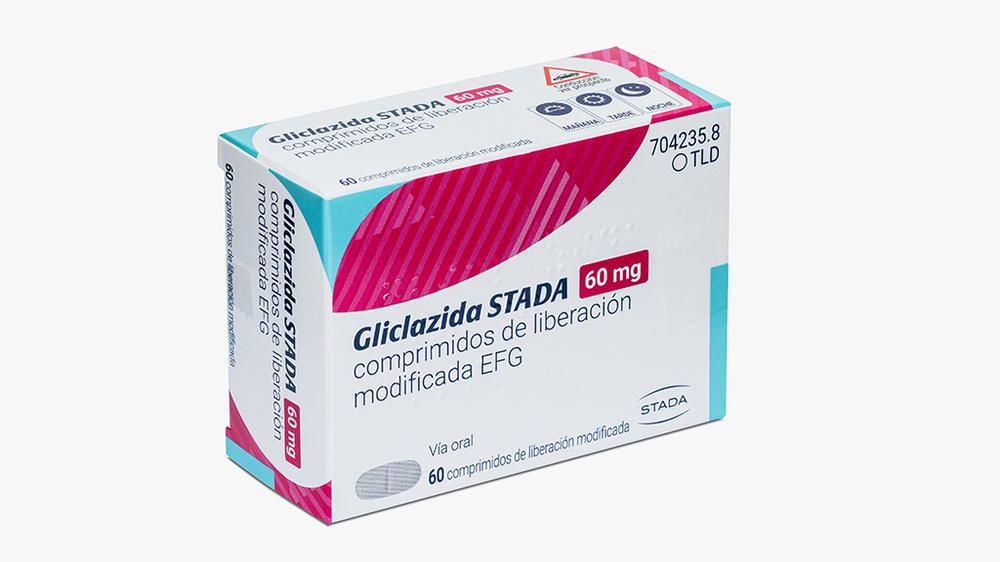
GLICLAZIDA STADA 60 MG COMPRIMIDOS DE LIBERACION MODIFICADA

Revisión de receta online
Un médico revisará tu caso y determinará si la prescripción es médicamente apropiada.

Habla con un médico sobre este medicamento
Comenta tus síntomas y las opciones de tratamiento en una consulta online.



Cómo usar GLICLAZIDA STADA 60 MG COMPRIMIDOS DE LIBERACION MODIFICADA EFG
Contenido del prospecto
- Introducción
- Qué es Gliclazida Stada y para qué se utiliza
- Qué necesita saber antes de empezar a tomar Gliclazida Stada
- Cómo tomar Gliclazida Stada
- Posibles efectos adversos
- Conservación de Gliclazida Stada
- Contenido del envase e información adicional
Introducción
Prospecto: información para el usuario
Gliclazida Stada 60 mg comprimidos de liberación modificada EFG
Lea todo el prospecto detenidamente antes de empezar a tomar este medicamento, porque contiene información importante para usted.
- Conserve este prospecto, ya que puede tener que volver a leerlo.
- Si tiene alguna duda, consulte a su médico o farmacéutico.
- Este medicamento se le ha recetado solamente a usted, y no debe dárselo a otras personas aunque tengan los mismos síntomas que usted, ya que puede perjudicarles.
- Si experimenta efectos adversos, consulte a su médico o farmacéutico, incluso si se trata de efectos adversos que no aparecen en este prospecto. Ver sección 4.
Contenido del prospecto:
- Qué es Gliclazida Stada y para qué se utiliza
- Qué necesita saber antes de empezar a tomar Gliclazida Stada
- Cómo tomar Gliclazida Stada
- Posibles efectos adversos
- Conservación de Gliclazida Stada
- Contenido del envase e información adicional
1. Qué es Gliclazida Stada y para qué se utiliza
Gliclazida Stada es un medicamento que reduce los niveles de azúcar en sangre (medicamento antidiabético oral perteneciente al grupo de las sulfonilureas).
Gliclazida Stada se utiliza en un cierto tipo de diabetes en adultos (diabetes mellitus tipo 2), cuando la dieta, el ejercicio físico y la pérdida de peso por sí solos no son adecuados para asegurar unos niveles de azúcar en sangre normales.

¿No estás seguro de si este medicamento es adecuado para ti?
Comenta tus síntomas y tratamiento con un médico online.
2. Qué necesita saber antes de empezar a tomar Gliclazida Stada
No tome Gliclazida Stada:
- Si es alérgico a gliclazida, o a cualquiera de los demás componentes de este medicamento (incluidos en la sección 6), o a otros medicamentos del mismo grupo (sulfonilureas), o a otros medicamentos relacionados (sulfamidas hipoglucemiantes);
- Si tiene diabetes dependiente de insulina (tipo 1);
- Si tiene cuerpos cetónicos y azúcar en la orina (lo que puede significar que tenga cetoacidosis diabética), un precoma o coma diabético;
- Si tiene alteración del riñón o del hígado grave;
- Si está recibiendo medicamentos para el tratamiento de infecciones por hongos (miconazol, ver sección “Uso de Gliclazida Stada con otros medicamentos”);
- Si está en período de lactancia (ver sección “Embarazo, lactancia y fertilidad”).
Advertencias y precauciones
Consulte a su médico antes de empezar a tomar Gliclazida Stada.
Debe seguir el tratamiento prescrito por su médico para conseguir niveles adecuados de azúcar en sangre. Esto significa que, además de la toma regular de los comprimidos, debe controlar la dieta, realizar ejercicio físico y, si fuera necesario, perder peso.
Durante el tratamiento con gliclazida es necesaria una monitorización periódica de su nivel de azúcar en sangre (y posiblemente en orina) y también de su hemoglobina glicosilada (HbA1c). En las primeras semanas de tratamiento se puede incrementar el riesgo de tener bajos niveles de azúcar en sangre (hipoglucemia). Siendo especialmente necesaria una supervisión clínica minuciosa;
La bajada en los niveles de azúcar en sangre (hipoglucemia) puede aparecer:
- si no mantiene una regularidad en las comidas o se las salta,
- si está en ayunas,
- si está malnutrido,
- si cambia su dieta,
- si aumenta su actividad física sin un aumento adecuado de la ingesta de carbohidratos,
- si bebe alcohol, especialmente si se salta las comidas,
- si toma otros medicamentos o remedios naturales al mismo tiempo,
- si toma dosis demasiado altas de gliclazida,
- si sufre determinados trastornos hormonales (alteraciones funcionales de la glándula tiroidea, de la hipófisis o corteza suprarrenal),
- si su función renal o hepática está gravemente disminuida,
Si sufre una bajada de azúcar en sangre puede experimentar los siguientes síntomas:
Dolor de cabeza, hambre intensa, náuseas, vómitos, cansancio, alteraciones del sueño, agitación, agresividad, falta de concentración, disminución del estado de alerta y del tiempo de reacción, depresión, confusión, alteraciones visuales y del habla, temblor, trastornos sensitivos, mareos, y vulnerabilidad.
También se pueden observar los siguientes signos y síntomas: sudoración, piel húmeda, ansiedad, aceleración del ritmo cardiaco o ritmo irregular, tensión arterial alta, dolor fuerte repentino en el pecho que puede extenderse a las zonas vecinas (angina de pecho).
Si los niveles de azúcar en sangre continúan bajando puede experimentar una gran confusión (delirio), sufrir convulsiones, pérdida de autocontrol, su respiración puede hacerse superficial y su latido cardiaco puede enlentecerse, pudiendo llegar a la inconsciencia.
En la mayoría de los casos los síntomas de una bajada de azúcar en sangre desaparecen rápidamente al consumir azúcar, ej.: comprimidos de glucosa, azucarillos, zumo azucarado, té azucarado.
Por tanto debería llevar siempre con usted algo de azúcar (comprimidos de glucosa, azucarillos). Recuerde que los edulcorantes artificiales no son efectivos. Si la ingesta de azúcar no ayuda o los síntomas reaparecen por favor póngase en contacto con su médico o con el hospital más cercano.
Los síntomas de unos niveles bajos de azúcar en sangre pueden no aparecer, ser poco pronunciados o desarrollarse muy lentamente o puede que usted no se dé cuenta a tiempo de que su nivel de azúcar en la sangre ha disminuido. Esto puede suceder en pacientes ancianos que toman ciertos medicamentos (ej.: aquellos que actúan sobre el sistema nervioso central y los beta-bloqueantes).
Si está en situación de estrés (ej.: accidentes, intervenciones quirúrgicas, fiebre etc.) su médico puede cambiarle temporalmente a tratamiento con insulina.
Los síntomas de un aumento de azúcar en sangre (hiperglucemia) pueden aparecer cuando gliclazida todavía no ha reducido suficientemente el azúcar en sangre, cuando no ha cumplido con el tratamiento prescrito por su médico, si toma preparaciones de Hierba de San Juan (Hypericum perforatum) (ver sección "Otros medicamentos y Gliclazida Stada), o en situaciones especiales de estrés. Pueden incluir sed, orinar frecuentemente, sequedad de boca, piel seca con picor, infecciones cutáneas y disminución del rendimiento.
Si aparecen estos síntomas, debe contactar con su médico o farmacéutico.
Se pueden producir alteraciones de la glucosa en la sangre (bajo nivel de azúcar en la sangre y azúcar en la sangre) cuando se prescribe gliclazida al mismo tiempo que medicamentos pertenecientes a una clase de antibióticos llamados fluoroquinolonas, especialmente en pacientes de edad avanzada. En este caso, su médico le recordará la importancia de controlar su glucosa en la sangre.
Si usted tiene antecedentes familiares o sabe que tiene un trastorno hereditario de deficiencia de glucosa-6-fosfato deshidrogenasa (G6PD) (alteración en los glóbulos rojos), puede producirse una disminución del nivel de hemoglobina y una destrucción de glóbulos rojos (anemia hemolítica). Contacte con su médico antes de tomar este medicamento.
Niños y adolescentes
Gliclazida no está recomendado para su uso en niños debido a la ausencia de datos.
Uso de Gliclazida Stada con otros medicamentos
Comunique a su médico o farmacéutico si está utilizando, ha utilizado recientemente o podría tener que utilizar cualquier otro medicamento.
El efecto hipoglucemiante de gliclazida puede potenciarse y aparecer signos de un bajo nivel de azúcar en sangre cuando se toma uno de los siguientes medicamentos:
- otros medicamentos utilizados para tratar niveles elevados de azúcar en sangre (antidiabéticos orales, agonistas del receptor GLP-1 o insulina),
- antibióticos (ej.: sulfamidas, claritromicina),
- medicamentos para tratar la tensión arterial elevada o la insuficiencia cardiaca (beta-bloqueantes, IECAs como captopril, o enalapril),
- medicamentos para tratar las infecciones fúngicas (miconazol, fluconazol),
- medicamentos para tratar úlceras en el estómago o en el duodeno (antagonistas del receptor H2),
- medicamentos para tratar la depresión (inhibidores de la monoaminoxidasa),
- analgésicos o antirreumáticos (fenilbutazona, ibuprofeno),
- medicamentos que contienen alcohol.
El efecto hipoglucemiante de gliclazida puede disminuir e incrementar los niveles de azúcar en sangre si se toma alguno de los siguientes medicamentos:
- medicamentos para tratar trastornos del sistema nervioso central (clorpromazina),
- medicamentos antiinflamatorios (corticoesteroides),
- medicamentos para tratar el asma o utilizados durante el parto (salbutamol intravenoso, ritodrina y terbutalina),
- medicamentos para tratar alteraciones mamarias, sangrado menstrual abundante y endometriosis (danazol),
- preparaciones de Hierba de San Juan (Hypericum perforatum)
Puede producirse alteración de la glucosa en la sangre (bajo nivel de azúcar en la sangre y niveles altos de azúcar en la sangre) cuando se toma un medicamento perteneciente a una clase de antibióticos llamados fluoroquinolonas al mismo tiempo que Gliclazida Stada, especialmente en pacientes de edad avanzada.
Este medicamento puede aumentar el efecto de los medicamentos que reducen la coagulación sanguínea (ej.: warfarina).
Consulte a su médico antes de utilizar cualquier otro medicamento. Si usted ingresa en un hospital comunique al personal que está tomando gliclazida.
Toma de Gliclazida Stada con alimentos, bebidas y alcohol
Este medicamento puede tomarse con las comidas y bebidas no alcohólicas.
El consumo de alcohol no está recomendado, ya que puede alterar el control de su diabetes de una forma impredecible.
Embarazo y lactancia
No se recomienda tomar Gliclazida Stada durante el embarazo.
Si está embarazada, cree que podría estar embarazada o tiene intención de quedarse embarazada, consulte a su médico antes de tomar este medicamento ya que él puede prescribirle un tratamiento más adecuado para usted.
No debe utilizar este medicamento durante la lactancia.
Conducción y uso de máquinas
Si disminuye demasiado su nivel de azúcar en sangre (hipoglucemia), o aumenta demasiado (hiperglucemia) o si sufre problemas visuales consecuencia de estos trastornos, su capacidad para concentrarse o para reaccionar puede verse afectada.
Tenga en cuenta que podría ponerse en peligro usted o a los demás (ej.: al conducir o manejar maquinaria).
Por favor pregunte a su médico si puede conducir si:
- tiene episodios frecuentes de niveles bajos de azúcar en sangre (hipoglucemia),
- no tiene signos que le adviertan de un bajo nivel de azúcar en sangre o éstos son leves (hipoglucemia).
Gliclazida Stada contiene lactosa
Si su médico le ha indicado que padece una intolerancia a ciertos azúcares, consulte con él antes de tomar este medicamento.
3. Cómo tomar Gliclazida Stada
Dosis
Siga exactamente las instrucciones de administración de este medicamento indicadas por su médico. En caso de duda, consulte de nuevo a su médico o farmacéutico.
La dosis la determinará el médico, dependiendo de sus niveles de azúcar en sangre y posiblemente en orina.
Se pueden precisar ajustes en las dosis de gliclazida debido a cambios en factores externos (ej.: pérdida de peso, cambio en el estilo de vida, estrés) o a mejoras en el control del azúcar en sangre.
La dosis recomendada es de medio comprimido a dos comprimidos (máximo 120 mg) en una sola toma con el desayuno. Esto depende de la respuesta al tratamiento.
Si se comienza una terapia combinada de gliclazida con metformina, un inhibidor de la alfa- glucosidasa, una tiazolidinediona, un inhibidor de la dipeptidil peptidasa-4, un agonista del receptor GLP-1 o insulina, su médico determinará de manera individualizada la dosis adecuada de cada medicamento para usted.
Póngase en contacto con su médico o farmacéutico, si nota que sus niveles de azúcar en sangre están altos a pesar de estar tomando este medicamento tal y como se lo prescribió su médico.
Vía y forma de administración
Gliclazida se administra vía oral.
El comprimido puede dividirse en dos dosis iguales.
Tome el/los comprimido/s con un vaso de agua en el desayuno (preferiblemente a la misma hora cada día).
Trague la mitad del comprimido o el/ los comprimido/ s enteros. No masticar ni triturar.
Siempre debe comer después de tomar el/los comprimido/s.
Si toma más Gliclazida Stada del que debe
Si toma demasiados comprimidos, póngase inmediatamente en contacto con su médico o con las Urgencias del hospital más cercano. En caso de sobredosis o ingestión accidental, consulte inmediatamente a su médico o farmacéutico, o llame al Servicio de Información Toxicológica, teléfono (91) 562 04 20 (indicando el medicamento y la cantidad ingerida).
Los síntomas de sobredosis son aquellos de niveles bajos de azúcar en sangre (hipoglucemia) descritos en la sección 2. Los síntomas pueden mejorar tomando inmediatamente azúcar (de 4 a 6 azucarillos) o bebidas azucaradas, seguido de un tentempié sustancial o comida. Si el paciente está inconsciente informe al médico inmediatamente y llame a los servicios de urgencias. Lo mismo debe hacerse si alguien, ej.: un niño, ha tomado el medicamento de manera accidental. No se debe dar de comer ni de beber a las personas que se encuentren inconscientes.
Debe asegurarse de que siempre haya una persona informada que pueda llamar al médico en caso de urgencia.
Si olvidó tomar Gliclazida Stada
Es importante que tome su medicamento cada día ya que un tratamiento regular es más eficaz.
Sin embargo, si olvida tomar una dosis de este medicamento, tome la siguiente dosis a la hora habitual. No tome una dosis doble para compensar las dosis olvidadas.
Si interrumpe el tratamiento con Gliclazida Stada
Como el tratamiento de la diabetes normalmente es de por vida, debe consultar con su médico antes de dejar de tomar este medicamento. Interrumpir el tratamiento podría causar un aumento del azúcar en sangre (hiperglucemia) que aumenta el riesgo de desarrollar complicaciones de la diabetes.
Si tiene cualquier otra duda sobre el uso de este medicamento, pregunte a su médico o farmacéutico.

¿Has empezado a tomar el medicamento y tienes preguntas?
Comenta tus síntomas y tratamiento con un médico online.
4. Posibles efectos adversos
Al igual que todos los medicamentos, este medicamento puede producir efectos adversos, aunque no todas las personas los sufran.
El efecto adverso más frecuentemente observado es la bajada de azúcar en sangre (hipoglucemia). Para los síntomas y signos ver sección “Advertencias y precauciones”.
Si estos síntomas no se tratan podrían progresar a somnolencia, pérdida de conocimiento o posiblemente coma. Deberá solicitar inmediatamente atención médica si el episodio de bajada de azúcar en sangre es grave o prolongado, incluso si se controla temporalmente con la ingesta de azúcar.
Trastornos del hígado
Se han notificado casos aislados de función hepática anormal, que puede causar coloración amarilla de la piel y ojos. Si padece esto, acuda a su médico inmediatamente. Estos síntomas desaparecen generalmente al interrumpir el tratamiento. Su médico decidirá si es necesario interrumpir su tratamiento.
Trastornos de la piel
Se han notificado reacciones de la piel como:
- Erupción cutánea.
- Eritema.
- Picor.
- Urticaria.
- Angioedema (rápida hinchazón de los tejidos como párpados, cara, labios, boca, lengua o garganta que puede producir dificultad al respirar). La erupción cutánea puede evolucionar a la formación de ampollas diseminadas o a la descamación de la piel.
Excepcionalmente, se han notificado signos de reacciones de hipersensibilidad severa (DRESS):
Inicialmente como síntomas similares a la gripe y posteriormente como una erupción en la cara con erupción extendida y temperatura alta.
Trastornos de la sangre
Se han notificado descensos en el número de células de la sangre (ej.: plaquetas, células sanguíneas de la serie roja y blanca) que pueden causar:
- Palidez.
- Sangrado prolongado.
- Hematomas.
- Dolor de garganta.
- Fiebre.
Estos síntomas suelen desaparecer cuando se interrumpe el tratamiento.
Trastornos gastrointestinales
- Dolor abdominal.
- Náuseas, vómitos.
- Indigestión.
- Diarrea.
- Estreñimiento.
Estos efectos se reducen cuando gliclazida se toma con las comidas, tal y como está recomendado.
Trastornos oculares
Su visión puede verse afectada transitoriamente especialmente al inicio del tratamiento. Este efecto se debe a cambios en los niveles de azúcar en sangre.
Al igual que con otras sulfonilureas, se han observado las siguientes reacciones adversas: casos de cambios graves en el número de células de la sangre e inflamación alérgica de la pared de los vasos sanguíneos, disminución del sodio en sangre (hiponatremia), síntomas de insuficiencia en el hígado (ej.: ictericia) que en la mayoría de los casos desaparecieron después de la retirada de la sulfonilurea, pero que en casos aislados pueden llevar a una insuficiencia en el hígado con amenaza vital.
Comunicación de efectos adversos :
Si experimenta cualquier tipo de efecto adverso, consulte a su médico o farmacéutico, incluso si se trata de posibles efectos adversos que no aparecen en este prospecto. También puede comunicarlos directamente a través del Sistema Español de Farmacovigilancia de medicamentos de Uso Humano: https://www.notificaram.es . Mediante la comunicación de efectos adversos usted puede contribuir a proporcionar más información sobre la seguridad de este medicamento.
5. Conservación de Gliclazida Stada
Mantener este medicamento fuera de la vista y del alcance de los niños.
No utilice este medicamento después de la fecha de caducidad que aparece en el cartonaje y en el blíster después de CAD. La fecha de caducidad es el último día del mes que se indica.
Este medicamento no requiere condiciones especiales de conservación.
Los medicamentos no se deben tirar por los desagües ni a la basura. Deposite los envases y los medicamentos que no necesita en el Punto SIGRE de la farmacia. En caso de duda pregunte a su farmacéutico cómo deshacerse de los envases y de los medicamentos que no necesita. De esta forma, ayudará a proteger el medio ambiente.
6. Contenido del envase e información adicional
Composición de Gliclazida Stada
- El principio activo es gliclazida.
Cada comprimido de liberación modificada contiene 60 mg de gliclazida.
- Los demás componentes son:
Intragranular: lactosa monohidratada, hipromelosa (HPMC K100 LV) (E464), hipromelosa (HPMC K4M CR) (E464).
Extragranular: hipromelosa (HPMC K100 LV) (E464), hipromelosa (HPMC K4M CR) (E464), estearato de magnesio (E572).
Aspecto del producto y contenido del envase
Los comprimidos de liberación modificada de 60 mg son de color blanco, biconvexos, ovalados, ranurados en ambas caras, grabados con “GLI” y “60” a cada lado de la ranura en ambas caras y con unas dimensiones de 15,0 x 7,0 mm. Los comprimidos pueden dividirse en dosis iguales.
Gliclazida Stada 60 mg comprimidos de liberación modificada está disponible en blísters envasados en cajas de 10, 28, 30, 56, 60, 90, 120, 150 y 180 comprimidos*.
*Puede que solamente estén comercializados algunos tamaños de envases.
Titular de la autorización de comercialización y responsable de la fabricación:
Titular de la autorización de comercialización
Laboratorio STADA , S.L.
Frederic Mompou, 5
08960 Sant Just Desvern (Barcelona)
España
Responsable de la fabricación
STADA Arzneimittel AG
Stadastrasse 2-18,
61118 Bad Vilbel
Alemania
o
STADA Arzneimittel GmbH
Muthgasse 36, 1190 Wien
Austria
o
Sanico N.V.
Veedijk 59
2300 Turnhout
Bélgica
Ó
Fairmed Healthcare GmbH
Maria-Goeppert-Straße 3
23562 Lübeck
Alemania
O
Laboratori Fundació DAU
Calle Lletra C de la Zona Franca 12-14
Polígono Industrial de la Zona Franca de Barcelona
08040 Barcelona
España
Este medicamento está autorizado en los estados miembros del Espacio Económico Europeo con los siguientes nombres:
Dinamarca: Gliclazid STADA 60 mg modified-release tablets
Austria: Gliclazid STADA 60 mg Tabletten mit veränderter Wirkstofffreisetzung
Bulgaria: MADRAS MR 60 mg modified release tablets x 30 tablets
Bélgica: Uni Gliclazide EG 60mg tabletten met gereguleerde afgifte
España: Gliclazida STADA 60 mg comprimidos de liberación modificada EFG
Francia: GLICLAZIDE EG 60 mg, comprimé sécable à libération modifiéeé
Luxemburgo: Uni Gliclazide EG 60mg comprimés à libération modifiée
Portugal: Gliclazida Ciclum
Eslovenia: Gliklazid STADA 60 mg tablete s prirejenim sprošcanjem
Eslovaquia: Gliclazide MR Stada
Fecha de la última revisión de este prospecto:marzo 2017
La información detallada y actualizada de este medicamento está disponible en la página Web de la Agencia Española de Medicamentos y Productos Sanitarios (AEMPS) http://www.aemps.gob.es/
- País de registro
- Forma farmacéuticaCOMPRIMIDO LIBERACION MODIFICADA, 60 mg
- Código ATCA10BB09
- Precio medio en farmacia11.18 EUR
- Principio activo
- Requiere recetaSí
- Fabricante
- ComposiciónLACTOSA MONOHIDRATO (163,8 mg mg)
- Esta información es de carácter general y no sustituye la consulta con un profesional sanitario.
- Alternativas a GLICLAZIDA STADA 60 MG COMPRIMIDOS DE LIBERACION MODIFICADA EFGForma farmacéutica: COMPRIMIDO LIBERACION MODIFICADA, 30 mgPrincipio activo: gliclazidaFabricante: Les Laboratoires ServierRequiere recetaForma farmacéutica: COMPRIMIDO LIBERACION MODIFICADA, 60 mgPrincipio activo: gliclazidaFabricante: Les Laboratoires ServierRequiere recetaForma farmacéutica: COMPRIMIDO LIBERACION MODIFICADA, 30 mgPrincipio activo: gliclazidaFabricante: Aurovitas Spain, S.A.U.Requiere receta
Médicos online para GLICLAZIDA STADA 60 MG COMPRIMIDOS DE LIBERACION MODIFICADA EFG
Comenta la dosis, los posibles efectos secundarios, interacciones, contraindicaciones o la revisión de receta de GLICLAZIDA STADA 60 MG COMPRIMIDOS DE LIBERACION MODIFICADA EFG, sujeto a valoración médica y a la normativa local.

Obtén una receta de GLICLAZIDA STADA 60 MG COMPRIMIDOS DE LIBERACION MODIFICADA EFG online
Rellena un formulario de 2 minutos
Cuéntanos tus síntomas, historial y el medicamento que necesitas.
Elige un médico o nosotros te asignamos uno
Escoge un especialista o te conectamos con el próximo médico disponible.
El médico revisa tu caso
Normalmente en 30 minutos. Puede hacerte preguntas adicionales por chat.
Recógela en cualquier farmacia
Receta electrónica enviada a tu correo, válida en toda España.
Preguntas frecuentes
GLICLAZIDA STADA 60 MG COMPRIMIDOS DE LIBERACION MODIFICADA EFG requiere receta en España. Puedes confirmarlo con un médico online según tu caso.
El principio activo de GLICLAZIDA STADA 60 MG COMPRIMIDOS DE LIBERACION MODIFICADA EFG es gliclazida. Esta información ayuda a identificar medicamentos con la misma composición pero con diferentes nombres comerciales.
El precio medio en farmacia de GLICLAZIDA STADA 60 MG COMPRIMIDOS DE LIBERACION MODIFICADA EFG es de aproximadamente 11.18 EUR. Puede variar según el fabricante y la forma farmacéutica.
GLICLAZIDA STADA 60 MG COMPRIMIDOS DE LIBERACION MODIFICADA EFG es fabricado por Laboratorio Stada S.L.. La marca y el envase pueden variar según el distribuidor.
Los Médicos de familia, Psiquiatras, Dermatólogos, Cardiólogos, Endocrinólogos, Gastroenterólogos, Neumólogos, Nefrólogos, Reumatólogos, Hematólogos, Infectólogos, Alergólogos, Geriatras, Pediatras, Oncólogos pueden valorar la prescripción de GLICLAZIDA STADA 60 MG COMPRIMIDOS DE LIBERACION MODIFICADA EFG cuando esté clínicamente indicado. Puedes reservar una videoconsulta para comentar tu caso y las opciones de tratamiento.
España cuenta con una infraestructura sanitaria bien desarrollada en ciudades principales como Madrid, Barcelona, Valencia y Sevilla. Las farmacias están ampliamente disponibles y operan bajo estrictas regulaciones, garantizando el acceso a medicamentos con receta.
Puedes comprar GLICLAZIDA STADA 60 MG COMPRIMIDOS DE LIBERACION MODIFICADA EFG en Madrid, Barcelona, Sevilla o Valencia en cualquier farmacia local con una receta válida.
Para obtener una receta, puedes utilizar Oladoctor:
Otros medicamentos con el mismo principio activo (gliclazida) incluyen DIAMICRON 30 mg COMPRIMIDOS DE LIBERACION MODIFICADA, DIAMICRON 60 mg COMPRIMIDOS DE LIBERACION MODIFICADA, GLICLAZIDA AUROVITAS 30 MG COMPRIMIDOS DE LIBERACION MODIFICADA EFG. Pueden tener diferentes nombres comerciales o formulaciones, pero contienen el mismo componente terapéutico. Consulta siempre con un médico antes de cambiar o iniciar un nuevo medicamento.
