



GASTRIMUT 20 mg Capsulas

Revisión de receta online
Un médico revisará tu caso y determinará si la prescripción es médicamente apropiada.

Habla con un médico sobre este medicamento
Comenta tus síntomas y las opciones de tratamiento en una consulta online.



Cómo usar GASTRIMUT 20 mg CAPSULAS
Contenido del prospecto
- Introducción
- Qué es Gastrimut y para qué se utiliza
- Antes de tomar Gastrimut
- Cómo tomar Gastrimut
- Posibles efectos adversos
- Conservación de Gastrimut
- INFORMACIÓN ADICIONAL
Introducción
PROSPECTO: INFORMACIÓN PARA EL USUARIO
Gastrimut 20mg cápsulas duras gastrorresistentes
Omeprazol
Lea todo el prospecto detenidamente antes de empezar a tomar el medicamento.
- Conserve este prospecto, ya que puede tener que volver a leerlo.
- Si tiene alguna duda, consulte a su médico o farmacéutico.
- Este medicamento se le ha recetado a usted y no debe dárselo a otras personas, aunque tengan los mismos síntomas, ya que puede perjudicarles.
- Si considera que alguno de los efectos adversos que sufre es grave o si aprecia cualquier efecto adverso no mencionado en este prospecto, informe a su médico o farmacéutico.
Contenido del prospecto:
- Qué es Gastrimut y para qué se utiliza
- Antes de tomar Gastrimut
- Cómo tomar Gastrimut
- Posibles efectos adversos
- Conservación de Gastrimut
- Información adicional
1. Qué es Gastrimut y para qué se utiliza
Gastrimut contiene el principio activo omeprazol. Pertenece a un grupo de medicamentos denominados “inhibidores de la bomba de protones”. Estos medicamentos actúan reduciendo la cantidad de ácido producida por el estómago.
Gastrimut se utiliza para tratar las siguientes enfermedades:
En adultos:
- “Enfermedad por reflujo gastroesofágico” (ERGE). En este trastorno, el ácido del estómago pasa al esófago (el tubo que une la garganta con el estómago), provocando dolor, inflamación y ardor.
- Úlceras en la parte superior del intestino (úlcera duodenal) o en el estómago (úlcera gástrica).
- Úlceras infectadas por una bacteria llamada “Helicobacter pylori”. Si padece esta enfermedad, es posible que su médico le recete además antibióticos para tratar la infección y permitir que cicatrice la úlcera.
- Úlceras causadas por unos medicamentos denominados AINEs (antiinflamatorios no esteroideos). Gastrimut puede usarse además para impedir la formación de úlceras si está tomando AINEs.
- Exceso de ácido en el estómago provocado por un tumor en el páncreas (síndrome de Zollinger‑Ellison).
En niños:
Niños de más de 1 año de edad y= 10 kg
- “Enfermedad por reflujo gastroesofágico” (ERGE). En este trastorno, el ácido del estómago pasa al esófago (el tubo que une la garganta con el estómago), provocando dolor, inflamación y ardor.En los niños, los síntomas de la enfermedad pueden incluir el retorno del contenido del estómago a la boca (regurgitación), vómitos y un aumento de peso insuficiente.
Niños de más de 4 años de edad y adolescentes
- Úlceras infectadas por una bacteria llamada “Helicobacter pylori”. Si su hijo padece esta enfermedad, es posible que su médico le recete además antibióticos para tratar la infección y permitir que cicatrice la úlcera.

¿No estás seguro de si este medicamento es adecuado para ti?
Comenta tus síntomas y tratamiento con un médico online.
2. Antes de tomar Gastrimut
No tome Gastrimut
- si es alérgico (hipersensible) al omeprazol o a cualquiera de los demás componentes de Gastrimut si es alérgico a medicamentos que contengan inhibidores de la bomba de protones (ej. pantoprazol, lansoprazol, rabeprazol, esomeprazol).
- si está tomando un medicamento que contenga nelfinavir (usado para la infección por VIH).
Si no está seguro, hable con su médico o farmacéutico antes de tomar Gastrimut
Tenga especial cuidado con Gastrimut
Gastrimut puede ocultar los síntomas de otras enfermedades. Por tanto, si experimenta cualquiera de las siguientes dolencias antes de empezar a tomar Gastrimut o durante el tratamiento, consulte inmediatamente con su médico:
- Adelgaza mucho sin motivo aparente y tiene problemas para tragar.
- Tiene dolor de estómago o indigestión.
- Empieza a vomitar la comida o a vomitar sangre.
- Sus deposiciones son de color negro (heces teñidas de sangre).
- Si presenta diarrea grave o persistente, ya que se ha asociado el omeprazol a un ligero aumento de diarreas infecciosas.
- Tiene problemas de hígado graves.
- si alguna vez ha tenido una reacción en la piel después del tratamiento con un medicamento similar a Gastrimut para reducir la acidez de estómago.
Si sufre una erupción cutánea, especialmente en zonas de la piel expuestas al sol, consulte a su médico lo antes posible, ya que puede ser necesario interrumpir el tratamiento con Gastrimut. Recuerde mencionar cualquier otro síntoma que pueda notar, como dolor en las articulaciones.
Si toma Gastrimut durante un periodo largo (más de 1 año) probablemente su médico le realizará revisiones periódicas. Debe informar de cualquier síntoma y circunstancia nueva o inusual siempre que visite a su médico.
Uso de otros medicamentos
Informe a su médico o farmacéutico si está utilizando o ha utilizado recientemente otros medicamentos, incluso los adquiridos sin receta. Gastrimut puede afectar al mecanismo de acción de algunos medicamentos y algunos medicamentos pueden afectar a Gastrimut .
No tome Gastrimut si está tomando un medicamento que contenga nelfinavir(usado para tratar la infección por VIH).
Informe a su médico o farmacéutico si está tomando alguno de los siguientes medicamentos:
- Ketoconazol, itraconazol o voriconazol (usados para tratar las infecciones por hongos)
- Digoxina (usada para el tratamiento de problemas de corazón)
- Diazepam (usado para tratar la ansiedad, relajar los músculos o en la epilepsia)
- Fenitoína (usada en la epilepsia). Si está tomando fenitoína, su médico tendrá que mantenerle controlado cuando empiece o termine el tratamiento con Gastrimut
- Medicamentos empleados para impedir la formación de coágulos de sangre, como warfarina u otros antagonistas de la vitamina K. Su médico tendrá que mantenerle controlado cuando empiece o termine el tratamiento con Gastrimut
- Rifampicina (se usa para tratar la tuberculosis)
- Atazanavir (usado para tratar la infección por VIH)
- Tacrolimús (en casos de trasplante de órganos)
- Hierba de San Juan (Hypericum perforatum) (usada para tratar la depresión leve)
- Cilostazol (usado para tratar la claudicación intermitente)
- Saquinavir (usado para tratar la infección por VIH)
- Clopidogrel (usado para prevenir los coágulos de sangre (trombos))
Si su médico, además de Gastrimut , le ha recetado los antibióticos amoxicilina y claritromicina para tratar las úlceras causadas por la infección por Helicobacter pylori, es muy importante que le informe de los demás medicamentos que esté tomando.
Advertencias y precauciones
Antes de tomar este medicamento, comunique a su médico si:
- Está previsto que le realicen un análisis específico de sangre (Cromogranina A)
Al tomar omeprazol, puede producirse inflamación en el riñón. Los signos y síntomas pueden incluir disminución del volumen de orina o sangre en la orina y/o reacciones de hipersensibilidad como fiebre, erupción cutánea y rigidez articular. Debe informar de dichos signos al médico que le trate.
Toma de Gastrimut con los alimentos y bebidas
Puede tomar sus cápsulas con alimentos o con el estómago vacío.
Embarazo y lactancia
Antes de tomar Gastrimut , informe a su médico si está embarazada o intentando quedarse embarazada. Su médico decidirá si puede tomar Gastrimut durante ese tiempo.
Su médico decidirá si puede tomar Gastrimut si está en periodo de lactancia.
Conducción y uso de máquinas
No es probable que Gastrimut afecte a su capacidad para conducir o utilizar herramientas o máquinas. Pueden aparecer efectos adversos tales como mareo y alteraciones visuales (ver sección 4). Si ocurrieran, no debería conducir o utilizar máquinas.
Gastrimut contienelactosa, sacarosa, glucosa y sodio.
Este medicamento contiene lactosa, sacarosa y glucosa. Si su medico le ha indicado que padece una intolerancia a ciertos azucares, consulte con él antes de tomar este medicamento.
Este medicamento contiene menos de 23 mg de sodio (1mmol) por cápsula; esto es, esencialmente “exento de sodio”
3. Cómo tomar Gastrimut
Siga exactamente las instrucciones de administración de Gastrimut indicadas por su médico. Consulte a su médico o farmacéutico si tiene dudas.
Su médico le indicará cuántas cápsulas debe tomar y durante cuánto tiempo. Esto dependerá de su afección y de su edad.
Las dosis habituales se indican a continuación.
Adultos:
Tratamiento de los síntomas de la ERGE, como ardor y regurgitación ácida:
- Si su médico comprueba que tiene daños leves en el esófago, la dosis normal es de 20 mg una vez al día durante 4‑8 semanas. Es posible que su médico le recete una dosis de 40 mg durante otras 8 semanas si el esófago todavía no ha cicatrizado.
- La dosis normal una vez cicatrizado el esófago es de 10 mg una vez al día.
- Si no tiene daños en el esófago, la dosis normal es de 10 mg una vez al día.
Tratamiento de las úlceras de la parte superior del intestino(úlcera duodenal):
- La dosis normal es de 20 mg una vez al día durante 2 semanas. Es posible que su médico le recete esa misma dosis durante otras 2 semanas si la úlcera todavía no ha cicatrizado.
- Si la úlcera no cicatriza del todo, la dosis podrá aumentarse a 40 mg una vez al día durante 4 semanas.
Tratamiento de las úlceras del estómago(úlcera gástrica):
- La dosis normal es de 20 mg una vez al día durante 4 semanas. Es posible que su médico le recete esa misma dosis durante otras 4 semanas si la úlcera todavía no ha cicatrizado.
- Si la úlcera no cicatriza del todo, la dosis podrá aumentarse a 40 mg una vez al día durante 8 semanas.
Prevenciónde la reaparición de las úlceras de estómago y duodeno:
- La dosis normal es de 10 mg o 20 mg una vez al día. Puede que su médico aumente la dosis a 40 mg una vez al día.
Tratamiento de las úlceras de estómago y duodeno causadas por los AINEs(antiinflamatorios no esteroideos):
- La dosis normal es de 20 mg una vez al día durante 4‑8 semanas.
Prevención de las úlceras de estómago y duodenodurante la administración de AINEs:
- La dosis normal es de 20 mg una vez al día
Tratamiento de las úlceras causadaspor la infección porHelicobacter pyloriyprevención de su reaparición:
- La dosis normal es de 20 mg de Gastrimut dos veces al día durante una semana.
- Su médico le indicará además que tome dos antibióticos de los siguientes: amoxicilina, claritromicina y metronidazol.
Tratamiento del exceso de ácido en el estómago provocado por un tumor en el páncreas (síndrome de Zollinger-Ellison):
- La dosis habitual es de 60 mg al día.
- Su médico ajustará la dosis dependiendo de sus necesidades y decidirá además durante cuánto tiempo tiene que tomar el medicamento.
Niños:
Tratamiento de los síntomas de la ERGE, como ardor y regurgitación ácida
- Los niños mayores de un año de edad que pesen más de 10 kg pueden tomar omeprazol . La dosis de los niños se basa en el peso corporal y el médico decidirá la dosis correcta.
Tratamiento de las úlcerascausadaspor la infección porHelicobacter pyloriy prevención de su reaparición:
- Los niños mayores de 4 años pueden tomar omeprazol. La dosis de los niños se basa en el peso corporal y el médico decidirá la dosis correcta.
- El médico recetará además a su hijo dos antibióticos, amoxicilina y claritromicina.
Cómo tomar este medicamento
- Se recomienda tomar las cápsulas por la mañana.
- Puede tomar sus cápsulas con alimentos o con el estómago vacío.
- Trague las cápsulas enteras con medio vaso de agua. No mastique ni triture las cápsulas, ya que contienen gránulos recubiertos que impiden que el medicamento se descomponga por la acción del ácido del estómago. Es importante no dañar los gránulos.
Qué debe hacer si usted o su hijo tienen problemas para tragar las cápsulas
- Si usted o su hijo tienen problemas para tragar las cápsulas:
- Abra las cápsulas y trague el contenido directamente con medio vaso de agua o vierta el contenido en un vaso de agua sin gas, un zumo de frutas ácido (p. ej., manzana, naranja o piña) o compota de manzana.
- Agite siempre la mezcla justo antes de beberla (la mezcla no será transparente). A continuación, bébase la mezcla inmediatamente o en el plazo de 30 minutos.
- Para asegurarse de que se ha tomado todo el medicamento, llene el vaso de agua hasta la mitad, enjuáguelo bien y bébase el agua. Las partes sólidas contienen el medicamento; no las mastique ni las triture.
Si toma más Gastrimut del que debiera
Si ha tomado más Gastrimut del recetado por su médico, consulte inmediatamente a su médico o farmacéutico. También puede llamar al Servicio de Información Toxicológica, teléfono 91 562 04 20, indicando el medicamento y la cantidad ingerida.
Si olvidó tomar Gastrimut
Si se olvidó de tomar una dosis, tómela en cuanto se acuerde. No obstante, si queda poco tiempo para la toma siguiente, sáltese la dosis olvidada. No tome una dosis doble para compensar las dosis olvidadas.

¿Has empezado a tomar el medicamento y tienes preguntas?
Comenta tus síntomas y tratamiento con un médico online.
4. Posibles efectos adversos
Al igual que todos los medicamentos, Gastrimut puede producir efectos adversos, aunque no todas las personas los sufran.
Si aprecia alguno de los siguientes efectos adversos raros pero graves, deje de tomar Gastrimut y consulte al médico inmediatamente:
- Silbidos repentinos al respirar (sibilancias repentinas), hinchazón de los labios, la lengua y la garganta o del cuerpo, erupción en la piel, desmayo o dificultades al tragar (reacción alérgica grave).
- Enrojecimiento de la piel con formación de ampollas o descamación. También podrían aparecer ampollas intensas y sangrado en los labios, los ojos, la boca, la nariz y los genitales. Podría tratarse de “síndrome de Stevens-Johnson” o “necrólisis epidérmica tóxica”.
- Coloración amarilla de la piel, orina oscura y cansancio, que pueden ser síntomas de problemas del hígado.
Los efectos adversos pueden ocurrir con determinadas frecuencias, que se definen tal y como se indica a continuación:
Muy frecuentes: | afectan a más de 1 paciente de cada 10 |
Frecuentes: | afectan de 1 a 10 pacientes de cada 100 |
Poco frecuentes: | afectan de 1 a 10 pacientes de cada 1.000 |
Raras: | afectan de 1 a 10 pacientes de cada 10.000 |
Muy raras: | afectan a menos de 1 paciente de cada 10.000 |
Frecuencia desconocida: | No puede estimarse a partir de los datos disponibles |
Otros efectos adversos son:
Efectos adversos frecuentes
- Dolor de cabeza.
- Efectos en el estómago o el intestino: diarrea, dolor de estómago, estreñimiento y gases (flatulencia).
- Náuseas o vómitos.
- Pólipos benignos en el estómago.
Efectos adversos poco frecuentes
- Hinchazón de los pies y los tobillos.
- Trastornos del sueño (insomnio).
- Mareo, sensación de hormigueo, somnolencia.
- Sensación de que todo da vueltas (vértigo).
- Alteraciones de los análisis de sangre que sirven para comprobar el funcionamiento del hígado.
- Erupción en la piel, habones y picores.
- Sensación de malestar general y falta de energía.
Efectos adversos raros
- Problemas en la sangre, como disminución de los glóbulos blancos o las plaquetas. Esto puede causar debilidad o hematomas y aumentar la probabilidad de contraer infecciones.
- Reacciones alérgicas, a veces muy intensas, que incluyen hinchazón de los labios, la lengua y la garganta, fiebre y sibilancias.
- Concentración baja de sodio en la sangre. Puede provocar debilidad, vómitos y calambres.
- Agitación, confusión o depresión.
- Alteraciones del gusto.
- Problemas visuales, como visión borrosa.
- Sensación repentina de respiración dificultosa (broncoespasmo).
- Sequedad de boca.
- Inflamación del interior de la boca.
- Infección denominada “candidiasis” que puede afectar al intestino y que está provocada por un hongo.
- Problemas de hígado, como ictericia, que pueden causar color amarillo de la piel, orina oscura y cansancio.
- Caída del cabello (alopecia).
- Erupción en la piel con la exposición a la luz solar.
- Dolor articular (artralgias) o dolor muscular (mialgias).
- Problemas graves de riñón (nefritis intersticial).
- Aumento de la sudoración.
Efectos adversos muy raros
- Alteraciones del recuento sanguíneo, como agranulocitosis (falta de glóbulos blancos).
- Agresividad.
- Ver, sentir u oír cosas que no existen (alucinaciones).
- Problemas graves de hígado que provocan insuficiencia hepática e inflamación del cerebro.
- Aparición repentina de una erupción intensa, formación de ampollas o descamación de la piel. Puede acompañarse de fiebre alta y dolores articulares (eritema multiforme, síndrome de Stevens-Johnson, necrólisis epidérmica tóxica).
- Debilidad muscular.
- Aumento del tamaño de las mamas en los varones.
En casos muy raros Gastrimut puede afectar a los glóbulos blancos de la sangre y provocar una inmunodeficiencia. Si padece una infección con síntomas como fiebre con un estado general muydeteriorado o fiebre con síntomas de infección local, como dolor de cuello, garganta o boca o dificultades para orinar, deberá consultar a su médico lo antes posible para realizar un análisis de sangre y poder descartar una carencia de glóbulos blancos (agranulocitosis). Es importante que en ese momento proporcione información acerca del medicamento que esté tomando.
Efectos adversos de frecuencia desconocida
Si usted esta tomando Gastrimut 20 mg cápsulas duras gastrorresistentes durante mas de tres meses es posible que los niveles de magnesio en sangre puedan descender. Los niveles bajos de magnesio pueden causar fatiga, contracciones musculares involuntarias, desorientación, convulsiones, mareos y aumento del ritmo cardiaco. Si usted tiene algunos de estos síntomas, acuda al médico inmediatamente. Niveles bajos de magnesio también pueden producir una disminución de los niveles de potasio y calcio en sangre. Su médico puede decidir realizarle análisis de sangre periódicos para controlar los niveles de magnesio.
Erupción cutánea, posiblemente con dolor en las articulaciones.
Si esta tomando inhibidores de la bomba de protones como Gastrimut 20 mg cápsulas duras gastrorresistentes, especialmente durante un periodo de más de un año puede aumentar ligeramente el riesgo de fractura de cadera, muñeca y columna vertebral. Informe a su médico si tiene osteoporosis o si esta tomando corticosteroides (pueden incrementar el riesgo de osteoporosis).
No se preocupe por esta lista de posibles efectos adversos. Puede que no presente ninguno de ellos. Si considera que alguno de los efectos adversos que sufre es grave o si aprecia cualquier efecto adverso no mencionado en este prospecto, informe a su médico o farmacéutico.
5. Conservación de Gastrimut
- Mantener este medicamento fuera de la vista y del alcance de los niños.
- No utilice Gastrimut después de la fecha de caducidad que aparece en el envase después de CAD. La fecha de caducidad es el último día del mes que se indica.
- Conservar por debajo de 30ºC
Conservar el blister en el embalaje original para protegerlo de la humedad.
- Los medicamentos no se deben tirar por los desagües ni a la basura. Deposite los envases y los medicamentos que no necesita en el Punto SIGRE de la farmacia. En caso de duda pregunte a su farmacéutico cómo deshacerse de los envases y de los medicamentos que no necesita. De esta forma ayudará a proteger el medio ambiente.
6. INFORMACIÓN ADICIONAL
Composición de Gastrimut
- El principio activo es omeprazol. Gastrimut cápsulas contiene, 20 mg, de omeprazol.
Los demás componentes (excipientes) son: sacarosa; almidón de maíz; ftalato de hipromelosa, hidroxipropil metilcelulosa (hipromelosa), lactosa, glucosa, hidroxipropilcelulosa laurilsulfato de sodio, ftalato de dietilo y hidrogenofosfato de sodio dihidrato. .
La cápsula de gelatina está compuesta de: gelatina, eritrosina (E-127), índigo carmin (E-132) y dióxido de titanio (E-171).
Aspecto del producto y contenido del envase
Las cápsulas de Gastrimut 20 mg, están formadas por un cuerpo y una tapa de color blanco y rojo.
Tamaños de los envases: blisters de 14, 28, 56 y 500 cápsulas.
Titular de la autorización de comercialización y responsable de la fabricación
LABORATORIOS NORMON, S.A.
Ronda de Valdecarrizo, 6 – 28760 Tres Cantos – Madrid (ESPAÑA)
Este prospecto ha sido revisado en: Marzo de 2023
La información detallada y actualizada de este medicamento está disponible en la página Web de la Agencia Española de Medicamentos y Productos Sanitarios (AEMPS) http://www.aemps.gob.es/
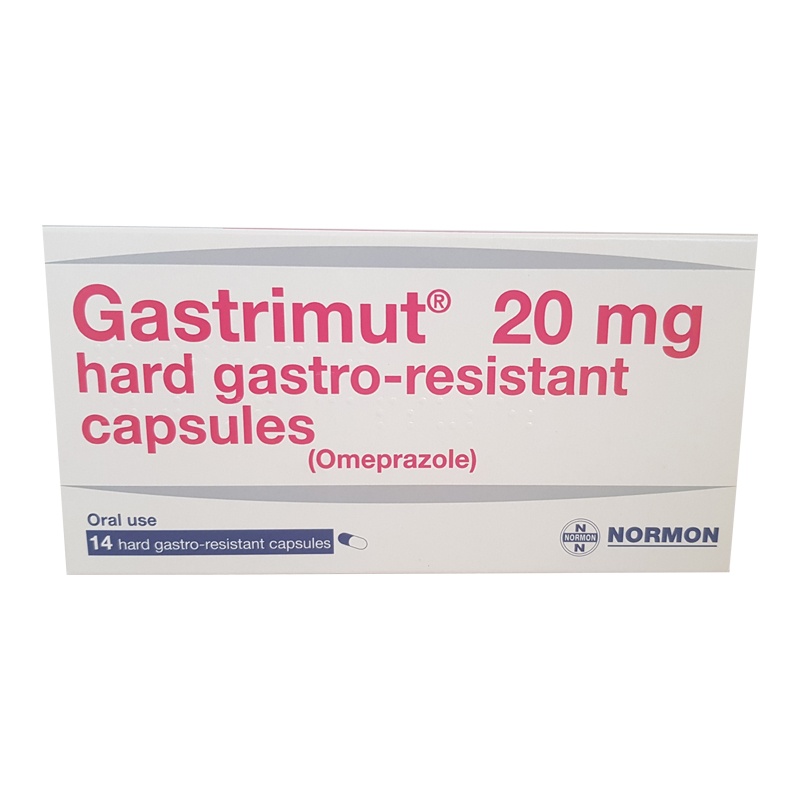
- País de registro
- Forma farmacéuticaCAPSULA, 20 mg
- Código ATCA02BC01
- Precio medio en farmacia1.28 EUR
- Principio activo
- Requiere recetaSí
- Fabricante
- ComposiciónHIDROGENOFOSFATO DE SODIO DIHIDRATO (0,09 mg mg), GLUCOSA (7 mg mg), LACTOSA (8 mg mg), LAURILSULFATO DE SODIO (0,5 mg mg), SACAROSA (125 mg mg)
- Esta información es de carácter general y no sustituye la consulta con un profesional sanitario.
- Alternativas a GASTRIMUT 20 mg CAPSULASForma farmacéutica: CAPSULA, 20 mgPrincipio activo: OmeprazolFabricante: Arafarma Group S.A.Requiere recetaForma farmacéutica: CAPSULA, 40 mgPrincipio activo: OmeprazolFabricante: Arafarma Group S.A.Requiere recetaForma farmacéutica: CAPSULA, 20 mgPrincipio activo: OmeprazolFabricante: Especialidades Farmaceuticas Centrum S.A.Requiere receta
Médicos online para GASTRIMUT 20 mg CAPSULAS
Comenta la dosis, los posibles efectos secundarios, interacciones, contraindicaciones o la revisión de receta de GASTRIMUT 20 mg CAPSULAS, sujeto a valoración médica y a la normativa local.









Obtén una receta de GASTRIMUT 20 mg CAPSULAS online
Rellena un formulario de 2 minutos
Cuéntanos tus síntomas, historial y el medicamento que necesitas.
Elige un médico o nosotros te asignamos uno
Escoge un especialista o te conectamos con el próximo médico disponible.
El médico revisa tu caso
Normalmente en 30 minutos. Puede hacerte preguntas adicionales por chat.
Recógela en cualquier farmacia
Receta electrónica enviada a tu correo, válida en toda España.
Preguntas frecuentes
GASTRIMUT 20 mg CAPSULAS requiere receta en España. Puedes confirmarlo con un médico online según tu caso.
El principio activo de GASTRIMUT 20 mg CAPSULAS es Omeprazol. Esta información ayuda a identificar medicamentos con la misma composición pero con diferentes nombres comerciales.
El precio medio en farmacia de GASTRIMUT 20 mg CAPSULAS es de aproximadamente 1.28 EUR. Puede variar según el fabricante y la forma farmacéutica.
GASTRIMUT 20 mg CAPSULAS es fabricado por Laboratorios Normon S.A.. La marca y el envase pueden variar según el distribuidor.
Los Médicos de familia, Psiquiatras, Dermatólogos, Cardiólogos, Endocrinólogos, Gastroenterólogos, Neumólogos, Nefrólogos, Reumatólogos, Hematólogos, Infectólogos, Alergólogos, Geriatras, Pediatras, Oncólogos pueden valorar la prescripción de GASTRIMUT 20 mg CAPSULAS cuando esté clínicamente indicado. Puedes reservar una videoconsulta para comentar tu caso y las opciones de tratamiento.
España cuenta con una infraestructura sanitaria bien desarrollada en ciudades principales como Madrid, Barcelona, Valencia y Sevilla. Las farmacias están ampliamente disponibles y operan bajo estrictas regulaciones, garantizando el acceso a medicamentos con receta.
Puedes comprar GASTRIMUT 20 mg CAPSULAS en Madrid, Barcelona, Sevilla o Valencia en cualquier farmacia local con una receta válida.
Para obtener una receta, puedes utilizar Oladoctor:
Otros medicamentos con el mismo principio activo (Omeprazol) incluyen ARAPRIDE 20 mg CAPSULAS DURAS GASTRORRESISTENTES EFG, ARAPRIDE 40 mg CAPSULAS DURAS GASTRORRESISTENTES, AULCER 20 mg CAPSULAS DURAS GASTRORRESISTENTES.. Pueden tener diferentes nombres comerciales o formulaciones, pero contienen el mismo componente terapéutico. Consulta siempre con un médico antes de cambiar o iniciar un nuevo medicamento.
