



FRIOLGRIP 650 mg /2.8 Mg/14.66 Mg Solución/Suspensión Oral

Revisión de receta online
Un médico revisará tu caso y determinará si la prescripción es médicamente apropiada.

Habla con un médico sobre este medicamento
Comenta tus síntomas y las opciones de tratamiento en una consulta online.



Cómo usar FRIOLGRIP ANTITUSIVO POLVO PARA SOLUCION ORAL
Contenido del prospecto
- Introducción
- Qué es Friolgrip Antitusivo y para qué se utiliza
- Qué necesita saber antes de empezar a tomar Friolgrip Antitusivo
- Cómo tomar Friolgrip Antitusivo
- Posibles efectos adversos
- Conservación de Friolgrip Antitusivo
- Contenido del envase e información adicional
Introducción
Prospecto: información para el usuario
Friolgrip antitusivo polvo para solucion oral
Paracetamol+ Dextrometorfano hidrobromuro + Clorfenamina maleato
Lea todo el prospecto detenidamente antes de empezar a tomar este medicamento, porque contiene información importante para usted.
Siga exactamente las instrucciones de administración del medicamento contenidas en este prospecto o las indicadas por su médico o farmacéutico.
- Conserve este prospecto, ya que puede tener que volver a leerlo.
- Si necesita consejo o más información, consulte a su farmacéutico.
- Si experimenta efectos adversos, consulte a su médico o farmacéutico, incluso si se trata de efectos adversos que no aparecen en este prospecto. Ver sección 4.
- Debe consultar al médico o farmacéutico si empeora o si no mejora o si la fiebre persiste durante más de 3 días o el dolor o los otros síntomas persisten más de 5 días.
Contenido del prospecto
- Qué es Friolgrip Antitusivo y para qué se utiliza.
- Qué necesita saber antes de empezar a tomar Friolgrip Antitusivo
- Cómo tomar Friolgrip Antitusivo
- Posibles efectos adversos
- Conservación de Friolgrip Antitusivo
- Contenido del envase e información adicional.
1. Qué es Friolgrip Antitusivo y para qué se utiliza
Es una asociación de paracetamol, clorfenamina y dextrometorfano.
El paracetamol es un analgésico que reduce la fiebre y alivia el dolor.
La clorfenamina es un antihistamínico que alivia la congestión nasal y los estornudos.
El dextrometorfano es un antitusivo que inhibe el reflejo de la tos.
Está indicado en adultos y adolescentes mayores de 14 años para el alivio de los síntomas de los catarros y gripes que cursan con dolor leve o moderado, fiebre, tos improductiva (tos irritativa, tos nerviosa) y secreción nasal.
Debe consultar al médico si empeora o si no mejora o si la fiebre persiste durante más de 3 días o el dolor o los otros síntomas persisten más de 5 días.

¿No estás seguro de si este medicamento es adecuado para ti?
Comenta tus síntomas y tratamiento con un médico online.
2. Qué necesita saber antes de empezar a tomar Friolgrip Antitusivo
No tomeFriolgrip Antitusivo
- si es alérgico a los principios activos o a cualquiera de los demás componentes de este medicamento (incluidos en la sección 6)
- si padece alguna enfermedad del hígado,
- si tiene insuficiencia respiratoria
- si tiene tos asmática
- si tiene tos acompañada de abundantes secreciones
- Si está en tratamiento o lo ha estado durante las 2 semanas anteriores con algún medicamento inhibidor de la monoaminooxidasa (IMAO) utilizado para el tratamiento de la depresión, para la enfermedad de Parkinson u otras enfermedades así como otros medicamentos inhibidores de la recaptación de la serotonina utilizados para el tratamiento de la depresión como fluoxetina y paroxetina; o también con bupropion que es un medicamento utilizado para dejar de fumar o con linezolid que es un medicamento antibacteriano.(Ver apartado uso de otros medicamentos).
- Los enfermos menores de 14 años no pueden tomar este medicamento.
Advertencias y precauciones
Este medicamento puede provocar dependencia. Por lo tanto el tratamiento debe ser de corta duración.
Consulte a su médico o farmacéutico antes de tomar Friolgrip Antitusivo:
- Si usted está tomando otros medicamentos como antidepresivos o antipsicóticos, Friolgrip Antitusivo puede interactuar con estos medicamentos y es posible que experimente cambios en su estado mental (p. ej. agitación, alucinaciones, coma) y otros efectos como temperatura corporal superior a los 38º C, aumento de la frecuencia cardíaca, hipertensión arterial y exageración de los reflejos, rigidez muscular, falta de coordinación y/o síntomas gastrointestinales (p. ej., náuseas, vómitos y diarrea).
- En caso de déficit de glucosa-6-fosfato deshidrogenasa (G6PD) (puede provocar anemia hemolítica)
- No debe tomar más cantidad de medicamento que la recomendada en la sección 3. Cómo tomar Friolgrip Antitusivo.
- Debe evitarse el uso simultáneo de este medicamento con otros medicamentos que contengan paracetamol, ya que las dosis altas pueden dar lugar a daño en el hígado. No use más de un medicamento que contenga paracetamol sin consultar al médico.
- Los alcohólicos crónicos, deberán tener la precaución de no tomar más de 2 g de paracetamol al día, lo que equivale a un máximo de 3 sobres de Friolgrip Antitusivo al día.
- Deberán consultar al médico antes de tomar este medicamento:
- Pacientes asmáticos sensibles al ácido acetilsalicílico, deberán consultar con el médico antes de tomar este medicamento.
- Pacientes con tos persistente o crónica, como la debida al tabaco
- Pacientes con dermatitis atópica (enfermedad inflamatoria de la piel caracterizada por eritema, picor, exudación, costras y descamación, que comienza en la infancia en individuos con predisposición alérgica hereditaria) que están sedados, debilitados, incapacitados o encamados.
- Los pacientes sensibles (alérgicos) a un antihistamínico, porque pueden ser sensibles a otros antihistamínicos (como es clorfenamina).
- Los pacientes con enfermedades del riñón, del hígado, del corazón o del pulmón y los pacientes con anemia, deberán consultar con el médico antes de tomar este medicamento.
- Cuando se está en tratamiento con algún medicamento para tratar la epilepsia debe consultar al médico antes de tomar este medicamento, debido a que cuando se usan al mismo tiempo, se disminuye la eficacia y se potencia la hepatotoxicidad del paracetamol, especialmente en tratamientos con dosis altas de paracetamol.
- Pacientes que tengan la tensión alta (hipertensión arterial), la presión del ojo elevada (Glaucoma), alguna enfermedad del tiroides (hipertiroidismo), alteraciones de la próstata (hipertrofia prostática), obstrucción del cuello vesical (enfermedad de la vejiga de la orina) o retención de la orina, así como ataques agudos de asma, deben consultar al médico antes de utilizar este medicamento.
- Si tiene enfermedades graves, como insuficiencia renal grave o sepsis (cuando las bacterias y sus toxinas circulan en la sangre, lo que provoca daños en los órganos), o si padece malnutrición, alcoholismo crónico o si también está tomando flucloxacilina (un antibiótico). Se ha notificado una enfermedad grave denominada acidosis metabólica (una anomalía en la sangre y los líquidos) en pacientes en estas situaciones cuando se utiliza paracetamol a dosis regulares durante un período prolongado o cuando se toma paracetamol junto con flucloxacilina. Los síntomas de acidosis metabólica pueden incluir: dificultad respiratoria grave con respiración profunda y rápida, somnolencia, sensación de malestar (náuseas) y vómitos.
- Este medicamento puede producir sedación y somnolencia. Debe evitarse el uso concomitante con bebidas alcohólicas o fármacos barbitúricos (utilizados como inductores del sueño, sedantes y anticonvulsivantes) o tranquilizantes.
Los niños y las personas mayores, pueden experimentar una reacción paradójica caracterizada por hiperexcitabilidad (nerviosismo, intranquilidad).
Las personas mayores, pueden ser más susceptibles a experimentar mareo, sedación, confusión, hipotensión (bajada de tensión) o sequedad de boca. Estos son efectos adversos que pueden aparecer con la clorfenamina.
Se han descrito casos de abuso con medicamentos que contienen dextrometorfano en adolescentes, por lo tanto deberá tenerse en cuenta esta posibilidad, debido a que pueden ocasionarse efectos adversos graves (ver apartado Si toma másFriolgrip Antitusivodel que debiera).
Interferencias con pruebas analíticas:
Si le van a hacer alguna prueba analítica (incluidos análisis de sangre, orina, etc.…) comunique a su médico que está tomando/usando este medicamento, ya que puede alterar los resultados.
Toma deFriolgrip Antitusivocon otros medicamentos
Comunique a su médico o farmacéutico si está tomando, ha tomado recientemente o podría tener que tomar cualquier otro medicamento.
En particular, si está utilizando algunos de los siguientes medicamentos, ya que puede ser necesario modificar la dosis de algunos de ellos o la interrupción del tratamiento:
- Medicamentos para tratar la epilepsia: Antiepilépticos (lamotrigina, fenitoína u otras hidantoínas, fenobarbital, metilfenobarbital, primidona, carbamacepina).
- Medicamentos para tratar la tuberculosis (isoniazida, rifampicina).
- Medicamentos para tratar las convulsiones y la depresión (barbitúricos), utilizados como hipnóticos, sedantes y anticonvulsivantes.
- Medicamentos que producen depresión sobre el sistema nervioso central (como los empleados para el insomnio o la ansiedad).
- Medicamentos utilizados para tratar la enfermedad de Parkinson u otras enfermedades (Inhibidores de la monoaminooxidasa (IMAO)).
- Medicamentos utilizados para evitar la formación de coágulos en la sangre: Anticoagulantes orales (acenocumarol, warfarina).
- Medicamentos utilizados para aumentar la eliminación de orina (diuréticos del asa como los del grupo furosemida, u otros diuréticos), y otros diuréticos que producen pérdida de potasio (como diuréticos para tratar la hipertensión u otros).
- Medicamentos utilizados para evitar nauseas y vómitos (metoclopramida y domperidona).
- Medicamentos utilizados para el tratamiento de la gota (probenecid y sulfinpirazona).
- Medicamentos utilizados en el tratamiento de la tensión arterial alta (hipertensión) y las alteraciones del ritmo del corazón (arritmias cardiacas) (propranolol, amiodarona y quinidina).
- Medicamentos utilizados para disminuir los niveles de colesterol en sangre (colestiramina).
- Medicamentos que tienen como efecto adverso que dañan al oído (ototóxicos).
- Medicamentos que producen alergia a la luz (medicamentos fotosensibilizantes).
- Medicamentos antiinflamatorios (celecoxib, parecoxib o valdecoxib)
- Medicamentos expectorantes y mucolíticos
- Medicamento utilizado para tratar alteraciones psíquicas (haloperidol).
- Flucloxacilina (antibiótico), debido a un riesgo grave de anomalía sanguínea y fluida (denominada acidosis metabólica) que debe recibir un tratamiento urgente (ver sección 2).
No tome este medicamento durante el tratamiento, ni en las 2 semanas posteriores al mismo con los siguientes medicamentos, ya que se puede producir excitación, tensión arterial alta y fiebre más alta de 40 ºC (hiperpirexia):
- Medicamentos para el tratamiento de la depresión: inhibidores de la monoaminooxidasa (IMAO) (moclobemida, traniciprona), inhibidores de la recaptación de la serotonina (paroxetina, fluoxetina) o tranilcipromina.
- Medicamento utilizado para dejar de fumar (bupropión)
- Medicamento utilizado para el tratamiento de las infecciones (isoniazida)
- Medicamento utilizado como antibacteriano (linezolid)
- Medicamento utilizado para el tratamiento de la tensión arterial alta (pargilina)
- Medicamento utilizado para el tratamiento del cáncer (procarbazina)
- Medicamento utilizado para el tratamiento del parkinson (selegilina)
- Medicamento utilizado para el tratamiento de la obesidad (sibutramina)
Toma deFriolgrip Antitusivocon alimentos, bebidas y alcohol
Mientras esté en tratamiento con este medicamento no debe tomar bebidas alcohólicas, porque le puede potenciar la aparición de efectos adversos de este medicamento.
Además la utilización de medicamentos que contienen paracetamol por pacientes que consumen habitualmente alcohol (3 o más bebidas alcohólicas: cerveza, vino, licor,... al día) puede provocar daño en el hígado.
No tomar conjuntamente con zumo de pomelo, o con naranja amarga porque pueden aumentar los efectos adversos de este medicamento.
Embarazo y lactancia
Si está embarazada o en periodo de lactancia, o cree que podría estar embarazada o tiene intención de quedarse embarazada, consulte a su médico o farmacéutico antes de utilizar este medicamento.
Este medicamento no se debe tomar durante el embarazo, a no ser que su médico considere que es estrictamente necesario.
Este medicamento no se puede utilizar durante el periodo de lactancia, porque puede producir efectos adversos en el bebé.
Conducción y uso de máquinas
Este medicamento puede producir somnolencia. Si durante el tratamiento con este medicamento nota somnolencia, evite conducir vehículos o utilizar máquinas.
Friolgrip Antitusivocontiene sacarosa
Este medicamento contiene sacarosa. Si su médico le ha indicado que padece una intolerancia a ciertos azúcares, consulte con él antes de tomar este medicamento.
Puede producir caries en los dientes.
3. Cómo tomar Friolgrip Antitusivo
Siga exactamente las instrucciones de administración del medicamento contenidas en este prospecto o las indicadas por su médico o farmacéutico. En caso de dudas, pregunte a su médico o farmacéutico.
La dosis recomendada es:
Adultos y adolescentes mayores de 14 años:1 sobre cada 6-8 horas según necesidad (3-4 sobres al día). No tomar más de 4 sobres al día (equivalente 2,6 g de pacetamol al día). No tomar más de 3 g de paracetamol cada 24 horas (ver apartado “Advertencias y precauciones”).
Pacientes con enfermedades del riñón: No pueden tomar este medicamento debido a su contenido en paracetamol 650 mg.
Pacientes con enfermedades del hígado:En caso de insuficiencia hepática o síndrome de Gilbert’s, 1 sobre cada 8 horas. No se excederá de 3 sobres /24 horas y el intervalo mínimo entre dosis no puede ser inferior a 8 horas
Uso en niños y adolescentes
Este medicamento está contraindicado en menores de 14 años.
Uso en pacientes de edad avanzada
Las personas de edad avanzada no pueden utilizar este medicamento sin consultar al médico.
Porque les pueden afectar especialmente algunos efectos adversos del medicamento como la aparición latidos del corazón lentos (bradicardia) o la reducción del caudal cardiaco, por el contenido de clorfenamina. También es más probable que puedan presentar efectos adversos como sedación, confusión, hipotensión o excitación, y pueden ser más sensibles a efectos como sequedad de boca y retención urinaria.
Cómo tomar
Este medicamento se toma por vía oral.
Rasgue el sobre y vierta el contenido del mismo en un vaso, añada agua caliente hasta la mitad y remuévalo. Ingerir una vez disuelto.
Usar siempre la dosis menor que sea efectiva.
La medicación debe iniciarse al aparecer los primeros síntomas, a medida que éstos desaparezcan debe suspender la medicación.
Debe consultar al médico si la fiebre se mantiene durante más de 3 días de tratamiento, el dolor o los otros síntomas durante más de 5 días, o bien los síntomas aumentan o aparecen otros nuevos.
Si toma másFriolgrip Antitusivodel que debe
Si toma más Friolgrip Antitusivo de lo indicado, puede experimentar los siguientes síntomas: náuseas y vómitos, contracciones musculares involuntarias, agitación, confusión, somnolencia, trastornos de la consciencia, movimientos oculares involuntarios y rápidos, trastornos cardíacos (aceleración del ritmo cardíaco), trastornos de coordinación, psicosis con alucinaciones visuales e hiperexcitabilidad.
Otros síntomas en caso de sobredosis masiva pueden ser: coma, problemas respiratorios graves y convulsiones.
Póngase en contacto con su médico u hospital inmediatamente si experimenta cualquiera de los síntomas mencionados.
Como contiene paracetamol puede dañar el hígado cuando se toma en dosis más altas de las aconsejadas o en tratamientos prolongados. La sobredosis también puede provocar: trastornos de coagulación (coágulos sanguíneos y hemorragias). El tratamiento de la sobredosis por paracetamol es más eficaz si se inicia dentro de las 4 horas siguientes a la toma de la sobredosis.
Los pacientes en tratamiento con barbitúricos o los alcohólicos crónicos, pueden ser más susceptibles a la toxicidad de una sobredosis de paracetamol.
En caso de sobredosis o ingestión accidental, acuda inmediatamente a un centro médico o llame al Servicio de Información Toxicológica (teléfono: 91.5620420), indicando el medicamento y la cantidad ingerida.

¿Has empezado a tomar el medicamento y tienes preguntas?
Comenta tus síntomas y tratamiento con un médico online.
4. Posibles efectos adversos
Al igual que todos los medicamentos, este medicamento puede producir efectos adversos, aunque no todas las personas los sufran.
Durante el periodo de uso de paracetamol, dextrometorfano y clorfenamina, se han comunicado los siguientes efectos adversos, cuya frecuencia no se ha establecido con exactitud
- Los efectos adversos que pueden aparecer más frecuentemente son: Ligera somnolencia, mareo, debilidad muscular: estos efectos adversos pueden desaparecer tras 2-3 días de tratamiento. Dificultad en los movimientos de la cara, torpeza, temblor, alteraciones en las sensaciones y hormigueos, sequedad de boca, pérdida de apetito, alteraciones del gusto o del olfato, molestias gastrointestinales (que pueden disminuir si se administra el medicamento junto con alimentos), náuseas, vómitos, diarrea, estreñimiento, dolor de estómago, retención de la orina, sequedad de nariz y garganta, espesamiento de las mucosidades, sudoración, visión borrosa u otros trastornos de la visión.
- Los efectos adversos que pueden aparecer con poca frecuencia (raros) son: Malestar, bajada de la tensión (hipotensión), y aumento de los niveles de transaminasas en sangre. Excitación nerviosa (generalmente con dosis altas, y más frecuente en ancianos y niños), que puede incluir síntomas como: inquietud, insomnio, nerviosismo e incluso convulsiones.
Otros efectos adversos que pueden aparecer con poca frecuencia son: presión en el pecho, ruidos en los pulmones, latidos del corazón rápidos o irregulares (taquicardia, generalmente con sobredosis), trastornos del hígado (que se pueden presentar con dolor de estómago o vientre, orina oscura u otros síntomas), reacción alérgica (tos, dificultad para tragar, latidos rápidos, picor, hinchazón de párpados o alrededor de los ojos, cara, lengua, dificultad respiratoria, etc.), fotosensibilidad (sensibilización a la luz del sol), sensibilidad cruzada (alergia) con medicamentos relacionados con la clorfenamina. Alteraciones sanguíneas (cambios en la fórmula de las células de la sangre, como agranulocitosis, leucopenia, anemia aplásica, trombocitopenia) con síntomas como hemorragia no habitual, dolor de garganta o cansancio; bajada o subida de tensión, edema (hinchazón), alteraciones en los oídos, impotencia, alteraciones menstruales.
- Los efectos adversos que pueden aparecer con muy poca frecuencia (muy raros) son: Enfermedades del riñón, orina turbia, dermatitis alérgica (erupción cutánea), ictericia (coloración amarillenta de la piel), hipoglucemia (bajada de azúcar en sangre), reacciones graves en la piel.
- Los efectos adversos cuya frecuencia no es conocida son:
Confusión mental, subida de la tensión arterial (hipertensión, generalmente con dosis elevadas y en pacientes sensibles), dolor de cabeza (con dosis altas y puede ser un síntoma de hipertensión), visión borrosa, visión doble, nariz seca, garganta seca, espesamiento del moco, boca seca, pérdida de apetito, alteraciones del gusto y el olfato, molestias gastrointestinales (náusea, vomitos, diarrea, estreñimiento, dolor epigástrico), sudoración, retención urinaria y dificultad para orinar.
Una enfermedad grave que puede hacer que la sangre sea más ácida (denominada acidosis metabólica) en pacientes con enfermedad grave que utilizan paracetamol (ver sección 2).
Comunicación de efectos adversos:
Si experimenta cualquier tipo de efecto adverso, consulte a su médico o farmacéutico, incluso si se trata de posibles efectos adversos que no aparecen en este prospecto. También puede comunicarlos directamente a través Sistema Español de Farmacovigilancia de Medicamentos de Uso Humano: https://www.notificaram.es. Mediante la comunicación de efectos adversos usted puede contribuir a proporcionar más información sobre la seguridad de este medicamento.
5. Conservación de Friolgrip Antitusivo
Mantener este medicamento fuera de la vista y del alcance de los niños.
No requiere condiciones especiales de conservación.
No utilice este medicamento después de la fecha de caducidad que aparece en el envase después de CAD. La fecha de caducidad es el último día del mes que se indica.
Los medicamentos no se deben tirar por los desagües ni a la basura. Deposite los envases y los medicamentos que no necesita en el Punto SIGRE de la farmacia. En caso de duda pregunte a su farmacéutico cómo deshacerse de los envases y de los medicamentos que no necesita. De esta forma ayudará a proteger el medio ambiente.
6. Contenido del envase e información adicional
Composición deFriolgrip Antitusivo:
-Los principios activos son: paracetamol, clorfenamina maleato y dextrometorfano hidrobromuro.
Cada sobre contiene:
Paracetamol…………….650 mg
Clorfenamina maleato……...4 mg
Dextrometorfano hidrobromuro…..20 mg
-Los demás componentes (excipientes) son: sílice coloidal anhidra, ácido cítrico anhidro, sacarina sódica, sacarosa (3.873 mg/sobre), ciclamato de sodio anhidro, aroma de naranja.
Aspecto del producto y contenido del envase
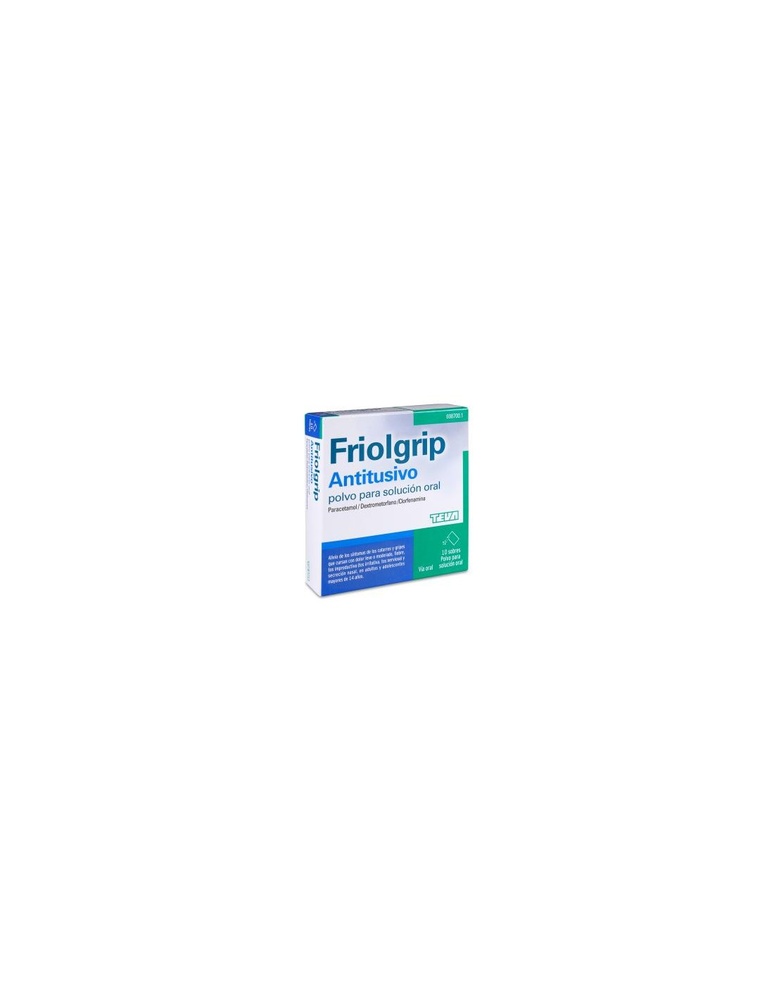
Caja que contiene 10 sobres de polvo para solución oral con sabor a naranja.
Titular de la autorización de comercialización y responsable de la fabricación
Titular de la autorización de comercialización
Teva Pharma, S.L.U.
C/ Anabel Segura 11, Edificio Albatros B, 1ª planta.
Alcobendas, 28108, Madrid (España)
Responsable de la fabricación
ALCALA FARMA, S.L.
Avenida de Madrid, 82
28802 (Alcalá de Henares) España
Fecha de la última revisión de este prospecto: Febrero 2025
La información detallada y actualizada de este medicamento está disponible en la página web de la Agencia Española de Medicamentos y Productos Sanitarios (AEMPS) http://www.aemps.gob.es
- País de registro
- Forma farmacéuticaSOLUCIÓN/SUSPENSIÓN ORAL, 650 mg/2,8 mg/14,66 mg
- Requiere recetaNo
- Fabricante
- ComposiciónSACARINA SODICA (25.0 mg mg), SACAROSA (3873.0 mg mg), CICLAMATO DE SODIO (140.0 mg mg)
- Esta información es de carácter general y no sustituye la consulta con un profesional sanitario.
- Alternativas a FRIOLGRIP ANTITUSIVO POLVO PARA SOLUCION ORALForma farmacéutica: SOLUCIÓN/SUSPENSIÓN ORAL, 7 mg/mlPrincipio activo: Hederae helicis foliumFabricante: Engelhard Arzneimittel Gmbh & Co. KgNo requiere recetaForma farmacéutica: COMPRIMIDO EFERVESCENTE, 600 MGPrincipio activo: AcetilcisteinaFabricante: Kern Pharma S.L.No requiere recetaForma farmacéutica: COMPRIMIDO EFERVESCENTE, 600 mgPrincipio activo: AcetilcisteinaFabricante: Laboratorios Alter S.A.Requiere receta
Médicos online para FRIOLGRIP ANTITUSIVO POLVO PARA SOLUCION ORAL
Comenta la dosis, los posibles efectos secundarios, interacciones, contraindicaciones o la revisión de receta de FRIOLGRIP ANTITUSIVO POLVO PARA SOLUCION ORAL, sujeto a valoración médica y a la normativa local.









Obtén una receta de FRIOLGRIP ANTITUSIVO POLVO PARA SOLUCION ORAL online
Rellena un formulario de 2 minutos
Cuéntanos tus síntomas, historial y el medicamento que necesitas.
Elige un médico o nosotros te asignamos uno
Escoge un especialista o te conectamos con el próximo médico disponible.
El médico revisa tu caso
Normalmente en 30 minutos. Puede hacerte preguntas adicionales por chat.
Recógela en cualquier farmacia
Receta electrónica enviada a tu correo, válida en toda España.
Preguntas frecuentes
FRIOLGRIP ANTITUSIVO POLVO PARA SOLUCION ORAL no requiere receta en España. Puedes confirmarlo con un médico online según tu caso.
FRIOLGRIP ANTITUSIVO POLVO PARA SOLUCION ORAL es fabricado por Teva Pharma S.L.U.. La marca y el envase pueden variar según el distribuidor.
Los Médicos de familia, Psiquiatras, Dermatólogos, Cardiólogos, Endocrinólogos, Gastroenterólogos, Neumólogos, Nefrólogos, Reumatólogos, Hematólogos, Infectólogos, Alergólogos, Geriatras, Pediatras, Oncólogos pueden valorar la prescripción de FRIOLGRIP ANTITUSIVO POLVO PARA SOLUCION ORAL cuando esté clínicamente indicado. Puedes reservar una videoconsulta para comentar tu caso y las opciones de tratamiento.
España cuenta con una infraestructura sanitaria bien desarrollada en ciudades principales como Madrid, Barcelona, Valencia y Sevilla. Las farmacias están ampliamente disponibles y operan bajo estrictas regulaciones, garantizando el acceso a medicamentos con receta.
Puedes comprar FRIOLGRIP ANTITUSIVO POLVO PARA SOLUCION ORAL en Madrid, Barcelona, Sevilla o Valencia en cualquier farmacia local con una receta válida.
Para obtener una receta, puedes utilizar Oladoctor:
Otros medicamentos con el mismo principio activo () incluyen ABRILAR JARABE, ACETILCISTEINA ABEX 600 MG COMPRIMIDOS EFERVESCENTES, ACETILCISTEINA ALTER 600 MG COMPRIMIDOS EFERVESCENTES EFG. Pueden tener diferentes nombres comerciales o formulaciones, pero contienen el mismo componente terapéutico. Consulta siempre con un médico antes de cambiar o iniciar un nuevo medicamento.
