


FOSCARNET TILLOMED 24 MG/ML SOLUCION PARA PERFUSION EFG
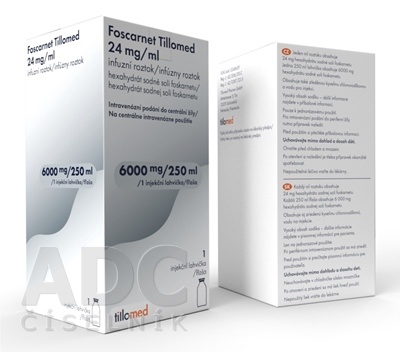



Cómo usar FOSCARNET TILLOMED 24 MG/ML SOLUCION PARA PERFUSION EFG
Traducción generada por IA
Este contenido ha sido traducido automáticamente y se ofrece solo con fines informativos. No sustituye la consulta con un profesional sanitario.
Ver originalContenido del prospecto
Introducción
Prospecto: información para el usuario
Foscarnet Tillomed24 mg/ml solución para perfusión EFG
Foscarnet sódico hexahidrato
Lea todo el prospecto detenidamente antes de empezar a usar este medicamento, porque contiene información importante para usted.
- Conserve este prospecto, ya que puede tener que volver a leerlo.
- Si tiene alguna duda, consulte a su médico, farmacéutico o enfermero.
- Si experimenta efectos adversos, consulte a su médico, farmacéutico o enfermero, incluso si se trata de efectos adversos que no aparecen en este prospecto. Ver sección 4.
Contenido del prospecto
- Qué es Foscarnet Tillomed y para qué se utiliza
- Qué necesita saber antes de empezar a usar Foscarnet Tillomed
- Cómo usar Foscarnet Tillomed
- Posibles efectos adversos
- Conservación de Foscarnet Tillomed
- Contenido del envase e información adicional
1. Qué es Foscarnet Tillomed y para qué se utiliza
Este medicamento contiene el principio activo foscarnet sódico hexahidrato, que pertenece a un grupo de medicamentos denominados antivirales. Actúa inhibiendo la multiplicación de algunos virus.
Este medicamento se utiliza para tratar las siguientes infecciones en pacientes con sida:
- La retinitis por CMV es una infección ocular potencialmente mortal o que pone en peligro la visión, causada por un virus en personas con sida, que provoca la pérdida de visión y, finalmente, la ceguera. El virus se llama citomegalovirus (CMV) y la infección se conoce como retinitis por CMV. Foscarnet impide que la infección empeore, pero no puede reparar el daño que ya se ha producido.
- Virus del Herpes Simple (VHS). Foscarnet se administra a personas con infección por VHS que presentan un sistema inmune debilitado. Se les administra a personas que no han mejorado del VHS después de haber sido tratadas con aciclovir.

2. Qué necesita saber antes de empezar a usar Foscarnet Tillomed
No useFoscarnet Tillomed:
- Si es alérgico al foscarnet sódico hexahidrato o a alguno de los demás componentes de este medicamento (incluidos en la sección 6).
Si no está seguro, hable con su médico o enfermero antes de que le administren foscarnet.
Advertencias y precauciones
Consulte a su médico o enfermero antes de empezar a usar Foscarnet Tillomed si.
- tiene problemas renales.
- tiene problemas cardíacos.
Si no está seguro de que esto le sea de aplicación, hable con su médico o enfermero antes de que le administren foscarnet.
Niños y adolescentes
No se ha establecido la seguridad y eficacia de foscarnet sódico hexahidrato en niños.
Otros medicamentos yFoscarnet Tillomed
Informe a su médico o enfermero si está utilizando, ha utilizado recientemente o pudiera tener que utilizar cualquier otro medicamento, incluidos los medicamentos adquiridos sin receta y las plantas medicinales.
En particular, informe a su médico o enfermero si está tomando alguno de los siguientes medicamentos:
- Pentaminida (para infecciones).
- Amfotericina B (para infecciones por hongos).
- Aciclovir (para infecciones virales).
- Antibióticos denominados aminoglucósidos, como gentamicina o estreptomicina (para infecciones).
- Ciclosporina A, metotrexato o tacrolimus (utilizados para suprimir el sistema inmunitario).
- Medicamentos inhibidores de la proteasa, como ritonavir y saquinavir.
- Laxantes.
- Quinidina, amiodarona, sotalol u otros medicamentos que puedan afectar a su frecuencia y ritmo cardíacos.
- Tranquilizantes (neurolépticos).
Embarazo, lactancia y fertilidad
Si está embarazada o en periodo de lactancia, cree que podría estar embarazada o tiene intención de quedarse embarazada, consulte a su médico o farmacéutico antes de utilizar este medicamento.
No se recomienda el uso de este medicamento durante el embarazo.
No se recomienda intentar quedarse embarazada durante el tratamiento con este medicamento y, por ello, debería emplear métodos anticonceptivos efectivos durante o hasta 6 meses después del tratamiento.
Los hombres que estén siendo tratados con este medicamento no deben procrear durante o hasta 6 meses después del tratamiento.
No use este medicamento si está amamantando a su hijo.
Conducción y uso de máquinas
Foscarnet puede afectar su capacidad para conducir o utilizar máquinas. Consulte con su médico antes de realizar alguna de estas actividades.
Pruebas antes y durante su tratamiento conFoscarnet Tillomed
Su médico puede hacerle análisis de sangre y orina antes y durante su tratamiento con Foscarnet Tillomed. Esto es para verificar el buen funcionamiento de sus riñones y el nivel de minerales en su sangre.
Foscarnet Tillomedcontiene sodio
Este medicamento contiene 1.375 mg de sodio (componente principal de la sal de mesa/para cocinar) en cada frasco de 250 ml. Esto equivale al 69% de la ingesta diaria máxima de sodio recomendada para un adulto.
Consulte con su médico o farmacéutico si necesita 71 ml o más de forma diaria por un período prolongado, especialmente si le han recomendado una dieta baja en sal (sodio).
3. Cómo usar Foscarnet Tillomed
Siga exactamente las instrucciones de administración de este medicamento indicadas por su médico o farmacéutico. En caso de duda, consulte de nuevo a su médico o farmacéutico.
- Este medicamento le será administrado por un médico o enfermero. Se le administrará en forma de perfusión (goteo) intravenosa. Podrá ser administrado a través de una vía central en su pecho si usted ya tiene una colocada en ese lugar.
- Cada perfusión durará al menos 1 hora. No interfiera en el goteo durante la perfusión.
- La cantidad de foscarnet que se le administre dependerá del funcionamiento de sus riñones y también de su peso.
- Es importante recibir suficiente líquido con la perfusión. Esto ayudará a prevenir problemas en los riñones. Si usted necesita líquido, su médico o enfermero se lo proporcionará al mismo tiempo que le administra foscarnet.
Uso deFoscarnet Tillomedpara infección por CMV
Si usted está en tratamiento con este medicamento debido a retinitis por CMV, el tratamiento se realizará en dos etapas. La primera etapa se conoce como tratamiento de inducción y la segunda etapa se denomina tratamiento de mantenimiento.
Tratamiento de inducción
- Durante la inducción, se le administrarán perfusiones cada 8 horas, normalmente durante 2 o 3 semanas.
- La dosis habitual para el tratamiento de inducción es de 60 mg de Foscarnet por cada kilogramo de peso (60 mg/kg) tres veces al día (cada 8 horas) o 90 mg/kg de peso, dos veces al día (cada 12 horas).
- Su médico le indicará cuando es el momento de cambiar al tratamiento de mantenimiento.
Tratamiento de mantenimiento
- Durante el tratamiento de mantenimiento, se le administrará una perfusión una vez al día.
- La dosis habitual para el tratamiento de mantenimiento es de 60 a 120 mg de Foscarnet por cada kilogramo de peso (60-120 mg/kg).
Su médico le dirá si necesita tomar más o menos de este medicamento y con qué frecuencia debe tomarlo. Esto es para que tenga la dosis adecuada para usted.
Puede que su médico también le recete un medicamento denominado ganciclovir para asegurarse de que usted recibe el tratamiento adecuado.
Uso deFoscarnet Tillomedpara el virus del herpes simple
- Si usted está en tratamiento con este medicamento debido a una infección por el virus del herpes simple, el tratamiento se realizará en una sola etapa.
- Se le administrará una perfusión cada 8 horas.
- Sus heridas (lesiones) pueden comenzar a curarse después de 1 semana aproximadamente. Sin embargo, puede que necesite seguir con el tratamiento de este medicamento durante 2 o 3 semanas, o hasta que sus heridas se hayan curado.
- La dosis habitual es de 40 mg de Foscarnet por cada kilogramo de peso (40 mg/kg).
Higiene personal
Lávese los genitales cuidadosamente después de orinar. Esto ayudará a prevenir el desarrollo de llagas.
Si la solución deFoscarnet Tillomedentra en contacto con la piel o los ojos
Si por error la solución de este medicamento entra en contacto con la piel o los ojos, lávese inmediatamente la zona afectada con agua.
Uso en niños y adolescentes:
No se ha establecido la seguridad y eficacia de este medicamento en niños y adolescentes menores de 18 años.
Si usa másFoscarnet Tillomeddel que debe
Si cree que le han administrado demasiado Foscarnet , informe a su médico inmediatamente.
Si olvidó usarFoscarnet Tillomed
Si cree que olvidó una dosis, consulte inmediatamente a su médico.
Si tiene cualquier otra duda sobre el uso de este medicamento, pregunte a su médico o enfermero.

4. Posibles efectos adversos
Al igual que todos los medicamentos, este medicamento puede producir efectos adversos, aunque no todas las personas los sufran.
Algunos efectos adversos pueden ser graves y necesitar atención médica inmediata:
- Reacciones alérgicas graves, incluida una bajada de la presión arterial, shock e hinchazón de la piel (angioedema). Se las conoce como hipersensibilidad, reacciones anafilácticas o anafilactoides.
- Erupciones cutáneas graves. Este tipo de erupciones pueden asociarse con enrojecimiento, hinchazón y ampollas en la piel, boca, garganta, ojos y otros lugares dentro del cuerpo y, en ocasiones, pueden provocar la muerte. Se denominan eritema multiforme, síndrome de Stevens-Johnson y necrólisis epidérmica tóxica.
Si usted experimenta alguno de los efectos adversos anteriores, informe a su médico inmediatamente o acuda a la unidad de emergencia más cercana.
Otros efectos secundarios incluyen:
Muy frecuentes: (pueden afectar a más de 1 de cada 10 personas)
- Pérdida de apetito.
- Diarrea.
- Sensación de enfermedad.
- Sensación de debilidad o cansancio.
- Temperatura elevada o escalofríos.
- Sensación de mareo.
- Cefalea.
- Hormigueo
- Erupción cutánea.
- Cambios en el buen funcionamiento de sus riñones (que se muestran en los análisis de sangre).
- Niveles bajos de glóbulos blancos. Los signos incluyen infecciones y temperatura elevada (fiebre).
- Cambios en el nivel de glóbulos rojos (que se muestran en los análisis de sangre). Esto puede hacerle sentir cansado o verse pálido.
- Un desequilibrio en las concentraciones de sales y minerales de su sangre, incluyendo debilidad, calambres, sed, hormigueo o picor en la piel y espasmos musculares.
Frecuentes: (pueden afectar hasta 1 de cada 10 personas)
- Dolor en la barriga (abdomen), estreñimiento, indigestión o sangrado gastrointestinal.
- Páncreas inflamado (pancreatitis) o cambios en el funcionamiento del páncreas. Los signos incluyen dolor de estómago intenso y puede haber cambios que se muestran en los análisis de sangre.
- Sentirse ansioso, nervioso, deprimido, agitado, agresivo o confundido.
- Problemas de coordinación.
- Ataques (convulsiones).
- Pérdida de sensibilidad en la piel.
- Picor en la piel.
- Malestar general.
- Hinchazón de pies y piernas.
- Latidos cardíacos fuertes (palpitaciones) o cambio de ritmo, p. ej. torsade de pointes o taquicardia.
- Tensión arterial alta.
- Tensión arterial baja. Esto puede provocar que se sienta mareado.
- Cambios en las pruebas que muestran cuál es el funcionamiento de su corazón (ECG).
- Problemas musculares, incluyendo cambios que se muestran en los análisis de sangre y músculos doloridos, débiles o temblorosos.
- Agitación (temblores).
- Daño nervioso que puede causar cambios en la sensación o debilidad muscular (neuropatía).
- Hinchazón, dolor y enrojecimiento a lo largo de una vena o donde se inserta la aguja de inyección.
- Úlceras genitales.
- Cambios en el funcionamiento de su hígado (que se muestran en los análisis de sangre).
- Niveles bajos de plaquetas en sangre, lo que puede causar la aparición de cardenales más fácilmente.
- Infección de la sangre.
- Problemas renales, que incluyen dolor en los riñones (puede sentir dolor en la parte baja de la espalda) y fallo renal. Pueden aparecer cambios que se muestran en los análisis de sangre u orina.
- Necesidad de orinar con más frecuencia de lo normal. En raras ocasiones, también puede sentir mucha sed o deshidratación.
- Dolor en el pecho.
Poco frecuentes: (pueden afectar hasta 1 de cada 100 personas)
- Erupción con picor (urticaria).
- Demasiado ácido en la sangre. Esto puede hacer que respire más rápido.
- Reducción de todos los glóbulos sanguíneos (pancitopenia)
Frecuencia no conocida:no puede estimarse a partir de los datos disponibles
- Latidos cardíacos inusuales.
- Una úlcera en el esófago (el conducto por el que los alimentos viajan desde la garganta hasta el estómago), que puede ser dolorosa.
- Problemas musculares graves con ruptura del tejido muscular (rabdomiólisis). Los síntomas incluyen color anormal de la orina y debilidad muscular grave, sensibilidad o rigidez.
- Sangre en la orina.
Comunicación de efectos adversos
Si experimenta cualquier tipo de efecto adverso, consulte a su médico o farmacéutico, incluso si se trata de posibles efectos adversos que no aparecen en este prospecto. También puede comunicarlos directamente a través del Sistema Español de Farmacovigilancia de Medicamentos de Uso Humano: https://www.notificaRAM.es. Mediante la comunicación de efectos adversos usted puede contribuir a proporcionar más información sobre la seguridad de este medicamento.
5. Conservación de Foscarnet Tillomed
- Mantener este medicamento fuera de la vista y del alcance de los niños.
- No utilice este medicamento después de la fecha de caducidad que aparece en el envase y en la etiqueta del frasco después de CAD. La fecha de caducidad es el último día del mes que se indica.
- No refrigerar ni congelar.
- Este medicamento no debe conservarse por debajo de 8°C, ya que puede producirse precipitación a temperaturas más bajas. La precipitación se mantiene incluso si la solución para perfusión se congela y se descongela de nuevo.
- Este medicamento puede volver a estar listo para su uso si se ha almacenado accidentalmente a temperaturas de frigorífico o si la solución para perfusión ha estado expuesta a temperaturas inferiores a la de congelación. A continuación, el frasco debe agitarse enérgicamente varias veces y mantenerse a temperatura ambiente durante 4 horas hasta que todo el precipitado se haya disuelto por completo.
Después de la apertura:
Desde un punto de vista microbiológico, a menos que el método de apertura excluya el riesgo de contaminación microbiana, el producto debe utilizarse inmediatamente. Si no se utiliza inmediatamente, los tiempos y condiciones de almacenamiento en uso son responsabilidad del usuario.
Después de la dilución:
Se ha demostrado la estabilidad química y física en uso durante 36 horas a 2-8? y 20-25?, cuando la solución se diluye de 24 mg/ml a 12 mg/ml de foscarnet sódico hexahidrato en bolsas de PVC. Desde un punto de vista microbiológico, el producto debe utilizarse inmediatamente. Si no se utiliza inmediatamente, las condiciones de conservación y el tiempo, antes del uso, son responsabilidad del usuario no debiendo superar las 24 horas conservado entre 2 y 8ºC, a menos que la reconstitución haya tenido lugar en condiciones asépticas controladas y validadas.
- No utilice este medicamento si observa algún daño en el frasco, decoloración u otros signos de deterioro.
- Los medicamentos no deben tirarse por los desagües ni a la basura. Pregunte a su farmacéutico cómo deshacerse de los envases y de los medicamentos que no necesita. De esta forma ayudará a proteger el medio ambiente.
6. Contenido del envase e información adicional
Composición deFoscarnet Tillomed
- El principio activo es foscarnet sódico hexahidrato.
- 1 ml de solución para perfusión contiene 24 mg de foscarnet sódico hexahidrato. Cada frasco de 250 ml contiene 6.000 mg de foscarnet sódico hexahidrato.
- Los demás componentes son: ácido clorhídrico, diluído para ajustar el pH y agua para preparaciones inyectables.
Aspecto del producto y contenido del envase
Foscarnet Tillomed es una solución transparente e incolora para perfusión en frascos de vidrio. Cada envase contiene 1 frasco o 10 frascos de 250 ml.
Puede que solamente estén comercializados algunos tamaños de envases.
Titular de la autorización de comercialización
Laboratorios Tillomed Spain, S.L.U.
C/ Cardenal Marcelo Spínola 8
28016 Madrid, España
Responsable de la fabricación[1]
MIAS Pharma Limited
Suite 2, Stafford House,
Strand Road Portmarnock,
Co. Dublin
Irlanda
Siegfried Hameln GmbH
Langes Feld 13
31789 Hameln
Alemania
SGS Pharma Magyarorszag Kft.
Derkovits Gyula Utca 53,
Budapest XIX,1193,
Hungría
Tillomed Malta Limited
Malta Life Science Park
LS2.01.06 Industrial Estate
San Gwann, SGN 3000, Malta
Este medicamento está autorizado en los estados miembros del Espacio Económico Europeo con los siguientes nombres:
Austria : Foscarnet Tillomed 24 mg / ml Infusionslösung
República Checa : Foscarnet Tillomed
Dinamarca : Foscarnet “Tillomed”
Estonia : Foscarnet sodium Tillomed
Finlandia : Foscarnet Tillomed 24 mg/ml infuusioneste, liuos
Francia : Foscarnet Tillomed 24 mg/ml solution pour perfusion
Alemania : Foscarnet Tillomed 24 mg / ml Infusionslösung
Grecia : Foscarnet Tillomed 24 mg / ml δι?λυμα για ?γχυση
Irlanda : Foscarnet sodium hexahydrate Tillomed 24 mg/ml solution for infusion
Italia : Foscarnet Tillomed
Letonia : Foscarnet sodium Tillomed
Lituania : “Foscarnet Tillomed” 24 mg / ml infuzinis tirpalas
Paises Bajos : Foscarnet Tillomed 24 mg / ml oplossing voor infusie
Noruega : Foskarnetnatriumheksahydrat Tillomed
Polonia : Foscarnet sodium hexahydrate Tillomed
Portugal : Foscarnet Tillomed 24 mg / ml solução para perfusão
Eslovaquia : Foscarnet Tillomed 24 mg / ml infúzny roztok
España : Foscarnet Tillomed 24 mg/ml solución para perfusión EFG
Suecia : Foscarnet Tillomed 24 mg/ml infusionsvätska, lösning
Fecha de la última revisión de este prospecto 05/2022
------------------------------------------------------------------------------------------------------------
Esta información está destinada únicamente a profesionales sanitarios:
Instrucciones de uso y manipulación
Cuando se perfunde en venas periféricas, la solución debe diluirse de 24 mg/ml a 12 mg/ml de foscarnet sódico hexahidrato antes de su uso. Las dosis individuales de este medicamento deben transferirse asépticamente a bolsas de perfusión de plástico (bolsas de PVC) y diluirse con partes iguales de solución de cloruro de sodio de 9 mg/ml (0,9%) o de solución de glucosa de 50 mg/ml (5%).
Almacenamiento y periodo de validez del medicamento y de la solución diluida: ver sección 5.
Cada frasco de este medicamento solo debe usarse para tratar a un único paciente con una sola perfusión.
El contacto accidental con la piel o con los ojos de la solución de foscarnet sódico hexahidrato puede causar irritación local y sensación de quemazón. En caso de producirse un contacto accidental deberá lavarse la zona afectada con agua.
[1]
1Sólo se indica el fabricante real en el folleto impreso
- País de registro
- Forma farmacéuticaINYECTABLE PERFUSION, 24 mg/ml
- Código ATCJ05AD01
- Principio activo
- Requiere recetaSí
- Fabricante
- Esta información es de carácter general y no sustituye la consulta con un profesional sanitario.
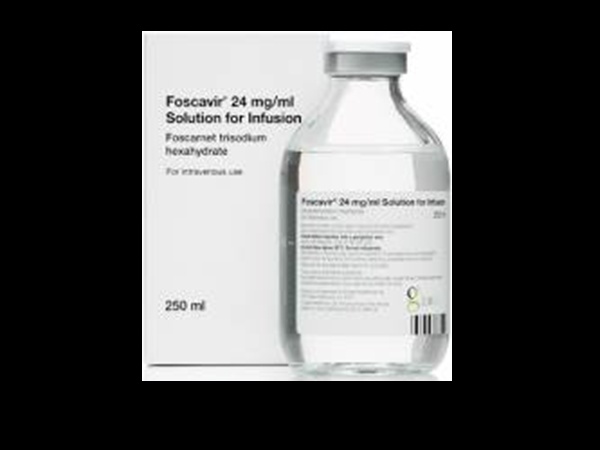
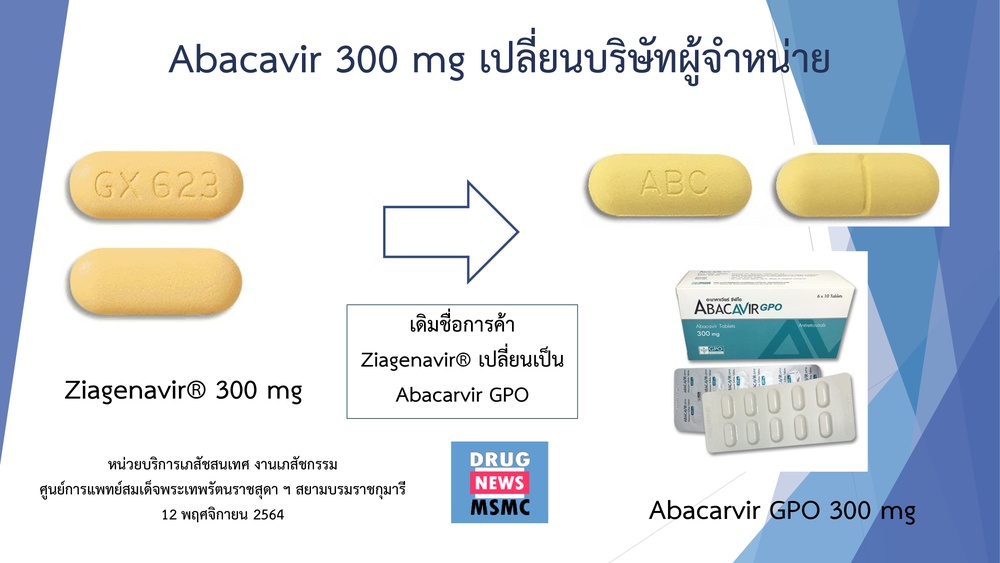
- Alternativas a FOSCARNET TILLOMED 24 MG/ML SOLUCION PARA PERFUSION EFGForma farmacéutica: INYECTABLE PERFUSION, 24 mg/mlPrincipio activo: foscarnetFabricante: Fresenius Kabi España, S.A.U.Requiere recetaForma farmacéutica: INYECTABLE PERFUSION, 24 mg foscarnet sodico/mlPrincipio activo: foscarnetFabricante: Clinigen Healthcare B.V.Requiere recetaForma farmacéutica: COMPRIMIDO, 300 MGPrincipio activo: AbacavirFabricante: Tarbis Farma S.L.Requiere receta

Médicos online para FOSCARNET TILLOMED 24 MG/ML SOLUCION PARA PERFUSION EFG
Comenta la dosis, los posibles efectos secundarios, interacciones, contraindicaciones o la revisión de receta de FOSCARNET TILLOMED 24 MG/ML SOLUCION PARA PERFUSION EFG, sujeto a valoración médica y a la normativa local.











Obtén una receta de FOSCARNET TILLOMED 24 MG/ML SOLUCION PARA PERFUSION EFG online
Rellena un formulario de 2 minutos
Cuéntanos tus síntomas, historial y el medicamento que necesitas.
Elige un médico o nosotros te asignamos uno
Escoge un especialista o te conectamos con el próximo médico disponible.
El médico revisa tu caso
Normalmente en 30 minutos. Puede hacerte preguntas adicionales por chat.
Recógela en cualquier farmacia
Receta electrónica enviada a tu correo, válida en toda España.
Preguntas frecuentes
