


Foscarnet Kabi 24 mg/ml solución para perfusión

Revisión de receta online
Un médico revisará tu caso y determinará si la prescripción es médicamente apropiada.

Habla con un médico sobre este medicamento
Comenta tus síntomas y las opciones de tratamiento en una consulta online.



Cómo usar FOSCARNET KABI 24 MG/ML SOLUCION PARA PERFUSION EFG
Contenido del prospecto
- Introducción
- Qué es Foscarnet Kabi y para qué se utiliza
- Qué necesita saber antes de empezar a usar Foscarnet Kabi
- Cómo usar Foscarnet Kabi
- Posibles efectos adversos
- Conservación de Foscarnet Kabi
- Contenido del envase e información adicional
Introducción
Prospecto: información para el usuario
Foscarnet Kabi 24 mg/ml solución para perfusión EFG
foscarnet sódico hexahidrato
Lea todo el prospecto detenidamente antes de empezar a usar este medicamento, porque contiene información importante para usted.
- Conserve este prospecto, ya que puede tener que volver a leerlo.
- Si tiene alguna duda, consulte a su médico o enfermero.
- Este medicamento se le ha recetado solamente a usted, y no debe dárselo a otras personas aunque tengan los mismos síntomas que usted, ya que puede perjudicarles.
- Si experimenta efectos adversos, consulte a su médico o enfermero, incluso si se trata de efectos adversos que no aparecen en este prospecto. Ver sección 4.
Contenido del prospecto
- Qué es Foscarnet Kabi y para qué se utiliza
- Qué necesita saber antes de empezar a usar Foscarnet Kabi
- Cómo usar Foscarnet Kabi
- Posibles efectos adversos
- Conservación de Foscarnet Kabi
- Contenido del envase e información adicional
1. Qué es Foscarnet Kabi y para qué se utiliza
Este medicamento pertenece a un grupo de medicamentos llamados antivirales. Actúa sobre determinados virus [todos los virus pertenecientes al grupo de herpes y algunos retrovirus como el citomegalovirus (CMV)]. Impide que el virus se reproduzca en las células infectadas.
Foscarnet se utiliza en personas con un sistema inmunitario debilitado:
- Para tratar la retinitis por CMV en pacientes con SIDA.
- Para tratar la infección por herpes (de labios, nariz, ojos y genitales).
- Foscarnet se administra a personas con infección por CMV tras un trasplante de médula ósea. Esto también se conoce como trasplante de células madre hematopoyéticas (HSCT, por sus siglas en inglés). En ocasiones, la infección puede detectarse antes de que el paciente comience a presentar síntomas. Esto se conoce como viremia por CMV.

¿No estás seguro de si este medicamento es adecuado para ti?
Comenta tus síntomas y tratamiento con un médico online.
2. Qué necesita saber antes de empezar a usar Foscarnet Kabi
No use Foscarnet Kabi:
- Si es alérgico al foscarnet o a alguno de los demás componentes de este medicamento (incluidos en la sección 6).
CONSULTE A SU MÉDICO O FARMACÉUTICO SI NO ESTÁ SEGURO.
Advertencias y precauciones
Consulte a su médico o enfermero antes de empezar a usar este medicamento:
- Si tiene problemas de riñon. En este caso, su médico podrá adaptar la dosis a su estado.
- Si tiene niveles bajos de calcio en sangre antes de recibir este medicamento, y si está tomando un medicamento que reduce los niveles de calcio en sangre.
- Si tiene problemas del corazón.
- Si tiene hormigueo en las manos o los labios, y náuseas. En este caso, su enfermero reducirá la velocidad de perfusión.
- En caso de contacto accidental con el producto, enjuague la piel expuesta o las membranas mucosas (interior de la boca, nariz, oídos o genitales) con agua.
Se recomienda prestar mucha atención a la higiene personal después de orinar: lavar el pene (o la vulva) con agua corriente para evitar lesiones genitales (ulceración genital),
Análisis de sangre
Antes y durante el tratamiento, su médico puede pedirle que se haga análisis de sangre y de orina. Estos análisis tienen como objetivo comprobar la función renal y los niveles de minerales en la sangre.
Otros medicamentos y Foscarnet Kabi
Informe a su médico o enfermero si está utilizando, ha utilizado recientemente o pudiera tener que utilizar cualquier otro medicamento, incluidos los medicamentos adquiridos sin receta y las plantas medicinales. Esto es debido a que foscarnet puede afectar a la forma en que funcionan algunos medicamentos y algunos medicamentos pueden tener efectos sobre foscarnet.
En particular, informe a su médico o enfermero si está tomando alguno de los siguientes medicamentos:
- Pentaminida (para infecciones).
- Amfotericina B (para infecciones por hongos).
- Aciclovir (para infecciones virales).
- Antibióticos denominados aminoglucósidos, como gentamicina o estreptomicina (para infecciones).
- Ciclosporina A, metotrexato o tacrolimus (utilizados para suprimir el sistema inmune).
- Medicamentos inhibidores de la proteasa, como ritonavir y saquinavir.
- Quinidina, amiodarona, sotalol u otros medicamentos que puedan afectar a su frecuencia y ritmo cardíacos.
- Ansiolíticos (neurolépticos).
Embarazo y lactancia
Si es está embarazada o en periodo de lactancia, cree que podría estar embarazada o tiene intención de quedarse embarazada, consulte a su médico o farmacéutico antes de utilizar este medicamento.
- No se recomienda el uso de foscarnet durante el embarazo.
- Debe evitar quedarse embarazada durante el tratamiento con foscarnet y, por ello, debería emplear métodos anticonceptivos efectivos mientras esté en tratamiento con foscarnet y durante los 7 meses siguientes a la finalización del mismo.
- Se recomienda a los hombres tratados con foscarnet que utilicen medidas anticonceptivas eficaces y no deben procrear durante o hasta 4 meses después del tratamiento.
- No tome foscarnet durante la lactancia.
Conducción y uso de máquinas
Foscarnet puede afectar su capacidad para conducir o utilizar máquinas. Esto se debe al riesgo de convulsiones, movimientos anormales y mareos reportados con este medicamento. Consulte con su médico antes de realizar alguna de estas actividades.
Foscarnet Kabi contiene sodio
Este medicamento contiene 240 micromoles (5,5 mg) de sodio (componente principal de la sal de mesa/para cocinar) en cada ml. Esto debe ser tenido en cuenta por los pacientes que siguen una diete controlada de sodio, por lo que le rogamos que informe a su médico o enfermero si sigue una dieta baja en sodio.
La dosis máxima recomendada de este medicamento contiene 2,89 gramos de sodio (presente en la sal de mesa).
Esto equivale al 144,5 % de la ingesta diaria máxima de sodio recomendada para un adulto.
Consulte con su médico o farmacéutico si necesita foscarnet de forma diaria por un período prolongado, especialmente si le han recomendado una dieta baja en sal.
3. Cómo usar Foscarnet Kabi
Siga exactamente las instrucciones de administración de este medicamento indicadas por su médico. En caso de duda, consulte de nuevo a su médico.
- Foscarnet le será administrado por un médico o enfermero. Se le administrará en forma de perfusión (goteo) intravenosa. Podrá ser administrado a través de una vía central en su pecho si usted ya tiene una colocada en ese lugar.
- Cada perfusión durará al menos 1 hora. No interfiera en el goteo durante la perfusión.
- La dosis de foscarnet que se le administre dependerá de su peso y del funcionamiento de sus riñones.
- Es importante mantener una ingesta adecuada de líquidos durante la perfusión, lo que también ayudará a prevenir problemas en los riñones. Si es necesario, su médico o enfermero le administrará el régimen de hidratación necesario al mismo tiempo que la perfusión de foscarnet.
Higiene personal
Lávese los genitales cuidadosamente después de orinar. Esto ayudará a prevenir el desarrollo de llagas.
Si la solución de foscarnet entra en contacto con la piel o los ojos
Si por error la solución de foscarnet entra en contacto con la piel o los ojos, lávese inmediatamente la zona afectada con agua.
Si usa más Foscarnet Kabi del que debe
Si se le administra una dosis extremadamente elevada de foscarnet, comuníqueselo a su médico o farmacéutico inmediatamente.
Si cree que le han administrado demasiado foscarnet, informe a su médico inmediatamente.
En caso de sobredosis consulte a su médico o farmacéutico o llame al Servicio de Información Toxicológica, teléfono: 91 562 04 20, indicando el medicamento y la cantidad administrada.

¿Has empezado a tomar el medicamento y tienes preguntas?
Comenta tus síntomas y tratamiento con un médico online.
4. Posibles efectos adversos
Al igual que todos los medicamentos, este medicamento puede producir efectos adversos, aunque no todas las personas los sufran.
Algunos efectos adversos pueden ser graves y necesitar atención médica inmediata:
- Reacciones alérgicas graves, incluida una bajada de la presión arterial, shock e hinchazón de la piel (angioedema). Se las conoce como hipersensibilidad, reacciones anafilácticas o anafilactoides.
- Erupciones cutáneas graves. Este tipo de erupciones pueden asociarse con enrojecimiento, hinchazón y ampollas en la piel, boca, garganta, ojos y otros lugares dentro del cuerpo y, en ocasiones, pueden provocar la muerte. Se denominan eritema multiforme, síndrome de Stevens-Johnson y necrólisis epidérmica tóxica.
Si usted experimenta alguno de los efectos adversos anteriores, informe a su médico inmediatamente o acuda a la unidad de emergencia más cercana.
Otros efectos secundarios incluyen:
Muy frecuentes: pueden afectar a más de 1 de cada 10 personas
- Reducción del recuento de glóbulos rojos (mostrado en los análisis). Puede sentirse cansado o tener un aspecto pálido.
- Niveles bajos de glóbulos blancos (granulocitopenia). Los signos incluyen infecciones y alta temperatura (fiebre).
- Reducción del nivel de potasio en sangre.
- Reducción del nivel de magnesio en sangre.
- Reducción del nivel de calcio en sangre.
- Mareos.
- Dolor de cabeza.
- Hormigueo.
- Diarrea.
- Náuseas, vómitos.
- Sensación de debilidad o cansancio.
- Temperatura elevada o escalofríos.
- Erupción cutánea.
- Cambios en el buen funcionamiento de sus riñones (que se muestran en los análisis de sangre), por ejemplo, aumento de la creatina sérica, descenso de la concentración de hemoglobina.
Frecuentes: pueden afectar hasta 1 de cada 10 personas
- Niveles bajos de glóbulos blancos (leucopenia y/o neutropenia). Los signos incluyen infecciones y temperatura alta (fiebre).
- Niveles reducidos de plaquetas en la sangre. Esto puede hacer que le salgan moratones con más facilidad.
- Infección generalizada (sepsis).
- Aumento o reducción del nivel de fosfato en sangre.
- Reducción del nivel de sodio en sangre.
- Aumento del nivel de calcio en sangre.
- Deshidratación.
- Funcionamiento anormal del hígado.
- Encimas hepáticas elevadas (gamma-GT, alanina aminotransferasa (ALT), aspartato aminotransferasa (AST), LDH).
- Cambios anímicos. Estos incluyen agresividad, agitación, ansiedad, confusión, depresión, nerviosismo.
- Coordinación anormal de los movimientos.
- Convulsiones.
- Reducción de la sensibilidad en la piel.
- Latidos inusuales del corazón (palpitaciones).
- Ritmo cardíaco rápido (taquicardia).
- Trastornos nerviosos susceptibles de provocar cambios sensoriales o debilidad muscular (neuropatía).
- Temblores.
- Hipertensión.
- Hipotensión, que puede provocar mareos.
- Hinchazón, dolor y enrojecimiento a lo largo de una vena.
- Dolor abdominal, estreñimiento e indigestión.
- Inflamación del páncreas (pancreatitis) o cambios en el funcionamiento del páncreas. Los signos incluyen un fuerte dolor de estómago y puede haber cambios en los análisis de sangre (aumento de las lipasas).
- Picor en la piel.
- Dolores musculares.
- Trastornos renales, por ejemplo, dolor en los riñones (dolor en la parte baja de la espalda), insuficiencia renal, presencia de proteínas en la orina.
- Dolor al orinar.
- Llagas o úlceras genitales. Se trata de lesiones aisladas o múltiples que remiten al suspender el tratamiento (ver “Advertencias y precauciones”).
- Malestar general.
- Dolor e inflamación en el lugar de inyección.
- Hinchazón de pues y piernas.
- Cambios en las pruebas que muestran el funcionamiento del corazón (ECG).
Poco frecuentes: pueden afectar hasta 1 de cada 100 personas
- Reducción de glóbulos rojos, blancos y plaquetas.
- Demasiado ácido en la sangre. Esto puede hacer que respire más rápido.
- Erupción con picazón (urticaria)
- Trastornos renales y urinarios (alteración renal tubular, glomerulonefritis, síndrome nefrótico).
- Aumento de ciertas enzimas de la sangre, por ejemplo, amilasa, creatina y fosfoquinasa.
Frecuencia no conocida (no puede estimarse a partir de los datos disponibles)
- Latidos cardíacos inusuales.
- Diabetes. Los signos incluyen orinar con más frecuencia de lo habitual. Más raramente, también puede sentir una sed excesiva.
- Aumento del nivel de sodio en sangre.
- Encefalopatía.
- Latidos cardíacos inusuales o cambios en la frecuencia cardíaca, por ejemplo, torsade de pointes.
- Problemas musculares: debilidad muscular, destrucción del tejido muscular (rabdomiólisis: color anormal de la orina y rigidez muscular severa, sensibilidad o debilidad).
- Problemas renales, por ejemplo, dolor, sangre en orina, necrosis tubular, nefropatía por cristales.
- Extravasación.
Comunicación de efectos adversos
Si experimenta cualquier tipo de efecto adverso, consulte a su médico o farmacéutico, incluso si se trata de posibles efectos adversos que no aparecen en este prospecto. También puede comunicarlos directamente a través del Sistema Español de Farmacovigilancia de Medicamentos de Uso Humano: https://www.notificaRAM.es. Mediante la comunicación de efectos adversos usted puede contribuir a proporcionar más información sobre la seguridad de este medicamento.
5. Conservación de Foscarnet Kabi
- Mantener este medicamento fuera de la vista y del alcance de los niños.
- No utilice este medicamento después de la fecha de caducidad que aparece en la etiqueta después de CAD. La fecha de caducidad es el último día del mes que se indica.
- No refrigerar o congelar. Si se conserva en nevera o se expone a temperaturas inferiores al punto de congelación, puede precipitar. Este precipitado se puede volver a solubilizar manteniendo el frasco a temperatura ambiente y agitando repetidamente.
- Se ha demostrado la estabilidad química y física en uso del producto durante 9 días a 25 °C. Desde un punto de vista microbiológico, el producto debe utilizarse inmediatamente a menos que la apertura y la dilución se hayan llevado a cabo en condiciones que excluyan el riesgo de contaminación microbiana. Si no se utiliza inmediatamente, el tiempo y las condiciones de conservación, antes del uso, son responsabilidad del usuario.
- Foscarnet puede ser mezclado con otro líquido por un farmacéutico. Esto es para proporcionarle un medicamento listo para usar. El farmacéutico le informará sobre cómo almacenar y cuándo usar el medicamento.
- Los medicamentos no se deben tirar por los desagües ni a la basura. Pregunte a su farmacéutico cómo deshacerse de los envases y de los medicamentos que ya no necesita. De esta forma, ayudará a proteger el medio ambiente.
6. Contenido del envase e información adicional
Composición de Foscarnet Kabi
El principio activo es foscarnet.
Cada ml contiene 24 mg de foscarnet sódico hexahidrato
Los demás componentes son agua para preparaciones inyectables y ácido clorhídrico.
Aspecto del producto y contenido del envase
Foscarnet es una solución para perfusión estéril.
La solución es transparente e incolora.
Foscarnet se presenta en frascos de 250 ml.
Titular de la autorización de comercialización
Fresenius Kabi España, S.A.U
Torre Mapfre – Vila Olímpica
Marina 16-18
08005 Barcelona
España
Responsable de la fabricación
Fresenius Kabi Austria GmbH
Hafnerstrasse 36
A-8055 Graz
Austria
Este medicamento está autorizado en los estados miembros del Espacio Económico Europeo con los siguientes nombres:
Bélgica: Foscarnet Fresenius Kabi 24 mg/ml oplossing voor infusie; Foscarnet Fresenius Kabi 24 mg/ml solution pour perfusion; Foscarnet Fresenius Kabi 24 mg/ml Infusionslösung
Francia: FOSCARNET KABI 24 mg/ml, solution pour perfusion
Alemania: Foscarnet Kabi 24 mg/ml Infusionslösung
Italia: Foscarnet Kabi
Luxemburgo: Foscarnet Sodium 24 mg/ml Solution for Infusion
Portugal: Foscarneto sódico Kabi
España: Foscarnet Kabi 24 mg/ml solución para perfusión EFG
Reino Unido: Foscarnet Sodium 24 mg/ml Solution for Infusion
Fecha de la última revisión de este prospecto:agosto 2022
La información detallada de este medicamento está disponible en la página web de la Agencia Española de Medicamentos y Productos Sanitarios (AEMPS) http://www.aemps.gob.es/.
------------------------------------------------------------------------------------------------------------------------
Esta información está destinada únicamente a profesionales sanitarios:
Tenga especial cuidado con Foscarnet Kabi
- En pacientes con deterioro de la función renal:
- La creatina sérica debe ser controlada regularmente.
- Debe preverse un ajuste de la dosis en pacientes con la función renal alterada. Para evitar cambios en la función renal que puedan producirse durante el tratamiento, debe mantenerse una hidratación adecuada.
- No utilizar soluciones que puedan contener calcio.
- En caso de contacto accidental, aclarar con agua la piel o las mucosas expuestas.
Forma de administración
Foscarnet debe administrarse únicamente por vía intravenosa, ya sea por una vía venosa central (catéter) o en una vena periférica.
Precaución: No administrar foscarnet por inyección intravenosa rápida.
No administrar foscarnet sin un régimen de hidratación.
No utilice soluciones que puedan contener calcio, glucosa al 30%, anfotericina B, aciclovir sódico, ganciclovir, isetionato de pentamidina, trimetoprim-sulfametoxazol y clorhidrato de vancomicina.
Como en todas las perfusiones, se requiere el cumplimiento de condiciones estrictamente asépticas durante la manipulación.
Cuando se usan venas periféricas, la solución de foscarnet 24 mg/ml tiene que diluirse. Los servicios de farmacia hospitalaria deben transferir asépticamente las dosis de foscarnet dispensadas individualmente a bolsas de perfusión de plástico, así como diluirlo en partes iguales de cloruro de sodio al 0,9% (9 mg/ml) o dextrosa al 5% (50 mg/ml). La estabilidad fisicoquímica del foscarnet, de las diluciones de foscarnet y de sus diluciones en bolsas de PVC es de 9 días. Las soluciones diluidas se deben usar lo antes posible después de la preparación, pero se pueden almacenar hasta 24 horas si se mantienen refrigeradas.
La toxicidad renal de foscarnet puede reducirse con una adecuada hidratación del paciente. Ver la sección “Hidratación” más adelante.
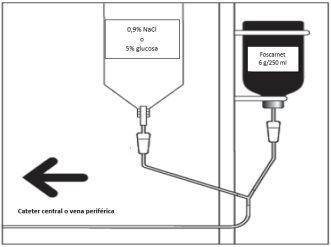
Si se utiliza un sistema de perfusión en Y, perfundir simultáneamente 0,5 a 1 litro de NaCl 0,9% o glucosa 5%.
No administrar otros productos en la misma perfusión. Cuando el producto se administra por perfusión en una vena periférica, la hidratación intravenosa simultánea sirve de dilución (ver sección “Hidratación”).
Esquema de un sistema de perfusión en Y
Hidratación:
Debe prestarse especial atención a la importancia de prevenir la toxicidad renal de foscarnet asegurando que los pacientes reciban una hidratación adecuada.
Si se utiliza un sistema de perfusión en Y, debe perfundirse simultáneamente 0,5 a 1 litro de NaCl 0,9% o glucosa 5%. En los pacientes que cumplen los requisitos, se ha utilizado la hidratación oral con regímenes de hidratación similares. Los pacientes clínicamente deshidratados deben tener su condición corregida antes de iniciar el tratamiento con foscarnet.
Cada frasco de foscarnet solo debe usarse para tratar a un único paciente con una sola perfusión.
El contacto accidental con la piel o con los ojos de la solución de foscarnet sódico puede causar irritación local y sensación de quemazón. En caso de producirse un contacto accidental deberá lavarse la zona afectada con agua.
Foscarnet refrigerado o expuesto a temperaturas por debajo del punto de congelación, puede precipitar. Al mantener el frasco a temperatura ambiente con agitación constante, el precipitado puede volver a convertirse en solución.
La eliminación del medicamento no utilizado y de todos los materiales que hayan estado en contacto con él se realizará de acuerdo con la normativa local.
- País de registro
- Forma farmacéuticaINYECTABLE PERFUSION, 24 mg/ml
- Código ATCJ05AD01
- Principio activo
- Requiere recetaSí
- Fabricante
- Esta información es de carácter general y no sustituye la consulta con un profesional sanitario.
- Alternativas a FOSCARNET KABI 24 MG/ML SOLUCION PARA PERFUSION EFGForma farmacéutica: INYECTABLE PERFUSION, 24 mg/mlPrincipio activo: foscarnetFabricante: Laboratorios Tillomed Spain S.L.URequiere recetaForma farmacéutica: INYECTABLE PERFUSION, 24 mg foscarnet sodico/mlPrincipio activo: foscarnetFabricante: Clinigen Healthcare B.V.Requiere recetaForma farmacéutica: COMPRIMIDO, 300 MGPrincipio activo: AbacavirFabricante: Tarbis Farma S.L.Requiere receta
Médicos online para FOSCARNET KABI 24 MG/ML SOLUCION PARA PERFUSION EFG
Comenta la dosis, los posibles efectos secundarios, interacciones, contraindicaciones o la revisión de receta de FOSCARNET KABI 24 MG/ML SOLUCION PARA PERFUSION EFG, sujeto a valoración médica y a la normativa local.









Preguntas frecuentes
FOSCARNET KABI 24 MG/ML SOLUCION PARA PERFUSION EFG requiere receta en España. Puedes confirmarlo con un médico online según tu caso.
El principio activo de FOSCARNET KABI 24 MG/ML SOLUCION PARA PERFUSION EFG es foscarnet. Esta información ayuda a identificar medicamentos con la misma composición pero con diferentes nombres comerciales.
FOSCARNET KABI 24 MG/ML SOLUCION PARA PERFUSION EFG es fabricado por Fresenius Kabi España, S.A.U.. La marca y el envase pueden variar según el distribuidor.
Los Médicos de familia, Psiquiatras, Dermatólogos, Cardiólogos, Endocrinólogos, Gastroenterólogos, Neumólogos, Nefrólogos, Reumatólogos, Hematólogos, Infectólogos, Alergólogos, Geriatras, Pediatras, Oncólogos pueden valorar la prescripción de FOSCARNET KABI 24 MG/ML SOLUCION PARA PERFUSION EFG cuando esté clínicamente indicado. Puedes reservar una videoconsulta para comentar tu caso y las opciones de tratamiento.
La receta la emite un médico tras valorar tu estado de salud. En España, FOSCARNET KABI 24 MG/ML SOLUCION PARA PERFUSION EFG se dispensa en las farmacias con esa receta médica. Una consulta online no garantiza su emisión: la decisión corresponde siempre al médico.
Para solicitar una valoración puedes usar Oladoctor:
Otros medicamentos con el mismo principio activo (foscarnet) incluyen FOSCARNET TILLOMED 24 MG/ML SOLUCION PARA PERFUSION EFG, FOSCAVIR 24 mg/ml SOLUCION PARA PERFUSION, ABACAVIR TARBIS 300 MG COMPRIMIDOS RECUBIERTOS CON PELICULA EFG. Pueden tener diferentes nombres comerciales o formulaciones, pero contienen el mismo componente terapéutico. Consulta siempre con un médico antes de cambiar o iniciar un nuevo medicamento.
