



ETORICOXIB 60 mg Comprimidos Recubiertos Con Película

Revisión de receta online
Un médico revisará tu caso y determinará si la prescripción es médicamente apropiada.

Habla con un médico sobre este medicamento
Comenta tus síntomas y las opciones de tratamiento en una consulta online.



Cómo usar ETORICOXIB COMBIX 60 MG COMPRIMIDOS RECUBIERTOS CON PELICULA EFG
Contenido del prospecto
- Introducción
- Qué es Etoricoxib Combix y para qué se utiliza
- Qué necesita saber antes de empezar a tomar Etoricoxib Combix
- Cómo tomar Etoricoxib Combix
- Posibles efectos adversos
- Conservación de Etoricoxib Combix
- Contenido del envase e información adicional
Introducción
Prospecto: información para el paciente
Etoricoxib Combix 30 mg comprimidos recubiertos con película EFG
Etoricoxib Combix 60 mg comprimidos recubiertos con película EFG
Etoricoxib Combix 90 mg comprimidos recubiertos con película EFG
Etoricoxib Combix 120 mg comprimidos recubiertos con película EFG
Lea todo el prospecto detenidamente antes de empezar a tomar este medicamento, porque contiene información importante para usted.
- Conserve este prospecto, ya que puede tener que volver a leerlo.
- Si tiene alguna duda, consulte a su médico o farmacéutico.
- Este medicamento se le ha recetado solamente a usted,y no debe dárselo a otras personas aunque tengan los mismos síntomas que usted, ya que puede perjudicarles.
- Si experimenta efectos adversos, consulte a su médico o farmacéutico, incluso si se trata de efectos adversos que no aparecen en este prospecto. Ver sección 4.
Contenido del prospecto:
- Qué es Etoricoxib Combix y para qué se utiliza
- Qué necesita saber antes de empezar a tomar Etoricoxib Combix
- Cómo tomar Etoricoxib Combix
- Posibles efectos adversos
- Conservación de Etoricoxib Combix
- Contenido del envase e información adicional
1. Qué es Etoricoxib Combix y para qué se utiliza
¿Qué es Etoricoxib?
- Este medicamento contiene el principio activo etoricoxib. Etoricoxib pertenece a un grupo de medicamentos denominados inhibidores selectivos de la COX-2. Éstos pertenecen a una familia de medicamentos llamados fármacos antiinflamatorios no esteroideos (AINEs).
¿Para qué se utiliza Etoricoxib?
- Etoricoxib ayuda a reducir el dolor y la hinchazón (inflamación) en las articulaciones y músculos de personas de 16 años de edad y mayores con artrosis, artritis reumatoide, espondilitis anquilosante y gota.
- Etoricoxib también se utiliza para el tratamiento a corto plazo del dolor moderado tras cirugía dental en personas de 16 años de edad y mayores.
¿Qué es la artrosis?
La artrosis es una enfermedad de las articulaciones. Provoca la ruptura gradual del cartílago que amortigua los extremos de los huesos. Esto provoca hinchazón (inflamación), dolor, sensibilidad, rigidez e incapacidad.
¿Qué es la artritis reumatoide?
La artritis reumatoide es una enfermedad inflamatoria de larga duración de las articulaciones. Causa dolor, rigidez, hinchazón y pérdida progresiva de movilidad en las articulaciones afectadas. También causa inflamación en otras áreas del organismo.
¿Qué es la gota?
La gota es una enfermedad de ataques repentinos y recurrentes de inflamación muy dolorosa y enrojecimiento de las articulaciones. Está causada por depósitos de cristales minerales en la articulación.
¿Qué es la espondilitis anquilosante?
La espondilitis anquilosante es una enfermedad inflamatoria de la columna vertebral y de las articulaciones largas.

¿No estás seguro de si este medicamento es adecuado para ti?
Comenta tus síntomas y tratamiento con un médico online.
2. Qué necesita saber antes de empezar a tomar Etoricoxib Combix
No tome Etoricoxib:
- si es alérgico (hipersensible) a etoricoxib o a alguno de los demás componentes de este medicamento(incluidos en la sección 6)
- si es alérgico a los fármacos antiinflamatorios no esteroideos (AINEs), incluyendo la aspirina y los inhibidores de la COX-2 (ver Posibles efectos adversos, sección 4)
- si actualmente tiene una úlcera o hemorragia de estómago o duodenal
- si tiene una enfermedad grave de hígado
- si tiene una enfermedad grave de riñón
- si está o puede estar embarazada, o está dando el pecho a su hijo (ver "Embarazo, lactancia y fertilidad")
- si tiene menos de 16 años de edad
- si tiene una enfermedad inflamatoria intestinal, como la enfermedad de Crohn, colitis ulcerosa o colitis
- si tiene tensión arterial alta que no ha sido controlada con el tratamiento (consulte con su médico o enfermera si no está seguro de si su tensión arterial está controlada adecuadamente)
- si su médico le ha diagnosticado problemas cardiacos incluyendo insuficiencia cardiaca (de tipo moderado o grave), angina de pecho (dolor torácico)
- si ha tenido un infarto de miocardio, revascularización quirúrgica, enfermedad arterial periférica (poca circulación en las piernas o los pies debido a arterias estrechas o bloqueadas)
- si ha tenido cualquier tipo de infarto cerebral (incluyendo un accidente cerebral transitorio o un accidente isquémico transitorio).
Etoricoxib puede aumentar ligeramente su riesgo de infarto de miocardio y de infarto cerebral, y por esto no debe usarse en aquellos pacientes que ya hayan tenido problemas de corazón o un infarto cerebral.
Si cree hallarse en alguno de estos casos, no tome los comprimidos hasta que lo haya consultado con su médico.
Advertencias y precauciones
Consulte a su médico o farmacéutico antes de empezar a tomar Etoricoxib si:
- Tiene antecedentes de úlceras o hemorragia de estómago.
- Está deshidratado, por ejemplo, como consecuencia de una enfermedad prolongada con vómitos o diarrea.
- Tiene hinchazón debido a retención de líquidos.
- Tiene antecedentes de insuficiencia cardiaca o cualquier otra forma de enfermedad cardiaca.
- Tiene antecedentes de tensión arterial alta. Etoricoxib puede aumentar la tensión arterial en algunas personas, especialmente en dosis altas, y su médico querrá comprobar su tensión arterial de vez en cuando.
- Tiene antecedentes de enfermedad de hígado o de riñón.
- Está siendo tratado de una infección. Etoricoxib puede enmascarar o encubrir la fiebre, que es un signo de infección.
- Tiene diabetes, colesterol alto, o es fumador, ya que estos pueden aumentar su riesgo de sufrir una enfermedad cardiaca.
- Es una mujer intentando quedarse embarazada.
- Es mayor de 65 años.
Si no está seguro de si alguna de las situaciones anteriores le afecta a usted, hable con su médico antes de tomar este medicamentopara comprobar si etoricoxib es apropiado para usted.
Etoricoxib funciona igual de bien en pacientes adultos y jóvenes. Si es mayor de 65 años, su médico querrá mantener un control adecuado de usted. No es necesario ajustar la dosis en los pacientes mayores de 65 años.
Niños y adolescentes
No administre este medicamento a niños y adolescentes menores de 16 años de edad.
Toma de Etoricoxib con otros medicamentos
Informe a su médico o farmacéutico si está utilizando, ha utilizado recientemente o pudiera tener que utilizar cualquier otro medicamento, incluso los adquiridos sin receta.
En particular si está utilizando alguno de los siguientes medicamentos, puede que su médico quiera controlarle para comprobar que sus medicamentos funcionan adecuadamente una vez que empiece a tomar Etoricoxib:
- medicamentos que hacen su sangre menos espesa (anticoagulantes), como warfarina
- rifampicina (un antibiótico)
- metotrexato (un medicamento utilizado para suprimir el sistema inmune y a menudo usado en la artritis reumatoide)
- ciclosporina o tacrolimus (medicamentos utilizados para suprimir el sistema inmune)
- litio (un medicamento utilizado para tratar algunos tipos de depresión)
- medicamentos utilizados para ayudar a controlar la tensión arterial alta y la insuficiencia cardiaca denominados inhibidores de la ECA y antagonistas del receptor de angiotensina, por ejemplo enalapril y ramipril, y losartán y valsartán
- diuréticos (comprimidos para orinar)
- digoxina (un medicamento para la insuficiencia cardiaca y el ritmo irregular del corazón)
- minoxidil (un medicamento utilizado para tratar la tensión arterial alta)
- comprimidos o solución oral de salbutamol (un medicamento para el asma)
- anticonceptivos orales (la combinación puede aumentar su riesgo de efectos adversos)
- terapia hormonal de sustitución (la combinación puede aumentar su riesgo de efectos adversos)
- ácido acetilsalicílico (aspirina), el riesgo de úlceras en el estómago es mayor si toma Etoricoxib con ácido acetilsalicílico.
- Acido acetilsalicílico para la prevención de infartos de miocardio o de infarto cerebral:
Etoricoxib puede tomarse con dosis bajasde aspirina. Si actualmente está tomando dosis bajas de aspirina para prevenir infartos de miocardio o un infarto cerebral, no debe dejar de tomar aspirina hasta que hable con su médico
- Acido acetilsalicílico y otros fármacos antiinflamatorios no esteroideos (AINEs):
no tome dosis altasde aspirina u otros medicamentos antiinflamatorios mientras esté tomando este medicamento.
Toma de Etoricoxib con alimentos y bebidas
El comienzo del efecto de Etoricoxib puede ser más rápido si se toma sin alimentos.
Embarazo, lactanciay fertilidad
Embarazo
Los comprimidos de Etoricoxib no deben tomarse durante el embarazo. No tome los comprimidos si está embarazada, si cree que puede estar embarazada o si tiene previsto quedarse embarazada. Si se queda embarazada, deje de tomar los comprimidos y consulte a su médico. Consulte a su médico si tiene dudas o si necesita más información.
Lactancia
No se sabe si Etoricoxib se elimina por la leche humana. Si está dando el pecho o tiene previsto hacerlo, consulte a su médico antes de tomar Etoricoxib . Si está utilizando este medicamento, no debe dar el pecho.
Fertilidad
No se recomienda utilizar Etoricoxib en mujeres que estén intentando quedarse embarazadas.
Conducción y uso de máquinas
En algunos pacientes que toman Etoricoxib, se han comunicado mareos y somnolencia.
No conduzca si experimenta mareos o somnolencia.
No utilice herramientas o máquinas si experimenta mareos o somnolencia.
Etoricoxib Combix contiene lactosa
Si su médico le ha indicado que padece intolerancia a ciertos azúcares, consulte con él antes de tomar este medicamento.
3. Cómo tomar Etoricoxib Combix
Siga exactamente las instrucciones de administración de este medicamento indicadas por su médico. En caso de duda, consulte de nuevo a su médico o farmacéutico.
No tome más de la dosis recomendada para su enfermedad. Su médico querrá hablar de su tratamiento de vez en cuando. Es importante que utilice la dosis más baja que controla su dolor y no debe tomar Etoricoxib más tiempo del necesario. Esto se debe a que el riesgo de infartos de miocardio e infartos cerebrales podría aumentar después de un tratamiento prolongado, especialmente con dosis altas.
Hay diferentes dosis disponibles para este medicamento, y dependiendo de su enfermedad, su médico le prescribirá el comprimido con la dosis que sea adecuada para usted.
La dosis recomendada es:
Artrosis
La dosis recomendada es de 30 mg una vez al día, aumentándose hasta un máximo de 60 mg una vez al día si es necesario.
Artritis reumatoide
La dosis recomendada es de 60 mg una vez al día, aumentándose hasta un máximo de 90 mg una vez al día si es necesario.

¿Has empezado a tomar el medicamento y tienes preguntas?
Comenta tus síntomas y tratamiento con un médico online.
Espondilitis anquilosante
La dosis recomendada es de 60 mg una vez al día, aumentándose hasta un máximo de 90 mg una vez al día si es necesario.
Situaciones de dolor agudo
Etoricoxib sólo debe utilizarse durante el periodo de dolor agudo.
Gota
La dosis recomendada es de 120 mg una vez al día que sólo debe utilizarse durante el periodo de dolor agudo, limitada a un máximo de 8 días de tratamiento.
Dolor postoperatorio tras cirugía dental
La dosis recomendada es de 90 mg una vez al día, limitada a un máximo de 3 días de tratamiento.
Pacientes con problemas de hígado
- Si tiene una enfermedad leve de hígado, no debe tomar más de 60 mg al día.
- Si tiene una enfermedad moderadade hígado, no debe tomar más de 30mg al día.
Uso en niños y adolescentes
Niños o adolescentes menores de 16 años de edad no deben tomar los comprimidos de Etoricoxib.
Pacientes mayores de 65años
No es necesario un ajuste de dosis en pacientes mayores de 65 años. Como con otros medicamentos, se debe tener precaución en pacientes de edad avanzada.
Forma de administración
Este medicamento se administra por vía oral. Tome los comprimidos una vez al día. Etoricoxib se puede tomar con o sin alimentos.
Si toma más Etoricoxib del que debe
Nunca debe tomar más comprimidos que los que su médico le recomienda. Si toma demasiados comprimidos de Etoricoxib, busque atención médica inmediatamente.
En caso de sobredosis o ingestión accidental, también puede llamar al Servicio de Información Toxicológica, Tfno. 91 562 04 20, indicando el medicamento y la cantidad tomada. Se recomendará llevar el envase y el prospecto del medicamento al profesional sanitario.
Si olvidó tomar Etoricoxib
Es importante que tome este medicamento como su médico le haya indicado. Si olvida una dosis, limítese a reanudar el régimen habitual al día siguiente. No tome una dosis doble para compensar las dosis olvidadas.
Si tiene cualquier otra duda sobre el uso de este medicamento, pregunte a su médico o farmacéutico.
4. Posibles efectos adversos
Al igual que todos los medicamentos, este medicamento puede producir efectos adversos, aunque no todas las personas los sufran.
Si desarrolla alguno de estos signos, deje de tomareste medicamentoy hable con su médico inmediatamente (ver sección2.Qué necesita saber antes de empezar a tomar Etoricoxib):
- dificultad para respirar, dolor torácico o hinchazón de tobillo, o si éstos empeoran
- color amarillento de la piel y los ojos (ictericia) - éstos son signos de problemas de hígado
- dolor de estómago intenso o continuo o sus heces adquieren un color negro
- una reacción alérgica – que puede incluir problemas en la piel como úlceras o formación de ampollas, o hinchazón de la cara, labios, lengua o garganta que puede causar dificultad al respirar
Los siguientes efectos adversos pueden producirse durante el tratamiento con Etoricoxib:
Muy frecuentes(pueden afectar a más de 1 de cada 10personas):
- dolor de estómago
Frecuentes(pueden afectar hasta 1 de cada 10personas):
- osteitis alveolar (inflamación y dolor tras la extracción de un diente)
- hinchazón de las piernas y/o los pies debido a la retención de líquidos (edema)
- mareo, dolor de cabeza
- palpitaciones (latido del corazón rápido o irregular), ritmo cardiaco irregular (arritmia)
- tensión arterial elevada
- jadeo o dificultad para respirar (broncoespasmo)
- estreñimiento, gases (gas en exceso), gastritis (inflamación de la capa interna del estómago), ardor, diarrea, indigestión (dispepsia)/molestia de estómago, náuseas, vómitos, inflamación del esófago, úlceras bucales
- cambios en los análisis de sangre relacionados con su hígado
- hematomas
- debilidad y fatiga, enfermedad tipo gripe
Poco frecuentes(pueden afectar hasta 1 de cada 100personas):
- gastroenteritis (inflamación del tracto gastrointestinal que afecta tanto al estómago como al intestino delgado/catarro gástrico), resfriado, infección urinaria
- cambios en los resultados de laboratorio (número disminuido de glóbulos rojos, número disminuido de glóbulos blancos, descenso de plaquetas)
- hipersensibilidad (reacción alérgica incluyendo urticaria que puede ser lo suficientemente grave para requerir atención médica inmediata)
- aumentos o descensos del apetito, ganancia de peso
- ansiedad, depresión, disminución de la agudeza mental; ver, sentir u oír cosas que no existen (alucinaciones)
- alteración del gusto, incapacidad para dormir, entumecimiento u hormigueo, somnolencia
- visión borrosa, irritación y enrojecimiento ocular
- ruidos en los oídos, vértigo (sensación de giro estando parado)
- ritmo cardiaco anómalo (fibrilación auricular), frecuencia cardiaca rápida, insuficiencia cardiaca, sensación de tensión, presión o pesadez en el pecho (angina de pecho), infarto de miocardio
- enrojecimiento, infarto cerebral, mini infarto cerebral (ataque isquémico transitorio), aumento grave de la tensión arterial, inflamación de los vasos sanguíneos
- tos, falta de respiración, hemorragia nasal
- hinchazón de estómago, cambios en los hábitos del movimiento de su intestino, sequedad de boca, úlcera de estómago, inflamación de la capa interna del estómago que puede llegar a ser grave y puede producir hemorragias, síndrome de colon irritable, inflamación del páncreas
- hinchazón de la cara, erupción o picor cutáneo, enrojecimiento de la piel
- calambre/espasmo muscular, dolor/rigidez muscular
- niveles elevados de potasio en su sangre, cambios en los análisis de sangre o de orina relacionados con su riñón, problemas renales graves
- dolor torácico
Raros(pueden afectar hasta 1 de cada 1.000personas):
- angioedema (reacción alérgica con hinchazón de la cara, labios, lengua, y/o garganta que puede causar dificultad para respirar o tragar, que puede ser lo suficientemente grave para requerir atención médica inmediata)/reacciones anafilácticas/anafilactoides incluyendo shock (reacción alérgica grave que requiere atención médica inmediata)
- confusión, nerviosismo
- problemas de hígado (hepatitis)
- niveles bajos de sodio en sangre
- alteración del hígado, color amarillento de la piel y/o los ojos (ictericia)
- reacciones cutáneas graves
Comunicación de efectos adversos:Si experimenta cualquier tipo de efecto adverso, consulte a su médico o farmacéutico, incluso si se trata de posibles efectos adversos que no aparecen en este prospecto. También puede comunicarlos directamente a través del Sistema Español de Farmacovigilancia de medicamentos de Uso Humano: https://www.notificaram.es. Mediante la comunicación de efectos adversos usted puede contribuir a proporcionar más información sobre la seguridad de este medicamento.
5. Conservación de Etoricoxib Combix
Mantener este medicamento fuera de la vista y del alcance de los niños.
No utilice este medicamento después de la fecha de caducidad que aparece en el envase después de CAD. La fecha de caducidad es el último día del mes que se indica.
Este medicamento no requiere condiciones especiales de conservación.
Los medicamentos no se deben tirar por los desagües ni a la basura. Deposite los envases y los medicamentos que no necesita en el Punto SIGRE de la farmacia. En caso de duda pregunte a su farmacéutico cómo deshacerse de los envases y de los medicamentos que no necesita. De esta forma, ayudará a proteger el medio ambiente.
6. Contenido del envase e información adicional
Composición de Etoricoxib Combix
- El principio activo es etoricoxib. Cada comprimido recubierto con película contiene 30 mg, 60 mg, 90 mg y 120 mg de etoricoxib.
- Los demás componentes (excipientes) son:
Núcleo del comprimido: laurilsulfato de sodio, celulosa microcristalina, hidroxipropilcelulosa, hidrogenofosfato de calcio anhidro, croscarmelosa de sodio, sílice coloidal anhidra, estearato de magnesio.
Recubrimiento del comprimido: lactosa monohidrato, triacetina, hipromelosa y dióxido de titanio (E171). Los comprimidos de 30 mg, 60 mg y 120 mg también contienen indigotina (Laca índigo carmín) (E132) y óxido de hierro amarillo (E172).
Aspecto del producto y contenido del envase
Los comprimidos de Etoricoxib Combix están disponibles en 4 dosis:
Etoricoxib Combix 30 mg comprimidos recubiertos con pelicula: se presenta en forma de comprimidos recubiertos con película lisos por ambas caras, biconvexos, redondos, de color verde claro a verde azulado.
Etoricoxib Combix 60 mg comprimidos recubiertos con película: se presenta en forma de comprimidos recubiertos con película grabados con ‘60’ en una cara y lisos por la otra, biconvexos, redondos, de color verde.
Etoricoxib Combix90 mg comprimidos recubiertos con película: se presenta en forma de comprimidos recubiertos con película lisos por ambas caras, biconvexos, redondos, de color blanco a blanquecino.
Etoricoxib Combix120 mg comprimidos recubiertos con película: se presenta en forma de comprimidos recubiertos con película grabados con ‘120’ en una cara y lisos por la otra, biconvexos, redondos, de color verde.
Tamaños de envases:
Etoricoxib Combix 30 mg, 60 mg y 90 mg: 28 comprimidos recubiertos con película.
Etoricoxib Combix 120 mg: 7 comprimidos recubiertos con película.
Titular de la autorización de comercialización
Laboratorios Combix, S.L.U.
C/ Badajoz 2, Edificio 2
28223 Pozuelo de Alarcón (Madrid)
España
Responsable de la fabricación
Zydus France
ZAC Les Hautes Patures
Parc d'activités des Peupliers
25 Rue des Peupliers
92000 Nanterre
Francia
ó
Centre Spécialités Pharmaceutiques
ZAC des Suzots
35 rue de la Chapelle
63450 Saint Amant Tallende
Francia
Fecha de la última revisión de este prospecto: Abril 2017
La información detallada y actualizada de este medicamento está disponible en la página Web de la Agencia Española de Medicamentos y Productos Sanitarios (AEMPS)http://www.aemps.gob.es/
- País de registro
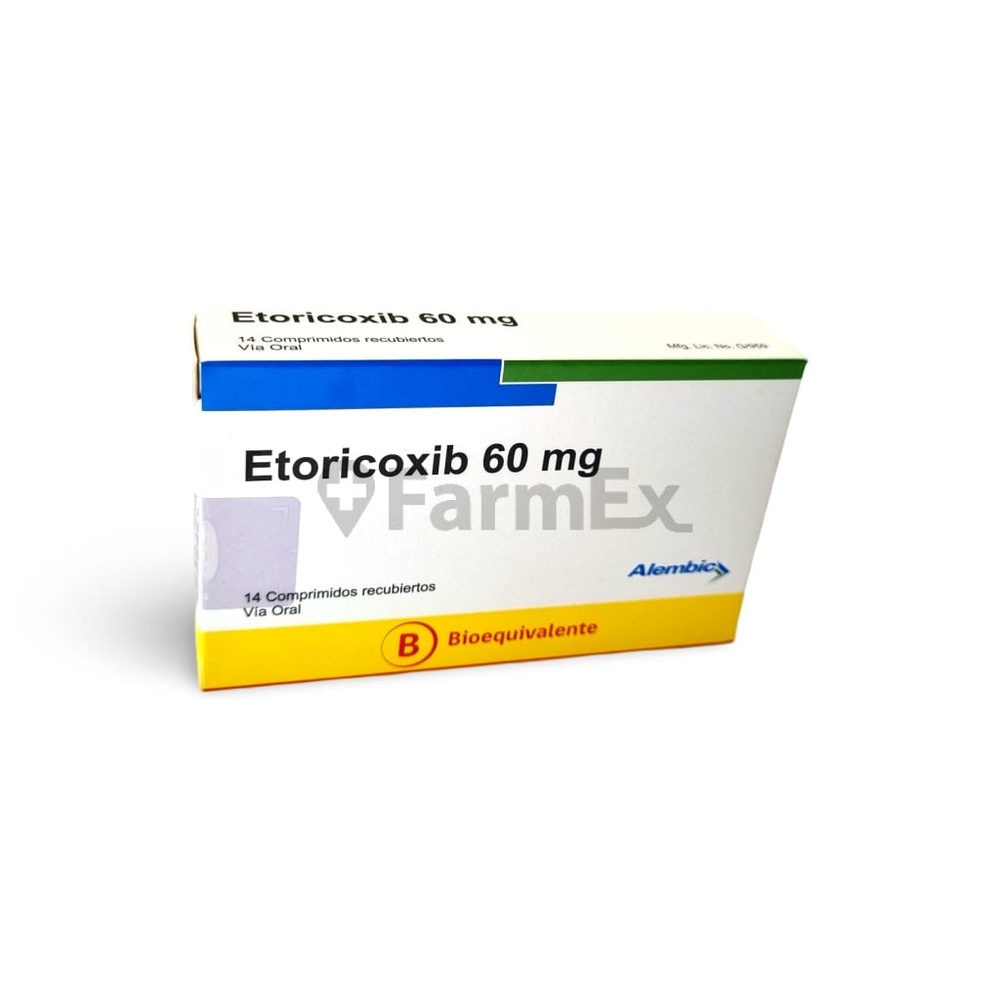
- Forma farmacéuticaCOMPRIMIDO, 60 mg
- Código ATCM01AH05
- Precio medio en farmacia10.74 EUR
- Principio activo
- Requiere recetaSí
- Fabricante
- ComposiciónLAURILSULFATO DE SODIO (5,00 mg mg), CROSCARMELOSA SODICA (6,00 mg mg), LACTOSA MONOHIDRATO (PHARMATOSE 200M) (1,00 mg mg)
- Esta información es de carácter general y no sustituye la consulta con un profesional sanitario.
- Alternativas a ETORICOXIB COMBIX 60 MG COMPRIMIDOS RECUBIERTOS CON PELICULA EFGForma farmacéutica: COMPRIMIDO, 120 mg etoricoxibPrincipio activo: etoricoxibFabricante: Organon Salud S.L.Requiere recetaForma farmacéutica: COMPRIMIDO, 30 mg etoricoxibPrincipio activo: etoricoxibFabricante: Organon Salud S.L.Requiere recetaForma farmacéutica: COMPRIMIDO, 60 mg etoricoxibPrincipio activo: etoricoxibFabricante: Organon Salud S.L.Requiere receta
Médicos online para ETORICOXIB COMBIX 60 MG COMPRIMIDOS RECUBIERTOS CON PELICULA EFG
Comenta la dosis, los posibles efectos secundarios, interacciones, contraindicaciones o la revisión de receta de ETORICOXIB COMBIX 60 MG COMPRIMIDOS RECUBIERTOS CON PELICULA EFG, sujeto a valoración médica y a la normativa local.









Obtén una receta de ETORICOXIB COMBIX 60 MG COMPRIMIDOS RECUBIERTOS CON PELICULA EFG online
Rellena un formulario de 2 minutos
Cuéntanos tus síntomas, historial y el medicamento que necesitas.
Elige un médico o nosotros te asignamos uno
Escoge un especialista o te conectamos con el próximo médico disponible.
El médico revisa tu caso
Normalmente en 30 minutos. Puede hacerte preguntas adicionales por chat.
Recógela en cualquier farmacia
Receta electrónica enviada a tu correo, válida en toda España.
Preguntas frecuentes
ETORICOXIB COMBIX 60 MG COMPRIMIDOS RECUBIERTOS CON PELICULA EFG requiere receta en España. Puedes confirmarlo con un médico online según tu caso.
El principio activo de ETORICOXIB COMBIX 60 MG COMPRIMIDOS RECUBIERTOS CON PELICULA EFG es etoricoxib. Esta información ayuda a identificar medicamentos con la misma composición pero con diferentes nombres comerciales.
El precio medio en farmacia de ETORICOXIB COMBIX 60 MG COMPRIMIDOS RECUBIERTOS CON PELICULA EFG es de aproximadamente 10.74 EUR. Puede variar según el fabricante y la forma farmacéutica.
ETORICOXIB COMBIX 60 MG COMPRIMIDOS RECUBIERTOS CON PELICULA EFG es fabricado por Laboratorios Combix S.L.U.. La marca y el envase pueden variar según el distribuidor.
Los Médicos de familia, Psiquiatras, Dermatólogos, Cardiólogos, Endocrinólogos, Gastroenterólogos, Neumólogos, Nefrólogos, Reumatólogos, Hematólogos, Infectólogos, Alergólogos, Geriatras, Pediatras, Oncólogos pueden valorar la prescripción de ETORICOXIB COMBIX 60 MG COMPRIMIDOS RECUBIERTOS CON PELICULA EFG cuando esté clínicamente indicado. Puedes reservar una videoconsulta para comentar tu caso y las opciones de tratamiento.
España cuenta con una infraestructura sanitaria bien desarrollada en ciudades principales como Madrid, Barcelona, Valencia y Sevilla. Las farmacias están ampliamente disponibles y operan bajo estrictas regulaciones, garantizando el acceso a medicamentos con receta.
Puedes comprar ETORICOXIB COMBIX 60 MG COMPRIMIDOS RECUBIERTOS CON PELICULA EFG en Madrid, Barcelona, Sevilla o Valencia en cualquier farmacia local con una receta válida.
Para obtener una receta, puedes utilizar Oladoctor:
Otros medicamentos con el mismo principio activo (etoricoxib) incluyen ACOXXEL 120 mg COMPRIMIDOS RECUBIERTOS CON PELICULA, ACOXXEL 30 mg COMPRIMIDOS RECUBIERTOS CON PELICULA, ACOXXEL 60 mg COMPRIMIDOS RECUBIERTOS CON PELICULA. Pueden tener diferentes nombres comerciales o formulaciones, pero contienen el mismo componente terapéutico. Consulta siempre con un médico antes de cambiar o iniciar un nuevo medicamento.
