



ETINILESTRADIOL/DROSPIRENONA EXELTIS 0,02 MG/3 MG COMPRIMIDOS RECUBIERTOS CON PELICULA

Revisión de receta online
Un médico revisará tu caso y determinará si la prescripción es médicamente apropiada.

Habla con un médico sobre este medicamento
Comenta tus síntomas y las opciones de tratamiento en una consulta online.



Cómo usar ETINILESTRADIOL/DROSPIRENONA EXELTIS 0,02 MG/3 MG COMPRIMIDOS RECUBIERTOS CON PELICULA (24+4) EFG
Contenido del prospecto
- Introducción
- Qué es Etinilestradiol/Drospirenona Exeltis y para qué se utiliza
- Qué necesita saber antes de empezar a tomar Etinilestradiol/Drospirenona Exeltis
- Cómo tomar Etinilestradiol/Drospirenona Exeltis
- Posibles efectos adversos
- Conservación de Etinilestradiol/Drospirenona Exeltis
- Contenido del envase e información adicional
Introducción
Prospecto: información para el paciente
Etinilestradiol/Drospirenona Exeltis 0,02 mg/3 mg comprimidos recubiertos con película (24+4) EFG
Lea todo el prospecto detenidamente antes de empezar a tomar este medicamento, porque contiene información importante para usted
- Conserve este prospecto, ya que puede tener que volver a leerlo.
- Si tiene alguna duda, consulte a su médico, farmacéutico o enfermero.
- Este medicamento se le ha recetado solamente a usted y no debe dárselo a otras personas, aunque tengan los mismos síntomas que usted, ya que puede perjudicarles.
- Si experimenta efectos adversos, consulte a su médico o farmacéutico, incluso si se trata de efectos adversos que no aparecen en este prospecto. Ver sección 4.
Cosas importantes que debe saber acerca de los anticonceptivos hormonales combinados (AHCs):
- Son uno de los métodos anticonceptivos reversibles más fiables si se utilizan correctamente.
- Aumentan ligeramente el riesgo de sufrir un coágulo de sangre en las venas y arterias, especialmente, en el primer año o cuando se reinicia el uso de un anticonceptivo hormonal combinado tras una pausa de 4 semanas o más.
- Esté alerta y consulte a su médico si cree que puede tener síntomas de un coágulo de sangre (ver sección 2 “Coágulos de sangre”).
Contenido del prospecto:
- Qué es Etinilestradiol/Drospirenona Exeltis y para qué se utiliza
- Qué necesita saber antes de empezar a tomar Etinilestradiol/Drospirenona Exeltis
No tome Etinilestradiol/Drospirenona Exeltis
Advertencias y precauciones
Coágulos de sangre
Etinilestradiol/Drospirenona Exeltisy cáncer
Sangrado entre periodos
Qué debe hacer si no tiene la regla durante los días de placebo
Otros medicamentos y Etinilestradiol/Drospirenona Exeltis
Pruebas de laboratorio
Embarazo y lactancia
Conducción y uso de máquinas
Etinilestradiol/Drospirenona Exeltiscontiene lactosa
- Cómo tomar Etinilestradiol/Drospirenona Exeltis
Preparación del blíster
Cuándo puede empezar con el primer blíster
Si toma más Etinilestradiol/Drospirenona Exeltisdel que debe
Si olvidó tomar Etinilestradiol/Drospirenona Exeltis
Qué debe hacer en caso de vómitos o diarrea intensa
Retraso del periodo menstrual: qué debe saber
Cambio del primer día de su periodo menstrual: qué debe saber
Si interrumpe el tratamiento con Etinilestradiol/Drospirenona Exeltis
- Posibles efectos adversos
- Conservación de Etinilestradiol/Drospirenona Exeltis
- Contenido del envase e información adicional
1. Qué es Etinilestradiol/Drospirenona Exeltis y para qué se utiliza
- Etinilestradiol/drospirenona es una píldora anticonceptiva que se utiliza para evitar el embarazo.
- Cada uno de los 24 comprimidos rosa contiene una pequeña cantidad de dos hormonas femeninas diferentes, denominadas drospirenona y etinilestradiol.
- Los 4 comprimidos blancos no contienen principios activos y también se denominan comprimidos de placebo.
- Los anticonceptivos que contienen dos hormonas se denominan anticonceptivos combinados.

¿No estás seguro de si este medicamento es adecuado para ti?
Comenta tus síntomas y tratamiento con un médico online.
2. Qué necesita saber antes de empezar a tomar Etinilestradiol/Drospirenona Exeltis
Consideraciones generales Antes de empezar a tomar etinilestradiol/drospirenona debe leer la información acerca de los coágulos de sangre en la sección 2. Es particularmente importante que lea los síntomas de un coágulo de sangre (ver sección 2 “Coágulos de sangre”). Antes de empezar a tomar etinilestradiol/drospirenona, su médico le hará algunas preguntas sobre su historia clínica personal y familiar. El médico también medirá su presión arterial y, dependiendo de su situación personal, podrá llevar a cabo algunas otras pruebas. En este prospecto se describen varias situaciones en las que usted debería de interrumpir el uso de etinilestradiol/drospirenona o en las que la fiabilidad de etinilestradiol/drospirenona puede disminuir. En dichas situaciones, usted no debería tener relaciones sexuales o debería tomar precauciones anticonceptivas adicionales no hormonales, por ejemplo, uso de preservativo u otro método de barrera. No utilice el método del ritmo o el de la temperatura. Estos métodos pueden no ser fiables puesto que etinilestradiol/drospirenona altera los cambios mensuales de la temperatura corporal y del moco cervical. Etinilestradiol/drospirenona, al igual que otros anticonceptivos hormonales, no protege frente a la infección por VIH (SIDA) o cualquier otra enfermedad de transmisión sexual. |
No tome Etinilestradiol/DrospirenonaExeltis
No debe tomar etinilestradiol/drospirenona si tiene alguna de las afecciones enumeradas a continuación. Informe a su médico si tiene alguna de las afecciones enumeradas a continuación. Su médico comentará con usted qué otra forma de anticoncepción sería más adecuada.
- Si tiene (o ha tenido alguna vez) un coágulo de sangre en un vaso sanguíneo de las piernas (trombosis venosa profunda, TVP), en los pulmones (embolia pulmonar, EP) o en otros órganos.
- Si ha sufrido alguna vez un ataque al corazón o un ictus.
- Si tiene (o ha tenido alguna vez) una angina de pecho (una afección que provoca fuerte dolor en el pecho y puede ser el primer signo de un ataque al corazón) o un accidente isquémico transitorio (AIT, síntomas temporales de ictus).
- Si tiene alguna de las siguientes enfermedades que puede aumentar su riesgo de formación de un coágulo en las arterias:
- Diabetes grave con lesión de los vasos sanguíneos.
- Tensión arterial muy alta.
- Niveles muy altos de grasa en sangre (colesterol o triglicéridos).
- Una afección llamada hiperhomocisteinemia.
- Si sabe que padece un trastorno que afecta a la coagulación de la sangre: por ejemplo, deficiencia de proteína C, deficiencia de proteína S, deficiencia de antitrombina III, factor V Leiden o anticuerpos antifosfolípidos.
- Si tiene (o ha tenido alguna vez) un tipo de migraña llamada “migraña con aura”.
- Si tiene (o ha tenido alguna vez) una enfermedad del hígado y su función hepática no se ha normalizado todavía.
- Si sus riñones no funcionan bien (fallo renal).
- Si tiene (o ha tenido en el pasado) un tumor en el hígado.
- Si tiene (o ha tenido en el pasado) o se sospecha que tiene cáncer de mama o cáncer de los órganos sexuales.
- Si tiene hemorragias vaginales, de causa no conocida.
- Si necesita una operación o si pasa mucho tiempo sin ponerse de pie (ver sección 2 “Coágulos de sangre”).
- Si es alérgica a etinilestradiol o drospirenona, o alguno de los demás componentes de este medicamento (incluidos en la sección 6). Esto puede manifestarse con picor, erupción o inflamación.
- No tome etinilestradiol/drospirenona si padece hepatitis C y está tomando medicamentos que contienen ombitasvir/paritaprevir/ritonavir, dasabuvir, glecaprevir/pibrentasvir o sofosbuvir/velpatasvir/voxilaprevir (ver también la sección “Otros medicamentos y Etinilestradiol/Drospirenona Exeltis”).
Niños y adolescentes
Este medicamento no está indicado para el uso en mujeres que aún no han tenido el primer periodo menstrual.
Mujeres de edad avanzada
Este medicamento no está indicado para su uso después de la menopausia.
Mujeres con insuficiencia hepática
No tome este medicamento si sufre una enfermedad hepática. Ver secciones “No tome Etinilestradiol/Drospirenona Exeltis” y “Advertencias y precauciones”.
Mujeres con insuficiencia renal
No tome este medicamento si está sufriendo un mal funcionamiento de sus riñones o un fallo renal agudo. Ver secciones “No tome Etinilestradiol/Drospirenona Exeltis” y “Advertencias y precauciones”.
Advertencias y precauciones
¿Cuándo debe consultar a su médico? Busque asistencia médica urgente
Para obtener una descripción de los síntomas de estos efectos adversos graves, consulte “Cómo reconocer un coágulo de sangre”. |
En algunas situaciones, deberá tener especial cuidado mientras use etinilestradiol/drospirenona o cualquier otro anticonceptivo hormonal combinado y puede ser necesario que su médico le examine de forma periódica.
Consulte a su médico si algunas de las siguientes condiciones se desarrollan o empeoran mientras está usando etinilestradiol/drospirenona.
Consulte con su médico antes de tomar etinilestradiol/drospirenona:
- Si algún familiar cercano tiene o ha tenido cáncer de mama.
- Si tiene cáncer.
- Si tiene alguna enfermedad del hígado o de la vesícula biliar.
- Si tiene otros problemas de riñón y está tomando medicamentos que aumentan los niveles de potasio en sangre.
- Si tiene diabetes.
- Si tiene depresión.
- Si tiene enfermedad de Crohn o colitis ulcerosa (enfermedad intestinal inflamatoria crónica).
- Si tiene síndrome urémico hemolítico (SUH, un trastorno de la coagulación de la sangre que provoca insuficiencia en el riñón).
- Si tiene anemia de células falciformes (una enfermedad hereditaria de los glóbulos rojos).
- Si tiene epilepsia (ver “Otros medicamentos y Etinilestradiol/Drospirenona Exeltis").
- Si tiene lupus eritematoso sistémico (LES, una enfermedad que afecta a su sistema natural de defensa).
- Si tiene niveles elevados de grasa en sangre (hipertrigliceridemia) o antecedentes familiares conocidos de esta afección. La hipertrigliceridemia se ha asociado a un mayor riesgo de padecer pancreatitis (inflamación del páncreas).
- Si necesita una operación o pasa mucho tiempo sin ponerse de pie (ver sección 2 “Coágulos de sangre”).
- Si acaba de dar a luz corre mayor riesgo de sufrir coágulos de sangre. Debe preguntar a su médico cuándo puede empezar a tomar etinilestradiol/drospirenona tras el parto.
- Si tiene una inflamación de las venas que hay debajo de la piel (tromboflebitis superficial).
- Si tiene varices.
- Si tiene algunas enfermedades que aparecieron por primera vez durante el embarazo o en un anterior uso de hormonas sexuales (por ejemplo, pérdida de audición), una enfermedad de la sangre llamada porfiria, erupción cutánea con vesículas durante el embarazo (herpes gestacional), una enfermedad nerviosa en la que aparecen movimientos involuntarios (corea de Sydenham).
- Si tiene la presión arterial alta durante el tratamiento, la cual no está controlada con medicamentos.
- Si tiene o ha tenido alguna vez manchas de color pardo dorado (cloasma), también llamadas “manchas del embarazo”, especialmente, en la cara. En este caso, evite la exposición directaal sol o a los rayos ultravioleta mientras tome este medicamento.
- Si tiene angioedema hereditario. Si experimenta síntomas de angioedema, tales como hinchazón de la cara, lengua y/o garganta, y/o dificultad para tragar o urticaria, con posible dificultad para respirar, contacte con un médico inmediatamente. Los productos que contienen estrógenos pueden inducir o empeorar los síntomas de angioedema hereditario o adquirido.
Coágulos de sangre
El uso de un anticonceptivo hormonal combinado como etinilestradiol/drospirenona, aumenta su riesgo de sufrir un coágulo de sangre en comparación con no usarlo. En raras ocasiones un coágulo de sangre puede bloquear vasos sanguíneos y provocar problemas graves.
Se pueden formar coágulos de sangre:
- En las venas (lo que se llama “trombosis venosa”, “tromboembolismo venoso” o TEV).
- En las arterias (lo que se llama “trombosis arterial”, “tromboembolismo arterial” o TEA).
La recuperación de los coágulos de sangre no es siempre completa. En raras ocasiones, puede haber efectos graves duraderos o, muy raramente, pueden ser mortales.
Es importante recordar que el riesgo global de un coágulo de sangre perjudicial debido a etinilestradiol/drospirenona es pequeño.
Cómo reconocer un coágulo de sangre
Busque asistencia médica urgente si nota alguno de los siguientes signos o síntomas.
¿Experimenta alguno de estos signos? | ¿Qué es posible que esté sufriendo? |
| Trombosis venosa profunda |
Si no está segura, consulte a un médico, ya que algunos de estos síntomas como la tos o la falta de aliento se pueden confundir con una afección más leve como una infección respiratoria (por ejemplo, un “catarro común”). | Embolia pulmonar |
Síntomas que se producen con más frecuencia en un ojo:
| Trombosis de las venas retinianas (coágulo de sangre en el ojo) |
| Ataque al corazón |
A veces, los síntomas de un ictus pueden ser breves, con una recuperación casi inmediata y completa, pero de todos modos debe buscar asistencia médica urgente, ya que puede correr riesgo de sufrir otro ictus. | Ictus |
| Coágulos de sangre que bloquean otros vasos sanguíneos. |
Coágulos de sangre en una vena
¿Qué puede ocurrir si se forma un coágulo de sangre en una vena?
- El uso de anticonceptivos hormonales combinados se ha relacionado con un aumento del riesgo de coágulos de sangre en las venas (trombosis venosa). No obstante, estos efectos adversos son raros. Se producen con más frecuencia en el primer año de uso de un anticonceptivo hormonal combinado.
- Si se forma un coágulo de sangre en una vena de la pierna o del pie, puede provocar trombosis venosa profunda (TVP).
- Si un coágulo de sangre se desplaza desde la pierna y se aloja en el pulmón puede provocar una embolia pulmonar.
- En muy raras ocasiones, se puede formar un coágulo en una vena de otro órgano como el ojo (trombosis de las venas retinianas).
¿Cuándo es mayor el riesgo de presentar un coágulo de sangre en una vena?
El riesgo de presentar un coágulo de sangre en una vena es mayor durante el primer año en el que se toma un anticonceptivo hormonal combinado por primera vez. El riesgo puede ser mayor también si vuelve a empezar a tomar un anticonceptivo hormonal combinado (el mismo medicamento o un medicamento diferente) después de una interrupción de 4 semanas o más.
Después del primer año, el riesgo disminuye, pero siempre es algo mayor que si no estuviera tomando un anticonceptivo hormonal combinado.
Cuando deja de tomar etinilestradiol/drospirenona, su riesgo de presentar un coágulo de sangre regresa a la normalidad en pocas semanas.
¿Cuál es el riesgo de presentar un coágulo de sangre?
El riesgo depende de su riesgo natural de TEV y del tipo de anticonceptivo hormonal combinado que esté tomando.
El riesgo global de presentar un coágulo de sangre en la pierna o en el pulmón (TVP o EP) con etinilestradiol/drospirenona es pequeño.
- De cada 10.000 mujeres que no usan un anticonceptivo hormonal combinado y que no están embarazadas, unas 2 presentarán un coágulo de sangre en un año.
- De cada 10.000 mujeres que usan un anticonceptivo hormonal combinado que contiene levonorgestrel, noretisterona o norgestimato, unas 5-7 presentarán un coágulo de sangre en un año.
- De cada 10.000 mujeres que usan un anticonceptivo hormonal combinado que contiene drospirenona como etinilestradiol/drospirenona, entre unas 9 y 12 mujeres presentarán un coágulo de sangre en un año.
- El riesgo de presentar un coágulo de sangre dependerá de sus antecedentes personales (ver “Factores que aumentan su riesgo de un coágulo sanguíneo” más adelante).
Riesgo de presentar un coágulo de sangre en un año | |
Mujeres que no utilizanun comprimido/parche/anillo hormonal combinado y que no están embarazadas | Unas 2 de cada 10.000 mujeres |
Mujeres que utilizan un comprimido anticonceptivo hormonal combinado que contiene levonorgestrel, noretisterona o norgestimato | Unas 5-7 de cada 10.000 mujeres |
Mujeres que utilizan etinilestradiol/drospirenona | Unas 9-12 de cada 10.000 mujeres |
Factores que aumentan su riesgo de un coágulo de sangre en una vena
El riesgo de tener un coágulo de sangre con etinilestradiol/drospirenona es pequeño, pero algunas afecciones aumentan el riesgo. Su riesgo es mayor:
- Si tiene exceso de peso (índice de masa corporal o IMC superior a 30 kg/m2).
- Si alguno de sus parientes próximos ha tenido un coágulo de sangre en la pierna, pulmón u otro órgano a una edad temprana (es decir, antes de los 50 años, aproximadamente). En este caso podría tener un trastorno hereditario de la coagulación de la sangre.
- Si necesita operarse o si pasa mucho tiempo de pie debido a una lesión o enfermedad o si tiene la pierna escayolada. Tal vez haya que interrumpir el uso de etinilestradiol/drospirenona varias semanas antes de la intervención quirúrgica o mientras tenga menos movilidad. Si necesita interrumpir el uso de etinilestradiol/drospirenona pregúntele a su médico cuándo puede empezar a usarlo de nuevo.
- Al aumentar la edad (en especial, por encima de unos 35 años).
- Si ha dado a luz hace menos de unas semanas.
El riesgo de presentar un coágulo de sangre aumenta cuantas más afecciones tenga.
Los viajes en avión (más de 4 horas) pueden aumentar, temporalmente, el riesgo de un coágulo de sangre, en especial, si tiene alguno de los demás factores de riesgo enumerados.
Es importante informar a su médico si sufre cualquiera de las afecciones anteriores, aunque no esté segura. Su médico puede decidir que hay que interrumpir el uso de etinilestradiol/drospirenona.
Si alguna de las afecciones anteriores cambia mientras está utilizando etinilestradiol/drospirenona, por ejemplo, un pariente próximo experimenta una trombosis sin causa conocida o usted aumenta mucho de peso, informe a su médico.
Coágulos de sangre en una arteria
¿Qué puede ocurrir si se forma un coágulo de sangre en una arteria?
Al igual que un coágulo de sangre en una vena, un coágulo en una arteria puede provocar problemas graves. Por ejemplo, puede provocar un ataque al corazón o un ictus.
Factores que aumentan su riesgo de un coágulo de sangre en una arteria
Es importante señalar que el riesgo de un ataque al corazón o un ictus por utilizar etinilestradiol/drospirenona es muy pequeño, pero puede aumentar:
- Con la edad (por encima de unos 35 años).
- Si fuma. Cuando utiliza un anticonceptivo hormonal combinado como etinilestradiol/drospirenona se le aconseja que deje de fumar. Si no es capaz de dejar de fumar y tiene más de 35 años, su médico puede aconsejarle que utilice un tipo de anticonceptivo diferente.
- Si tiene sobrepeso.
- Si tiene la tensión alta.
- Si algún pariente próximo ha sufrido un ataque al corazón o un ictus a una edad temprana (menos de unos 50 años). En este caso usted también podría tener mayor riesgo de sufrir un ataque al corazón o un ictus.
- Si usted o alguno de sus parientes próximos tiene un nivel elevado de grasa en sangre (colesterol o triglicéridos).
- Si padece migrañas, especialmente, migrañas con aura.
- Si tiene un problema de corazón (trastorno de las válvulas, alteración del ritmo cardíaco llamado fibrilación auricular).
- Si tiene diabetes.
Si tiene una o más de estas afecciones o si alguna de ellas es especialmente grave, el riesgo de presentar un coágulo de sangre puede verse incrementado aún más.
Si alguna de las afecciones anteriores cambia mientras está utilizando etinilestradiol/drospirenona, por ejemplo, empieza a fumar, un pariente próximo experimenta una trombosis sin causa conocida o usted aumenta mucho de peso, informe a su médico.
Etinilestradiol/DrospirenonaExeltisy cáncer
Se ha observado cáncer de mama ligeramente más a menudo en mujeres que usan anticonceptivos combinados, pero no se sabe si esto se debe al tratamiento. Por ejemplo, puede ser que se detecten más tumores en mujeres que usan anticonceptivos combinados porque son examinadas por el médico más a menudo. La incidencia de tumores de mama disminuye, gradualmente, después de dejar de tomar anticonceptivos hormonales combinados. Es importante someterse, regularmente, a exámenes de las mamas y debe acudir a su médico si nota cualquier bulto.
En raras ocasiones, se han comunicado tumores benignos en el hígado y, más raramente, tumores malignos, en usuarias de anticonceptivos. Acuda a su médico si sufre un dolor abdominal inusualmente fuerte, o hinchazón abdominal (que puede ser debido al agrandamiento del hígado).
Sangrado entre periodos
Durante los primeros meses en los que está tomando etinilestradiol/drospirenona, puede tener sangrados inesperados (sangrados fuera de los días de uso de comprimidos placebo). Si estos sangrados persisten más allá de unos meses o comienzan tras unos meses, su médico debe investigar la causa.
Qué debe hacer si no tiene la regla durante los días de placebo
Si ha tomado correctamente todos los comprimidos activos de color rosa, no ha tenido vómitos o diarrea intensa y tampoco ha tomado otros medicamentos, es muy improbable que esté embarazada. Si la regla prevista no le viene en dos ocasiones consecutivas, puede estar embarazada. Acuda a su médico inmediatamente. No comience con el siguiente blíster hasta que no esté segura de que no está embarazada.
Trastornos psiquiátricos
Algunas mujeres que utilizan anticonceptivos hormonales como etinilestradiol/drospirenona han notificado depresión o un estado de ánimo deprimido. La depresión puede ser grave y, a veces, puede inducir pensamientos suicidas. Si experimenta alteraciones del estado de ánimo y síntomas depresivos, póngase en contacto con su médico para obtener asesoramiento médico adicional lo antes posible.
Otros medicamentos y Etinilestradiol/DrospirenonaExeltis
Informe a su médico si está tomando, ha tomado recientemente o pudiera tener que tomar cualquier otro medicamento, incluyendo preparados a base de hierbas. También informe a cualquier otro médico o dentista que le recete otro medicamento (o a su farmacéutico) que toma etinilestradiol/drospirenona. Ellos pueden indicarle si necesita tomar precauciones anticonceptivas adicionales (por ejemplo, preservativos) y, si es así, durante cuánto tiempo o si debe cambiar el uso de otro medicamento que necesite. |
No tome etinilestradiol/drospirenona si padece hepatitis C y está tomando medicamentos que contienen ombitasvir/paritaprevir/ritonavir, dasabuvir, glecaprevir/pibrentasvir o sofosbuvir/velpatasvir/voxilaprevir, ya que estos medicamentos pueden producir aumentos en los resultados de los análisis de sangre para evaluar la función hepática (aumento de la enzima hepática ALT).
Su médico le recetará otro tipo de anticonceptivo antes de iniciar el tratamiento con estos medicamentos.
La administración de etinilestradiol/drospirenona puede reiniciarse unas 2 semanas después de finalizar este tratamiento. Ver sección “No tome Etinilestradiol/Drospirenona Exeltis”.
Algunos medicamentos pueden tener influencia en los niveles sanguíneos de etinilestradiol/drospirenona y hacer que pierda efecto anticonceptivo o pueden causar sangrados inesperados. Esto puede ocurrir con:
- Medicamentos utilizados en el tratamiento de:
- La epilepsia (por ejemplo, primidona, fenitoína, barbitúricos, carbamazepina, oxcarbazepina, felbamato, topiramato).
- La tuberculosis (por ejemplo, rifampicina).
- La infección por el VIH y Hepatitis C (medicamentos denominados como inhibidores de proteasa y los inhibidores de la transcriptasa inversa no nucleósidos, tales como ritonavir, nevirapina, efavirenz).
- Infecciones por hongos (por ejemplo, griseofulvina, ketoconazol).
- Artritis, artrosis (etoricoxib).
- La presión alta en los vasos sanguíneos de los pulmones (bosentán).
- Y los preparados a base de hierba de San Juan.
Si está tomando alguno de los medicamentos antes mencionados junto con etinilestradiol/drospirenona, deberá tomar precauciones anticonceptivas adicionales (por ejemplo, preservativo) durante y por 28 días después de la terapia.
Etinilestradiol/drospirenona puede influir sobre el efecto de otros medicamentos, por ejemplo:
- Medicamentos que contienen ciclosporina.
- El antiepiléptico lamotrigina (puede llevar a un aumento de la frecuencia de convulsiones).
- Teofilina (para tratar problemas respiratorios).
- Tizanidina (para tratar el dolor muscular y/o calambres musculares).
Su médico podría controlar sus niveles de potasio en sangre si está tomando ciertos medicamentos para tratar problemas cardíacos (por ejemplo, diuréticos).
Pruebas de laboratorio
Si necesita un análisis de sangre, comente con su médico o con el personal del laboratorio que está tomando un anticonceptivo, ya que los anticonceptivos orales pueden influir en los resultados de algunas pruebas.
Embarazo y lactancia
Embarazo
Si está embarazada, no debe tomar etinilestradiol/drospirenona. Si se queda embarazada durante el tratamiento con etinilestradiol/drospirenona, debe interrumpir el tratamiento inmediatamente y ponerse en contacto con su médico. Si desea quedarse embarazada, puede dejar de tomar etinilestradiol/drospirenona en cualquier momento (ver también “Si interrumpe el tratamiento con Etinilestradiol/Drospirenona Exeltis”).
Lactancia
En general, no se recomienda tomar etinilestradiol/drospirenona durante el periodo de lactancia. Si quiere tomar el anticonceptivo mientras está en periodo de lactancia, debe consultar con su médico.
Si está embarazada o amamantando, cree que podría estar embarazada o tiene intención de tener un bebé, consulte a su médico o farmacéutico antes de tomar este medicamento.
Conducción y uso de máquinas
No hay información que sugiera que el uso de etinilestradiol/drospirenona tenga algún efecto sobre la capacidad para conducir o para utilizar máquinas.
Etinilestradiol/Drospirenona Exeltis contiene lactosa y sodio
Si su médico le ha indicado que padece una intolerancia a ciertos azúcares, consulte con él antes de tomar este medicamento.
Este medicamento contiene menos de 1 mmol de sodio (23 mg) por comprimido; esto es, esencialmente “exento de sodio”.
3. Cómo tomar Etinilestradiol/Drospirenona Exeltis
Siga exactamente las instrucciones de administración indicadas por su médico o farmacéutico para este medicamento. En caso de duda, consulte de nuevo a su médico o farmacéutico.
Cada blíster contiene 24 comprimidos activos de color rosa y 4 comprimidos blancos de placebo.
Los comprimidos de etinilestradiol/drospirenona de dos colores distintos están ordenados. Un blíster contiene 28 comprimidos.
Tome un comprimido de etinilestradiol/drospirenona todos los días, con algo de agua si fuera necesario. Puede tomar los comprimidos con o sin comida, pero todos los días aproximadamente a la misma hora.
No confunda los comprimidos: tome un comprimido de color rosa durante los primeros 24 días y después un comprimido blanco durante los últimos 4 días. Después debe comenzar otro blíster inmediatamente (24 comprimidos de color rosa y después 4 comprimidos blancos). Por lo tanto, no hay intervalo entre dos blísteres.
Dado que la composición de los comprimidos es distinta, tiene que comenzar por el comprimido de la esquina superior izquierda y tomar los comprimidos todos los días. Siga la dirección de las flechas en el blíster para tomar los comprimidos en el orden correcto.
Preparación del blíster
Para ayudarle a seguir el orden de toma, cada blíster de etinilestradiol/drospirenona contiene 7 tiras autoadhesivas con los 7 días de la semana. Escoja la tira de la semana que empieza con el día en que toma el primer comprimido. Por ejemplo, si toma su primer comprimido un miércoles, utilice la tira que empieza con “MIE”.
Pegue la tira adhesiva de la semana en la parte superior del blíster de etinilestradiol/drospirenona, donde se indica “Inicio”. Ahora tendrá un día marcado por encima de cada comprimido y podrá comprobar visualmente si ha tomado su comprimido. Las flechas indican el orden de toma de los comprimidos.
A lo largo de los 4 días en que se toman los comprimidos de placebo (los días placebo), debería tener lugar la menstruación (la denominada hemorragia por privación). Habitualmente comienza el 2º o 3er día después de tomar el último comprimido activo de color rosa de etinilestradiol/drospirenona. Después de haber tomado el último comprimido blanco, comience el siguiente blíster, aunque la menstruación no haya finalizado. Esto quiere decir que debe comenzar el siguiente blíster en el mismo día de la semanaen que inició el anterior y que la menstruación por privación debe tener lugar durante los mismos días todos los meses.
Si usa etinilestradiol/drospirenona de este modo, también está protegida frente al embarazo durante los 4 días en los que toma el comprimido placebo.
Cuándo puede empezar con el primer blíster
- Si no ha tomado ningún anticonceptivo hormonal en el mes anterior.
Comience a tomar etinilestradiol/drospirenona el primer día de su ciclo (es decir, el primer día de su menstruación). Si comienza etinilestradiol/drospirenona el primer día de su menstruación, está protegida inmediatamente frente a un embarazo. También puede comenzar los días 2–5 del ciclo, pero en ese caso debe utilizar métodos anticonceptivos adicionales (por ejemplo, un preservativo) durante los 7 primeros días.
- Cambio desde un anticonceptivo hormonal combinado, anillo anticonceptivo combinado vaginal o parche.
Debe comenzar a tomar etinilestradiol/drospirenona preferentemente el día después de tomar el último comprimido activo (el último comprimido que contiene principios activos) de su anticonceptivo anterior, pero, a más tardar, al día siguiente de los días sin comprimidos (o después del último comprimido inactivo) de su anticonceptivo anterior. Cuando cambie desde un anillo anticonceptivo combinado vaginal o parche, siga las indicaciones de su médico.
- Cambio desde un método basado exclusivamente en progestágenos (píldora solo gestágeno, inyección, implante o sistema de liberación intrauterino (SLI) de progestágenos).
Puede cambiar desde la píldora solo gestágeno cualquier día, de un implante o un SLI, el mismo día de su retirada; si se trata de un inyectable, cuando corresponda la siguiente inyección. En todos los casos es recomendable que utilice medidas anticonceptivas adicionales (por ejemplo, un preservativo) durante los 7 primeros días de toma de comprimidos.
- Después de un aborto o al término de su embarazo.
Siga las recomendaciones de su médico.
- Después de tener un niño.
Tras tener un niño, puede comenzar a tomar etinilestradiol/drospirenona entre 21 y 28 días después. Si comienza más tarde, debe utilizar uno de los métodos denominados de barrera (por ejemplo, un preservativo) durante los 7 primeros días del uso de etinilestradiol/drospirenona.
Si, después de tener un niño, ha tenido relaciones sexuales, antes de comenzar a tomar etinilestradiol/drospirenona, debe estar segura de no estar embarazada o esperar a su siguiente periodo menstrual.
- Si está en periodo de lactancia y quiere empezar a tomar etinilestradiol/drospirenona (nuevamente) después de tener un bebé.
Lea la sección "Lactancia".
Consulte a su médico si tiene dudas sobre cuándo empezar.
Si toma más Etinilestradiol/Drospirenona Exeltis del que debe
No se han comunicado casos en los que la ingestión de una sobredosis de etinilestradiol/drospirenona haya causado daños graves.
Si toma muchos comprimidos a la vez, puede encontrarse mal, tener vómitos o hemorragia vaginal. Esta hemorragia puede aparecer incluso en chicas que aún no han tenido el primer periodo menstrual, si accidentalmente han tomado este medicamento.
Si ha tomado demasiados comprimidos de etinilestradiol/drospirenona, o descubre que un niño los ha tomado, consulte con su médico o farmacéutico.
En caso de sobredosis o ingestión accidental consulte inmediatamente a su médico o farmacéutico o llame al Servicio de Información Toxicológica, teléfono: 91 562 04 20, indicando el medicamento y la cantidad ingerida.
Si olvidó tomar Etinilestradiol/Drospirenona Exeltis
Los 4 últimos comprimidos de la 4ª filadel blíster son comprimidos de placebo. Si olvidó uno de estos comprimidos, no se pierde efecto anticonceptivo de etinilestradiol/drospirenona. Debe desechar el comprimido placebo olvidado.
Si olvidó un comprimido activo de color rosa (comprimidos 1–24 del blíster), debe seguir los siguientes consejos:
- Si se retrasa menos de 24 horasen la toma de algún comprimido, la protección frente al embarazo no disminuye. Tome el comprimido tan pronto como se acuerde y los comprimidos siguientes a la hora habitual.
- Si se retrasa más de 24 horasen la toma de algún comprimido, la protección frente al embarazo puede reducirse. Cuanto más comprimidos haya olvidado, mayor es el riesgo de tener un embarazo.
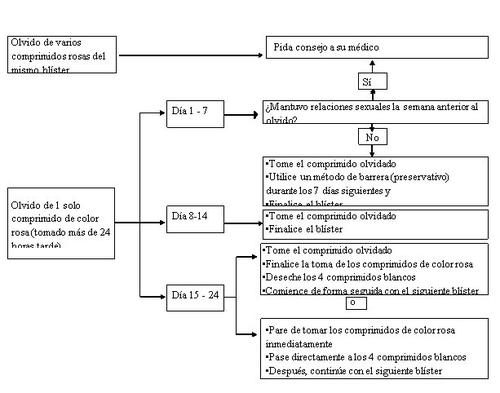
El riesgo de protección incompleta frente al embarazo es máximo si olvida tomar un comprimido de color rosa al principio o al final del blíster. A continuación, se enumeran las recomendaciones a seguir en esta situación (véase también el diagrama de más abajo):
- Olvido de más de un comprimido del blíster
Consulte con su médico.
- Olvido de un comprimido durante los días 1–7 (primera fila)
Tome el comprimido olvidado tan pronto como se acuerde, aunque esto signifique que tenga que tomar dos comprimidos a la vez. Siga tomando los comprimidos siguientes a la hora habitual y utilice precauciones adicionales,por ejemplo, preservativos, durante los 7 días siguientes. Si ha mantenido relaciones sexuales en la semana previa al olvido del comprimido debe saber que hay riesgo de embarazo. En ese caso, consulte con su médico.
- Olvido de un comprimido durante los días 8–14 (segunda fila)
Tome el comprimido olvidado tan pronto como se acuerde, aunque esto signifique que tenga que tomar dos comprimidos a la vez. Siga tomando los comprimidos siguientes a la hora habitual. La protección frente al embarazo no disminuye y no necesita tomar precauciones adicionales.
- Olvido de un comprimido entre los días 15 y 24 (tercera o cuarta fila)
Puede elegir entre dos posibilidades:
- Tome el comprimido olvidado tan pronto como se acuerde, aunque esto signifique que tenga que tomar dos comprimidos a la vez. Siga tomando los comprimidos siguientes a la hora habitual. En lugar de continuar con los comprimidos blancos de placebo, deséchelos y comience a tomar el siguiente blíster (el día en que toma el primer comprimido será diferente).
Probablemente, tendrá la regla al final del segundo blíster –durante la toma de los comprimidos blancos de placebo– aunque puede presentar manchado o hemorragias durante la toma del segundo blíster.
- También puede interrumpir la toma de comprimidos activos de color rosa y pasar directamente a los 4 comprimidos blancos de placebo (incluyendo los días que olvidó los comprimidos, antes de tomar los comprimidos de placebo, anote el día en el que olvidó tomar su comprimido).Si quiere comenzar un nuevo blíster en su día fijado de inicio, tome los comprimidos de placebo durante menos de 4 días.
Si sigue una de estas dos recomendaciones, permanecerá protegida frente al embarazo.
- Si ha olvidado tomar algún comprimido de un blíster y no tiene la regla durante los días de placebo, esto puede significar que está embarazada. En este caso, debe acudir a su médico antes de seguir con el siguiente blíster.
El siguiente diagrama describe cómo proceder si se olvida tomar el comprimido (s):
Qué debe hacer en caso de vómitos o diarrea intensa
Si tiene vómitos en las 3–4 horas siguientes a la toma de un comprimido activo de color rosa o si padece diarrea intensa, hay riesgo de que los principios activos del comprimido no sean absorbidos totalmente por su organismo en cuyo caso es posible que necesite usar una protección adicional (como el preservativo) para evitar el embarazo. Esto es similar a lo que ocurre cuando olvida un comprimido. Tras los vómitos o la diarrea, debe tomar otro comprimido de color rosa de un blíster de reserva lo antes posible. Si es posible, tómelo dentro de las 24 horas posteriores a la hora habitual en que toma su anticonceptivo. Si no es posible o han transcurrido más de 24 horas, siga los consejos de la sección “Si olvidó tomar Etinilestradiol/Drospirenona Exeltis”.
Retraso del periodo menstrual: qué debe saber
Aunque no es recomendable, es posible retrasar su periodo menstrual si no toma los comprimidos blancos de placebo de la 4ª fila y comienza directamente a tomar los comprimidos de un nuevo blíster de etinilestradiol/drospirenona hasta finalizar este nuevo blíster. Puede experimentar manchado o hemorragias intermenstruales durante el uso del segundo blíster. Termine este segundo blíster tomando los 4 comprimidos blancos de la 4.ª fila. Luego, comience el siguiente blíster.
Antes de decidir el retraso de su periodo menstrual, debe preguntar a su médico.
Cambio del primer día de su periodo menstrual: qué debe saber
Si toma los comprimidos según las instrucciones, su periodo menstrual comenzará durante los días de placebo. Si tiene que cambiar este día, lo puede hacer reduciendo los días de placebo (los días en los que toma los comprimidos blancos) ¡pero nunca alargando – 4 días es el máximo! Por ejemplo, si empieza los días de placebo un viernes y quiere cambiarlo a martes (3 días antes), debe comenzar un nuevo blíster 3 días antes de lo habitual. Es posible que no se produzca hemorragia durante estos días de placebo. Entonces, puede experimentar manchados o hemorragias intermenstruales.
Si no está segura de cómo proceder, consulte con su médico.
Si interrumpe el tratamiento con Etinilestradiol/Drospirenona Exeltis
Puede dejar de tomar etinilestradiol/drospirenona siempre que lo desee. Si no quiere quedarse embarazada, consulte con su médico acerca de otros métodos eficaces de control de la natalidad. Si quiere quedarse embarazada, es aconsejable que deje de tomar etinilestradiol/drospirenona y espere hasta su periodo menstrual antes de intentar quedarse embarazada. Así podrá calcular la fecha estimada del parto más fácilmente.
Si tiene cualquier otra duda sobre el uso de este medicamento, pregunte a su médico o farmacéutico.

¿Has empezado a tomar el medicamento y tienes preguntas?
Comenta tus síntomas y tratamiento con un médico online.
4. Posibles efectos adversos
Al igual que todos los medicamentos, este medicamento puede producir efectos adversos, aunque no todas las personas los sufran.
Si sufre cualquier efecto adverso, especialmente, si es grave y persistente o tiene algún cambio de salud que cree que puede deberse a etinilestradiol/drospirenona, consulte a su médico.
Todas las mujeres que toman anticonceptivos hormonales combinados corren mayor riesgo de presentar coágulos de sangre en las venas (tromboembolismo venoso (TEV)) o coágulos de sangre en las arterias (tromboembolismo arterial (TEA)). Para obtener información más detallada sobre los diferentes riesgos de tomar anticonceptivos hormonales combinados, ver sección 2 “Qué necesita saber antes de empezar a tomar Etinilestradiol/Drospirenona Exeltis”.
Contacte con su médico inmediatamente si experimenta alguno de los siguientes síntomas de angioedema: hinchazón de la cara, lengua y/o garganta, y/o dificultad para tragar o urticaria, con posible dificultad para respirar (ver también sección “Advertencia y precauciones”).
Si padece alguno de los siguientes efectos adversos, es posible que necesite atención médica urgente. Deje de tomar etinilestradiol/drospirenona y acuda al médico o vaya al hospital más cercano:
Raros(pueden afectar hasta 1 de cada 1.000 personas):
- Inflamación de la vesícula biliar.
- Hipersensibilidad (reacciones alérgicas con signos tales como hinchazón de la cara, lengua y/o garganta y/o dificultad para tragar, o urticaria junto con dificultad para respirar).
- Formación de coágulos sanguíneos en una vena o arteria, por ejemplo:
- En una pierna o en un pie (es decir, trombosis venosa profunda (TVP)).
- En un pulmón (es decir, la embolia pulmonar (EP)).
- Ataque al corazón.
- Accidente cerebrovascular.
- Mini-ictus o síntomas similares a la apoplejía temporal, conocido como un ataque isquémico transitorio (TIA).
- Coágulos sanguíneos en el hígado, el estómago/intestino, los riñones o los ojos.
La probabilidad de tener un coágulo de sangre puede ser mayor si tiene otras condiciones que aumentan este riesgo (véase la sección 2 para obtener más información sobre las condiciones que aumentan el riesgo de coágulos de sangre y los síntomas de un coágulo de sangre).
Condiciones que pueden ocurrir o empeorar durante el embarazo o al uso previo de la píldora incluyen:
- Lupus eritematoso sistémico (LES, una enfermedad que afecta al sistema inmune).
- Inflamación del colon o de otras partes del intestino (con signos tales como diarrea con sangre, dolor al pasar las heces, dolor en el abdomen) (enfermedad de Crohn y colitis ulcerosa).
- Epilepsia.
- Mioma uterino (tumor no canceroso que crece dentro del tejido muscular del útero).
- Trastorno en sangre (porfiria).
- Ampollas como erupción cutánea (herpes gestacional) durante su embarazo.
- Corea de Sydenham (enfermedad de los nervios en la que aparecen movimientos bruscos del cuerpo).
- Ciertos trastornos sanguíneos que causa lesiones renales (síndrome hemolítico urémico, con señales, tales como disminución de la orina, sangre en la orina, un nivel bajo en las células rojas en sangre, náuseas, vómitos, confusión y diarrea).
- Coloración amarillenta de la piel o el blanco de los ojos debido a la obstrucción de la vía biliar (colestasis ictericia).
Además, se ha observado cáncer de mama (ver sección 2 Etinilestradiol/Drospirenona Exeltis y cáncer) y cánceres benignos y tumores (cancerosos malignos) del hígado (con signos tales como hinchazón del abdomen, pérdida de peso, función hepática anormal, que puede ser visto en análisis de sangre) y cloasma (manchas pardoamarillentas en la piel, en particular, la cara, los llamados "moretones de embarazo"), que puede ser permanente, especialmente, en las mujeres que han tenido previamente cloasma durante el embarazo.
Otros efectos adversos
- Frecuentes(pueden afectar hasta 1 de cada 10 personas):
- Cambios en el estado de ánimo.
- Dolor de cabeza.
- Náuseas.
- Dolor de las mamas, problemas con los periodos como periodos irregulares, ausencia de periodos.
- Poco frecuentes(pueden afectar hasta 1 de cada 100 personas):
- Depresión, nerviosismo, somnolencia.
- Mareo, hormigueo.
- Migraña, venas varicosas, aumento de la presión arterial.
- Dolor de estómago, vómitos, indigestión, gases intestinales, inflamación del estómago, diarrea.
- Acné, picor, erupción cutánea.
- Molestias y dolores como dolor de espalda, dolor en las extremidades, calambres musculares.
- Infección vaginal por hongos, dolor en la región abdominal inferior (pélvica), aumento de tamaño de las mamas, bultos benignos en las mamas, hemorragias uterino/vaginales (que suelen remitir a lo largo del tratamiento), secreción vaginal, sofocos, inflamación de la vagina (vaginitis), problemas con las reglas, reglas dolorosas, reglas más cortas, reglas abundantes, sequedad vaginal, frotis cervical anormal, pérdida de interés por el sexo.
- Falta de energía, aumento de la sudoración, retención de líquidos (con signos tales como hinchazón de la cara y las extremidades).
- Aumento de peso.
- Raros(pueden afectar hasta 1 de cada 1.000 personas):
- Candidiasis (una infección por hongos).
- Anemia, aumento del número de plaquetas en sangre.
- Reacción alérgica.
- Trastorno hormonal (endocrino).
- Aumento del apetito, pérdida del apetito, concentración de potasio en sangre, anormalmente, elevada, concentración de sodio en sangre, anormalmente, baja.
- Ausencia de orgasmo, insomnio.
- Vértigo, temblores.
- Trastornos oculares como inflamación de los párpados, sequedad ocular.
- Frecuencia del corazón, inusualmente, rápida.
- Inflamación de una vena, sangrado nasal, desvanecimiento.
- Aumento de tamaño del abdomen, trastorno intestinal, sensación de flatulencia, hernia gástrica, infección de la boca por hongos, estreñimiento, sequedad de boca.
- Dolor en los conductos biliares o vesícula biliar.
- Eczema, pérdida de pelo, inflamación de la piel parecida al acné, sequedad de piel, inflamación de la piel con hinchazones, crecimiento excesivo del pelo, trastornos de la piel, marcas de tensión sobre la piel, inflamación de la piel, inflamación de la piel por fotosensibilidad, nódulos de la piel.
- Relaciones sexuales difíciles o dolorosas, inflamación de la vagina (vulvovaginitis), hemorragias después de las relaciones sexuales, hemorragias intermenstruales, quiste en las mamas, aumento del número de células mamarias (hiperplasia), crecimiento anormal de la superficie mucosa del cuello del útero, contracción o atrofia de la mucosa del útero, quistes ováricos, aumento de tamaño del útero.
- Malestar general.
- Pérdida de peso.
- Frecuencia no conocida(no puede estimarse a partir de los datos disponibles):
- Eritema multiforme (erupción cutánea con rojeces en forma de diana o úlceras).
Comunicación de efectos adversos
Si experimenta cualquier tipo de efecto adverso, consulte a su médico, farmacéutico o enfermero, incluso si se trata de posibles efectos adversos que no aparecen en este prospecto. También puede comunicarlos directamente a través del Sistema Español de Farmacovigilancia de Medicamentos de Uso Humano: https://www.notificaram.es. Mediante la comunicación de efectos adversos usted puede contribuir a proporcionar más información sobre la seguridad de este medicamento.
5. Conservación de Etinilestradiol/Drospirenona Exeltis
Mantener este medicamento fuera de la vista y del alcance de los niños.
Conservar por debajo de 30ºC.
No utilice este medicamento después de la fecha de caducidad que aparece en el envase, después de CAD o EXP. La fecha de caducidad es el último día del mes que se indica.
Los medicamentos no se deben tirar por los desagües ni a la basura. Deposite los envases y los medicamentos que no necesita en el Punto SIGRE de la farmacia. En caso de duda pregunte a su farmacéutico cómo deshacerse de los envases y de los medicamentos que no necesita. De esta forma, ayudará a proteger el medio ambiente.
6. Contenido del envase e información adicional
Composición de Etinilestradiol/DrospirenonaExeltis
- Los principios activos son etinilestradiol y drospirenona.
Cada comprimido recubierto con película de color rosa contiene 0,02 mg de etinilestradiol y 3 mg de drospirenona.
Los comprimidos recubiertos con película blancos no contienen principios activos.
- Los demás componentes son:
Comprimidos recubiertos con película activos de color rosa: lactosa monohidrato, almidón de maíz pregelatinizado, povidona (E-1201), croscarmelosa sódica, polisorbato 80, estearato de magnesio (E-572), alcohol de polivinilo (E-1203), dióxido de titanio (E-171), macrogol, talco (E-553b), óxido de hierro amarillo (E-172), óxido de hierro rojo (E-172), óxido de hierro negro (E-172).
Comprimidos recubiertos con película inactivos blancos: lactosa anhidra, povidona (E-1201), estearato de magnesio (E-572), alcohol de polivinilo parcialmente hidrolizado (E-1203), dióxido de titanio (E-171), macrogol, talco (E-553b).
Aspecto del producto y contenido del envase
- Cada blíster de Etinilestradiol/Drospirenona Exeltis contiene 24 comprimidos recubiertos con película activos de color rosa en la 1ª, 2ª, 3ª y 4ª fila del blíster y 4 comprimidos recubiertos con película blancos de placebo en la 4ª fila.
- Los comprimidos de Etinilestradiol/Drospirenona Exeltis, tanto de color rosa como blancos, son comprimidos recubiertos con película; el núcleo del comprimido está recubierto.
- Etinilestradiol/Drospirenona Exeltis está disponible en cajas de 1, 3, 6 y 13 blísteres, cada uno con 28 (24 + 4) comprimidos.
Puede que solamente estén comercializados algunos tamaños de envases.
Titular de laautorizaciónde comercializacióny responsable de la fabricación
Titular de la autorización de comercialización
Exeltis Healthcare S.L.
Avenida de Miralcampo, 7.
Polígono Industrial Miralcampo.
19200 Azuqueca de Henares.
Guadalajara, España.
Responsable de la fabricación
Laboratorios León Farma, S.A.
C/ La Vallina, s/n, Pol. Ind. Navatejera
–24193 - Villaquilambre, León
España
o
McDermott Laboratories Ltd T/A Gerard Laboratories T/A Mylan Dublin
35/36 Baldoyle Industrial Estate, Grange Road
Dublín 13
Irlanda
o
Mylan Hungary Kft
2900 Komárom, Mylan utca 1
Hungría
Este medicamento está autorizado en los estados miembros del Espacio Económico Europeo con los siguientes nombres:
Bélgica: Marliesexeltis 0,02 mg/3 mg comprimés pelliculés
España: Etinilestradiol/Drospirenona Exeltis 0,02 mg/3 mg comprimidos recubiertos con película (24+4) EFG
Italia: Mycyclamen
Países Bajos: Ethinylestradiol/Drospirenon Xiromed 24+4 0,02 mg/3 mg, filmomhulde tabletten
Portugal: Drosdiol
Este prospecto se revisó por última vez en: diciembre 2022
La información detallada de este medicamento está disponible en la página web de la Agencia Española de Medicamentos y Productos Sanitarios (AEMPS) https://www.aemps.gob.es/
- País de registro
- Forma farmacéuticaCOMPRIMIDO, 3 mg/0,02 mg
- Código ATCG03AA12
- Principio activo
- Requiere recetaSí
- Fabricante
- ComposiciónLACTOSA MONOHIDRATO (44.00 mg mg), CROSCARMELOSA SODICA (1.20 mg mg), POLISORBATO 80 (0.90 mg mg), LACTOSA ANHIDRA (89.50 mg mg)
- Esta información es de carácter general y no sustituye la consulta con un profesional sanitario.
- Alternativas a ETINILESTRADIOL/DROSPIRENONA EXELTIS 0,02 MG/3 MG COMPRIMIDOS RECUBIERTOS CON PELICULA (24+4) EFGForma farmacéutica: COMPRIMIDO, 3 mg/0,03 mgPrincipio activo: drospirenone and ethinylestradiolFabricante: Laboratorios Cinfa S.A.Requiere recetaForma farmacéutica: COMPRIMIDO, 3 mg/0,03 mgPrincipio activo: drospirenone and ethinylestradiolFabricante: Laboratorios Cinfa S.A.Requiere recetaForma farmacéutica: COMPRIMIDO, 3 mg/0,02 mgPrincipio activo: drospirenone and ethinylestradiolFabricante: Laboratorios Cinfa S.A.Requiere receta
Médicos online para ETINILESTRADIOL/DROSPIRENONA EXELTIS 0,02 MG/3 MG COMPRIMIDOS RECUBIERTOS CON PELICULA (24+4) EFG
Comenta la dosis, los posibles efectos secundarios, interacciones, contraindicaciones o la revisión de receta de ETINILESTRADIOL/DROSPIRENONA EXELTIS 0,02 MG/3 MG COMPRIMIDOS RECUBIERTOS CON PELICULA (24+4) EFG, sujeto a valoración médica y a la normativa local.
Obtén una receta de ETINILESTRADIOL/DROSPIRENONA EXELTIS 0,02 MG/3 MG COMPRIMIDOS RECUBIERTOS CON PELICULA (24+4) EFG online
Rellena un formulario de 2 minutos
Cuéntanos tus síntomas, historial y el medicamento que necesitas.
Elige un médico o nosotros te asignamos uno
Escoge un especialista o te conectamos con el próximo médico disponible.
El médico revisa tu caso
Normalmente en 30 minutos. Puede hacerte preguntas adicionales por chat.
Recógela en cualquier farmacia
Receta electrónica enviada a tu correo, válida en toda España.
Preguntas frecuentes
ETINILESTRADIOL/DROSPIRENONA EXELTIS 0,02 MG/3 MG COMPRIMIDOS RECUBIERTOS CON PELICULA (24+4) EFG requiere receta en España. Puedes confirmarlo con un médico online según tu caso.
El principio activo de ETINILESTRADIOL/DROSPIRENONA EXELTIS 0,02 MG/3 MG COMPRIMIDOS RECUBIERTOS CON PELICULA (24+4) EFG es drospirenone and ethinylestradiol. Esta información ayuda a identificar medicamentos con la misma composición pero con diferentes nombres comerciales.
ETINILESTRADIOL/DROSPIRENONA EXELTIS 0,02 MG/3 MG COMPRIMIDOS RECUBIERTOS CON PELICULA (24+4) EFG es fabricado por Exeltis Healthcare S.L.. La marca y el envase pueden variar según el distribuidor.
Los Médicos de familia, Psiquiatras, Dermatólogos, Cardiólogos, Endocrinólogos, Gastroenterólogos, Neumólogos, Nefrólogos, Reumatólogos, Hematólogos, Infectólogos, Alergólogos, Geriatras, Pediatras, Oncólogos pueden valorar la prescripción de ETINILESTRADIOL/DROSPIRENONA EXELTIS 0,02 MG/3 MG COMPRIMIDOS RECUBIERTOS CON PELICULA (24+4) EFG cuando esté clínicamente indicado. Puedes reservar una videoconsulta para comentar tu caso y las opciones de tratamiento.
España cuenta con una infraestructura sanitaria bien desarrollada en ciudades principales como Madrid, Barcelona, Valencia y Sevilla. Las farmacias están ampliamente disponibles y operan bajo estrictas regulaciones, garantizando el acceso a medicamentos con receta.
Puedes comprar ETINILESTRADIOL/DROSPIRENONA EXELTIS 0,02 MG/3 MG COMPRIMIDOS RECUBIERTOS CON PELICULA (24+4) EFG en Madrid, Barcelona, Sevilla o Valencia en cualquier farmacia local con una receta válida.
Para obtener una receta, puedes utilizar Oladoctor:
Otros medicamentos con el mismo principio activo (drospirenone and ethinylestradiol) incluyen AIDRA 3 MG/0,03 MG COMPRIMIDOS RECUBIERTOS CON PELICULA EFG, AIDRA DIARIO 3 MG/0,03 MG COMPRIMIDOS RECUBIERTOS CON PELICULA EFG, AIDRAELLE 3 MG/0,02 MG COMPRIMIDOS RECUBIERTOS CON PELICULA EFG. Pueden tener diferentes nombres comerciales o formulaciones, pero contienen el mismo componente terapéutico. Consulta siempre con un médico antes de cambiar o iniciar un nuevo medicamento.
