



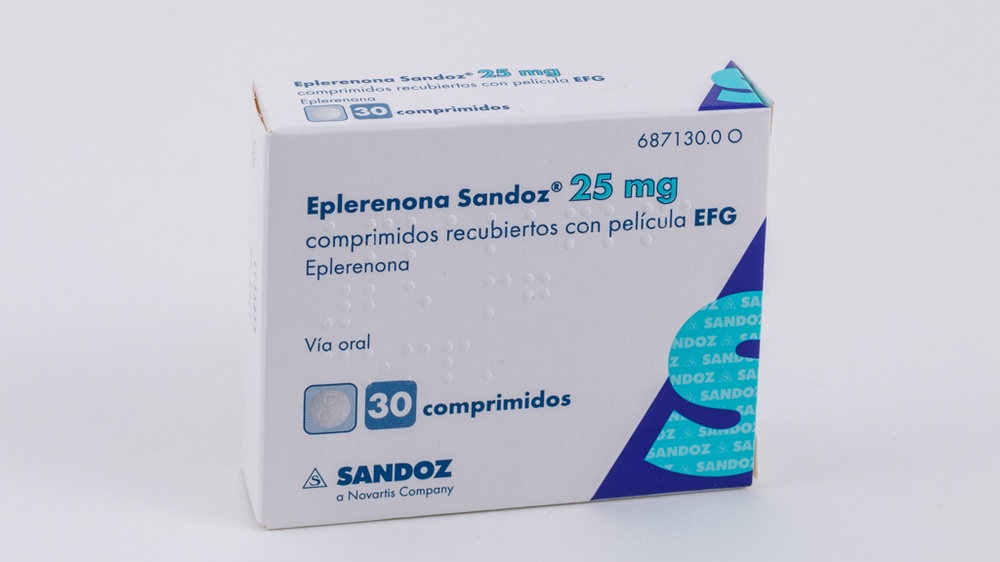
EPLERENONA 25 mg Comprimidos Recubiertos Con Película

Revisión de receta online
Un médico revisará tu caso y determinará si la prescripción es médicamente apropiada.

Habla con un médico sobre este medicamento
Comenta tus síntomas y las opciones de tratamiento en una consulta online.



Cómo usar EPLERENONA SANDOZ 25 mg COMPRIMIDOS RECUBIERTOS CON PELÍCULA EFG
Contenido del prospecto
- Introducción
- Qué es Eplerenona Sandoz y para qué se utiliza
- Qué necesita saber antes de empezar a tomar Eplerenona Sandoz
- Cómo tomar Eplerenona Sandoz
- Posibles efectos adversos
- Conservación de Eplerenona Sandoz
- Contenido del envase e información adicional
Introducción
Prospecto: información para el usuario
Eplerenona Sandoz 25 mg comprimidos recubiertos con película EFG
Eplerenona Sandoz 50 mg comprimidos recubiertos con película EFG
Leatodo el prospecto detenidamente antes de empezar a tomar este medicamento, porque contiene información importante para usted.
- Conserve este prospecto, ya que puede tener que volver a leerlo.
- Si tiene alguna duda, consulte a su médico o farmacéutico.
- Este medicamento se le ha recetado solamente a usted y no debe dárselo a otras personas aunque tengan los mismos síntomas que usted, ya que puede perjudicarles.
- Si experimenta efectos adversos, consulte a su médico o farmacéutico, incluso si se trata de efectos adversos que no aparecen en este prospecto. Ver sección 4.
Contenido del prospecto
- Qué es Eplerenona Sandoz y para qué se utiliza
- Qué necesita saber antes de empezar a tomar Eplerenona Sandoz
- Cómo tomar Eplerenona Sandoz
- Posibles efectos adversos
- Conservación de Eplerenona Sandoz
- Contenido del envase e información adicional
1. Qué es Eplerenona Sandoz y para qué se utiliza
Eplerenona Sandoz pertenece al grupo de medicamentos conocidos como bloqueantes selectivos de la aldosterona. Estos agentes bloqueantes inhiben la acción de la aldosterona, una sustancia que produce el organismo y que controla la tensión sanguínea y la función cardíaca. Niveles elevados de aldosterona pueden producir cambios en su organismo que desemboquen en insuficiencia cardíaca.
Eplerenona se utiliza para tratar la insuficiencia cardiaca para prevenir el empeoramiento y reducir la hospitalización si tiene:
- un infarto de miocardio reciente, en combinación con otros medicamentos que se utilizan para tratar su insuficiencia cardiaca, o
- síntomas leves persistentes, a pesar del tratamiento que ha estado recibiendo hasta el momento.

¿No estás seguro de si este medicamento es adecuado para ti?
Comenta tus síntomas y tratamiento con un médico online.
2. Qué necesita saber antes de empezar a tomar Eplerenona Sandoz
No tome Eplerenona :
- Si es alérgico a eplerenona o a alguno de los demás componentes de este medicamento (incluidos en la sección 6),
- si tiene niveles elevados de potasio en sangre (hiperpotasemia),
- si está tomando medicamentos de grupos que le ayuden a eliminar el exceso de líquidos en el organismo (diuréticos ahorradores de potasio),
- si tiene insuficiencia renal grave,
- si tiene insuficiencia hepática grave,
- si está tomando medicamentos utilizados para tratar las infecciones causadas por hongos (ketoconazol o itraconazol),
- si está tomando medicamentos antivirales utilizados para tratar infecciones por VIH (ritonavir o nelfinavir),
- si está tomando antibióticos utilizados para tratar infecciones bacterianas (claritromicina o telitromicina),
- si está tomando nefazodona para tratar la depresión,
- si está tomando a la vez medicamentos utilizados para tratar ciertas enfermedades cardíacas o hipertensión (como son los inhibidores de la enzima conversora de angiotensina (ECA) y antagonistas de los receptores de angiotensina (ARA)).
Advertencias y precauciones
Consulte a su médico, farmacéutico o enfermero antes de empezar a tomar Eplerenona Sandoz
- si tiene una enfermedad de riñón o de hígado (ver “No tome Eplerenona Sandoz”),
- si está tomando litio (utilizado normalmente para trastornos maniaco depresivos, también llamado trastorno bipolar),
- si está tomando tacrólimus o ciclosporina (utilizados para tratar enfermedades de la piel tales como psoriasis o eczema y para prevenir el rechazo de órganos trasplantados).
Niños y adolescentes
No se ha establecido la seguridad y la eficacia de eplerenona en niños y adolescentes.
Otros medicamentos y Eplerenona Sandoz
Informe a su médico o farmacéutico si está tomando, ha tomado recientemente o pudiera tener que tomar cualquier otro medicamento.
- Itraconazol o ketoconazol (utilizados para tratar infecciones por hongos), ritonavir, nelfinavir (medicamentos antivirales para tratar el SIDA), claritromicina, telitromicina (utilizados para tratar infecciones bacterianas) o nefazodona (utilizados para tratar la depresión), ya que estos medicamentos reducen el metabolismo de eplerenona, y por tanto prolongan su efecto en el organismo,
- diuréticos ahorradores de potasio (medicamentos que le ayuden a eliminar el exceso de líquido en el organismo) y suplementos de potasio (comprimidos de sal), ya que estos medicamentos aumentan el riesgo de presentar niveles elevados de potasio en sangre,
- inhibidores de la enzima conversora de angiotensina (ECA) y antagonistas de los receptores de angiotensina (ARA) a la vez (que se utilizan para tratar la presión sanguínea elevada, enfermedad cardiaca o ciertas enfermedades del riñón) ya que estos medicamentos pueden aumentar el riesgo de presentar niveles elevados de potasio en la sangre,
- litio (utilizado normalmente para trastornos maniaco depresivos, también llamado trastorno bipolar). El uso de litio junto con diuréticos e inhibidores de la ECA (utilizados para tratar la tensión sanguínea elevada y la enfermedad cardíaca) ha demostrado ocasionar niveles, demasiado elevados, de litio en sangre que pueden causar las siguientes reacciones adversas como pérdida de apetito, alteraciones de la visión, cansancio, debilidad muscular y calambres musculares,
- ciclosporina o tacrólimus (utilizados para tratar enfermedades de la piel tales como psoriasis o eczema y para prevenir el rechazo de órganos trasplantados). Estos medicamentos pueden causar problemas renales y por tanto aumentar el riesgo de que se produzcan niveles elevados de potasio en sangre,
- medicamentos antiinflamatorios no esteroideos (AINEs – ciertos analgésicos como ibuprofeno, utilizados para aliviar el dolor, rigidez e inflamación). Estos medicamentos pueden causar problemas de riñón y por tanto aumentar el riesgo de niveles elevados de potasio en la sangre,
- trimetoprim (utilizado para tratar las infecciones bacterianas) puede aumentar el riesgo de niveles elevados de potasio en la sangre,
- bloqueantes alfa-1, como prazosina o alfuzosina (utilizados para tratar la tensión sanguínea elevada y ciertas enfermedades de la próstata) pueden llevar a una disminución de la tensión sanguínea y a la aparición de mareos al levantarse,
- antidepresivos tricíclicos como amitriptilina o amoxapina (para el tratamiento de la depresión), antipsicóticos (conocidos como neurolépticos) como clorpromazina o haloperidol (para el tratamiento de trastornos psiquiátricos), amifostina (utilizado durante la quimioterapia del cáncer) y baclofeno (utilizado para tratar espasmos musculares). Estos medicamentos pueden llevar a una disminución de la tensión sanguínea y a la aparición de mareos al levantarse,
- glucocorticoides, como hidrocortisona o prednisona (utilizados para tratar la inflamación y ciertas enfermedades de la piel) y tetracosactida (utilizado principalmente para diagnosticar y tratar enfermedades de la corteza adrenal) puede reducir el efecto reductor de la tensión sanguínea de eplerenona,
- digoxina (utilizado en el tratamiento de enfermedades cardíacas). Los niveles sanguíneos de digoxina pueden aumentar cuando se toma junto con eplerenona,
- warfarina (un medicamento anticoagulante): Se requiere precaución cuando se administren dosis de warfarina debido a que niveles elevados de warfarina en sangre pueden ocasionar modificaciones del efecto de eplerenona en el cuerpo,
- eritromicina (utilizado para tratar infecciones bacterianas), saquinavir (medicamento antiviral para tratar infecciones por VIH), fluconazol (utilizado para tratar infecciones por hongos), amiodarona, diltiazem y verapamilo (para el tratamiento de problemas cardíacos y tensión sanguínea elevada) por reducir el metabolismo de eplerenona prolongando por tanto el efecto de eplerenona en el organismo,
- Hierba de San Juan (planta medicinal), rifampicina (utilizado para tratar infecciones bacterianas), carbamazepina, fenitoína y fenobarbital (utilizado, entro otros, para tratar la epilepsia) pueden aumentar el metabolismo de eplerenona y por tanto reducir su efecto.
Toma de Eplerenona Sandoz con alimentos y bebidas
Eplerenona Sandoz puede tomarse con o sin alimentos.
Embarazo y lactancia
Si está embarazada o en periodo de lactancia, cree que podría estar embarazada o tiene intención de quedarse embarazada, consulte a su médico o farmacéutico antes de utilizar este medicamento. No se ha evaluado el efecto de eplerenona durante el embarazo en humanos.
Se desconoce si eplerenona se elimina en leche materna. El médico decidirá con usted si se interrumpe el tratamiento o la lactancia.
Conducción y uso de máquinas
Tras tomar Eplerenona Sandoz, puede sentirse mareado. Si esto sucediera, no conduzca ni maneje maquinaria.
Eplerenona Sandoz contiene lactosa monohidrato y sodio
Este medicamento contiene lactosa. Si su médico le ha indicado que padece una intolerancia a ciertos azúcares, consulte con él antes de tomar este medicamento.
Este medicamento contiene menos de 23 mg de sodio (1mmol) por comprimido recubierto con película; esto es, esencialmente “exento de sodio”
3. Cómo tomar Eplerenona Sandoz
Siga exactamente las instrucciones de administración de este medicamento indicadas por su médico o farmacéutico. En caso de duda, consulte de nuevo a su médico o farmacéutico.
Los comprimidos de Eplerenona Sandoz pueden tomarse con o sin alimentos. Trague los comprimidos enteros con agua abundante.
Eplerenona Sandoz se administra normalmente junto con otros medicamentos para la insuficiencia cardíaca, por ejemplo, beta-bloqueantes. La dosis habitual inicial es un comprimido de 25 mg una vez al día, aumentando posteriormente tras unas 4 semanas a 50 mg diarios (un comprimido de 50 mg o dos comprimidos de 25 mg). El régimen de dosis máximo es de 50 mg al día.
Deben realizarse determinaciones de potasio en sangre antes de empezar el tratamiento con Eplerenona Sandoz, durante la primera semana y al mes después de iniciar el tratamiento o tras un cambio en la dosis. Su médico podrá ajustar la dosis en función de sus niveles de potasio en sangre.
Si tiene una insuficiencia renal leve, deberá iniciar el tratamiento con un comprimido de 25 mg al día. Si tiene una insuficiencia renal moderada, deberá iniciar el tratamiento con un comprimido de 25 mg en días alternos. Estas dosis se podrán ajustar, si su médico se lo indica, y de acuerdo a sus niveles de potasio sanguíneos.
Eplerenona Sandoz no está recomendado en pacientes con enfermedad renal grave.
No es necesario un ajuste de dosis inicial en los pacientes con insuficiencia hepática de leve a moderada. Si usted tiene alguna enfermedad del hígado o del riñón, puede ser necesario hacerle con más frecuencia determinaciones de potasio en sangre (ver también “No tome Eplerenona Sandoz”).
En pacientes de edad avanzada: no se requiere un ajuste de dosis inicial.
En niños y adolescentes: Eplerenona Sandoz no está recomendado.
Si toma más Eplerenona Sandoz del que debe
Si toma más Eplerenona Sandoz del que debe, avise inmediatamente a su médico o farmacéutico. Si ha tomado demasiado medicamento, los síntomas más posibles serán baja tensión sanguínea (manifestada como una sensación de desvanecimiento, mareo, visión borrosa, debilidad, pérdida aguda de la consciencia) o hiperpotasemia, altos niveles de potasio en la sangre (manifestado por calambres musculares, diarrea, náuseas, mareo o dolor de cabeza).
Si ha tomado más Eplerenona Sandoz del que debe, consulte inmediatamente a su médico o farmacéutico o llame al Servicio de Información Toxicológica, teléfono 91 562 04 20, indicando el medicamento y la cantidad utilizada.
Si olvidó tomar Eplerenona Sandoz
Si ya es casi hora de tomar el siguiente comprimido, sáltese la dosis que ha olvidado y tome el comprimido siguiente a la hora que corresponda.
De lo contrario, tome el comprimido en cuanto se acuerde, siempre que falten más de 12 horas hasta la hora de tomar el siguiente comprimido. Vuelva a tomar su medicamento de la forma habitual.
No tome una dosis doble para compensar las dosis olvidadas.
Si interrumpe el tratamiento con Eplerenona Sandoz
Es importante seguir tomando Eplerenona Sandoz como le indicaron, a menos que su médico le indique que cese el tratamiento.
Si tiene cualquier otra duda sobre el uso de este medicamento, pregunte a su médico o farmacéutico.

¿Has empezado a tomar el medicamento y tienes preguntas?
Comenta tus síntomas y tratamiento con un médico online.
4. Posibles efectos adversos
Al igual que todos los medicamentos, este medicamento puede producir efectos adversos, aunque no todas las personas los sufran.
Si se produce alguno de los siguientes,solicite atención médica inmediatamente
- hinchazón de la cara, lengua o garganta,
- dificultad para tragar,
- ampollas y dificultad para respirar.
Estos son los síntomas del edema angioneurótico, un efecto adverso poco frecuente (que afecta hasta 1 de cada 100 personas).
Otros efectos adversos comunicados incluyen:
Efectos adversos frecuentes(pueden afectar hasta 1 de cada 10 pacientes):
- niveles de potasio elevados en sangre (estos síntomas incluyen calambres musculares, diarrea, náuseas, mareos o dolor de cabeza),
- mareos,
- desmayos,
- cantidad elevada de colesterol en la sangre,
- insomnio (dificultad para dormir),
- dolor de cabeza,
- molestias cardíacas, por ejemplo, latidos irregulares e insuficiencia cardíaca,
- tos,
- estreñimiento,
- presión sanguínea baja,
- diarrea,
- náuseas,
- vómitos
- función renal anormal,
- erupción,
- picores,
- dolor de espalda,
- sensación de debilidad,
- espasmo muscular,
- aumento de los niveles de urea en sangre.
- elevación de los niveles de creatinina en sangre que puede indicar problemas de riñón.
Efectos adversos poco frecuentes(pueden afectar hasta 1 de cada 100 pacientes):
- infección
- eosinofilia (aumento de ciertos glóbulos blancos),
- deshidratación,
- cantidades elevadas de triglicéridos (grasas) en sangre,
- bajos niveles de sodio en sangre,
- latidos del corazón rápidos,
- inflamación de la vesícula biliar,
- bajada de la tensión sanguínea que puede causar mareos al levantarse,
- trombosis (coágulo sanguíneo) en las piernas,
- dolor de garganta,
- flatulencia,
- tiroides hipoactiva,
- aumento en la glucosa en sangre,
- disminución del sentido del tacto,
- aumento de la sudoración,
- dolor musculoesquelético,
- malestar general,
- inflamación de riñón,
- aumento de las mamas en hombres,
- cambios en los resultados de algunas pruebas sanguíneas.
Comunicación de efectos adversos
Si experimenta cualquier tipo de efecto adverso, consulte a su médico o farmacéutico, incluso si se trata de posibles efectos adversos que no aparecen en este prospecto. También puede comunicarlos directamente a través del Sistema Español de Farmacovigilancia de Medicamentos de Uso Humano: https://www.notificaram.es. Mediante la comunicación de efectos adversos usted puede contribuir a proporcionar más información sobre la seguridad de este medicamento.
5. Conservación de Eplerenona Sandoz
Mantener este medicamento fuera de la vista y del alcance de los niños.
No utilice este medicamento después de la fecha de caducidad que aparece en el envase y el blíster después de CAD. La fecha de caducidad es el último día del mes que se indica.
No requiere condiciones especiales de conservación.
Los medicamentos no se deben tirar por los desagües ni a la basura. Deposite los envases y los medicamentos que no necesita en el Punto SIGRE de la farmacia. En caso de duda pregunte a su farmacéutico cómo deshacerse de los envases y de los medicamentos que no necesita. De esta forma, ayudará a proteger el medio ambiente.
6. Contenido del envase e información adicional
Composición de Eplerenona Sandoz
El principio activo es eplerenona.
Cada comprimido de Eplerenona Sandoz 25 mg contiene 25 mg de eplerenona.
Cada comprimido de Eplerenona Sandoz 50 mg contiene 50 mg de eplerenona.
Los demás excipientes son:
Núcleo del comprimido:
Lactosa monohidrato
Celulosa microcristalina (tipo 101)
Croscarmelosa de sodio
Hipromelosa (Tipo 2910)
Celulosa microcristalina (tipo 102)
Laurilsulfato de sodio
Talco
Estearato de magnesio
Recubrimiento del comprimido:
Lactosa monohidrato
Hipromelosa (Tipo 2910)
Dióxido de titanio (E171)
Macrogol 4000
Aspecto del producto y contenido del envase
Eplerenona Sandoz 25 mg comprimidos: son comprimidos blancos o casi blancos, redondos, de aproximadamente 6 mm de diámetro, biconvexos, marcados “CG3” en una cara del comprimido sin marcar en la otra cara.
Los comprimidos se envasan en blíster de PVC/aluminio dentro de una caja de cartón conteniendo 10, 20, 30, 50, 90 o 100 comprimidos.
Los comprimidos se envasan en frascos dentro de una caja de cartón conteniendo 105, 110, 112 y 120 comprimidos.
Eplerenona Sandoz 50 mg comprimidos: son comprimidos blancos o casi blancos, redondos, biconvexos, de aproximadamente 8 mm de diámetro, marcados “CG4” en una cara del comprimido y sin marcar en la otra cara.
Los comprimidos se envasan en blíster de PVC/aluminio dentro de una caja de cartón conteniendo 10, 20, 30, 50, 90 o 100 comprimidos.
Puede que solamente estén comercializados algunos tamaños de envases.
Titular de la autorización de comercialización y responsable de la fabricación
Titular de la autorización de comercialización
Sandoz Farmacéutica, S.A.
Centro Empresarial Parque Norte
Edificio Roble
C/ Serrano Galvache, 56
28033 Madrid España
Responsable de la fabricación
Laboratorios LICONSA S.A.
Avenida Miralcampo 7, Polígono Industrial Miralcampo
19200 Azuqueca de Henares, Guadalajara
España
STADA Arzneimittel AG
Stadastrasse 2-18
61118 Bad Vilbel
Alemania
Genericon Pharma Gesellschaft m.b.H.,
Hafnerstrasse 211
8054 Graz,
Austria
(Solo en AT)
Este medicamento está autorizado en los estados miembros del Espacio Económico Europeo y en Reino Unido (Irlanda del Norte) con los siguientes nombres:
Austria: Eplerenon +pharma 25/50 mg Filmtabletten
Alemania: Eplerenon AL 25 mg Filmtabletten
Eplerenon AL 50 mg Filmtabletten
Rumanía: EPLOHART 25 mg comprimate filmate
EPLOHART 50 mg comprimate filmate
Noruega: Eplerenon Medical Valley 25 mg Tablett, filmdrasjert
Eplerenon Medical Valley 50 mg Tablett, filmdrasjert
Suecia: Eplerenon Medical Valley
Eplerenon Medical Valley
Dinamarca: Eplerenon Medical Valley
Eplerenon Medical Valley
Fecha de la última revisión de este prospecto: Diciembre 2023
La información detallada y actualizada de este medicamento está disponible en la página web de la Agencia Española de Medicamentos y Productos Sanitarios (AEMPS) http://www.aemps.gob.es/
- País de registro
- Forma farmacéuticaCOMPRIMIDO, 25 MG
- Código ATCC03DA04
- Precio medio en farmacia26.68 EUR
- Principio activo
- Requiere recetaSí
- Fabricante
- ComposiciónLACTOSA MONOHIDRATO (35.700 mg mg), CROSCARMELOSA SODICA (4.250 mg mg), LAURILSULFATO DE SODIO (0.850 mg mg), LACTOSA MONOHIDRATO (1.224 mg mg)
- Esta información es de carácter general y no sustituye la consulta con un profesional sanitario.
- Alternativas a EPLERENONA SANDOZ 25 mg COMPRIMIDOS RECUBIERTOS CON PELÍCULA EFGForma farmacéutica: COMPRIMIDO, 25 mg eplerenonaPrincipio activo: EplerenonaFabricante: Almirall S.A.Requiere recetaForma farmacéutica: COMPRIMIDO, 50 mg eplerenonaPrincipio activo: EplerenonaFabricante: Almirall S.A.Requiere recetaForma farmacéutica: COMPRIMIDO, 25 mgPrincipio activo: EplerenonaFabricante: Laboratorios Alter S.A.Requiere receta
Médicos online para EPLERENONA SANDOZ 25 mg COMPRIMIDOS RECUBIERTOS CON PELÍCULA EFG
Comenta la dosis, los posibles efectos secundarios, interacciones, contraindicaciones o la revisión de receta de EPLERENONA SANDOZ 25 mg COMPRIMIDOS RECUBIERTOS CON PELÍCULA EFG, sujeto a valoración médica y a la normativa local.
Obtén una receta de EPLERENONA SANDOZ 25 mg COMPRIMIDOS RECUBIERTOS CON PELÍCULA EFG online
Rellena un formulario de 2 minutos
Cuéntanos tus síntomas, historial y el medicamento que necesitas.
Elige un médico o nosotros te asignamos uno
Escoge un especialista o te conectamos con el próximo médico disponible.
El médico revisa tu caso
Normalmente en 30 minutos. Puede hacerte preguntas adicionales por chat.
Recógela en cualquier farmacia
Receta electrónica enviada a tu correo, válida en toda España.
Preguntas frecuentes
EPLERENONA SANDOZ 25 mg COMPRIMIDOS RECUBIERTOS CON PELÍCULA EFG requiere receta en España. Puedes confirmarlo con un médico online según tu caso.
El principio activo de EPLERENONA SANDOZ 25 mg COMPRIMIDOS RECUBIERTOS CON PELÍCULA EFG es Eplerenona. Esta información ayuda a identificar medicamentos con la misma composición pero con diferentes nombres comerciales.
El precio medio en farmacia de EPLERENONA SANDOZ 25 mg COMPRIMIDOS RECUBIERTOS CON PELÍCULA EFG es de aproximadamente 26.68 EUR. Puede variar según el fabricante y la forma farmacéutica.
EPLERENONA SANDOZ 25 mg COMPRIMIDOS RECUBIERTOS CON PELÍCULA EFG es fabricado por Sandoz Farmaceutica S.A.. La marca y el envase pueden variar según el distribuidor.
Los Médicos de familia, Psiquiatras, Dermatólogos, Cardiólogos, Endocrinólogos, Gastroenterólogos, Neumólogos, Nefrólogos, Reumatólogos, Hematólogos, Infectólogos, Alergólogos, Geriatras, Pediatras, Oncólogos pueden valorar la prescripción de EPLERENONA SANDOZ 25 mg COMPRIMIDOS RECUBIERTOS CON PELÍCULA EFG cuando esté clínicamente indicado. Puedes reservar una videoconsulta para comentar tu caso y las opciones de tratamiento.
España cuenta con una infraestructura sanitaria bien desarrollada en ciudades principales como Madrid, Barcelona, Valencia y Sevilla. Las farmacias están ampliamente disponibles y operan bajo estrictas regulaciones, garantizando el acceso a medicamentos con receta.
Puedes comprar EPLERENONA SANDOZ 25 mg COMPRIMIDOS RECUBIERTOS CON PELÍCULA EFG en Madrid, Barcelona, Sevilla o Valencia en cualquier farmacia local con una receta válida.
Para obtener una receta, puedes utilizar Oladoctor:
Otros medicamentos con el mismo principio activo (Eplerenona) incluyen ELECOR 25 mg COMPRIMIDOS RECUBIERTOS CON PELICULA, ELECOR 50 mg COMPRIMIDOS RECUBIERTOS CON PELICULA, EPLERENONA ALTER 25 MG COMPRIMIDOS RECUBIERTOS CON PELICULA EFG. Pueden tener diferentes nombres comerciales o formulaciones, pero contienen el mismo componente terapéutico. Consulta siempre con un médico antes de cambiar o iniciar un nuevo medicamento.
