



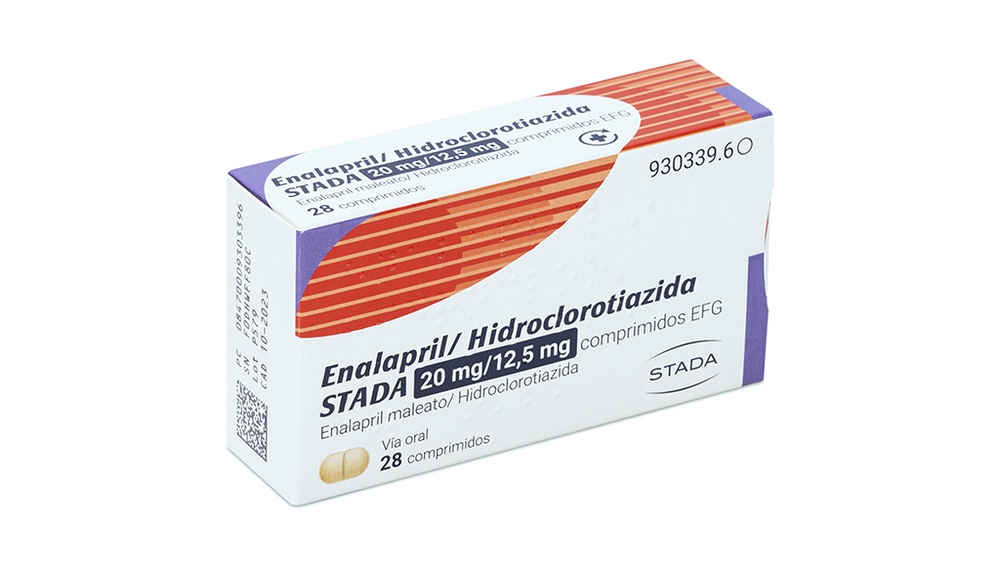
ENALAPRIL/HIDROCLOROTIAZIDA STADA 20/12,5 mg COMPRIMIDOS

Revisión de receta online
Un médico revisará tu caso y determinará si la prescripción es médicamente apropiada.

Habla con un médico sobre este medicamento
Comenta tus síntomas y las opciones de tratamiento en una consulta online.



Cómo usar ENALAPRIL/HIDROCLOROTIAZIDA STADA 20/12,5 mg COMPRIMIDOS EFG
Contenido del prospecto
- Introducción
- Qué es Enalapril/Hidroclorotiazida Stada y para qué se utiliza
- Qué necesita saber antes de empezar a tomar Enalapril/Hidroclorotiazida Stada
- Cómo tomar Enalapril/Hidroclorotiazida Stada
- Posibles efectos adversos
- Conservación de Enalapril/Hidroclorotiazida Stada
- Contenido del envase e información adicional
Introducción
Prospecto: información para el usuario
Enalapril/Hidroclorotiazida STADA 20 mg/12,5 mg comprimidos EFG
Enalapril maleato/ Hidroclorotiazida
Lea todo el prospecto detenidamente antes de empezar a tomar este medicamento, porque contiene información importante para usted.
- Conserve este prospecto, ya que puede tener que volver a leerlo.
- Si tiene alguna duda, consulte a su médico o farmacéutico.
- Este medicamento se le ha recetado solamente a usted, y no debe dárselo a otras personas aunque tengan los mismos síntomas que usted, ya que puede perjudicarles.
- Si experimenta efectos adversos, consulte a su médico o farmacéutico, incluso si se trata de efectos adversos que no aparecen en este prospecto. Ver sección 4.
Contenido del prospecto
- Qué es Enalapril/Hidroclorotiazida Stada y para qué se utiliza
- Qué necesita saber antes de empezar a tomar Enalapril/Hidroclorotiazida Stada
- Cómo tomar Enalapril/Hidroclorotiazida Stada
- Posibles efectos adversos
- Conservación de Enalapril/Hidroclorotiazida Stada
- Contenido del envase e información adicional
1. Qué es Enalapril/Hidroclorotiazida Stada y para qué se utiliza
Este medicamento contiene dos principios activos, enalapril e hidroclorotiazida, que pertenecen al grupo de los antihipertensivos y que, por diferentes mecanismos, reducen la tensión arterial elevada.
El componente enalapril de Enalapril/Hidroclorotiazida Stada es un medicamento que pertenece a un grupo de medicamentos conocidos como inhibidores de la enzima de conversión de la angiotensina (inhibidores de la ECA), que actúa dilatando los vasos sanguíneos para hacer que el corazón bombee con más facilidad sangre a todas las partes del organismo. El componente hidroclorotiazida de enalapril/hidroclorotiazida pertenece al grupo de medicamentos conocidos como diuréticos tiazídicos (medicamentos que aumentan la eliminación de orina). Conjuntamente, enalapril e hidroclorotiazida ayudan a disminuir la tensión arterial elevada.
Su médico le ha recetado enalapril/hidroclorotiazida para tratar la hipertensión (tensión arterial alta) porque no está adecuadamente controlada con enalapril o un inhibidor de la ECA solo.

¿No estás seguro de si este medicamento es adecuado para ti?
Comenta tus síntomas y tratamiento con un médico online.
2. Qué necesita saber antes de empezar a tomar Enalapril/Hidroclorotiazida Stada
No tomeEnalapril/Hidroclorotiazida Stada:
- Si es alérgico a enalapril, a hidroclorotiazida, tiazidas o a alguno de los demás componentes de este medicamento (incluidos en la sección 6).
- Si es alérgico a sustancias derivadas de las sulfonamidas. Pregunte a su médico si no está seguro de lo que son los medicamentos derivados de las sulfonamidas.
- Si ha sido tratado previamente con un medicamento del mismo grupo que enalapril/hidroclorotiazida (los inhibidores de la ECA), y ha tenido reacciones alérgicas con hinchazón de la cara, labios, lengua y/o garganta con dificultad para tragar o respirar.
- Si ha tenido ese tipo de reacciones alérgicas sin una causa conocida, o si le han diagnosticado angioedema hereditario o idiopático (enfermedad del sistema inmunológico que produce inflamación en la cara y vías respiratorias, y cólicos abdominales).
- Si tiene alguna enfermedad de hígado grave.
- Si tiene alguna enfermedad de riñón grave.
- Si padece anuria (no orina).
- Si tiene diabetes o insuficiencia renal y le están tratando con un medicamento para bajar la presión arterial que contiene aliskireno.
- Si está embarazada de más de 3 meses. (También es mejor evitar enalapril/hidroclorotiazida al principio del embarazo - ver sección embarazo).
- Si ha tomado o está tomando en este momento sacubitril/valsartán, un medicamento utilizado para tratar un tipo de insuficiencia cardíaca a largo plazo (crónica) en adultos, ya que el riesgo de angioedema (hinchazón rápida debajo de la piel en un área como la garganta) es elevado.
Si no está seguro de si debe empezar a tomar enalapril/hidroclorotiazida, consulte a su médico.
Advertencias y precauciones
Consulte a su médico o farmacéutico antes de empezar a tomar Enalapril/Hidroclorotiazida Stada.
En las siguientes situaciones, su médico puede necesitar ajustarle la dosis de enalapril/hidroclorotiazida o vigilar su nivel de potasio en sangre:
- Si ha tenido problemas respiratorios o pulmonares (como inflamación o líquido en los pulmones) tras la toma de hidroclorotiazida en el pasado. Si presenta disnea o dificultad para respirar grave después de tomar enalapril/hidroclorotiazida, acuda al médico inmediatamente.
- Si padece una enfermedad del corazón que curse con estrechamiento de las válvulas cardiacas (estenosis de la válvula mitral o aórtica) u otros factores que reducen el flujo de la cavidad izquierda del corazón (miocardiopatía hipertrófica obstructiva).
- Si padece trastornos que reducen el volumen de líquidos o el nivel de sodio del organismo (por ejemplo: vómitos intensos, diarrea o si está en tratamiento con dosis elevadas de medicamentos que aumentan la eliminación de orina).
- Si presenta alguna alteración en la sangre.
- Si tiene diabetes y está tomando medicamentos para tratar la diabetes, incluyendo la insulina, ya que puede ser necesario un ajuste de dosis de los medicamentos utilizados para tratar la diabetes. La diabetes puede provocar niveles elevados de potasio en la sangre que pueden ser graves.
- Si tiene problemas de hígado.
- Si tiene problemas de riñón (incluyendo trasplante renal), ya que éstos pueden provocar niveles elevados de potasio en la sangre que pueden ser graves.
- Si se somete a diálisis.
- Si sigue una dieta sin sal, toma suplementos de potasio, medicamentos ahorradores de potasio (medicamentos que aumentan los niveles de potasio) o sustitutos de la sal que contengan potasio u otros medicamentos que puedan aumentar el potasio en sangre como por ejemplo, heparina (un medicamento que se usa para prevenir los coágulos), medicamentos con trimetoprima o cotrimoxazol, también conocido como trimetoprima/sulfametoxazol (medicamentos que se usan para tratar infecciones).
- Si durante el tratamiento aparece una reacción alérgica con hinchazón de la cara, labios, lengua y/o garganta con dificultad para tragar o respirar. Ha de tener en cuenta que los pacientes de raza negra son más sensibles a este tipo de medicamentos.
- Si está a punto de someterse a un tratamiento llamado aféresis de LDL (es un procedimiento similar a la diálisis, para eliminar de la sangre las partículas de LDL o colesterol malo en los casos en que está excesivamente elevado).
- Si va a someterse a un tratamiento de desensibilización para reducir el efecto de una alergia a la picadura de abeja o de avispa.
- Si tiene la tensión arterial baja, ya que el uso de enalapril/hidroclorotiazida, especialmente en las primeras dosis, puede producir una disminución brusca de la tensión arterial (puede notarlo como desmayos o mareos, especialmente al ponerse de pie).
- Consulte a su médico antes de empezar a tomar enalapril/hidroclorotiazida si ha tenido cáncer de piel o si le aparece una lesión de la piel inesperada durante el tratamiento. El tratamiento con hidroclorotiazida, en particular su uso a largo plazo a dosis altas, puede aumentar el riesgo de algunos tipos de cáncer de piel y labios (cáncer de piel no-melanoma). Proteja la piel de la exposición al sol y a los rayos UV mientras esté tomando enalapril/hidroclorotiazida.
- Si está usando alguno de los siguientes medicamentos, el riesgo de sufrir angioedema (rápida hinchazón bajo la piel en zonas como la garganta) puede aumentar:
- racecadotrilo, un medicamento utilizado para tratar la diarrea
- medicamentos utilizados para prevenir el rechazo al trasplante de órganos y para el cáncer (p. ej., temsirólimus, sirólimus, everólimus).
- vildagliptina, un medicamento utilizado para tratar la diabetes.
- Informe a su médico si está tomando alguno de los siguientes medicamentos utilizados para tratar la presión arterial alta:
- un antagonista de los receptores de angiotensina II (ARA) (también conocidos como "sartanes" - por ejemplo, valsartán, telmisartán, irbesartán), en particular si sufre problemas renales relacionados con la diabetes.
- aliskireno
- Informe a su médico si experimenta una disminución de la visión o dolor ocular, podrían ser síntomas de acumulación de líquido en la capa vascular del ojo (derrame coroideo) o un aumento de la presión en el ojo y se pueden producir en un plazo de entre unas horas y unas semanas después de tomar enalapril/hidroclorotiazida. Si no se trata, esto puede llevar a una pérdida de visión permanente. Puede tener un mayor riesgo de que aparezca si anteriormente ha tenido alergia a penicilina o a sulfonamida.
Puede que su médico le controle la función renal, la presión arterial y los niveles de electrolitos en la sangre (por ejemplo, potasio), a intervalos regulares.
Ver también la información bajo el encabezado “No tome Enalapril/Hidroclorotiazida Stada”.
Antes de someterse a una intervención quirúrgica o a anestesia (incluso en la consulta del dentista), informe al médico o al dentista que está tomando enalapril/hidroclorotiazida, pues puede sufrir una bajada brusca de la tensión arterial por causa de la anestesia.
Debe informar al médico si cree que está embarazada (o pudiera estarlo). No se recomienda enalapril/hidroclorotiazida al principio del embarazo y no debe utilizarse si está embarazada de más de 3 meses, ya que puede causar graves daños a su bebé si se utiliza en esta etapa (ver sección embarazo).
Niños y adolescentes
No se ha establecido la seguridad y la eficacia de enalapril/hidroclorotiazida en este grupo de población, por lo que no se recomienda su uso en niños.
Pacientes de edad avanzada
En estudios en los que se tomaron juntos enalapril e hidroclorotiazida, el efecto de los fármacos y la tolerabilidad fueron similares en pacientes adultos jóvenes y ancianos con tensión arterial alta.
Otrosmedicamentosy Enalapril/Hidroclorotiazida Stada
Informe a su médico o farmacéutico si está tomando, ha tomado recientemente o pudiera tener que tomar cualquier otro medicamento. Puede que su médico deba modificar su dosis y/o tomar otras precauciones.
Es especialmente importante que informe a su médico si está utilizando o ha utilizado recientemente alguno de los siguientes medicamentos:
- Un antagonista de los receptores de angiotensina II (ARA) o aliskireno (ver también la información bajo los encabezados “No tome Enalapril/Hidroclorotiazida Stada” y “Advertencias y precauciones”)
- Medicamentos antihipertensivos (reducen la tensión arterial elevada), por ejemplo vasodilatadores, betabloqueantes, diuréticos.
- Medicamentos con potasio (incluidos los sustitutos dietéticos de la sal), diuréticos ahorradores de potasio y otros medicamentos que pueden aumentar la cantidad de potasio en sangre (por ejemplo, trimetroprima y cotrimoxazol para infecciones causadas por bacterias; ciclosporina, un medicamento inmunosupresor que se usa para prevenir el rechazo de trasplantes de órganos; y heparina, un medicamento que se usa para diluir la sangre para prevenir los coágulos). Ver también la información en la sección “Advertencias y precauciones”.
- Medicamentos utilizados para tratar algunos trastornos mentales como el litio, los antipsicóticos o los antidepresivos tricíclicos.
- Anestésicos.
- Estupefacientes (medicamentos utilizados para tratar el dolor intenso).
- Medicamentos utilizados para tratar la diabetes como la insulina o los antidiabéticos orales (p. ej. metformina).
- Medicamentos utilizados para tratar el dolor o ciertas inflamaciones, como los antiinflamatorios no esteroideos (AINEs), como el ácido acetil salicílico, incluyendo los inhibidores selectivos de la ciclooxigenasa-2 (COX-2).
- Medicamentos simpaticomiméticos (medicamentos que se emplean en el tratamiento de ciertos trastornos del corazón y de los vasos sanguíneos y algunos medicamentos para el resfriado).
- Aminas presoras, como noradrenalina.
- Relajantes de los músculos como la tubocurarina.
- Medicamentos trombolíticos (que evitan la formación de coágulos en la sangre).
- Sales de calcio y vitamina D.
- Resinas de intercambio iónico (medicamentos que se usan para disminuir el colesterol en sangre), como colestiramina y colestipol.
- Antiarrítmicos (medicamentos que se usan para la prevención y control de las alteraciones del ritmo del corazón), como glucósidos digitálicos, quinidina, amiodarona.
- Medicamentos anticolinérgicos (medicamentos que disminuyen la velocidad de vaciado gástrico), como atropina (que se usa antes de la anestesia general o para evitar espasmos) o biperideno (utilizado en pacientes con enfermedad de Parkinson).
- Medicamentos para el tratamiento de la gota, como probenecid, sulfinpirazona y alopurinol.
- Procainamida (medicamento para tratar problemas del ritmo cardíaco)
- Antivirales (medicamentos para tratar las infecciones producidas por virus), como amantadina.
- Medicamentos citotóxicos (utilizados para el tratamiento del cáncer), como ciclofosfamida y metotrexato.
- Medicamentos inmunosupresores (utilizados para la prevención del rechazo en trasplantes de órganos), como ciclosporina.
- Antibióticos (medicamentos para tratar algunas infecciones), como tetraciclinas, anfotericina B.
- Sales de oro (usadas para tratar enfermedades reumáticas como la artritis reumatoide).
- La administración simultánea de inhibidores de mTOR (p. ej. temsirólimus, sirólimus, everólimus) podría aumentar el riesgo de una reacción alérgica llamada angioedema.
- Un medicamento que contiene un inhibidor de neprisilina como sacubitril (disponible en una combinación de dosis fija con valsartán), racecadotrilo o vildagliptina. Puede aumentar el riesgo de angioedema (hinchazón de la cara, labios, lengua o garganta con dificultad para tragar o respirar).
Ver también la información en las secciones “No tome Enalapril/Hidroclorotiazida Stada” y “Advertencias y precauciones”.
Toma de Enalapril/Hidroclorotiazida Stada con alimentos, bebidas y alcohol
Enalapril/hidroclorotiazida puede tomarse con o sin alimentos. La mayoría de las personas toman enalapril/hidroclorotiazida con un vaso de agua.
El alcohol puede aumentar el efecto hipotensor (reductor de la tensión arterial) de este medicamento.
Embarazo, lactancia y fertilidad
Consulte a su médico o farmacéutico antes de utilizar cualquier medicamento.
Embarazo
Si está embarazada o en periodo de lactancia, cree que podría estar embarazada o tiene intención de quedarse embarazada, consulte a su médico o farmacéutico antes de utilizar este medicamento.
Normalmente su médico le aconsejará que deje de tomar enalapril/hidroclorotiazida antes de quedarse embarazada o tan pronto como sepa que está embarazada y le aconsejará tomar otro medicamento distinto de enalapril/hidroclorotiazida. No se recomienda enalapril/hidroclorotiazida durante el embarazo y no debe tomarse si está embarazada de más de 3 meses, ya que puede causar graves daños a su bebé si se utiliza a partir del tercer mes del embarazo.
Lactancia
Informe a su médico si está en periodo de lactancia o está a punto de empezar la lactancia. No se recomienda enalapril/hidroclorotiazida en madres que estén en periodo de lactancia.
Los dos principios activos de enalapril/hidroclorotiazida, enalapril e hidroclorotiazida, pasan a la leche materna. Si está en periodo de lactancia o pretende hacerlo, consulte a su médico.
Conducción y uso de máquinas
Es poco probable que enalapril/hidroclorotiazida afecte a su capacidad para conducir o utilizar máquinas. No obstante, se pueden experimentar ocasionalmente mareos o fatiga durante el tratamiento de la presión arterial elevada, especialmente al inicio. Si observa dichos efectos, debe consultar al médico antes de realizar estas actividades.
Enalapril/Hidroclorotiazida Stada contiene lactosa y sodio
Este medicamento contiene lactosa. Si su médico le ha indicado que padece una intolerancia a ciertos azúcares, consulte con él antes de tomar este medicamento.
Este medicamento contiene menos de 1 mmol de sodio (23 mg); esto es, esencialmente “exento de sodio”.
Uso en Deportistas
Este medicamento contiene hidroclorotiazida que puede producir un resultado positivo en las pruebas de control de dopaje.
Interferencias con pruebas diagnósticas
Si deben realizarle alguna prueba diagnóstica para valorar la función de la glándula paratiroides comunique a su médico que está en tratamiento con enalapril/hidroclorotiazida, ya que puede alterar los resultados.
.
3. Cómo tomar Enalapril/Hidroclorotiazida Stada
Siga exactamente las instrucciones de administración de este medicamento indicadas por su médico o farmacéutico. En caso de duda, consulte de nuevo a su médico o farmacéutico.
Recuerde tomar su medicamento.
Su médico decidirá la dosis adecuada, en función de su estado y de si está tomando otros medicamentos.
Tome enalapril/hidroclorotiazida todos los días, exactamente del modo indicado por el médico. Es muy importante que continúe tomando este medicamento durante el tiempo que su médico se lo recete.
La dosis recomendada es de uno o dos comprimidos administrados una vez al día. Tome enalapril/hidroclorotiazida todos los días, exactamente del modo indicado por el médico. Es muy importante que continúe tomando este medicamento durante el tiempo que su médico se lo recete. No tome más comprimidos de los de la dosis prescrita.
La dosis inicial puede causar una mayor caída de la tensión arterial que la que se producirá después del tratamiento continuado. Puede notar desmayos o mareos y tumbarse podría ayudarle. Si le preocupa, consulte a su médico.
Uso en pacientes con la función de los riñones alterada:
Si tiene alguna enfermedad de riñón, su médico le indicará la dosis más adecuada.
Forma de administración
Este medicamento se administra por vía oral.
Tome los comprimidos de enalapril/hidroclorotiazida con la ayuda de un vaso de agua. Enalapril/hidroclorotiazida puede tomarse antes o después de las comidas.
Si toma más Enalapril/Hidroclorotiazida Stada del que debe
En caso de sobredosis o ingestión accidental, consulte inmediatamente a su médico o farmacéutico, o llame al Servicio de Información Toxicológica, teléfono: 91 562 04 20, indicando el medicamento y la cantidad ingerida.
Se recomienda llevar el envase y el prospecto del medicamento al personal sanitario.
Los síntomas más probables serían sensación de mareo o vértigo debido a un descenso repentino o excesivo de la presión arterial y/o sed excesiva, desorientación, disminución de la producción de orina y/o taquicardia.
Si olvidó tomar Enalapril/Hidroclorotiazida Stada
Debe tomar enalapril/hidroclorotiazida como se le haya recetado. No tome una dosis doble para compensar las dosis olvidadas. Limítese a tomar la dosis siguiente del modo habitual.
Si interrumpe el tratamiento con Enalapril/Hidroclorotiazida Stada
Su médico le indicará la duración de su tratamiento con enalapril/hidroclorotiazida. No suspenda el tratamiento antes, aunque se sienta mejor.
No deje de tomar su medicamento a menos que su médico le diga que lo haga.
Si tiene cualquier otra duda sobre el uso de este medicamento, pregunte a su médico o farmacéutico.

¿Has empezado a tomar el medicamento y tienes preguntas?
Comenta tus síntomas y tratamiento con un médico online.
4. Posibles efectos adversos
Al igual que todos los medicamentos, este medicamento puede producir efectos adversos, aunque no todas las personas los sufran.
Los efectos adversos registrados se detallan a continuación según las siguientes frecuencias:
Muy frecuentes: (pueden afectar a más de 1 de cada 10 personas)
Frecuentes: (pueden afectar hasta 1 de cada 10 personas)
Poco frecuentes: (pueden afectar hasta 1 de cada 100 personas)
Raros: (pueden afectar hasta 1 de cada 1.000 personas)
Muy raros: (pueden afectar hasta 1 de 10.000 personas)
Frecuencia no conocida: (no puede estimarse a partir de los datos disponibles)
Neoplasias benignas, malignas y no especificadas (incluyen quistes y pólipos)
No conocida: cáncer de piel y labios (cáncer de piel no-melanoma).
Trastornos de la sangre y del sistema linfático:
Poco frecuentes: descenso de los glóbulos rojos (células de la sangre que transportan oxígeno)
Raras: reducción de un tipo de glóbulos blancos (neutrófilos), descenso de la hemoglobina (proteína de los glóbulos rojos que transporta el oxígeno), disminución del número de plaquetas en sangre, disminución del hematocrito (proporción de glóbulos rojos en la sangre), disminución del número de glóbulos blancos, depresión de la médula ósea (disminución de la capacidad del organismo para formar células de la sangre), inflamación de los nódulos linfáticos, enfermedades del sistema inmune.
Trastornos endocrinos:
No conocidas: síndrome de secreción inadecuada de hormona antidiurética (SIADH).
Trastornos del metabolismo y de la nutrición:
Frecuentes: nivel elevado de potasio en sangre, aumento del colesterol, aumento de los triglicéridos, aumento del ácido úrico en sangre
Poco frecuentes: nivel bajo de glucosa y de magnesio en sangre, gota
Raras: aumento de la glucosa en sangre
Muy raras: nivel elevado de calcio en sangre
Trastornos del sistema nervioso:
Frecuentes: dolor de cabeza, síncope, alteración del gusto
Poco frecuentes: confusión, somnolencia, insomnio, sensación de hormigueo, vértigo
Raras: parálisis (debido a nivel bajo de potasio en sangre).
Trastornos psiquiátricos:
Frecuentes: depresión
Poco frecuentes: nerviosismo, libido disminuida*
Raras: sueños anormales, trastornos del sueño.
Trastornos oculares:
Muy frecuentes: visión borrosa.
No conocida: alteraciones visuales, disminución de la visión o dolor en los ojos debido a una presión elevada -signos posibles de acumulación de líquido en la capa vascular del ojo (derrame coroideo) o glaucoma agudo de ángulo cerrado-.
Trastornos del oído y del laberinto:
Poco frecuentes: ruido en los oídos.
Trastornos cardiacos y vasculares:
Muy frecuentes: mareos
Frecuentes: bajada de la tensión arterial asociada a desvanecimiento, trastornos del ritmo cardiaco, angina de pecho, taquicardia (latidos rápidos del corazón)
Poco frecuentes: rubor, palpitaciones (sensación rápida e irregular de los latidos del corazón), infarto de miocardio o accidente cerebrovascular, posiblemente secundario a una excesiva disminución de la tensión arterial en pacientes de alto riesgo (ver sección “Advertencias y precauciones”)
Raras: cambios en la coloración de la piel de dedos de manos y pies, nariz u orejas (fenómeno de Raynaud).
Trastornos respiratorios, torácicos y mediastínicos:
Muy frecuentes: tos
Frecuentes: falta de aliento
Poco frecuentes: secreción de moco, dolor de garganta y ronquera, broncoespasmo (dificultad para respirar) y asma
Raras: infiltrados pulmonares, dificultad respiratoria (incluyendo neumonía y edema pulmonar), inflamación de las mucosas de la nariz, alveolitis alérgica (inflamación del alveolo pulmonar por alergia)/neumonía eosinofílica (enfermedad en la que un tipo de glóbulos blancos, llamados eosinófilos, se acumulan en los pulmones).
Muy raras: dificultad respiratoria aguda (los signos incluyen dificultad respiratoria grave, fiebre, debilidad y confusión)
Trastornos gastrointestinales:
Muy frecuentes: náuseas
Frecuentes: diarrea, dolor abdominal
Poco frecuentes: obstrucción del intestino con dolor intenso, inflamación del páncreas, vómitos, molestias relacionadas con la digestión, estreñimiento, falta de apetito, irritación gástrica, boca seca, úlcera péptica, flatulencia (gases)*
Raras: infección o inflamación de la mucosa de la boca, inflamación de la lengua
Muy raras: angioedema intestinal (inflamación de la pared del intestino).
Trastornos hepatobiliares:
Raras: insuficiencia hepática, necrosis hepática (que puede ser mortal), inflamación del hígado, supresión o detención de la secreción de bilis, coloración amarillenta de la piel o los ojos, inflamación de la vesícula biliar (en particular en pacientes con formación preexistente de cálculos en la vías biliares).
Trastornos de la piel y del tejido subcutáneo:
Frecuentes: erupción cutánea (exantema)
hipersensibilidad/edema angioneurótico: hinchazón de la cara, extremidades, labios, lengua, glotis y/o laringe
Poco frecuentes: sudoración abundante, picor, urticaria, pérdida de pelo
Raras: enrojecimiento de la piel, grave formación de ampollas o hemorragias en la piel (síndrome de Stevens-Johnson), enrojecimiento/erupción cutánea grave con pérdida de piel y de pelo, descamación de la piel, aparición de manchas rojas en la piel, alteración cutánea, enrojecimiento de la piel.
Se ha comunicado un complejo sintomático que puede incluir todos o alguno de los siguientes síntomas: fiebre, serositis, vasculitis, inflamación/dolor de los músculos, inflamación/dolor de las articulaciones, prueba de anticuerpos antinucleares positiva, aumento de la velocidad de sedimentación globular, eosinofilia y leucocitosis. También puede producirse erupción cutánea, sensibilidad a la luz del sol u otras manifestaciones cutáneas.
Trastornos musculoesqueléticos, del tejido conjuntivo y de los huesos:
Frecuentes: calambres en los músculos †
Poco frecuentes: dolor en las articulaciones *
Trastornos renales y urinarios:
Poco frecuentes: disfunción renal (alteración de la función del riñón), insuficiencia renal, presencia de proteínas en la orina
Raras: secreción deficiente de orina, inflamación de las células del riñón.
Trastornos del aparato reproductor y de la mama:
Poco frecuentes: impotencia
Raras: aumento del tamaño de las mamas en los hombres.
Trastornos generales y alteraciones en el lugar de administración:
Muy frecuentes: cansancio
Frecuentes: dolor torácico, fatiga
Poco frecuentes: malestar general, fiebre.
Exploraciones complementarias:
Frecuentes: nivel elevado de potasio en sangre, aumentos en la creatinina sérica
Poco frecuentes: aumentos en la urea sanguínea, nivel bajo de sodio en sangre
Raras: aumentos de las enzimas hepáticas, aumentos de la bilirrubina sérica.
- Sólo se observa con dosis de hidroclorotiazida de 12,5 mg y 25 mg, como se encuentra en enalapril/hidroclorotiazida
† La frecuencia de los calambres musculares como "frecuente" se aplica a las dosis de hidroclorotiazida de 12,5 mg y 25 mg, como se encuentra en enalapril/hidroclorotiazida, aunque la frecuencia del acontecimiento es "poco frecuente", y se aplica a la dosis de 6 mg de hidroclorotiazida como en enalapril/hidroclorotiazida.
Comunicación de efectos adversos:
Si experimenta cualquier tipo de efecto adverso, consulte a su médico o farmacéutico, incluso si se trata de posibles efectos adversos que no aparecen en este prospecto. También puede comunicarlos directamente a través del Sistema Español de Farmacovigilancia de Medicamentos de Uso Humano: https://www.notificaram.es. Mediante la comunicación de efectos adversos usted puede contribuir a proporcionar más información sobre la seguridad de este medicamento.
5. Conservación de Enalapril/Hidroclorotiazida Stada
Mantener fuera de la vista y del alcance de los niños.
No requiere de condiciones especiales de conservación. Conservar en el envase original.
No utilice este medicamento después de la fecha de caducidad que aparece en el envase después de CAD. La fecha de caducidad es el último día del mes que se indica.
Los medicamentos no se deben tirar por los desagües ni a la basura. Deposite los envases y los medicamentos que no necesita en el Punto SIGRE de su farmacia. Pregunte a su farmacéutico cómo deshacerse de los envases y de los medicamentos que ya no necesita. De esta forma ayudará a proteger el medio ambiente.
6. Contenido del envase e información adicional
Composición de Enalapril/Hidroclorotiazida Stada
- Los principios activos son enalapril en forma de maleato e hidroclorotiazida.
Cada comprimido contiene 20 mg de enalapril maleato y 12,5 mg de hidroclorotiazida.
- Los demás componentes son lactosa monohidrato, hidrogenocarbonato de sodio, almidón de maíz, almidón de maíz pregelatinizado, óxido de hierro amarillo (E-172) y estearato de magnesio.
Aspecto del producto y contenido del envase
Enalapril/Hidroclorotiazida Stada se presenta en forma de comprimidos amarillos, alargados, biconvexos y ranurados en una cara.
La ranura sirve únicamente para fraccionar y facilitar la deglución, pero no para dividir en dosis iguales.
Cada envase contiene 28 o 500 (envase clínico) comprimidos.
Puede que solamente estén comercializados algunos tamaños de envases.
Titular de la autorización de comercialización y responsable de la fabricación
Titular de la autorización de comercialización
Laboratorio STADA, S.L.
Frederic Mompou, 5
08960 Sant Just Desvern (Barcelona)
España
Responsable de la fabricación
Neuraxpharm Pharmaceuticals, S.L.
Avda. Barcelona, 69
08970 Sant Joan Despí (Barcelona)
España
Fecha de la última revisión de este prospecto:marzo 2024
La información detallada de este medicamento está disponible en la página web de la Agencia Española de Medicamentos y Productos Sanitarios (AEMPS) (http://www.aemps.gob.es/)
- País de registro
- Forma farmacéuticaCOMPRIMIDO, 20/12,5 mg/mg
- Código ATCC09BA02
- Precio medio en farmacia1.84 EUR
- Principio activo
- Requiere recetaSí
- Fabricante
- ComposiciónHIDROGENOCARBONATO DE SODIO (10,00 mg mg), LACTOSA MONOHIDRATO (132,40 mg mg)
- Esta información es de carácter general y no sustituye la consulta con un profesional sanitario.
- Alternativas a ENALAPRIL/HIDROCLOROTIAZIDA STADA 20/12,5 mg COMPRIMIDOS EFGForma farmacéutica: COMPRIMIDO, 20/12,5 mg/mgPrincipio activo: enalapril and diureticsFabricante: Alfasigma Espana S.L.Requiere recetaForma farmacéutica: COMPRIMIDO, 20/12,5 mg/mgPrincipio activo: enalapril and diureticsFabricante: Aristo Pharma Iberia S.L.Requiere recetaForma farmacéutica: COMPRIMIDO, 20/12,5 mg/mgPrincipio activo: enalapril and diureticsFabricante: Neuraxpharm Spain S.L.Requiere receta
Médicos online para ENALAPRIL/HIDROCLOROTIAZIDA STADA 20/12,5 mg COMPRIMIDOS EFG
Comenta la dosis, los posibles efectos secundarios, interacciones, contraindicaciones o la revisión de receta de ENALAPRIL/HIDROCLOROTIAZIDA STADA 20/12,5 mg COMPRIMIDOS EFG, sujeto a valoración médica y a la normativa local.
Obtén una receta de ENALAPRIL/HIDROCLOROTIAZIDA STADA 20/12,5 mg COMPRIMIDOS EFG online
Rellena un formulario de 2 minutos
Cuéntanos tus síntomas, historial y el medicamento que necesitas.
Elige un médico o nosotros te asignamos uno
Escoge un especialista o te conectamos con el próximo médico disponible.
El médico revisa tu caso
Normalmente en 30 minutos. Puede hacerte preguntas adicionales por chat.
Recógela en cualquier farmacia
Receta electrónica enviada a tu correo, válida en toda España.
Preguntas frecuentes
ENALAPRIL/HIDROCLOROTIAZIDA STADA 20/12,5 mg COMPRIMIDOS EFG requiere receta en España. Puedes confirmarlo con un médico online según tu caso.
El principio activo de ENALAPRIL/HIDROCLOROTIAZIDA STADA 20/12,5 mg COMPRIMIDOS EFG es enalapril and diuretics. Esta información ayuda a identificar medicamentos con la misma composición pero con diferentes nombres comerciales.
El precio medio en farmacia de ENALAPRIL/HIDROCLOROTIAZIDA STADA 20/12,5 mg COMPRIMIDOS EFG es de aproximadamente 1.84 EUR. Puede variar según el fabricante y la forma farmacéutica.
ENALAPRIL/HIDROCLOROTIAZIDA STADA 20/12,5 mg COMPRIMIDOS EFG es fabricado por Laboratorio Stada S.L.. La marca y el envase pueden variar según el distribuidor.
Los Médicos de familia, Psiquiatras, Dermatólogos, Cardiólogos, Endocrinólogos, Gastroenterólogos, Neumólogos, Nefrólogos, Reumatólogos, Hematólogos, Infectólogos, Alergólogos, Geriatras, Pediatras, Oncólogos pueden valorar la prescripción de ENALAPRIL/HIDROCLOROTIAZIDA STADA 20/12,5 mg COMPRIMIDOS EFG cuando esté clínicamente indicado. Puedes reservar una videoconsulta para comentar tu caso y las opciones de tratamiento.
España cuenta con una infraestructura sanitaria bien desarrollada en ciudades principales como Madrid, Barcelona, Valencia y Sevilla. Las farmacias están ampliamente disponibles y operan bajo estrictas regulaciones, garantizando el acceso a medicamentos con receta.
Puedes comprar ENALAPRIL/HIDROCLOROTIAZIDA STADA 20/12,5 mg COMPRIMIDOS EFG en Madrid, Barcelona, Sevilla o Valencia en cualquier farmacia local con una receta válida.
Para obtener una receta, puedes utilizar Oladoctor:
Otros medicamentos con el mismo principio activo (enalapril and diuretics) incluyen ACEDIUR 20 mg/12.5mg comprimidos, ACETENSIL PLUS 20 mg/12,5 mg COMPRIMIDOS EFG, BARIPRIL DIU 20 mg/12,5 mg COMPRIMIDOS. Pueden tener diferentes nombres comerciales o formulaciones, pero contienen el mismo componente terapéutico. Consulta siempre con un médico antes de cambiar o iniciar un nuevo medicamento.
