



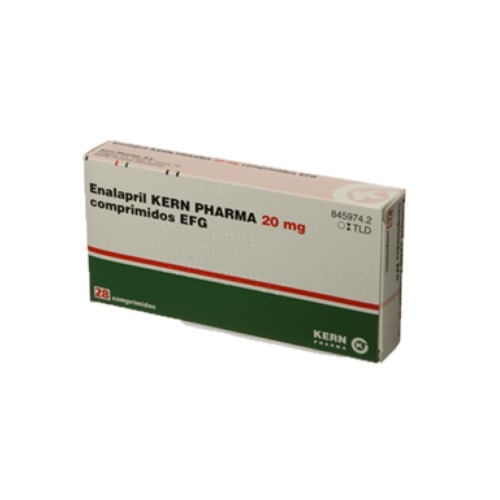
ENALAPRIL 20 mg Comprimidos

Revisión de receta online
Un médico revisará tu caso y determinará si la prescripción es médicamente apropiada.

Habla con un médico sobre este medicamento
Comenta tus síntomas y las opciones de tratamiento en una consulta online.



Cómo usar ENALAPRIL KERN PHARMA 20 mg COMPRIMIDOS EFG
Contenido del prospecto
- Introducción
- Qué es Enalapril Kern Pharma y para qué se utiliza
- Qué necesita saber antes de empezar a tomar Enalapril Kern Pharma
- Cómo tomar Enalapril Kern Pharma
- Posibles efectos adversos
- Conservación de Enalapril Kern Pharma
- Contenido del envase e información adicional
Introducción
Prospecto: información para el usuario
Enalapril Kern Pharma 20 mg comprimidos EFG
Enalapril maleato
Lea todo el prospecto detenidamente antes de empezar a tomar este medicamento, porque contiene información importante para usted.
- Conserve este prospecto, ya que puede tener que volver a leerlo.
- Si tiene alguna duda, consulte a su médico o farmacéutico.
- Este medicamento se le ha recetado solamente a usted, y no debe dárselo a otras personas aunque tengan los mismos síntomas que usted, ya que puede perjudicarles.
- Si experimenta efectos adversos, consulte a su médico o farmacéutico, incluso si se trata de efectos adversos que no aparecen en este prospecto. Ver sección 4.
Contenido del prospecto:
- Qué es Enalapril Kern Pharma y para qué se utiliza
- Qué necesita saber antes de empezar a tomar Enalapril Kern Pharma
- Cómo tomar Enalapril Kern Pharma
- Posibles efectos adversos
- Conservación de Enalapril Kern Pharma
- Contenido del envase e información adicional
1. Qué es Enalapril Kern Pharma y para qué se utiliza
Enalapril pertenece al grupo de medicamentos denominado inhibidores de la enzima de conversión de la angiotensina (inhibidores de la ECA). Este medicamento funciona ensanchando sus vasos sanguíneos. De esta manera, se reduce su presión sanguínea. Esto permite que su corazón bombee más fácilmente la sangre por todo el cuerpo.
Enalapril está indicado para:
- Tratar la hipertensión (tensión arterial alta).
- Tratar la insuficiencia cardíaca (debilitamiento de la función del corazón) sintomática.
- Prevenir la insuficiencia cardíaca sintomática.

¿No estás seguro de si este medicamento es adecuado para ti?
Comenta tus síntomas y tratamiento con un médico online.
2. Qué necesita saber antes de empezar a tomar Enalapril Kern Pharma
No tome Enalapril Kern Pharma
- Si es alérgico (hipersensible) al enalapril o a cualquiera de los demás componentes de este medicamento (incluidos en la sección 6).
- Si ha sido tratado previamente con un medicamento del mismo grupo de fármacos que enalapril (inhibidores de la ECA) y ha tenido reacciones alérgicas con hinchazón de la cara, labios, lengua y/o garganta con dificultad para tragar o respirar.
- Si le han diagnosticado angioedema (es el desarrollo de grandes ronchas en la superficie de la piel, especialmente alrededor de los ojos y los labios, las cuales pueden también afectar manos, pies y garganta y también puede provocar hinchazón de la cara, labios, lengua y/o garganta con dificultad para tragar o respirar) hereditario o de causa desconocida.
- Si tiene diabetes o insuficiencia renal y le están tratando con un medicamento para bajar la presión arterial que contiene aliskirén.
- Si está embarazada de más de 3 meses. También es mejor evitar enalapril al principio del embarazo (ver sección Embarazo).
Advertencias y precauciones
Consulte a su médico o farmacéutico antes de empezar a tomar enalapril:
- Si padece una enfermedad cardíaca (que obstruye la salida de sangre del corazón).
- Si padece una enfermedad que afecta a los vasos sanguíneos del cerebro.
- Si presenta trastornos sanguíneos como nivel bajo o falta de glóbulos blancos (neutropenia/agranulocitosis), bajo recuento de plaquetas (trombocitopenia) o un número bajo de glóbulos rojos (anemia).
- Si presenta problemas de hígado.
- Si se somete a diálisis (procedimiento para purificar la sangre cuando tiene problemas del riñón).
- Si recibe tratamiento con diuréticos (medicamentos que aumentan la eliminación de orina).
- Si ha sufrido recientemente vómitos o diarrea excesivos.
- Si sigue una dieta sin sal, toma suplementos de potasio, medicamentos ahorradores de potasio o sustitutos de la sal que contengan potasio o medicamentos asociados con elevaciones de potasio en sangre (p.ej. anticoagulantes como la heparina).
- Si tiene más de 70 años.
- Si tiene diabetes mellitus (niveles altos de glucosa en sangre) o cualquier problema del riñón (incluyendo el trasplante renal), ya que éstos pueden llevar a elevados niveles de potasio en la sangre que pueden ser graves.
- Si alguna vez ha tenido una reacción alérgica con hinchazón de la cara, labios, lengua y/o garganta con dificultad para tragar o respirar. Ha de tener en cuenta que los pacientes de raza negra son más sensibles a este tipo de reacciones a los inhibidores de la ECA.
- Si está a punto de someterse a un tratamiento llamado aféresis de LDL, o a un tratamiento de desensibilización para reducir el efecto de una alergia a la picadura de abeja o avispa.
- Si tiene la presión arterial baja (puede notarlo como desmayos o mareos, especialmente en las dosis iniciales y al estar de pie. En estos casos, tumbarse podría ayudarle).
- Si tiene enfermedad del colágeno vascular (p. ej. lupus eritematoso, artritis reumatoide, o escleroderma), está en tratamiento con medicamentos que suprimen su sistema inmunológico, está tomando los medicamentos alopurinol o procainimida o cualquier combinación de éstos.
- Si está tomando alguno de los siguientes medicamentos utilizados para tratar la presión arterial alta (hipertensión):
- un antagonista de los receptores de angiotensina II (ARA) (también conocidos como "sartanes" - por ejemplo, valsartán, telmisartán, irbesartán), en particular si sufre problemas renales relacionados con la diabetes.
- aliskirén.
Puede que su médico le controle la función renal, la presión arterial y los niveles de electrolitos en la sangre (por ejemplo, potasio), a intervalos regulares.
Ver también la información bajo el encabezado “No tome Enalapril Kern Pharma”.
Debe informar a su médico si cree que está embarazada (o pudiera estarlo). No se recomienda enalapril al principio del embarazo y no debe tomarse si está embarazada de más de 3 meses, ya que puede causar graves daños a su bebé si se utiliza en esta etapa (ver sección Embarazo).
Ha de tener en cuenta que enalapril disminuye la presión arterial en los pacientes de raza negra de forma menos eficaz que en los pacientes que no son de raza negra.
En todos estos casos, informe a su médico ya que puede necesitar un ajuste de la dosis o suprimir la medicación con enalapril o controlar su nivel de potasio en sangre. Si tiene diabetes y está tomando antidiabéticos orales o insulina, debe vigilar estrechamente sus niveles de glucosa en sangre, especialmente durante el primer mes de tratamiento con este medicamento.
Antes de someterse a una intervención quirúrgica o anestesia (incluso en la consulta del dentista), informe al médico o al dentista que está tomando enalapril, pues puede haber un descenso súbito de la tensión arterial asociado con la anestesia.
Toma de Enalapril Kern Pharma con otros medicamentos
Comunique a su médico o farmacéutico si está utilizando o ha utilizado recientemente o pudiera tener que tomar cualquier otro medicamento.
Ciertos medicamentos pueden interaccionar con enalapril. Puede que su médico deba modificar su dosis y/o tomar otras precauciones, o interrumpir el tratamiento con alguno de ellos.
Es importante que informe a su médico si está tomando o ha tomado recientemente alguno de los siguientes medicamentos:
- Un antagonista de los receptores de angiotensina II (ARA) o aliskiren (ver también la información bajo los encabezados “No tome Enalapril Kern Pharma” y “Advertencias y precauciones”).
- Otros medicamentos antihipertensivos (reducen la tensión arterial elevada).
- Diuréticos (medicamentos que aumentan la eliminación de orina).
- Medicamentos con potasio (incluidos los sustitutos dietéticos de la sal).
- Litio (medicamento utilizado para tratar cierto tipo de depresiones).
- Antidepresivos tricíclicos (un tipo de antidepresivo).
- Antipsicóticos (medicamentos utilizados en el tratamiento de psicosis).
- Anestésicos.
- Antidiabéticos (medicamentos que disminuyen los niveles de glucosa en sangre).
- Antiinflamatorios no esteroideos (AINES) (medicamentos para tratar el dolor o ciertas inflamaciones, p.ej.: ácido acetilsalicílico).
- Simpaticomiméticos (medicamentos que incrementan el ritmo del corazón y la presión arterial o que dilatan los bronquios).
- Ciertos medicamentos para el dolor o la artritis, incluyendo el tratamiento con oro.
- Medicamentos anti-inflamatorios no esteroideos (AINES), incluyendo los inhibidores de la COX-2 (medicamentos que reducen la inflamación y que pueden utilizarse para ayudarle a aliviar el dolor).
Toma de Enalapril Kern Pharma con los alimentos, bebidas y alcohol
Los alimentos no afectan a la absorción de enalapril.
El alcohol potencia el efecto hipotensor (reducción de la tensión arterial) de enalapril, por lo tanto, se debe administrar con precaución en pacientes que consumen alcohol. Si usted bebe habitualmente alcohol, consulte a su médico.
Embarazo y lactancia
Si está embarazada o en periodo de lactancia, cree que podría estar embarazada o tiene intención de quedare embarazada, consulte a su médico o farmacéutico antes de utilizar cualquier medicamento.
Enalapril no debe utilizarse en mujeres embarazadas.
Debe informar al médico si cree que está embarazada (o pudiera estarlo). Normalmente su médico le aconsejará que deje de tomar enalapril antes de quedarse embarazada o tan pronto como sepa que está embarazada y le aconsejará tomar otro medicamento distinto de enalapril. No se recomienda este medicamento al principio del embarazo y no debe tomarse si está embarazada de más de 3 meses, ya que puede causar graves daños a su bebé si se utiliza a partir del tercer mes del embarazo.
Informe a su médico si está dando el pecho o está a punto de empezar a dar el pecho. Mientras esté tomando enalapril no se recomienda la lactancia en recién nacidos (primeras semanas después de nacer), y especialmente en bebés prematuros. En el caso de un bebé más mayor, su médico debería aconsejarle sobre los beneficios y riesgos de tomar enalapril, comparado con otros tratamientos, mientras dé el pecho.
Conducción y uso de máquinas
Las respuestas individuales a la medicación pueden variar.
Dado que enalapril puede producir mareos o cansancio, procure no realizar tareas que puedan requerir una atención especial (conducir vehículos o manejar maquinaria) hasta que sepa como tolera el medicamento.
Enalapril Kern Pharma contiene lactosa, sorbitol y aceite de ricino hidrogenado
Este medicamento contiene como excipientes lactosa y sorbitol. Si su médico le ha indicado que padece una intolerancia a ciertos azúcares, consulte con él antes de tomar este medicamento.
Este medicamento puede producir molestias de estómago y diarrea porque contiene aceite de ricino hidrogenado.
3. Cómo tomar Enalapril Kern Pharma
Siga exactamente las instrucciones de administración de este medicamento indicadas por su médico o farmacéutico. En caso de duda, consulte de nuevo a su médico o farmacéutico.
Recuerde tomar su medicamento.
Su médico le indicará la duración de su tratamiento con enalapril. No suspenda el tratamiento antes.
Enalapril puede tomarse con las comidas o entre ellas junto con un vaso de agua.
La ranura sirve únicamente para partir el comprimido si le resulta difícil tragárselo entero.
Si médico decidirá la dosis apropiada de enalapril que debe tomar, dependiendo de su estado y de si está tomando otros medicamentos.
Hipertensión
Para la mayoría de los pacientes la dosis inicial recomendada normalmente es de 5 a 20 mg una vez al día. Algunos pacientes pueden necesitar una dosis inicial menor.
La dosis habitual a largo plazo es de 20 mg una vez al día.
La dosis máxima a largo plazo es de 40 mg al día, dividida en dos tomas.
Insuficiencia cardíaca
La dosis inicial recomendada normalmente es de 2,5 mg una vez al día. El médico aumentará la dosis poco a poco hasta que se alcance la dosis adecuada en su caso. La dosis habitual a largo plazo es 20 mg al día en una o dos tomas.
La dosis máxima a largo plazo es de 40 mg al día, dividida en dos tomas.
Al inicio del tratamiento se deben extremar las precauciones dada la posibilidad de que aparezcan mareos o vértigo.
Informe inmediatamente al médico si presenta estos síntomas.
Si estima que la acción de este medicamento es demasiado fuerte o débil, comuníqueselo a su médico o farmacéutico.
Si toma más Enalapril Kern Pharma del que debe
En caso de una sobredosis, el síntoma más probable es una sensación de mareo o vértigo debido a un descenso repentino o excesivo de la tensión arterial.
En caso de sobredosis o ingestión accidental, consulte inmediatamente a su médico o farmacéutico o llame al Servicio de Información Toxicológica, teléfono: 91 562 04 20, indicando el medicamento y la cantidad ingerida.
Si olvidó tomar Enalapril Kern Pharma
Debe continuar tomando enalapril tal como se le ha prescrito. No tome una dosis doble para compensar las dosis olvidadas.
Si interrumpe el tratamiento con Enalapril Kern Pharma
No suspenda el tratamiento sin que su médico se lo indique.
Si tiene cualquier otra duda sobre el uso de este producto, pregunte a su médico o farmacéutico.

¿Has empezado a tomar el medicamento y tienes preguntas?
Comenta tus síntomas y tratamiento con un médico online.
4. Posibles efectos adversos
Al igual que todos los medicamentos, este medicamento puede producir efectos adversos, aunque no todas las personas los sufran.
Los efectos adversos se han codificado teniendo en cuenta las siguientes definiciones de frecuencias: muy frecuentes (al menos 1 de cada 10 pacientes), frecuentes (al menos 1 de cada 100 pacientes), poco frecuentes (al menos 1 de cada 1.000 pacientes), raros (al menos 1 de cada 10.000 pacientes) y muy raros (menos de 1 de cada 10.000 pacientes).
Trastornos sanguíneos y del sistema linfático:
Poco frecuentes: anemia (disminución del número de glóbulos rojos en sangre) (incluyendo anemia aplásica y hemolítica).
Raros:trastornos sanguíneos, tales como un número anormalmente bajo de neutrófilos (un tipo de célula sanguínea), niveles bajos de hemoglobina, reducción o ausencia completa de granulocitos (un tipo de célula sanguínea), deficiencia de todos los tipos de células de la sangre, depresión de la médula ósea (tejido del interior hueso que genera células sanguíneas), enfermedad de los nódulos linfáticos o respuesta inmune anormal.
Trastornos del metabolismo y de la nutrición:
Poco frecuentes:niveles bajos de glucosa en sangre.
Trastornos del sistema nervioso y mentales:
Frecuentes:dolor de cabeza, depresión.
Poco frecuentes:confusión, somnolencia o incapacidad para dormir, nerviosismo, sensación de hormigueo o adormecimiento, vértigo.
Raros:alteraciones del sueño, problemas de sueño.
Trastornos oculares:
Muy frecuentes:visión borrosa.
Trastornos cardíacos y de los vasos sanguíneos:
Muy frecuentes:mareos.
Frecuentes:caída de la presión sanguínea (incluyendo caída de la presión sanguínea al ponerse de pie), desvanecimiento, dolor torácico, alteraciones del ritmo cardíaco, angina de pecho, latidos del corazón rápidos.
Poco frecuentes:hipotensión ortostática (disminución de la presión sanguínea al sentarse o permanecer de pie), latidos del corazón rápidos y fuertes, infarto de miocardio o accidente cerebrovascular posiblemente debido a una presión arterial excesivamente baja en pacientes de alto riesgo (pacientes con alteraciones en el flujo de la sangre del corazón y/o del cerebro.
Raros:estrechamiento de las arterias, normalmente en los dedos de las manos o de los pies, que producen espasmos que hacen que la piel se vuelva pálida o de un color rojo desigual a azul (fenómeno de Raynaud).
Trastornos respiratorios:
Muy frecuentes:tos.
Frecuentes:dificultad para respirar.
Poco frecuentes:mucosidad nasal acuosa abundante, picor de garganta y ronquera, asma.
Raros:líquido en los pulmones, inflamación de la membrana de la mucosa nasal, inflamación alérgica de los pulmones.
Trastornos del estómago e intestino:
Muy frecuentes:náuseas.
Frecuentes:diarrea, dolor abdominal, alteración del gusto.
Poco frecuentes:obstrucción del intestino, inflamación del páncreas, vómitos, indigestión, estreñimiento, anorexia, irritación gástrica, boca seca, úlcera péptica.
Raros:inflamación y úlceras de la boca, inflamación de la lengua.
Trastornos del hígado:
Raros:insuficiencia hepática, inflamación del hígado (hepatitis), reducción u obstrucción del flujo de bilis desde el conducto biliar hasta el hígado (colestasis incluyendo ictericia).
Trastornos de la piel y del tejido subcutáneo:
Frecuentes:erupción cutánea, hipersensibilidad o reacción alérgica que produce hinchazón de la cara, extremidades, labios, lengua, glotis y laringe.
Poco frecuentes:sudor, prurito (sensación de picor), urticaria (hinchazón roja y que pica), pérdida de pelo.
Raros:reacción cutánea grave, incluyendo enrojecimiento excesivo de la piel, ampollas, descamación de la piel.
Se ha observado un conjunto de síntomas que puede incluir alguna de las siguientes reacciones: fiebre, inflamación de los vasos sanguíneos, dolor e inflamación de músculos y articulaciones, trastornos sanguíneos que afectan a los componentes de la sangre y normalmente detectados en un análisis de sangre, erupción cutánea, hipersensibilidad a la luz del sol y otros efectos en la piel.
Trastornos renales y urinarios:
Poco frecuentes:función renal reducida o insuficiencia renal, presencia de proteínas en la orina.
Raros:reducción de la cantidad de orina producida al día.
Trastornos del sistema reproductor y de las mamas:
Poco frecuentes:impotencia.
Raros:aumento de las mamas en los hombres.
Trastornos generales y alteraciones en el lugar de administración:
Muy frecuentes:debilidad.
Frecuentes:fatiga.
Poco frecuentes:calambres musculares, rubor, ruidos en los oídos, malestar general, fiebre.
Análisis clínicos:
Frecuentes:niveles altos de potasio en sangre, aumentos de creatinina en sangre.
Poco frecuentes:aumentos de urea en la sangre, disminución de los niveles de sodio en sangre.
Raros:aumentos de las enzimas hepáticas, aumentos de la bilirrubina en la sangre.
Deje de tomar enalapril y consulte a su médico inmediatamente en cualquiera de los siguientes casos:
- si se le hinchan la cara, labios, lengua y/o garganta de forma que le resulte difícil respirar o tragar,
- si se le hinchan las manos, pies o tobillos,
- si le aparece urticaria (picor y enrojecimiento en algunas zonas del cuerpo).
Ha de tener en cuenta que los pacientes de raza negra son más sensibles a este tipo de reacciones adversas.
Comunicación de efectos adversos
Si experimenta cualquier tipo de efecto adverso, consulte a su médico o farmacéutico, incluso si se trata de posibles efectos adversos que no aparecen en este prospecto. También puede comunicarlos directamente a través del Sistema Español de Farmacovigilancia de medicamentos de Uso Humano: https://www.notificaram.es.
Mediante la comunicación de efectos adversos usted puede contribuir a proporcionar más información sobre la seguridad de este medicamento.
5. Conservación de Enalapril Kern Pharma
Mantener este medicamento fuera de la vista y del alcance de los niños.
No conservar a temperatura superior a 25ºC.
No utilice este medicamento después de la fecha de caducidad que aparece en el envase después de “CAD”. La fecha de caducidad es el último día del mes que se indica.
Los medicamentos no se deben tirar por los desagües ni a la basura. Deposite los envases y los medicamentos que no necesita en el Punto SIGRE de la farmacia. En caso de duda pregunte a su farmacéutico cómo deshacerse de los envases y los medicamentos que ya no necesita. De esta forma, ayudará a proteger el medio ambiente.
6. Contenido del envase e información adicional
Composición de Enalapril Kern Pharma
- El principio activo es enalapril maleato. Cada comprimido contiene 20 mg de enalapril maleato.
- Los demás componentes (excipientes) son: carbonato de magnesio (E-540i), almidón pregelatinizado de maíz, lactosa monohidrato, sorbitol (E-420), hidroxipropilcelulosa (E-463), estearato de magnesio, aceite de ricino hidrogenado, óxido de hierro rojo (E-172) y óxido de hierro amarillo (E-172).
Aspecto del producto y contenido del envase
Enalapril Kern Pharma se presenta en forma de comprimidos.
Cada envase contiene 28 comprimidos. Los comprimidos son anaranjados, de forma cilíndrica y, ranurados en una de las caras.
La ranura sirve para fraccionar y facilitar la deglución pero no para dividir en dosis iguales.
Titular de la autorización de comercialización y responsable de la fabricación
Kern Pharma, S.L.
Venus, 72 - Pol. Ind. Colón II
08228 Terrassa - Barcelona
España
Fecha de la última revisión del este prospecto: Febrero 2016
La información detallada de este medicamento está disponible en la página web de la Agencia Española de Medicamentos y Productos Sanitarios (AEMPS) (http://www.aemps.gob.es/)
- País de registro
- Forma farmacéuticaCOMPRIMIDO, 20 mg enalapril maleato
- Código ATCC09AA02
- Precio medio en farmacia1.61 EUR
- Principio activo
- Requiere recetaSí
- Fabricante
- ComposiciónLACTOSA MONOHIDRATO (8 mg mg), SORBITOL (34,8 mg mg)
- Esta información es de carácter general y no sustituye la consulta con un profesional sanitario.
- Alternativas a ENALAPRIL KERN PHARMA 20 mg COMPRIMIDOS EFGForma farmacéutica: COMPRIMIDO, 10 mgPrincipio activo: enalaprilFabricante: Uxa Farma S.A.Requiere recetaForma farmacéutica: COMPRIMIDO, 20 mgPrincipio activo: enalaprilFabricante: Aristo Pharma Iberia S.L.Requiere recetaForma farmacéutica: COMPRIMIDO, 20 mgPrincipio activo: enalaprilFabricante: Neuraxpharm Spain S.L.Requiere receta
Médicos online para ENALAPRIL KERN PHARMA 20 mg COMPRIMIDOS EFG
Comenta la dosis, los posibles efectos secundarios, interacciones, contraindicaciones o la revisión de receta de ENALAPRIL KERN PHARMA 20 mg COMPRIMIDOS EFG, sujeto a valoración médica y a la normativa local.
Obtén una receta de ENALAPRIL KERN PHARMA 20 mg COMPRIMIDOS EFG online
Rellena un formulario de 2 minutos
Cuéntanos tus síntomas, historial y el medicamento que necesitas.
Elige un médico o nosotros te asignamos uno
Escoge un especialista o te conectamos con el próximo médico disponible.
El médico revisa tu caso
Normalmente en 30 minutos. Puede hacerte preguntas adicionales por chat.
Recógela en cualquier farmacia
Receta electrónica enviada a tu correo, válida en toda España.
Preguntas frecuentes
ENALAPRIL KERN PHARMA 20 mg COMPRIMIDOS EFG requiere receta en España. Puedes confirmarlo con un médico online según tu caso.
El principio activo de ENALAPRIL KERN PHARMA 20 mg COMPRIMIDOS EFG es enalapril. Esta información ayuda a identificar medicamentos con la misma composición pero con diferentes nombres comerciales.
El precio medio en farmacia de ENALAPRIL KERN PHARMA 20 mg COMPRIMIDOS EFG es de aproximadamente 1.61 EUR. Puede variar según el fabricante y la forma farmacéutica.
ENALAPRIL KERN PHARMA 20 mg COMPRIMIDOS EFG es fabricado por Kern Pharma S.L.. La marca y el envase pueden variar según el distribuidor.
Los Médicos de familia, Psiquiatras, Dermatólogos, Cardiólogos, Endocrinólogos, Gastroenterólogos, Neumólogos, Nefrólogos, Reumatólogos, Hematólogos, Infectólogos, Alergólogos, Geriatras, Pediatras, Oncólogos pueden valorar la prescripción de ENALAPRIL KERN PHARMA 20 mg COMPRIMIDOS EFG cuando esté clínicamente indicado. Puedes reservar una videoconsulta para comentar tu caso y las opciones de tratamiento.
España cuenta con una infraestructura sanitaria bien desarrollada en ciudades principales como Madrid, Barcelona, Valencia y Sevilla. Las farmacias están ampliamente disponibles y operan bajo estrictas regulaciones, garantizando el acceso a medicamentos con receta.
Puedes comprar ENALAPRIL KERN PHARMA 20 mg COMPRIMIDOS EFG en Madrid, Barcelona, Sevilla o Valencia en cualquier farmacia local con una receta válida.
Para obtener una receta, puedes utilizar Oladoctor:
Otros medicamentos con el mismo principio activo (enalapril) incluyen ABECOR 10 MG COMPRIMIDOS EFG, ACETENSIL 20 mg COMPRIMIDOS EFG, BARIPRIL 20 mg COMPRIMIDOS. Pueden tener diferentes nombres comerciales o formulaciones, pero contienen el mismo componente terapéutico. Consulta siempre con un médico antes de cambiar o iniciar un nuevo medicamento.
